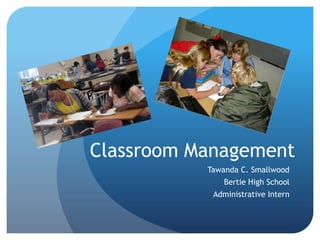
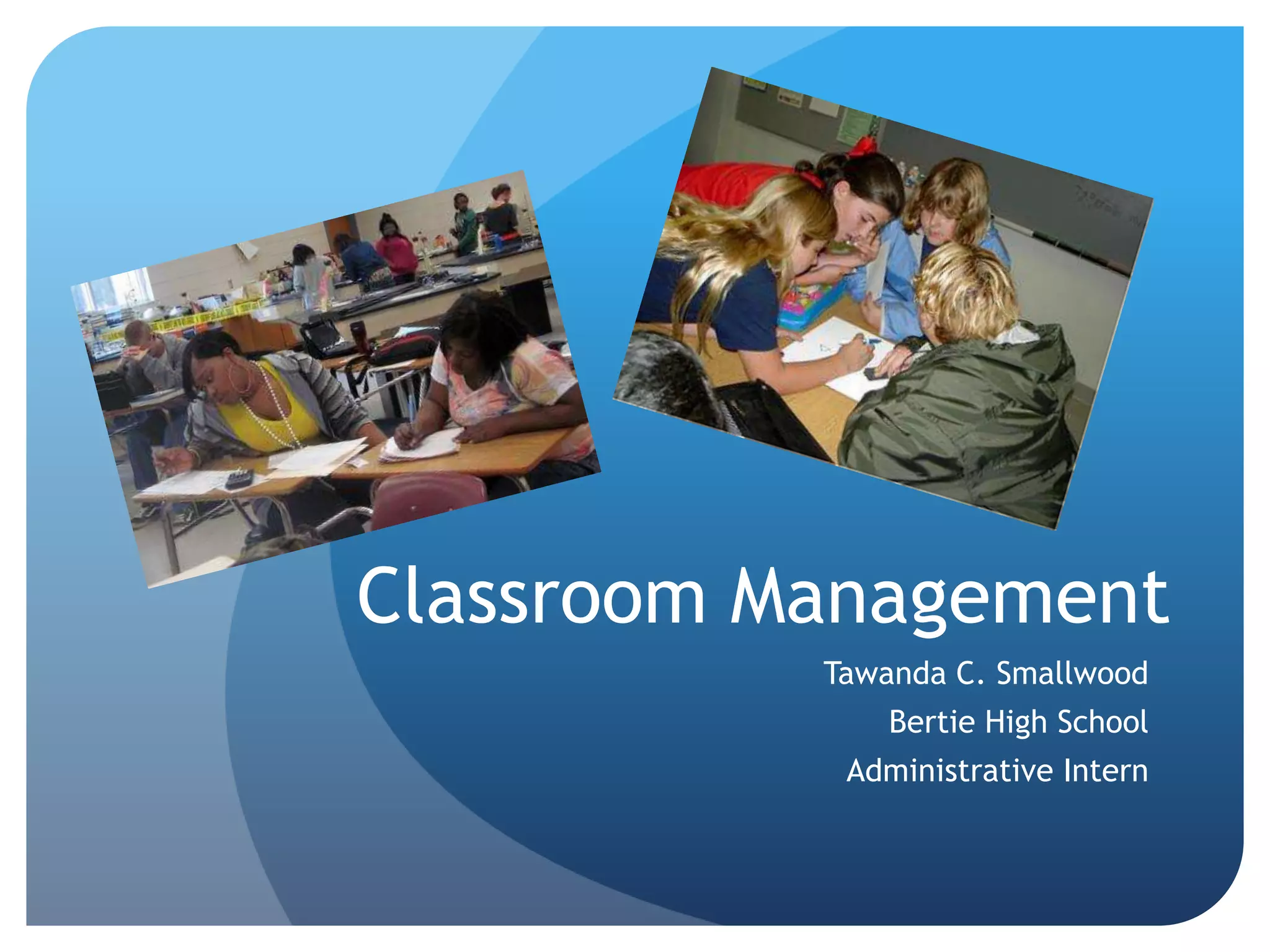
Classroom Management
Tawanda C. Smallwood
Bertie High School
Administrative Intern
Questions to Consider
 In regards to management, what procedures or
practices are going well for you in your classroom?
 What do you do when a student does not follow your
directions? First step? Second step? Third step?
Objectives
 Identify your management strengths and needs
 Describe the characteristics of great classroom
management
 Apply strategies learned for developing great classroom
management
What is Classroom
Management?
 With your group discuss what you think classroom
management is and generate a list. Put your
responses on the Google Doc.
7 minutes
What is Classroom Management?
 It’s effective discipline
 It’s being prepared for class
 It’s motivating your students
 It’s providing a safe, comfortable learning environment
 It’s building your students’ self esteem
 It’s being creative and imaginative in daily lessons
 And…
…It’s different for EVERYONE!!
 Why
 Teaching Styles
 Personality/Attitudes
 Student Population
 Not all management strategies are effective for every
teacher
 Try different strategies to see if they work for you
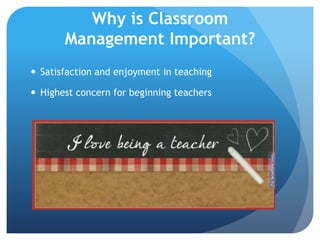
Why is Classroom
Management Important?
 Satisfaction and enjoyment in teaching
 Highest concern for beginning teachers
The Ideal Teacher:
 Enjoys students.
 Uses different teaching
techniques.
 Has a great sense of humor.
 Acts like an adult and not a child
(or high school student).
 Keeps promises.
 Is organized.
 Knows the subject matter.
 Admits when he or she is wrong.
 Uses a pleasant voice.
 Is enthusiastic about the subject.
 Is willing to listen to both sides
of an issue.
 Has a reputation for giving
challenging work.
 Isn’t a pushover. Keeps
misbehaving students in line.
 Keeps everyone busy.
 Does not have favorites.
 Is polite to everyone all of the
time.
 Is friendly and fair.
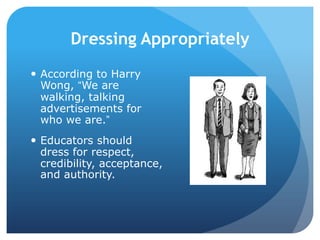
Dressing Appropriately
 According to Harry
Wong, “We are
walking, talking
advertisements for
who we are.”
 Educators should
dress for respect,
credibility, acceptance,
and authority.
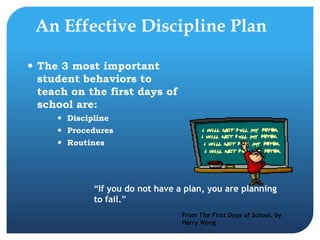
An Effective Discipline Plan
 The 3 most important
student behaviors to
teach on the first days of
school are:
 Discipline
 Procedures
 Routines
“If you do not have a plan, you are planning
to fail.”
From The First Days of School, by
Harry Wong
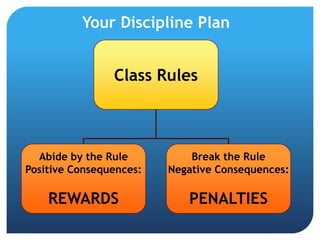
Class Rules
Abide by the Rule
Positive Consequences:
REWARDS
Break the Rule
Negative Consequences:
PENALTIES
Your Discipline Plan
Creating Your Class Rules
 Only have 3 to 5 rules
 State rules positively.
 Make the rules easy for you and your students to
remember.
 Be able to enforce the rules consistently.
 Remember:
 Rules deal with behavior, not procedures.
Rewards
 Harry Wong emphasizes,“The best reward
is the satisfaction of a job well done.”
 Some examples include:
 Praise
 A note home (Good News Cards)
 Student of the day, week, or month
 Tangible rewards
 Work posted
 Certificates of Honor
 Coupons
Penalties
 Time out
 Demerit or fine
 Detention
 Assignment to write ways to correct
problem
 Being last to leave
 Loss of reward
 Exclusion of class participation
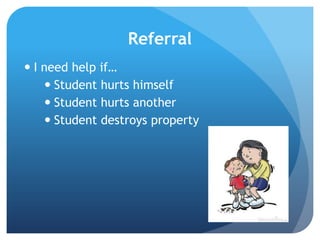
Referral
 I need help if…
 Student hurts himself
 Student hurts another
 Student destroys property
Classroom Expectations
 Come up with 3 – 5 classroom expectations/rules. Share
with your group.
10 minutes
Enlist Parent Support
 Be sure to send a copy of your discipline plan
home to parents the first day of school.
 Make positive parent contact before you need
their assistance with a problem.
 Contact parents as soon as you see a change in
their child’s behavior patterns.
 Parents can be one of your biggest allies in
managing the student’s behavior.
Prevention
 Prevention is the key to good discipline.
 Post the rules
 Explain it then expect it
 Proximity control (room arrangement)
 Be organized
 Call to attention signal
 Put aside pet peeves
 Positive tone
Mistakes to Avoid…
 Inconsistency
 Excessive warning
 Excessive public/verbal
discipline
 Majoring in the minors
 Low level distractions
 Arguments/power struggles
 Not teaching procedures
 Being too tolerant
 Emphasizing the negatives
 Disrespectful interventions
 Losing control/behaving
unprofessionally
 Discarding the plan when it
doesn’t go as you expected
Procedures and Routines
 Harry Wong writes in The First Days of School, “The
number one problem in the classroom is not discipline;
it is the lack of procedures and routines.”
 Wong also states, “A procedure is simply a method or
process for how things are to be done in a classroom.”
 Procedures answer the question, “What do I do
when…?”
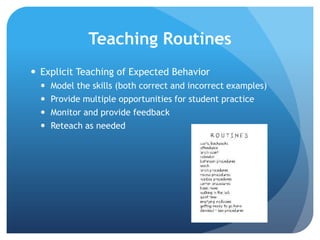
Teaching Routines
 Explicit Teaching of Expected Behavior
 Model the skills (both correct and incorrect examples)
 Provide multiple opportunities for student practice
 Monitor and provide feedback
 Reteach as needed
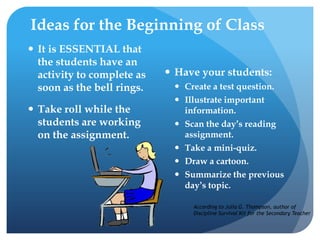
Ideas for the Beginning of Class
 It is ESSENTIAL that
the students have an
activity to complete as
soon as the bell rings.
 Take roll while the
students are working
on the assignment.
 Have your students:
 Create a test question.
 Illustrate important
information.
 Scan the day’s reading
assignment.
 Take a mini-quiz.
 Draw a cartoon.
 Summarize the previous
day’s topic.
According to Julia G. Thompson, author of
Discipline Survival Kit for the Secondary Teacher
Managing Transitions
 Julia G. Thompson suggests the following techniques:
 Time students between transitions.
 Provide students with a checklist/agenda of the
day’s activities.
 Give students activities to “sponge”any dead time.
• List ten words associated with the lesson today.
• Defend your position on…
• Make flashcards for this unit.
• Circle the key words from yesterday’s notes.
Ending Class Without Chaos
 The end of class should
be as structured as the
beginning.
 Closing exercises will
provide a constructive
review of the day’s
lesson.
 Be sure that you
dismiss the students
and not the bell.
 Some more ideas to try from
Julia G. Thompson:
 Chain Games
 Predict the next lesson
 Review homework
directions
 Show a relevant cartoon
 Play a game for bonus
points
What are your
classroom procedures?
Activity
15 minutes
Scenario 1
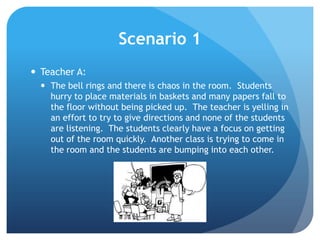
 Teacher A:
 The bell rings and there is chaos in the room. Students
hurry to place materials in baskets and many papers fall to
the floor without being picked up. The teacher is yelling in
an effort to try to give directions and none of the students
are listening. The students clearly have a focus on getting
out of the room quickly. Another class is trying to come in
the room and the students are bumping into each other.
Scenario 1
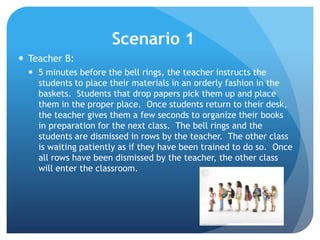
 Teacher B:
 5 minutes before the bell rings, the teacher instructs the
students to place their materials in an orderly fashion in the
baskets. Students that drop papers pick them up and place
them in the proper place. Once students return to their desk,
the teacher gives them a few seconds to organize their books
in preparation for the next class. The bell rings and the
students are dismissed in rows by the teacher. The other class
is waiting patiently as if they have been trained to do so. Once
all rows have been dismissed by the teacher, the other class
will enter the classroom.
Scenario 2
 Teacher A
 It’s the first day of school
 As the students leave the cafeteria, the students are in
line, but the students aren’t in a straight line (it’s more
like a group of people standing in a rectangle).
 The teacher doesn’t address the wide line, but hears some
students talking and says, “Y’all act like a bunch of second
graders. I can’t believe that you can’t even form a straight
line. I can see this is going to be a tough year!”
Scenario 2
 Teacher B
 The students leave the cafeteria and form a line in
the hallway. The line is not perfectly straight, but in
a calm voice the teacher encourages the students to
create a straight line while smiling and displaying a
caring attitude toward the students. The line is
practically perfect now. Some students are talking
and with a quiet voice she explains that others are
having class and that everyone needs to respect that.
The students are now quiet and ready to walk down
the hallway to the classroom. She immediately
praises them by saying, “You guys are doing great on
the first day of school. I know this is going to be a
wonderful school year with such a great group!”
Teacher behaviors can impact
student behavior in a positive or
negative way?
How do you build relationships?
 Seek first to understand the student’s point of view.
Listen and communicate.
 Honor your students as human beings worthy of respect.
 Keep your promises.
 Be kind and courteous. Caring is key.
 Be loyal.
 Be fair.
 Be consistent.
Ways to Build Positive
Relationships
 Greet everyone at the door
 Call on everyone equitably
 Give specific praise
 Listen attentively
 Show personal interest in student activities
 Provide individual help
 Respect your students
Classroom Management
Toolbox
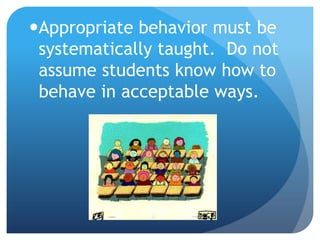
Appropriate behavior must be
systematically taught. Do not
assume students know how to
behave in acceptable ways.
Tawanda C. Smallwood
Bertie High School
Administrative Intern
tsmallwood@bertie.k12.nc.us
(252) 794-3034
Thank You!

Classroom management 101

  • 1.
    Classroom Management Tawanda C.Smallwood Bertie High School Administrative Intern
  • 2.
    Questions to Consider In regards to management, what procedures or practices are going well for you in your classroom?  What do you do when a student does not follow your directions? First step? Second step? Third step?
  • 3.
    Objectives  Identify yourmanagement strengths and needs  Describe the characteristics of great classroom management  Apply strategies learned for developing great classroom management
  • 4.
    What is Classroom Management? With your group discuss what you think classroom management is and generate a list. Put your responses on the Google Doc. 7 minutes
  • 5.
    What is ClassroomManagement?  It’s effective discipline  It’s being prepared for class  It’s motivating your students  It’s providing a safe, comfortable learning environment  It’s building your students’ self esteem  It’s being creative and imaginative in daily lessons  And…
  • 6.
    …It’s different forEVERYONE!!  Why  Teaching Styles  Personality/Attitudes  Student Population  Not all management strategies are effective for every teacher  Try different strategies to see if they work for you
  • 7.
    Why is Classroom ManagementImportant?  Satisfaction and enjoyment in teaching  Highest concern for beginning teachers
  • 8.
    The Ideal Teacher: Enjoys students.  Uses different teaching techniques.  Has a great sense of humor.  Acts like an adult and not a child (or high school student).  Keeps promises.  Is organized.  Knows the subject matter.  Admits when he or she is wrong.  Uses a pleasant voice.  Is enthusiastic about the subject.  Is willing to listen to both sides of an issue.  Has a reputation for giving challenging work.  Isn’t a pushover. Keeps misbehaving students in line.  Keeps everyone busy.  Does not have favorites.  Is polite to everyone all of the time.  Is friendly and fair.
  • 9.
    Dressing Appropriately  Accordingto Harry Wong, “We are walking, talking advertisements for who we are.”  Educators should dress for respect, credibility, acceptance, and authority.
  • 10.
    An Effective DisciplinePlan  The 3 most important student behaviors to teach on the first days of school are:  Discipline  Procedures  Routines “If you do not have a plan, you are planning to fail.” From The First Days of School, by Harry Wong
  • 11.
    Class Rules Abide bythe Rule Positive Consequences: REWARDS Break the Rule Negative Consequences: PENALTIES Your Discipline Plan
  • 12.
    Creating Your ClassRules  Only have 3 to 5 rules  State rules positively.  Make the rules easy for you and your students to remember.  Be able to enforce the rules consistently.  Remember:  Rules deal with behavior, not procedures.
  • 13.
    Rewards  Harry Wongemphasizes,“The best reward is the satisfaction of a job well done.”  Some examples include:  Praise  A note home (Good News Cards)  Student of the day, week, or month  Tangible rewards  Work posted  Certificates of Honor  Coupons
  • 14.
    Penalties  Time out Demerit or fine  Detention  Assignment to write ways to correct problem  Being last to leave  Loss of reward  Exclusion of class participation
  • 15.
    Referral  I needhelp if…  Student hurts himself  Student hurts another  Student destroys property
  • 16.
    Classroom Expectations  Comeup with 3 – 5 classroom expectations/rules. Share with your group. 10 minutes
  • 17.
    Enlist Parent Support Be sure to send a copy of your discipline plan home to parents the first day of school.  Make positive parent contact before you need their assistance with a problem.  Contact parents as soon as you see a change in their child’s behavior patterns.  Parents can be one of your biggest allies in managing the student’s behavior.
  • 18.
    Prevention  Prevention isthe key to good discipline.  Post the rules  Explain it then expect it  Proximity control (room arrangement)  Be organized  Call to attention signal  Put aside pet peeves  Positive tone
  • 19.
    Mistakes to Avoid… Inconsistency  Excessive warning  Excessive public/verbal discipline  Majoring in the minors  Low level distractions  Arguments/power struggles  Not teaching procedures  Being too tolerant  Emphasizing the negatives  Disrespectful interventions  Losing control/behaving unprofessionally  Discarding the plan when it doesn’t go as you expected
  • 20.
    Procedures and Routines Harry Wong writes in The First Days of School, “The number one problem in the classroom is not discipline; it is the lack of procedures and routines.”  Wong also states, “A procedure is simply a method or process for how things are to be done in a classroom.”  Procedures answer the question, “What do I do when…?”
  • 21.
    Teaching Routines  ExplicitTeaching of Expected Behavior  Model the skills (both correct and incorrect examples)  Provide multiple opportunities for student practice  Monitor and provide feedback  Reteach as needed
  • 22.
    Ideas for theBeginning of Class  It is ESSENTIAL that the students have an activity to complete as soon as the bell rings.  Take roll while the students are working on the assignment.  Have your students:  Create a test question.  Illustrate important information.  Scan the day’s reading assignment.  Take a mini-quiz.  Draw a cartoon.  Summarize the previous day’s topic. According to Julia G. Thompson, author of Discipline Survival Kit for the Secondary Teacher
  • 23.
    Managing Transitions  JuliaG. Thompson suggests the following techniques:  Time students between transitions.  Provide students with a checklist/agenda of the day’s activities.  Give students activities to “sponge”any dead time. • List ten words associated with the lesson today. • Defend your position on… • Make flashcards for this unit. • Circle the key words from yesterday’s notes.
  • 24.
    Ending Class WithoutChaos  The end of class should be as structured as the beginning.  Closing exercises will provide a constructive review of the day’s lesson.  Be sure that you dismiss the students and not the bell.  Some more ideas to try from Julia G. Thompson:  Chain Games  Predict the next lesson  Review homework directions  Show a relevant cartoon  Play a game for bonus points
  • 25.
    What are your classroomprocedures? Activity 15 minutes
  • 26.
    Scenario 1  TeacherA:  The bell rings and there is chaos in the room. Students hurry to place materials in baskets and many papers fall to the floor without being picked up. The teacher is yelling in an effort to try to give directions and none of the students are listening. The students clearly have a focus on getting out of the room quickly. Another class is trying to come in the room and the students are bumping into each other.
  • 27.
    Scenario 1  TeacherB:  5 minutes before the bell rings, the teacher instructs the students to place their materials in an orderly fashion in the baskets. Students that drop papers pick them up and place them in the proper place. Once students return to their desk, the teacher gives them a few seconds to organize their books in preparation for the next class. The bell rings and the students are dismissed in rows by the teacher. The other class is waiting patiently as if they have been trained to do so. Once all rows have been dismissed by the teacher, the other class will enter the classroom.
  • 28.
    Scenario 2  TeacherA  It’s the first day of school  As the students leave the cafeteria, the students are in line, but the students aren’t in a straight line (it’s more like a group of people standing in a rectangle).  The teacher doesn’t address the wide line, but hears some students talking and says, “Y’all act like a bunch of second graders. I can’t believe that you can’t even form a straight line. I can see this is going to be a tough year!”
  • 29.
    Scenario 2  TeacherB  The students leave the cafeteria and form a line in the hallway. The line is not perfectly straight, but in a calm voice the teacher encourages the students to create a straight line while smiling and displaying a caring attitude toward the students. The line is practically perfect now. Some students are talking and with a quiet voice she explains that others are having class and that everyone needs to respect that. The students are now quiet and ready to walk down the hallway to the classroom. She immediately praises them by saying, “You guys are doing great on the first day of school. I know this is going to be a wonderful school year with such a great group!”
  • 30.
    Teacher behaviors canimpact student behavior in a positive or negative way?
  • 31.
    How do youbuild relationships?  Seek first to understand the student’s point of view. Listen and communicate.  Honor your students as human beings worthy of respect.  Keep your promises.  Be kind and courteous. Caring is key.  Be loyal.  Be fair.  Be consistent.
  • 32.
    Ways to BuildPositive Relationships  Greet everyone at the door  Call on everyone equitably  Give specific praise  Listen attentively  Show personal interest in student activities  Provide individual help  Respect your students
  • 33.
  • 34.
    Appropriate behavior mustbe systematically taught. Do not assume students know how to behave in acceptable ways.
  • 35.
    Tawanda C. Smallwood BertieHigh School Administrative Intern tsmallwood@bertie.k12.nc.us (252) 794-3034 Thank You!