Classroom Management:
Muhammad Yusuf
Strategies that Work
SIPD, Rashidabad
Use “Chat” option to ask questions or write comments:
Please type your question or write a comment in the chat
window privately to host
Once connected, keep your microphone on mute and
camera turned off.
Welcome
Classroom Management: Strategies that Work
Content
Classroom Management: Strategies that Work
Classroom Management is..
Good Vs Bad
General Classroom
Management Strategies
Managing Online Learning
Classroom management
relies on threats and
punishment.
The quietest classrooms are
the best managed.
If you’re nice, a student will
take advantage of you
Behavior is more difficult to
manage in a student-centered
classroom
If you’re nice, a student
will take advantage of you
Common misconceptions
about classroom
management
Classroom Management.
Kauchak and Egger, 2005
A process of
creating and
maintaining orderly
classroom.
Stimulating compliance
from the students
Stimulating respect from the
students.
Establishing rules and regulation
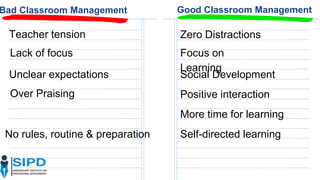
Bad Classroom Management
Zero Distractions
Good Classroom Management
Focus on
Learning
Social Development
Positive interaction
More time for learning
Self-directed learning
Teacher tension
Lack of focus
Unclear expectations
Over Praising
No rules, routine & preparation
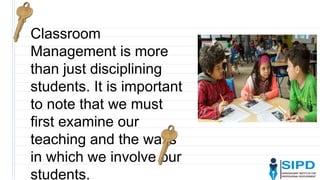
Classroom
Management is more
than just disciplining
students. It is important
to note that we must
first examine our
teaching and the ways
in which we involve our
students.
Model ideal behavior
Make it a habit to model the actions you want to see in others.
Use polite language
Maintain eye contact
Let one another speak uninterrupted
Raise concerns about one another’s statements in a respectful
manner
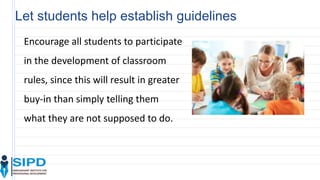
Let students help establish guidelines
Encourage all students to participate
in the development of classroom
rules, since this will result in greater
buy-in than simply telling them
what they are not supposed to do.
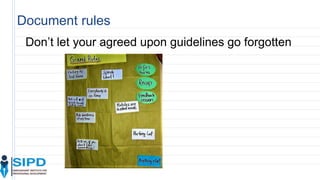
Document rules
Don’t let your agreed upon guidelines go forgotten
Don’t punish the class
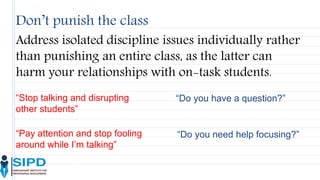
Address isolated discipline issues individually rather
than punishing an entire class, as the latter can
harm your relationships with on-task students.
“Stop talking and disrupting
other students”
“Do you have a question?”
“Pay attention and stop fooling
around while I’m talking”
“Do you need help focusing?”
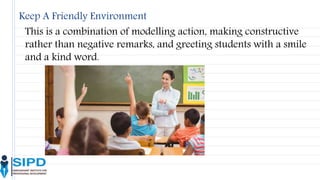
Keep A Friendly Environment
This is a combination of modelling action, making constructive
rather than negative remarks, and greeting students with a smile
and a kind word.
Praise students for good work because it
improves academic and behavioral performance.
Offer praise
Inspire the class
Improve a student’s self-confidence
Reinforce rules and values you want to see
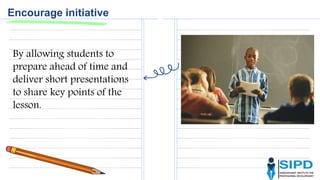
Encourage initiative
By allowing students to
prepare ahead of time and
deliver short presentations
to share key points of the
lesson.
Use non-verbal communication
To improve content delivery, use actions and visual aids to help
students focus and process lessons.
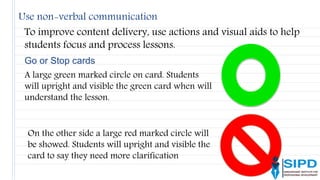
A large green marked circle on card. Students
will upright and visible the green card when will
understand the lesson.
On the other side a large red marked circle will
be showed. Students will upright and visible the
card to say they need more clarification
Go or Stop cards
Give open-ended
projects
Encourage students to work on open-ended projects that do
not require a specific product, allowing them to demonstrate
knowledge in ways that are naturally suited to them.
Work and learn at their own paces
Involve actively with suitable content
Demonstrate understanding effectively
Interview students
Interview students who aren't academically involved or exhibiting
prosocial behavior to learn how to manage them better.
Pull each student apart for a few minutes while running a group activity.
Ask about:
What helps them focus
Who they work well with
Their favorite types of lessons
Their favorite in-class activities
Which kinds of exercises help them remember key lesson
points
Address undesired behavior immediately
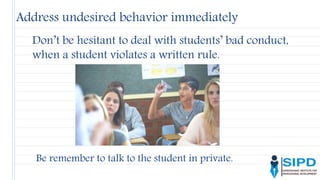
Don’t be hesitant to deal with students’ bad conduct,
when a student violates a written rule.
Be remember to talk to the student in private.
Be prepared
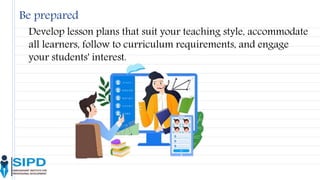
Develop lesson plans that suit your teaching style, accommodate
all learners, follow to curriculum requirements, and engage
your students' interest.
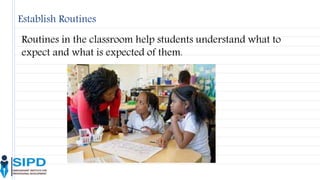
Establish Routines
Routines in the classroom help students understand what to
expect and what is expected of them.
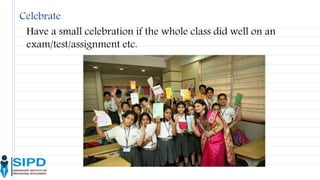
Celebrate
Have a small celebration if the whole class did well on an
exam/test/assignment etc.
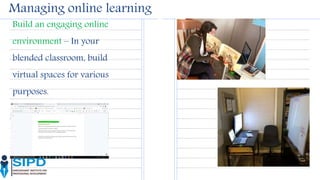
Managing online learning
Build an engaging online
environment – In your
blended classroom, build
virtual spaces for various
purposes.
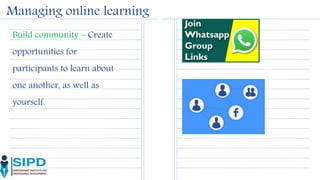
Managing online learning
Build community – Create
opportunities for
participants to learn about
one another, as well as
yourself.
Managing online learning
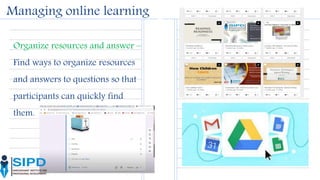
Organize resources and answer –
Find ways to organize resources
and answers to questions so that
participants can quickly find
them.
Managing online learning
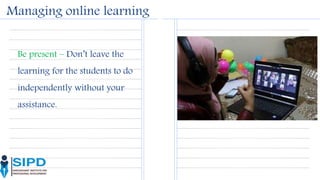
Be present – Don’t leave the
learning for the students to do
independently without your
assistance.
Managing online learning
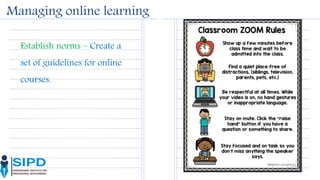
Establish norms – Create a
set of guidelines for online
courses.
Don’t make group randomly – Use criteria to group
participants.
Don’t shy away from difficult conversations – Stay
on top of issues as they arise
Managing online learning
Use various means to contact
participants – Contact small
groups of students and also the
whole class routinely, but
know when it’s time to do a
behind-the-scenes
intervention.
Teach about plagiarism – Teach the students what plagiarism is
and how to avoid it.
Managing online learning
Christopher Thao Vang
“Without classroom Management
teaching is practically impossible.”
Reference:
Wolpert-Gawron, H (2017), Extending classroom management online,
nine suggestions to help you provide online learners with class norms
and expectations and a sense of community.
https://www.edutopia.org/article/extending-classroom-management-
online
Guido, M, (2021), 20 Classroom Management Strategies and Techniques.
https://www.prodigygame.com/main-en/blog/classroom-management-
strategies/
Marzano, R J., et al (2005), A handbook for classroom management that
works. Association for Supervision and Curriculum Development,
Virginia
Classroom Management: Strategies that Work

Classroom Management: Strategies that Work

  • 1.
  • 2.
    Use “Chat” optionto ask questions or write comments: Please type your question or write a comment in the chat window privately to host Once connected, keep your microphone on mute and camera turned off. Welcome Classroom Management: Strategies that Work
  • 3.
    Content Classroom Management: Strategiesthat Work Classroom Management is.. Good Vs Bad General Classroom Management Strategies Managing Online Learning
  • 4.
    Classroom management relies onthreats and punishment. The quietest classrooms are the best managed. If you’re nice, a student will take advantage of you Behavior is more difficult to manage in a student-centered classroom If you’re nice, a student will take advantage of you Common misconceptions about classroom management
  • 5.
    Classroom Management. Kauchak andEgger, 2005 A process of creating and maintaining orderly classroom. Stimulating compliance from the students Stimulating respect from the students. Establishing rules and regulation
  • 6.
    Bad Classroom Management ZeroDistractions Good Classroom Management Focus on Learning Social Development Positive interaction More time for learning Self-directed learning Teacher tension Lack of focus Unclear expectations Over Praising No rules, routine & preparation
  • 7.
    Classroom Management is more thanjust disciplining students. It is important to note that we must first examine our teaching and the ways in which we involve our students.
  • 8.
    Model ideal behavior Makeit a habit to model the actions you want to see in others. Use polite language Maintain eye contact Let one another speak uninterrupted Raise concerns about one another’s statements in a respectful manner
  • 9.
    Let students helpestablish guidelines Encourage all students to participate in the development of classroom rules, since this will result in greater buy-in than simply telling them what they are not supposed to do.
  • 10.
    Document rules Don’t letyour agreed upon guidelines go forgotten
  • 11.
    Don’t punish theclass Address isolated discipline issues individually rather than punishing an entire class, as the latter can harm your relationships with on-task students. “Stop talking and disrupting other students” “Do you have a question?” “Pay attention and stop fooling around while I’m talking” “Do you need help focusing?”
  • 12.
    Keep A FriendlyEnvironment This is a combination of modelling action, making constructive rather than negative remarks, and greeting students with a smile and a kind word.
  • 13.
    Praise students forgood work because it improves academic and behavioral performance. Offer praise Inspire the class Improve a student’s self-confidence Reinforce rules and values you want to see
  • 14.
    Encourage initiative By allowingstudents to prepare ahead of time and deliver short presentations to share key points of the lesson.
  • 15.
    Use non-verbal communication Toimprove content delivery, use actions and visual aids to help students focus and process lessons. A large green marked circle on card. Students will upright and visible the green card when will understand the lesson. On the other side a large red marked circle will be showed. Students will upright and visible the card to say they need more clarification Go or Stop cards
  • 16.
    Give open-ended projects Encourage studentsto work on open-ended projects that do not require a specific product, allowing them to demonstrate knowledge in ways that are naturally suited to them. Work and learn at their own paces Involve actively with suitable content Demonstrate understanding effectively
  • 17.
    Interview students Interview studentswho aren't academically involved or exhibiting prosocial behavior to learn how to manage them better. Pull each student apart for a few minutes while running a group activity. Ask about: What helps them focus Who they work well with Their favorite types of lessons Their favorite in-class activities Which kinds of exercises help them remember key lesson points
  • 18.
    Address undesired behaviorimmediately Don’t be hesitant to deal with students’ bad conduct, when a student violates a written rule. Be remember to talk to the student in private.
  • 19.
    Be prepared Develop lessonplans that suit your teaching style, accommodate all learners, follow to curriculum requirements, and engage your students' interest.
  • 20.
    Establish Routines Routines inthe classroom help students understand what to expect and what is expected of them.
  • 21.
    Celebrate Have a smallcelebration if the whole class did well on an exam/test/assignment etc.
  • 22.
    Managing online learning Buildan engaging online environment – In your blended classroom, build virtual spaces for various purposes.
  • 23.
    Managing online learning Buildcommunity – Create opportunities for participants to learn about one another, as well as yourself.
  • 24.
    Managing online learning Organizeresources and answer – Find ways to organize resources and answers to questions so that participants can quickly find them.
  • 25.
    Managing online learning Bepresent – Don’t leave the learning for the students to do independently without your assistance.
  • 26.
    Managing online learning Establishnorms – Create a set of guidelines for online courses.
  • 27.
    Don’t make grouprandomly – Use criteria to group participants. Don’t shy away from difficult conversations – Stay on top of issues as they arise Managing online learning
  • 28.
    Managing online learning Usevarious means to contact participants – Contact small groups of students and also the whole class routinely, but know when it’s time to do a behind-the-scenes intervention.
  • 29.
    Teach about plagiarism– Teach the students what plagiarism is and how to avoid it. Managing online learning
  • 30.
    Christopher Thao Vang “Withoutclassroom Management teaching is practically impossible.”
  • 31.
    Reference: Wolpert-Gawron, H (2017),Extending classroom management online, nine suggestions to help you provide online learners with class norms and expectations and a sense of community. https://www.edutopia.org/article/extending-classroom-management- online Guido, M, (2021), 20 Classroom Management Strategies and Techniques. https://www.prodigygame.com/main-en/blog/classroom-management- strategies/ Marzano, R J., et al (2005), A handbook for classroom management that works. Association for Supervision and Curriculum Development, Virginia