Pamela Netinho
English Language Fellow
Centro Colombo Americano
Bogota, Colombia
CLASSROOM
MANAGEMENT
BASICS
EFFECTIVE TEACHERS
MANAGE THEIR CLASSROOMS.
INEFFECTIVE TEACHERS
DISCIPLINE THEIR CLASSROOMS.
The First Days of School: How to Be an Effective Teacher
by Harry Wong and Rosemary Wong
RESPONSIBILITIES OF THE
EFFECTIVE TEACHER:
1. Making intelligent decisions about effective
instructional strategies to implement in
lesson design.
2. Determining the sequence and pacing of
the curriculum to promote student learning.
3. Implementing effective classroom
management techniques.
“A well managed class
does not just appear
out of nowhere. It
takes a good deal of
effort to create—and
the person who is most
responsible for
creating it is the
teacher.”
Dr. Robert Marzano
• Getting Ready Before the School Year Begins
• Establishing Rules and Consequences
• Implementing Procedures and Routines
• Building a Community of Learners
• Classroom Management Styles
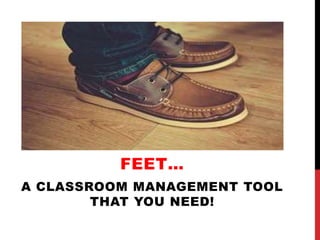
FEET…
A CLASSROOM MANAGEMENT TOOL
THAT YOU NEED!
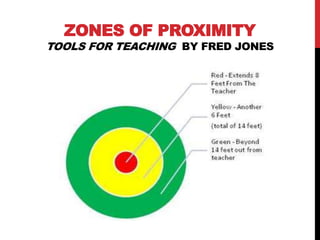
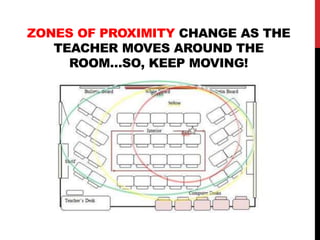
ZONES OF PROXIMITY
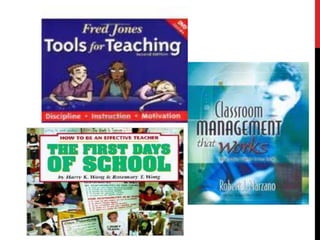
TOOLS FOR TEACHING BY FRED JONES
ZONES OF PROXIMITY CHANGE AS THE
TEACHER MOVES AROUND THE
ROOM…SO, KEEP MOVING!
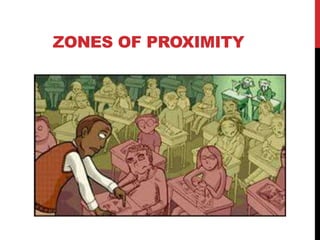
ZONES OF PROXIMITY
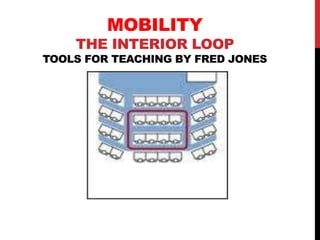
MOBILITY
THE INTERIOR LOOP
TOOLS FOR TEACHING BY FRED JONES
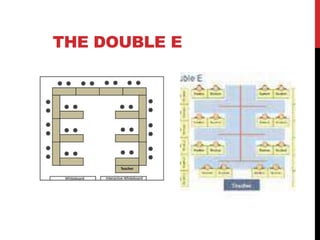
THE DOUBLE E
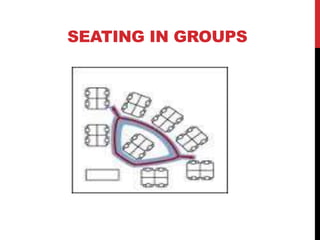
SEATING IN GROUPS
MUST BE TAUGHT AT THE BEGINNING
OF THE SCHOOL YEAR:
• RULES: Rules describe how students are
to BEHAVE or ACT in the classroom.
• PROCEDURES: Procedures describe how
things are DONE in the classroom.
• ROUTINES: Routines are what the
students do automatically. Procedures with
practice becomes routines.
Wong, Harry and Rosemary. The First Days of School: How to
be an Effective Teacher.
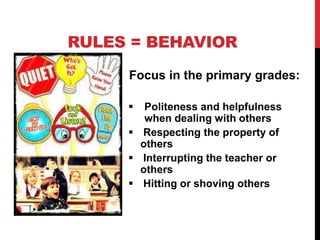
Focus in the primary grades:
 Politeness and helpfulness
when dealing with others
 Respecting the property of
others
 Interrupting the teacher or
others
 Hitting or shoving others
RULES = BEHAVIOR
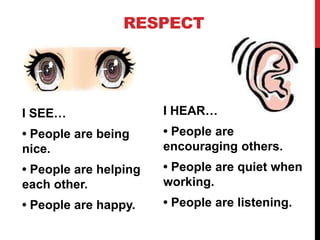
RESPECT
I SEE…
• People are being
nice.
• People are helping
each other.
• People are happy.
I HEAR…
• People are
encouraging others.
• People are quiet when
working.
• People are listening.
RULES = BEHAVIOR
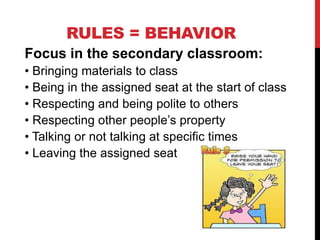
Focus in the secondary classroom:
• Bringing materials to class
• Being in the assigned seat at the start of class
• Respecting and being polite to others
• Respecting other people’s property
• Talking or not talking at specific times
• Leaving the assigned seat
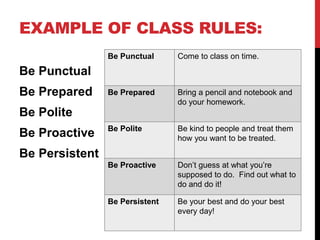
EXAMPLE OF CLASS RULES:
Be Punctual
Be Prepared
Be Polite
Be Proactive
Be Persistent
Be Punctual Come to class on time.
Be Prepared Bring a pencil and notebook and
do your homework.
Be Polite Be kind to people and treat them
how you want to be treated.
Be Proactive Don’t guess at what you’re
supposed to do. Find out what to
do and do it!
Be Persistent Be your best and do your best
every day!
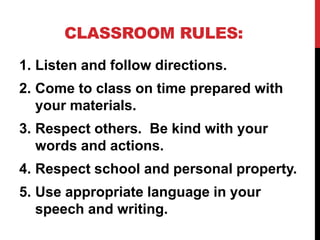
CLASSROOM RULES:
1. Listen and follow directions.
2. Come to class on time prepared with
your materials.
3. Respect others. Be kind with your
words and actions.
4. Respect school and personal property.
5. Use appropriate language in your
speech and writing.
FINDING:
“Rules and procedures should not
simply be imposed on students.
Rather, the proper design of rules and
procedures involves explanation and
input.”
Classroom Management That Works
by Robert Marzano
RULES & CONSEQUENCES:
TEACH STUDENTS:
• Every action results in a
consequence. (Positive or Negative)
• Consequences are not punishments.
• Consequences are the result of a
person’s chosen action.
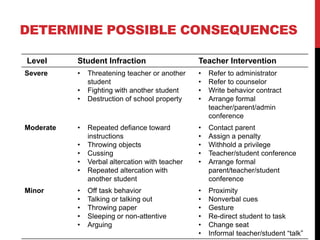
DETERMINE POSSIBLE CONSEQUENCES
Level Student Infraction Teacher Intervention
Severe • Threatening teacher or another
student
• Fighting with another student
• Destruction of school property
• Refer to administrator
• Refer to counselor
• Write behavior contract
• Arrange formal
teacher/parent/admin
conference
Moderate • Repeated defiance toward
instructions
• Throwing objects
• Cussing
• Verbal altercation with teacher
• Repeated altercation with
another student
• Contact parent
• Assign a penalty
• Withhold a privilege
• Teacher/student conference
• Arrange formal
parent/teacher/student
conference
Minor • Off task behavior
• Talking or talking out
• Throwing paper
• Sleeping or non-attentive
• Arguing
• Proximity
• Nonverbal cues
• Gesture
• Re-direct student to task
• Change seat
• Informal teacher/student “talk”
PROCEDURES AND ROUTINES ARE
THE KEY TO A WELL-MANAGED
CLASSROOM
Effective classroom teachers spend
more of their time in the first few
weeks of the school year teaching
classroom rules, procedures and
routines as opposed to academic
content. The First Days of School by Harry and
Rosemary Wong.
PROCEDURES = HOW THINGS GET DONE
• Starting class = DO NOW
• Posting class or day’s schedule
• Use of bathroom/drinks
• Signal to get students’ attention
• When student needs pencil and/or paper
• How do students’ ask for help
• Working in groups (short voice vs. long
voice)
• Passing in papers or notebooks
• Class dismissal
• And more….
3- STEP APPROACH TO TEACH
PROCEDURES
①EXPLAIN: State, explain, model, and
demonstrate the procedure.
②REHEARSE: Rehearse and practice the
procedure under your supervision.
③REINFORCE: Reteach, rehearse, practice,
and reinforce the classroom procedure until
it becomes a routine.
The First Days of School: How to Be an Effective Teacher
by Harry and Rosemary Wong.
PROCEDURES, WITH
PRACTICE, BECOME
ROUTINES
• Routines provide structure
for students.
• Students know what to
expect in your class.
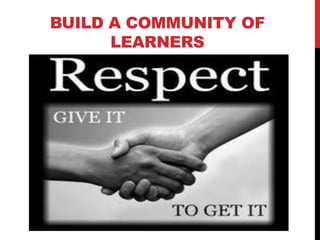
BUILD A COMMUNITY OF
LEARNERS
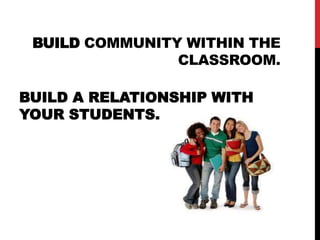
BUILD COMMUNITY WITHIN THE
CLASSROOM.
BUILD A RELATIONSHIP WITH
YOUR STUDENTS.
“WHAT ARE SOME WAYS
THAT TEACHERS SHOW YOU
RESPECT?”
Participants were 980 middle school
students in Chicago, Illinois, USA.
Approximately 63% of students at the
school received free or reduced priced
lunch.
RESULTS: HOW TEACHERS SHOW
RESPECT TO THEIR STUDENTS…
12. Talk sincerely—no sarcasm or “eye
rolling.”
11. Return evaluated work promptly.
10. Be available during non-classroom times.
9. Use student’s name when talking to him or
her.
8. Let parents/ guardians know student did a
good job sometimes.
7. Prepare exciting lessons.
RESPECT CONTINUED…
6. Display student work around the
classroom and/or school.
5. Have a sense of humor.
4. Listen without interrupting.
3. Respect personal space--don’t touch,
grab, eyeball, crowd, etc.
2. Use a calm tone of voice, even when
upset. No yelling.
#1 WAY A TEACHER SHOWS
RESPECT TO STUDENTS
1. Talk privately to a student when
a problem occurs.
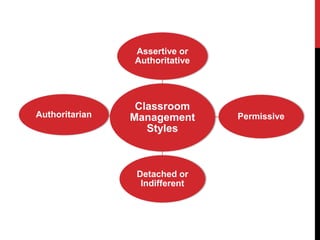
Classroom
Management
Styles
Assertive or
Authoritative
Permissive
Detached or
Indifferent
Authoritarian
CONSISTENCY!
Students appreciate consistency.
Once students have internalized
classroom rules, procedures, and
routines, the day will run much more
smoothly. Harry Wong.
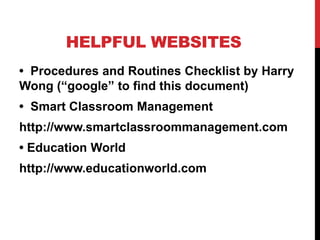
HELPFUL WEBSITES
• Procedures and Routines Checklist by Harry
Wong (“google” to find this document)
• Smart Classroom Management
http://www.smartclassroommanagement.com
• Education World
http://www.educationworld.com
SOURCES
Jones, Fredric H., and Patrick Jones. Tools for Teaching:
Discipline, Instruction, Motivation. Santa Cruz, CA: F.H.
Jones & Associates, 2000.Print.
Marzano, Robert J., and Jana S. Marzano. Classroom
Management That Works: Research-Based Strategies
for Every Teacher. Alexandria, VA: Association for
Supervision and Curriculum Development, 2003. Print.
Rutherford, Paula. Why Didn’t I Learn This in College?
Alexandria, VA: Just Ask Publications, 2002. Print.
Wong, Harry and Rosemary. The First Days of School: How to Be
an Effective Teacher (4th ed.) 2009. Print.

Classroom Management Basics

  • 1.
    Pamela Netinho English LanguageFellow Centro Colombo Americano Bogota, Colombia CLASSROOM MANAGEMENT BASICS
  • 2.
    EFFECTIVE TEACHERS MANAGE THEIRCLASSROOMS. INEFFECTIVE TEACHERS DISCIPLINE THEIR CLASSROOMS. The First Days of School: How to Be an Effective Teacher by Harry Wong and Rosemary Wong
  • 4.
    RESPONSIBILITIES OF THE EFFECTIVETEACHER: 1. Making intelligent decisions about effective instructional strategies to implement in lesson design. 2. Determining the sequence and pacing of the curriculum to promote student learning. 3. Implementing effective classroom management techniques.
  • 5.
    “A well managedclass does not just appear out of nowhere. It takes a good deal of effort to create—and the person who is most responsible for creating it is the teacher.” Dr. Robert Marzano
  • 6.
    • Getting ReadyBefore the School Year Begins • Establishing Rules and Consequences • Implementing Procedures and Routines • Building a Community of Learners • Classroom Management Styles
  • 7.
    FEET… A CLASSROOM MANAGEMENTTOOL THAT YOU NEED!
  • 8.
    ZONES OF PROXIMITY TOOLSFOR TEACHING BY FRED JONES
  • 9.
    ZONES OF PROXIMITYCHANGE AS THE TEACHER MOVES AROUND THE ROOM…SO, KEEP MOVING!
  • 10.
  • 11.
    MOBILITY THE INTERIOR LOOP TOOLSFOR TEACHING BY FRED JONES
  • 12.
  • 13.
  • 14.
    MUST BE TAUGHTAT THE BEGINNING OF THE SCHOOL YEAR: • RULES: Rules describe how students are to BEHAVE or ACT in the classroom. • PROCEDURES: Procedures describe how things are DONE in the classroom. • ROUTINES: Routines are what the students do automatically. Procedures with practice becomes routines. Wong, Harry and Rosemary. The First Days of School: How to be an Effective Teacher.
  • 15.
    Focus in theprimary grades:  Politeness and helpfulness when dealing with others  Respecting the property of others  Interrupting the teacher or others  Hitting or shoving others RULES = BEHAVIOR
  • 16.
    RESPECT I SEE… • Peopleare being nice. • People are helping each other. • People are happy. I HEAR… • People are encouraging others. • People are quiet when working. • People are listening.
  • 17.
    RULES = BEHAVIOR Focusin the secondary classroom: • Bringing materials to class • Being in the assigned seat at the start of class • Respecting and being polite to others • Respecting other people’s property • Talking or not talking at specific times • Leaving the assigned seat
  • 18.
    EXAMPLE OF CLASSRULES: Be Punctual Be Prepared Be Polite Be Proactive Be Persistent Be Punctual Come to class on time. Be Prepared Bring a pencil and notebook and do your homework. Be Polite Be kind to people and treat them how you want to be treated. Be Proactive Don’t guess at what you’re supposed to do. Find out what to do and do it! Be Persistent Be your best and do your best every day!
  • 19.
    CLASSROOM RULES: 1. Listenand follow directions. 2. Come to class on time prepared with your materials. 3. Respect others. Be kind with your words and actions. 4. Respect school and personal property. 5. Use appropriate language in your speech and writing.
  • 20.
    FINDING: “Rules and proceduresshould not simply be imposed on students. Rather, the proper design of rules and procedures involves explanation and input.” Classroom Management That Works by Robert Marzano
  • 21.
    RULES & CONSEQUENCES: TEACHSTUDENTS: • Every action results in a consequence. (Positive or Negative) • Consequences are not punishments. • Consequences are the result of a person’s chosen action.
  • 22.
    DETERMINE POSSIBLE CONSEQUENCES LevelStudent Infraction Teacher Intervention Severe • Threatening teacher or another student • Fighting with another student • Destruction of school property • Refer to administrator • Refer to counselor • Write behavior contract • Arrange formal teacher/parent/admin conference Moderate • Repeated defiance toward instructions • Throwing objects • Cussing • Verbal altercation with teacher • Repeated altercation with another student • Contact parent • Assign a penalty • Withhold a privilege • Teacher/student conference • Arrange formal parent/teacher/student conference Minor • Off task behavior • Talking or talking out • Throwing paper • Sleeping or non-attentive • Arguing • Proximity • Nonverbal cues • Gesture • Re-direct student to task • Change seat • Informal teacher/student “talk”
  • 23.
    PROCEDURES AND ROUTINESARE THE KEY TO A WELL-MANAGED CLASSROOM Effective classroom teachers spend more of their time in the first few weeks of the school year teaching classroom rules, procedures and routines as opposed to academic content. The First Days of School by Harry and Rosemary Wong.
  • 24.
    PROCEDURES = HOWTHINGS GET DONE • Starting class = DO NOW • Posting class or day’s schedule • Use of bathroom/drinks • Signal to get students’ attention • When student needs pencil and/or paper • How do students’ ask for help • Working in groups (short voice vs. long voice) • Passing in papers or notebooks • Class dismissal • And more….
  • 26.
    3- STEP APPROACHTO TEACH PROCEDURES ①EXPLAIN: State, explain, model, and demonstrate the procedure. ②REHEARSE: Rehearse and practice the procedure under your supervision. ③REINFORCE: Reteach, rehearse, practice, and reinforce the classroom procedure until it becomes a routine. The First Days of School: How to Be an Effective Teacher by Harry and Rosemary Wong.
  • 27.
    PROCEDURES, WITH PRACTICE, BECOME ROUTINES •Routines provide structure for students. • Students know what to expect in your class.
  • 28.
    BUILD A COMMUNITYOF LEARNERS
  • 29.
    BUILD COMMUNITY WITHINTHE CLASSROOM. BUILD A RELATIONSHIP WITH YOUR STUDENTS.
  • 30.
    “WHAT ARE SOMEWAYS THAT TEACHERS SHOW YOU RESPECT?” Participants were 980 middle school students in Chicago, Illinois, USA. Approximately 63% of students at the school received free or reduced priced lunch.
  • 31.
    RESULTS: HOW TEACHERSSHOW RESPECT TO THEIR STUDENTS… 12. Talk sincerely—no sarcasm or “eye rolling.” 11. Return evaluated work promptly. 10. Be available during non-classroom times. 9. Use student’s name when talking to him or her. 8. Let parents/ guardians know student did a good job sometimes. 7. Prepare exciting lessons.
  • 32.
    RESPECT CONTINUED… 6. Displaystudent work around the classroom and/or school. 5. Have a sense of humor. 4. Listen without interrupting. 3. Respect personal space--don’t touch, grab, eyeball, crowd, etc. 2. Use a calm tone of voice, even when upset. No yelling.
  • 33.
    #1 WAY ATEACHER SHOWS RESPECT TO STUDENTS 1. Talk privately to a student when a problem occurs.
  • 34.
  • 35.
    CONSISTENCY! Students appreciate consistency. Oncestudents have internalized classroom rules, procedures, and routines, the day will run much more smoothly. Harry Wong.
  • 36.
    HELPFUL WEBSITES • Proceduresand Routines Checklist by Harry Wong (“google” to find this document) • Smart Classroom Management http://www.smartclassroommanagement.com • Education World http://www.educationworld.com
  • 37.
    SOURCES Jones, Fredric H.,and Patrick Jones. Tools for Teaching: Discipline, Instruction, Motivation. Santa Cruz, CA: F.H. Jones & Associates, 2000.Print. Marzano, Robert J., and Jana S. Marzano. Classroom Management That Works: Research-Based Strategies for Every Teacher. Alexandria, VA: Association for Supervision and Curriculum Development, 2003. Print. Rutherford, Paula. Why Didn’t I Learn This in College? Alexandria, VA: Just Ask Publications, 2002. Print. Wong, Harry and Rosemary. The First Days of School: How to Be an Effective Teacher (4th ed.) 2009. Print.

Editor's Notes

  • #25 READ over the slide….. Do not start the year thinking… content, content, content….At the beginning of the year you must SLOW down content to teach the rules and procedures. When students automatically do a a procedure, then it has become a routine. And you want class routines to build structure! What’s a DO NOW? A do now is a 5-7 minute individual activity that starts class every day. The DO NOW is a review of something the students learned a day or 2 before. It should be at the independent level, a review. Each student works alone writing the work in his/her notebook. It might be 5 sentences with fill in the blank. Matching vocabulary to its definition. It allows the students time to settle into class. It allows the teacher time to prepare any materials and take attendance. The DO NOW should be quickly checked together. Total 10-12 minutes of class. Then the lesson for the day begins… Goggle Procedures and routines by Harry Wong…a document with a list of possible routines to implement in your class. Again, some more elementary than secondary. Select what you need for your classes.