Classroom Management Heather Kimmel February, 2009
Classroom Management: Refers to the process of setting up and maintaining a positive learning environment in the classroom.  It includes providing structured class time, providing clear expectations, and maintaining discipline.
Philosophy of Classroom Management Classroom management should be  proactive .   When students’ time is structured, when they have positive activities to engage in, and when expectations are clear, reactive measures become less necessary. Although classroom management should be proactive, reactive measures should not be abandoned.  It is important to follow through with rules and consequences which provide structure to both the class as a whole and the students as individuals. Effective classroom management is  essential  to both creating a positive learning environment and fostering student achievement
Positive Learning Environment In order to effectively manage a class the teacher must create and maintain a positive learning environment A positive learning environment is one in which all students feel comfortable participating Lessons must be structured so that the students are set up to succeed, but there must also be room for failure and learning from mistakes  A positive learning environment provides a place for intellectual  and  social and emotional growth
Be in your seat and working when the bell rings Do not speak out of turn Follow directions Stay on task No eating junk food Show respect to yourself, your classmates, and this place (or at least pretend to) RULES
CONSEQUENCES Verbal Warning/Name on Board  Detention/Writing Assignment Phone Call Home Office Referral  (Shaped not numbered)
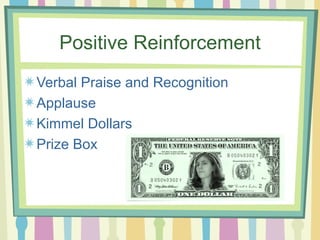
Verbal Praise and Recognition  Applause Kimmel Dollars Prize Box Positive Reinforcement
Parent Involvement Intro letter to parents Letter home concerning any projects Phone calls to parents  Conferences  Email Online grade book
Various Procedures Starting Class Speaking in Class Bathroom Breaks Pencil Sharpening and Materials Binders Turning in Homework
Starting Class Students should be in their seats working on the warm up when the bell rings I take attendance and check homework while students are working
Speaking in Class Most of the time students know they must raise their hand and be called on to speak.  I frequently remind students of this by saying “hands” after a question and raising my own hand. Students may shout out their answers when I specifically say the word “class” at the end of a question, or if I say any one can “shout out.” Students are smart, they quickly learn when I expect them to raise their hands and when they can shout out.
Bathroom Breaks Students will be given 2 bathroom breaks per quarter Each term I hang up papers with the students passes on them.  Before a students can take the hall pass to use use the restroom or get a drink the must first tare one of their passes from the sheet and place it in my hand.
Pencil Sharpening and Materials High school students should be mature enough to quietly prepare themselves for class before the bell rings.  If they fail to do so, it counts as their warning. I keep sharpeners and other materials on the back table that students can help themselves to as long as there is only one person at the table at time.
Binders Organization is key to success.  Binders must be kept and will be graded Binders must be divided into five sections  Warm-ups Notes Classwork/Homework Tests and Quizzes Extra Paper
Turning in Homework When told: Students pass their assignments forward to the first person in their row The students in the first row passes the papers to the left The student in the left hand corner of the room winds up with all of the papers  I collect the papers from this student There is a red box in the room where students can turn in late work for partial credit
The End (you may now applaud)

Classroom Managment

  • 1.
    Classroom Management HeatherKimmel February, 2009
  • 2.
    Classroom Management: Refersto the process of setting up and maintaining a positive learning environment in the classroom. It includes providing structured class time, providing clear expectations, and maintaining discipline.
  • 3.
    Philosophy of ClassroomManagement Classroom management should be proactive . When students’ time is structured, when they have positive activities to engage in, and when expectations are clear, reactive measures become less necessary. Although classroom management should be proactive, reactive measures should not be abandoned. It is important to follow through with rules and consequences which provide structure to both the class as a whole and the students as individuals. Effective classroom management is essential to both creating a positive learning environment and fostering student achievement
  • 4.
    Positive Learning EnvironmentIn order to effectively manage a class the teacher must create and maintain a positive learning environment A positive learning environment is one in which all students feel comfortable participating Lessons must be structured so that the students are set up to succeed, but there must also be room for failure and learning from mistakes A positive learning environment provides a place for intellectual and social and emotional growth
  • 5.
    Be in yourseat and working when the bell rings Do not speak out of turn Follow directions Stay on task No eating junk food Show respect to yourself, your classmates, and this place (or at least pretend to) RULES
  • 6.
    CONSEQUENCES Verbal Warning/Nameon Board Detention/Writing Assignment Phone Call Home Office Referral (Shaped not numbered)
  • 7.
    Verbal Praise andRecognition Applause Kimmel Dollars Prize Box Positive Reinforcement
  • 8.
    Parent Involvement Introletter to parents Letter home concerning any projects Phone calls to parents Conferences Email Online grade book
  • 9.
    Various Procedures StartingClass Speaking in Class Bathroom Breaks Pencil Sharpening and Materials Binders Turning in Homework
  • 10.
    Starting Class Studentsshould be in their seats working on the warm up when the bell rings I take attendance and check homework while students are working
  • 11.
    Speaking in ClassMost of the time students know they must raise their hand and be called on to speak. I frequently remind students of this by saying “hands” after a question and raising my own hand. Students may shout out their answers when I specifically say the word “class” at the end of a question, or if I say any one can “shout out.” Students are smart, they quickly learn when I expect them to raise their hands and when they can shout out.
  • 12.
    Bathroom Breaks Studentswill be given 2 bathroom breaks per quarter Each term I hang up papers with the students passes on them. Before a students can take the hall pass to use use the restroom or get a drink the must first tare one of their passes from the sheet and place it in my hand.
  • 13.
    Pencil Sharpening andMaterials High school students should be mature enough to quietly prepare themselves for class before the bell rings. If they fail to do so, it counts as their warning. I keep sharpeners and other materials on the back table that students can help themselves to as long as there is only one person at the table at time.
  • 14.
    Binders Organization iskey to success. Binders must be kept and will be graded Binders must be divided into five sections Warm-ups Notes Classwork/Homework Tests and Quizzes Extra Paper
  • 15.
    Turning in HomeworkWhen told: Students pass their assignments forward to the first person in their row The students in the first row passes the papers to the left The student in the left hand corner of the room winds up with all of the papers I collect the papers from this student There is a red box in the room where students can turn in late work for partial credit
  • 16.
    The End (youmay now applaud)