Classroom Management

Penny Ur

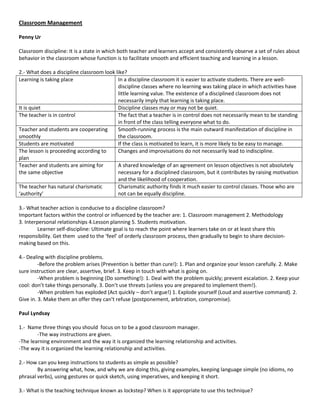
Classroom discipline: It is a state in which both teacher and learners accept and consistently observe a set of rules about
behavior in the classroom whose function is to facilitate smooth and efficient teaching and learning in a lesson.

2.- What does a discipline classroom look like?
Learning is taking place                   In a discipline classroom it is easier to activate students. There are well-
                                           discipline classes where no learning was taking place in which activities have
                                           little learning value. The existence of a disciplined classroom does not
                                           necessarily imply that learning is taking place.
It is quiet                                Discipline classes may or may not be quiet.
The teacher is in control                  The fact that a teacher is in control does not necessarily mean to be standing
                                           in front of the class telling everyone what to do.
Teacher and students are cooperating       Smooth-running process is the main outward manifestation of discipline in
smoothly                                   the classroom.
Students are motivated                     If the class is motivated to learn, it is more likely to be easy to manage.
The lesson is proceeding according to      Changes and improvisations do not necessarily lead to indiscipline.
plan
Teacher and students are aiming for        A shared knowledge of an agreement on lesson objectives is not absolutely
the same objective                         necessary for a disciplined classroom, but it contributes by raising motivation
                                           and the likelihood of cooperation.
The teacher has natural charismatic        Charismatic authority finds it much easier to control classes. Those who are
‘authority’                                not can be equally discipline.

3.- What teacher action is conducive to a discipline classroom?
Important factors within the control or influenced by the teacher are: 1. Classroom management 2. Methodology
3. Interpersonal relationships 4.Lesson planning 5. Students motivation.
         Learner self-discipline: Ultimate goal is to reach the point where learners take on or at least share this
responsibility. Get them used to the ‘feel’ of orderly classroom process, then gradually to begin to share decision-
making based on this.

4.- Dealing with discipline problems.
         -Before the problem arises (Prevention is better than cure!): 1. Plan and organize your lesson carefully. 2. Make
sure instruction are clear, assertive, brief. 3. Keep in touch with what is going on.
         -When problem is beginning (Do something!): 1. Deal with the problem quickly; prevent escalation. 2. Keep your
cool: don’t take things personally. 3. Don’t use threats (unless you are prepared to implement them!).
         -When problem has exploded (Act quickly – don’t argue!) 1. Explode yourself (Loud and assertive command). 2.
Give in. 3. Make them an offer they can’t refuse (postponement, arbitration, compromise).

Paul Lyndsay

1.- Name three things you should focus on to be a good classroom manager.
        -The way instructions are given.
-The learning environment and the way it is organized the learning relationship and activities.
-The way it is organized the learning relationship and activities.

2.- How can you keep instructions to students as simple as possible?
        By answering what, how, and why we are doing this, giving examples, keeping language simple (no idioms, no
phrasal verbs), using gestures or quick sketch, using imperatives, and keeping it short.

3.- What is the teaching technique known as lockstep? When is it appropriate to use this technique?
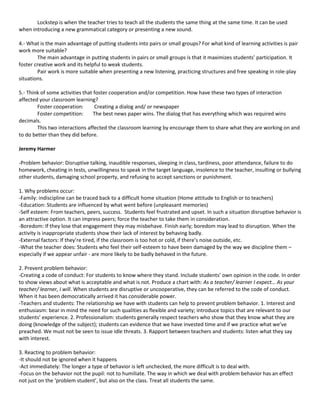
Lockstep is when the teacher tries to teach all the students the same thing at the same time. It can be used
when introducing a new grammatical category or presenting a new sound.

4.- What is the main advantage of putting students into pairs or small groups? For what kind of learning activities is pair
work more suitable?
        The main advantage in putting students in pairs or small groups is that it maximizes students’ participation. It
foster creative work and its helpful to weak students.
        Pair work is more suitable when presenting a new listening, practicing structures and free speaking in role-play
situations.

5.- Think of some activities that foster cooperation and/or competition. How have these two types of interaction
affected your classroom learning?
        Foster cooperation:       Creating a dialog and/ or newspaper
        Foster competition:       The best news paper wins. The dialog that has everything which was required wins
decimals.
        This two interactions affected the classroom learning by encourage them to share what they are working on and
to do better than they did before.

Jeremy Harmer

-Problem behavior: Disruptive talking, inaudible responses, sleeping in class, tardiness, poor attendance, failure to do
homework, cheating in tests, unwillingness to speak in the target language, insolence to the teacher, insulting or bullying
other students, damaging school property, and refusing to accept sanctions or punishment.

1. Why problems occur:
-Family: indiscipline can be traced back to a difficult home situation (Home attitude to English or to teachers)
-Education: Students are influenced by what went before (unpleasant memories)
-Self esteem: From teachers, peers, success. Students feel frustrated and upset. In such a situation disruptive behavior is
an attractive option. It can impress peers; force the teacher to take them in consideration.
-Boredom: If they lose that engagement they may misbehave. Finish early; boredom may lead to disruption. When the
activity is inappropriate students show their lack of interest by behaving badly.
-External factors: If they’re tired, if the classroom is too hot or cold, if there’s noise outside, etc.
-What the teacher does: Students who feel their self-esteem to have been damaged by the way we discipline them –
especially if we appear unfair - are more likely to be badly behaved in the future.

2. Prevent problem behavior:
-Creating a code of conduct: For students to know where they stand. Include students’ own opinion in the code. In order
to show views about what is acceptable and what is not. Produce a chart with: As a teacher/ learner I expect… As your
teacher/ learner, I will. When students are disruptive or uncooperative, they can be referred to the code of conduct.
When it has been democratically arrived it has considerable power.
-Teachers and students: The relationship we have with students can help to prevent problem behavior. 1. Interest and
enthusiasm: bear in mind the need for such qualities as flexible and variety; introduce topics that are relevant to our
students’ experience. 2. Professionalism: students generally respect teachers who show that they know what they are
doing (knowledge of the subject); students can evidence that we have invested time and if we practice what we’ve
preached. We must not be seen to issue idle threats. 3. Rapport between teachers and students: listen what they say
with interest.

3. Reacting to problem behavior:
-It should not be ignored when it happens
-Act immediately: The longer a type of behavior is left unchecked, the more difficult is to deal with.
-Focus on the behavior not the pupil: not to humiliate. The way in which we deal with problem behavior has an effect
not just on the ‘problem student’, but also on the class. Treat all students the same.
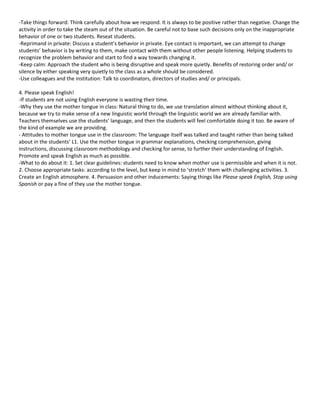
-Take things forward: Think carefully about how we respond. It is always to be positive rather than negative. Change the
activity in order to take the steam out of the situation. Be careful not to base such decisions only on the inappropriate
behavior of one or two students. Reseat students.
-Reprimand in private: Discuss a student’s behavior in private. Eye contact is important, we can attempt to change
students’ behavior is by writing to them, make contact with them without other people listening. Helping students to
recognize the problem behavior and start to find a way towards changing it.
-Keep calm: Approach the student who is being disruptive and speak more quietly. Benefits of restoring order and/ or
silence by either speaking very quietly to the class as a whole should be considered.
-Use colleagues and the institution: Talk to coordinators, directors of studies and/ or principals.

4. Please speak English!
-If students are not using English everyone is wasting their time.
-Why they use the mother tongue in class: Natural thing to do, we use translation almost without thinking about it,
because we try to make sense of a new linguistic world through the linguistic world we are already familiar with.
Teachers themselves use the students’ language, and then the students will feel comfortable doing it too. Be aware of
the kind of example we are providing.
- Attitudes to mother tongue use in the classroom: The language itself was talked and taught rather than being talked
about in the students’ L1. Use the mother tongue in grammar explanations, checking comprehension, giving
instructions, discussing classroom methodology and checking for sense, to further their understanding of English.
Promote and speak English as much as possible.
-What to do about it: 1. Set clear guidelines: students need to know when mother use is permissible and when it is not.
2. Choose appropriate tasks: according to the level, but keep in mind to ‘stretch’ them with challenging activities. 3.
Create an English atmosphere. 4. Persuasion and other inducements: Saying things like Please speak English, Stop using
Spanish or pay a fine of they use the mother tongue.

Classroom management

  • 1.
    Classroom Management Penny Ur Classroomdiscipline: It is a state in which both teacher and learners accept and consistently observe a set of rules about behavior in the classroom whose function is to facilitate smooth and efficient teaching and learning in a lesson. 2.- What does a discipline classroom look like? Learning is taking place In a discipline classroom it is easier to activate students. There are well- discipline classes where no learning was taking place in which activities have little learning value. The existence of a disciplined classroom does not necessarily imply that learning is taking place. It is quiet Discipline classes may or may not be quiet. The teacher is in control The fact that a teacher is in control does not necessarily mean to be standing in front of the class telling everyone what to do. Teacher and students are cooperating Smooth-running process is the main outward manifestation of discipline in smoothly the classroom. Students are motivated If the class is motivated to learn, it is more likely to be easy to manage. The lesson is proceeding according to Changes and improvisations do not necessarily lead to indiscipline. plan Teacher and students are aiming for A shared knowledge of an agreement on lesson objectives is not absolutely the same objective necessary for a disciplined classroom, but it contributes by raising motivation and the likelihood of cooperation. The teacher has natural charismatic Charismatic authority finds it much easier to control classes. Those who are ‘authority’ not can be equally discipline. 3.- What teacher action is conducive to a discipline classroom? Important factors within the control or influenced by the teacher are: 1. Classroom management 2. Methodology 3. Interpersonal relationships 4.Lesson planning 5. Students motivation. Learner self-discipline: Ultimate goal is to reach the point where learners take on or at least share this responsibility. Get them used to the ‘feel’ of orderly classroom process, then gradually to begin to share decision- making based on this. 4.- Dealing with discipline problems. -Before the problem arises (Prevention is better than cure!): 1. Plan and organize your lesson carefully. 2. Make sure instruction are clear, assertive, brief. 3. Keep in touch with what is going on. -When problem is beginning (Do something!): 1. Deal with the problem quickly; prevent escalation. 2. Keep your cool: don’t take things personally. 3. Don’t use threats (unless you are prepared to implement them!). -When problem has exploded (Act quickly – don’t argue!) 1. Explode yourself (Loud and assertive command). 2. Give in. 3. Make them an offer they can’t refuse (postponement, arbitration, compromise). Paul Lyndsay 1.- Name three things you should focus on to be a good classroom manager. -The way instructions are given. -The learning environment and the way it is organized the learning relationship and activities. -The way it is organized the learning relationship and activities. 2.- How can you keep instructions to students as simple as possible? By answering what, how, and why we are doing this, giving examples, keeping language simple (no idioms, no phrasal verbs), using gestures or quick sketch, using imperatives, and keeping it short. 3.- What is the teaching technique known as lockstep? When is it appropriate to use this technique?
  • 2.
    Lockstep is whenthe teacher tries to teach all the students the same thing at the same time. It can be used when introducing a new grammatical category or presenting a new sound. 4.- What is the main advantage of putting students into pairs or small groups? For what kind of learning activities is pair work more suitable? The main advantage in putting students in pairs or small groups is that it maximizes students’ participation. It foster creative work and its helpful to weak students. Pair work is more suitable when presenting a new listening, practicing structures and free speaking in role-play situations. 5.- Think of some activities that foster cooperation and/or competition. How have these two types of interaction affected your classroom learning? Foster cooperation: Creating a dialog and/ or newspaper Foster competition: The best news paper wins. The dialog that has everything which was required wins decimals. This two interactions affected the classroom learning by encourage them to share what they are working on and to do better than they did before. Jeremy Harmer -Problem behavior: Disruptive talking, inaudible responses, sleeping in class, tardiness, poor attendance, failure to do homework, cheating in tests, unwillingness to speak in the target language, insolence to the teacher, insulting or bullying other students, damaging school property, and refusing to accept sanctions or punishment. 1. Why problems occur: -Family: indiscipline can be traced back to a difficult home situation (Home attitude to English or to teachers) -Education: Students are influenced by what went before (unpleasant memories) -Self esteem: From teachers, peers, success. Students feel frustrated and upset. In such a situation disruptive behavior is an attractive option. It can impress peers; force the teacher to take them in consideration. -Boredom: If they lose that engagement they may misbehave. Finish early; boredom may lead to disruption. When the activity is inappropriate students show their lack of interest by behaving badly. -External factors: If they’re tired, if the classroom is too hot or cold, if there’s noise outside, etc. -What the teacher does: Students who feel their self-esteem to have been damaged by the way we discipline them – especially if we appear unfair - are more likely to be badly behaved in the future. 2. Prevent problem behavior: -Creating a code of conduct: For students to know where they stand. Include students’ own opinion in the code. In order to show views about what is acceptable and what is not. Produce a chart with: As a teacher/ learner I expect… As your teacher/ learner, I will. When students are disruptive or uncooperative, they can be referred to the code of conduct. When it has been democratically arrived it has considerable power. -Teachers and students: The relationship we have with students can help to prevent problem behavior. 1. Interest and enthusiasm: bear in mind the need for such qualities as flexible and variety; introduce topics that are relevant to our students’ experience. 2. Professionalism: students generally respect teachers who show that they know what they are doing (knowledge of the subject); students can evidence that we have invested time and if we practice what we’ve preached. We must not be seen to issue idle threats. 3. Rapport between teachers and students: listen what they say with interest. 3. Reacting to problem behavior: -It should not be ignored when it happens -Act immediately: The longer a type of behavior is left unchecked, the more difficult is to deal with. -Focus on the behavior not the pupil: not to humiliate. The way in which we deal with problem behavior has an effect not just on the ‘problem student’, but also on the class. Treat all students the same.
  • 3.
    -Take things forward:Think carefully about how we respond. It is always to be positive rather than negative. Change the activity in order to take the steam out of the situation. Be careful not to base such decisions only on the inappropriate behavior of one or two students. Reseat students. -Reprimand in private: Discuss a student’s behavior in private. Eye contact is important, we can attempt to change students’ behavior is by writing to them, make contact with them without other people listening. Helping students to recognize the problem behavior and start to find a way towards changing it. -Keep calm: Approach the student who is being disruptive and speak more quietly. Benefits of restoring order and/ or silence by either speaking very quietly to the class as a whole should be considered. -Use colleagues and the institution: Talk to coordinators, directors of studies and/ or principals. 4. Please speak English! -If students are not using English everyone is wasting their time. -Why they use the mother tongue in class: Natural thing to do, we use translation almost without thinking about it, because we try to make sense of a new linguistic world through the linguistic world we are already familiar with. Teachers themselves use the students’ language, and then the students will feel comfortable doing it too. Be aware of the kind of example we are providing. - Attitudes to mother tongue use in the classroom: The language itself was talked and taught rather than being talked about in the students’ L1. Use the mother tongue in grammar explanations, checking comprehension, giving instructions, discussing classroom methodology and checking for sense, to further their understanding of English. Promote and speak English as much as possible. -What to do about it: 1. Set clear guidelines: students need to know when mother use is permissible and when it is not. 2. Choose appropriate tasks: according to the level, but keep in mind to ‘stretch’ them with challenging activities. 3. Create an English atmosphere. 4. Persuasion and other inducements: Saying things like Please speak English, Stop using Spanish or pay a fine of they use the mother tongue.