Biological
Macromolecules
They’re Organic!!!
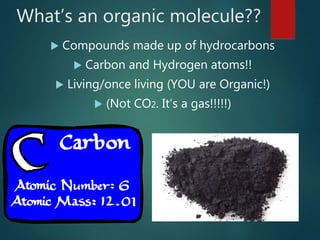
What’s an organic molecule??
 Compounds made up of hydrocarbons
 Carbon and Hydrogen atoms!!
 Living/once living (YOU are Organic!)
 (Not CO2. It’s a gas!!!!!)
There are four classes of biological
macromolecules we will be looking at:
Proteins
Lipids
Carbohydrates
Nucleic acids (This will be last)
First – Let’s
Concentrate
on these
three!
A very, very large
molecule!!
Biological
Macromolecule
All biological macro-molecule are
organic, meaning they all contain
hydrocarbons…Carbon atoms (with
attached Hydrogens!) Other elements
may include Oxygen, Nitrogen,
Phosphorus and Sulfur
Macromolecules
 We’re looking
at
“Mono” means one
SO… a polymer is
made up of many
monomers!!
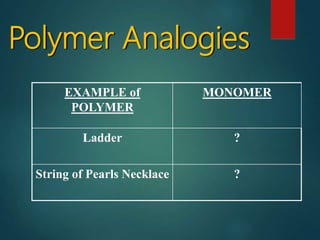
Polymer Analogies
EXAMPLE of
POLYMER
MONOMER
Ladder ?
String of Pearls Necklace ?
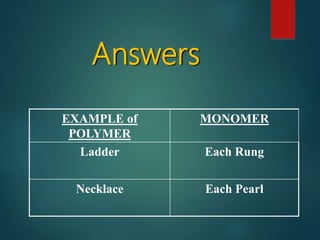
Answers
EXAMPLE of
POLYMER
MONOMER
Ladder Each Rung
Necklace Each Pearl
Can you think of a polymer??
What monomers make it up??
ALL four can be found in food!!
Think about it!!
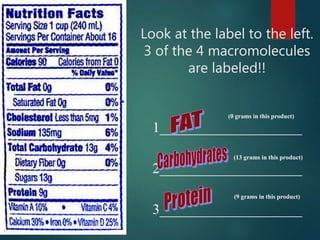
Look at the label to the left.
3 of the 4 macromolecules
are labeled!!
1____________________
2____________________
3____________________
(0 grams in this product)
(13 grams in this product)
(9 grams in this product)
On to Our First Biomolecule!!
Carbohydrates!!
Carbohydrates
C, H, O
SIMPLE CARBOHYDRATES
They are the main source of energy for the body !
Simple sugars Monosaccharide
Glucose, for example (Yes it IS a monomer!!), is the main
product of photosynthesis!!
C6H12O6 Atoms: C, H, O
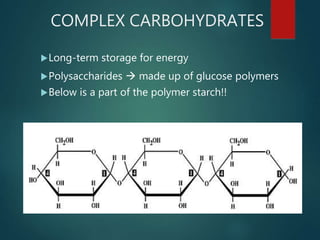
COMPLEX CARBOHYDRATES
Long-term storage for energy
Polysaccharides  made up of glucose polymers
Below is a part of the polymer starch!!
Starch Continued
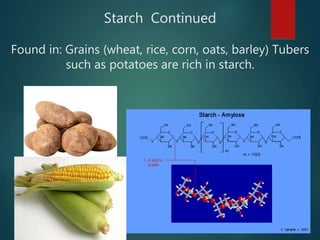
Found in: Grains (wheat, rice, corn, oats, barley) Tubers
such as potatoes are rich in starch.
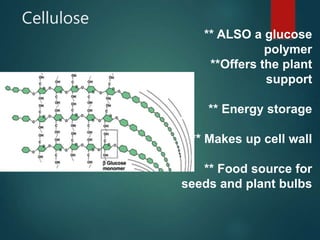
Cellulose
** ALSO a glucose
polymer
**Offers the plant
support
** Energy storage
** Makes up cell wall
** Food source for
seeds and plant bulbs
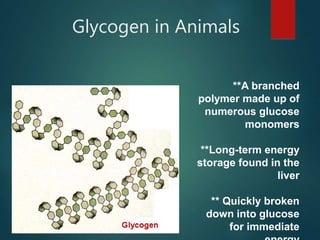
Glycogen in Animals
**A branched
polymer made up of
numerous glucose
monomers
**Long-term energy
storage found in the
liver
** Quickly broken
down into glucose
for immediate
Complex Carbs and Energy
 Starches, Cellulose and Glycogen are broken down by
proteins called enzymes (remember digestion in
lysosomes!!??.....similar concept!)
 Broken down into their monomers  Glucose
 Glucose is further broken down during cellular
respiration in the mitochondria for energy
 About 36 ATP molecules of energy per each glucose
molecule!!!
Lipids
Mostly C,H and some O
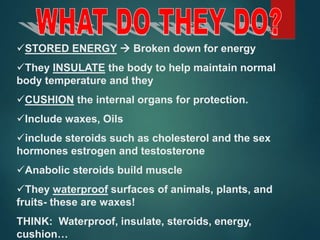
STORED ENERGY  Broken down for energy
They INSULATE the body to help maintain normal
body temperature and they
CUSHION the internal organs for protection.
Include waxes, Oils
include steroids such as cholesterol and the sex
hormones estrogen and testosterone
Anabolic steroids build muscle
They waterproof surfaces of animals, plants, and
fruits- these are waxes!
THINK: Waterproof, insulate, steroids, energy,
cushion…
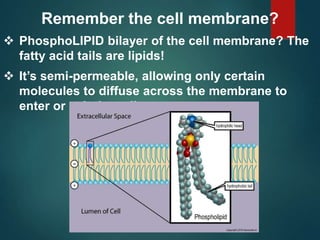
Remember the cell membrane?
 PhosphoLIPID bilayer of the cell membrane? The
fatty acid tails are lipids!
 It’s semi-permeable, allowing only certain
molecules to diffuse across the membrane to
enter or exit the cell.
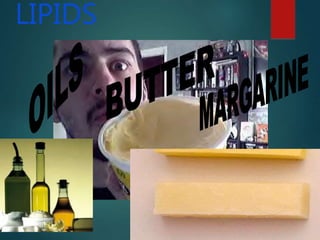
LIPIDS
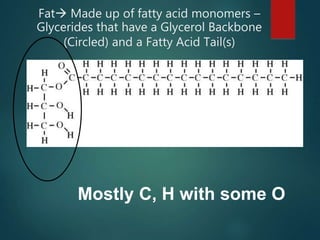
Fat Made up of fatty acid monomers –
Glycerides that have a Glycerol Backbone
(Circled) and a Fatty Acid Tail(s)
Mostly C, H with some O
Triglycerides
Glycerol Group with 3 Fatty Acid Chains
This is a triglyceride molecule
NOW ONTO PROTEINS
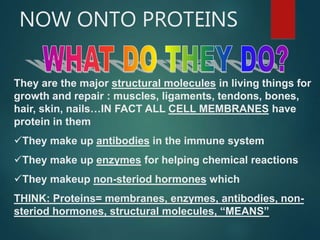
They are the major structural molecules in living things for
growth and repair : muscles, ligaments, tendons, bones,
hair, skin, nails…IN FACT ALL CELL MEMBRANES have
protein in them
They make up antibodies in the immune system
They make up enzymes for helping chemical reactions
They makeup non-steriod hormones which
THINK: Proteins= membranes, enzymes, antibodies, non-
steriod hormones, structural molecules, “MEANS”
Proteins
Made up of Mostly C, H, O and
N (Some Sulfur)
Proteins
Proteins
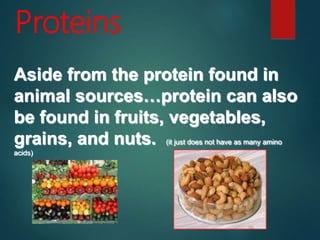
Aside from the protein found in
animal sources…protein can also
be found in fruits, vegetables,
grains, and nuts. (it just does not have as many amino
acids)
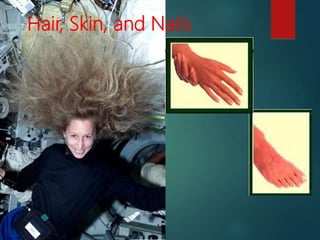
Hair, Skin, and Nails
Microscope View of
Skin and Nails
This is skin This is a nail
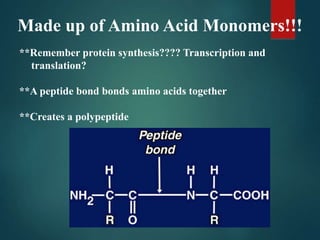
Made up of Amino Acid Monomers!!!
**Remember protein synthesis???? Transcription and
translation?
**A peptide bond bonds amino acids together
**Creates a polypeptide
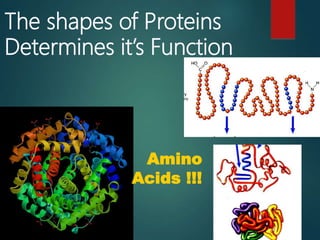
The shapes of Proteins
Determines it’s Function
Amino
Acids !!!
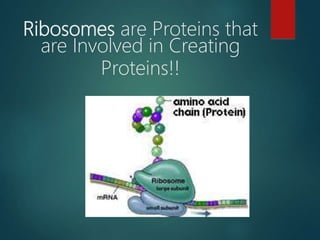
Ribosomes are Proteins that
are Involved in Creating
Proteins!!
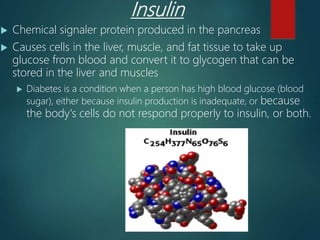
Insulin
 Chemical signaler protein produced in the pancreas
 Causes cells in the liver, muscle, and fat tissue to take up
glucose from blood and convert it to glycogen that can be
stored in the liver and muscles
 Diabetes is a condition when a person has high blood glucose (blood
sugar), either because insulin production is inadequate, or because
the body's cells do not respond properly to insulin, or both.
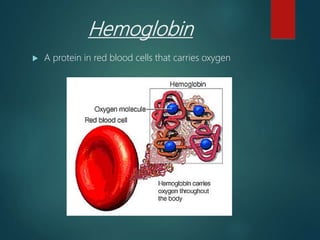
Hemoglobin
 A protein in red blood cells that carries oxygen
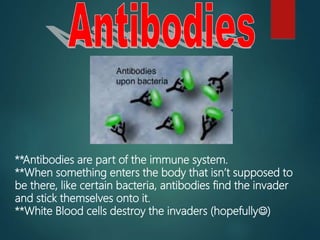
**Antibodies are part of the immune system.
**When something enters the body that isn’t supposed to
be there, like certain bacteria, antibodies find the invader
and stick themselves onto it.
**White Blood cells destroy the invaders (hopefully)
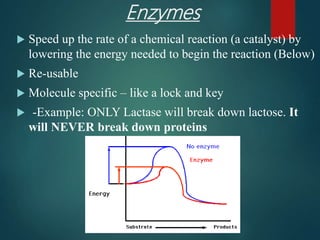
Enzymes
 Speed up the rate of a chemical reaction (a catalyst) by
lowering the energy needed to begin the reaction (Below)
 Re-usable
 Molecule specific – like a lock and key
 -Example: ONLY Lactase will break down lactose. It
will NEVER break down proteins
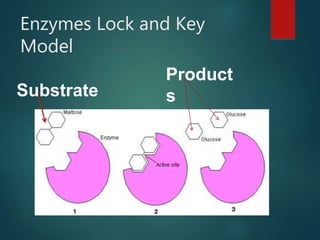
Enzymes Lock and Key
Model
Substrate
Product
s
Enzymes
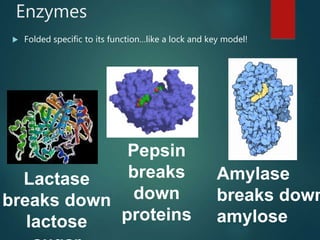
 Folded specific to its function…like a lock and key model!
Lactase
breaks down
lactose
Pepsin
breaks
down
proteins
Amylase
breaks down
amylose
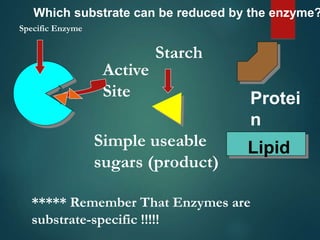
Active
Site
Specific Enzyme
Starch
***** Remember That Enzymes are
substrate-specific !!!!!
Simple useable
sugars (product)
Protei
n
Lipid
Which substrate can be reduced by the enzyme?
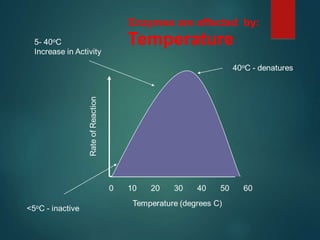
Enzymes are affected by:
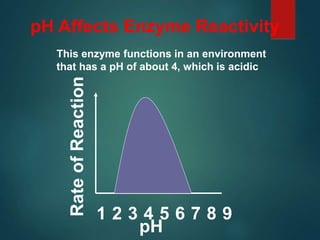
Rate
of
Reaction
pH Affects Enzyme Reactivity
1 3 4
2 5 6 7 8 9
pH
This enzyme functions in an environment
that has a pH of about 4, which is acidic
The 4th type is
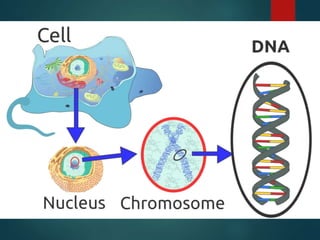
NUCLEIC ACIDS
The types of Nucleic Acids
DNA (DeoxyriboNucleic Acid)
RNA (RiboNucleic Acid)
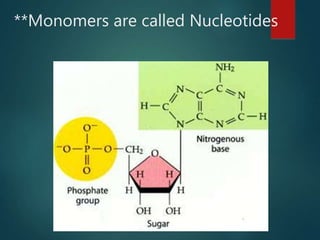
**Monomers are called Nucleotides
“DNA” is short for
Deoxyribonucleic Acid
**Your genetic makeup!!
“DNA” is short for
Ribonucleic Acid
**Works with DNA to create
proteins
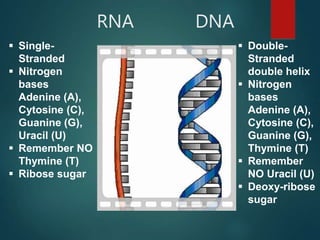
RNA DNA
 Single-
Stranded
 Nitrogen
bases
Adenine (A),
Cytosine (C),
Guanine (G),
Uracil (U)
 Remember NO
Thymine (T)
 Ribose sugar
 Double-
Stranded
double helix
 Nitrogen
bases
Adenine (A),
Cytosine (C),
Guanine (G),
Thymine (T)
 Remember
NO Uracil (U)
 Deoxy-ribose
sugar
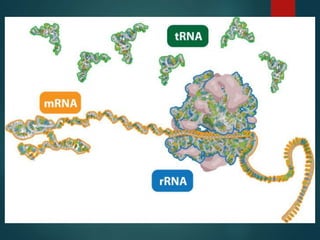
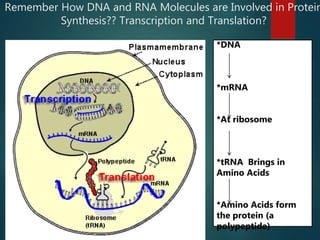
Remember How DNA and RNA Molecules are Involved in Protein
Synthesis?? Transcription and Translation?
*DNA
*mRNA
*At ribosome
*tRNA Brings in
Amino Acids
*Amino Acids form
the protein (a
polypeptide)

The Biological Macromolecules 2022.ppt

  • 1.
  • 2.
  • 3.
    What’s an organicmolecule??  Compounds made up of hydrocarbons  Carbon and Hydrogen atoms!!  Living/once living (YOU are Organic!)  (Not CO2. It’s a gas!!!!!)
  • 4.
    There are fourclasses of biological macromolecules we will be looking at: Proteins Lipids Carbohydrates Nucleic acids (This will be last) First – Let’s Concentrate on these three!
  • 6.
    A very, verylarge molecule!!
  • 7.
    Biological Macromolecule All biological macro-moleculeare organic, meaning they all contain hydrocarbons…Carbon atoms (with attached Hydrogens!) Other elements may include Oxygen, Nitrogen, Phosphorus and Sulfur
  • 8.
  • 11.
    “Mono” means one SO…a polymer is made up of many monomers!!
  • 12.
  • 13.
  • 14.
    Can you thinkof a polymer?? What monomers make it up??
  • 15.
    ALL four canbe found in food!! Think about it!!
  • 16.
    Look at thelabel to the left. 3 of the 4 macromolecules are labeled!! 1____________________ 2____________________ 3____________________ (0 grams in this product) (13 grams in this product) (9 grams in this product)
  • 17.
    On to OurFirst Biomolecule!! Carbohydrates!!
  • 18.
  • 19.
    SIMPLE CARBOHYDRATES They arethe main source of energy for the body ! Simple sugars Monosaccharide Glucose, for example (Yes it IS a monomer!!), is the main product of photosynthesis!! C6H12O6 Atoms: C, H, O
  • 20.
    COMPLEX CARBOHYDRATES Long-term storagefor energy Polysaccharides  made up of glucose polymers Below is a part of the polymer starch!!
  • 21.
    Starch Continued Found in:Grains (wheat, rice, corn, oats, barley) Tubers such as potatoes are rich in starch.
  • 22.
    Cellulose ** ALSO aglucose polymer **Offers the plant support ** Energy storage ** Makes up cell wall ** Food source for seeds and plant bulbs
  • 23.
    Glycogen in Animals **Abranched polymer made up of numerous glucose monomers **Long-term energy storage found in the liver ** Quickly broken down into glucose for immediate
  • 24.
    Complex Carbs andEnergy  Starches, Cellulose and Glycogen are broken down by proteins called enzymes (remember digestion in lysosomes!!??.....similar concept!)  Broken down into their monomers  Glucose  Glucose is further broken down during cellular respiration in the mitochondria for energy  About 36 ATP molecules of energy per each glucose molecule!!!
  • 25.
  • 26.
    STORED ENERGY Broken down for energy They INSULATE the body to help maintain normal body temperature and they CUSHION the internal organs for protection. Include waxes, Oils include steroids such as cholesterol and the sex hormones estrogen and testosterone Anabolic steroids build muscle They waterproof surfaces of animals, plants, and fruits- these are waxes! THINK: Waterproof, insulate, steroids, energy, cushion…
  • 27.
    Remember the cellmembrane?  PhosphoLIPID bilayer of the cell membrane? The fatty acid tails are lipids!  It’s semi-permeable, allowing only certain molecules to diffuse across the membrane to enter or exit the cell.
  • 28.
  • 29.
    Fat Made upof fatty acid monomers – Glycerides that have a Glycerol Backbone (Circled) and a Fatty Acid Tail(s) Mostly C, H with some O
  • 30.
    Triglycerides Glycerol Group with3 Fatty Acid Chains This is a triglyceride molecule
  • 31.
    NOW ONTO PROTEINS Theyare the major structural molecules in living things for growth and repair : muscles, ligaments, tendons, bones, hair, skin, nails…IN FACT ALL CELL MEMBRANES have protein in them They make up antibodies in the immune system They make up enzymes for helping chemical reactions They makeup non-steriod hormones which THINK: Proteins= membranes, enzymes, antibodies, non- steriod hormones, structural molecules, “MEANS”
  • 32.
    Proteins Made up ofMostly C, H, O and N (Some Sulfur)
  • 33.
  • 34.
    Proteins Aside from theprotein found in animal sources…protein can also be found in fruits, vegetables, grains, and nuts. (it just does not have as many amino acids)
  • 35.
  • 36.
    Microscope View of Skinand Nails This is skin This is a nail
  • 37.
    Made up ofAmino Acid Monomers!!! **Remember protein synthesis???? Transcription and translation? **A peptide bond bonds amino acids together **Creates a polypeptide
  • 38.
    The shapes ofProteins Determines it’s Function Amino Acids !!!
  • 39.
    Ribosomes are Proteinsthat are Involved in Creating Proteins!!
  • 40.
    Insulin  Chemical signalerprotein produced in the pancreas  Causes cells in the liver, muscle, and fat tissue to take up glucose from blood and convert it to glycogen that can be stored in the liver and muscles  Diabetes is a condition when a person has high blood glucose (blood sugar), either because insulin production is inadequate, or because the body's cells do not respond properly to insulin, or both.
  • 41.
    Hemoglobin  A proteinin red blood cells that carries oxygen
  • 42.
    **Antibodies are partof the immune system. **When something enters the body that isn’t supposed to be there, like certain bacteria, antibodies find the invader and stick themselves onto it. **White Blood cells destroy the invaders (hopefully)
  • 43.
    Enzymes  Speed upthe rate of a chemical reaction (a catalyst) by lowering the energy needed to begin the reaction (Below)  Re-usable  Molecule specific – like a lock and key  -Example: ONLY Lactase will break down lactose. It will NEVER break down proteins
  • 44.
    Enzymes Lock andKey Model Substrate Product s
  • 45.
    Enzymes  Folded specificto its function…like a lock and key model! Lactase breaks down lactose Pepsin breaks down proteins Amylase breaks down amylose
  • 46.
    Active Site Specific Enzyme Starch ***** RememberThat Enzymes are substrate-specific !!!!! Simple useable sugars (product) Protei n Lipid Which substrate can be reduced by the enzyme?
  • 47.
  • 48.
    Rate of Reaction pH Affects EnzymeReactivity 1 3 4 2 5 6 7 8 9 pH This enzyme functions in an environment that has a pH of about 4, which is acidic
  • 50.
    The 4th typeis NUCLEIC ACIDS The types of Nucleic Acids DNA (DeoxyriboNucleic Acid) RNA (RiboNucleic Acid)
  • 51.
  • 52.
    “DNA” is shortfor Deoxyribonucleic Acid **Your genetic makeup!!
  • 54.
    “DNA” is shortfor Ribonucleic Acid **Works with DNA to create proteins
  • 56.
    RNA DNA  Single- Stranded Nitrogen bases Adenine (A), Cytosine (C), Guanine (G), Uracil (U)  Remember NO Thymine (T)  Ribose sugar  Double- Stranded double helix  Nitrogen bases Adenine (A), Cytosine (C), Guanine (G), Thymine (T)  Remember NO Uracil (U)  Deoxy-ribose sugar
  • 57.
    Remember How DNAand RNA Molecules are Involved in Protein Synthesis?? Transcription and Translation? *DNA *mRNA *At ribosome *tRNA Brings in Amino Acids *Amino Acids form the protein (a polypeptide)