
1
Tan Delta Testing
on Medium Voltage Cables
Javier Ruiz Leiva
Cable Fault Location, Test and Diagnostic
Area Sales Manager
2
Moderator
n  Michael Fleischer
• Digital Marketing Specialist
4
Today’s Presenter & Panelists
Presenter
n  Javier Ruiz Leiva
• Cable Fault Location, Test & Diagnostic
Area Sales Manager
Panelists
n  Robert Probst
• Product Manager
n  Henning Oetjen
• Product Category Manager
5
Agenda
n  Basics
• Review VLF
• Cable Insulation Ageing Process
• What is Tan Delta?
• When and why do we use it?
n  Capabilities and Limitations
n  How does it work
n  What are the parameters
n  Assessment criteria
n  How to Interpret the results
n  Doing the test
6
Basics
VLF Test
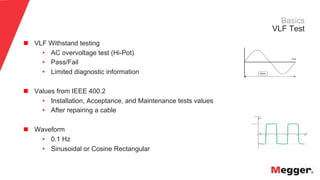
n  VLF Withstand testing
• AC overvoltage test (Hi-Pot)
• Pass/Fail
• Limited diagnostic information
n  Values from IEEE 400.2
• Installation, Acceptance, and Maintenance tests values
• After repairing a cable
n  Waveform
• 0.1 Hz
• Sinusoidal or Cosine Rectangular
7
§ All MV power cables have a high voltage life expectancy;
§ During the whole service life they are subjected to thermal, electrical,
mechanical and environmental stresses;
§ These stresses will change the morphological properties of the
insulation, so will age/degrade the insulation material;
§ Result is a decrease of the breakdown-strength of the insulation;
§ Decrease of the insulation breakdown-strength will finally lead to cable
failures;
§ To avoid failures in the insulation the measurement of the dielectric
losses could be a helpful tool!
Basics
Cable Insulation Ageing Process
8
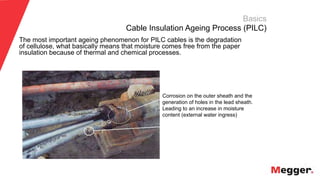
The most important ageing phenomenon for PILC cables is the degradation
of cellulose, what basically means that moisture comes free from the paper
insulation because of thermal and chemical processes.
Corrosion on the outer sheath and the
generation of holes in the lead sheath.
Leading to an increase in moisture
content (external water ingress)
Basics
Cable Insulation Ageing Process (PILC)
9
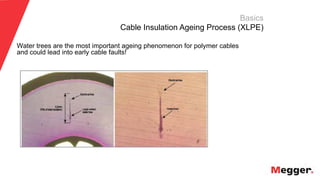
Water trees are the most important ageing phenomenon for polymer cables
and could lead into early cable faults!
Basics
Cable Insulation Ageing Process (XLPE)
10
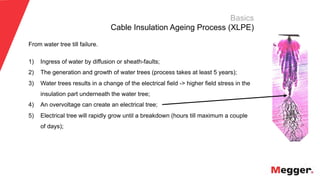
From water tree till failure.
1) Ingress of water by diffusion or sheath-faults;
2) The generation and growth of water trees (process takes at least 5 years);
3) Water trees results in a change of the electrical field -> higher field stress in the
insulation part underneath the water tree;
4) An overvoltage can create an electrical tree;
5) Electrical tree will rapidly grow until a breakdown (hours till maximum a couple
of days);
Basics
Cable Insulation Ageing Process (XLPE)
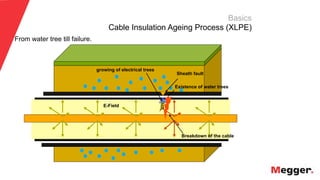
11VLF Tan Delta, (c) SebaKMT, all rights reserved.
E-Field
Sheath fault
Existence of water trees
growing of electrical trees
Breakdown of the cable
From water tree till failure.
Basics
Cable Insulation Ageing Process (XLPE)
12
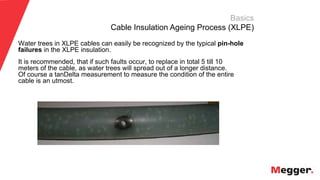
Water trees in XLPE cables can easily be recognized by the typical pin-hole
failures in the XLPE insulation.
It is recommended, that if such faults occur, to replace in total 5 till 10
meters of the cable, as water trees will spread out of a longer distance.
Of course a tanDelta measurement to measure the condition of the entire
cable is an utmost.
Basics
Cable Insulation Ageing Process (XLPE)
13
Tangent Delta test is a global method of testing cables to determine the remaining life
expectancy of the insulation.
“There is a correlation between an increasing 0.1 Hz tangent delta and a decreasing
insulation breakdown voltage level at power frequency” (Extract IEEE 400.2-2013)
Basics
What is the Tan Delta Test?
n  Based on VLF technology
• Add measurements
n  Diagnostic test
• Results in qualitative numbers
• Results can be compared to IEEE guide
n  Prescribed test method
• IEEE 400.2-2013
14
Basics
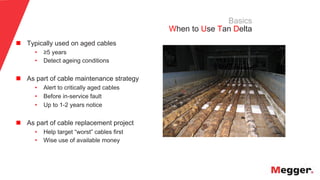
When to Use Tan Delta
n  Typically used on aged cables
• ≥5 years
• Detect ageing conditions
n  As part of cable maintenance strategy
• Alert to critically aged cables
• Before in-service fault
• Up to 1-2 years notice
n  As part of cable replacement project
• Help target “worst” cables first
• Wise use of available money
15
Basics
Why to Use Tan Delta
n  Non-Destructive
• Very unlikely to fault the cable during or after test
n  Diagnostic
• Gauge remaining life of cable
n  Detect
• Ageing conditions
n  Increase System Reliability
• Bulk Insulation
16
Capabilities and Limitations
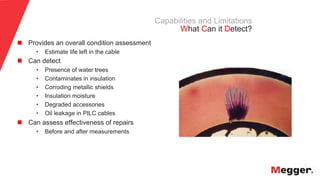
What Can it Detect?
n  Provides an overall condition assessment
• Estimate life left in the cable
n  Can detect
• Presence of water trees
• Contaminates in insulation
• Corroding metallic shields
• Insulation moisture
• Degraded accessories
• Oil leakage in PILC cables
n  Can assess effectiveness of repairs
• Before and after measurements
17
Capabilities and Limitations
What Can it Not Detect?
n  Can not locate discrete problems
• Only that there is or is not a problem
n  What (specifically) the problem is
• Is it a corroded concentric or water trees?
n  Problems in the jacket or Lead sheath
n  Poor Workmanship or installation defects
n  Must be single type of cable
• Different characteristics mask defects
• No mixing EPR & XLPE
18
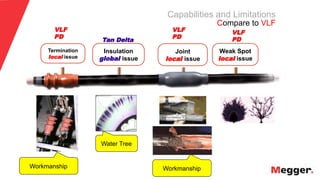
Capabilities and Limitations
Compare to VLF
Termination
local issue
Insulation
global issue
Joint
local issue
Weak Spot
local issue
Workmanship Workmanship
Water Tree
VLF
PD
VLF
PD
VLF
PDTan Delta
19
How does it Work?
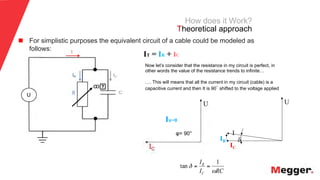
Theoretical approach
IT = IR + IC
Now let’s consider that the resistance in my circuit is perfect, in
other words the value of the resistance trends to infinite…
…. This will means that all the current in my circuit (cable) is a
capacitive current and then It is 90˚ shifted to the voltage appliedꝏ
U
IC
IR
I
δ
IR=0
φ= 90°
n  For simplistic purposes the equivalent circuit of a cable could be modeled as
follows:
RCI
I
C
R
ω
δ
1
tan ==
20
How does it Work?
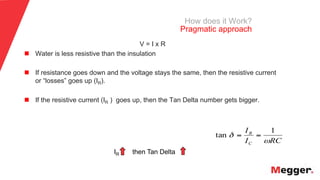
Pragmatic approach
V = I x R
n  Water is less resistive than the insulation
n  If resistance goes down and the voltage stays the same, then the resistive current
or “losses” goes up (IR).
n  If the resistive current (IR ) goes up, then the Tan Delta number gets bigger.
RCI
I
C
R
ω
δ
1
tan ==
IR then Tan Delta
R V then IR
21
How does it Work?
Summary
n  The Tan Delta is a scalar quantity (Dimensionless unit)
n  Measure the angle
• Ratio of Resistive to Capacitive current
n  As cables age
• Insulation resistance decreases
• Resistive current increases
• Angle increases
n  Compare this angle to IEEE 400.2 – 2013 tables.
• Able to make an assessment
22VLF Tan Delta, (c) SebaKMT, all rights reserved.
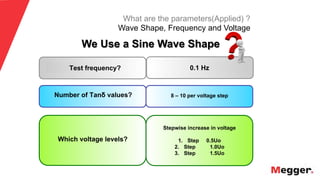
Test frequency?
Number of Tanδ values?
Which voltage levels?
0.1 Hz
8 – 10 per voltage step
Stepwise increase in voltage
1.  Step 0.5Uo
2.  Step 1.0Uo
3.  Step 1.5Uo
What are the parameters(Applied) ?
Wave Shape, Frequency and Voltage
We Use a Sine Wave Shape
23
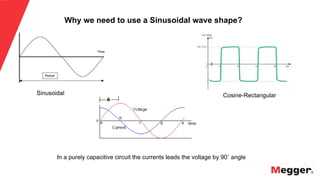
Sinusoidal Cosine-Rectangular
In a purely capacitive circuit the currents leads the voltage by 90˚ angle
Why we need to use a Sinusoidal wave shape?
24
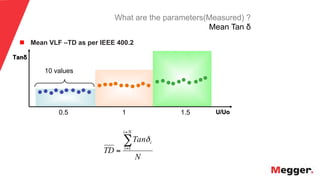
What are the parameters(Measured) ?
Mean Tan δ
n  Mean VLF –TD as per IEEE 400.2
Tanδ
U/Uo0.5 1 1.5
10 values
N
Tan
TD
Ni
i
i∑
=
=
= 1
δ
25
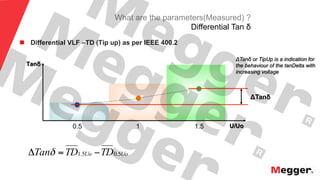
What are the parameters(Measured) ?
Differential Tan δ
U/Uo0.5 1 1.5
ΔTanδ
UoUo TDTDTan 5.05.1 −=Δ δ
ΔTanδ or TipUp is a indication for
the behaviour of the tanDelta with
increasing voltage
n  Differential VLF –TD (Tip up) as per IEEE 400.2
Tanδ
26
What are the parameters(Measured) ?
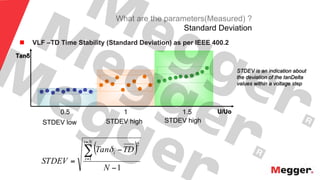
Standard Deviation
n  VLF –TD Time Stability (Standard Deviation) as per IEEE 400.2
Tanδ
U/Uo0.5 1 1.5
( )
1
1
2
−
−
=
∑
=
=
N
TDTan
STDEV
Ni
i
iδ
STDEV low STDEV high STDEV high
STDEV is an indication about
the deviation of the tanDelta
values within a voltage step
27
Assessment criteria
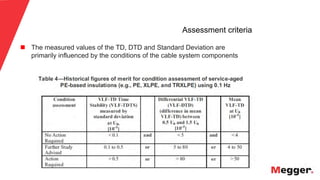
n  The measured values of the TD, DTD and Standard Deviation are
primarily influenced by the conditions of the cable system components
28
Assessment criteria
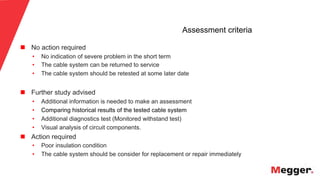
n  No action required
• No indication of severe problem in the short term
• The cable system can be returned to service
• The cable system should be retested at some later date
n  Further study advised
• Additional information is needed to make an assessment
• Comparing historical results of the tested cable system
• Additional diagnostics test (Monitored withstand test)
• Visual analysis of circuit components.
n  Action required
• Poor insulation condition
• The cable system should be consider for replacement or repair immediately
29
Assessment criteria
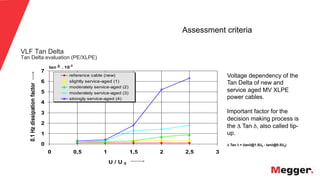
tan δ . 10-3
0
1
2
3
4
5
6
7
0 0,5 1 1,5 2 2,5 3
U / U 0
0.1Hzdissipationfactor
reference cable (new)
slightly service-aged (1)
moderately service-aged (2)
moderately service-aged (3)
strongly service-aged (4)
Voltage dependency of the
Tan Delta of new and
service aged MV XLPE
power cables.
Important factor for the
decision making process is
the Δ Tan δ, also called tip-
up.
Δ Tan δ = (tanδ@1.5U0 - tanδ@0.5U0)
VLF Tan Delta
Tan Delta evaluation (PE/XLPE)
30
How to Interpret the results
VLF Tan Delta
Tan Delta evaluation (PILC IEEE 400.2 2013)
PD in Electrical Power Apparatus; ISBN 3-8007-1760-3].
Voltage dependency of the TanDelta of a poor
and well impregnated PILC power cable.
Also in this case in addition to the absolute
TanDelta factor, the Δ Tan δ or tip-up is an
important factor in the decision making process.
Moisture ingress will also increase the tanDelta.
31
How to Interpret the results
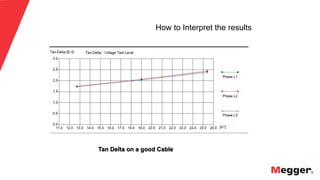
Tan Delta on a good Cable
32
How to Interpret the results
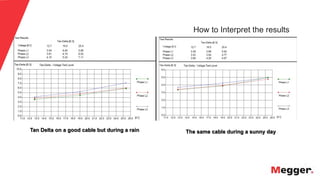
Tan Delta on a good cable but during a rain The same cable during a sunny day
33
How to Interpret the results
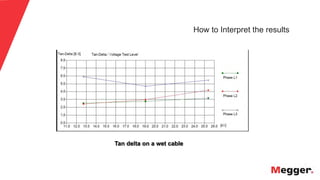
Tan delta on a wet cable
34
Doing the Tan Delta Test
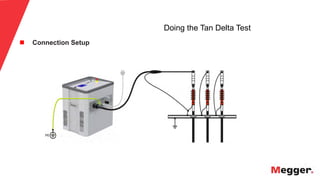
n  Connection Setup
35
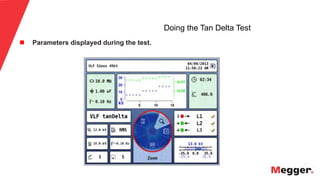
Doing the Tan Delta Test
n  Parameters displayed during the test.
36
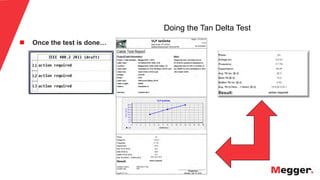
Doing the Tan Delta Test
n  Once the test is done…
37
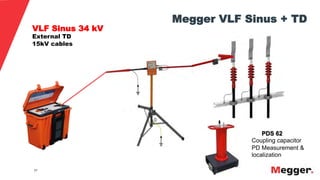
Megger VLF Sinus + TD
VLF Sinus 34 kV
External TD
15kV cables
PDS 62
Coupling capacitor
PD Measurement &
localization
38
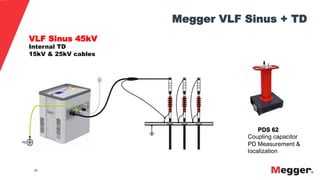
Megger VLF Sinus + TD
VLF Sinus 45kV
Internal TD
15kV & 25kV cables
PDS 62
Coupling capacitor
PD Measurement &
localization
39
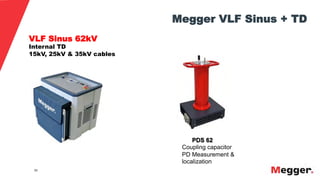
Megger VLF Sinus + TD
VLF Sinus 62kV
Internal TD
15kV, 25kV & 35kV cables
PDS 62
Coupling capacitor
PD Measurement &
localization

Tan Delta on MV Cables (Megger)

  • 1.
    1 Tan Delta Testing onMedium Voltage Cables Javier Ruiz Leiva Cable Fault Location, Test and Diagnostic Area Sales Manager
  • 2.
    2 Moderator n  Michael Fleischer •Digital Marketing Specialist
  • 3.
    4 Today’s Presenter &Panelists Presenter n  Javier Ruiz Leiva • Cable Fault Location, Test & Diagnostic Area Sales Manager Panelists n  Robert Probst • Product Manager n  Henning Oetjen • Product Category Manager
  • 4.
    5 Agenda n  Basics • ReviewVLF • Cable Insulation Ageing Process • What is Tan Delta? • When and why do we use it? n  Capabilities and Limitations n  How does it work n  What are the parameters n  Assessment criteria n  How to Interpret the results n  Doing the test
  • 5.
    6 Basics VLF Test n  VLFWithstand testing • AC overvoltage test (Hi-Pot) • Pass/Fail • Limited diagnostic information n  Values from IEEE 400.2 • Installation, Acceptance, and Maintenance tests values • After repairing a cable n  Waveform • 0.1 Hz • Sinusoidal or Cosine Rectangular
  • 6.
    7 § All MVpower cables have a high voltage life expectancy; § During the whole service life they are subjected to thermal, electrical, mechanical and environmental stresses; § These stresses will change the morphological properties of the insulation, so will age/degrade the insulation material; § Result is a decrease of the breakdown-strength of the insulation; § Decrease of the insulation breakdown-strength will finally lead to cable failures; § To avoid failures in the insulation the measurement of the dielectric losses could be a helpful tool! Basics Cable Insulation Ageing Process
  • 7.
    8 The most importantageing phenomenon for PILC cables is the degradation of cellulose, what basically means that moisture comes free from the paper insulation because of thermal and chemical processes. Corrosion on the outer sheath and the generation of holes in the lead sheath. Leading to an increase in moisture content (external water ingress) Basics Cable Insulation Ageing Process (PILC)
  • 8.
    9 Water trees arethe most important ageing phenomenon for polymer cables and could lead into early cable faults! Basics Cable Insulation Ageing Process (XLPE)
  • 9.
    10 From water treetill failure. 1) Ingress of water by diffusion or sheath-faults; 2) The generation and growth of water trees (process takes at least 5 years); 3) Water trees results in a change of the electrical field -> higher field stress in the insulation part underneath the water tree; 4) An overvoltage can create an electrical tree; 5) Electrical tree will rapidly grow until a breakdown (hours till maximum a couple of days); Basics Cable Insulation Ageing Process (XLPE)
  • 10.
    11VLF Tan Delta,(c) SebaKMT, all rights reserved. E-Field Sheath fault Existence of water trees growing of electrical trees Breakdown of the cable From water tree till failure. Basics Cable Insulation Ageing Process (XLPE)
  • 11.
    12 Water trees inXLPE cables can easily be recognized by the typical pin-hole failures in the XLPE insulation. It is recommended, that if such faults occur, to replace in total 5 till 10 meters of the cable, as water trees will spread out of a longer distance. Of course a tanDelta measurement to measure the condition of the entire cable is an utmost. Basics Cable Insulation Ageing Process (XLPE)
  • 12.
    13 Tangent Delta testis a global method of testing cables to determine the remaining life expectancy of the insulation. “There is a correlation between an increasing 0.1 Hz tangent delta and a decreasing insulation breakdown voltage level at power frequency” (Extract IEEE 400.2-2013) Basics What is the Tan Delta Test? n  Based on VLF technology • Add measurements n  Diagnostic test • Results in qualitative numbers • Results can be compared to IEEE guide n  Prescribed test method • IEEE 400.2-2013
  • 13.
    14 Basics When to UseTan Delta n  Typically used on aged cables • ≥5 years • Detect ageing conditions n  As part of cable maintenance strategy • Alert to critically aged cables • Before in-service fault • Up to 1-2 years notice n  As part of cable replacement project • Help target “worst” cables first • Wise use of available money
  • 14.
    15 Basics Why to UseTan Delta n  Non-Destructive • Very unlikely to fault the cable during or after test n  Diagnostic • Gauge remaining life of cable n  Detect • Ageing conditions n  Increase System Reliability • Bulk Insulation
  • 15.
    16 Capabilities and Limitations WhatCan it Detect? n  Provides an overall condition assessment • Estimate life left in the cable n  Can detect • Presence of water trees • Contaminates in insulation • Corroding metallic shields • Insulation moisture • Degraded accessories • Oil leakage in PILC cables n  Can assess effectiveness of repairs • Before and after measurements
  • 16.
    17 Capabilities and Limitations WhatCan it Not Detect? n  Can not locate discrete problems • Only that there is or is not a problem n  What (specifically) the problem is • Is it a corroded concentric or water trees? n  Problems in the jacket or Lead sheath n  Poor Workmanship or installation defects n  Must be single type of cable • Different characteristics mask defects • No mixing EPR & XLPE
  • 17.
    18 Capabilities and Limitations Compareto VLF Termination local issue Insulation global issue Joint local issue Weak Spot local issue Workmanship Workmanship Water Tree VLF PD VLF PD VLF PDTan Delta
  • 18.
    19 How does itWork? Theoretical approach IT = IR + IC Now let’s consider that the resistance in my circuit is perfect, in other words the value of the resistance trends to infinite… …. This will means that all the current in my circuit (cable) is a capacitive current and then It is 90˚ shifted to the voltage appliedꝏ U IC IR I δ IR=0 φ= 90° n  For simplistic purposes the equivalent circuit of a cable could be modeled as follows: RCI I C R ω δ 1 tan ==
  • 19.
    20 How does itWork? Pragmatic approach V = I x R n  Water is less resistive than the insulation n  If resistance goes down and the voltage stays the same, then the resistive current or “losses” goes up (IR). n  If the resistive current (IR ) goes up, then the Tan Delta number gets bigger. RCI I C R ω δ 1 tan == IR then Tan Delta R V then IR
  • 20.
    21 How does itWork? Summary n  The Tan Delta is a scalar quantity (Dimensionless unit) n  Measure the angle • Ratio of Resistive to Capacitive current n  As cables age • Insulation resistance decreases • Resistive current increases • Angle increases n  Compare this angle to IEEE 400.2 – 2013 tables. • Able to make an assessment
  • 21.
    22VLF Tan Delta,(c) SebaKMT, all rights reserved. Test frequency? Number of Tanδ values? Which voltage levels? 0.1 Hz 8 – 10 per voltage step Stepwise increase in voltage 1.  Step 0.5Uo 2.  Step 1.0Uo 3.  Step 1.5Uo What are the parameters(Applied) ? Wave Shape, Frequency and Voltage We Use a Sine Wave Shape
  • 22.
    23 Sinusoidal Cosine-Rectangular In apurely capacitive circuit the currents leads the voltage by 90˚ angle Why we need to use a Sinusoidal wave shape?
  • 23.
    24 What are theparameters(Measured) ? Mean Tan δ n  Mean VLF –TD as per IEEE 400.2 Tanδ U/Uo0.5 1 1.5 10 values N Tan TD Ni i i∑ = = = 1 δ
  • 24.
    25 What are theparameters(Measured) ? Differential Tan δ U/Uo0.5 1 1.5 ΔTanδ UoUo TDTDTan 5.05.1 −=Δ δ ΔTanδ or TipUp is a indication for the behaviour of the tanDelta with increasing voltage n  Differential VLF –TD (Tip up) as per IEEE 400.2 Tanδ
  • 25.
    26 What are theparameters(Measured) ? Standard Deviation n  VLF –TD Time Stability (Standard Deviation) as per IEEE 400.2 Tanδ U/Uo0.5 1 1.5 ( ) 1 1 2 − − = ∑ = = N TDTan STDEV Ni i iδ STDEV low STDEV high STDEV high STDEV is an indication about the deviation of the tanDelta values within a voltage step
  • 26.
    27 Assessment criteria n  Themeasured values of the TD, DTD and Standard Deviation are primarily influenced by the conditions of the cable system components
  • 27.
    28 Assessment criteria n  Noaction required • No indication of severe problem in the short term • The cable system can be returned to service • The cable system should be retested at some later date n  Further study advised • Additional information is needed to make an assessment • Comparing historical results of the tested cable system • Additional diagnostics test (Monitored withstand test) • Visual analysis of circuit components. n  Action required • Poor insulation condition • The cable system should be consider for replacement or repair immediately
  • 28.
    29 Assessment criteria tan δ. 10-3 0 1 2 3 4 5 6 7 0 0,5 1 1,5 2 2,5 3 U / U 0 0.1Hzdissipationfactor reference cable (new) slightly service-aged (1) moderately service-aged (2) moderately service-aged (3) strongly service-aged (4) Voltage dependency of the Tan Delta of new and service aged MV XLPE power cables. Important factor for the decision making process is the Δ Tan δ, also called tip- up. Δ Tan δ = (tanδ@1.5U0 - tanδ@0.5U0) VLF Tan Delta Tan Delta evaluation (PE/XLPE)
  • 29.
    30 How to Interpretthe results VLF Tan Delta Tan Delta evaluation (PILC IEEE 400.2 2013) PD in Electrical Power Apparatus; ISBN 3-8007-1760-3]. Voltage dependency of the TanDelta of a poor and well impregnated PILC power cable. Also in this case in addition to the absolute TanDelta factor, the Δ Tan δ or tip-up is an important factor in the decision making process. Moisture ingress will also increase the tanDelta.
  • 30.
    31 How to Interpretthe results Tan Delta on a good Cable
  • 31.
    32 How to Interpretthe results Tan Delta on a good cable but during a rain The same cable during a sunny day
  • 32.
    33 How to Interpretthe results Tan delta on a wet cable
  • 33.
    34 Doing the TanDelta Test n  Connection Setup
  • 34.
    35 Doing the TanDelta Test n  Parameters displayed during the test.
  • 35.
    36 Doing the TanDelta Test n  Once the test is done…
  • 36.
    37 Megger VLF Sinus+ TD VLF Sinus 34 kV External TD 15kV cables PDS 62 Coupling capacitor PD Measurement & localization
  • 37.
    38 Megger VLF Sinus+ TD VLF Sinus 45kV Internal TD 15kV & 25kV cables PDS 62 Coupling capacitor PD Measurement & localization
  • 38.
    39 Megger VLF Sinus+ TD VLF Sinus 62kV Internal TD 15kV, 25kV & 35kV cables PDS 62 Coupling capacitor PD Measurement & localization