1
OVERVIEW CABLE FAULT
LOCATION METHODS
Daniel Salathe
2
Agenda
What do I know?
Procedure for fault location in Power Cables
Cable Construction
Different Cable faults
Pre – Location Methods
Arm Multishot
NorNed World Record
Megger Products
3
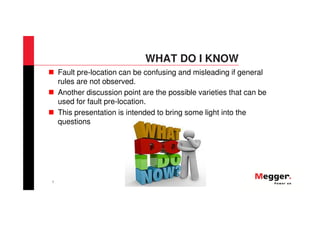
WHAT DO I KNOW
Fault pre-location can be confusing and misleading if general
rules are not observed.
Another discussion point are the possible varieties that can be
used for fault pre-location.
This presentation is intended to bring some light into the
questions
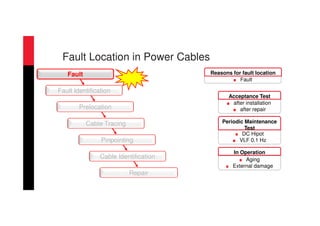
Fault
DC Hipot
VLF 0.1 Hz
Periodic Maintenance
Test
Aging
External damage
In Operation
after installation
after repair
Acceptance Test
Reasons for fault location
Repair
Cable Tracing
Fault Identification
Prelocation
Fault
Cable Identification
Pinpointing
Fault Location in Power Cables
Cable Type
Joints
Termination
Material
Manufacturer
P-P / P-N
Sheath
Insulation
Road work on track
Conduit?
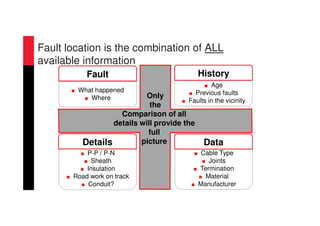
What happened
Where
Fault
DataDetails
Age
Previous faults
Faults in the vicinity
History
Only
the
Comparison of all
details will provide the
full
picture
Fault location is the combination of ALL
available information
Repair
Cable Tracing
Fault Identification
Prelocation
Fault
Cable Identification
Pinpointing
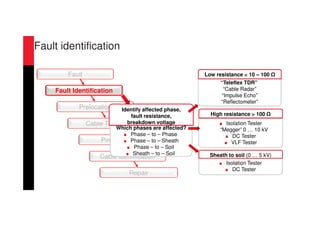
“Teleflex TDR”
“Cable Radar”
“Impulse Echo”
“Reflectometer”
Isolation Tester
“Megger” 0 … 10 kV
DC Tester
VLF Tester
Low resistance < 10 – 100 Ω
High resistance > 100 Ω
Isolation Tester
DC Tester
Sheath to soil (0 … 5 kV)
Which phases are affected?
Phase – to – Phase
Phase – to – Sheath
Phase – to – Soil
Sheath – to – Soil
Identify affected phase,
fault resistance,
breakdown voltage
Fault identification
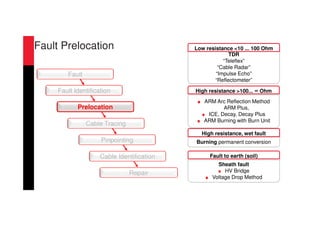
TDR
“Teleflex”
“Cable Radar”
“Impulse Echo”
“Reflectometer”
ARM Arc Reflection Method
ARM Plus,
ICE, Decay, Decay Plus
ARM Burning with Burn Unit
Sheath fault
HV Bridge
Voltage Drop Method
Burning permanent conversion
Low resistance <10 ... 100 Ohm
High resistance >100... ∞ Ohm
High resistance, wet fault
Fault to earth (soil)
Repair
Cable Tracing
Fault Identification
Prelocation
Fault
Cable Identification
Pinpointing
Fault Prelocation
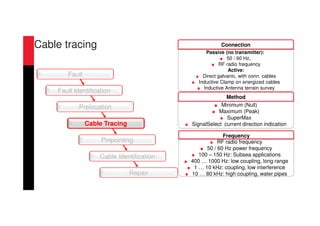
RF radio frequency
50 / 60 Hz power frequency
100 – 150 Hz: Subsea applications
400 … 1000 Hz: low coupling, long range
1 … 10 kHz: coupling, low interference
10 … 80 kHz: high coupling, water pipes
Minimum (Null)
Maximum (Peak)
SuperMax
SignalSelect current direction indication
Method
Frequency
Passive (no transmitter):
50 / 60 Hz,
RF radio frequency
Active:
Direct galvanic, with conn. cables
Inductive Clamp on energized cables
Inductive Antenna terrain survey
Connection
Repair
Cable Tracing
Fault Identification
Prelocation
Fault
Cable Identification
Pinpointing
Cable tracing
Fault Locating in Power Cables
- Pinpointing -
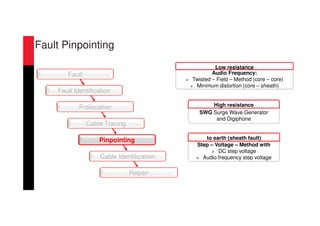
Audio Frequency:
Twisted – Field – Method (core – core)
Minimum distortion (core – sheath)
Low resistance
SWG Surge Wave Generator
and Digiphone
High resistance
Step – Voltage – Method with
DC step voltage
Audio frequency step voltage
to earth (sheath fault)
Repair
Cable Tracing
Fault Identification
Prelocation
Fault
Cable Identification
Pinpointing
Fault Pinpointing
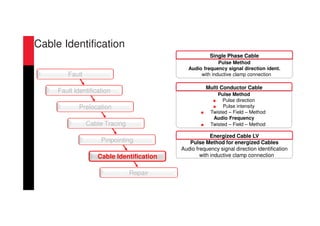
Pulse Method for energized Cables
Audio frequency signal direction identification
with inductive clamp connection
Pulse Method
Pulse direction
Pulse intensity
Twisted – Field – Method
Audio Frequency
Twisted – Field – Method
Multi Conductor Cable
Energized Cable LV
Pulse Method
Audio frequency signal direction ident.
with inductive clamp connection
Single Phase Cable
Repair
Cable Tracing
Fault Identification
Prelocation
Fault
Cable Identification
Pinpointing
Cable Identification
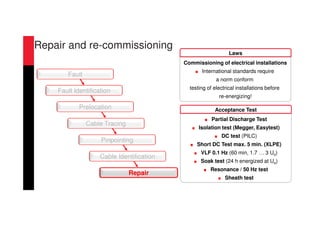
Partial Discharge Test
Isolation test (Megger, Easytest)
DC test (PILC)
Short DC Test max. 5 min. (XLPE)
VLF 0.1 Hz (60 min, 1.7 … 3 Uo)
Soak test (24 h energized at Uo)
Resonance / 50 Hz test
Sheath test
Acceptance Test
Repair
Cable Tracing
Fault Identification
Prelocation
Fault
Cable Identification
Pinpointing
Repair and re-commissioning
Commissioning of electrical installations
International standards require
a norm conform
testing of electrical installations before
re-energizing!
Laws
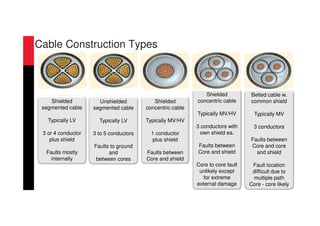
Shielded
segmented cable
Typically LV
3 or 4 conductor
plus shield
Faults mostly
internally
Unshielded
segmented cable
Typically LV
3 to 5 conductors
Faults to ground
and
between cores
Shielded
concentric cable
Typically MV/HV
1 conductor
plus shield
Faults between
Core and shield
Shielded
concentric cable
Typically MV/HV
3 conductors with
own shield ea.
Faults between
Core and shield
Core to core fault
unlikely except
for extreme
external damage
Belted cable w.
common shield
Typically MV
3 conductors
Faults between
Core and core
and shield
Fault location
difficult due to
multiple path
Core - core likely
Cable Construction Types
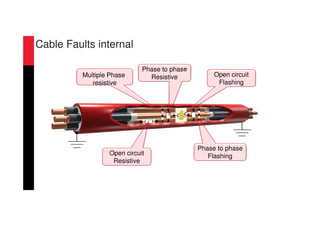
Open circuit
Resistive
Multiple Phase
resistive
Phase to phase
Resistive Open circuit
Flashing
Phase to phase
Flashing
Cable Faults internal
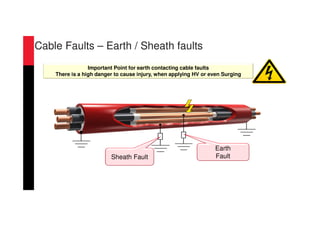
Sheath Fault
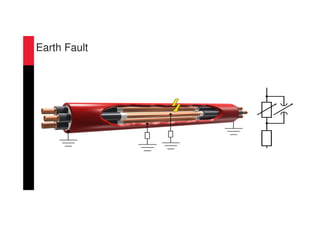
Earth
Fault
Important Point for earth contacting cable faults
There is a high danger to cause injury, when applying HV or even Surging
Cable Faults – Earth / Sheath faults
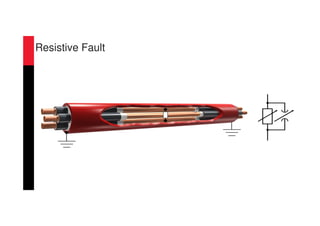
Resistive Fault
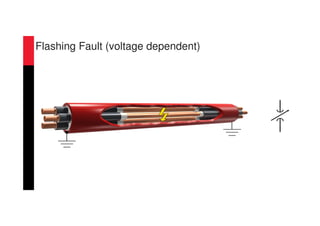
Flashing Fault (voltage dependent)
Earth Fault
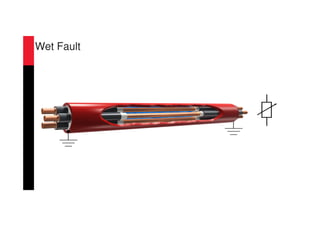
Wet Fault
19
The different (HV) Fault Prelocation technologies
20
Reflection measurement
The most common approach is a reflection measurement
A reflection measurement should be conducted before any other
type of measurement or test, just to obtain the full „picture“.
It will show the cable in its full distance and with many details.
In some cases, if the fault resistance is sufficiently low,
it will also show the fault without further HV support.
All of the “ARM” technologies are combinations wit the common
reflection measurement with High Voltage.
21
Pre – Location Methods
Pre – Location Methods from our
well known CENTRIX Cable Test Van
System
22
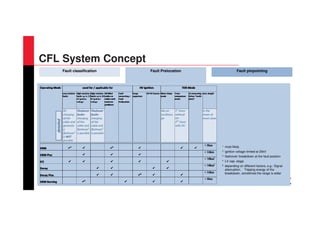
CFL System Concept
Fault classification Fault Prelocation Fault pinpointing
1 most likely
2 ignition voltage limited at 20kV
3 flashover/ breakdown at the fault position
4 LV cap- stage
5 depending on different factors, e.g.: Signal
attenuation, Tripping energy of the
breakdown, sometimes the range is wider
23
Fault classification Fault Prelocation Fault pinpointing
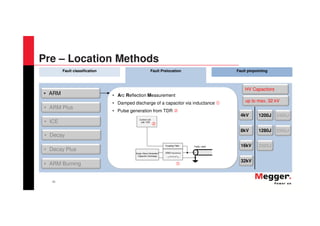
• Arc Reflection Measurement
• Damped discharge of a capacitor via inductance
• Pulse generation from TDR
4kV
8kV
1200J
16kV
32kV
1280J
2000J
2400J
2560J
• ARM
• Decay Plus
• ARM Burning
• ARM Plus
• ICE
• Decay
up to max. 32 kV
HV Capacitors
Pre – Location Methods
24
Fault classification Fault Prelocation Fault pinpointing
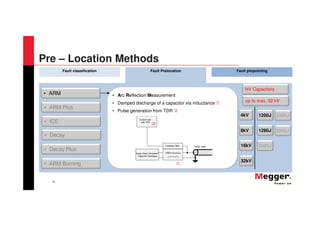
• Arc Reflection Measurement
• Damped discharge of a capacitor via inductance
• Pulse generation from TDR
4kV
8kV
1200J
16kV
32kV
1280J
2000J
2400J
2560J
• ARM
• Decay Plus
• ARM Burning
• ARM Plus
• ICE
• Decay
up to max. 32 kV
HV Capacitors
Pre – Location Methods
25
Pre – Location Methods
Fault classification Fault Prelocation
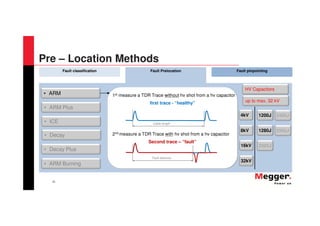
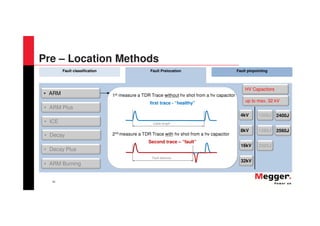
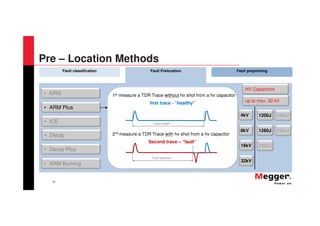
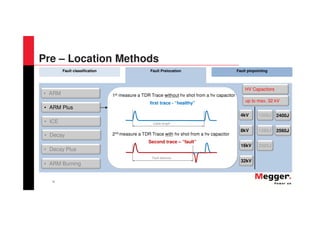
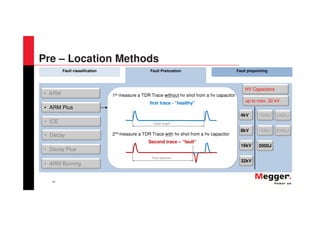
• ARM 1st measure a TDR Trace without hv shot from a hv capacitor
first trace - “healthy”
2nd measure a TDR Trace with hv shot from a hv capacitor
Second trace – “fault”
• Decay Plus
• ARM Burning
4kV
8kV
1200J
16kV
32kV
1280J
2000J
2400J
2560J
Fault distance
Cable length
• ARM Plus
• ICE
• Decay
up to max. 32 kV
HV Capacitors
Fault pinpointing
26
Fault classification Fault Prelocation Fault pinpointing
4kV
8kV
1200J
16kV
32kV
1280J
2000J
2400J
2560J
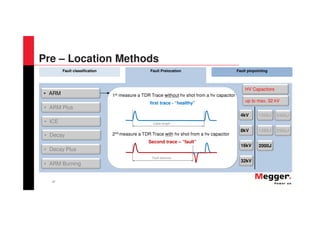
1st measure a TDR Trace without hv shot from a hv capacitor
first trace - “healthy”
2nd measure a TDR Trace with hv shot from a hv capacitor
Second trace – “fault”
Fault distance
Cable length
• ARM
• Decay Plus
• ARM Burning
• ARM Plus
• ICE
• Decay
up to max. 32 kV
HV Capacitors
Pre – Location Methods
27
Fault classification Fault Prelocation Fault pinpointing
4kV
8kV
1200J
16kV
32kV
1280J
2000J
2400J
2560J
1st measure a TDR Trace without hv shot from a hv capacitor
first trace - “healthy”
2nd measure a TDR Trace with hv shot from a hv capacitor
Second trace – “fault”
Fault distance
Cable length
• ARM
• Decay Plus
• ARM Burning
• ARM Plus
• ICE
• Decay
up to max. 32 kV
HV Capacitors
Pre – Location Methods
28
Fault classification Fault Prelocation Fault pinpointing
up to max. 32 kV
4kV
8kV
1200J
16kV
32kV
1280J
2000J
2400J
2560J
• ARM
• Decay Plus
• ARM Burning
• ARM Plus
• ICE
• Decay
HV Capacitors
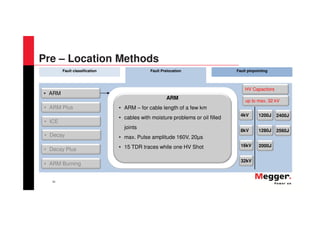
ARM
• ARM – for cable length of a few km
• cables with moisture problems or oil filled
joints
• max. Pulse amplitude 160V, 20µs
• 15 TDR traces while one HV Shot
Pre – Location Methods
29
Fault classification Fault Prelocation Fault pinpointing
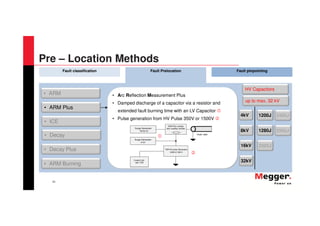
• Arc Reflection Measurement Plus
• Damped discharge of a capacitor via a resistor and
extended fault burning time with an LV Capacitor
• Pulse generation from HV Pulse 350V or 1500V
4kV
8kV
1200J
16kV
32kV
1280J
2000J
2400J
2560J
• ARM
• Decay Plus
• ARM Burning
• ARM Plus
• ICE
• Decay
up to max. 32 kV
HV Capacitors
Pre – Location Methods
30
Fault classification Fault Prelocation Fault pinpointing
1st measure a TDR Trace without hv shot from a hv capacitor
first trace - “healthy”
2nd measure a TDR Trace with hv shot from a hv capacitor
Second trace – “fault”
4kV
8kV
1200J
16kV
32kV
1280J
2000J
2400J
2560J
Fault distance
Cable length
• ARM
• Decay Plus
• ARM Burning
• ARM Plus
• ICE
• Decay
up to max. 32 kV
HV Capacitors
Pre – Location Methods
31
Fault classification Fault Prelocation Fault pinpointing
4kV
8kV
1200J
16kV
32kV
1280J
2000J
2400J
2560J
1st measure a TDR Trace without hv shot from a hv capacitor
first trace - “healthy”
2nd measure a TDR Trace with hv shot from a hv capacitor
Second trace – “fault”
Fault distance
Cable length
• ARM
• Decay Plus
• ARM Burning
• ARM Plus
• ICE
• Decay
up to max. 32 kV
HV Capacitors
Pre – Location Methods
32
Fault classification Fault Prelocation Fault pinpointing
4kV
8kV
1200J
16kV
32kV
1280J
2000J
2400J
2560J
1st measure a TDR Trace without hv shot from a hv capacitor
first trace - “healthy”
2nd measure a TDR Trace with hv shot from a hv capacitor
Second trace – “fault”
Fault distance
Cable length
• ARM
• Decay Plus
• ARM Burning
• ARM Plus
• ICE
• Decay
up to max. 32 kV
HV Capacitors
Pre – Location Methods
33
Fault classification Fault Prelocation Fault pinpointing
4kV
8kV
1200J
16kV
32kV
1280J
2000J
2400J
2560J
• ARM
• Decay Plus
• ARM Burning
• ARM Plus
• ICE
• Decay
up to max. 32 kV
HV Capacitors
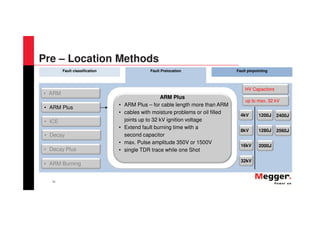
ARM Plus
• ARM Plus – for cable length more than ARM
• cables with moisture problems or oil filled
joints up to 32 kV ignition voltage
• Extend fault burning time with a
second capacitor
• max. Pulse amplitude 350V or 1500V
• single TDR trace while one Shot
Pre – Location Methods
34
Fault classification Fault Prelocation Fault pinpointing
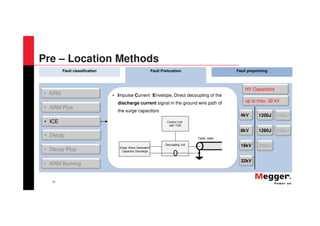
• Impulse Current Envelope, Direct decoupling of the
discharge current signal in the ground wire path of
the surge capacitors
4kV
8kV
1200J
16kV
32kV
1280J
2000J
2400J
2560J
• ARM
• Decay Plus
• ARM Burning
• ARM Plus
• ICE
• Decay
up to max. 32 kV
HV Capacitors
Pre – Location Methods
35
Fault classification Fault Prelocation Fault pinpointing
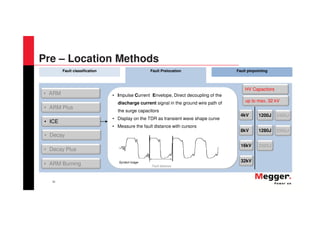
• Impulse Current Envelope, Direct decoupling of the
discharge current signal in the ground wire path of
the surge capacitors
• Display on the TDR as transient wave shape curve
• Measure the fault distance with cursors
4kV
8kV
1200J
16kV
32kV
1280J
2000J
2400J
2560J
• ARM
• Decay Plus
• ARM Burning
• ARM Plus
• ICE
• Decay
Symbol image
Fault distance
up to max. 32 kV
HV Capacitors
Pre – Location Methods
36
Fault classification Fault Prelocation Fault pinpointing
4kV
8kV
1200J
16kV
32kV
1280J
2000J
2400J
2560J
• ARM
• Decay Plus
• ARM Burning
• ARM Plus
• ICE
• Decay
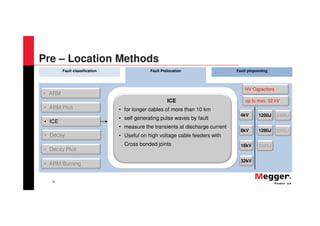
ICE
• for longer cables of more than 10 km
• self generating pulse waves by fault
• measure the transients at discharge current
• Useful on high voltage cable feeders with
Cross bonded joints
up to max. 32 kV
HV Capacitors
Pre – Location Methods
37
Fault classification Fault Prelocation Fault pinpointing
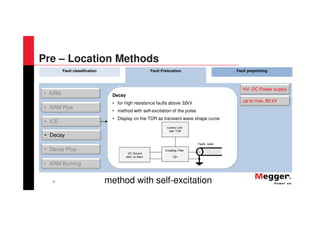
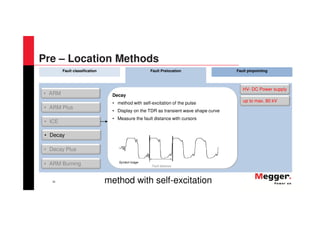
Decay
• for high resistance faults above 32kV
• method with self-excitation of the pulse
• Display on the TDR as transient wave shape curve
• ARM
• Decay Plus
• ARM Burning
• ARM Plus
• ICE
• Decay
method with self-excitation
up to max. 80 kV
HV- DC Power supply
Pre – Location Methods
38
Fault classification Fault Prelocation Fault pinpointing
Decay
• method with self-excitation of the pulse
• Display on the TDR as transient wave shape curve
• Measure the fault distance with cursors
• ARM
• Decay Plus
• ARM Burning
• ARM Plus
• ICE
• Decay
Symbol image
Fault distance
method with self-excitation
up to max. 80 kV
HV- DC Power supply
Pre – Location Methods
39
Fault classification Fault Prelocation Fault pinpointing
• ARM
• Decay Plus
• ARM Burning
• ARM Plus
• ICE
• Decay
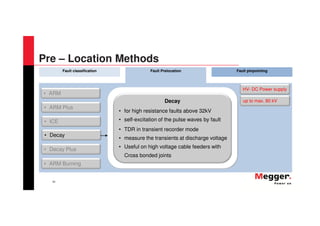
Decay
• for high resistance faults above 32kV
• self-excitation of the pulse waves by fault
• TDR in transient recorder mode
• measure the transients at discharge voltage
• Useful on high voltage cable feeders with
Cross bonded joints
up to max. 80 kV
HV- DC Power supply
Pre – Location Methods
40
Fault classification Fault Prelocation Fault pinpointing
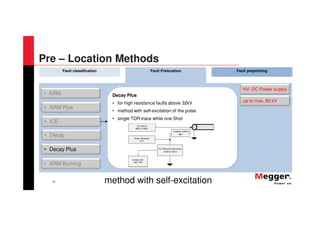
Decay Plus
• for high resistance faults above 32kV
• method with self-excitation of the pulse
• single TDR trace while one Shot
• ARM
• Decay Plus
• ARM Burning
• ARM Plus
• ICE
• Decay
method with self-excitation
up to max. 80 kV
HV- DC Power supply
Pre – Location Methods
41
Fault classification Fault Prelocation Fault pinpointing
• ARM
• Decay Plus
• ARM Burning
• ARM Plus
• ICE
• Decay
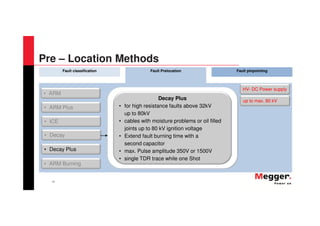
Decay Plus
• for high resistance faults above 32kV
up to 80kV
• cables with moisture problems or oil filled
joints up to 80 kV ignition voltage
• Extend fault burning time with a
second capacitor
• max. Pulse amplitude 350V or 1500V
• single TDR trace while one Shot
up to max. 80 kV
HV- DC Power supply
Pre – Location Methods
42
Fault classification Fault Prelocation Fault pinpointing
• ARM
• Decay Plus
• ARM Burning
• ARM Plus
• ICE
• Decay
up to max. 80 kV
HV- DC Power supply
Pre – Location Methods
43
Fault classification Fault Prelocation Fault pinpointing
• ARM
• Decay Plus
• ARM Burning
• ARM Plus
• ICE
• Decay
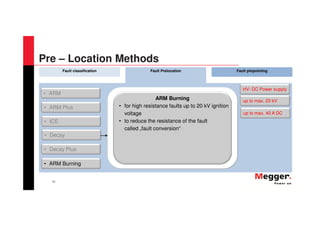
ARM Burning
• for high resistance faults up to 20 kV ignition
voltage
• to reduce the resistance of the fault
called „fault conversion“
up to max. 20 kV
HV- DC Power supply
up to max. 40 A DC
Pre – Location Methods
44
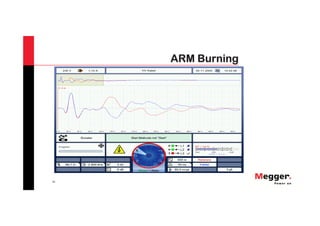
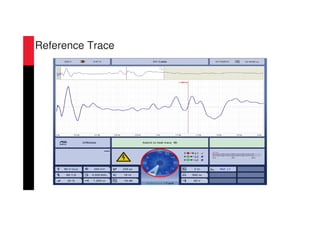
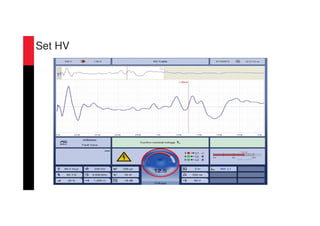
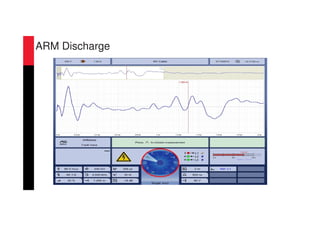
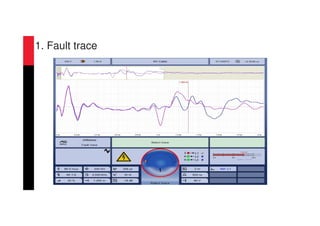
ARM BurningARM BurningARM BurningARM Burning
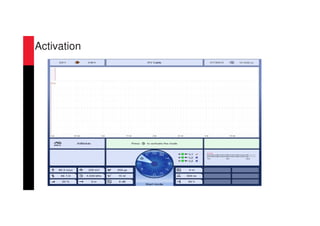
Activation
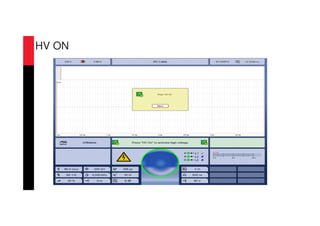
HV ON
Reference Trace
Set HV
ARM Discharge
1. Fault trace
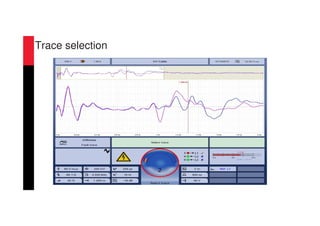
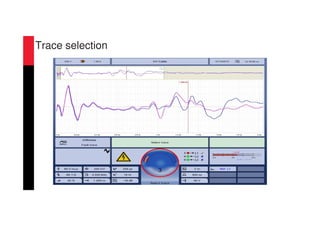
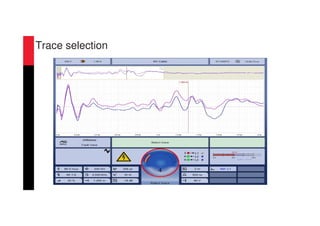
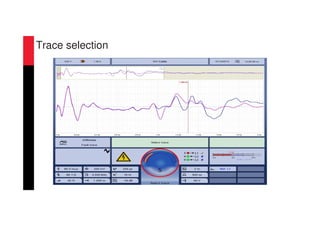
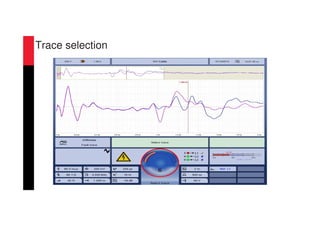
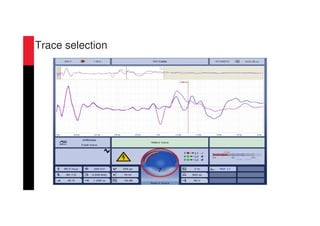
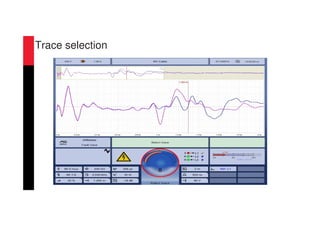
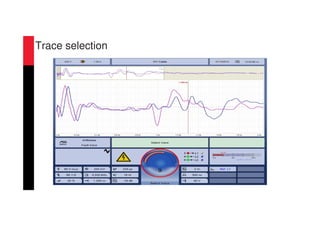
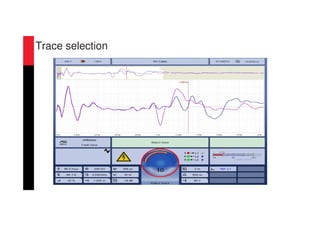
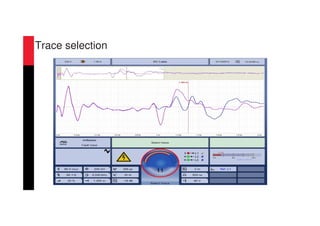
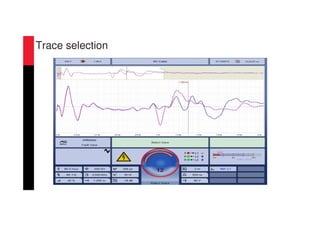
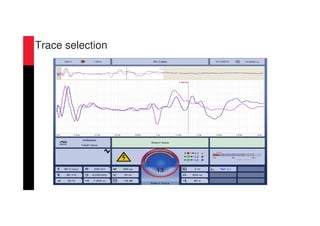
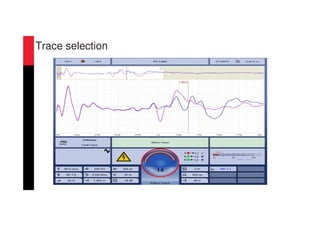
Trace selection
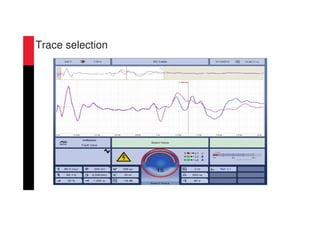
Trace selection
Trace selection
Trace selection
Trace selection
Trace selection
Trace selection
Trace selection
Trace selection
Trace selection
Trace selection
Trace selection
Trace selection
Trace selection
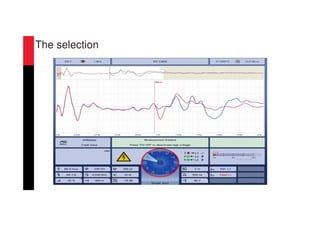
The selection
NorNed
NorNed is a 580-kilometre (360 mi) long HVDC submarine power
cable between Feda in Norway and the seaport of Eemshaven in
the Netherlands, which interconnects the electricity grids of both countries.
With a DC voltage of ±450 kV, the converter for the NorNed project
has a terminal to terminal DC voltage rating of 900 kV, making it also
the highest voltage rating of any HVDC converter in the world.
Installation of the first sections was started in early 2006;
the final section was laid by the end of 2007.
Commercial operation started on the 5th of May 2008 with a capacity auction.
The first commercial power transfer took place on 6th of May 2008.
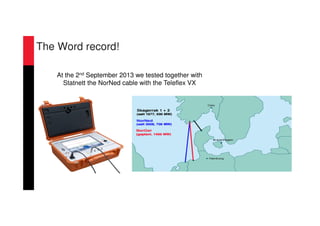
The Word record!
At the 2nd September 2013 we tested together with
Statnett the NorNed cable with the Teleflex VX
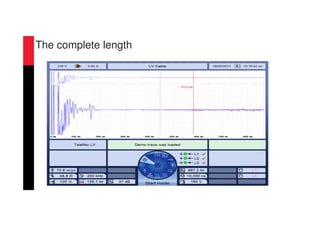
The complete length
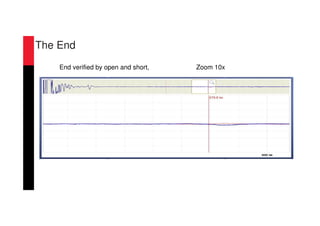
The End
End verified by open and short, Zoom 10x
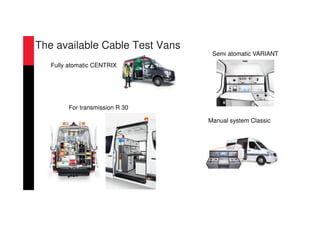
The available Cable Test Vans
Fully atomatic CENTRIX
Semi atomatic VARIANT
For transmission R 30
Manual system Classic
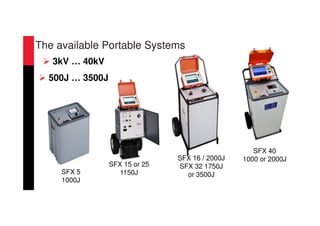
The available Portable Systems
3kV … 40kV
500J … 3500J
SFX 5
1000J
SFX 15 or 25
1150J
SFX 16 / 2000J
SFX 32 1750J
or 3500J
SFX 40
1000 or 2000J
72
Questions?
Power on
At Megger, we understand that keeping the power on is essential for the success
of your business. That is why we are dedicated to creating, designing and
manufacturing safe, reliable, easy-to-use portable test equipment backed by world-
leading support and expertise.
We can assist your acceptance, commissioning and maintenance testing for
predictive, diagnostic or routine purposes. By working closely with electrical
utilities, standards bodies and technical institutions, we contribute to the
dependability and advancement of the electrical supply industry.

Cable fault location methods (Megger)

  • 1.
    1 OVERVIEW CABLE FAULT LOCATIONMETHODS Daniel Salathe
  • 2.
    2 Agenda What do Iknow? Procedure for fault location in Power Cables Cable Construction Different Cable faults Pre – Location Methods Arm Multishot NorNed World Record Megger Products
  • 3.
    3 WHAT DO IKNOW Fault pre-location can be confusing and misleading if general rules are not observed. Another discussion point are the possible varieties that can be used for fault pre-location. This presentation is intended to bring some light into the questions
  • 4.
    Fault DC Hipot VLF 0.1Hz Periodic Maintenance Test Aging External damage In Operation after installation after repair Acceptance Test Reasons for fault location Repair Cable Tracing Fault Identification Prelocation Fault Cable Identification Pinpointing Fault Location in Power Cables
  • 5.
    Cable Type Joints Termination Material Manufacturer P-P /P-N Sheath Insulation Road work on track Conduit? What happened Where Fault DataDetails Age Previous faults Faults in the vicinity History Only the Comparison of all details will provide the full picture Fault location is the combination of ALL available information
  • 6.
    Repair Cable Tracing Fault Identification Prelocation Fault CableIdentification Pinpointing “Teleflex TDR” “Cable Radar” “Impulse Echo” “Reflectometer” Isolation Tester “Megger” 0 … 10 kV DC Tester VLF Tester Low resistance < 10 – 100 Ω High resistance > 100 Ω Isolation Tester DC Tester Sheath to soil (0 … 5 kV) Which phases are affected? Phase – to – Phase Phase – to – Sheath Phase – to – Soil Sheath – to – Soil Identify affected phase, fault resistance, breakdown voltage Fault identification
  • 7.
    TDR “Teleflex” “Cable Radar” “Impulse Echo” “Reflectometer” ARMArc Reflection Method ARM Plus, ICE, Decay, Decay Plus ARM Burning with Burn Unit Sheath fault HV Bridge Voltage Drop Method Burning permanent conversion Low resistance <10 ... 100 Ohm High resistance >100... ∞ Ohm High resistance, wet fault Fault to earth (soil) Repair Cable Tracing Fault Identification Prelocation Fault Cable Identification Pinpointing Fault Prelocation
  • 8.
    RF radio frequency 50/ 60 Hz power frequency 100 – 150 Hz: Subsea applications 400 … 1000 Hz: low coupling, long range 1 … 10 kHz: coupling, low interference 10 … 80 kHz: high coupling, water pipes Minimum (Null) Maximum (Peak) SuperMax SignalSelect current direction indication Method Frequency Passive (no transmitter): 50 / 60 Hz, RF radio frequency Active: Direct galvanic, with conn. cables Inductive Clamp on energized cables Inductive Antenna terrain survey Connection Repair Cable Tracing Fault Identification Prelocation Fault Cable Identification Pinpointing Cable tracing
  • 9.
    Fault Locating inPower Cables - Pinpointing - Audio Frequency: Twisted – Field – Method (core – core) Minimum distortion (core – sheath) Low resistance SWG Surge Wave Generator and Digiphone High resistance Step – Voltage – Method with DC step voltage Audio frequency step voltage to earth (sheath fault) Repair Cable Tracing Fault Identification Prelocation Fault Cable Identification Pinpointing Fault Pinpointing
  • 10.
    Pulse Method forenergized Cables Audio frequency signal direction identification with inductive clamp connection Pulse Method Pulse direction Pulse intensity Twisted – Field – Method Audio Frequency Twisted – Field – Method Multi Conductor Cable Energized Cable LV Pulse Method Audio frequency signal direction ident. with inductive clamp connection Single Phase Cable Repair Cable Tracing Fault Identification Prelocation Fault Cable Identification Pinpointing Cable Identification
  • 11.
    Partial Discharge Test Isolationtest (Megger, Easytest) DC test (PILC) Short DC Test max. 5 min. (XLPE) VLF 0.1 Hz (60 min, 1.7 … 3 Uo) Soak test (24 h energized at Uo) Resonance / 50 Hz test Sheath test Acceptance Test Repair Cable Tracing Fault Identification Prelocation Fault Cable Identification Pinpointing Repair and re-commissioning Commissioning of electrical installations International standards require a norm conform testing of electrical installations before re-energizing! Laws
  • 12.
    Shielded segmented cable Typically LV 3or 4 conductor plus shield Faults mostly internally Unshielded segmented cable Typically LV 3 to 5 conductors Faults to ground and between cores Shielded concentric cable Typically MV/HV 1 conductor plus shield Faults between Core and shield Shielded concentric cable Typically MV/HV 3 conductors with own shield ea. Faults between Core and shield Core to core fault unlikely except for extreme external damage Belted cable w. common shield Typically MV 3 conductors Faults between Core and core and shield Fault location difficult due to multiple path Core - core likely Cable Construction Types
  • 13.
    Open circuit Resistive Multiple Phase resistive Phaseto phase Resistive Open circuit Flashing Phase to phase Flashing Cable Faults internal
  • 14.
    Sheath Fault Earth Fault Important Pointfor earth contacting cable faults There is a high danger to cause injury, when applying HV or even Surging Cable Faults – Earth / Sheath faults
  • 15.
  • 16.
  • 17.
  • 18.
  • 19.
    19 The different (HV)Fault Prelocation technologies
  • 20.
    20 Reflection measurement The mostcommon approach is a reflection measurement A reflection measurement should be conducted before any other type of measurement or test, just to obtain the full „picture“. It will show the cable in its full distance and with many details. In some cases, if the fault resistance is sufficiently low, it will also show the fault without further HV support. All of the “ARM” technologies are combinations wit the common reflection measurement with High Voltage.
  • 21.
    21 Pre – LocationMethods Pre – Location Methods from our well known CENTRIX Cable Test Van System
  • 22.
    22 CFL System Concept Faultclassification Fault Prelocation Fault pinpointing 1 most likely 2 ignition voltage limited at 20kV 3 flashover/ breakdown at the fault position 4 LV cap- stage 5 depending on different factors, e.g.: Signal attenuation, Tripping energy of the breakdown, sometimes the range is wider
  • 23.
    23 Fault classification FaultPrelocation Fault pinpointing • Arc Reflection Measurement • Damped discharge of a capacitor via inductance • Pulse generation from TDR 4kV 8kV 1200J 16kV 32kV 1280J 2000J 2400J 2560J • ARM • Decay Plus • ARM Burning • ARM Plus • ICE • Decay up to max. 32 kV HV Capacitors Pre – Location Methods
  • 24.
    24 Fault classification FaultPrelocation Fault pinpointing • Arc Reflection Measurement • Damped discharge of a capacitor via inductance • Pulse generation from TDR 4kV 8kV 1200J 16kV 32kV 1280J 2000J 2400J 2560J • ARM • Decay Plus • ARM Burning • ARM Plus • ICE • Decay up to max. 32 kV HV Capacitors Pre – Location Methods
  • 25.
    25 Pre – LocationMethods Fault classification Fault Prelocation • ARM 1st measure a TDR Trace without hv shot from a hv capacitor first trace - “healthy” 2nd measure a TDR Trace with hv shot from a hv capacitor Second trace – “fault” • Decay Plus • ARM Burning 4kV 8kV 1200J 16kV 32kV 1280J 2000J 2400J 2560J Fault distance Cable length • ARM Plus • ICE • Decay up to max. 32 kV HV Capacitors Fault pinpointing
  • 26.
    26 Fault classification FaultPrelocation Fault pinpointing 4kV 8kV 1200J 16kV 32kV 1280J 2000J 2400J 2560J 1st measure a TDR Trace without hv shot from a hv capacitor first trace - “healthy” 2nd measure a TDR Trace with hv shot from a hv capacitor Second trace – “fault” Fault distance Cable length • ARM • Decay Plus • ARM Burning • ARM Plus • ICE • Decay up to max. 32 kV HV Capacitors Pre – Location Methods
  • 27.
    27 Fault classification FaultPrelocation Fault pinpointing 4kV 8kV 1200J 16kV 32kV 1280J 2000J 2400J 2560J 1st measure a TDR Trace without hv shot from a hv capacitor first trace - “healthy” 2nd measure a TDR Trace with hv shot from a hv capacitor Second trace – “fault” Fault distance Cable length • ARM • Decay Plus • ARM Burning • ARM Plus • ICE • Decay up to max. 32 kV HV Capacitors Pre – Location Methods
  • 28.
    28 Fault classification FaultPrelocation Fault pinpointing up to max. 32 kV 4kV 8kV 1200J 16kV 32kV 1280J 2000J 2400J 2560J • ARM • Decay Plus • ARM Burning • ARM Plus • ICE • Decay HV Capacitors ARM • ARM – for cable length of a few km • cables with moisture problems or oil filled joints • max. Pulse amplitude 160V, 20µs • 15 TDR traces while one HV Shot Pre – Location Methods
  • 29.
    29 Fault classification FaultPrelocation Fault pinpointing • Arc Reflection Measurement Plus • Damped discharge of a capacitor via a resistor and extended fault burning time with an LV Capacitor • Pulse generation from HV Pulse 350V or 1500V 4kV 8kV 1200J 16kV 32kV 1280J 2000J 2400J 2560J • ARM • Decay Plus • ARM Burning • ARM Plus • ICE • Decay up to max. 32 kV HV Capacitors Pre – Location Methods
  • 30.
    30 Fault classification FaultPrelocation Fault pinpointing 1st measure a TDR Trace without hv shot from a hv capacitor first trace - “healthy” 2nd measure a TDR Trace with hv shot from a hv capacitor Second trace – “fault” 4kV 8kV 1200J 16kV 32kV 1280J 2000J 2400J 2560J Fault distance Cable length • ARM • Decay Plus • ARM Burning • ARM Plus • ICE • Decay up to max. 32 kV HV Capacitors Pre – Location Methods
  • 31.
    31 Fault classification FaultPrelocation Fault pinpointing 4kV 8kV 1200J 16kV 32kV 1280J 2000J 2400J 2560J 1st measure a TDR Trace without hv shot from a hv capacitor first trace - “healthy” 2nd measure a TDR Trace with hv shot from a hv capacitor Second trace – “fault” Fault distance Cable length • ARM • Decay Plus • ARM Burning • ARM Plus • ICE • Decay up to max. 32 kV HV Capacitors Pre – Location Methods
  • 32.
    32 Fault classification FaultPrelocation Fault pinpointing 4kV 8kV 1200J 16kV 32kV 1280J 2000J 2400J 2560J 1st measure a TDR Trace without hv shot from a hv capacitor first trace - “healthy” 2nd measure a TDR Trace with hv shot from a hv capacitor Second trace – “fault” Fault distance Cable length • ARM • Decay Plus • ARM Burning • ARM Plus • ICE • Decay up to max. 32 kV HV Capacitors Pre – Location Methods
  • 33.
    33 Fault classification FaultPrelocation Fault pinpointing 4kV 8kV 1200J 16kV 32kV 1280J 2000J 2400J 2560J • ARM • Decay Plus • ARM Burning • ARM Plus • ICE • Decay up to max. 32 kV HV Capacitors ARM Plus • ARM Plus – for cable length more than ARM • cables with moisture problems or oil filled joints up to 32 kV ignition voltage • Extend fault burning time with a second capacitor • max. Pulse amplitude 350V or 1500V • single TDR trace while one Shot Pre – Location Methods
  • 34.
    34 Fault classification FaultPrelocation Fault pinpointing • Impulse Current Envelope, Direct decoupling of the discharge current signal in the ground wire path of the surge capacitors 4kV 8kV 1200J 16kV 32kV 1280J 2000J 2400J 2560J • ARM • Decay Plus • ARM Burning • ARM Plus • ICE • Decay up to max. 32 kV HV Capacitors Pre – Location Methods
  • 35.
    35 Fault classification FaultPrelocation Fault pinpointing • Impulse Current Envelope, Direct decoupling of the discharge current signal in the ground wire path of the surge capacitors • Display on the TDR as transient wave shape curve • Measure the fault distance with cursors 4kV 8kV 1200J 16kV 32kV 1280J 2000J 2400J 2560J • ARM • Decay Plus • ARM Burning • ARM Plus • ICE • Decay Symbol image Fault distance up to max. 32 kV HV Capacitors Pre – Location Methods
  • 36.
    36 Fault classification FaultPrelocation Fault pinpointing 4kV 8kV 1200J 16kV 32kV 1280J 2000J 2400J 2560J • ARM • Decay Plus • ARM Burning • ARM Plus • ICE • Decay ICE • for longer cables of more than 10 km • self generating pulse waves by fault • measure the transients at discharge current • Useful on high voltage cable feeders with Cross bonded joints up to max. 32 kV HV Capacitors Pre – Location Methods
  • 37.
    37 Fault classification FaultPrelocation Fault pinpointing Decay • for high resistance faults above 32kV • method with self-excitation of the pulse • Display on the TDR as transient wave shape curve • ARM • Decay Plus • ARM Burning • ARM Plus • ICE • Decay method with self-excitation up to max. 80 kV HV- DC Power supply Pre – Location Methods
  • 38.
    38 Fault classification FaultPrelocation Fault pinpointing Decay • method with self-excitation of the pulse • Display on the TDR as transient wave shape curve • Measure the fault distance with cursors • ARM • Decay Plus • ARM Burning • ARM Plus • ICE • Decay Symbol image Fault distance method with self-excitation up to max. 80 kV HV- DC Power supply Pre – Location Methods
  • 39.
    39 Fault classification FaultPrelocation Fault pinpointing • ARM • Decay Plus • ARM Burning • ARM Plus • ICE • Decay Decay • for high resistance faults above 32kV • self-excitation of the pulse waves by fault • TDR in transient recorder mode • measure the transients at discharge voltage • Useful on high voltage cable feeders with Cross bonded joints up to max. 80 kV HV- DC Power supply Pre – Location Methods
  • 40.
    40 Fault classification FaultPrelocation Fault pinpointing Decay Plus • for high resistance faults above 32kV • method with self-excitation of the pulse • single TDR trace while one Shot • ARM • Decay Plus • ARM Burning • ARM Plus • ICE • Decay method with self-excitation up to max. 80 kV HV- DC Power supply Pre – Location Methods
  • 41.
    41 Fault classification FaultPrelocation Fault pinpointing • ARM • Decay Plus • ARM Burning • ARM Plus • ICE • Decay Decay Plus • for high resistance faults above 32kV up to 80kV • cables with moisture problems or oil filled joints up to 80 kV ignition voltage • Extend fault burning time with a second capacitor • max. Pulse amplitude 350V or 1500V • single TDR trace while one Shot up to max. 80 kV HV- DC Power supply Pre – Location Methods
  • 42.
    42 Fault classification FaultPrelocation Fault pinpointing • ARM • Decay Plus • ARM Burning • ARM Plus • ICE • Decay up to max. 80 kV HV- DC Power supply Pre – Location Methods
  • 43.
    43 Fault classification FaultPrelocation Fault pinpointing • ARM • Decay Plus • ARM Burning • ARM Plus • ICE • Decay ARM Burning • for high resistance faults up to 20 kV ignition voltage • to reduce the resistance of the fault called „fault conversion“ up to max. 20 kV HV- DC Power supply up to max. 40 A DC Pre – Location Methods
  • 44.
    44 ARM BurningARM BurningARMBurningARM Burning
  • 45.
  • 46.
  • 47.
  • 48.
  • 49.
  • 50.
  • 51.
  • 52.
  • 53.
  • 54.
  • 55.
  • 56.
  • 57.
  • 58.
  • 59.
  • 60.
  • 61.
  • 62.
  • 63.
  • 64.
  • 65.
  • 66.
    NorNed NorNed is a580-kilometre (360 mi) long HVDC submarine power cable between Feda in Norway and the seaport of Eemshaven in the Netherlands, which interconnects the electricity grids of both countries. With a DC voltage of ±450 kV, the converter for the NorNed project has a terminal to terminal DC voltage rating of 900 kV, making it also the highest voltage rating of any HVDC converter in the world. Installation of the first sections was started in early 2006; the final section was laid by the end of 2007. Commercial operation started on the 5th of May 2008 with a capacity auction. The first commercial power transfer took place on 6th of May 2008.
  • 67.
    The Word record! Atthe 2nd September 2013 we tested together with Statnett the NorNed cable with the Teleflex VX
  • 68.
  • 69.
    The End End verifiedby open and short, Zoom 10x
  • 70.
    The available CableTest Vans Fully atomatic CENTRIX Semi atomatic VARIANT For transmission R 30 Manual system Classic
  • 71.
    The available PortableSystems 3kV … 40kV 500J … 3500J SFX 5 1000J SFX 15 or 25 1150J SFX 16 / 2000J SFX 32 1750J or 3500J SFX 40 1000 or 2000J
  • 72.
    72 Questions? Power on At Megger,we understand that keeping the power on is essential for the success of your business. That is why we are dedicated to creating, designing and manufacturing safe, reliable, easy-to-use portable test equipment backed by world- leading support and expertise. We can assist your acceptance, commissioning and maintenance testing for predictive, diagnostic or routine purposes. By working closely with electrical utilities, standards bodies and technical institutions, we contribute to the dependability and advancement of the electrical supply industry.