FAULTS IN A OIL IMPREGNATED
PAPER CABLES AND EXTRUDED
CABLES
 Introduction
 General Constructions of Cable.
 Classification of Cables
 Properties of Insulating Material
 Types of materials used in insulation
 Types of cable faults
 Oil impregnated paper insulated cables
 Extruded (XLPE)cables
 Faults in OIPC and XLPE
 Conclusion
 References
 A power cable is an assembly of two or
more electrical conductors, usually held together with
an overall sheath. The assembly is used for
transmission of electrical power. Power cables may be
installed as permanent wiring within buildings, buried
in the ground, run overhead, or exposed.
 Flexible power cables are used for portable devices,
mobile tools and machinery.
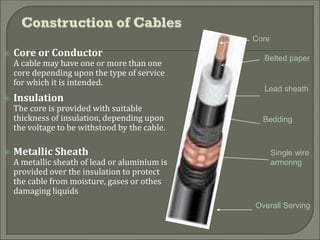
 Core or Conductor
A cable may have one or more than one
core depending upon the type of service
for which it is intended.
 Insulation
The core is provided with suitable
thickness of insulation, depending upon
the voltage to be withstood by the cable.
 Metallic Sheath
A metallic sheath of lead or aluminium is
provided over the insulation to protect
the cable from moisture, gases or othes
damaging liquids
Core
Belted paper
Lead sheath
Bedding
Single wire
armoring
Overall Serving
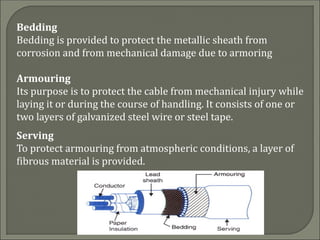
Bedding
Bedding is provided to protect the metallic sheath from
corrosion and from mechanical damage due to armoring
Armouring
Its purpose is to protect the cable from mechanical injury while
laying it or during the course of handling. It consists of one or
two layers of galvanized steel wire or steel tape.
Serving
To protect armouring from atmospheric conditions, a layer of
fibrous material is provided.
Properties of Insulating Material
The insulating materials used in cables should have the
following properties
 High resistivity.
 High dielectric strength.
 Low thermal co-efficient.
 Low water absorption.
 Low permittivity.
 Non – inflammable.
 Chemical stability.
 High mechanical strength.
 High viscosity at impregnation temperature.
 Capability to with stand high rupturing voltage.
 High tensile strength and plasticity.
TYPES OF MATERIALS USED IN INSULATION
 Vulcanized India rubber
 Impregnated paper
 Silk and cotton
 rubber
 Enamel insulation
 Varnished cambric
 Polyvinyl chloride
1. Low tension cable
2. Belted cable
3. Screened or H type cable
4. SL type cable (separate lead sheath cable)
5. HSL type cable (H+SL)
6.Super tension cable
(a) Oil field cable
(b) Gas pressure cable
1. Paper insulated Cable (PIC)
2. PVC Cable (Polyvinyl Chloride)
3. Oil filled paper insulated Cable
4. High Pressure oil filled Cable
5. Compressed gas insulated cable
6. Vulcanized rubber Cable
7. XLPE insulated Cable (Cross linked polyethylene
insulated)
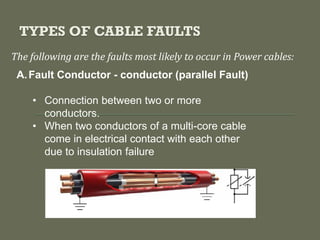
The following are the faults most likely to occur in Power cables:
A.Fault Conductor - conductor (parallel Fault)
• Connection between two or more
conductors.
• When two conductors of a multi-core cable
come in electrical contact with each other
due to insulation failure
TYPES OF CABLE FAULTS
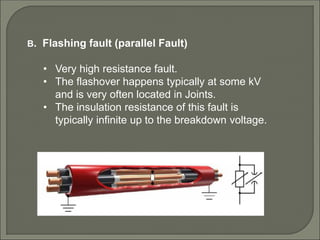
B. Flashing fault (parallel Fault)
• Very high resistance fault.
• The flashover happens typically at some kV
and is very often located in Joints.
• The insulation resistance of this fault is
typically infinite up to the breakdown voltage.
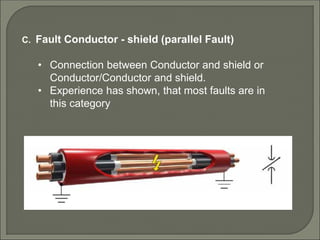
C. Fault Conductor - shield (parallel Fault)
• Connection between Conductor and shield or
Conductor/Conductor and shield.
• Experience has shown, that most faults are in
this category
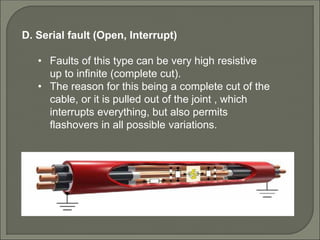
D. Serial fault (Open, Interrupt)
• Faults of this type can be very high resistive
up to infinite (complete cut).
• The reason for this being a complete cut of the
cable, or it is pulled out of the joint , which
interrupts everything, but also permits
flashovers in all possible variations.
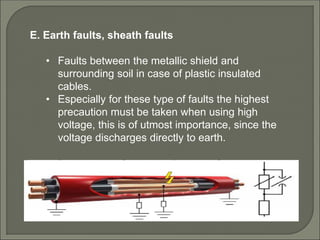
E. Earth faults, sheath faults
• Faults between the metallic shield and
surrounding soil in case of plastic insulated
cables.
• Especially for these type of faults the highest
precaution must be taken when using high
voltage, this is of utmost importance, since the
voltage discharges directly to earth.
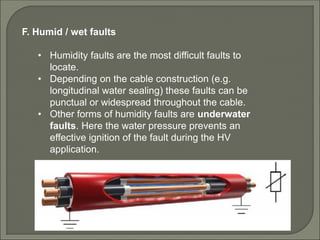
F. Humid / wet faults
• Humidity faults are the most difficult faults to
locate.
• Depending on the cable construction (e.g.
longitudinal water sealing) these faults can be
punctual or widespread throughout the cable.
• Other forms of humidity faults are underwater
faults. Here the water pressure prevents an
effective ignition of the fault during the HV
application.
 Paper or paper propylene
laminated (PPL) insulated with
individual metal sheaths and
impregnated with low pressure oil
 It is estimated that about 83% of HV
cables in existing systems are paper
insulated [1].
 At higher voltages they present
operational problems due to high
dielectric losses and presence of
voids.
• withstand an electric stress about 5 to 10 times higher than dry
paper insulation.
• Greater working temperature
• no voids present as the oil is present between the layers of the
paper which forms the insulation.
• Smaller size of cables due to reduced dielectric thickness
• At higher voltages they present operational problems due to high
dielectric losses
• Risk of oil leakage or fire
• Presence of void
Disadvantages:
 Paper insulation is still common, especially for land UG cables.
However, there is an increasing application of polymer cables
(XLPE),especially for in DC and submarine installations.
 In polymer insulation the insulating XLPE compounds must act as
thermoplastic materials, be immune to thermal degradation and
must not be prone to defects such as voids ,contaminants [1].
 XLPE cables constitute about 2 - 5% of installed HV cable
capacity in the 115-161 kV range, and make up about 50 -
70% of new cable installations in the HV range(220KV and
more) [1].
• No risk of oil release
• Excellent reliability performance
• Reduced operating costs
• lower capacitance of the XLPE cables offers numerous technical
and economical benefits
• insulation failures are much more difficult to monitor and detect.
• The diameter of the XLPE cables increase with voltage
Disadvantages:
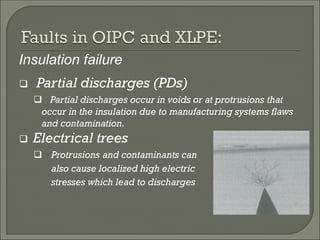
 Partial discharges (PDs)
 Partial discharges occur in voids or at protrusions that
occur in the insulation due to manufacturing systems flaws
and contamination.
 Electrical trees
 Protrusions and contaminants can
also cause localized high electric
stresses which lead to discharges
Insulation failure
 Influence of moisture
 Increased dielectric losses, increased conductivity and
lowered breakdown strength are instant consequences of
moisture in the cable.
moisture causes faster decomposition of cellulose .
 Influence of temperature
Rise in temperature also increases the dielectric loses
and deformation of the cable itself
Increased temperature also has negative impacts as
the lead or aluminum sheath can be stretched
permanently by the pressure of the expanding oil
 Thermoelectric ageing
Environmental considerations are forcing more high power cable
transmissions.
both high operating temperatures and electric stresses have an
impact on the life time of the cable
 Design considerations
The factors(e.g.operating temp., insulation parameter, length of
operation) need to be taken into account at the design stage.
Test data show that electric stress has a big influence on the
ageing rate
 As per the requirement, the cables need to be chosen
for suitable application and optimum parameters are
kept for its type and size.
 Modern underground power cables are sophisticated
assemblies of insulators, conductors and protective
materials.Within these components are sensors, which
enable cable operators to monitor conditions along
the cable in real time.
 The condition of the cable insulation is usually
monitored through the following two main methods:
a) Loss tangent measurements
b) Partial discharge (PD) measurements
1. A Haddad and D Warne (Editors), Advances in High
Voltage Engineering, IEE Power Energy Series 40, IEE
Publishers, London ISBN 0852961588, Chapter 10,
2000.
2. High voltage cable insulation systems by Prof. Nelson
Ljumba, University of KZN
3. Ch-5, pg 134 “High Voltage Engineering” - J R Lucas,
2001
4. Online Incipient Detection and Localization for Low
Voltage Faults in Oil Impregnated Paper Cables door:
N .G . van Luijk EPS .oZ.A.i65 July 2002
5. Ch-7, Pg 123 “Electrical power system”- Ashfaq
Husain , 5th Edition, 2010
Power cables

Power cables

  • 1.
    FAULTS IN AOIL IMPREGNATED PAPER CABLES AND EXTRUDED CABLES
  • 2.
     Introduction  GeneralConstructions of Cable.  Classification of Cables  Properties of Insulating Material  Types of materials used in insulation  Types of cable faults  Oil impregnated paper insulated cables  Extruded (XLPE)cables  Faults in OIPC and XLPE  Conclusion  References
  • 3.
     A powercable is an assembly of two or more electrical conductors, usually held together with an overall sheath. The assembly is used for transmission of electrical power. Power cables may be installed as permanent wiring within buildings, buried in the ground, run overhead, or exposed.  Flexible power cables are used for portable devices, mobile tools and machinery.
  • 4.
     Core orConductor A cable may have one or more than one core depending upon the type of service for which it is intended.  Insulation The core is provided with suitable thickness of insulation, depending upon the voltage to be withstood by the cable.  Metallic Sheath A metallic sheath of lead or aluminium is provided over the insulation to protect the cable from moisture, gases or othes damaging liquids Core Belted paper Lead sheath Bedding Single wire armoring Overall Serving
  • 5.
    Bedding Bedding is providedto protect the metallic sheath from corrosion and from mechanical damage due to armoring Armouring Its purpose is to protect the cable from mechanical injury while laying it or during the course of handling. It consists of one or two layers of galvanized steel wire or steel tape. Serving To protect armouring from atmospheric conditions, a layer of fibrous material is provided.
  • 6.
    Properties of InsulatingMaterial The insulating materials used in cables should have the following properties  High resistivity.  High dielectric strength.  Low thermal co-efficient.  Low water absorption.  Low permittivity.  Non – inflammable.  Chemical stability.  High mechanical strength.  High viscosity at impregnation temperature.  Capability to with stand high rupturing voltage.  High tensile strength and plasticity.
  • 7.
    TYPES OF MATERIALSUSED IN INSULATION  Vulcanized India rubber  Impregnated paper  Silk and cotton  rubber  Enamel insulation  Varnished cambric  Polyvinyl chloride
  • 8.
    1. Low tensioncable 2. Belted cable 3. Screened or H type cable 4. SL type cable (separate lead sheath cable) 5. HSL type cable (H+SL) 6.Super tension cable (a) Oil field cable (b) Gas pressure cable
  • 9.
    1. Paper insulatedCable (PIC) 2. PVC Cable (Polyvinyl Chloride) 3. Oil filled paper insulated Cable 4. High Pressure oil filled Cable 5. Compressed gas insulated cable 6. Vulcanized rubber Cable 7. XLPE insulated Cable (Cross linked polyethylene insulated)
  • 10.
    The following arethe faults most likely to occur in Power cables: A.Fault Conductor - conductor (parallel Fault) • Connection between two or more conductors. • When two conductors of a multi-core cable come in electrical contact with each other due to insulation failure TYPES OF CABLE FAULTS
  • 11.
    B. Flashing fault(parallel Fault) • Very high resistance fault. • The flashover happens typically at some kV and is very often located in Joints. • The insulation resistance of this fault is typically infinite up to the breakdown voltage.
  • 12.
    C. Fault Conductor- shield (parallel Fault) • Connection between Conductor and shield or Conductor/Conductor and shield. • Experience has shown, that most faults are in this category
  • 13.
    D. Serial fault(Open, Interrupt) • Faults of this type can be very high resistive up to infinite (complete cut). • The reason for this being a complete cut of the cable, or it is pulled out of the joint , which interrupts everything, but also permits flashovers in all possible variations.
  • 14.
    E. Earth faults,sheath faults • Faults between the metallic shield and surrounding soil in case of plastic insulated cables. • Especially for these type of faults the highest precaution must be taken when using high voltage, this is of utmost importance, since the voltage discharges directly to earth.
  • 15.
    F. Humid /wet faults • Humidity faults are the most difficult faults to locate. • Depending on the cable construction (e.g. longitudinal water sealing) these faults can be punctual or widespread throughout the cable. • Other forms of humidity faults are underwater faults. Here the water pressure prevents an effective ignition of the fault during the HV application.
  • 16.
     Paper orpaper propylene laminated (PPL) insulated with individual metal sheaths and impregnated with low pressure oil  It is estimated that about 83% of HV cables in existing systems are paper insulated [1].  At higher voltages they present operational problems due to high dielectric losses and presence of voids.
  • 17.
    • withstand anelectric stress about 5 to 10 times higher than dry paper insulation. • Greater working temperature • no voids present as the oil is present between the layers of the paper which forms the insulation. • Smaller size of cables due to reduced dielectric thickness • At higher voltages they present operational problems due to high dielectric losses • Risk of oil leakage or fire • Presence of void Disadvantages:
  • 18.
     Paper insulationis still common, especially for land UG cables. However, there is an increasing application of polymer cables (XLPE),especially for in DC and submarine installations.  In polymer insulation the insulating XLPE compounds must act as thermoplastic materials, be immune to thermal degradation and must not be prone to defects such as voids ,contaminants [1].
  • 19.
     XLPE cablesconstitute about 2 - 5% of installed HV cable capacity in the 115-161 kV range, and make up about 50 - 70% of new cable installations in the HV range(220KV and more) [1].
  • 20.
    • No riskof oil release • Excellent reliability performance • Reduced operating costs • lower capacitance of the XLPE cables offers numerous technical and economical benefits • insulation failures are much more difficult to monitor and detect. • The diameter of the XLPE cables increase with voltage Disadvantages:
  • 21.
     Partial discharges(PDs)  Partial discharges occur in voids or at protrusions that occur in the insulation due to manufacturing systems flaws and contamination.  Electrical trees  Protrusions and contaminants can also cause localized high electric stresses which lead to discharges Insulation failure
  • 22.
     Influence ofmoisture  Increased dielectric losses, increased conductivity and lowered breakdown strength are instant consequences of moisture in the cable. moisture causes faster decomposition of cellulose .  Influence of temperature Rise in temperature also increases the dielectric loses and deformation of the cable itself Increased temperature also has negative impacts as the lead or aluminum sheath can be stretched permanently by the pressure of the expanding oil
  • 23.
     Thermoelectric ageing Environmentalconsiderations are forcing more high power cable transmissions. both high operating temperatures and electric stresses have an impact on the life time of the cable  Design considerations The factors(e.g.operating temp., insulation parameter, length of operation) need to be taken into account at the design stage. Test data show that electric stress has a big influence on the ageing rate
  • 24.
     As perthe requirement, the cables need to be chosen for suitable application and optimum parameters are kept for its type and size.  Modern underground power cables are sophisticated assemblies of insulators, conductors and protective materials.Within these components are sensors, which enable cable operators to monitor conditions along the cable in real time.  The condition of the cable insulation is usually monitored through the following two main methods: a) Loss tangent measurements b) Partial discharge (PD) measurements
  • 25.
    1. A Haddadand D Warne (Editors), Advances in High Voltage Engineering, IEE Power Energy Series 40, IEE Publishers, London ISBN 0852961588, Chapter 10, 2000. 2. High voltage cable insulation systems by Prof. Nelson Ljumba, University of KZN 3. Ch-5, pg 134 “High Voltage Engineering” - J R Lucas, 2001 4. Online Incipient Detection and Localization for Low Voltage Faults in Oil Impregnated Paper Cables door: N .G . van Luijk EPS .oZ.A.i65 July 2002 5. Ch-7, Pg 123 “Electrical power system”- Ashfaq Husain , 5th Edition, 2010