08/30/24 1
Michael T. Peschel
High Voltage, Inc.
Copake, NY. USA
www.hvinc.com
VLF CABLE TESTING
INCLUDING PARTIAL DISCHARGE
& TANGENT DELTA
08/30/24 2
SUBJECTS COVERED
Review of DC Issues
What Is VLF
VLF Applications
IEEE Standards
Lab and Field Results
How To Perform The Test
Myths about VLF
Who Uses VLF
Selecting a VLF Model
Selecting A Cable Test Method
VLF Conclusion
Tan Delta Testing
VLF Partial Discharge Testing
08/30/24 3
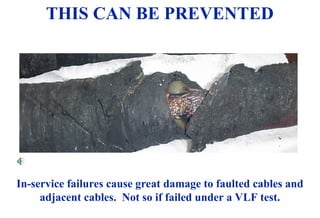
THIS CAN BE PREVENTED
In-service failures cause great damage to faulted cables and
adjacent cables. Not so if failed under a VLF test.
08/30/24 4
WHY WAS DC USED
DC hipots are small, portable, and economical.
DC originally used with PILC cable and worked well.
Same techniques used when HMW, XLPE, EPR, and other
solid dielectric cables were installed.
Years later DC was found to harm insulation and leakage
current measurements are often ineffective for exposing
defects. VLF work started.
Until recently, AC field testing of cable was not practical. Now
it is practical and economical.
08/30/24 5
Worldwide consensus exists among engineering
organizations, utilities, and cable manufacturers that
typical DC test voltages of 4 – 5 Vo (4 – 5x line-to-
ground operating voltage) damage insulation, lead to
failures, and leakage currents are often not indicative of
insulation integrity. Using lower voltages renders test
meaningless.
DC USE DISCOURAGED
08/30/24 6
Avoid DC Voltage On Service Aged,
Solid Dielectric Insulation
DC Voltage Polarizes Cable.
Water trees trap space charges – leads to failures.
08/30/24 7

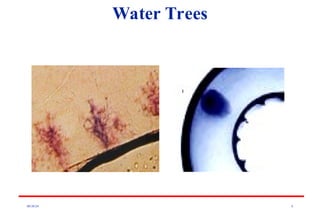
Tree shaped channels are found within the
insulation of operating cables resulting from the
presence of moisture and electrical fields.

Prevalent in solid dielectric cables.

Eventually leads to the inception of PD.

Leads to insulation failure.
WHY IS DC HARMFUL?
WATER TREES
08/30/24 8
Water Trees
08/30/24 9
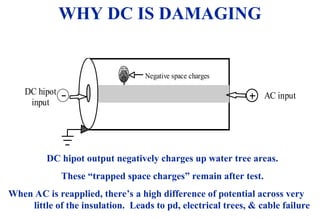
WHY DC IS DAMAGING
DC hipot
input
Negative space charges
AC input
DC hipot output negatively charges up water tree areas.
These “trapped space charges” remain after test.
When AC is reapplied, there’s a high difference of potential across very
little of the insulation. Leads to pd, electrical trees, & cable failure
08/30/24 10
UTILITIES RESPONSE TO DC CONCERNS
 Typical DC test voltages were/are 4 - 5 times V0.

At these high voltages, damage is done.

Some reduce voltage to 15 kVDC on 15 kV cable.

15 kV is only 30% above the peak AC stress in service.
At this voltage, leakage currents are meaningless.

Some do nothing, letting cables fail and then repair.

Many have adopted VLF AC hipoting to expose bad insulation
and accessories. VLF is the best splice checker.
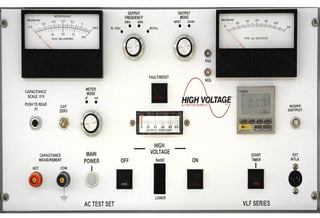
08/30/24 11
Advantages
• Light Weight.
• Low Cost.
• Simple to Use.
• Results are certain
Disadvantages
• Voltage Waveform in Some Designs – Can’t Use For TD & PD
• Cable May Fail Under Test.
• Perhaps Multiple Failures In Severely Deteriorated Insulation
IF NOT DC - THEN WHAT?
VLF – Very Low Frequency AC
08/30/24 12
WHAT IS VLF?
08/30/24 13
A VLF HIPOT IS SIMPLY AN AC OUTPUT
INSTRUMENT BUT AT A LOWER FREQUENCY.
THE LOWER THE FREQUENCY OUTPUT, THE LOWER
THE CURRENT AND POWER REQUIRED TO TEST HIGH
CAPACITANCE LOADS LIKE CABLES.
DON’T OVERCOMPLICATE IT.
IT’S A SIMPLE AC WITHSTAND TEST.
VLF IS THE EASIEST, CHEAPEST, MOST CERTAIN WAY
OF TESTING THE AC INTEGRITY OF A CABLE.
08/30/24 14
DROP THE FREQUENCY
Very Low Frequency: 0.1 Hz and lower.
By decreasing the frequency, it is possible to test
miles of cable with a small and affordable unit.
Output frequencies range from 0.1 – 0.01 Hz.
IEEE400.2 recognizes frequencies as low as 0.01Hz.
At 0.1 Hz, it takes 600 times less power to test a cable, or any other high
capacitance load, than at 60 Hz. At 0.01 Hz, 6000 times higher capacitive
loads can be tested than at 60 Hz with the same power consumption.
08/30/24 15
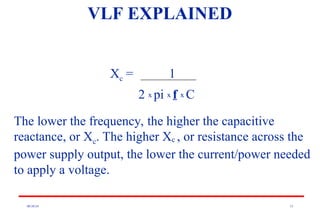
Xc = 1
2 x pi x f x C
The lower the frequency, the higher the capacitive
reactance, or Xc. The higher Xc , or resistance across the
power supply output, the lower the current/power needed
to apply a voltage.
VLF EXPLAINED
08/30/24 16
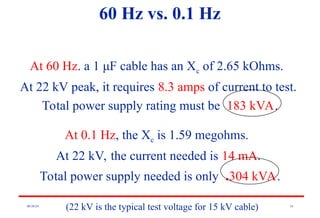
60 Hz vs. 0.1 Hz
At 60 Hz. a 1 μF cable has an Xc of 2.65 kOhms.
At 22 kV peak, it requires 8.3 amps of current to test.
Total power supply rating must be 183 kVA.
At 0.1 Hz, the Xc is 1.59 megohms.
At 22 kV, the current needed is 14 mA.
Total power supply needed is only .304 kVA.
(22 kV is the typical test voltage for 15 kV cable)
08/30/24 17
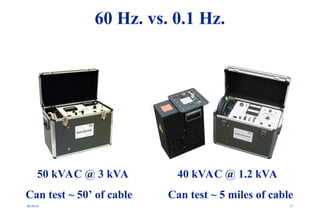
50 kVAC @ 3 kVA
Can test ~ 50’ of cable
60 Hertz
40 kVAC @ 1.2 kVA
Can test ~ 5 miles of cable
0.1 – 0.02 Hertz
60 Hz. vs. 0.1 Hz.
08/30/24 18
APPLICATIONS
08/30/24 19
•Power Cable
IEEE 400-2001 & IEEE 400.2-2004
•Large Rotating Machinery
IEEE 433-1974
•Diagnostic Testing:
Tan 
Partial discharge
IEEE STANDARDS EXIST
08/30/24 20
CAN OTHER LOADS BE VLF TESTED?
Yes, but no standards exist that define the test.
Most other loads are low in capacitance, permitting
60Hz AC hipots to be used.
Sometimes large insulators are VLF tested if a
powerful enough 60Hz hipot is not available.
08/30/24 21
WHY TEST CABLES WITH AC VOLTAGE?
Cables are designed to carry AC voltage.
They are factory tested with AC voltage.
Cables operate under AC voltage stress.
Cables should be tested with AC voltage.
Why would you not use AC if you could?
08/30/24 22
Can Now AC Stress Test Cable

With VLF, utilities, testing services, industrials, and others
can now AC stress test cables in the field.

Just like with vacuum bottle or rubber glove testing, now a
go/no-go AC stress test can be performed on power cable.

If a cable can’t hold 2 – 3 times normal voltage, it’s not
healthy. Find the problem, make the repair, and move on.

At the very least, every newly installed and repaired cable
should be VLF tested before energizing, since many
failures are due to installation damage, faulty
workmanship, stress from in-service failures, or over
voltage thumping.
08/30/24 23
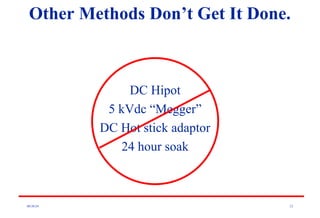
Other Methods Don’t Get It Done.
DC Hipot
5 kVdc “Megger”
DC Hot stick adaptor
24 hour soak
08/30/24 24
VLF IT!
08/30/24 25
IEEE STANDARDS
08/30/24 26
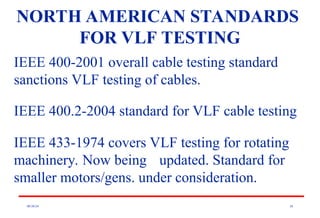
NORTH AMERICAN STANDARDS
FOR VLF TESTING
IEEE 400-2001 overall cable testing standard
sanctions VLF testing of cables.
IEEE 400.2-2004 standard for VLF cable testing
IEEE 433-1974 covers VLF testing for rotating
machinery. Now being updated. Standard for
smaller motors/gens. under consideration.
08/30/24 27
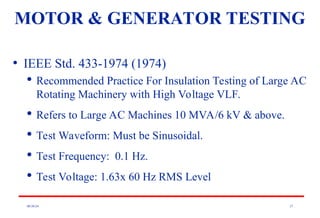
• IEEE Std. 433-1974 (1974)

Recommended Practice For Insulation Testing of Large AC
Rotating Machinery with High Voltage VLF.

Refers to Large AC Machines 10 MVA/6 kV & above.

Test Waveform: Must be Sinusoidal.

Test Frequency: 0.1 Hz.

Test Voltage: 1.63x 60 Hz RMS Level
MOTOR & GENERATOR TESTING
08/30/24 28
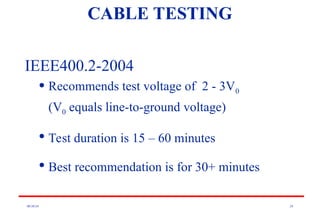
IEEE400.2-2004
 Recommends test voltage of 2 - 3V0
(V0 equals line-to-ground voltage)

Test duration is 15 – 60 minutes

Best recommendation is for 30+ minutes
CABLE TESTING
08/30/24 29
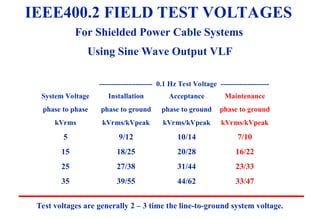
System Voltage
phase to phase
kVrms
5
15
25
35
Installation
phase to ground
kVrms/kVpeak
9/12
18/25
27/38
39/55
Acceptance
phase to ground
kVrms/kVpeak
10/14
20/28
31/44
44/62
Maintenance
phase to ground
kVrms/kVpeak
7/10
16/22
23/33
33/47
---------------------- 0.1 Hz Test Voltage --------------------
IEEE400.2 FIELD TEST VOLTAGES
For Shielded Power Cable Systems
Using Sine Wave Output VLF
Test voltages are generally 2 – 3 time the line-to-ground system voltage.
08/30/24 30
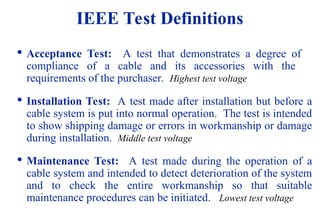
IEEE Test Definitions

Acceptance Test: A test that demonstrates a degree of
compliance of a cable and its accessories with the
requirements of the purchaser. Highest test voltage

Installation Test: A test made after installation but before a
cable system is put into normal operation. The test is intended
to show shipping damage or errors in workmanship or damage
during installation. Middle test voltage

Maintenance Test: A test made during the operation of a
cable system and intended to detect deterioration of the system
and to check the entire workmanship so that suitable
maintenance procedures can be initiated. Lowest test voltage
08/30/24 31
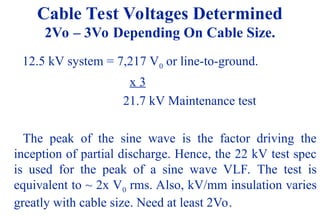
Cable Test Voltages Determined
2Vo – 3Vo Depending On Cable Size.
12.5 kV system = 7,217 V0 or line-to-ground.
x 3
21.7 kV Maintenance test
The peak of the sine wave is the factor driving the
inception of partial discharge. Hence, the 22 kV test spec
is used for the peak of a sine wave VLF. The test is
equivalent to ~ 2x V0 rms. Also, kV/mm insulation varies
greatly with cable size. Need at least 2Vo.
08/30/24 32
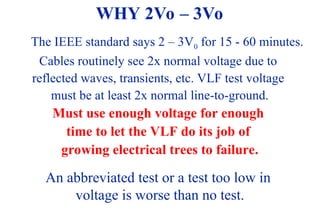
WHY 2Vo – 3Vo
The IEEE standard says 2 – 3V0 for 15 - 60 minutes.
Cables routinely see 2x normal voltage due to
reflected waves, transients, etc. VLF test voltage
must be at least 2x normal line-to-ground.
Must use enough voltage for enough
time to let the VLF do its job of
growing electrical trees to failure.
An abbreviated test or a test too low in
voltage is worse than no test.
08/30/24 33
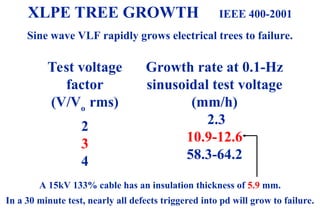
Growth rate at 0.1-Hz
sinusoidal test voltage
(mm/h)
2.3
10.9-12.6
58.3-64.2
Test voltage
factor
(V/Vo
rms)
2
3
4
XLPE TREE GROWTH IEEE 400-2001
Sine wave VLF rapidly grows electrical trees to failure.
A 15kV 133% cable has an insulation thickness of 5.9 mm.
In a 30 minute test, nearly all defects triggered into pd will grow to failure.
08/30/24 34
RESULTS FROM FIELD USE
AND LABORATORY RESEARCH
08/30/24 35
VLF TEST RESULTS
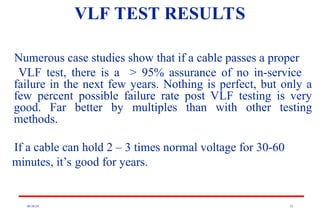
Numerous case studies show that if a cable passes a proper
VLF test, there is a > 95% assurance of no in-service
failure in the next few years. Nothing is perfect, but only a
few percent possible failure rate post VLF testing is very
good. Far better by multiples than with other testing
methods.
If a cable can hold 2 – 3 times normal voltage for 30-60
minutes, it’s good for years.
08/30/24 36
XLPE TESTING STATISTICS
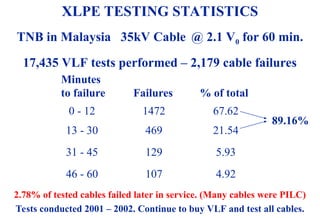
TNB in Malaysia 35kV Cable @ 2.1 V0 for 60 min.
17,435 VLF tests performed – 2,179 cable failures
0 - 12 1472 67.62
13 - 30 469 21.54
31 - 45 129 5.93
46 - 60 107 4.92
Minutes
to failure Failures % of total
89.16%
2.78% of tested cables failed later in service. (Many cables were PILC)
Tests conducted 2001 – 2002. Continue to buy VLF and test all cables.
08/30/24 37
XLPE TESTING STATISTICS
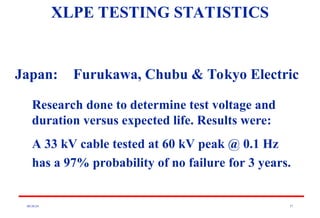
Japan: Furukawa, Chubu & Tokyo Electric
Research done to determine test voltage and
duration versus expected life. Results were:
A 33 kV cable tested at 60 kV peak @ 0.1 Hz
has a 97% probability of no failure for 3 years.
08/30/24 38
Germany produced some of the first
VLF products more than 20 years ago.
German standard: 3Vo rms for 60 minutes.
08/30/24 39
Most US users test at the IEEE
recommended voltages for 30 minutes.
08/30/24 40
The World View Of VLF
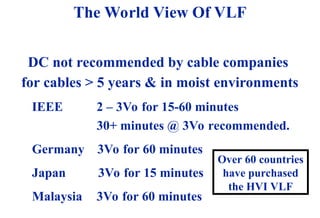
DC not recommended by cable companies
for cables > 5 years & in moist environments
IEEE 2 – 3Vo for 15-60 minutes
30+ minutes @ 3Vo recommended.
Germany 3Vo for 60 minutes
Japan 3Vo for 15 minutes
Malaysia 3Vo for 60 minutes
Over 60 countries
have purchased
the HVI VLF
08/30/24 41
HOW TO PERFORM A VLF TEST
08/30/24 42
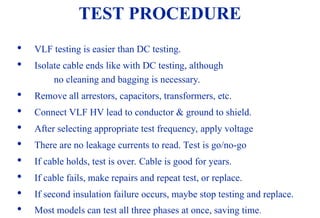
TEST PROCEDURE

VLF testing is easier than DC testing.

Isolate cable ends like with DC testing, although
no cleaning and bagging is necessary.

Remove all arrestors, capacitors, transformers, etc.

Connect VLF HV lead to conductor & ground to shield.

After selecting appropriate test frequency, apply voltage

There are no leakage currents to read. Test is go/no-go

If cable holds, test is over. Cable is good for years.

If cable fails, make repairs and repeat test, or replace.

If second insulation failure occurs, maybe stop testing and replace.

Most models can test all three phases at once, saving time.
08/30/24 43
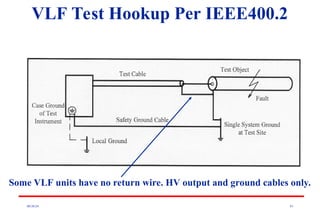
VLF Test Hookup Per IEEE400.2
Some VLF units have no return wire. HV output and ground cables only.
08/30/24 44
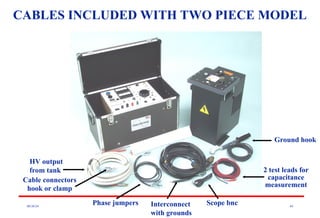
CABLES INCLUDED WITH TWO PIECE MODEL
HV output
from tank
Phase jumpers Interconnect
with grounds
Scope bnc
2 test leads for
capacitance
measurement
Ground hook
Cable connectors
hook or clamp
08/30/24 45
VLF-4022CM
08/30/24 46
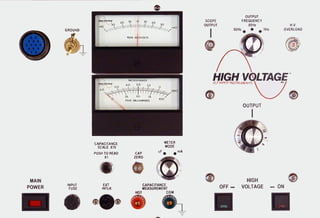
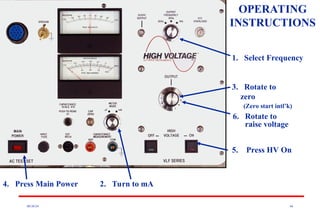
OPERATING
INSTRUCTIONS
1. Select Frequency
2. Turn to mA
3. Rotate to
zero
(Zero start intl’k)
4. Press Main Power
5. Press HV On
6. Rotate to
raise voltage
08/30/24 47
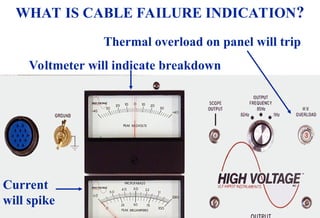
WHAT IS CABLE FAILURE INDICATION?
Thermal overload on panel will trip
Voltmeter will indicate breakdown
Current
will spike
08/30/24 48
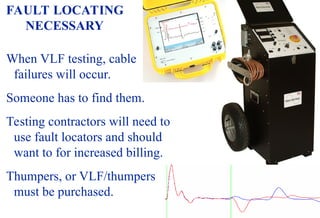
FAULT LOCATING
NECESSARY
When VLF testing, cable
failures will occur.
Someone has to find them.
Testing contractors will need to
use fault locators and should
want to for increased billing.
Thumpers, or VLF/thumpers
must be purchased.
08/30/24 49
COMMON VLF MYTHS
08/30/24 50
VLF IS DESTRUCTIVE TO INSULATION.
NOT TRUE. Cable is factory tested at voltages far
higher than field VLF levels. VLF is destructive to
existing defects that are severe enough to be triggered
into partial discharge during the test. That’s the point of
the test – light up defects and let them grow to failure.
Minor defects and good insulation are not effected.
08/30/24 51
VLF AGGRAVATES DEFECTS THAT
FAIL LATER IN SERVICE
Only if the test is not properly performed, like any testing
method. The proper VLF voltage must be applied for a long
enough time to permit defects triggered into pd to grow to
failure. An improper test is worse than no test at all. The
same can be said for 60Hz hipoting, pd testing, and other
tests. If done wrong, problems could result. If done correctly -
positive results.
08/30/24 52
VLF IS REALLY ALTERNATING DC
Not true. At 0.1 Hz there are polarity reversals every 5
seconds. Even at 0.01Hz there are reversals every 50
seconds. That does not compare at all to a 15 minute,
constantly negative output DC hipot test. Space
charges and traveling waves are not developed in
insulation during a VLF test. The IEEE recognizes
frequencies down to .01Hz as ok.
08/30/24 53
VLF EFFECTIVENESS IS UNPROVEN
Very wrong. Tell that to the hundreds of users over more
than 15 years that have tested tens of thousands of cables
with great success. Tell that to the IEEE, CEA, EPRI,
cable companies, and many international organizations
that have all endorsed VLF.
A VLF instrument is just a low frequency AC hipot.
Simple product – simple test – simple physics. There is
nothing to not work.
08/30/24 54
ONLY 0.1 HZ IS A VALID TEST
The IEEE standard recognizes frequencies down to 0.01Hz. While
it is true that most of the worldwide research over the last 20 years
into testing levels and durations has been done at 0.1Hz, that does
not mean lower frequencies are ineffective.
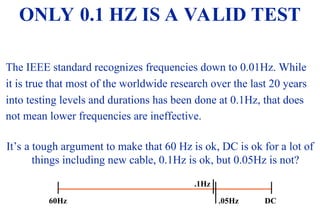
It’s a tough argument to make that 60 Hz is ok, DC is ok for a lot of
things including new cable, 0.1Hz is ok, but 0.05Hz is not?
60Hz
.1Hz
.05Hz DC
08/30/24 55
ONE WAVEFORM OUTPUT
IS BETTER THAN ANOTHER
Of the three major VLF vendors, two output waveforms
are offered: sine wave & cosine-rectangular (trapezoidal).
Both work well to VLF hipot cable, although the sine wave
output grows electrical trees faster - see IEEE400.
-However -
A sine wave VLF is better suited for use as a voltage
source for tan delta and partial discharge testing, both
desirable add-ons to VLF testing. Also, a sine wave is
necessary for motor/generator testing per IEEE433.
08/30/24 56
WHO USES VLF
08/30/24 57
UTILITIES TESTING SERVICES
INDUSTRIALS CONTRACTORS
Other methods of cable testing have their place, but
VLF is embraced worldwide as the easiest, most
effective, most economical method of cable testing.
Over 800 VLF units have been shipped from High
Voltage, Inc. over the last eight years, delivered to 54
countries and many US locations. Other VLF products
have shipped from other vendors for even longer.
08/30/24 58
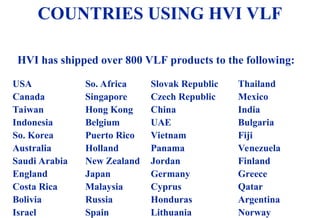
COUNTRIES USING HVI VLF
HVI has shipped over 800 VLF products to the following:
USA
Canada
Taiwan
Indonesia
So. Korea
Australia
Saudi Arabia
England
Costa Rica
Bolivia
Israel
So. Africa
Singapore
Hong Kong
Belgium
Puerto Rico
Holland
New Zealand
Japan
Malaysia
Russia
Spain
Slovak Republic
Czech Republic
China
UAE
Vietnam
Panama
Jordan
Germany
Cyprus
Honduras
Lithuania
Thailand
Mexico
India
Bulgaria
Fiji
Venezuela
Finland
Greece
Qatar
Argentina
Norway
08/30/24 59
SELECTING A VLF MODEL
08/30/24 60
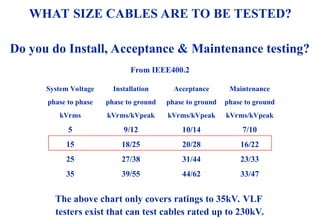
System Voltage
phase to phase
kVrms
5
15
25
35
Installation
phase to ground
kVrms/kVpeak
9/12
18/25
27/38
39/55
Acceptance
phase to ground
kVrms/kVpeak
10/14
20/28
31/44
44/62
Maintenance
phase to ground
kVrms/kVpeak
7/10
16/22
23/33
33/47
WHAT SIZE CABLES ARE TO BE TESTED?
Do you do Install, Acceptance & Maintenance testing?
From IEEE400.2
The above chart only covers ratings to 35kV. VLF
testers exist that can test cables rated up to 230kV.
08/30/24 61
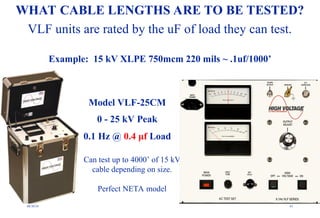
WHAT CABLE LENGTHS ARE TO BE TESTED?
VLF units are rated by the uF of load they can test.
Model VLF-25CM
0 - 25 kV Peak
0.1 Hz @ 0.4 μf Load
Can test up to 4000’ of 15 kV
cable depending on size.
Perfect NETA model
Example: 15 kV XLPE 750mcm 220 mils ~ .1uf/1000’
08/30/24 62
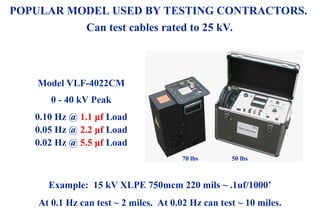
POPULAR MODEL USED BY TESTING CONTRACTORS.
Can test cables rated to 25 kV.
Model VLF-4022CM
0 - 40 kV Peak
0.10 Hz @ 1.1 μf Load
0.05 Hz @ 2.2 μf Load
0.02 Hz @ 5.5 μf Load
Example: 15 kV XLPE 750mcm 220 mils ~ .1uf/1000’
At 0.1 Hz can test ~ 2 miles. At 0.02 Hz can test ~ 10 miles.
70 lbs 50 lbs
08/30/24 63
MODEL SIZES AVAILABLE
(all vendors included)
Voltage ratings from 20 kV – 200 kV
Load ratings from 0.4 uF – 50 uF
For a 15 kV cable, 0.4 uF can test ~ 4000’
Some models can test > 30 miles of cable
08/30/24 64
Sine wave output is needed to use VLF
as a voltage source for td and pd testing.
IEEE433 for VLF testing rotating
machinery requires a sine wave output.
Leave all your future testing options
open by buying a sine wave VLF.
WILL IT BE USED FOR TAN DELTA
& PD TESTING?
08/30/24 65
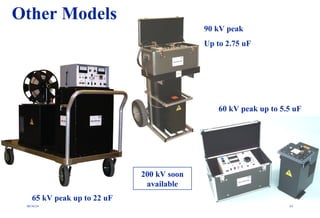
120 kV peak up to 5.5 uF
90 kV peak
Up to 2.75 uF
60 kV peak up to 5.5 uF
65 kV peak up to 22 uF
Other Models
200 kV soon
available
08/30/24 66
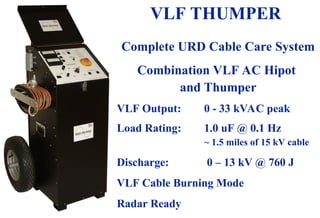
VLF THUMPER
Complete URD Cable Care System
Combination VLF AC Hipot
and Thumper
VLF Output: 0 - 33 kVAC peak
Load Rating: 1.0 uF @ 0.1 Hz
~ 1.5 miles of 15 kV cable
Discharge: 0 – 13 kV @ 760 J
VLF Cable Burning Mode
Radar Ready
08/30/24 67
SELECTING A CABLE TEST METHOD
08/30/24 68
CABLE TEST METHODS
• AC Power Frequency.
• AC Series & Parallel Resonant.
• DC Hipot.
• Very Low Frequency (VLF) AC Hipot.
• Tan Delta, Partial Discharge, And Other
Diagnostic Methods.
08/30/24 69
Ideally, VLF, Tan Delta, and Partial Discharge should all be used.
However, there are real world factors affecting the decision.
1. Type of test results desired
2. Ease of use
3. Cost of equipment
There is no one perfect method that does it all. A variety of
approaches is needed to meet all the requirements encountered.
SEVERAL METHODS – WHAT TO USE?
08/30/24 70
WHAT’S THE GOAL?

Verify new installation?

Verify repaired cable?

Verify critical cable?

Help to prioritize cable replacement or injection?
08/30/24 71
WHAT’S THE SITUATION?

Direct buried – must pinpoint problem to repair

Cable in conduit or trench - replaceable

Cable in raceways – visible and easily replaceable

How old is cable

What is the failure history

How easy is it to repair

Is there alternate feed should failure occur during test

Is fault location and repair available?

How much downtime can be tolerated?
08/30/24 72
EXAMPLES OF SITUATION vs. METHOD
New Install: Diagnostic test not appropriate, the insulation is good. VLF it to
make sure there are no installation flaws.
Old suspect cable: There may be many defects, don’t VLF. Use TD to see how
degraded cable is. If modest degradation, then PD possibly followed by VLF.
Critical cable in conduit: PD test to expose location and severity of defects. If
no PD tester available, VLF.
Direct buried, hard to repair: TD test to evaluate condition to prioritize cable
injection or replacment.
Prioritization for replacement or injection: If a comparative condition
assessment test is desired, tan delta is the easiest method.
Post repair test: VLF repaired cable to make sure it holds – no further damage
caused by over voltage thumping.
08/30/24 73
SO, WHAT TO DO?
NO SHORT AND EASY ANSWER.
Depends on money and available people.
A combination of methods is needed: some easy and
economical (VLF) and some more complicated and more
expensive (TD & PD), and each yielding different but
important data about your cable.
08/30/24 74
IT ALL STARTS WITH A VLF
Fact: As more industrial customers, utilities, and
specifying engineering companies spec VLF testing,
per IEEE400.2, you will need a VLF.
Fact: In addition to performing VLF AC stress tests, a
VLF hipot is the foundation for other tests, like partial
discharge and tan delta. You need VLF for pd and td.
To learn the most about the health of your cable, all three
tests, if economically and logistically feasible, are
recommended. If not all possible, VLF should be the
fallback, or nothing in old cable systems.
08/30/24 75
SUMMARY &
CONCLUSION
08/30/24 76

Has the virtues of DC test equipment (low cost, small size, light
weight, easy to use) but is AC.

Does not have the negative consequences of DC.

Requires 1/600 – 1/6000 of the kVA of power frequency.

Can be used for breakdown tests and predictive tests such as Tan
Delta and Partial Discharge. (sine wave VLF units)

Internationally accepted Standards exist and more are in the
process of issuance.
VLF TESTING SUMMARY
08/30/24 77
CONCLUSION
The surest way to verify the AC integrity of any load is
perform an AC stress test.
It’s easy and certain. The load holds voltage or fails.
VLF testing is easily performed with minimal training.
Worldwide standards and decades of history exist.
Some VLF models are very portable and affordable.
VLF makes Tan Delta and Partial Discharge diagnostic
testing easier and more economical.
08/30/24 78
CONCLUSION
VLF is suitable for use on cables and rotating machinery.
IEEE, VDE, CEA, EPRI, other country’s engineering
organizations, cable manufactures, and major utilities all
recommend VLF.
Hundreds of users worldwide have embraced VLF
VLF It! It’s economical, easy, and sure.
08/30/24 79
OTHER CABLE TEST
METHODS USING VLF
08/30/24 80
YOU HAVE YOUR VLF.
WHAT ELSE CAN YOU DO?
Accessorize. Add on a
Tan Delta measurement instrument.
Partial Discharge detection instrument.
08/30/24 81
Dissipation Factor or Loss Angle
Measurement For Power Cables
Non Destructive Testing To
Determine Insulation Quality
(Similar to Power Factor Testing)
TANGENT DELTA or TAN δ
82

Evaluates overall condition of cable (rather than localized
problems as with PD measurement)

Absolute values, variations, and trending of values are of
interest for predicting insulation integrity

Tan Delta is more easily measured at VLF (magnitude
increases as frequency decreases)

Requires VLF sinusoidal applied test voltage

Excellent way to evaluate Water Trees

Useful to help prioritize replacement, injection and helps to
determine what additional test may be useful
TAN DELTA MEASUREMENT
Using VLF @ 0.1 Hz
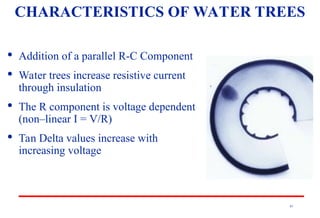
83

Addition of a parallel R-C Component

Water trees increase resistive current
through insulation

The R component is voltage dependent
(non–linear I = V/R)

Tan Delta values increase with
increasing voltage
CHARACTERISTICS OF WATER TREES
84
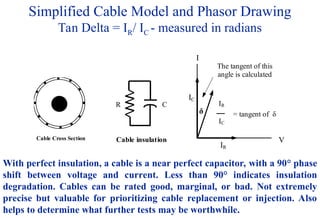
With perfect insulation, a cable is a near perfect capacitor, with a 90° phase
shift between voltage and current. Less than 90° indicates insulation
degradation. Cables can be rated good, marginal, or bad. Not extremely
precise but valuable for prioritizing cable replacement or injection. Also
helps to determine what further tests may be worthwhile.
The tangent of this
angle is calculated
δ
I
V
IC
IR
IR
IC
= tangent of δ
C
R
Cable insulation
Cable Cross Section
Simplified Cable Model and Phasor Drawing
Tan Delta = IR/ IC - measured in radians
85
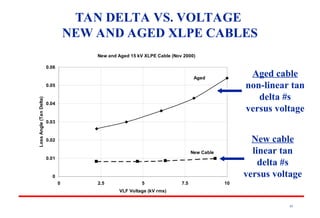
TAN DELTA VS. VOLTAGE
NEW AND AGED XLPE CABLES
New and Aged 15 kV XLPE Cable (Nov 2000)
0
0.01
0.02
0.03
0.04
0.05
0.06
0 2.5 5 7.5 10
VLF Voltage (kV rms)
Loss
Angle
(Tan
Delta)
Aged
Cable
New Cable
New cable
linear tan
delta #s
versus voltage
Aged cable
non-linear tan
delta #s
versus voltage
08/30/24 86
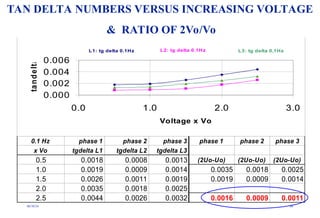
0.1 Hz phase 1 phase 2 phase 3 phase 1 phase 2 phase 3
x Vo tgdelta L1 tgdelta L2 tgdelta L3
0.5 0.0018 0.0008 0.0013 (2Uo-Uo) (2Uo-Uo) (2Uo-Uo)
1.0 0.0019 0.0009 0.0014 0.0035 0.0018 0.0025
1.5 0.0026 0.0011 0.0019 0.0019 0.0009 0.0014
2.0 0.0035 0.0018 0.0025
2.5 0.0044 0.0026 0.0032 0.0016 0.0009 0.0011
0.000
0.002
0.004
0.006
0.0 1.0 2.0 3.0
Voltage x Vo
ta
n
d
e
lta
L2: tg delta 0.1Hz L3: tg delta 0,1Hz
L1: tg delta 0.1Hz
TAN DELTA NUMBERS VERSUS INCREASING VOLTAGE
& RATIO OF 2Vo/Vo
08/30/24 87
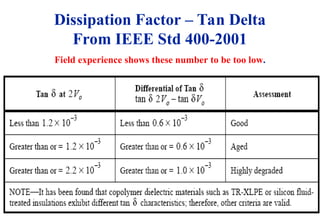
Dissipation Factor – Tan Delta
From IEEE Std 400-2001
Field experience shows these number to be too low.
08/30/24 88
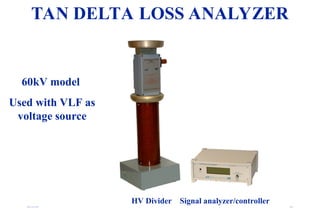
TAN DELTA LOSS ANALYZER
HV Divider Signal analyzer/controller
60kV model
Used with VLF as
voltage source
08/30/24 89
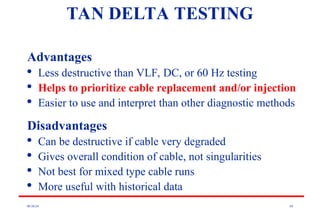
TAN DELTA TESTING
Advantages

Less destructive than VLF, DC, or 60 Hz testing

Helps to prioritize cable replacement and/or injection

Easier to use and interpret than other diagnostic methods
Disadvantages

Can be destructive if cable very degraded

Gives overall condition of cable, not singularities

Not best for mixed type cable runs

More useful with historical data
08/30/24 90
VLF
PARTIAL DISCHARGE
TESTING
08/30/24 91
“SEE” UNDERGROUND CABLE FAULTS
A PD detection system can show you the
location and severity of insulation and
accessory defects.
Using a VLF as the voltage generator to apply
voltages up to 2Vo, long cables can be tested
with portable equipment.
08/30/24 92
OFF-LINE VS. ON-LINE PD TESTING
Off-line testing using a VLF permits over voltage
analysis. Can measure PDIV and PDEV up to 2Vo.
On-line pd testing can only detect pd at operating
voltage, missing defects with a PDIV of 101% and
above of operating voltage, yet cables routinely see
twice normal voltage due to reflected waves, transients,
switching surges, etc.
Off-line testing may be less convenient, but the
information gained is far more valuable.
08/30/24 93
0.1Hz vs. 60Hz PD TESTING
Both frequencies initiate pd at defect locations. Both can
measure PDIV, PDEV, magnitude, and location.
The benefit of VLF is smaller size, lower weight, far lower
cost, and can test longer cables.
A 100 lb VLF can do the job of a 2000 lb 60Hz series
resonant unit.
08/30/24 94
THE BEST OF EVERYTHING
Start with a VLF tester to perform AC withstand testing.
Add a Tan Delta accessory for evaluating the overall condition
of a cable to help prioritize replacement, injection, or to
determine what other tests might be helpful.
Add a Partial Discharge accessory to map the location
and severity of pd in the insulation and splices, or to
determine what other tests might be helpful.
Perform all three tests to get the most complete profile possible
of your cable.
08/30/24 95
Thank You
Mike Peschel - High Voltage, Inc.
www.hvinc.com
08/30/24 96

Pruebas de cables con VLF (Very Low Frequency)

  • 1.
    08/30/24 1 Michael T.Peschel High Voltage, Inc. Copake, NY. USA www.hvinc.com VLF CABLE TESTING INCLUDING PARTIAL DISCHARGE & TANGENT DELTA
  • 2.
    08/30/24 2 SUBJECTS COVERED Reviewof DC Issues What Is VLF VLF Applications IEEE Standards Lab and Field Results How To Perform The Test Myths about VLF Who Uses VLF Selecting a VLF Model Selecting A Cable Test Method VLF Conclusion Tan Delta Testing VLF Partial Discharge Testing
  • 3.
    08/30/24 3 THIS CANBE PREVENTED In-service failures cause great damage to faulted cables and adjacent cables. Not so if failed under a VLF test.
  • 4.
    08/30/24 4 WHY WASDC USED DC hipots are small, portable, and economical. DC originally used with PILC cable and worked well. Same techniques used when HMW, XLPE, EPR, and other solid dielectric cables were installed. Years later DC was found to harm insulation and leakage current measurements are often ineffective for exposing defects. VLF work started. Until recently, AC field testing of cable was not practical. Now it is practical and economical.
  • 5.
    08/30/24 5 Worldwide consensusexists among engineering organizations, utilities, and cable manufacturers that typical DC test voltages of 4 – 5 Vo (4 – 5x line-to- ground operating voltage) damage insulation, lead to failures, and leakage currents are often not indicative of insulation integrity. Using lower voltages renders test meaningless. DC USE DISCOURAGED
  • 6.
    08/30/24 6 Avoid DCVoltage On Service Aged, Solid Dielectric Insulation DC Voltage Polarizes Cable. Water trees trap space charges – leads to failures.
  • 7.
    08/30/24 7  Tree shapedchannels are found within the insulation of operating cables resulting from the presence of moisture and electrical fields.  Prevalent in solid dielectric cables.  Eventually leads to the inception of PD.  Leads to insulation failure. WHY IS DC HARMFUL? WATER TREES
  • 8.
  • 9.
    08/30/24 9 WHY DCIS DAMAGING DC hipot input Negative space charges AC input DC hipot output negatively charges up water tree areas. These “trapped space charges” remain after test. When AC is reapplied, there’s a high difference of potential across very little of the insulation. Leads to pd, electrical trees, & cable failure
  • 10.
    08/30/24 10 UTILITIES RESPONSETO DC CONCERNS  Typical DC test voltages were/are 4 - 5 times V0.  At these high voltages, damage is done.  Some reduce voltage to 15 kVDC on 15 kV cable.  15 kV is only 30% above the peak AC stress in service. At this voltage, leakage currents are meaningless.  Some do nothing, letting cables fail and then repair.  Many have adopted VLF AC hipoting to expose bad insulation and accessories. VLF is the best splice checker.
  • 11.
    08/30/24 11 Advantages • LightWeight. • Low Cost. • Simple to Use. • Results are certain Disadvantages • Voltage Waveform in Some Designs – Can’t Use For TD & PD • Cable May Fail Under Test. • Perhaps Multiple Failures In Severely Deteriorated Insulation IF NOT DC - THEN WHAT? VLF – Very Low Frequency AC
  • 12.
  • 13.
    08/30/24 13 A VLFHIPOT IS SIMPLY AN AC OUTPUT INSTRUMENT BUT AT A LOWER FREQUENCY. THE LOWER THE FREQUENCY OUTPUT, THE LOWER THE CURRENT AND POWER REQUIRED TO TEST HIGH CAPACITANCE LOADS LIKE CABLES. DON’T OVERCOMPLICATE IT. IT’S A SIMPLE AC WITHSTAND TEST. VLF IS THE EASIEST, CHEAPEST, MOST CERTAIN WAY OF TESTING THE AC INTEGRITY OF A CABLE.
  • 14.
    08/30/24 14 DROP THEFREQUENCY Very Low Frequency: 0.1 Hz and lower. By decreasing the frequency, it is possible to test miles of cable with a small and affordable unit. Output frequencies range from 0.1 – 0.01 Hz. IEEE400.2 recognizes frequencies as low as 0.01Hz. At 0.1 Hz, it takes 600 times less power to test a cable, or any other high capacitance load, than at 60 Hz. At 0.01 Hz, 6000 times higher capacitive loads can be tested than at 60 Hz with the same power consumption.
  • 15.
    08/30/24 15 Xc =1 2 x pi x f x C The lower the frequency, the higher the capacitive reactance, or Xc. The higher Xc , or resistance across the power supply output, the lower the current/power needed to apply a voltage. VLF EXPLAINED
  • 16.
    08/30/24 16 60 Hzvs. 0.1 Hz At 60 Hz. a 1 μF cable has an Xc of 2.65 kOhms. At 22 kV peak, it requires 8.3 amps of current to test. Total power supply rating must be 183 kVA. At 0.1 Hz, the Xc is 1.59 megohms. At 22 kV, the current needed is 14 mA. Total power supply needed is only .304 kVA. (22 kV is the typical test voltage for 15 kV cable)
  • 17.
    08/30/24 17 50 kVAC@ 3 kVA Can test ~ 50’ of cable 60 Hertz 40 kVAC @ 1.2 kVA Can test ~ 5 miles of cable 0.1 – 0.02 Hertz 60 Hz. vs. 0.1 Hz.
  • 18.
  • 19.
    08/30/24 19 •Power Cable IEEE400-2001 & IEEE 400.2-2004 •Large Rotating Machinery IEEE 433-1974 •Diagnostic Testing: Tan  Partial discharge IEEE STANDARDS EXIST
  • 20.
    08/30/24 20 CAN OTHERLOADS BE VLF TESTED? Yes, but no standards exist that define the test. Most other loads are low in capacitance, permitting 60Hz AC hipots to be used. Sometimes large insulators are VLF tested if a powerful enough 60Hz hipot is not available.
  • 21.
    08/30/24 21 WHY TESTCABLES WITH AC VOLTAGE? Cables are designed to carry AC voltage. They are factory tested with AC voltage. Cables operate under AC voltage stress. Cables should be tested with AC voltage. Why would you not use AC if you could?
  • 22.
    08/30/24 22 Can NowAC Stress Test Cable  With VLF, utilities, testing services, industrials, and others can now AC stress test cables in the field.  Just like with vacuum bottle or rubber glove testing, now a go/no-go AC stress test can be performed on power cable.  If a cable can’t hold 2 – 3 times normal voltage, it’s not healthy. Find the problem, make the repair, and move on.  At the very least, every newly installed and repaired cable should be VLF tested before energizing, since many failures are due to installation damage, faulty workmanship, stress from in-service failures, or over voltage thumping.
  • 23.
    08/30/24 23 Other MethodsDon’t Get It Done. DC Hipot 5 kVdc “Megger” DC Hot stick adaptor 24 hour soak
  • 24.
  • 25.
  • 26.
    08/30/24 26 NORTH AMERICANSTANDARDS FOR VLF TESTING IEEE 400-2001 overall cable testing standard sanctions VLF testing of cables. IEEE 400.2-2004 standard for VLF cable testing IEEE 433-1974 covers VLF testing for rotating machinery. Now being updated. Standard for smaller motors/gens. under consideration.
  • 27.
    08/30/24 27 • IEEEStd. 433-1974 (1974)  Recommended Practice For Insulation Testing of Large AC Rotating Machinery with High Voltage VLF.  Refers to Large AC Machines 10 MVA/6 kV & above.  Test Waveform: Must be Sinusoidal.  Test Frequency: 0.1 Hz.  Test Voltage: 1.63x 60 Hz RMS Level MOTOR & GENERATOR TESTING
  • 28.
    08/30/24 28 IEEE400.2-2004  Recommendstest voltage of 2 - 3V0 (V0 equals line-to-ground voltage)  Test duration is 15 – 60 minutes  Best recommendation is for 30+ minutes CABLE TESTING
  • 29.
    08/30/24 29 System Voltage phaseto phase kVrms 5 15 25 35 Installation phase to ground kVrms/kVpeak 9/12 18/25 27/38 39/55 Acceptance phase to ground kVrms/kVpeak 10/14 20/28 31/44 44/62 Maintenance phase to ground kVrms/kVpeak 7/10 16/22 23/33 33/47 ---------------------- 0.1 Hz Test Voltage -------------------- IEEE400.2 FIELD TEST VOLTAGES For Shielded Power Cable Systems Using Sine Wave Output VLF Test voltages are generally 2 – 3 time the line-to-ground system voltage.
  • 30.
    08/30/24 30 IEEE TestDefinitions  Acceptance Test: A test that demonstrates a degree of compliance of a cable and its accessories with the requirements of the purchaser. Highest test voltage  Installation Test: A test made after installation but before a cable system is put into normal operation. The test is intended to show shipping damage or errors in workmanship or damage during installation. Middle test voltage  Maintenance Test: A test made during the operation of a cable system and intended to detect deterioration of the system and to check the entire workmanship so that suitable maintenance procedures can be initiated. Lowest test voltage
  • 31.
    08/30/24 31 Cable TestVoltages Determined 2Vo – 3Vo Depending On Cable Size. 12.5 kV system = 7,217 V0 or line-to-ground. x 3 21.7 kV Maintenance test The peak of the sine wave is the factor driving the inception of partial discharge. Hence, the 22 kV test spec is used for the peak of a sine wave VLF. The test is equivalent to ~ 2x V0 rms. Also, kV/mm insulation varies greatly with cable size. Need at least 2Vo.
  • 32.
    08/30/24 32 WHY 2Vo– 3Vo The IEEE standard says 2 – 3V0 for 15 - 60 minutes. Cables routinely see 2x normal voltage due to reflected waves, transients, etc. VLF test voltage must be at least 2x normal line-to-ground. Must use enough voltage for enough time to let the VLF do its job of growing electrical trees to failure. An abbreviated test or a test too low in voltage is worse than no test.
  • 33.
    08/30/24 33 Growth rateat 0.1-Hz sinusoidal test voltage (mm/h) 2.3 10.9-12.6 58.3-64.2 Test voltage factor (V/Vo rms) 2 3 4 XLPE TREE GROWTH IEEE 400-2001 Sine wave VLF rapidly grows electrical trees to failure. A 15kV 133% cable has an insulation thickness of 5.9 mm. In a 30 minute test, nearly all defects triggered into pd will grow to failure.
  • 34.
    08/30/24 34 RESULTS FROMFIELD USE AND LABORATORY RESEARCH
  • 35.
    08/30/24 35 VLF TESTRESULTS Numerous case studies show that if a cable passes a proper VLF test, there is a > 95% assurance of no in-service failure in the next few years. Nothing is perfect, but only a few percent possible failure rate post VLF testing is very good. Far better by multiples than with other testing methods. If a cable can hold 2 – 3 times normal voltage for 30-60 minutes, it’s good for years.
  • 36.
    08/30/24 36 XLPE TESTINGSTATISTICS TNB in Malaysia 35kV Cable @ 2.1 V0 for 60 min. 17,435 VLF tests performed – 2,179 cable failures 0 - 12 1472 67.62 13 - 30 469 21.54 31 - 45 129 5.93 46 - 60 107 4.92 Minutes to failure Failures % of total 89.16% 2.78% of tested cables failed later in service. (Many cables were PILC) Tests conducted 2001 – 2002. Continue to buy VLF and test all cables.
  • 37.
    08/30/24 37 XLPE TESTINGSTATISTICS Japan: Furukawa, Chubu & Tokyo Electric Research done to determine test voltage and duration versus expected life. Results were: A 33 kV cable tested at 60 kV peak @ 0.1 Hz has a 97% probability of no failure for 3 years.
  • 38.
    08/30/24 38 Germany producedsome of the first VLF products more than 20 years ago. German standard: 3Vo rms for 60 minutes.
  • 39.
    08/30/24 39 Most USusers test at the IEEE recommended voltages for 30 minutes.
  • 40.
    08/30/24 40 The WorldView Of VLF DC not recommended by cable companies for cables > 5 years & in moist environments IEEE 2 – 3Vo for 15-60 minutes 30+ minutes @ 3Vo recommended. Germany 3Vo for 60 minutes Japan 3Vo for 15 minutes Malaysia 3Vo for 60 minutes Over 60 countries have purchased the HVI VLF
  • 41.
    08/30/24 41 HOW TOPERFORM A VLF TEST
  • 42.
    08/30/24 42 TEST PROCEDURE  VLFtesting is easier than DC testing.  Isolate cable ends like with DC testing, although no cleaning and bagging is necessary.  Remove all arrestors, capacitors, transformers, etc.  Connect VLF HV lead to conductor & ground to shield.  After selecting appropriate test frequency, apply voltage  There are no leakage currents to read. Test is go/no-go  If cable holds, test is over. Cable is good for years.  If cable fails, make repairs and repeat test, or replace.  If second insulation failure occurs, maybe stop testing and replace.  Most models can test all three phases at once, saving time.
  • 43.
    08/30/24 43 VLF TestHookup Per IEEE400.2 Some VLF units have no return wire. HV output and ground cables only.
  • 44.
    08/30/24 44 CABLES INCLUDEDWITH TWO PIECE MODEL HV output from tank Phase jumpers Interconnect with grounds Scope bnc 2 test leads for capacitance measurement Ground hook Cable connectors hook or clamp
  • 45.
  • 46.
    08/30/24 46 OPERATING INSTRUCTIONS 1. SelectFrequency 2. Turn to mA 3. Rotate to zero (Zero start intl’k) 4. Press Main Power 5. Press HV On 6. Rotate to raise voltage
  • 47.
    08/30/24 47 WHAT ISCABLE FAILURE INDICATION? Thermal overload on panel will trip Voltmeter will indicate breakdown Current will spike
  • 48.
    08/30/24 48 FAULT LOCATING NECESSARY WhenVLF testing, cable failures will occur. Someone has to find them. Testing contractors will need to use fault locators and should want to for increased billing. Thumpers, or VLF/thumpers must be purchased.
  • 49.
  • 50.
    08/30/24 50 VLF ISDESTRUCTIVE TO INSULATION. NOT TRUE. Cable is factory tested at voltages far higher than field VLF levels. VLF is destructive to existing defects that are severe enough to be triggered into partial discharge during the test. That’s the point of the test – light up defects and let them grow to failure. Minor defects and good insulation are not effected.
  • 51.
    08/30/24 51 VLF AGGRAVATESDEFECTS THAT FAIL LATER IN SERVICE Only if the test is not properly performed, like any testing method. The proper VLF voltage must be applied for a long enough time to permit defects triggered into pd to grow to failure. An improper test is worse than no test at all. The same can be said for 60Hz hipoting, pd testing, and other tests. If done wrong, problems could result. If done correctly - positive results.
  • 52.
    08/30/24 52 VLF ISREALLY ALTERNATING DC Not true. At 0.1 Hz there are polarity reversals every 5 seconds. Even at 0.01Hz there are reversals every 50 seconds. That does not compare at all to a 15 minute, constantly negative output DC hipot test. Space charges and traveling waves are not developed in insulation during a VLF test. The IEEE recognizes frequencies down to .01Hz as ok.
  • 53.
    08/30/24 53 VLF EFFECTIVENESSIS UNPROVEN Very wrong. Tell that to the hundreds of users over more than 15 years that have tested tens of thousands of cables with great success. Tell that to the IEEE, CEA, EPRI, cable companies, and many international organizations that have all endorsed VLF. A VLF instrument is just a low frequency AC hipot. Simple product – simple test – simple physics. There is nothing to not work.
  • 54.
    08/30/24 54 ONLY 0.1HZ IS A VALID TEST The IEEE standard recognizes frequencies down to 0.01Hz. While it is true that most of the worldwide research over the last 20 years into testing levels and durations has been done at 0.1Hz, that does not mean lower frequencies are ineffective. It’s a tough argument to make that 60 Hz is ok, DC is ok for a lot of things including new cable, 0.1Hz is ok, but 0.05Hz is not? 60Hz .1Hz .05Hz DC
  • 55.
    08/30/24 55 ONE WAVEFORMOUTPUT IS BETTER THAN ANOTHER Of the three major VLF vendors, two output waveforms are offered: sine wave & cosine-rectangular (trapezoidal). Both work well to VLF hipot cable, although the sine wave output grows electrical trees faster - see IEEE400. -However - A sine wave VLF is better suited for use as a voltage source for tan delta and partial discharge testing, both desirable add-ons to VLF testing. Also, a sine wave is necessary for motor/generator testing per IEEE433.
  • 56.
  • 57.
    08/30/24 57 UTILITIES TESTINGSERVICES INDUSTRIALS CONTRACTORS Other methods of cable testing have their place, but VLF is embraced worldwide as the easiest, most effective, most economical method of cable testing. Over 800 VLF units have been shipped from High Voltage, Inc. over the last eight years, delivered to 54 countries and many US locations. Other VLF products have shipped from other vendors for even longer.
  • 58.
    08/30/24 58 COUNTRIES USINGHVI VLF HVI has shipped over 800 VLF products to the following: USA Canada Taiwan Indonesia So. Korea Australia Saudi Arabia England Costa Rica Bolivia Israel So. Africa Singapore Hong Kong Belgium Puerto Rico Holland New Zealand Japan Malaysia Russia Spain Slovak Republic Czech Republic China UAE Vietnam Panama Jordan Germany Cyprus Honduras Lithuania Thailand Mexico India Bulgaria Fiji Venezuela Finland Greece Qatar Argentina Norway
  • 59.
  • 60.
    08/30/24 60 System Voltage phaseto phase kVrms 5 15 25 35 Installation phase to ground kVrms/kVpeak 9/12 18/25 27/38 39/55 Acceptance phase to ground kVrms/kVpeak 10/14 20/28 31/44 44/62 Maintenance phase to ground kVrms/kVpeak 7/10 16/22 23/33 33/47 WHAT SIZE CABLES ARE TO BE TESTED? Do you do Install, Acceptance & Maintenance testing? From IEEE400.2 The above chart only covers ratings to 35kV. VLF testers exist that can test cables rated up to 230kV.
  • 61.
    08/30/24 61 WHAT CABLELENGTHS ARE TO BE TESTED? VLF units are rated by the uF of load they can test. Model VLF-25CM 0 - 25 kV Peak 0.1 Hz @ 0.4 μf Load Can test up to 4000’ of 15 kV cable depending on size. Perfect NETA model Example: 15 kV XLPE 750mcm 220 mils ~ .1uf/1000’
  • 62.
    08/30/24 62 POPULAR MODELUSED BY TESTING CONTRACTORS. Can test cables rated to 25 kV. Model VLF-4022CM 0 - 40 kV Peak 0.10 Hz @ 1.1 μf Load 0.05 Hz @ 2.2 μf Load 0.02 Hz @ 5.5 μf Load Example: 15 kV XLPE 750mcm 220 mils ~ .1uf/1000’ At 0.1 Hz can test ~ 2 miles. At 0.02 Hz can test ~ 10 miles. 70 lbs 50 lbs
  • 63.
    08/30/24 63 MODEL SIZESAVAILABLE (all vendors included) Voltage ratings from 20 kV – 200 kV Load ratings from 0.4 uF – 50 uF For a 15 kV cable, 0.4 uF can test ~ 4000’ Some models can test > 30 miles of cable
  • 64.
    08/30/24 64 Sine waveoutput is needed to use VLF as a voltage source for td and pd testing. IEEE433 for VLF testing rotating machinery requires a sine wave output. Leave all your future testing options open by buying a sine wave VLF. WILL IT BE USED FOR TAN DELTA & PD TESTING?
  • 65.
    08/30/24 65 120 kVpeak up to 5.5 uF 90 kV peak Up to 2.75 uF 60 kV peak up to 5.5 uF 65 kV peak up to 22 uF Other Models 200 kV soon available
  • 66.
    08/30/24 66 VLF THUMPER CompleteURD Cable Care System Combination VLF AC Hipot and Thumper VLF Output: 0 - 33 kVAC peak Load Rating: 1.0 uF @ 0.1 Hz ~ 1.5 miles of 15 kV cable Discharge: 0 – 13 kV @ 760 J VLF Cable Burning Mode Radar Ready
  • 67.
    08/30/24 67 SELECTING ACABLE TEST METHOD
  • 68.
    08/30/24 68 CABLE TESTMETHODS • AC Power Frequency. • AC Series & Parallel Resonant. • DC Hipot. • Very Low Frequency (VLF) AC Hipot. • Tan Delta, Partial Discharge, And Other Diagnostic Methods.
  • 69.
    08/30/24 69 Ideally, VLF,Tan Delta, and Partial Discharge should all be used. However, there are real world factors affecting the decision. 1. Type of test results desired 2. Ease of use 3. Cost of equipment There is no one perfect method that does it all. A variety of approaches is needed to meet all the requirements encountered. SEVERAL METHODS – WHAT TO USE?
  • 70.
    08/30/24 70 WHAT’S THEGOAL?  Verify new installation?  Verify repaired cable?  Verify critical cable?  Help to prioritize cable replacement or injection?
  • 71.
    08/30/24 71 WHAT’S THESITUATION?  Direct buried – must pinpoint problem to repair  Cable in conduit or trench - replaceable  Cable in raceways – visible and easily replaceable  How old is cable  What is the failure history  How easy is it to repair  Is there alternate feed should failure occur during test  Is fault location and repair available?  How much downtime can be tolerated?
  • 72.
    08/30/24 72 EXAMPLES OFSITUATION vs. METHOD New Install: Diagnostic test not appropriate, the insulation is good. VLF it to make sure there are no installation flaws. Old suspect cable: There may be many defects, don’t VLF. Use TD to see how degraded cable is. If modest degradation, then PD possibly followed by VLF. Critical cable in conduit: PD test to expose location and severity of defects. If no PD tester available, VLF. Direct buried, hard to repair: TD test to evaluate condition to prioritize cable injection or replacment. Prioritization for replacement or injection: If a comparative condition assessment test is desired, tan delta is the easiest method. Post repair test: VLF repaired cable to make sure it holds – no further damage caused by over voltage thumping.
  • 73.
    08/30/24 73 SO, WHATTO DO? NO SHORT AND EASY ANSWER. Depends on money and available people. A combination of methods is needed: some easy and economical (VLF) and some more complicated and more expensive (TD & PD), and each yielding different but important data about your cable.
  • 74.
    08/30/24 74 IT ALLSTARTS WITH A VLF Fact: As more industrial customers, utilities, and specifying engineering companies spec VLF testing, per IEEE400.2, you will need a VLF. Fact: In addition to performing VLF AC stress tests, a VLF hipot is the foundation for other tests, like partial discharge and tan delta. You need VLF for pd and td. To learn the most about the health of your cable, all three tests, if economically and logistically feasible, are recommended. If not all possible, VLF should be the fallback, or nothing in old cable systems.
  • 75.
  • 76.
    08/30/24 76  Has thevirtues of DC test equipment (low cost, small size, light weight, easy to use) but is AC.  Does not have the negative consequences of DC.  Requires 1/600 – 1/6000 of the kVA of power frequency.  Can be used for breakdown tests and predictive tests such as Tan Delta and Partial Discharge. (sine wave VLF units)  Internationally accepted Standards exist and more are in the process of issuance. VLF TESTING SUMMARY
  • 77.
    08/30/24 77 CONCLUSION The surestway to verify the AC integrity of any load is perform an AC stress test. It’s easy and certain. The load holds voltage or fails. VLF testing is easily performed with minimal training. Worldwide standards and decades of history exist. Some VLF models are very portable and affordable. VLF makes Tan Delta and Partial Discharge diagnostic testing easier and more economical.
  • 78.
    08/30/24 78 CONCLUSION VLF issuitable for use on cables and rotating machinery. IEEE, VDE, CEA, EPRI, other country’s engineering organizations, cable manufactures, and major utilities all recommend VLF. Hundreds of users worldwide have embraced VLF VLF It! It’s economical, easy, and sure.
  • 79.
    08/30/24 79 OTHER CABLETEST METHODS USING VLF
  • 80.
    08/30/24 80 YOU HAVEYOUR VLF. WHAT ELSE CAN YOU DO? Accessorize. Add on a Tan Delta measurement instrument. Partial Discharge detection instrument.
  • 81.
    08/30/24 81 Dissipation Factoror Loss Angle Measurement For Power Cables Non Destructive Testing To Determine Insulation Quality (Similar to Power Factor Testing) TANGENT DELTA or TAN δ
  • 82.
    82  Evaluates overall conditionof cable (rather than localized problems as with PD measurement)  Absolute values, variations, and trending of values are of interest for predicting insulation integrity  Tan Delta is more easily measured at VLF (magnitude increases as frequency decreases)  Requires VLF sinusoidal applied test voltage  Excellent way to evaluate Water Trees  Useful to help prioritize replacement, injection and helps to determine what additional test may be useful TAN DELTA MEASUREMENT Using VLF @ 0.1 Hz
  • 83.
    83  Addition of aparallel R-C Component  Water trees increase resistive current through insulation  The R component is voltage dependent (non–linear I = V/R)  Tan Delta values increase with increasing voltage CHARACTERISTICS OF WATER TREES
  • 84.
    84 With perfect insulation,a cable is a near perfect capacitor, with a 90° phase shift between voltage and current. Less than 90° indicates insulation degradation. Cables can be rated good, marginal, or bad. Not extremely precise but valuable for prioritizing cable replacement or injection. Also helps to determine what further tests may be worthwhile. The tangent of this angle is calculated δ I V IC IR IR IC = tangent of δ C R Cable insulation Cable Cross Section Simplified Cable Model and Phasor Drawing Tan Delta = IR/ IC - measured in radians
  • 85.
    85 TAN DELTA VS.VOLTAGE NEW AND AGED XLPE CABLES New and Aged 15 kV XLPE Cable (Nov 2000) 0 0.01 0.02 0.03 0.04 0.05 0.06 0 2.5 5 7.5 10 VLF Voltage (kV rms) Loss Angle (Tan Delta) Aged Cable New Cable New cable linear tan delta #s versus voltage Aged cable non-linear tan delta #s versus voltage
  • 86.
    08/30/24 86 0.1 Hzphase 1 phase 2 phase 3 phase 1 phase 2 phase 3 x Vo tgdelta L1 tgdelta L2 tgdelta L3 0.5 0.0018 0.0008 0.0013 (2Uo-Uo) (2Uo-Uo) (2Uo-Uo) 1.0 0.0019 0.0009 0.0014 0.0035 0.0018 0.0025 1.5 0.0026 0.0011 0.0019 0.0019 0.0009 0.0014 2.0 0.0035 0.0018 0.0025 2.5 0.0044 0.0026 0.0032 0.0016 0.0009 0.0011 0.000 0.002 0.004 0.006 0.0 1.0 2.0 3.0 Voltage x Vo ta n d e lta L2: tg delta 0.1Hz L3: tg delta 0,1Hz L1: tg delta 0.1Hz TAN DELTA NUMBERS VERSUS INCREASING VOLTAGE & RATIO OF 2Vo/Vo
  • 87.
    08/30/24 87 Dissipation Factor– Tan Delta From IEEE Std 400-2001 Field experience shows these number to be too low.
  • 88.
    08/30/24 88 TAN DELTALOSS ANALYZER HV Divider Signal analyzer/controller 60kV model Used with VLF as voltage source
  • 89.
    08/30/24 89 TAN DELTATESTING Advantages  Less destructive than VLF, DC, or 60 Hz testing  Helps to prioritize cable replacement and/or injection  Easier to use and interpret than other diagnostic methods Disadvantages  Can be destructive if cable very degraded  Gives overall condition of cable, not singularities  Not best for mixed type cable runs  More useful with historical data
  • 90.
  • 91.
    08/30/24 91 “SEE” UNDERGROUNDCABLE FAULTS A PD detection system can show you the location and severity of insulation and accessory defects. Using a VLF as the voltage generator to apply voltages up to 2Vo, long cables can be tested with portable equipment.
  • 92.
    08/30/24 92 OFF-LINE VS.ON-LINE PD TESTING Off-line testing using a VLF permits over voltage analysis. Can measure PDIV and PDEV up to 2Vo. On-line pd testing can only detect pd at operating voltage, missing defects with a PDIV of 101% and above of operating voltage, yet cables routinely see twice normal voltage due to reflected waves, transients, switching surges, etc. Off-line testing may be less convenient, but the information gained is far more valuable.
  • 93.
    08/30/24 93 0.1Hz vs.60Hz PD TESTING Both frequencies initiate pd at defect locations. Both can measure PDIV, PDEV, magnitude, and location. The benefit of VLF is smaller size, lower weight, far lower cost, and can test longer cables. A 100 lb VLF can do the job of a 2000 lb 60Hz series resonant unit.
  • 94.
    08/30/24 94 THE BESTOF EVERYTHING Start with a VLF tester to perform AC withstand testing. Add a Tan Delta accessory for evaluating the overall condition of a cable to help prioritize replacement, injection, or to determine what other tests might be helpful. Add a Partial Discharge accessory to map the location and severity of pd in the insulation and splices, or to determine what other tests might be helpful. Perform all three tests to get the most complete profile possible of your cable.
  • 95.
    08/30/24 95 Thank You MikePeschel - High Voltage, Inc. www.hvinc.com
  • 96.

Editor's Notes

  • #26 Assoc. edison illuminating companies
  • #57 The following slides are just a few examples of the worldwide acceptance of VLF. Previous slides showed the IEEE, EPRI, CEA, and the European acceptance, via their recommendations and/or standards for VLF testing.