We Take care of Your Assets
Power Cable Condition
Assessment
Techniques and Tools
Irfan Akhtar
We Take care of Your Assets
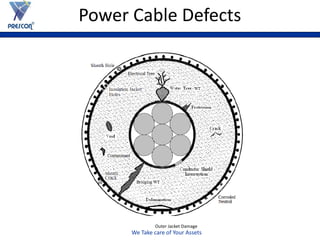
Power Cable Defects
Outer Jacket Damage
We Take care of Your Assets
Defects in Cables
Manufacturing Imperfections - Tend to increase
the local stress to either initial failure or higher
rates of aging:
 Voids
 Contaminants in insulations
 Poor application of shield material
 Protrusion on the shields
 Poor application of jackets
We Take care of Your Assets
Defects in Cables
Poor Workmanship - Tend to increase the local
stress leading to either early failure or higher
rates of aging:
 Cuts
 Contamination
 Missing applied components or connections
 Misalignment of accessories
We Take care of Your Assets
Defects in Cables
Aggressive Environment - Tends to reduce the
dielectric strength. The impact can be local if the
environment influence is local:
 Chemical attack
 Transformer oil leaks
 Floods
 Petrochemical spills
 Corrosion
We Take care of Your Assets
Defects in Cables
Overheating - Tends to reduce the dielectric
strength. The impact can be restricted to short
lengths (local) if the adverse thermal
environment is localized:
 Excessive conductor current for a given
environment and operating condition (global).
 Proximity to other cable circuits for short
distances (local).
We Take care of Your Assets
Defects in Cables
Mechanical – Tends to reduce the dielectric
strength. The impact can be restricted to short
lengths if the mechanical stress is localized:
 Damage during transportation (usually
localized)
 Excessive pulling tensions or sidewall bearing
pressures (can be localized or global)
 Damage from dig ins (local)
We Take care of Your Assets
Defects in Cables
Water Ingress – Tends to reduce the dielectric
strength and increase the stress in the area
surrounding the moisture:
 Normal migration through polymeric materials
 Breaks in seals or metallic sheaths
We Take care of Your Assets
Techniques to assess condition
• There is a wide range of techniques available for condition
assessment of High Voltage cables. Before we proceed
further, it is important to keep the following questions in
mind:
• Effectiveness – Does the technique do what is intended?
• Maturity – Has the technique been employed long enough
to assure its effectiveness.
• Accuracy – Does the technique deliver the correct
assessment
• Clarity – Does the technique provide actionable and clear
assessment
We Take care of Your Assets
Standards for Cable Installation,
Testing and Accessories
• IEC 62067, Power cables with extruded insulation and the
accessories for voltages above 150kV
• IEEE 400, Guide for Field Testing and Evaluation of the Insulation
of Shielded Power Cable Systems Rated 5 kV and Above
• IEEE 400.1, Guide for Field Testing of Laminated Dielectric,
Shielded Power Cable Systems Rated 5 kV and Above With High
Direct Current Voltage
• IEEE 400.2, Guide for Field Testing of Shielded Power Cable
Systems Using Very Low Frequency (VLF)(less than 1 Hz)
• IEEE 400.3, Guide for Partial Discharge Testing of Shielded Power
Cable Systems in a Field Environment
We Take care of Your Assets
Available Condition Assessment Technologies
and Brief Introduction
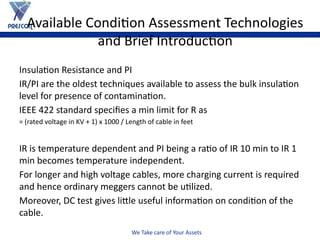
Insulation Resistance and PI
IR/PI are the oldest techniques available to assess the bulk insulation
level for presence of contamination.
IEEE 422 standard specifies a min limit for R as
= (rated voltage in KV + 1) x 1000 / Length of cable in feet
IR is temperature dependent and PI being a ratio of IR 10 min to IR 1
min becomes temperature independent.
For longer and high voltage cables, more charging current is required
and hence ordinary meggers cannot be utilized.
Moreover, DC test gives little useful information on condition of the
cable.
We Take care of Your Assets
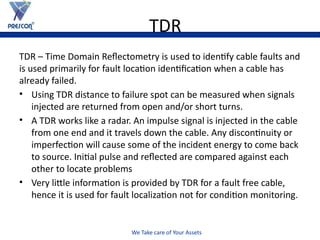
TDR
TDR – Time Domain Reflectometry is used to identify cable faults and
is used primarily for fault location identification when a cable has
already failed.
• Using TDR distance to failure spot can be measured when signals
injected are returned from open and/or short turns.
• A TDR works like a radar. An impulse signal is injected in the cable
from one end and it travels down the cable. Any discontinuity or
imperfection will cause some of the incident energy to come back
to source. Initial pulse and reflected are compared against each
other to locate problems
• Very little information is provided by TDR for a fault free cable,
hence it is used for fault localization not for condition monitoring.
We Take care of Your Assets
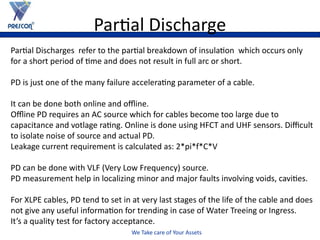
Partial Discharge
Partial Discharges refer to the partial breakdown of insulation which occurs only
for a short period of time and does not result in full arc or short.
PD is just one of the many failure accelerating parameter of a cable.
It can be done both online and offline.
Offline PD requires an AC source which for cables become too large due to
capacitance and votlage rating. Online is done using HFCT and UHF sensors. Difficult
to isolate noise of source and actual PD.
Leakage current requirement is calculated as: 2*pi*f*C*V
PD can be done with VLF (Very Low Frequency) source.
PD measurement help in localizing minor and major faults involving voids, cavities.
For XLPE cables, PD tend to set in at very last stages of the life of the cable and does
not give any useful information for trending in case of Water Treeing or Ingress.
It’s a quality test for factory acceptance.
We Take care of Your Assets
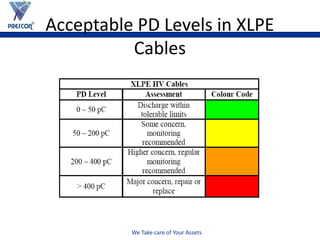
Acceptable PD Levels in XLPE
Cables
We Take care of Your Assets
Tan Delta
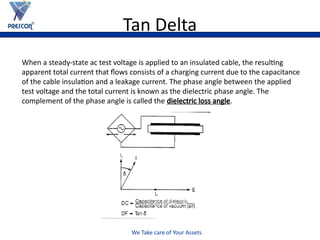
When a steady-state ac test voltage is applied to an insulated cable, the resulting
apparent total current that flows consists of a charging current due to the capacitance
of the cable insulation and a leakage current. The phase angle between the applied
test voltage and the total current is known as the dielectric phase angle. The
complement of the phase angle is called the dielectric loss angle.
We Take care of Your Assets
Tan Delta
Tan delta is helpful in assessing entire length of cable and gives
good information about bulk insulation quality. Detects water
trees.
However, as explained for PD, a high leakage current source
(tends to be heavy and bulky) is needed esp at power frequency
voltages. Recently in last decade or so, use of VLF source has
become a common practice esp in Americas. IEEE 400.2
standards specifies the application in detail.
At very low power factors (<10 percent), the dielectric power
factor is approximately equal to the dielectric dissipation factor.
That’s the reason this test is also known as Dielectric Dissipation
Factor.
We Take care of Your Assets
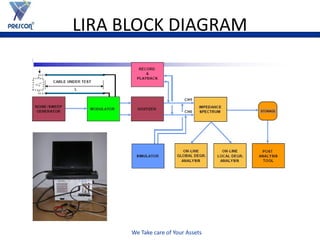
LIRA
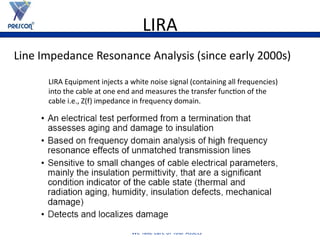
Line Impedance Resonance Analysis (since early 2000s)
LIRA Equipment injects a white noise signal (containing all frequencies)
into the cable at one end and measures the transfer function of the
cable i.e., Z(f) impedance in frequency domain.
We Take care of Your Assets
Cable Model
We Take care of Your Assets
LIRA
• LIRA Portable
• LIRA Portable is the proven test equipment used by Wirescan in service
missions in the harshest environments. Its features are:
• Sensitive to small degradations and cable defects
• Accurate location of cable degradations / defects
• Applicable to a wide range of cables and wires
• Applicable on multisegment systems with different cable types
• Non-destructive and non-intrusive
• Only one access point needed for measuring
• Fast and easy connection to test object
• Recording and playback for post analysis
• Detection of multiple faults / damages / failures, and their severity
• Pre-study / simulation of cable data and defects
We Take care of Your Assets
LIRA BLOCK DIAGRAM
We Take care of Your Assets
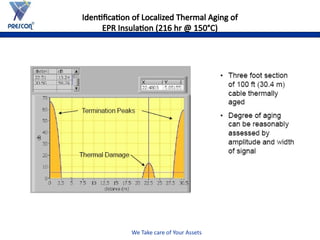
Identification of Localized Thermal Aging of
EPR Insulation (216 hr @ 150°C)

Presentation-Power-Cable-Condition-Assessment

  • 1.
    We Take careof Your Assets Power Cable Condition Assessment Techniques and Tools Irfan Akhtar
  • 2.
    We Take careof Your Assets Power Cable Defects Outer Jacket Damage
  • 3.
    We Take careof Your Assets Defects in Cables Manufacturing Imperfections - Tend to increase the local stress to either initial failure or higher rates of aging:  Voids  Contaminants in insulations  Poor application of shield material  Protrusion on the shields  Poor application of jackets
  • 4.
    We Take careof Your Assets Defects in Cables Poor Workmanship - Tend to increase the local stress leading to either early failure or higher rates of aging:  Cuts  Contamination  Missing applied components or connections  Misalignment of accessories
  • 5.
    We Take careof Your Assets Defects in Cables Aggressive Environment - Tends to reduce the dielectric strength. The impact can be local if the environment influence is local:  Chemical attack  Transformer oil leaks  Floods  Petrochemical spills  Corrosion
  • 6.
    We Take careof Your Assets Defects in Cables Overheating - Tends to reduce the dielectric strength. The impact can be restricted to short lengths (local) if the adverse thermal environment is localized:  Excessive conductor current for a given environment and operating condition (global).  Proximity to other cable circuits for short distances (local).
  • 7.
    We Take careof Your Assets Defects in Cables Mechanical – Tends to reduce the dielectric strength. The impact can be restricted to short lengths if the mechanical stress is localized:  Damage during transportation (usually localized)  Excessive pulling tensions or sidewall bearing pressures (can be localized or global)  Damage from dig ins (local)
  • 8.
    We Take careof Your Assets Defects in Cables Water Ingress – Tends to reduce the dielectric strength and increase the stress in the area surrounding the moisture:  Normal migration through polymeric materials  Breaks in seals or metallic sheaths
  • 9.
    We Take careof Your Assets Techniques to assess condition • There is a wide range of techniques available for condition assessment of High Voltage cables. Before we proceed further, it is important to keep the following questions in mind: • Effectiveness – Does the technique do what is intended? • Maturity – Has the technique been employed long enough to assure its effectiveness. • Accuracy – Does the technique deliver the correct assessment • Clarity – Does the technique provide actionable and clear assessment
  • 10.
    We Take careof Your Assets Standards for Cable Installation, Testing and Accessories • IEC 62067, Power cables with extruded insulation and the accessories for voltages above 150kV • IEEE 400, Guide for Field Testing and Evaluation of the Insulation of Shielded Power Cable Systems Rated 5 kV and Above • IEEE 400.1, Guide for Field Testing of Laminated Dielectric, Shielded Power Cable Systems Rated 5 kV and Above With High Direct Current Voltage • IEEE 400.2, Guide for Field Testing of Shielded Power Cable Systems Using Very Low Frequency (VLF)(less than 1 Hz) • IEEE 400.3, Guide for Partial Discharge Testing of Shielded Power Cable Systems in a Field Environment
  • 11.
    We Take careof Your Assets Available Condition Assessment Technologies and Brief Introduction Insulation Resistance and PI IR/PI are the oldest techniques available to assess the bulk insulation level for presence of contamination. IEEE 422 standard specifies a min limit for R as = (rated voltage in KV + 1) x 1000 / Length of cable in feet IR is temperature dependent and PI being a ratio of IR 10 min to IR 1 min becomes temperature independent. For longer and high voltage cables, more charging current is required and hence ordinary meggers cannot be utilized. Moreover, DC test gives little useful information on condition of the cable.
  • 12.
    We Take careof Your Assets TDR TDR – Time Domain Reflectometry is used to identify cable faults and is used primarily for fault location identification when a cable has already failed. • Using TDR distance to failure spot can be measured when signals injected are returned from open and/or short turns. • A TDR works like a radar. An impulse signal is injected in the cable from one end and it travels down the cable. Any discontinuity or imperfection will cause some of the incident energy to come back to source. Initial pulse and reflected are compared against each other to locate problems • Very little information is provided by TDR for a fault free cable, hence it is used for fault localization not for condition monitoring.
  • 13.
    We Take careof Your Assets Partial Discharge Partial Discharges refer to the partial breakdown of insulation which occurs only for a short period of time and does not result in full arc or short. PD is just one of the many failure accelerating parameter of a cable. It can be done both online and offline. Offline PD requires an AC source which for cables become too large due to capacitance and votlage rating. Online is done using HFCT and UHF sensors. Difficult to isolate noise of source and actual PD. Leakage current requirement is calculated as: 2*pi*f*C*V PD can be done with VLF (Very Low Frequency) source. PD measurement help in localizing minor and major faults involving voids, cavities. For XLPE cables, PD tend to set in at very last stages of the life of the cable and does not give any useful information for trending in case of Water Treeing or Ingress. It’s a quality test for factory acceptance.
  • 14.
    We Take careof Your Assets Acceptable PD Levels in XLPE Cables
  • 15.
    We Take careof Your Assets Tan Delta When a steady-state ac test voltage is applied to an insulated cable, the resulting apparent total current that flows consists of a charging current due to the capacitance of the cable insulation and a leakage current. The phase angle between the applied test voltage and the total current is known as the dielectric phase angle. The complement of the phase angle is called the dielectric loss angle.
  • 16.
    We Take careof Your Assets Tan Delta Tan delta is helpful in assessing entire length of cable and gives good information about bulk insulation quality. Detects water trees. However, as explained for PD, a high leakage current source (tends to be heavy and bulky) is needed esp at power frequency voltages. Recently in last decade or so, use of VLF source has become a common practice esp in Americas. IEEE 400.2 standards specifies the application in detail. At very low power factors (<10 percent), the dielectric power factor is approximately equal to the dielectric dissipation factor. That’s the reason this test is also known as Dielectric Dissipation Factor.
  • 17.
    We Take careof Your Assets LIRA Line Impedance Resonance Analysis (since early 2000s) LIRA Equipment injects a white noise signal (containing all frequencies) into the cable at one end and measures the transfer function of the cable i.e., Z(f) impedance in frequency domain.
  • 18.
    We Take careof Your Assets Cable Model
  • 19.
    We Take careof Your Assets LIRA • LIRA Portable • LIRA Portable is the proven test equipment used by Wirescan in service missions in the harshest environments. Its features are: • Sensitive to small degradations and cable defects • Accurate location of cable degradations / defects • Applicable to a wide range of cables and wires • Applicable on multisegment systems with different cable types • Non-destructive and non-intrusive • Only one access point needed for measuring • Fast and easy connection to test object • Recording and playback for post analysis • Detection of multiple faults / damages / failures, and their severity • Pre-study / simulation of cable data and defects
  • 20.
    We Take careof Your Assets LIRA BLOCK DIAGRAM
  • 21.
    We Take careof Your Assets Identification of Localized Thermal Aging of EPR Insulation (216 hr @ 150°C)