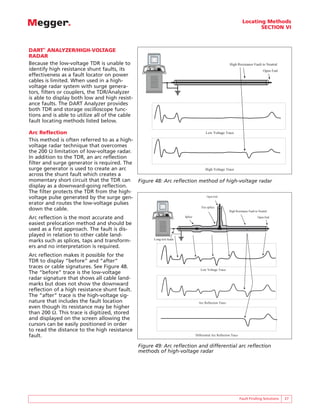
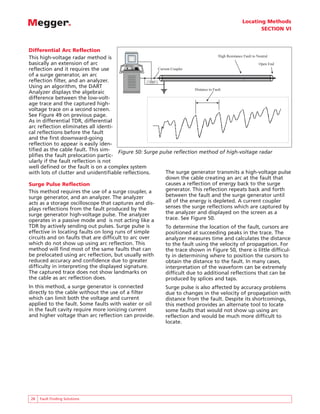
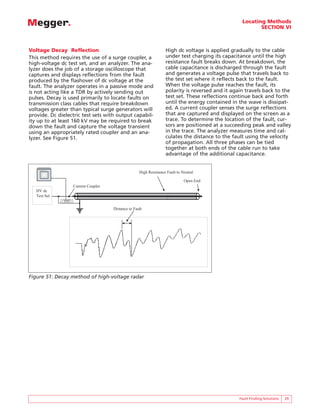
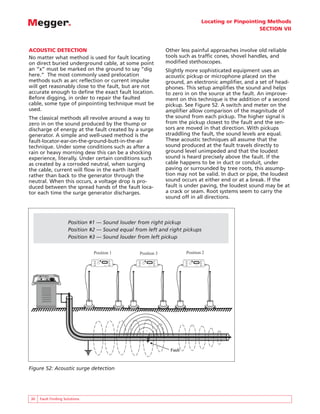
FAULT FINDING
   SOLUTIONS


            WWW.MEGGER.COM
Table of Contents


Section                                                                                  Page             Section                                                                                                       Page
I     Cable Characteristics                                                                               V    Surge Generators, Filters and Couplers
      Good Cable Insulation . . . . . . . . . . . . . . . . . . . .2                                           Surge Generators         .   .   .   .   .   .   .   .   .   .   .   .   .   .   .   .   .   .   .   .   .   .   .19
      When Cable Insulation is Bad . . . . . . . . . . . . . .2                                                  Energy . . . . . .     .   .   .   .   .   .   .   .   .   .   .   .   .   .   .   .   .   .   .   .   .   .   .19
       Why a cable becomes bad . . . . . . . . . . . . . . .3                                                    Capacitance . .        .   .   .   .   .   .   .   .   .   .   .   .   .   .   .   .   .   .   .   .   .   .   .20
      Cable Faults Described . . . . . . . . . . . . . . . . . . . .3                                            Voltage . . . . . .    .   .   .   .   .   .   .   .   .   .   .   .   .   .   .   .   .   .   .   .   .   .   .20
                                                                                                               Basic Surge Generator Operation                                              .   .   .   .   .   .   .   .   .   .21
II    Fault Locating Procedures
                                                                                                                 Proof/Burn . . . . . . . . . . . . . . . .                                 .   .   .   .   .   .   .   .   .   .21
      Locate Faults in Buried Primary Cable                              .   .   .   .   .   .   .   .4          Surge . . . . . . . . . . . . . . . . . . . .                              .   .   .   .   .   .   .   .   .   .21
        Test the cable . . . . . . . . . . . . . . . . .                 .   .   .   .   .   .   .   .4
                                                                                                                 Ground . . . . . . . . . . . . . . . . . . .                               .   .   .   .   .   .   .   .   .   .21
        Fault resistance and loop test . . . .                           .   .   .   .   .   .   .   .4
        TDR tests . . . . . . . . . . . . . . . . . . . . .              .   .   .   .   .   .   .   .5        Single Point Grounding . . . . . . . . . . . . . . . . . .22
        DC hipot test . . . . . . . . . . . . . . . . .                  .   .   .   .   .   .   .   .5        Arc Reflection Filters and Couplers . . . . . . . . .22
      Analyze the Data . . . . . . . . . . . .           .   .   .   .   .   .   .   .   .   .   .   .5   VI   Localizing Methods
        Fault resistance and loop test                   .   .   .   .   .   .   .   .   .   .   .   .5        Overview . . . . . . . . . . . . . . . . . . . . . . . . .                                           .   .   .   .24
        TDR tests . . . . . . . . . . . . . . . . .      .   .   .   .   .   .   .   .   .   .   .   .6          Sectionalizing . . . . . . . . . . . . . . . . . . . .                                             .   .   .   .24
        DC Hipot test . . . . . . . . . . . . .          .   .   .   .   .   .   .   .   .   .   .   .6          Resistance ratio . . . . . . . . . . . . . . . . . .                                               .   .   .   .24
        Cable Route . . . . . . . . . . . . . .          .   .   .   .   .   .   .   .   .   .   .   .6          Electromagnetic surge detection . . . . .                                                          .   .   .   .25
      Localize - prelocate the fault . . . . . . . . . . . . . . .6                                                Single phase, coaxial power cable
                                                                                                                   with neutral bridges over splices . . .                                                          . . . .25
      Locate - pinpoint the fault . . . . . . . . . . . . . . . .6
                                                                                                                   Single phase PILC cable with bonded
      Locate Faults in Above Ground                                                                                grounds in conduit . . . . . . . . . . . . . .                                                   . . . .26
      Primary Cable . . . . . . . . . . . . . . . . . . . . . . . . . . .6                                         Three-phase PILC . . . . . . . . . . . . . . . .                                                 . . . .26
III   Cable Route Tracers/Locators                                                                             DART Analyzer/High-Voltage Radar                                                     .   .   .   .   .   .   .   .27
      Overview . . . . . . . . . . . . . . . . . . . . . . . . . . . . . .7                                     Arc reflection . . . . . . . . . . . . . . . .                                      .   .   .   .   .   .   .   .27
      Selecting a Locator . . . . . . . . . . . . . . . . . . . . . .8                                          Differential arc reflection . . . . . . .                                           .   .   .   .   .   .   .   .28
      Hookups . . . . . . . . . . . . . . . . . . . . . . . . . . . . . . .9                                    Surge pulse reflection . . . . . . . . .                                            .   .   .   .   .   .   .   .28
      Using the Receiver . . . . . . . . . . . . . . . . . . . . . .10                                          Voltage decay reflection . . . . . . .                                              .   .   .   .   .   .   .   .29

IV    How to See Underground Cable Problems                                                               VII Locating or Pinpointing Methods
      Methods of Operation . . . . . . . . . . . . . . . . . . .12                                             Acoustic Detection . . . . . . . . . . . . . . . . . . . . . .30
       Time domain reflectometry . . . . . . . . . . . . .12                                                   Electromagnetic Surge Detection . . . . . . . . . .31
       Differential TDR/radar . . . . . . . . . . . . . . . . .13                                              Electromagnetic/Acoustic Surge Detection . . .31
      Descriptions and Applications . .                  . . . . . . . . . . .13                               Earth Gradient . . . . . . . . . . . . . . . . . . . . . . . . .33
        Low-voltage TDR/cable radar .                    . . . . . . . . . . .13
                                                                                                          VIII Solutions for Cable Fault Locating
        Faults that a low-voltage
        TDR will display . . . . . . . . . . .           . . . . . . . . . . .13                               Underground Utility Locating
                                                                                                               and Tracing Equipment . . . . . . . . . . . . . . . . . .34
        Landmarks that a low-voltage
        TDR will display . . . . . . . . . . .           . . . . . . . . . . .13                               Time Domain Reflectometers . . . . . . . . . . . . . .35
      Controls and Inputs to the TDR                 .   .   .   .   .   .   .   .   .   .   .   .14           Cable Fault Pinpointing Equipment . . . . . . . . .36
        Velocity of propagation . . . .              .   .   .   .   .   .   .   .   .   .   .   .14           High-Voltage DC Dielectric Test Sets . . . . . . . .37
        Range . . . . . . . . . . . . . . . . . .    .   .   .   .   .   .   .   .   .   .   .   .16           Suitcase Impulse Generator . . . . . . . . . . . . . . .37
        Gain . . . . . . . . . . . . . . . . . . .   .   .   .   .   .   .   .   .   .   .   .   .16           Cable Analyzer . . . . . . . . . . . . . . . . . . . . . . . . .38
        Cursors . . . . . . . . . . . . . . . . .    .   .   .   .   .   .   .   .   .   .   .   .16           Power Fault Locators . . . . . . . . . . . . . . . . . . . .38
        Zoom . . . . . . . . . . . . . . . . . .     .   .   .   .   .   .   .   .   .   .   .   .16
                                                                                                               Impulse Generators . . . . . . . . . . . . . . . . . . . . .40
        Pulse width . . . . . . . . . . . . . .      .   .   .   .   .   .   .   .   .   .   .   .16
      Distance Measurements . . . . . . . . . . . . . . . . . .17
        Three-stake method . . . . . . . . . . . . . . . . . . .17


      Fault Finding Solutions
Table of Figures


Figure                                                               Page       Figure                                                            Page
1        Good insulation . . . . . . . . . . . . . . . . . . . . . . .2         28       TDR used to measure distance to
                                                                                         open in conductor . . . . . . . . . . . . . . . . . . . .16
2        Equivalent circuit of good cable . . . . . . . . . .2
                                                                                29       TDR used to localize distance to splice . . . .17
3        Bad insulation . . . . . . . . . . . . . . . . . . . . . . . .2
                                                                                30       TDR used to localize distance to T-tap . . . . .18
4        Ground or shunt fault on the cable . . . . . . . .3
                                                                                31       TDR used to localize distance to
5        Fault region simplified diagram . . . . . . . . . . .3                          fault relative to a landmark . . . . . . . . . . . . .18
6        Open or series fault on the cable . . . . . . . . . .3                 32       Three-stake method . . . . . . . . . . . . . . . . . . .18
7        Test for insulation (fault) resistance                                 33       Block diagram of surge generator . . . . . . . .19
         using a Megger® insulation tester . . . . . . . . .4
                                                                                34       Energy vs. voltage for a 4-µF, 25-kV
8        Loop test for continuity using a                                                surge generator . . . . . . . . . . . . . . . . . . . . . .19
         Megger insulation tester . . . . . . . . . . . . . . . .4
                                                                                35       Energy vs. voltage for a 12-µF, 16-kV
9        TDR test for cable length . . . . . . . . . . . . . . . .5                      surge generator . . . . . . . . . . . . . . . . . . . . . .20
10       TDR test for continuity . . . . . . . . . . . . . . . . . .5           36       Energy vs. voltage for a constant
11       How cable locators work . . . . . . . . . . . . . . . .7                        energy 12-µF, 16/32-kV surge generator . . .20
12       Cable under test . . . . . . . . . . . . . . . . . . . . . . .7        37       Acoustic shock wave from arcing fault . . . .21
13       Using an ohmmeter to measure                                           38       Single point grounding . . . . . . . . . . . . . . . .22
         resistance of the circuit . . . . . . . . . . . . . . . . .8           39       Inductive arc reflection diagram . . . . . . . . .23
14       Hookup showing ground rod at                                           40       Resistive arc reflection diagram . . . . . . . . . .23
         far end of cable under test . . . . . . . . . . . . . .9
                                                                                41       Sectionalizing method . . . . . . . . . . . . . . . . .24
15       Hookup with far end of cable
         under test isolated . . . . . . . . . . . . . . . . . . . . .9         42       Basic Wheatstone Bridge . . . . . . . . . . . . . . .24
16       Current coupler connection to                                          43       Murray Loop Bridge application . . . . . . . . .24
         neutral on primary jacketed cable . . . . . . . . .9
                                                                                44       Application of Bridge/TDR . . . . . . . . . . . . . .25
17       Inductive coupling to neutral on
         primary jacketed cable . . . . . . . . . . . . . . . . .10             45       Coaxial power cable with neutral
                                                                                         bridges over splices . . . . . . . . . . . . . . . . . . .25
18       Use of return wire to
         improve current loop . . . . . . . . . . . . . . . . . .10             46       Electromagnetic detection in single-phase
                                                                                         PILC cable with bonded grounds . . . . . . . . .26
19       Circling path with receiver . . . . . . . . . . . . . .10
                                                                                47       Electromagnetic detection of faults on
20       No interference, no offset between                                              three-phase power cable . . . . . . . . . . . . . . .26
         magnetic field center and center
         of cable . . . . . . . . . . . . . . . . . . . . . . . . . . . . .11   48       Arc reflection method of HV radar . . . . . . .27

21       Depth measurement using null method                                    49       Arc reflection and differential arc
         with antenna at 45-degree angle . . . . . . . .11                               reflection methods of HV radar . . . . . . . . . .27

22       Offset caused by interference from                                     50       Surge pulse reflection method
         nontarget cable . . . . . . . . . . . . . . . . . . . . . .11                   of HV radar . . . . . . . . . . . . . . . . . . . . . . . . . .28

23       Aircraft radar . . . . . . . . . . . . . . . . . . . . . . . .12       51       Decay method of HV radar . . . . . . . . . . . . .29

24       TDR reflections from perfect cable . . . . . . .13                     52       Acoustic surge detection . . . . . . . . . . . . . . .30

25       TDR used to measure length of cable                                    53       Electromagnetic pinpointing . . . . . . . . . . . .31
         with far end open . . . . . . . . . . . . . . . . . . . .14            54       Acoustic/electromagnetic pinpointing . . . . .32
26       TDR used to measure length of cable                                    55       SD-3000 display at positions 1, 2, & 3 . . . . .33
         with far end shorted . . . . . . . . . . . . . . . . . .14
                                                                                56       AC voltage gradient . . . . . . . . . . . . . . . . . . .33
27       TDR measuring distance to a
         low-resistance fault to ground . . . . . . . . . . .15                 57       DC voltage gradient . . . . . . . . . . . . . . . . . . .33


                                                                                                                           Fault Finding Solutions     1
Cable Characteristics
                                                                                                SECTION I


GOOD CABLE INSULATION                                    WHEN CABLE INSULATION IS BAD
When voltage is impressed across any insulation          When the magnitude of the leakage current
system, some current leaks into, through, and            exceeds the design limit, the cable will no longer
around the insulation. When testing with dc high-        deliver energy efficiently. See Figure 3.
voltage, capacitive charging current, insulation
absorption current, insulation leakage current, and      Why A Cable Becomes Bad
by-pass current are all present to some degree. For      All insulation deteriorates naturally with age,
the purposes of this document on cable fault             especially when exposed to elevated temperature
locating, only leakage current through the insula-       due to high loading and even when it is not physi-
tion will be considered.                                 cally damaged. In this case, there is a distributed
For shielded cable, insulation is used to limit cur-     flow of leakage current during a test or while
rent leakage between the phase conductor and             energized. Many substances such as water, oil and
ground or between two conductors of differing            chemicals can contaminate and shorten the life of
potential. As long as the leakage current does not       insulation and cause serious problems. Cross-linked
exceed a specific design limit, the cable is judged      polyethylene (XLPE) insulation is subject to a con-
good and is able to deliver electrical energy to a       dition termed treeing. It has been found that the
load efficiently.                                        presence of moisture containing contaminants,
                                                         irregular surfaces or protrusions into the insulation
Cable insulation may be considered good when             plus electrical stress provides the proper environ-
leakage current is negligible but since there is no      ment for inception and growth of these trees
perfect insulator even good insulation allows some       within the polyethylene material. Testing indicates
small amount of leakage current measured in              that the ac breakdown strength of these treed
microamperes. See Figure 1.                              cables is dramatically reduced. Damage caused by
                                                         lightning, fire, or overheating may require replace-
                                                         ment of the cable to restore service.
 µAmps


                                                                      Inductance        Series Resistance

                                                                          L                    RS
     HV
     Test
     Set
                                                         Z0           Capacitance        Parallel           Z0
                                                                          C             Resistance
                                                                                           RP
Figure 1: Good insulation


The electrical equivalent circuit of a good run of
cable is shown in Figure 2. If the insulation were       Figure 2: Equivalent circuit of good cable
perfect, the parallel resistance RP would not exist
and the insulation would appear as strictly capaci-
tance. Since no insulation is perfect, the parallel or
insulation resistance exists. This is the resistance
measured during a test using a Megger® Insulation             mAmps

Tester. Current flowing through this resistance is
measured when performing a dc hipot test as
shown in Figure 1. The combined inductance (L),
series resistance (RS), capacitance (C) and parallel
resistance (RP) as shown in Figure 2 is defined as                HV
                                                                  Test
the characteristic impedance (Z0) of the cable.                   Set


                                                         Figure 3: Bad insulation


 2   Fault Finding Solutions
Cable Characteristics
                                                                                            SECTION I


CABLE FAULTS DESCRIBED                                                            Phase Conductor
When at some local point in a cable, insulation has
deteriorated to a degree that a breakdown occurs
allowing a surge of current to ground, the cable is
referred to as a faulted cable and the position of        Spark Gap
maximum leakage may be considered a cata-                     G
strophic insulation failure. See Figure 4. At this                                     Fault Resistance
location the insulation or parallel resistance has                                            RF
been drastically reduced and a spark gap has
developed. See Figure 5.
Occasionally a series fault shown in Figure 6 can
develop due to a blown open phase conductor
caused by high fault current, a dig-in or a failed                               Shield or Neutral
splice.
                                                      Figure 5: Fault region simplified diagram


 mAmps
                                                                      Spark Gap
                                                                          G        Phase Conductor


     HV
     Test                  Fault                                    Fault Resistance
     Set
                                                                           RF


Figure 4: Ground or shunt fault on the cable

                                                                                   Shield or Neutral

                                                      Figure 6: Open or series fault on the cable


                                                                                    Fault Finding Solutions   3
Fault Locating Procedures
                                                                                                          SECTION II


LOCATE FAULTS IN BURIED PRIMARY CABLE                             ■   At end A, connect the instrument between each
After all clearances have been obtained and the                       of the other phase conductors, if any, and
cable has been isolated in preparation for cable                      ground and record the insulation resistance
fault locating, it is strongly recommended that a                     readings.
fixed plan of attack be followed for locating the                 ■    After connecting a short between the phase and
fault. As in diagnosing any complex problem, fol-                     neutral at end B (Figure 8), do a loop test for
lowing a set step-by-step procedure will help in                      continuity at end A using the ohms or continuity
arriving at the solution or, in this case, pinpointing                range on the instrument. If a reading of greater
the fault efficiently.                                                than 10 ohms is obtained when the cable has a
At the very start, it is a good idea to gather as                     concentric neutral, test the conductor and neu-
much information as possible about the cable                          tral independently by using a nearby good cable
under test. Information that will help in the fault                   as a return path. This will help to determine
locating process is:                                                  whether it is the conductor or neutral that is
                                                                      the problem. A reading in the hundreds of ohms
■   Cable type — is it lead covered, concentric neu-                  is a good indication of corroded neutral if work-
    tral (bare or jacketed), tape shield?                             ing on a bare concentric-type cable. If no nearby
■   Insulation type — is it XLPE, EPR, Paper?                         good cable is available, use a long insulated con-
                                                                      ductor to complete the loop from end B. If a
■   Conductor and size — is it CU, AL, stranded,                      reading of infinity is measured either the phase
    solid, 2/0, 350 MCM?                                              conductor or the neutral is completely open
■   Length of the run — how long is it?                               between end A and end B which could be
                                                                      caused by a dig-in or a fault that has blown
■   Splices — are there splices, are the locations                    open the phase conductor.
    known?
                                                                  ■   Repeat all tests from end B and record all
■   T-taps or wye splices — are there any taps, are                   readings.
    the locations known, how long are branches?
After obtaining the cable description the acronym
“TALL” can help you remember the procedure for
finding cable faults in buried cable.

         TEST        ANALYZE LOCALIZE
                       LOCATE
                                                                       End A                                                   End B
TEST THE CABLE                                       MEGGER
                                                     Insulation
Fault Resistance and Loop Test                       Tester

Although most faults occur between phase
                                                                                           Fault
and ground, series opens also occur such as
a blown open splice or a dig-in. Phase-to-
phase faults can also occur on multi- phase
runs. Helpful information can be gathered
                                                     Figure 7: Test for insulation (fault) resistance using a
with a Megger® Insulation Tester that has            Megger® insulation tester
both megohm and an ohm (continuity)
range.
Make a series of measurements as follows:
                                                                       End A                                            End B
■   At end A, connect the instrument                 MEGGER
    between the faulted conductor and                Insulation
                                                     Tester
    ground as shown in Figure 7. Using an
    insulation resistance range, measure and                                              Fault
    record this resistance reading.
                                                                                           Shorting Strap or Grounding Elbow


                                                     Figure 8: Loop test for continuity using a Megger® insulation
                                                     tester


    4   Fault Finding Solutions
Fault Locating Procedures
                                                                                                    SECTION II


TDR Tests
                                                                         End A                                                End B
Refer to Section IV for details on the use of the
Time Domain Reflectometer.
                                                             TDR
■   At end A, connect a TDR or DART® Cable
                                                                                          Fault
    Analyzer (use the TDR mode) between the fault-
    ed conductor and neutral or shield as shown in
    Figure 9. Look for an upward reflection from the
    open end of the cable and measure the length
    to the open using the cursors.
                                                            Figure 9: TDR test for cable length
■   After connecting a short between phase and
    neutral at end B (Figure 10), look for the down-
    ward indication of a short circuit at the cable
    end on the TDR. If the TDR shows an alternating                      End A                                         End B
    open and short when alternately removing and
    applying the ground at the end of the cable, the         TDR

    phase and shield are continuous to the cable
                                                                                         Fault
    end. If the short does not appear on the TDR
    and a high resistance was read during the loop                                        Shorting Strap or Grounding Elbow
    test, either the phase or shield is open at some
    point before the cable end.
■   If a downward reflection is observed on the TDR         Figure 10: TDR test for continuity
    and the fault resistance measured less than
    200 Ω in the test, the fault has been found. If a
    downward reflection is observed on the TDR and          If tests indicate insulation (fault) resistance values
    the fault resistance measured greater than 200 Ω        less than 10 ohms, it may not be possible to create
    in the test, there is likely a T-tap or wye splice at   a flashover at the fault site when surge generator
    that location.                                          methods are used. This type of fault is often
                                                            referred to as a bolted fault. A TDR can be used to
DC Hipot Test                                               locate this type of fault.
After a surge generator is connected to the cable
under test, do a quick dc proof test to be sure the         If a measurement of very low resistance in ohms is
cable is faulted and will not hold voltage. Make a          made from one end and a high resistance in
note of the kilovolt measurement when the fault             megohms from the other end, it is likely that the
breaks down. This will be an indicator of what              phase conductor or a splice is blown open.
voltage will be required when surging in order              If the loop test indicates a resistance reading in
break down the fault when doing prelocation or              the 10 to 1000 ohm range and particularly if the
pinpointing. If there are transformers connected            reading varies during the measurement, there is
to the cable under test, a proof test will always           very likely neutral corrosion on the cable. This
indicate a failure due to the low resistance path to        could affect success when performing localizing
ground through the transformer primary winding.             and locating procedures. If the loop test measure-
A dc proof test in this case is not a valid test.           ment is infinity, indicating an open circuit, either
                                                            the phase conductor or a splice has blown open or
ANALYZE THE DATA                                            a dig-in has occurred.
Fault Resistance and Loop Test                              TDR Tests
If the insulation resistance of the faulted conduc-         If the TDR tests indicate a shorter than expected
tor is less than 50 Ω or more than one MΩ, the              cable length with no change of reflections when a
fault will be relatively easy to prelocate but may          short is applied to the cable end there is likely a
be difficult to pinpoint. For values between 50 Ω           blown open splice or phase conductor or a dig-in
and 1 MΩ, the fault may be more difficult to                has occurred. If the TDR tests indicate a longer
locate. Some reasons for the difficulty with these          than expected cable run, a thorough route trace
faults is the possible presence of oil or water in          may be in order to detect additional cable not
the faulted cavity or the presence of multiple              indicated on maps.
faults.


                                                                                             Fault Finding Solutions             5
Fault Locating Procedures
                                                                                               SECTION II


DC Hipot Test                                           Voltage gradient test sets are effective in pinpoint-
                                                        ing faults on direct-buried secondary cable but the
If the cable holds voltage during the dc hipot test,
                                                        method depends on the fault existing between
the cable may be good. If the cable is faulted,
                                                        conductor and earth. When the cable is in conduit,
burning may be required to reduce the breakdown
                                                        a different method must be used. When a single
voltage required when surging or you have con-
                                                        conductor is contained within a plastic conduit,
nected to the wrong phase.
                                                        shorts cannot occur unless water gains access
                                                        through a crack or other entry point. When a fault
Cable Route                                             develops, leakage current flows from the conduc-
At this point, it is recommended that the cable         tor through the break in insulation, and then fol-
route be determined or confirmed by consulting          lows the water to the break in the conduit to
accurate maps or actually tracing the cable route.      earth. If voltage gradient is used, the location of
See Section III. When attempting to localize or         the crack in the conduit could be found, but the
locate the cable fault, prelocation measurements        location of the fault in the insulation would
and pinpointing techniques must be made over            remain unknown.
the actual cable path. Being off the route by as lit-
tle as a few feet may make the locate an extreme-       LOCATE FAULTS IN ABOVE GROUND PRIMARY
ly difficult and time-consuming process.                CABLE
                                                        Some faults can be found by searching for obvious
LOCALIZE - PRELOCATE THE FAULT                          physical damage to the cable especially if the cable
Selection of a localizing technique is based, at        section is short. If necessary, connect a surge gen-
least in part, on the character of the fault. Several   erator and walk the cable and listen for the dis-
techniques are fully described in Section VI. They      charge. If the cable is very long it might take a
are as follows:                                         good deal of time to walk the cable while the
■   Sectionalizing                                      surge generator is on. To reduce the total time
                                                        spent and to minimize high-voltage exposure to
■   Bridge — single faults                              the cable, use a localizing technique before
■   TDR/low-voltage radar — faults measuring less       attempting to pinpoint the fault.
    than 200 Ω and all opens                            Once the fault is localized, a listening aid is used
■   High-voltage radar methods — all faults arc         to zero in on the thump that occurs when the
    reflection, surge pulse reflection and decay        surge generator breaks down the fault. For metal-
                                                        to-metal (bolted) faults on non-buried cable, an
■   Electromagnetic impulse detection — all shorts      electromagnetic impulse detector may help to pin-
    and some opens                                      point the fault. The use of electromagnetic
                                                        impulse detectors is discussed in detail in Section
LOCATE - PINPOINT THE FAULT                             VI.
Locating, often referred to as pinpointing, is nec-
essary before digging up direct buried cable. After
the fault has been localized, a surge generator is
connected to one end of the faulted cable and
then listening in the localized area for the telltale
thump from the fault. When the thump is not loud
enough to hear, it may be necessary to use a surge
detector or an acoustic impulse detector to pin-
point the fault.


    6   Fault Finding Solutions
Cable Route Tracers/Cable Locators
                                                                                                               SECTION III


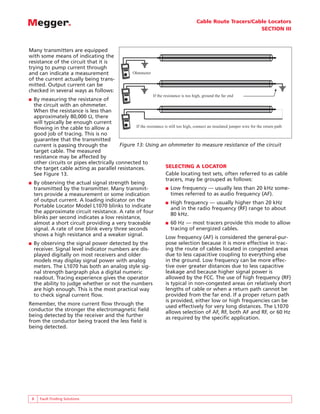
OVERVIEW                                                             ■   Is the cable shielded or unshielded?
Before attempting to locate underground cable                        ■   Is the cable direct buried or in conduit?
faults on direct buried primary cable, it is neces-
sary to know where the cable is located and what                     ■   Are there metal pipes or other underground
route it takes. If the fault is on secondary cable,                      structures under, over or near the target cable?
knowing the exact route is even more critical.                       ■   Is the target cable connected to other cables or
Since it is extremely difficult to find a cable fault                    pipes through grounded neutrals?
without knowing where the cable is, it makes
sense to master cable locating and tracing and to                    This information will help to select the most
do a cable trace before beginning the fault locat-                   appropriate locator and to prepare to locate the
ing process.                                                         cable successfully. See Figure 12.
Success in locating or tracing the route of electrical
cable and metal pipe depends upon knowledge,
skill, and perhaps, most of all,
experience. Although locating can                                                    Receiver Antenna
be a complex job, it will very likely                                                                     Electromagnetic Field
                                                   AC Current Flow
become even more complex as                                                                               Produced by Current Flow
more and more underground              Transmitter
plant is installed. It is just as
important to understand how the
equipment works as it is to be
thoroughly familiar with the exact
equipment being used.
                                                                             Nearby Cables and/or Pipes
All popular locators/tracers consist
of two basic modules:
The transmitter — an ac generator
                                              Current Return Paths
which supplies the signal current
on the underground cable or pipe
to be traced.                              Figure 11: How cable locators work
The receiver — detects the electro-
magnetic field produced by the
transmitted ac current flow. See
Figure 11.                                           Interfering Cables and Pipes

Before starting, it will be helpful
to obtain the following informa-
tion:
                                            Cable to be traced
■   What type of cable is it?
■   Is the cable the same type all the
    way along its length?                                                                                    Tee or Wye Splice

■   Is the target cable the only cable
    in the trench?
■   Are there any taps?
■   Is the cable run single phase or       Figure 12: Cable under test
    multiphase?


7   MEGGER
                                                                                                             Fault Finding Solutions   7
Cable Route Tracers/Cable Locators
                                                                                                                 SECTION III


Many transmitters are equipped
with some means of indicating the
resistance of the circuit that it is
trying to pump current through
and can indicate a measurement                       Ohmmeter
of the current actually being trans-
mitted. Output current can be
checked in several ways as follows:
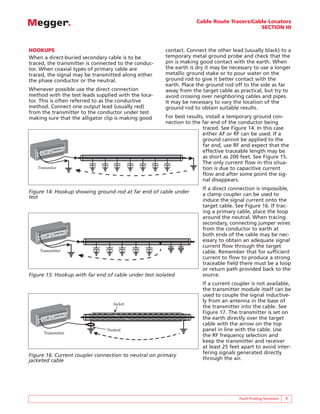
                                                                If the resistance is too high, ground the far end
■ By measuring the resistance of
  the circuit with an ohmmeter.
  When the resistance is less than
  approximately 80,000 Ω, there
  will typically be enough current
  flowing in the cable to allow a              If the resistance is still too high, connect an insulated jumper wire for the return path
  good job of tracing. This is no
  guarantee that the transmitted
  current is passing through the        Figure 13: Using an ohmmeter to measure resistance of the circuit
  target cable. The measured
  resistance may be affected by
  other circuits or pipes electrically connected to
  the target cable acting as parallel resistances.                SELECTING A LOCATOR
  See Figure 13.                                                  Cable locating test sets, often referred to as cable
                                                                  tracers, may be grouped as follows:
■ By observing the actual signal strength being
  transmitted by the transmitter. Many transmit-                  ■ Low frequency — usually less than 20 kHz some-
  ters provide a measurement or some indication                      times referred to as audio frequency (AF).
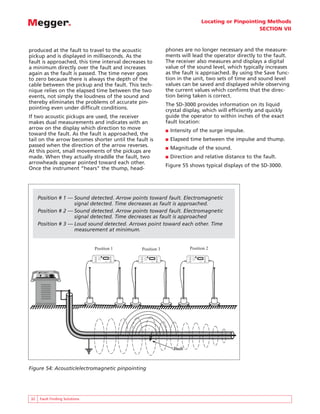
  of output current. A loading indicator on the                   ■ High frequency — usually higher than 20 kHz
  Portable Locator Model L1070 blinks to indicate                    and in the radio frequency (RF) range to about
  the approximate circuit resistance. A rate of four                 80 kHz.
  blinks per second indicates a low resistance,
  almost a short circuit providing a very traceable               ■ 60 Hz — most tracers provide this mode to allow
  signal. A rate of one blink every three seconds                    tracing of energized cables.
  shows a high resistance and a weaker signal.
                                                                  Low frequency (AF) is considered the general-pur-
■ By observing the signal power detected by the                   pose selection because it is more effective in trac-
  receiver. Signal level indicator numbers are dis-               ing the route of cables located in congested areas
  played digitally on most receivers and older                    due to less capacitive coupling to everything else
  models may display signal power with analog                     in the ground. Low frequency can be more effec-
  meters. The L1070 has both an analog style sig-                 tive over greater distances due to less capacitive
  nal strength bargraph plus a digital numeric                    leakage and because higher signal power is
  readout. Tracing experience gives the operator                  allowed by the FCC. The use of high frequency (RF)
  the ability to judge whether or not the numbers                 is typical in non-congested areas on relatively short
  are high enough. This is the most practical way                 lengths of cable or when a return path cannot be
  to check signal current flow.                                   provided from the far end. If a proper return path
                                                                  is provided, either low or high frequencies can be
Remember, the more current flow through the                       used effectively for very long distances. The L1070
conductor the stronger the electromagnetic field                  allows selection of AF, RF, both AF and RF, or 60 Hz
being detected by the receiver and the further                    as required by the specific application.
from the conductor being traced the less field is
being detected.


    8   Fault Finding Solutions
Cable Route Tracers/Cable Locators
                                                                                                              SECTION III


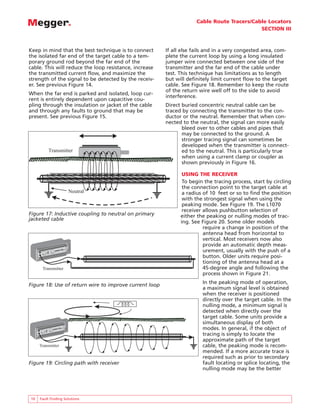
HOOKUPS                                                                   contact. Connect the other lead (usually black) to a
When a direct-buried secondary cable is to be                             temporary metal ground probe and check that the
traced, the transmitter is connected to the conduc-                       pin is making good contact with the earth. When
tor. When coaxial types of primary cable are                              the earth is dry it may be necessary to use a longer
traced, the signal may be transmitted along either                        metallic ground stake or to pour water on the
the phase conductor or the neutral.                                       ground rod to give it better contact with the
                                                                          earth. Place the ground rod off to the side as far
Whenever possible use the direct connection                               away from the target cable as practical, but try to
method with the test leads supplied with the loca-                        avoid crossing over neighboring cables and pipes.
tor. This is often referred to as the conductive                          It may be necessary to vary the location of the
method. Connect one output lead (usually red)                             ground rod to obtain suitable results.
from the transmitter to the conductor under test
making sure that the alligator clip is making good                        For best results, install a temporary ground con-
                                                                          nection to the far end of the conductor being
                                                                                          traced. See Figure 14. In this case
                                                                                          either AF or RF can be used. If a
                                                                                          ground cannot be applied to the
                                                                                          far end, use RF and expect that the
                                                                                          effective traceable length may be
                                     L1070 Locator
                          E          Portable
                                 R


                    BIDDL
                R
           TM


                                                                                          as short as 200 feet. See Figure 15.
                                                                                          The only current flow in this situa-
   Transmiter                                                                             tion is due to capacitive current
                                                                                          flow and after some point the sig-
                                                                                          nal disappears.
                                                                                         If a direct connection is impossible,
Figure 14: Hookup showing ground rod at far end of cable under                           a clamp coupler can be used to
test
                                                                                         induce the signal current onto the
                                                                                         target cable. See Figure 16. If trac-
                                                                                         ing a primary cable, place the loop
                                                                                         around the neutral. When tracing
                                                                                         secondary, connecting jumper wires
                                              L1070 Locator
                                                                                         from the conductor to earth at
                                    E

                                                                                         both ends of the cable may be nec-
                                              Portable
                                          R


                              BIDDL
                          R
                     TM


                                                                                         essary to obtain an adequate signal
                                                                                         current flow through the target
    Transmitter                                                                          cable. Remember that for sufficient
                                                                                         current to flow to produce a strong
                                                                                         traceable field there must be a loop
                                                                                         or return path provided back to the
Figure 15: Hookup with far end of cable under test isolated                              source.
                                                                                         If a current coupler is not available,
                                                                                         the transmitter module itself can be
                                                                                         used to couple the signal inductive-
                                                                                         ly from an antenna in the base of
                                                                 Jacket
                                                                                         the transmitter into the cable. See
                                    E
                                          R   L1070 Locator
                                              Portable
                                                                                         Figure 17. The transmitter is set on
                              BIDDL

                                                                                         the earth directly over the target
                          R
                     TM


                                                                                         cable with the arrow on the top
                                                              Neutral                    panel in line with the cable. Use
      Transmitter
                                                                                         the RF frequency selection and
                                                                                         keep the transmitter and receiver
                                                                                         at least 25 feet apart to avoid inter-
                                                                                         fering signals generated directly
Figure 16: Current coupler connection to neutral on primary
jacketed cable                                                                           through the air.


                                                                                                         Fault Finding Solutions   9
Cable Route Tracers/Cable Locators
                                                                                                                SECTION III


Keep in mind that the best technique is to connect                          If all else fails and in a very congested area, com-
the isolated far end of the target cable to a tem-                          plete the current loop by using a long insulated
porary ground rod beyond the far end of the                                 jumper wire connected between one side of the
cable. This will reduce the loop resistance, increase                       transmitter and the far end of the cable under
the transmitted current flow, and maximize the                              test. This technique has limitations as to length
strength of the signal to be detected by the receiv-                        but will definitely limit current flow to the target
er. See previous Figure 14.                                                 cable. See Figure 18. Remember to keep the route
                                                                            of the return wire well off to the side to avoid
When the far end is parked and isolated, loop cur-
                                                                            interference.
rent is entirely dependent upon capacitive cou-
pling through the insulation or jacket of the cable                         Direct buried concentric neutral cable can be
and through any faults to ground that may be                                traced by connecting the transmitter to the con-
present. See previous Figure 15.                                            ductor or the neutral. Remember that when con-
                                                                            nected to the neutral, the signal can more easily
                                                                                   bleed over to other cables and pipes that
                                                                                   may be connected to the ground. A
                                                                                   stronger tracing signal can sometimes be
                                                                                   developed when the transmitter is connect-
          Transmitter                                                              ed to the neutral. This is particularly true
                                                                                   when using a current clamp or coupler as
                                                                                   shown previously in Figure 16.

                                                                                   USING THE RECEIVER
                                                                                   To begin the tracing process, start by circling
                                                                                   the connection point to the target cable at
                                                                  Neutral          a radius of 10 feet or so to find the position
                                                                                   with the strongest signal when using the
                                                                                   peaking mode. See Figure 19. The L1070
                                                                                   receiver allows pushbutton selection of
Figure 17: Inductive coupling to neutral on primary                               either the peaking or nulling modes of trac-
jacketed cable
                                                                                  ing. See Figure 20. Some older models
                                                                                            require a change in position of the
                                                                                            antenna head from horizontal to
                                                                                            vertical. Most receivers now also
                                                                                            provide an automatic depth meas-
                        TM
                             R
                                 BIDDL
                                       E
                                              R   L1070 Locator
                                                  Portable

                                                                                            urement, usually with the push of a
                                                                                            button. Older units require posi-
                                                                                            tioning of the antenna head at a
      Transmitter                                                                           45-degree angle and following the
                                                                                            process shown in Figure 21.

Figure 18: Use of return wire to improve current loop                                      In the peaking mode of operation,
                                                                                           a maximum signal level is obtained
                                                                                           when the receiver is positioned
                                                                                           directly over the target cable. In the
                                                                                           nulling mode, a minimum signal is
                                                                                           detected when directly over the
                                                                                           target cable. Some units provide a
                                                                                           simultaneous display of both
             TM
                  R
                      BIDDL
                            E
                                    R   L1070 Locator
                                        Portable
                                                                                           modes. In general, if the object of
                                                                                           tracing is simply to locate the
                                                                                           approximate path of the target
     Transmitter                                                                           cable, the peaking mode is recom-
                                                                                           mended. If a more accurate trace is
                                                                                           required such as prior to secondary
Figure 19: Circling path with receiver                                                     fault locating or splice locating, the
                                                                                           nulling mode may be the better


10   Fault Finding Solutions
Cable Route Tracers/Cable Locators
                                                                                              SECTION III


choice. An analog bar-graph display, a digital
numeric readout, a variable volume audible tone
or all three may indicate the receiver signal level.
                                                                                 X Feet   X Feet
While walking along the route with the strongest
signal level, note the value of signal strength. Also
while tracing, periodically check the depth. If the
signal level numbers drop as you proceed along
the path away from the transmitter, there should
be a corresponding increase in depth. If the signal                X Feet
level increases as you proceed along the path,
there should be a corresponding decrease in
depth. If signal level decreases, even though the
depth does not increase, it could mean that you
have just passed a fault to ground or a wye splice.
The transmitter current flow beyond a fault may
be significantly reduced to only capacitive leakage       Figure 21: Depth measurement using null method
so the resulting drop in signal level may be              with antenna at 45-degree angle
enough evidence to conclude that a fault to
ground has been passed.
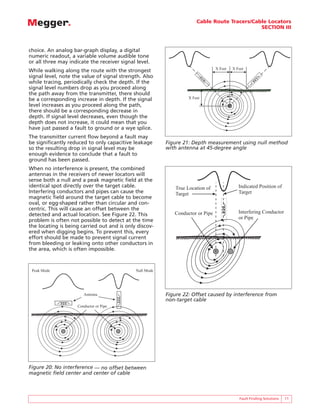
When no interference is present, the combined
antennas in the receivers of newer locators will
sense both a null and a peak magnetic field at the
identical spot directly over the target cable.                True Location of               Indicated Position of
Interfering conductors and pipes can cause the                Target                         Target
magnetic field around the target cable to become
oval, or egg-shaped rather than circular and con-
centric. This will cause an offset between the
                                                             Conductor or Pipe               Interfering Conductor
detected and actual location. See Figure 22. This
                                                                                             or Pipe
problem is often not possible to detect at the time
the locating is being carried out and is only discov-
ered when digging begins. To prevent this, every
effort should be made to prevent signal current
from bleeding or leaking onto other conductors in
the area, which is often impossible.


 Peak Mode                                    Null Mode


                        Antenna                           Figure 22: Offset caused by interference from
                                                          non-target cable
                     Conductor or Pipe


Figure 20: No interference — no offset between
magnetic field center and center of cable


                                                                                             Fault Finding Solutions   11
How to See Underground Cable Problems
                                                                                        SECTION IV


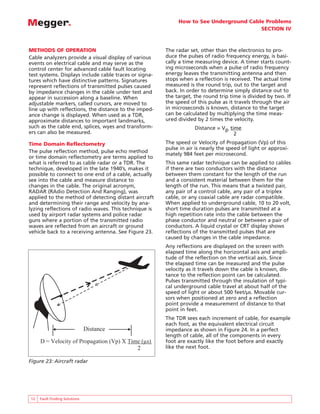
METHODS OF OPERATION                                    The radar set, other than the electronics to pro-
Cable analyzers provide a visual display of various     duce the pulses of radio frequency energy, is basi-
events on electrical cable and may serve as the         cally a time measuring device. A timer starts count-
control center for advanced cable fault locating        ing microseconds when a pulse of radio frequency
test systems. Displays include cable traces or signa-   energy leaves the transmitting antenna and then
tures which have distinctive patterns. Signatures       stops when a reflection is received. The actual time
represent reflections of transmitted pulses caused      measured is the round trip, out to the target and
by impedance changes in the cable under test and        back. In order to determine simply distance out to
appear in succession along a baseline. When             the target, the round trip time is divided by two. If
adjustable markers, called cursors, are moved to        the speed of this pulse as it travels through the air
line up with reflections, the distance to the imped-    in microseconds is known, distance to the target
ance change is displayed. When used as a TDR,           can be calculated by multiplying the time meas-
approximate distances to important landmarks,           ured divided by 2 times the velocity.
such as the cable end, splices, wyes and transform-                 Distance = Vp time
ers can also be measured.                                                           2
Time Domain Reflectometry                               The speed or Velocity of Propagation (Vp) of this
                                                        pulse in air is nearly the speed of light or approxi-
The pulse reflection method, pulse echo method
                                                        mately 984 feet per microsecond.
or time domain reflectometry are terms applied to
what is referred to as cable radar or a TDR. The        This same radar technique can be applied to cables
technique, developed in the late 1940’s, makes it       if there are two conductors with the distance
possible to connect to one end of a cable, actually     between them constant for the length of the run
see into the cable and measure distance to              and a consistent material between them for the
changes in the cable. The original acronym,             length of the run. This means that a twisted pair,
RADAR (RAdio Detection And Ranging), was                any pair of a control cable, any pair of a triplex
applied to the method of detecting distant aircraft     cable, or any coaxial cable are radar compatible.
and determining their range and velocity by ana-        When applied to underground cable, 10 to 20 volt,
lyzing reflections of radio waves. This technique is    short time duration pulses are transmitted at a
used by airport radar systems and police radar          high repetition rate into the cable between the
guns where a portion of the transmitted radio           phase conductor and neutral or between a pair of
waves are reflected from an aircraft or ground          conductors. A liquid crystal or CRT display shows
vehicle back to a receiving antenna. See Figure 23.     reflections of the transmitted pulses that are
                                                        caused by changes in the cable impedance.
                                                        Any reflections are displayed on the screen with
                                                        elapsed time along the horizontal axis and ampli-
                                                        tude of the reflection on the vertical axis. Since
                                                        the elapsed time can be measured and the pulse
                                                        velocity as it travels down the cable is known, dis-
                                                        tance to the reflection point can be calculated.
                                                        Pulses transmitted through the insulation of typi-
                                                        cal underground cable travel at about half of the
                                                        speed of light or about 500 feet/µs. Movable cur-
                                                        sors when positioned at zero and a reflection
                                                        point provide a measurement of distance to that
                                                        point in feet.
                                                        The TDR sees each increment of cable, for example
                                                        each foot, as the equivalent electrical circuit
                               Distance                 impedance as shown in Figure 24. In a perfect
                                                        length of cable, all of the components in every
     D = Velocity of Propagation (Vp) X Time (µs)       foot are exactly like the foot before and exactly
                                           2            like the next foot.

Figure 23: Aircraft radar


12   Fault Finding Solutions
How to See Underground Cable Problems
                                                                                        SECTION IV


                                                        DESCRIPTIONS AND APPLICATIONS
                                                        Low-Voltage TDR/Cable Radar
                                                        A low-voltage TDR is an appropriate method to
                                                        localize faults and other impedance changes on
                                                        electrical cable such as twisted pair, parallel pair,
                                                        and coaxial structure. TDRs are available in small
                                                        hand-held, larger portable, and rack mount con-
                                                        figurations for a broad variety of applications.
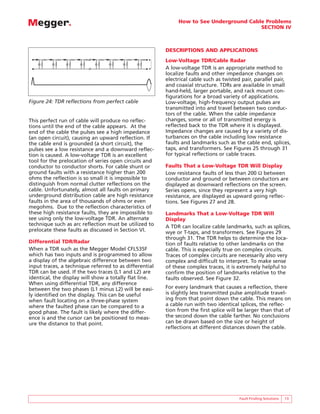
Figure 24: TDR reflections from perfect cable           Low-voltage, high-frequency output pulses are
                                                        transmitted into and travel between two conduc-
                                                        tors of the cable. When the cable impedance
This perfect run of cable will produce no reflec-       changes, some or all of transmitted energy is
tions until the end of the cable appears. At the        reflected back to the TDR where it is displayed.
end of the cable the pulses see a high impedance        Impedance changes are caused by a variety of dis-
(an open circuit), causing an upward reflection. If     turbances on the cable including low resistance
the cable end is grounded (a short circuit), the        faults and landmarks such as the cable end, splices,
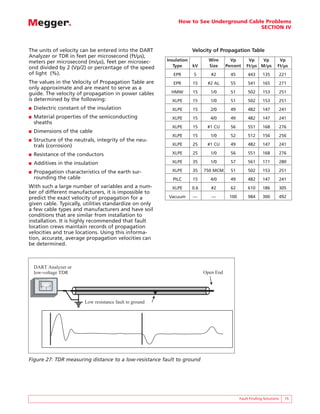
pulses see a low resistance and a downward reflec-      taps, and transformers. See Figures 25 through 31
tion is caused. A low-voltage TDR is an excellent       for typical reflections or cable traces.
tool for the prelocation of series open circuits and
conductor to conductor shorts. For cable shunt or       Faults That a Low-Voltage TDR Will Display
ground faults with a resistance higher than 200         Low resistance faults of less than 200 Ω between
ohms the reflection is so small it is impossible to     conductor and ground or between conductors are
distinguish from normal clutter reflections on the      displayed as downward reflections on the screen.
cable. Unfortunately, almost all faults on primary      Series opens, since they represent a very high
underground distribution cable are high resistance      resistance, are displayed as upward going reflec-
faults in the area of thousands of ohms or even         tions. See Figures 27 and 28.
megohms. Due to the reflection characteristics of
these high resistance faults, they are impossible to    Landmarks That a Low-Voltage TDR Will
see using only the low-voltage TDR. An alternate        Display
technique such as arc reflection must be utilized to    A TDR can localize cable landmarks, such as splices,
prelocate these faults as discussed in Section VI.      wye or T-taps, and transformers. See Figures 29
                                                        through 31. The TDR helps to determine the loca-
Differential TDR/Radar                                  tion of faults relative to other landmarks on the
When a TDR such as the Megger Model CFL535F             cable. This is especially true on complex circuits.
which has two inputs and is programmed to allow         Traces of complex circuits are necessarily also very
a display of the algebraic difference between two       complex and difficult to interpret. To make sense
input traces, a technique referred to as differential   of these complex traces, it is extremely helpful to
TDR can be used. If the two traces (L1 and L2) are      confirm the position of landmarks relative to the
identical, the display will show a totally flat line.   faults observed. See Figure 32.
When using differential TDR, any difference
between the two phases (L1 minus L2) will be easi-      For every landmark that causes a reflection, there
ly identified on the display. This can be useful        is slightly less transmitted pulse amplitude travel-
when fault locating on a three-phase system             ing from that point down the cable. This means on
where the faulted phase can be compared to a            a cable run with two identical splices, the reflec-
good phase. The fault is likely where the differ-       tion from the first splice will be larger than that of
ence is and the cursor can be positioned to meas-       the second down the cable farther. No conclusions
ure the distance to that point.                         can be drawn based on the size or height of
                                                        reflections at different distances down the cable.


                                                                                       Fault Finding Solutions   13
How to See Underground Cable Problems
                                                                                        SECTION IV


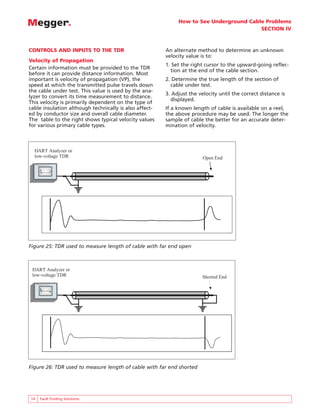
CONTROLS AND INPUTS TO THE TDR                          An alternate method to determine an unknown
                                                        velocity value is to:
Velocity of Propagation
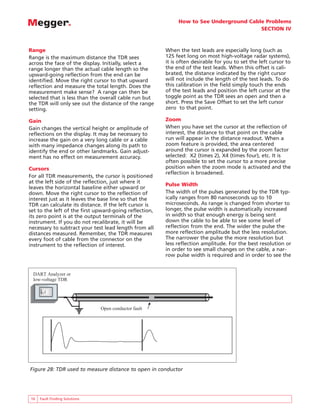
                                                        1. Set the right cursor to the upward-going reflec-
Certain information must be provided to the TDR
                                                          tion at the end of the cable section.
before it can provide distance information. Most
important is velocity of propagation (VP), the          2. Determine the true length of the section of
speed at which the transmitted pulse travels down         cable under test.
the cable under test. This value is used by the ana-
                                                        3. Adjust the velocity until the correct distance is
lyzer to convert its time measurement to distance.
                                                          displayed.
This velocity is primarily dependent on the type of
cable insulation although technically is also affect-   If a known length of cable is available on a reel,
ed by conductor size and overall cable diameter.        the above procedure may be used. The longer the
The table to the right shows typical velocity values    sample of cable the better for an accurate deter-
for various primary cable types.                        mination of velocity.


  DART Analyzer or
  low-voltage TDR                                                       Open End
         BIDDLE       DART R
     R
                  R
                      ANALYSIS SYSTEM


Figure 25: TDR used to measure length of cable with far end open


 DART Analyzer or
 low-voltage TDR                                                        Shorted End
             BIDDLE       DART R
         R
                      R
                          ANALYSIS SYSTEM


Figure 26: TDR used to measure length of cable with far end shorted


14            Fault Finding Solutions
How to See Underground Cable Problems
                                                                                                         SECTION IV


The units of velocity can be entered into the DART                                    Velocity of Propagation Table
Analyzer or TDR in feet per microsecond (ft/µs),
meters per microsecond (m/µs), feet per microsec-                        Insulation           Wire       Vp        Vp    Vp          Vp
ond divided by 2 (Vp/2) or percentage of the speed                          Type      kV      Size     Percent    Ft/µs M/µs        Ft/µs
of light (%).                                                               EPR       5        #2        45       443      135          221
The values in the Velocity of Propagation Table are                         EPR       15     #2 AL       55       541      165          271
only approximate and are meant to serve as a
guide. The velocity of propagation in power cables                         HMW        15      1/0        51       502      153          251
is determined by the following:                                            XLPE       15      1/0        51       502      153          251
■   Dielectric constant of the insulation                                  XLPE       15      2/0        49       482      147          241
■   Material properties of the semiconducting                              XLPE       15      4/0        49       482      147          241
    sheaths
                                                                           XLPE       15     #1 CU       56       551      168          276
■   Dimensions of the cable
                                                                           XLPE       15      1/0        52       512      156          256
■   Structure of the neutrals, integrity of the neu-
    trals (corrosion)                                                      XLPE       25     #1 CU       49       482      147          241

■   Resistance of the conductors                                           XLPE       25      1/0        56       551      168          276

■   Additives in the insulation                                            XLPE       35      1/0        57       561      171          280

■   Propagation characteristics of the earth sur-                          XLPE       35    750 MCM      51       502      153          251
    rounding the cable                                                     PILC       15      4/0        49       482      147          241
With such a large number of variables and a num-                           XLPE       0.6      #2        62       610      186          305
ber of different manufacturers, it is impossible to
predict the exact velocity of propagation for a                           Vacuum      —        —        100       984      300          492
given cable. Typically, utilities standardize on only
a few cable types and manufacturers and have soil
conditions that are similar from installation to
installation. It is highly recommended that fault
location crews maintain records of propagation
velocities and true locations. Using this informa-
tion, accurate, average propagation velocities can
be determined.


    DART Analyzer or
    low-voltage TDR                                                                         Open End
         BIDDLE       DART R
     R
                  R
                      ANALYSIS SYSTEM


                                        Low resistance fault to ground


Figure 27: TDR measuring distance to a low-resistance fault to ground


                                                                                                              Fault Finding Solutions     15
How to See Underground Cable Problems
                                                                                               SECTION IV


Range                                                          When the test leads are especially long (such as
Range is the maximum distance the TDR sees                     125 feet long on most high-voltage radar systems),
across the face of the display. Initially, select a            it is often desirable for you to set the left cursor to
range longer than the actual cable length so the               the end of the test leads. When this offset is cali-
upward-going reflection from the end can be                    brated, the distance indicated by the right cursor
identified. Move the right cursor to that upward               will not include the length of the test leads. To do
reflection and measure the total length. Does the              this calibration in the field simply touch the ends
measurement make sense? A range can then be                    of the test leads and position the left cursor at the
selected that is less than the overall cable run but           toggle point as the TDR sees an open and then a
the TDR will only see out the distance of the range            short. Press the Save Offset to set the left cursor
setting.                                                       zero to that point.

Gain                                                           Zoom
Gain changes the vertical height or amplitude of               When you have set the cursor at the reflection of
reflections on the display. It may be necessary to             interest, the distance to that point on the cable
increase the gain on a very long cable or a cable              run will appear in the distance readout. When a
with many impedance changes along its path to                  zoom feature is provided, the area centered
identify the end or other landmarks. Gain adjust-              around the cursor is expanded by the zoom factor
ment has no effect on measurement accuracy.                    selected: X2 (times 2), X4 (times four), etc. It is
                                                               often possible to set the cursor to a more precise
Cursors                                                        position when the zoom mode is activated and the
                                                               reflection is broadened.
For all TDR measurements, the cursor is positioned
at the left side of the reflection, just where it
                                                               Pulse Width
leaves the horizontal baseline either upward or
down. Move the right cursor to the reflection of               The width of the pulses generated by the TDR typ-
interest just as it leaves the base line so that the           ically ranges from 80 nanoseconds up to 10
TDR can calculate its distance. If the left cursor is          microseconds. As range is changed from shorter to
set to the left of the first upward-going reflection,          longer, the pulse width is automatically increased
its zero point is at the output terminals of the               in width so that enough energy is being sent
instrument. If you do not recalibrate, it will be              down the cable to be able to see some level of
necessary to subtract your test lead length from all           reflection from the end. The wider the pulse the
distances measured. Remember, the TDR measures                 more reflection amplitude but the less resolution.
every foot of cable from the connector on the                  The narrower the pulse the more resolution but
instrument to the reflection of interest.                      less reflection amplitude. For the best resolution or
                                                               in order to see small changes on the cable, a nar-
                                                               row pulse width is required and in order to see the


 DART Analyzer or
 low-voltage TDR
         BIDDLE       DART R
     R
                  R
                      ANALYSIS SYSTEM


                                        Open conductor fault


Figure 28: TDR used to measure distance to open in conductor


16        Fault Finding Solutions
How to See Underground Cable Problems
                                                                                        SECTION IV


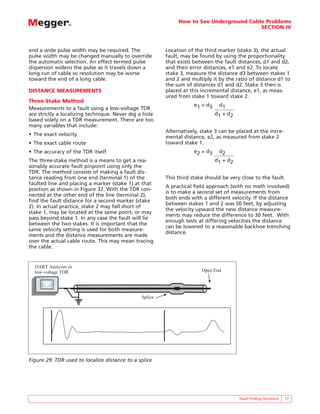
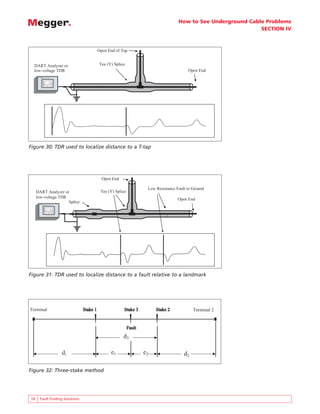
end a wide pulse width may be required. The             Location of the third marker (stake 3), the actual
pulse width may be changed manually to override         fault, may be found by using the proportionality
the automatic selection. An effect termed pulse         that exists between the fault distances, d1 and d2,
dispersion widens the pulse as it travels down a        and their error distances, e1 and e2. To locate
long run of cable so resolution may be worse            stake 3, measure the distance d3 between stakes 1
toward the end of a long cable.                         and 2 and multiply it by the ratio of distance d1 to
                                                        the sum of distances d1 and d2. Stake 3 then is
DISTANCE MEASUREMENTS                                   placed at this incremental distance, e1, as meas-
                                                        ured from stake 1 toward stake 2.
Three-Stake Method
                                                                    e1 = d3    d1
Measurements to a fault using a low-voltage TDR
are strictly a localizing technique. Never dig a hole                         d1 + d2
based solely on a TDR measurement. There are too
many variables that include:
                                                        Alternatively, stake 3 can be placed at the incre-
• The exact velocity
                                                        mental distance, e2, as measured from stake 2
• The exact cable route                                 toward stake 1.
• The accuracy of the TDR itself                                    e2 = d3    d2
The three-stake method is a means to get a rea-                               d1 + d2
sonably accurate fault pinpoint using only the
TDR. The method consists of making a fault dis-
tance reading from one end (terminal 1) of the          This third stake should be very close to the fault.
faulted line and placing a marker (stake 1) at that
                                                        A practical field approach (with no math involved)
position as shown in Figure 32. With the TDR con-
                                                        is to make a second set of measurements from
nected at the other end of the line (terminal 2),
                                                        both ends with a different velocity. If the distance
find the fault distance for a second marker (stake
                                                        between stakes 1 and 2 was 50 feet, by adjusting
2). In actual practice, stake 2 may fall short of
                                                        the velocity upward the new distance measure-
stake 1, may be located at the same point, or may
                                                        ments may reduce the difference to 30 feet. With
pass beyond stake 1. In any case the fault will lie
                                                        enough tests at differing velocities the distance
between the two stakes. It is important that the
                                                        can be lowered to a reasonable backhoe trenching
same velocity setting is used for both measure-
                                                        distance.
ments and the distance measurements are made
over the actual cable route. This may mean tracing
the cable.


  DART Analyzer or
  low-voltage TDR                                                      Open End
        BIDDLE       DART R
    R
                 R
                     ANALYSIS SYSTEM


                                               Splice


Figure 29: TDR used to localize distance to a splice


                                                                                        Fault Finding Solutions   17
How to See Underground Cable Problems
                                                                                                                                     SECTION IV


                                                               Open End of Tap


  DART Analyzer or                                             Tee (Y) Splice
  low-voltage TDR                                                                                              Open End
           BIDDLE       DART R
       R
                    R
                        ANALYSIS SYSTEM


Figure 30: TDR used to localize distance to a T-tap


                                                                 Open End

                                                                                          Low Resistance Fault to Ground
     DART Analyzer or                                           Tee (Y) Splice
     low-voltage TDR                                                                                     Open End
                     Splice
                BIDDLE        DART R
            R
                          R
                              ANALYSIS SYSTEM


Figure 31: TDR used to localize distance to a fault relative to a landmark


Terminal                                             Stake 1                 Stake 3          Stake 2             Terminal 2


                                                                                 Fault
                                                                            d3

                                                d1                   e1                  e2                  d2

Figure 32: Three-stake method


18    Fault Finding Solutions
Surge Generators, Filters and Couplers
                                                                                                         SECTION V


SURGE GENERATORS                                           higher voltage and more energy is required to
The first commercially available surge generators          locate faults with no damage to the cable. There is
for underground cable fault locating were intro-           mixed opinion as to the treeing situation in EPR.
duced in the late 1940’s. The device is basically a        Due to this treeing situation, many utilities issued
high voltage impulse generator consisting of a dc          work rules reducing the maximum allowable volt-
power supply, a high voltage capacitor, and some           age to be used for fault locating.
type of high voltage switch. See Figure 33.
                                                           Energy
The power supply is used to charge the capacitor
                                                           The energy output of any surge generator meas-
                                                           ured in Joules (Watt-Seconds) is calculated as fol-
                     Proof / Burn Mode
                                                           lows:
                                               HV
                                                                  E = V2 C
                     Surge Mode                                           2

                          HV Switch                        where E = Energy in Joules, C = capacitance in µf,
                                          Discharge
   HV dc
   Power                                  Switch                             V = voltage in kV
   Supply                     Discharge
               Cap                                         To increase the “bang” at the fault the only two
                              Resistor      HV Return      options are to increase the voltage which can be
                                                           done by the operator or increase the capacitance
  Chassis
                                                           which must be done by the manufacturer. Figure
                                           Safety Ground   34 shows the output energy curve of a typical four
                                                           microfarad surge generator that generates 1250
Figure 33: Block diagram of surge generator                Joules at a maximum voltage of 25 kV. If the fault
                                                           locating crew is told that the output voltage of
                                                           the thumper must be limited to 12.5 kV (one half
to a high voltage and then a contact closure dis-          of 25 kV), the output energy of their thumper is
charges the capacitor into the cable under test. If        reduced by a factor of four down to 312 Joules.
the voltage is high enough to break down the               In a practical world, 300 to 400 Joules is the
fault, the energy stored in the capacitor is rapidly       threshold for hearing a thump at ground level
discharged through a flashover at the fault creat-         with no acoustic amplification and with very little
ing a detectable sound or “thump” at ground                background noise. If the thump at the fault can
level. The important specifications of a thumper           not be heard, the only option is to increase volt-
are the maximum voltage it can develop and how             age in order to find the fault, make a repair and
much energy it delivers to the fault.                      get the lights back on.
The classical fault locating process has been to
hook up the surge generator, crank up the volt-
age, and walk back and forth over the cable route                     1400
until the thump is heard or better yet to feel the                                                                            1250
                                                                      1200
earth move. This process pinpoints the fault allow-
ing a repair crew to dig a hole and repair the                        1000

cable. In some cases, it may take hours (or days) to                  800
                                                             Joules


walk the cable and definitely locate the fault.                       600
During that time, the cable is being exposed to
                                                                      400
high voltage thumping.
                                                                      200
A few years after polyethylene cable began to be
                                                                        0
installed underground, evidence began to surface                             1   3   5   7   9   11   13 15   17   19   21   23    25
that due to “treeing” in the insulation, high-volt-                                                    kV
age thumping of this plastic cable for long periods
of time was doing more harm than good. The
same is not true for PILC cables where typically           Figure 34: Energy vs. voltage for a 4-µF, 25-kV
                                                           surge generator


                                                                                                         Fault Finding Solutions        19
Surge Generators, Filters and Couplers
                                                                                                               SECTION V


To help in lowering the voltage required to locate                Capacitance
underground faults, the PFL-4000 Surge Generator                  Cables by their very nature are capacitive since
uses a 12 microfarad capacitor producing 1536                     they consist of two conductors separated by an
Joules at 16 kV. See Figure 35. This allows thump-                insulator. The two conductors in power cable are
ing at lower voltages while still delivering reason-              the phase conductor and the shield, sheath, or
able energy to the fault. Thumping at 12.5 kV, as                 concentric neutral. These two conductors are sepa-
above, now produces a very audible 937 Joules.                    rated by XLPE, EPR, or oil impregnated paper.
Different surge generator energy levels are                       Safety is always a priority even when a cable is not
                                                                  energized because, as any capacitor, the cable will
         1600                                                     hold a charge until discharged or grounded. A
                                                                  cable must always be grounded before making any
         1400                                                     connections even if the cable has been parked and
                                                           1536
                                                                  isolated as it may pickup up a charge from the
         1200                                                     field of adjacent energized phases.
         1000                                                     The longer the cable or the more complex the sys-
                                                                  tem or network, the higher the capacitance. If the
Joules


         800                                                      surge generator capacitor is smaller than the cable
         600
                                                                  capacitance, the fault will not discharge until cable
                                                                  capacitance is fully charged which could take mul-
         400                                                      tiple surges. If the cable capacitance is smaller
                                                                  than the surge generator capacitance, the fault
         200                                                      will typically flashover on the first try.
           0
                1     3       5     7        9   11   13     15
                                                                  Voltage
                                        kV                        Deciding on surge generator voltage levels is
                                                                  extremely important. Without a high enough volt-
                                                                  age, the fault will not break down. Very high volt-
Figure 35: Energy vs. voltage for a 12-µF, 16 kV
surge generator                                                   age surging for long periods of time may promote
                                                                  the growth of treeing and reduce cable life. If the
                                                                  fault does not flashover, there will be no thump
required to do fault locating on different lengths                that identifies and pinpoints the fault. A very
and types of cable constructions. XLPE and EPR                    important factor to consider is that the voltage
insulated cables typically require much less energy               pulse doubles in peak-to-peak amplitude on a
to locate a fault than a lead cable of comparable                 good cable as it reflects from the isolated open
size and construction. For long runs or complex
systems of lead cable that cannot be broken down
into small manageable sections, high voltage and                            3500
energy may be required to flashover a fault.                                                                                     3072
                                                                                                           3072
                                                                            3000
There are currently two types of surge generators
available, one referred to as progressive energy as                         2500
described above and the second, constant energy.
The constant energy units contain two or more                               2000
                                                                   Joules


capacitors with a corresponding voltage range for
                                                                            1500
each capacitor. The energy is only constant at the
maximum voltage on each range. A typical exam-                              1000
ple is a PFL-6000 with two voltage ranges of 0 to
16 kV and 0 to 32 kV. When the 16 kV range is                                500
selected, a 24 µF capacitor is switched in and when
the 32 kV range is selected a 6 µF capacitor is used.                          0
                                                                                   1   3   5   7   9 11 13 15 17 19 21 23 25 27 29 31 33
In this case, at 16 kV or 32 kV the energy output
will be a constant 3072 Joules. See Figure 36.
                                                                  Figure 36: Energy vs. voltage for a 12-µF, 16/32-µF
                                                                  surge generator


20        Fault Finding Solutions
Surge Generators, Filters and Couplers
                                                                                                  SECTION V


end. This also applies if the cable is faulted but the     Surge
voltage doubling only occurs between the fault             In the surge mode, the internal capacitor is
the open isolated end of the cable.                        charged up to the level selected with the voltage
When surging at 15 kV, the cable between the               control and then discharged into the cable. This
fault and the end is exposed to a shock wave of 30         process can be automatically repeated on a time
kV peak-to-peak. A hint for fault locating on a            basis by adjusting the surge interval control or
cable that has several splices and has been worked         manually by push-button on some models. A surge
on from the same end is to look for the current            of current from the discharging capacitor travels
fault past the last splice. That section of cable was      down the cable, arcs over at the fault, and returns
exposed to voltage doubling during the previous            back to the capacitor on the neutral or sheath.
fault locate with a high probability that the pres-        This rapid discharge of energy causes an audible
ent fault is at a weak spot in that length of cable.       explosion and the sound created travels out
                                                           through the earth and is used to pinpoint the fault
BASIC SURGE GENERATOR OPERATION                            location. See Figure 37. It is assumed that the
                                                           sound travels in a straight and direct path up to
Proof/Burn                                                 the surface of the earth. Sometimes the soil condi-
A proof test is performed to determine whether or          tions are such that the sound travels away in a
not a cable and accessories are good or bad. The           downward direction or is absorbed and cannot be
result of a proof test is on a go/no-go basis. The         heard. In this case, some type of listening device or
voltage is increased on the cable under test to the        surge detector may be needed to assist in pin-
required voltage level and held there for a period         pointing. If the surge of current sees a high resist-
of time. If there is little or no leakage current and      ance path back to the capacitor, as is the case
the voltage reading is stable, the cable is consid-        when the neutral is corroded, the sound level cre-
ered to be good. If a voltage is reached where the         ated at the fault will be minimal. This current flow
reading becomes unstable or drops with a dramat-           back through the earth can also cause a rise in
ic increase in current, it is considered to be bad.        potential of any metallic structures mounted in the
This test should be done initially as described in         ground and a difference in potential on the sur-
Section I to help establish that the cable is actually     face.
bad and then to gain some information on the
fault condition. A quick check can also be done            Ground
after repair to be sure there is not another fault         If the surge generator safety ground is connected
and to check workmanship on the splice.                    properly, the ground mode absolutely and posi-
                                                           tively grounds and discharges the surge genera-
The burn mode is used when the fault will not              tor’s capacitor and the cable under test. After
flashover at the maximum available voltage of the          turning the main power switch off, which dis-
surge generator. This condition is due to the elec-        charges the capacitor and cable through a resistor,
trical characteristics of the fault that may be            always move the mode switch to ground before
altered by applying voltage to the cable until the         removing test leads.
fault breaks down and then supplying
current flow. This causes conditioning
or additional damage at the fault loca-                    Surge Generator
tion that in turn decreases the fault
resistance and reduces voltage
required for breakdown.
When applied to paper-insulated
cable, the insulation actually burns                               Shock Wave
and becomes charred, permanently
altering the fault characteristics. As
applied to XLPE cable, heat produced
by arcing at the fault can soften the
insulation but when arcing is stopped
the insulation returns to a solid condi-                                                             Fault
tion without changing its characteris-
tics drastically. Burning can be effec-      Figure 37: Acoustic shock wave from arcing fault
tive on a splice failure or a water filled
fault.


                                                                                          Fault Finding Solutions   21
Surge Generators, Filters and Couplers
                                                                                                          SECTION V


SINGLE POINT GROUNDING                                                A signal coupler must be added to the surge gen-
For safety, always use the single point grounding                     erator to provide the additional capability of using
scheme as shown in Figure 38 when using a surge                       the surge pulse reflection method of prelocation.
generator. When making or removing connections                        See Figure 39. The coupler can be an inductive or
to a cable always follow your company’s safety                        capacitive type that is used to pick up reflections
rules and regulations.                                                on the cable and send them to the DART Analyzer.
                                                                      Both types of couplers work effectively and the
Check the isolated cable for voltage and ground it.                   only difference is that the captured wave shapes
Connect the surge generator safety ground to the                      vary slightly.
ground rod at the transformer, switch cabinet or
pole. Next, connect the high-voltage return lead to                   An arc reflection filter is necessary to provide the
the shield or neutral as close as possible to the                     capability of using the arc reflection method. This
high-voltage connection. Leave the neutral                            filter allows a TDR developing 10 to 20 volt pulses
grounded at both ends of the cable. Finally, con-                     to be connected to the same cable that is also
nect the high-voltage test lead to the phase con-                     being surged at 10,000 volts. The filter also does
ductor. When removing test leads, use the oppo-                       some pulse routing to make sure both high- and
site sequence by removing the high voltage, high                      low-voltage pulses are sent down the cable under
voltage return and lastly the safety ground. The                      test. The primary purpose of the filter is to allow
local ground is only required if company safety                       the TDR or analyzer to look down the cable while
procedures demand it. The safest and lowest resist-                   it is being surged and, of course, to allow this
ance safety ground connection is system neutral                       while not destroying the analyzer in the process.
which will keep the equipment at zero volts in the                    The filter may also contain the coupler necessary
case of a backfeed.                                                   to provide surge pulse capability.
                                                                      There are two types of arc reflection filters, induc-
ARC REFLECTION FILTERS AND COUPLERS                                   tive and resistive. Both types are placed in the cir-
In order to reduce the cable exposure to high volt-                   cuit between the surge generator and the cable
age surging and thereby avoid the possibility of                      under test. The inductive filter, as shown in Figure
setting the cable up for future failures, some                        39, uses a choke that slows the surge generator
method of fault prelocation should be used. The                       pulse down, extending it over time. This makes the
surge pulse and arc reflection methods of preloca-                    arc at the fault last longer and reflects more TDR
tion have been used for many years. In order to                       pulses, providing a higher probability that a down-
use either method, additional equipment is                            ward going reflection will be captured. The induc-
required including a DART® Analysis System as dis-                    tance of the choke also blocks the TDR pulses from
cussed in detail in Section VI.


                                 High voltage


                                                High-voltage return

                               Safety ground

      Local ground
      (supplemental)


Figure 38: Single point grounding


22   Fault Finding Solutions
Surge Generators, Filters and Couplers
                                                                                              SECTION V


going back to the surge generator’s capacitor and
basically being shorted out. One advantage of the                          Proof burn impulse
                                                                                                        HV
inductive filter is that it helps to clamp or limit the
voltage applied to the cable under test to only the
level required to breakdown the fault. The choke
in the inductive filter also absorbs less energy cre-                      Arc Reflection
ated by the surge generator, letting more down
the cable to arc over at the fault.                             Analyzer

The second type of filter, as shown in Figure 40,
uses a resistor to do the job of pulse routing and                            Inductive surge                   Analyzer/TDR
                                                                              pulse coupler
has the benefits of lower cost and smaller size. The                                                  HV return
resistor still blocks the TDR pulses and changes the
surge generator pulse slightly but does not limit or
clamp the voltage. The resistive filter tends to          Figure 39: Inductive arc reflection diagram
absorb somewhat more of the surge generator
energy than the inductive filter.
                                                                          Proof burn impulse             HV


                                                                          Arc Reflection
                                                               Analyzer


                                                                             Inductive surge                    Analyzer/TDR
                                                                             pulse coupler
                                                                                                    HV return


                                                          Figure 40: Resistive arc reflection diagram


                                                                                                Fault Finding Solutions   23
Locating Methods
                                                                                                            SECTION VI


OVERVIEW                                                 the relatively short “bad” section remaining can
                                                         be replaced. If the cable is in duct or conduit, the
Localizing or prelocation methods provide an
                                                         bad section can be replaced. This relatively primi-
approximate distance to a fault. With cable in con-
                                                         tive method is usable on most types of phase-to-
duit or duct, an approximate distance is all that is
                                                         ground and phase-to-phase faults.
required because the bad cable will be pulled out
and new back in. With direct buried underground
                                                         Resistance Ratio
residential distribution loop fed circuits, localizing
can be used to isolate a bad section between two         Often called the
pad-mount transformers. The bad section can then         bridge method, a
be parked and the loop fed from both ends. In the        variation of the
                                                         Wheatstone                        B2                           C2
case of a radial feed localizing must be followed
by an appropriate pinpointing method. Some early         Bridge is an
localizing methods are as follows:                       example of the                               D
                                                         resistance ratio
Sectionalizing                                           methods. See
                                                         Figure 42.
The earliest sectionalizing method has been called
the “Cut and Try Method” or the “Divide and              When using a                      B1                           C1
Conquer Method.” This was among the first tech-          Wheatstone
niques to be used for fault locating on direct-          Bridge, B1, B2,
buried cable. Hopefully, its use today is limited to     and C2 represent
that of a last resort. See Figure 41.                    known resistanc-                     Battery
                                                         es. C1 represents
                                                         the unknown              Figure 42: Basic Wheatstone
                               L                         resistance.              Bridge
        First Cut at 1/2 L
        Second Cut at 3/4 L
                                                         At balance, typi-
        Third Cut at 5/8 L                               cally by adjusting the resistance values of B1 and
                                                         B2 when the zero center null detector D indicates
                                                         zero, C1/C2 = B1/B2
                                                         Therefore, C1 = (C2 x B1)/B2
                               Fault
                                                         A variation on the Wheatstone Bridge is the
                                                         Murray Loop Bridge. Figure 43 shows that the
                                                         adjacent resistances, RC1 of a faulted cable in a
Figure 41: Sectionalizing method
                                                         loop with RC2 of a good cable can be made to
                                                         represent C1 and C2 of the Wheatstone Bridge.
                                                         Similarly, corresponding portions of a slidewire
After isolating both ends of the cable section           resistor RB1 and RB2 can be made to represent the
under test, a Megger® Insulation Tester is connect-      resistances B1 and B2. At balance in the Murray
ed between the conductor and neutral or ground.          Loop Bridge, RC1/ RC2 is equal to RB1/RB2.
A faulted cable will have a lower insulation resist-
ance than a cable with no fault. After measuring
the fault resistance, a hole is dug half way down
the length of the cable section. The cable is cut at
that location and a resistance measurement is                                                    L
                                                                   RB2
made on each half. The “bad” half of the cable                               Good Conductor

with the fault will a have lower resistance than the                     D
“good” half and the resistance value on the “bad”
half should be the same as the fault resistance                              Faulted Conductor
measured on the complete length of cable. A sec-                                                             RC2         Shorting
                                                                   RB1
                                                                                                                         Jumper
ond dig is made half the distance down the “bad”         Battery
                                                                                     RC1                   Rf
half. Again, the cable is cut and a resistance meas-                                  Lx             Fault Resistance
urement is made on each section to identify the
faulted part of the remaining section. Eventually,
                                                         Figure 43: Murray Loop Bridge application


24   Fault Finding Solutions
Locating Methods
                                                                                                           SECTION VI


When it is assumed that the resistance of a uni-                   mostly on network lead paper cables. Electromag-
form conductor is linear and proportional to its                   netic detection methods are used with a surge
length, and the total length of the cable section                  generator which provides the impulse of current
under test is L, the distance to the fault, Lx, is cal-            necessary to produce the strong electromagnetic
culated as follows:                                                field required to make the method practical.
                         Lx = 2L RB1/RB2                           Since the current impulse is polarized, the field is
                                                                   also polarized which gives the method much of its
When using the Murray Loop method the series
                                                                   usefulness. An iron core sheath coil with a second-
resistance and length of the good phase and fault-
                                                                   ary winding will induce a polarized output when
ed phase must be identical. If the resistances are
                                                                   subjected to this field. When a zero center
different, as would exist if one phase contains a
                                                                   microammeter is connected to the sheath coil sec-
splice and not the other, the resulting accuracy is
                                                                   ondary winding, the direction of the net electro-
drastically affected. This is a localizing method not
                                                                   magnetic field can be determined. This characteris-
a pinpointing method. Figure 44 illustrates the
                                                                   tic allows a determination of whether the fault is
practical application of an instrument that
                                                                   ahead of or behind the detector. See Figures 45
combines a TDR and Murray Loop Bridge in one
                                                                   and 46. Since the sheath coil is polarized, and to
instrument.
                                                                   maintain consistent information, always place the
                                                                   coil with arrow on top pointing toward the surge
Electromagnetic Surge Detection                                    generator.
Electromagnetic surge detection techniques have
been used to localize faults on power cable for                    Single Phase, Coaxial Power Cable with Neutral
more than 50 years. Theoretically, the methods can                 Bridges Over the Splices
be used to locate faults on many types of power
                                                                   Electromagnetic detection methods can be used to
cable but they are generally used only to identify
                                                                   locate faults on coaxial cable systems with access
faulted sections of cable in conduit or duct and
                                                                              points such as manholes, cabinets, and
                                                                              pull boxes as shown in Figure 45. When
                                                                              the cable system is designed with neutral
                                                                              bridges over the splices, the pickup coil is
                                                                              placed directly on the cable under the
                                                                     Shorting neutral. The current impulse produced
                                                                     Jumper
                                                                              by a surge generator will produce a
                                           Fault                              strong polarized indication as it passes
                                                                              through the phase conductor and the
                                                                              direction of the current impulse can be
                                                                              determined. As long as a strong positive-
                                                                              ly polarized electromagnetic field can be
                                                                              sensed, the fault is located in the portion
Figure 44: Application of Bridge/TDR                                          of cable still ahead. Since the phase con-
                                                                              ductor is isolated at the far end, the cur-
                                                                              rent impulse flows through the fault and
                                                       -
                                                                              then back to the surge generator
             -   0
                     +                                     0
                                                               +
                                                                              through the neutral. Either a weak or no
                                                                              electromagnetic field will be sensed past
        Access #1                                  Access #2                  the location of the fault. Therefore, it is
        Strong Field                               Weak Field                 possible to determine in which direction
                                                                              the fault is located.
                                                                             If the sheath coil is placed over the neu-
                                                                             tral, the electromagnetic field produced
                                                                             by the current impulse in the conductor
                                Fault                                        is balanced exactly by the return current
                                                                             back through the neutral and the meter
                                                                             provides no indication and stays at zero.
Figure 45: Coaxial power cable with neutral bridges over the                 When bonded grounds are present in a
splices


                                                                                                   Fault Finding Solutions   25
Locating Methods
                                                                                                                     SECTION VI


system such as usually found in paper-insulated,                      phase cable will generate a stronger magnetic
lead-covered cable (PILC) construction, it may be                     field at the cable surface closest to the faulted
possible to use a fault locating technique involving                  phase. When the detector is placed at various posi-
electromagnetic detectors, even though the pickup                     tions around the cable ahead of the fault, the
coil must be placed over the leaded neutral.                          readings will vary in magnitude. When the detec-
                                                                      tor is placed at various positions around the cable
Single-Phase PILC Cable with Bonded Grounds in                        in the first manhole past the fault, all readings will
Conduit                                                               be the same. Note that almost all of the current
As shown in Figure 46, this method only applies to                    pulse returns to the surge generator through the
circuits with good bonded grounds at every man-                       neutral at the fault site. A small amount of surge
hole location as commonly provided in network                         current passes through the neutral past the fault
systems. Without bonded grounds, the surge cur-                       and out of the next bonded ground. This small
rent through the phase conductor is exactly the                       current finds its way back to the surge generator
same magnitude as the return surge current                            from earth through the bonded grounds ahead of
through the neutral. With bonded grounds, the                         the fault.
current impulse through the phase conductor
is slightly greater than the returning surge
current in the neutral. This differential is
                                                       Surge current to Thumper
caused by the small amount of surge current                              First manhole in system        First manhole after fault
that flows through the neutral beyond the
fault and into earth through the bonded
                                                                                                  Fault
ground at the next manhole and back to the
surge generator through the bonded grounds
before the fault. See Figure 46. No current
flows through the second bonded ground
after the fault. When relative readings are
taken with the sheath coil placed on the            Surge Current from Thumper
cable both before and after the fault, they
will all be positive. Readings taken on the       Figure 46: Electromagnetic detection in single-phase PILC
conductor before the fault will almost always cable with bonded grounds
be noticeably higher in magnitude than those
after the fault. However, the difference is
often too small to instill confidence
in the cable fault location. More
importantly, readings taken on the           Cross section of cable at last                       Cross section of cable at first
bonded grounds before the fault              manhole before the fault                             manhole after the fault
will become progressively higher as
the faulted section is approached.             Sensor position 1 (Strong)                                    All Detector positions
                                                                                         Fault to         detect the same strength
Also, the reading taken on the                                                           neutral
                                                         Phase 1 being surged
bonded ground in the first manhole
after the fault will also be high.
Readings taken on the bonded
ground in the second and succeed-
ing manholes after the fault will be
zero. This process allows the faulted
section of cable can be identified.

Three-phase PILC
                                                 Sensor position 4 (Weak)
Strange as it may seem at first, it is                                                   First bonded ground after fault
                                                 Sensor position 3 (Weak)
usually easier to locate a fault in              Sensor position 2 (Strong)   First bonded ground in system
three-phase PILC coaxial cable than
in single phase. See Figure 47. The
current pulse from a surge genera-             Figure 47: Electromagnetic detection of faults on three-phase power
tor through one phase of a three-              cable


 26   Fault Finding Solutions
Locating Methods
                                                                                                                                                                                     SECTION VI


DART® ANALYZER/HIGH-VOLTAGE
RADAR                                                     R

                                                              BIDDLE   R   DART   R


                                                                           ANALYSIS SYSTEM


Because the low-voltage TDR is unable to                                                                                                                           High Resistance Fault to Neutral
identify high resistance shunt faults, its                                                                                                                                                Open End
effectiveness as a fault locator on power
cables is limited. When used in a high-
voltage radar system with surge genera-
tors, filters or couplers, the TDR/Analyzer
is able to display both low and high resist-
ance faults. The DART Analyzer provides
both TDR and storage oscilloscope func-
tions and is able to utilize all of the cable
fault locating methods listed below.

Arc Reflection                                                         Low Voltage Trace

This method is often referred to as a high-
voltage radar technique that overcomes
the 200 Ω limitation of low-voltage radar.
In addition to the TDR, an arc reflection
filter and surge generator is required. The
surge generator is used to create an arc                               High Voltage Trace
across the shunt fault which creates a
momentary short circuit that the TDR can Figure 48: Arc reflection method of high-voltage radar
display as a downward-going reflection.
The filter protects the TDR from the high-
voltage pulse generated by the surge gen-                               Open End

erator and routes the low-voltage pulses                                                     R

                                                                                                 BIDDLE   R   DART   R


                                                                                                              ANALYSIS SYSTEM


                                                                    Tee splice
down the cable.                                                                       High Resistance Fault to Neutral

Arc reflection is the most accurate and                                                                                         Splice                                                 Open End

easiest prelocation method and should be
used as a first approach. The fault is dis-
played in relation to other cable land-
                                                                            Long test leads
marks such as splices, taps and transform-
ers and no interpretation is required.
Arc reflection makes it possible for the
TDR to display “before” and “after”
traces or cable signatures. See Figure 48.                                                                                                   Low Voltage Trace
The “before” trace is the low-voltage
radar signature that shows all cable land-
marks but does not show the downward
reflection of a high resistance shunt fault.
The “after” trace is the high-voltage sig-
nature that includes the fault location                                                                                                    Arc Reflection Trace
even though its resistance may be higher
than 200 Ω. This trace is digitized, stored
and displayed on the screen allowing the
cursors can be easily positioned in order
to read the distance to the high resistance
fault.                                                                                                                                   Differential Arc Reflection Trace


                                                     Figure 49: Arc reflection and differential arc reflection
                                                     methods of high-voltage radar


                                                                                                                                                                             Fault Finding Solutions   27
Locating Methods
                                                                                                                        SECTION VI


Differential Arc Reflection
                                                                                      High Resistance Fault to Neutral
                                                 BIDDLE       DART
                                             R                       R
                                                          R
                                                              ANALYSIS SYSTEM


This high-voltage radar method is
basically an extension of arc                                                                                   Open End
reflection and it requires the use                    Current Coupler
of a surge generator, an arc
reflection filter, and an analyzer.
Using an algorithm, the DART
                                                                       Distance to Fault
Analyzer displays the algebraic
difference between the low-volt-
age trace and the captured high-
voltage trace on a second screen.
See Figure 49 on previous page.
As in differential TDR, differential
arc reflection eliminates all identi-
cal reflections before the fault
and the first downward-going
reflection to appear is easily iden-
tified as the cable fault. This sim-  Figure 50: Surge pulse reflection method of high-voltage radar
plifies the fault prelocation partic-
ularly if the fault reflection is not
well defined or the fault is on a complex system
with lots of clutter and unidentifiable reflections.      The surge generator transmits a high-voltage pulse
                                                          down the cable creating an arc at the fault that
Surge Pulse Reflection                                    causes a reflection of energy back to the surge
This method requires the use of a surge coupler, a        generator. This reflection repeats back and forth
surge generator, and an analyzer. The analyzer            between the fault and the surge generator until
acts as a storage oscilloscope that captures and dis-     all of the energy is depleted. A current coupler
plays reflections from the fault produced by the          senses the surge reflections which are captured by
surge generator high-voltage pulse. The analyzer          the analyzer and displayed on the screen as a
operates in a passive mode and is not acting like a       trace. See Figure 50.
TDR by actively sending out pulses. Surge pulse is                              To determine the location of the fault, cursors are
effective in locating faults on long runs of simple                             positioned at succeeding peaks in the trace. The
circuits and on faults that are difficult to arc over                           analyzer measures time and calculates the distance
which do not show up using arc reflection. This                                 to the fault using the velocity of propagation. For
method will find most of the same faults that can                               the trace shown in Figure 50, there is little difficul-
be prelocated using arc reflection, but usually with                            ty in determining where to position the cursors to
reduced accuracy and confidence due to greater                                  obtain the distance to the fault. In many cases,
difficulty in interpreting the displayed signature.                             interpretation of the waveform can be extremely
The captured trace does not show landmarks on                                   difficult due to additional reflections that can be
the cable as arc reflection does.                                               produced by splices and taps.
In this method, a surge generator is connected                                  Surge pulse is also affected by accuracy problems
directly to the cable without the use of a filter                               due to changes in the velocity of propagation with
which can limit both the voltage and current                                    distance from the fault. Despite its shortcomings,
applied to the fault. Some faults with water or oil                             this method provides an alternate tool to locate
in the fault cavity require more ionizing current                               some faults that would not show up using arc
and higher voltage than arc reflection can provide.                             reflection and would be much more difficult to
                                                                                locate.


 28   Fault Finding Solutions
Locating Methods
                                                                                                                              SECTION VI


Voltage Decay Reflection                                                               High dc voltage is applied gradually to the cable
This method requires the use of a surge coupler, a                                     under test charging its capacitance until the high
high-voltage dc test set, and an analyzer. The ana-                                    resistance fault breaks down. At breakdown, the
lyzer does the job of a storage oscilloscope that                                      cable capacitance is discharged through the fault
captures and displays reflections from the fault                                       and generates a voltage pulse that travels back to
produced by the flashover of dc voltage at the                                         the test set where it reflects back to the fault.
fault. The analyzer operates in a passive mode and                                     When the voltage pulse reaches the fault, its
is not acting like a TDR by actively sending out                                       polarity is reversed and it again travels back to the
pulses. Decay is used primarily to locate faults on                                    test set. These reflections continue back and forth
transmission class cables that require breakdown                                       until the energy contained in the wave is dissipat-
voltages greater than typical surge generators will                                    ed. A current coupler senses the surge reflections
provide. Dc dielectric test sets with output capabil-                                  that are captured and displayed on the screen as a
ity up to at least 160 kV may be required to break                                     trace. To determine the location of the fault, cur-
down the fault and capture the voltage transient                                       sors are positioned at a succeeding peak and valley
using an appropriately rated coupler and an ana-                                       in the trace. The analyzer measures time and cal-
lyzer. See Figure 51.                                                                  culates the distance to the fault using the velocity
                                                                                       of propagation. All three phases can be tied
                                                                                       together at both ends of the cable run to take
                                                                                       advantage of the additional capacitance.


                                                                        High Resistance Fault to Neutral
        BIDDLE       DART
    R                       R
                 R
                     ANALYSIS SYSTEM


                                                                                                  Open End
                                       Current Coupler
   HV dc
   Test Set


                                                         Distance to Fault


Figure 51: Decay method of high-voltage radar


                                                                                                                      Fault Finding Solutions   29
Locating or Pinpointing Methods
                                                                                                                                                                                                          SECTION VII


ACOUSTIC DETECTION                                                                                                                Other less painful approaches involve old reliable
No matter what method is used for fault locating                                                                                  tools such as traffic cones, shovel handles, and
on direct buried underground cable, at some point                                                                                 modified stethoscopes.
an “x” must be marked on the ground to say “dig                                                                                   Slightly more sophisticated equipment uses an
here.” The most commonly used prelocation                                                                                         acoustic pickup or microphone placed on the
methods such as arc reflection or current impulse                                                                                 ground, an electronic amplifier, and a set of head-
will get reasonably close to the fault, but are not                                                                               phones. This setup amplifies the sound and helps
accurate enough to define the exact fault location.                                                                               to zero in on the source at the fault. An improve-
Before digging, in order to repair the faulted                                                                                    ment on this technique is the addition of a second
cable, some type of pinpointing technique must be                                                                                 pickup. See Figure 52. A switch and meter on the
used.                                                                                                                             amplifier allow comparison of the magnitude of
The classical methods all revolve around a way to                                                                                 the sound from each pickup. The higher signal is
zero in on the sound produced by the thump or                                                                                     from the pickup closest to the fault and the sen-
discharge of energy at the fault created by a surge                                                                               sors are moved in that direction. With pickups
generator. A simple and well-used method is the                                                                                   straddling the fault, the sound levels are equal.
fault-locator-ear-on-the-ground-butt-in-the-air                                                                                   These acoustic techniques all assume that the
technique. Under some conditions such as after a                                                                                  sound produced at the fault travels directly to
rain or heavy morning dew this can be a shocking                                                                                  ground level unimpeded and that the loudest
experience, literally. Under certain conditions such                                                                              sound is heard precisely above the fault. If the
as created by a corroded neutral, when surging                                                                                    cable happens to be in duct or conduit, under
the cable, current will flow in the earth itself                                                                                  paving or surrounded by tree roots, this assump-
rather than back to the generator through the                                                                                     tion may not be valid. In duct or pipe, the loudest
neutral. When this occurs, a voltage drop is pro-                                                                                 sound occurs at either end or at a break. If the
duced between the spread hands of the fault loca-                                                                                 fault is under paving, the loudest sound may be at
tor each time the surge generator discharges.                                                                                     a crack or seam. Root systems seem to carry the
                                                                                                                                  sound off in all directions.


                     Position #1 — Sound louder from right pickup
                     Position #2 — Sound equal from left and right pickups
                     Position #3 — Sound louder from left pickup

                                 Position 1                                            Position 3                                                  Position 2
                               MAG    VOLUME
                                                                       ON/OFF   MAG     VOLUME                                              MAG     VOLUME
                               SET             TIME                                                                      ON/OFF                                                      ON/OFF
                                                                                SET              TIME                                       SET              TIME
                                               AMPL
                                                                                                 AMPL                                                        AMPL
                               FREQ                                    SAVE
                                                                                FREQ                                     SAVE               FREQ                                     SAVE


                               LEFT                   SD-3000          RIGHT
                                                                                LEFT                    SD-3000          RIGHT              LEFT                    SD-3000          RIGHT
                               MUTE                   SURGE DETECTOR   MUTE
                                                                                MUTE                                     MUTE               MUTE                                     MUTE
                                                                                         TM


                                                                                                        SURGE DETECTOR                                              SURGE DETECTOR


                                                                                                                                    Fault


Figure 52: Acoustic surge detection


30   Fault Finding Solutions
Locating or Pinpointing Methods
                                                                                             SECTION VII


ELECTROMAGNETIC SURGE DETECTION                          past the fault making it difficult to determine a
An alternate technique is the use of an electro-         precise pinpoint location. This method may be the
magnetic impulse detector. See Figure 53. The dis-       only hope if the fault is very low resistance and
charge from a surge generator creates a current          the surge generator is producing little or no sound
impulse that travels down the cable through the          at the fault.
fault and back to the capacitor of the surge gener-
ator. Using the proper antenna or surface coil and       ELECTROMAGNETIC/ACOUSTIC SURGE
an amplifier, the magnetic field created by this         DETECTION
current impulse can be detected and measured             The Model SD-3000 Surge Detector combines both
while walking above the cable. This is similar to        electromagnetic and acoustic pickups to efficiently
cable route tracing where the maximum signal is          pinpoint the fault. See Figure 54. A pickup in the
detected directly over the cable, except that this       receiver detects the magnetic field produced by
signal is only present each time the thumper dis-        the current impulse and also displays its magni-
charges. As the fault location is approached, the        tude on a bar graph display every time the
intensity of the magnetic field will generally           thumper discharges. The indicated magnitude of
increase and after passing the fault the magnitude       the impulse will decrease if the fault has been
falls off fairly rapidly. This increase and then rapid   passed or if the receiver is no longer over the
decrease can sometimes be used to pinpoint an            cable route. After detecting an impulse, an
underground fault accurately enough to dig.              acoustic pickup placed on the ground listens for a
Unfortunately, in the case of direct buried, bare-       thump as a result of the discharge. The detected
concentric neutral cables, a portion of the impulse      impulse starts a timer in the receiver and when an
current may follow the neutral for some distance         audible thump is sensed, the timer is stopped. This
                                                         measurement is the time it takes the sound wave


   Position #1 — Detect electromagnetic signal from surge
   Position #2 — Detect increase in electromagnetic signal as fault is approached
   Position #3 — Detect decrease in electromagnetic signal as fault is passed


                            Position 1    Position 2       Position 3


                                                          Fault


Figure 53: Electromagnetic pinpointing


                                                                                       Fault Finding Solutions   31
Locating or Pinpointing Methods
                                                                                                                                                                                                   SECTION VII


produced at the fault to travel to the acoustic                                                                                   phones are no longer necessary and the measure-
pickup and is displayed in milliseconds. As the                                                                                   ments will lead the operator directly to the fault.
fault is approached, this time interval decreases to                                                                              The receiver also measures and displays a digital
a minimum directly over the fault and increases                                                                                   value of the sound level, which typically increases
again as the fault is passed. The time never goes                                                                                 as the fault is approached. By using the Save func-
to zero because there is always the depth of the                                                                                  tion in the unit, two sets of time and sound level
cable between the pickup and the fault. This tech-                                                                                values can be saved and displayed while observing
nique relies on the elapsed time between the two                                                                                  the current values which confirms that the direc-
events, not simply the loudness of the sound and                                                                                  tion being taken is correct.
thereby eliminates the problems of accurate pin-                                                                                  The SD-3000 provides information on its liquid
pointing even under difficult conditions.                                                                                         crystal display, which will efficiently and quickly
If two acoustic pickups are used, the receiver                                                                                    guide the operator to within inches of the exact
makes dual measurements and indicates with an                                                                                     fault location:
arrow on the display which direction to move                                                                                      ■   Intensity of the surge impulse.
toward the fault. As the fault is approached, the
tail on the arrow becomes shorter until the fault is                                                                              ■   Elapsed time between the impulse and thump.
passed when the direction of the arrow reverses.
                                                                                                                                  ■   Magnitude of the sound.
At this point, small movements of the pickups are
made. When they actually straddle the fault, two                                                                                  ■   Direction and relative distance to the fault.
arrowheads appear pointed toward each other.
                                                                                                                                  Figure 55 shows typical displays of the SD-3000.
Once the instrument “hears” the thump, head-


     Position # 1 — Sound detected. Arrow points toward fault. Electromagnetic
                    signal detected. Time decreases as fault is approached.
     Position # 2 — Sound detected. Arrow points toward fault. Electromagnetic
                    signal detected. Time decreases as fault is approached
     Position # 3 — Loud sound detected. Arrows point toward each other. Time
                    measurement at minimum.


                                 Position 1                                            Position 3                                                     Position 2
                               MAG    VOLUME
                                                                       ON/OFF   MAG     VOLUME                                                 MAG     VOLUME
                               SET             TIME                                                                      ON/OFF                                                         ON/OFF
                                                                                SET              TIME                                          SET              TIME
                                               AMPL
                                                                                                 AMPL                                                           AMPL
                               FREQ                                    SAVE
                                                                                FREQ                                     SAVE                  FREQ                                     SAVE


                               LEFT                   SD-3000          RIGHT
                                                                                LEFT                    SD-3000          RIGHT                 LEFT                    SD-3000          RIGHT
                               MUTE                                    MUTE
                                       TM


                                                      SURGE DETECTOR            MUTE
                                                                                         TM


                                                                                                                         MUTE                  MUTE
                                                                                                                                                        TM


                                                                                                                                                                                        MUTE
                                                                                                        SURGE DETECTOR                                                 SURGE DETECTOR


                                                                                                                                       Fault


Figure 54: Acoustic/electromagnetic pinpointing


32   Fault Finding Solutions
Locating or Pinpointing Methods
                                                                                                                                                 SECTION VII


              Impulse
         Elapsed Time                                           1. 9ms             2. 5       3. 9   1. 0ms          1. 5    1. 9        1. 9ms                  2. 5       3. 9
               Sound                                             29                    25      19     59              39      29          29                      25         19
 Direction & Distance


Figure 55: SD-3000 display at positions 1, 2, and 3


EARTH GRADIENT                                                                                       When using an ac transmitter as shown in Figure
Although primarily designed to pinpoint faults on                                                    56, the voltage measured increases as the A-frame
direct buried secondary cable, an earth gradient                                                     is moved closer to the fault. When the A-frame
test set can at times be used to pinpoint faults on                                                  straddles the fault, the measurement drops to zero
jacketed primary cables when all else fails. A gen-                                                  and after the fault is passed, the voltage increases
erator is used to produce a flow of current                                                          again. At the indicated point of the fault, turn the
between the point of the fault through the earth                                                     A-frame at a right angle and follow the same pro-
and back to the generator by way of an earth con-                                                    cedure. This will confirm the fault location when
tact. Because the earth is a resistance, current flow                                                moving left and right at ninety degrees to the
will develop a difference in potential or earth gra-                                                 cable path.
dient along the surface.                                                                             A similar technique uses a dc generator that pro-
The A-frame, with two isolated measuring probes                                                      duces a several second pulse of voltage at a regu-
connected to its receiver, measures and displays                                                     lar time interval. In this case, a zero-center meter
the value of this potential difference. The A-frame                                                  on the A-frame will jog in one direction for every
must be moved along directly over the cable route                                                    pulse as you approach the fault, read zero when
so tracing the cable before hand is essential. If the                                                directly over the fault, and jog to the opposite
current flow is equal in all directions, measuring                                                   direction after the fault is passed. This approach
the voltage drop along the cable route will lead to                                                  has the advantage that in most cases the voltage is
the point of the fault. If the current flow finds its                                                much higher than that produced by an ac genera-
way onto another conductor such as a buried pipe,                                                    tor. Higher voltage creates a larger current flow
this technique will likely be ineffective because no                                                 through the earth producing a higher earth gradi-
voltage gradient is developed.                                                                       ent voltage. See Figure 57.


  Transmitter
                                                 450              850        000        400
                                                                                                       DC                     0                    0         0          0

                                                                                                       Transmitter
                                 L1070 Locator

                    BIDDLE
                             R

                R
                                 Portable
           TM


                                                                                                                                                       Voltage Drop
                                                                        Voltage Drop


                                                                                                                                    Current Flow
                                                       Current Flow


Figure 56: AC voltage gradient                                                                        Figure 57: DC voltage gradient


                                                                                                                                               Fault Finding Solutions         33
Solutions for Finding Faults
                                                                                               SECTION VIII


    Megger offers solutions for finding cable faults with its comprehensive line of Power Fault Locating
    (PFL) systems designed specifically for performing maintenance on underground residential
    distribution systems (URDs). Each Megger PFL System includes a power fault locator with your choice
    of mounting options and capabilities, and an advanced control device (the DART® Cable Analyzer)
    featuring many useful improvements. In addition to Power Fault Locating systems, Megger offers test
    equipment for various telecommunications applications.
    An overview of the various products available is described below. For more information on these and
    the many other Megger products, please contact us at (800) 723-2861. Or visit our web site
    www.megger.com for the most up-to-date news, product and service information…24 hours a day.


UNDERGROUND UTILITY LOCATING AND                         Split Box Pipe and Cable Locator
TRACING EQUIPMENT                                        ■ Energized or de-energized lines tracing

Portable Locators Models L1070 and L1050                 ■   Conductive or inductive coupling
■ Selectable AF or RF signals                            ■   Peak and null detection capabilities
■   High power at low frequency                          The Split-box Pipe and Cable Locator is the classic
Megger offers two Portable Locators in its               “split-box” design consisting of a transmitter and
extensive line of cable/pipe locating equipment.         receiver. The instrument traces underground
The L1070 and L1050 are unparalleled in their            conductive networks such as water and gas mains,
capability to successfully locate cable/pipe in          telephone, CATV, and electric power cables. It
various situations combining high power at low           determines buried lines depth and locates
frequency eliminating coupling into adjacent             underground metallic masses such as valve caps
objects. Both models offer 815 Hz (AF) and 82 kHz                                 and manhole covers.
(RF) tracing frequencies. The L1070 adds 60 Hz
detection capability, push-button depth
measurement, current flow measurement and
fault locating using the optional earth frame.


                                                         AccuTrace® Cable Route Tracer
                                                         ■ Peak and null-tracing capability

                                                         ■   Traces energized or de-energized lines through
                                                             inductive or conductive coupling
                                                         ■   Extremely lightweight receiver
                                                         The AccuTrace Cable Route Tracer locates and
                                                                                traces any conductive line
                                                                                      such as cable, pipe,
                                                                                         or metallic
                                                                                           conduit. Depth
                                                                                            of the line can
                                                                                            be established
                                                                                         quickly by taking
                                                                                     advantage of the
                                                                                swivel-mounted antenna.
                                                                                Cable Analyzer


34    Fault Finding Solutions
Solutions for Finding Faults
                                                                                             SECTION VIII


TIME DOMAIN REFLECTOMETERS                              General-purpose TDR
Hand-held TDR                                           Model CFL535F*
Model CFL510F*                                          Model TDR2000-2*
Model TDR1000-2*                                        ■ No blocking filter required for live line testing
                                                          up to 480 Vac
■ Automatic event finder key
                                                        ■   Output pulse amplitude control
■   No blocking filter required for live line testing
    up to 480 V ac                                      ■   Automatic event finder key
■   Simple keypad                                       ■   Graphical help menu
■   Bright, backlit LCD                                 The CFL535F offers nine user-selectable ranges and
                                                        measurement resolution down to four inches.
This TDR is designed to test all types of cable
                                                        Among its unique features are five user-selectable
including twisted pair, coaxial, parallel conductor
                                                        pulse widths for each range which enhances fault
and concentric neutral and provides the user with
                                                        location on both long cable runs and close-in
the ability to perform fault diagnosis. The 510F
                                                        faults. Its display zoom feature allows the cursor to
offers six ranges of testing capability and features
                                                        be accurately positioned at the beginning of the
microprocessor control and solid-state digital
                                                        fault.
signal handling processes. Among its unique
features are front panel accessible controls for        The 535F features a mode which allows the
gain (trace amplification), balance, display contrast   operator to average a number of trace samples to
and display backlight.                                  reduce the effect of intermittent noise. By
                                                        averaging the traces, the inflections caused by the
The 510F includes four user selectable output
                                                        noise reduce in size, allowing the actual fault to
impedance which makes the TDR multi-industry
                                                        appear more clearly. The instrument has the
applicable: 25 Ω (Power); 75 Ω (CATV); 50 Ω
                                                        facility to store and recall up to 15 waveforms,
(Cellular); and 100 Ω (Telephony).
                                                        with corresponding instrument settings for
                                                        Velocity Factor, Range, Impedance, and Amplitude
                                                        Gain. A standard RS232 serial output port enables
                                                        results to be downloaded and uploaded from a pc.


*Model CFL510F TDR is sold in North America.
Model TDR1000-2 is sold in all other areas of the       Model CFL535F TDR is sold in North America.
world. Both instruments incorporate the same            Model TDR2000-2 is sold in all other areas of the
features.                                               world. Both instruments incorporate the same
                                                        features.


                                                                                         Fault Finding Solutions   35
Solutions for Finding Faults
                                                                                           SECTION VIII


CABLE FAULT PINPOINTING EQUIPMENT                    Electromagnetic Impulse Detector
                                                     ■ Indicates direction of fault
Surge Detector Model SD-3000
■ Determines distance and direction to the fault     ■   Works under all weather conditions
■   Operates in all weather conditions               ■   Converts to voltage gradient tester with option-
                                                         al earth frame
■   Selectable acoustic frequency band
                                                     The Electromagnetic Impulse Detector is used
The SD-3000 has been designed to locate faults in    primarily to localize faults on cable in duct or
shielded, direct buried cables by detecting both     conduit. The instrument is comprised of an
the electromagnetic and acoustic pulses emitted      amplifier module, a sheath coil and a carrying
from an arcing fault when it is surged. Either       case. With the optional surface coil, it is possible to
single or dual detector configurations are           trace cable while surging. When used with the
available. As a single detector, the set provides    optional earth frame, it is possible to pinpoint
detection of acoustic emission, measurement of       faults on direct-buried cable.
time delay between acoustic and electromagnetic
signals, and distance to the fault. If a second
detector is added, the set will also display the
direction to the fault. The SD-3000 can be used as
an accessory to any surge generator.


36    Fault Finding Solutions
Solutions for Finding Faults
                                                                                             SECTION VIII


HIGH VOLTAGE DC DIELECTRIC TEST SETS                    SUITCASE IMPULSE GENERATOR
                                                        ■ Lightweight for easy transport
70, 120, and 160-kV DC Test Sets
■ Lightest weight available in air-insulated high-      ■   Compact design
  voltage model                                         ■   Noiseless discharge technique
■   Advanced performance with long-term reliability     The Suitcase Impulse generator is a lightweight
    provided by filtered half-wave rectification        and compact unit that impulses at 3, 6, 9, 12, or
■   Operate like a full-wave rectified unit (filtered   15-kV. Unlike conventional impulse generators,
    half-wave rectification)                            this unit incorporates a solid-state circuit
                                                        generating an impulse that is transmitted to the
The High Voltage DC Dielectric Test Sets (70 kV,        cable by a pulse transformer.
120 kV and 160 kV) provide the most dependable,
portable dc high voltage sources for checking the       The Suitcase Impulse Generator offers benefits
quality of electrical power cables, motors,             that ensure efficient and effective fault locating:
switchgear, insulators, transformers and capacitors.    Rugged construction — housed in a sturdy
Tests are performed by applying controlled high         fiberglass case, designed to withstand the rigors of
voltages to the unit under test at or above the         field operation
insulation system’s operating level.
                                                        Convenient transport/storage — its light weight
Each portable set (heaviest is 73 lb, 32.8 kg) is       allows one person to carry unit easily. Its compact
comprised of a control module and a high-voltage        size allows for easy storage and transport in tight
module. The three models                                locations.
cover a range of output
voltages that meet                                      Noiseless discharge — SCR provides discharge with
commonly specified                                      no air gap or moving parts. Quiet discharge is
ratings in 5-kV to 69-                                  extremely desirable in confined locations.
kV class cable. All are                                 Simple operation — minimum of controls and
suitable for testing                                    instrumentation to reduce operation complexity.
power cable,
switchgear and
rotating machinery in
accordance with IEEE,
IPCEA, NEMA and
ANSI guidelines.


                                                                                       Fault Finding Solutions   37
Solutions for Finding Faults
                                                                                            SECTION VIII


CABLE ANALYZER                                        POWER FAULT LOCATORS
DART® Cable Analysis System                           URD Loop Power Fault Locator
■ Simplified control functions developed in collab-   Model PFL-1000
  oration with utility service crews                  ■ Compact design to fit into the tool bin of a serv-
■   Easy-to-use touchscreen interface                   ice truck
■   Color or monochrome display options               ■   Eliminates the need for fault current indicators
                                                      This system configuration is designed specifically
                                                      for use in underground residential loop
                                                      sectionalizing. The PFL-1000 base unit and DART
                                                      Cable Analyzer are designed for installation into
                                                      the tool bin of a utility service truck. The system
                                                      delivers a maximum energy surge of 1500 Joules at
                                                      16 kV providing necessary energy to overcome the
                                                      capacitive loading of large URD loop circuits. It
                                                      supports multiple fault location techniques
                                                      including time domain reflectometry, digital arc
                                                      reflection, and surge pulse reflection.


The DART® Cable Analysis Systems operates as the
control device of each Power Fault Locating (PFL)
system to simplify the process of locating high
impedance cable faults. It has the capability for
using arc reflection, differential arc reflection
(DART) and surge pulse methods of fault locating.
Windows® based operating software allows for
ease of use, quicker loading and use of future
software upgrades. The DART also incorporates
simplified control functions developed in
collaboration with utility service crews who
regularly perform underground cable fault
locating. Mounting options include rack mounting,
a flip-top lid or stand alone package.


38    Fault Finding Solutions
Solutions for Finding Faults
                                                                                           SECTION VIII


Power Fault Locator                                  Power Fault Locator
Model PFL-4000                                       Model PFL-5000
■ Compact, rugged and designed for portability in    ■ Specifically designed for vehicle installation
  the field
                                                     ■   Incorporates the base PFL-5000 unit and the
■   Supports multiple test modes including arc           DART Analyzer
    reflection, surge pulse, surge, and proof and
                                                     ■   Performs multiple test modes including arc
    burn
                                                         reflection, surge pulse, surge, and proof and
The PFL-4000 is designed for portability featuring       burn
a rugged base unit chassis and the DART Analyzer
                                                     The PFL-5000 is specifically designed for
housed in a flip-top lid for extra protection when
                                                     installation and use in utility URD troubleshooting
used in the field. The system delivers a maximum
                                                     vehicles. This system delivers full performance and
energy surge at 1500 Joules at 16 kV providing the
                                                     a multitude of fault locating methods. It is the
necessary energy to condition and break down
                                                     perfect tool for isolating a faulted cable section
faults in cables, joints, and terminations. The
                                                     between transformers with one surge and
system also includes a 20 kV proof tester and
                                                     measuring the distance to the fault. This system
60-mA burner for testing and conditioning cable
                                                     delivers a maximum energy surge of 1500 Joules at
faults.
                                                     16 kV providing the necessary energy to condition
                                                     and break down faults in cable, joints and
                                                     termination. It also features a 20-kV proof tester
                                                     and 60-mA burner for testing and conditioning
                                                     cable faults.


                                                                                     Fault Finding Solutions   39
Solutions for Finding Faults
                                                                                          SECTION VIII


IMPULSE GENERATORS                                    Megger offers four models to meet every
                                                      application:
Portable, Dual-Voltage, Standard and
Heavy-Duty Models                                     15-kV Portable Model — For lightweight economy,
                                                      this 75-lb (34 kg) portable unit delivers 536 Joules
■ Maintenance-free operation
                                                      for pinpointing faults on most primary distribution
■   Engineered to assure optimum operator safety      cable rated to 15 kV.
■   Heavy-Duty model delivers up to 10,800 Joules,    Dual-Voltage Model — This 80-lb (36 kg) constant
    the highest impulse in the industry               energy unit permits up to 450 Joules to be
                                                      discharged of both the 7.5 and 15 kV maximum
■   Simple to use, even for the infrequent operator   voltages of the unit. This model is designed
Impulse generators are designed to locate faults in   primarily for direct buried cable in applications
power cable by the high voltage impulse method,       that require instrument transport without a truck
in which a high-voltage impulse is transmitted        or van.
down the cable to cause the fault to arc. The         Standard Model — This unit stores up to 1250
arcing fault is then pinpointed using an              Joules at 25 kV to meet the requirements of a
appropriate impulse detector.                         majority of applications. Although this unit is
The impulse generators may also be used to            heavier than the dual-voltage model, it is still
perform voltage versus time acceptance tests, or to   portable for convenient transport to remote sites.
burn faults that fail to break down under impulse     The energy output makes it effective on direct
to reduce their resistance.                           buried cable and simple network circuits.
                                                           Heavy-Duty Model — This powerful unit,
                    Heavy-duty Model                        designed for van or substation use, offers
                                                            the highest impulse rating in the industry. It
                                                             delivers up to 5400 Joules at 30 kV (12 µF).
                                                             A 24 µF option is available which delivers
15-kV Portable Model                                         up to 10,800 Joules at 30 kV. This model is
                                                              designed for applications such as complex
                                                              network circuits and faults located in
                                                              pockets of water and oil.


    Dual-voltage Model                                                        Standard Model


40    Fault Finding Solutions
Your “One Stop” Source for all your electrical test   Megger is a world leading manufacturer
equipment needs                                       and supplier of test and measurement
                                                      instruments used within the electric power,
■   Battery Test Equipment
                                                      building wiring and telecommunication
■   Cable Fault Locating Equipment                    industries.
■   Circuit Breaker Test Equipment                    With research, engineering and
                                                      manufacturing facilities in the USA and UK,
■   Data Communications Test Equipment                combined with sales and technical support
■   Fiber Optic Test Equipment                        in most countries, Megger is uniquely
                                                      placed to meet the needs of its customers
■   Ground Resistance Test Equipment                  worldwide.
■   Insulation Power Factor (C&DF) Test Equipment     For more information about Megger and
■   Insulation Resistance Test Equipment              its diversified line of test and measurement
                                                      instruments:
■   Line Testing Equipment
                                                      Call:   1-800-723-2861 - USA
■   Low Resistance Ohmmeters
                                                              1-800-297-9688 - Canada
■   Motor & Phase Rotation Test Equipment
                                                              1-214-333-3201 - Outside the USA
■   Multimeters                                                                and Canada
■   Oil Test Equipment                                Fax:    1-214-331-7379
■   Partial Discharge Test Equipment                  Email: ussales@megger.com
■   Portable Appliance & Tool Testers                 Or go to our website: www.megger.com
■   Power Quality Instruments
■   Recloser Test Equipment
■   Relay Test Equipment
■   T1 Network Test Equipment
■   Tachometers & Speed Measuring Instruments
■   TDR Test Equipment
■   Transformer Test Equipment
■   Transmission Impairment Test Equipment
■   Watthour Meter Test Equipment
■   STATES® Terminal Blocks & Test Switches
■   Professional Hands-On Technical and Safety
    Training Programs                                                                                WWW.MEGGER.COM
Megger
                                                                             PO Box 118 Cherrybrook
                                                                             NSW 2126
                                                                             AUSTRALIA
                                                                           T +61 (0)2 9875 4765
                                                                           F +61 (0)2 9875 1094
                                                                           E ausales@megger.com

                                                                             Megger
                                                                             PO Box 15777
                                                                             Kingdom of BAHRAIN
                                                                           T +973 254752
                                                                           F +973 274232
                                                                           E mesales@megger.com

                                                                               Megger Limited
                                                                               110 Milner Avenue Unit 1
                                                                               Scarborough Ontario M1S 3R2
                                                                               CANADA
                                                                           T   1 800 297 9688 (Canada only)
                                                                           T   +1 416 298 6770
                                                                           F   +1 416 298 0848
                                                                           E   casales@megger.com

                                                                             Megger SARL
                                                                             23 rue Eugène Henaff
                                                                             ZA du Buisson de la Couldre
                                                                             78190 TRAPPES
                                                                           T +01 30 16 08 90
                                                                           F +01 34 61 23 77
                                                                           E infos@megger.com

                                                                             Megger
                                                                             PO Box 12052
                                                                             Mumbai 400 053
                                                                             INDIA
                       See us on the web at www.megger.com                 T +91 22 6315114
                                                                           F +91 22 6328004
                                                                           E insales@megger.com

                                                                             Megger
                                                                             MBE No 393
                                                 1-800-723-2861              C/Modesto Lafuente 58
                                                                             28003 Madrid
                                              Tel: 1-214-330-3255            ESPAÑA
                                                                           T + 44 1304 502101
                                              Fax: 1-214-333-3533          F + 44 1304 207342

                                              c f l @ m e g g e r. c o m   E espana@megger.com

                                                                             Megger Limited
                                                                             Archcliffe Road Dover
                                                                             CT17 9EN
                                                                             UK
                                                                           T +44 (0) 1304 502100
                                                                           F +44 (0) 1304 207342
                                                                           E uksales@megger.com

                                                                               Megger
                                                                               4271 Bronze Way
                                                                               Dallas, TX 75237-1088 USA
                                                                           T   1 800 723 2861 (USA only)
                                                                           T   +1 214 333 3201
                                                                           F   +1 214 331 7399
                                                                           E   ussales@megger.com


                                                                                                              WWW.MEGGER.COM


The word “Megger” is a registered trademark


MEG-231/MIL/3M/11.2003

Cable Fault Location

  • 1.
    FAULT FINDING SOLUTIONS WWW.MEGGER.COM
  • 2.
    Table of Contents Section Page Section Page I Cable Characteristics V Surge Generators, Filters and Couplers Good Cable Insulation . . . . . . . . . . . . . . . . . . . .2 Surge Generators . . . . . . . . . . . . . . . . . . . . . . .19 When Cable Insulation is Bad . . . . . . . . . . . . . .2 Energy . . . . . . . . . . . . . . . . . . . . . . . . . . . . .19 Why a cable becomes bad . . . . . . . . . . . . . . .3 Capacitance . . . . . . . . . . . . . . . . . . . . . . . . .20 Cable Faults Described . . . . . . . . . . . . . . . . . . . .3 Voltage . . . . . . . . . . . . . . . . . . . . . . . . . . . . .20 Basic Surge Generator Operation . . . . . . . . . .21 II Fault Locating Procedures Proof/Burn . . . . . . . . . . . . . . . . . . . . . . . . . .21 Locate Faults in Buried Primary Cable . . . . . . . .4 Surge . . . . . . . . . . . . . . . . . . . . . . . . . . . . . .21 Test the cable . . . . . . . . . . . . . . . . . . . . . . . . .4 Ground . . . . . . . . . . . . . . . . . . . . . . . . . . . . .21 Fault resistance and loop test . . . . . . . . . . . .4 TDR tests . . . . . . . . . . . . . . . . . . . . . . . . . . . . .5 Single Point Grounding . . . . . . . . . . . . . . . . . .22 DC hipot test . . . . . . . . . . . . . . . . . . . . . . . . .5 Arc Reflection Filters and Couplers . . . . . . . . .22 Analyze the Data . . . . . . . . . . . . . . . . . . . . . . . .5 VI Localizing Methods Fault resistance and loop test . . . . . . . . . . . .5 Overview . . . . . . . . . . . . . . . . . . . . . . . . . . . . .24 TDR tests . . . . . . . . . . . . . . . . . . . . . . . . . . . . .6 Sectionalizing . . . . . . . . . . . . . . . . . . . . . . . .24 DC Hipot test . . . . . . . . . . . . . . . . . . . . . . . . .6 Resistance ratio . . . . . . . . . . . . . . . . . . . . . .24 Cable Route . . . . . . . . . . . . . . . . . . . . . . . . . .6 Electromagnetic surge detection . . . . . . . . .25 Localize - prelocate the fault . . . . . . . . . . . . . . .6 Single phase, coaxial power cable with neutral bridges over splices . . . . . . .25 Locate - pinpoint the fault . . . . . . . . . . . . . . . .6 Single phase PILC cable with bonded Locate Faults in Above Ground grounds in conduit . . . . . . . . . . . . . . . . . .26 Primary Cable . . . . . . . . . . . . . . . . . . . . . . . . . . .6 Three-phase PILC . . . . . . . . . . . . . . . . . . . .26 III Cable Route Tracers/Locators DART Analyzer/High-Voltage Radar . . . . . . . .27 Overview . . . . . . . . . . . . . . . . . . . . . . . . . . . . . .7 Arc reflection . . . . . . . . . . . . . . . . . . . . . . . .27 Selecting a Locator . . . . . . . . . . . . . . . . . . . . . .8 Differential arc reflection . . . . . . . . . . . . . . .28 Hookups . . . . . . . . . . . . . . . . . . . . . . . . . . . . . . .9 Surge pulse reflection . . . . . . . . . . . . . . . . .28 Using the Receiver . . . . . . . . . . . . . . . . . . . . . .10 Voltage decay reflection . . . . . . . . . . . . . . .29 IV How to See Underground Cable Problems VII Locating or Pinpointing Methods Methods of Operation . . . . . . . . . . . . . . . . . . .12 Acoustic Detection . . . . . . . . . . . . . . . . . . . . . .30 Time domain reflectometry . . . . . . . . . . . . .12 Electromagnetic Surge Detection . . . . . . . . . .31 Differential TDR/radar . . . . . . . . . . . . . . . . .13 Electromagnetic/Acoustic Surge Detection . . .31 Descriptions and Applications . . . . . . . . . . . . .13 Earth Gradient . . . . . . . . . . . . . . . . . . . . . . . . .33 Low-voltage TDR/cable radar . . . . . . . . . . . .13 VIII Solutions for Cable Fault Locating Faults that a low-voltage TDR will display . . . . . . . . . . . . . . . . . . . . . .13 Underground Utility Locating and Tracing Equipment . . . . . . . . . . . . . . . . . .34 Landmarks that a low-voltage TDR will display . . . . . . . . . . . . . . . . . . . . . .13 Time Domain Reflectometers . . . . . . . . . . . . . .35 Controls and Inputs to the TDR . . . . . . . . . . . .14 Cable Fault Pinpointing Equipment . . . . . . . . .36 Velocity of propagation . . . . . . . . . . . . . . . .14 High-Voltage DC Dielectric Test Sets . . . . . . . .37 Range . . . . . . . . . . . . . . . . . . . . . . . . . . . . . .16 Suitcase Impulse Generator . . . . . . . . . . . . . . .37 Gain . . . . . . . . . . . . . . . . . . . . . . . . . . . . . . .16 Cable Analyzer . . . . . . . . . . . . . . . . . . . . . . . . .38 Cursors . . . . . . . . . . . . . . . . . . . . . . . . . . . . .16 Power Fault Locators . . . . . . . . . . . . . . . . . . . .38 Zoom . . . . . . . . . . . . . . . . . . . . . . . . . . . . . .16 Impulse Generators . . . . . . . . . . . . . . . . . . . . .40 Pulse width . . . . . . . . . . . . . . . . . . . . . . . . . .16 Distance Measurements . . . . . . . . . . . . . . . . . .17 Three-stake method . . . . . . . . . . . . . . . . . . .17 Fault Finding Solutions
  • 3.
    Table of Figures Figure Page Figure Page 1 Good insulation . . . . . . . . . . . . . . . . . . . . . . .2 28 TDR used to measure distance to open in conductor . . . . . . . . . . . . . . . . . . . .16 2 Equivalent circuit of good cable . . . . . . . . . .2 29 TDR used to localize distance to splice . . . .17 3 Bad insulation . . . . . . . . . . . . . . . . . . . . . . . .2 30 TDR used to localize distance to T-tap . . . . .18 4 Ground or shunt fault on the cable . . . . . . . .3 31 TDR used to localize distance to 5 Fault region simplified diagram . . . . . . . . . . .3 fault relative to a landmark . . . . . . . . . . . . .18 6 Open or series fault on the cable . . . . . . . . . .3 32 Three-stake method . . . . . . . . . . . . . . . . . . .18 7 Test for insulation (fault) resistance 33 Block diagram of surge generator . . . . . . . .19 using a Megger® insulation tester . . . . . . . . .4 34 Energy vs. voltage for a 4-µF, 25-kV 8 Loop test for continuity using a surge generator . . . . . . . . . . . . . . . . . . . . . .19 Megger insulation tester . . . . . . . . . . . . . . . .4 35 Energy vs. voltage for a 12-µF, 16-kV 9 TDR test for cable length . . . . . . . . . . . . . . . .5 surge generator . . . . . . . . . . . . . . . . . . . . . .20 10 TDR test for continuity . . . . . . . . . . . . . . . . . .5 36 Energy vs. voltage for a constant 11 How cable locators work . . . . . . . . . . . . . . . .7 energy 12-µF, 16/32-kV surge generator . . .20 12 Cable under test . . . . . . . . . . . . . . . . . . . . . . .7 37 Acoustic shock wave from arcing fault . . . .21 13 Using an ohmmeter to measure 38 Single point grounding . . . . . . . . . . . . . . . .22 resistance of the circuit . . . . . . . . . . . . . . . . .8 39 Inductive arc reflection diagram . . . . . . . . .23 14 Hookup showing ground rod at 40 Resistive arc reflection diagram . . . . . . . . . .23 far end of cable under test . . . . . . . . . . . . . .9 41 Sectionalizing method . . . . . . . . . . . . . . . . .24 15 Hookup with far end of cable under test isolated . . . . . . . . . . . . . . . . . . . . .9 42 Basic Wheatstone Bridge . . . . . . . . . . . . . . .24 16 Current coupler connection to 43 Murray Loop Bridge application . . . . . . . . .24 neutral on primary jacketed cable . . . . . . . . .9 44 Application of Bridge/TDR . . . . . . . . . . . . . .25 17 Inductive coupling to neutral on primary jacketed cable . . . . . . . . . . . . . . . . .10 45 Coaxial power cable with neutral bridges over splices . . . . . . . . . . . . . . . . . . .25 18 Use of return wire to improve current loop . . . . . . . . . . . . . . . . . .10 46 Electromagnetic detection in single-phase PILC cable with bonded grounds . . . . . . . . .26 19 Circling path with receiver . . . . . . . . . . . . . .10 47 Electromagnetic detection of faults on 20 No interference, no offset between three-phase power cable . . . . . . . . . . . . . . .26 magnetic field center and center of cable . . . . . . . . . . . . . . . . . . . . . . . . . . . . .11 48 Arc reflection method of HV radar . . . . . . .27 21 Depth measurement using null method 49 Arc reflection and differential arc with antenna at 45-degree angle . . . . . . . .11 reflection methods of HV radar . . . . . . . . . .27 22 Offset caused by interference from 50 Surge pulse reflection method nontarget cable . . . . . . . . . . . . . . . . . . . . . .11 of HV radar . . . . . . . . . . . . . . . . . . . . . . . . . .28 23 Aircraft radar . . . . . . . . . . . . . . . . . . . . . . . .12 51 Decay method of HV radar . . . . . . . . . . . . .29 24 TDR reflections from perfect cable . . . . . . .13 52 Acoustic surge detection . . . . . . . . . . . . . . .30 25 TDR used to measure length of cable 53 Electromagnetic pinpointing . . . . . . . . . . . .31 with far end open . . . . . . . . . . . . . . . . . . . .14 54 Acoustic/electromagnetic pinpointing . . . . .32 26 TDR used to measure length of cable 55 SD-3000 display at positions 1, 2, & 3 . . . . .33 with far end shorted . . . . . . . . . . . . . . . . . .14 56 AC voltage gradient . . . . . . . . . . . . . . . . . . .33 27 TDR measuring distance to a low-resistance fault to ground . . . . . . . . . . .15 57 DC voltage gradient . . . . . . . . . . . . . . . . . . .33 Fault Finding Solutions 1
  • 4.
    Cable Characteristics SECTION I GOOD CABLE INSULATION WHEN CABLE INSULATION IS BAD When voltage is impressed across any insulation When the magnitude of the leakage current system, some current leaks into, through, and exceeds the design limit, the cable will no longer around the insulation. When testing with dc high- deliver energy efficiently. See Figure 3. voltage, capacitive charging current, insulation absorption current, insulation leakage current, and Why A Cable Becomes Bad by-pass current are all present to some degree. For All insulation deteriorates naturally with age, the purposes of this document on cable fault especially when exposed to elevated temperature locating, only leakage current through the insula- due to high loading and even when it is not physi- tion will be considered. cally damaged. In this case, there is a distributed For shielded cable, insulation is used to limit cur- flow of leakage current during a test or while rent leakage between the phase conductor and energized. Many substances such as water, oil and ground or between two conductors of differing chemicals can contaminate and shorten the life of potential. As long as the leakage current does not insulation and cause serious problems. Cross-linked exceed a specific design limit, the cable is judged polyethylene (XLPE) insulation is subject to a con- good and is able to deliver electrical energy to a dition termed treeing. It has been found that the load efficiently. presence of moisture containing contaminants, irregular surfaces or protrusions into the insulation Cable insulation may be considered good when plus electrical stress provides the proper environ- leakage current is negligible but since there is no ment for inception and growth of these trees perfect insulator even good insulation allows some within the polyethylene material. Testing indicates small amount of leakage current measured in that the ac breakdown strength of these treed microamperes. See Figure 1. cables is dramatically reduced. Damage caused by lightning, fire, or overheating may require replace- ment of the cable to restore service. µAmps Inductance Series Resistance L RS HV Test Set Z0 Capacitance Parallel Z0 C Resistance RP Figure 1: Good insulation The electrical equivalent circuit of a good run of cable is shown in Figure 2. If the insulation were Figure 2: Equivalent circuit of good cable perfect, the parallel resistance RP would not exist and the insulation would appear as strictly capaci- tance. Since no insulation is perfect, the parallel or insulation resistance exists. This is the resistance measured during a test using a Megger® Insulation mAmps Tester. Current flowing through this resistance is measured when performing a dc hipot test as shown in Figure 1. The combined inductance (L), series resistance (RS), capacitance (C) and parallel resistance (RP) as shown in Figure 2 is defined as HV Test the characteristic impedance (Z0) of the cable. Set Figure 3: Bad insulation 2 Fault Finding Solutions
  • 5.
    Cable Characteristics SECTION I CABLE FAULTS DESCRIBED Phase Conductor When at some local point in a cable, insulation has deteriorated to a degree that a breakdown occurs allowing a surge of current to ground, the cable is referred to as a faulted cable and the position of Spark Gap maximum leakage may be considered a cata- G strophic insulation failure. See Figure 4. At this Fault Resistance location the insulation or parallel resistance has RF been drastically reduced and a spark gap has developed. See Figure 5. Occasionally a series fault shown in Figure 6 can develop due to a blown open phase conductor caused by high fault current, a dig-in or a failed Shield or Neutral splice. Figure 5: Fault region simplified diagram mAmps Spark Gap G Phase Conductor HV Test Fault Fault Resistance Set RF Figure 4: Ground or shunt fault on the cable Shield or Neutral Figure 6: Open or series fault on the cable Fault Finding Solutions 3
  • 6.
    Fault Locating Procedures SECTION II LOCATE FAULTS IN BURIED PRIMARY CABLE ■ At end A, connect the instrument between each After all clearances have been obtained and the of the other phase conductors, if any, and cable has been isolated in preparation for cable ground and record the insulation resistance fault locating, it is strongly recommended that a readings. fixed plan of attack be followed for locating the ■ After connecting a short between the phase and fault. As in diagnosing any complex problem, fol- neutral at end B (Figure 8), do a loop test for lowing a set step-by-step procedure will help in continuity at end A using the ohms or continuity arriving at the solution or, in this case, pinpointing range on the instrument. If a reading of greater the fault efficiently. than 10 ohms is obtained when the cable has a At the very start, it is a good idea to gather as concentric neutral, test the conductor and neu- much information as possible about the cable tral independently by using a nearby good cable under test. Information that will help in the fault as a return path. This will help to determine locating process is: whether it is the conductor or neutral that is the problem. A reading in the hundreds of ohms ■ Cable type — is it lead covered, concentric neu- is a good indication of corroded neutral if work- tral (bare or jacketed), tape shield? ing on a bare concentric-type cable. If no nearby ■ Insulation type — is it XLPE, EPR, Paper? good cable is available, use a long insulated con- ductor to complete the loop from end B. If a ■ Conductor and size — is it CU, AL, stranded, reading of infinity is measured either the phase solid, 2/0, 350 MCM? conductor or the neutral is completely open ■ Length of the run — how long is it? between end A and end B which could be caused by a dig-in or a fault that has blown ■ Splices — are there splices, are the locations open the phase conductor. known? ■ Repeat all tests from end B and record all ■ T-taps or wye splices — are there any taps, are readings. the locations known, how long are branches? After obtaining the cable description the acronym “TALL” can help you remember the procedure for finding cable faults in buried cable. TEST ANALYZE LOCALIZE LOCATE End A End B TEST THE CABLE MEGGER Insulation Fault Resistance and Loop Test Tester Although most faults occur between phase Fault and ground, series opens also occur such as a blown open splice or a dig-in. Phase-to- phase faults can also occur on multi- phase runs. Helpful information can be gathered Figure 7: Test for insulation (fault) resistance using a with a Megger® Insulation Tester that has Megger® insulation tester both megohm and an ohm (continuity) range. Make a series of measurements as follows: End A End B ■ At end A, connect the instrument MEGGER between the faulted conductor and Insulation Tester ground as shown in Figure 7. Using an insulation resistance range, measure and Fault record this resistance reading. Shorting Strap or Grounding Elbow Figure 8: Loop test for continuity using a Megger® insulation tester 4 Fault Finding Solutions
  • 7.
    Fault Locating Procedures SECTION II TDR Tests End A End B Refer to Section IV for details on the use of the Time Domain Reflectometer. TDR ■ At end A, connect a TDR or DART® Cable Fault Analyzer (use the TDR mode) between the fault- ed conductor and neutral or shield as shown in Figure 9. Look for an upward reflection from the open end of the cable and measure the length to the open using the cursors. Figure 9: TDR test for cable length ■ After connecting a short between phase and neutral at end B (Figure 10), look for the down- ward indication of a short circuit at the cable end on the TDR. If the TDR shows an alternating End A End B open and short when alternately removing and applying the ground at the end of the cable, the TDR phase and shield are continuous to the cable Fault end. If the short does not appear on the TDR and a high resistance was read during the loop Shorting Strap or Grounding Elbow test, either the phase or shield is open at some point before the cable end. ■ If a downward reflection is observed on the TDR Figure 10: TDR test for continuity and the fault resistance measured less than 200 Ω in the test, the fault has been found. If a downward reflection is observed on the TDR and If tests indicate insulation (fault) resistance values the fault resistance measured greater than 200 Ω less than 10 ohms, it may not be possible to create in the test, there is likely a T-tap or wye splice at a flashover at the fault site when surge generator that location. methods are used. This type of fault is often referred to as a bolted fault. A TDR can be used to DC Hipot Test locate this type of fault. After a surge generator is connected to the cable under test, do a quick dc proof test to be sure the If a measurement of very low resistance in ohms is cable is faulted and will not hold voltage. Make a made from one end and a high resistance in note of the kilovolt measurement when the fault megohms from the other end, it is likely that the breaks down. This will be an indicator of what phase conductor or a splice is blown open. voltage will be required when surging in order If the loop test indicates a resistance reading in break down the fault when doing prelocation or the 10 to 1000 ohm range and particularly if the pinpointing. If there are transformers connected reading varies during the measurement, there is to the cable under test, a proof test will always very likely neutral corrosion on the cable. This indicate a failure due to the low resistance path to could affect success when performing localizing ground through the transformer primary winding. and locating procedures. If the loop test measure- A dc proof test in this case is not a valid test. ment is infinity, indicating an open circuit, either the phase conductor or a splice has blown open or ANALYZE THE DATA a dig-in has occurred. Fault Resistance and Loop Test TDR Tests If the insulation resistance of the faulted conduc- If the TDR tests indicate a shorter than expected tor is less than 50 Ω or more than one MΩ, the cable length with no change of reflections when a fault will be relatively easy to prelocate but may short is applied to the cable end there is likely a be difficult to pinpoint. For values between 50 Ω blown open splice or phase conductor or a dig-in and 1 MΩ, the fault may be more difficult to has occurred. If the TDR tests indicate a longer locate. Some reasons for the difficulty with these than expected cable run, a thorough route trace faults is the possible presence of oil or water in may be in order to detect additional cable not the faulted cavity or the presence of multiple indicated on maps. faults. Fault Finding Solutions 5
  • 8.
    Fault Locating Procedures SECTION II DC Hipot Test Voltage gradient test sets are effective in pinpoint- ing faults on direct-buried secondary cable but the If the cable holds voltage during the dc hipot test, method depends on the fault existing between the cable may be good. If the cable is faulted, conductor and earth. When the cable is in conduit, burning may be required to reduce the breakdown a different method must be used. When a single voltage required when surging or you have con- conductor is contained within a plastic conduit, nected to the wrong phase. shorts cannot occur unless water gains access through a crack or other entry point. When a fault Cable Route develops, leakage current flows from the conduc- At this point, it is recommended that the cable tor through the break in insulation, and then fol- route be determined or confirmed by consulting lows the water to the break in the conduit to accurate maps or actually tracing the cable route. earth. If voltage gradient is used, the location of See Section III. When attempting to localize or the crack in the conduit could be found, but the locate the cable fault, prelocation measurements location of the fault in the insulation would and pinpointing techniques must be made over remain unknown. the actual cable path. Being off the route by as lit- tle as a few feet may make the locate an extreme- LOCATE FAULTS IN ABOVE GROUND PRIMARY ly difficult and time-consuming process. CABLE Some faults can be found by searching for obvious LOCALIZE - PRELOCATE THE FAULT physical damage to the cable especially if the cable Selection of a localizing technique is based, at section is short. If necessary, connect a surge gen- least in part, on the character of the fault. Several erator and walk the cable and listen for the dis- techniques are fully described in Section VI. They charge. If the cable is very long it might take a are as follows: good deal of time to walk the cable while the ■ Sectionalizing surge generator is on. To reduce the total time spent and to minimize high-voltage exposure to ■ Bridge — single faults the cable, use a localizing technique before ■ TDR/low-voltage radar — faults measuring less attempting to pinpoint the fault. than 200 Ω and all opens Once the fault is localized, a listening aid is used ■ High-voltage radar methods — all faults arc to zero in on the thump that occurs when the reflection, surge pulse reflection and decay surge generator breaks down the fault. For metal- to-metal (bolted) faults on non-buried cable, an ■ Electromagnetic impulse detection — all shorts electromagnetic impulse detector may help to pin- and some opens point the fault. The use of electromagnetic impulse detectors is discussed in detail in Section LOCATE - PINPOINT THE FAULT VI. Locating, often referred to as pinpointing, is nec- essary before digging up direct buried cable. After the fault has been localized, a surge generator is connected to one end of the faulted cable and then listening in the localized area for the telltale thump from the fault. When the thump is not loud enough to hear, it may be necessary to use a surge detector or an acoustic impulse detector to pin- point the fault. 6 Fault Finding Solutions
  • 9.
    Cable Route Tracers/CableLocators SECTION III OVERVIEW ■ Is the cable shielded or unshielded? Before attempting to locate underground cable ■ Is the cable direct buried or in conduit? faults on direct buried primary cable, it is neces- sary to know where the cable is located and what ■ Are there metal pipes or other underground route it takes. If the fault is on secondary cable, structures under, over or near the target cable? knowing the exact route is even more critical. ■ Is the target cable connected to other cables or Since it is extremely difficult to find a cable fault pipes through grounded neutrals? without knowing where the cable is, it makes sense to master cable locating and tracing and to This information will help to select the most do a cable trace before beginning the fault locat- appropriate locator and to prepare to locate the ing process. cable successfully. See Figure 12. Success in locating or tracing the route of electrical cable and metal pipe depends upon knowledge, skill, and perhaps, most of all, experience. Although locating can Receiver Antenna be a complex job, it will very likely Electromagnetic Field AC Current Flow become even more complex as Produced by Current Flow more and more underground Transmitter plant is installed. It is just as important to understand how the equipment works as it is to be thoroughly familiar with the exact equipment being used. Nearby Cables and/or Pipes All popular locators/tracers consist of two basic modules: The transmitter — an ac generator Current Return Paths which supplies the signal current on the underground cable or pipe to be traced. Figure 11: How cable locators work The receiver — detects the electro- magnetic field produced by the transmitted ac current flow. See Figure 11. Interfering Cables and Pipes Before starting, it will be helpful to obtain the following informa- tion: Cable to be traced ■ What type of cable is it? ■ Is the cable the same type all the way along its length? Tee or Wye Splice ■ Is the target cable the only cable in the trench? ■ Are there any taps? ■ Is the cable run single phase or Figure 12: Cable under test multiphase? 7 MEGGER Fault Finding Solutions 7
  • 10.
    Cable Route Tracers/CableLocators SECTION III Many transmitters are equipped with some means of indicating the resistance of the circuit that it is trying to pump current through and can indicate a measurement Ohmmeter of the current actually being trans- mitted. Output current can be checked in several ways as follows: If the resistance is too high, ground the far end ■ By measuring the resistance of the circuit with an ohmmeter. When the resistance is less than approximately 80,000 Ω, there will typically be enough current flowing in the cable to allow a If the resistance is still too high, connect an insulated jumper wire for the return path good job of tracing. This is no guarantee that the transmitted current is passing through the Figure 13: Using an ohmmeter to measure resistance of the circuit target cable. The measured resistance may be affected by other circuits or pipes electrically connected to the target cable acting as parallel resistances. SELECTING A LOCATOR See Figure 13. Cable locating test sets, often referred to as cable tracers, may be grouped as follows: ■ By observing the actual signal strength being transmitted by the transmitter. Many transmit- ■ Low frequency — usually less than 20 kHz some- ters provide a measurement or some indication times referred to as audio frequency (AF). of output current. A loading indicator on the ■ High frequency — usually higher than 20 kHz Portable Locator Model L1070 blinks to indicate and in the radio frequency (RF) range to about the approximate circuit resistance. A rate of four 80 kHz. blinks per second indicates a low resistance, almost a short circuit providing a very traceable ■ 60 Hz — most tracers provide this mode to allow signal. A rate of one blink every three seconds tracing of energized cables. shows a high resistance and a weaker signal. Low frequency (AF) is considered the general-pur- ■ By observing the signal power detected by the pose selection because it is more effective in trac- receiver. Signal level indicator numbers are dis- ing the route of cables located in congested areas played digitally on most receivers and older due to less capacitive coupling to everything else models may display signal power with analog in the ground. Low frequency can be more effec- meters. The L1070 has both an analog style sig- tive over greater distances due to less capacitive nal strength bargraph plus a digital numeric leakage and because higher signal power is readout. Tracing experience gives the operator allowed by the FCC. The use of high frequency (RF) the ability to judge whether or not the numbers is typical in non-congested areas on relatively short are high enough. This is the most practical way lengths of cable or when a return path cannot be to check signal current flow. provided from the far end. If a proper return path is provided, either low or high frequencies can be Remember, the more current flow through the used effectively for very long distances. The L1070 conductor the stronger the electromagnetic field allows selection of AF, RF, both AF and RF, or 60 Hz being detected by the receiver and the further as required by the specific application. from the conductor being traced the less field is being detected. 8 Fault Finding Solutions
  • 11.
    Cable Route Tracers/CableLocators SECTION III HOOKUPS contact. Connect the other lead (usually black) to a When a direct-buried secondary cable is to be temporary metal ground probe and check that the traced, the transmitter is connected to the conduc- pin is making good contact with the earth. When tor. When coaxial types of primary cable are the earth is dry it may be necessary to use a longer traced, the signal may be transmitted along either metallic ground stake or to pour water on the the phase conductor or the neutral. ground rod to give it better contact with the earth. Place the ground rod off to the side as far Whenever possible use the direct connection away from the target cable as practical, but try to method with the test leads supplied with the loca- avoid crossing over neighboring cables and pipes. tor. This is often referred to as the conductive It may be necessary to vary the location of the method. Connect one output lead (usually red) ground rod to obtain suitable results. from the transmitter to the conductor under test making sure that the alligator clip is making good For best results, install a temporary ground con- nection to the far end of the conductor being traced. See Figure 14. In this case either AF or RF can be used. If a ground cannot be applied to the far end, use RF and expect that the effective traceable length may be L1070 Locator E Portable R BIDDL R TM as short as 200 feet. See Figure 15. The only current flow in this situa- Transmiter tion is due to capacitive current flow and after some point the sig- nal disappears. If a direct connection is impossible, Figure 14: Hookup showing ground rod at far end of cable under a clamp coupler can be used to test induce the signal current onto the target cable. See Figure 16. If trac- ing a primary cable, place the loop around the neutral. When tracing secondary, connecting jumper wires L1070 Locator from the conductor to earth at E both ends of the cable may be nec- Portable R BIDDL R TM essary to obtain an adequate signal current flow through the target Transmitter cable. Remember that for sufficient current to flow to produce a strong traceable field there must be a loop or return path provided back to the Figure 15: Hookup with far end of cable under test isolated source. If a current coupler is not available, the transmitter module itself can be used to couple the signal inductive- ly from an antenna in the base of Jacket the transmitter into the cable. See E R L1070 Locator Portable Figure 17. The transmitter is set on BIDDL the earth directly over the target R TM cable with the arrow on the top Neutral panel in line with the cable. Use Transmitter the RF frequency selection and keep the transmitter and receiver at least 25 feet apart to avoid inter- fering signals generated directly Figure 16: Current coupler connection to neutral on primary jacketed cable through the air. Fault Finding Solutions 9
  • 12.
    Cable Route Tracers/CableLocators SECTION III Keep in mind that the best technique is to connect If all else fails and in a very congested area, com- the isolated far end of the target cable to a tem- plete the current loop by using a long insulated porary ground rod beyond the far end of the jumper wire connected between one side of the cable. This will reduce the loop resistance, increase transmitter and the far end of the cable under the transmitted current flow, and maximize the test. This technique has limitations as to length strength of the signal to be detected by the receiv- but will definitely limit current flow to the target er. See previous Figure 14. cable. See Figure 18. Remember to keep the route of the return wire well off to the side to avoid When the far end is parked and isolated, loop cur- interference. rent is entirely dependent upon capacitive cou- pling through the insulation or jacket of the cable Direct buried concentric neutral cable can be and through any faults to ground that may be traced by connecting the transmitter to the con- present. See previous Figure 15. ductor or the neutral. Remember that when con- nected to the neutral, the signal can more easily bleed over to other cables and pipes that may be connected to the ground. A stronger tracing signal can sometimes be developed when the transmitter is connect- Transmitter ed to the neutral. This is particularly true when using a current clamp or coupler as shown previously in Figure 16. USING THE RECEIVER To begin the tracing process, start by circling the connection point to the target cable at Neutral a radius of 10 feet or so to find the position with the strongest signal when using the peaking mode. See Figure 19. The L1070 receiver allows pushbutton selection of Figure 17: Inductive coupling to neutral on primary either the peaking or nulling modes of trac- jacketed cable ing. See Figure 20. Some older models require a change in position of the antenna head from horizontal to vertical. Most receivers now also provide an automatic depth meas- TM R BIDDL E R L1070 Locator Portable urement, usually with the push of a button. Older units require posi- tioning of the antenna head at a Transmitter 45-degree angle and following the process shown in Figure 21. Figure 18: Use of return wire to improve current loop In the peaking mode of operation, a maximum signal level is obtained when the receiver is positioned directly over the target cable. In the nulling mode, a minimum signal is detected when directly over the target cable. Some units provide a simultaneous display of both TM R BIDDL E R L1070 Locator Portable modes. In general, if the object of tracing is simply to locate the approximate path of the target Transmitter cable, the peaking mode is recom- mended. If a more accurate trace is required such as prior to secondary Figure 19: Circling path with receiver fault locating or splice locating, the nulling mode may be the better 10 Fault Finding Solutions
  • 13.
    Cable Route Tracers/CableLocators SECTION III choice. An analog bar-graph display, a digital numeric readout, a variable volume audible tone or all three may indicate the receiver signal level. X Feet X Feet While walking along the route with the strongest signal level, note the value of signal strength. Also while tracing, periodically check the depth. If the signal level numbers drop as you proceed along the path away from the transmitter, there should be a corresponding increase in depth. If the signal X Feet level increases as you proceed along the path, there should be a corresponding decrease in depth. If signal level decreases, even though the depth does not increase, it could mean that you have just passed a fault to ground or a wye splice. The transmitter current flow beyond a fault may be significantly reduced to only capacitive leakage Figure 21: Depth measurement using null method so the resulting drop in signal level may be with antenna at 45-degree angle enough evidence to conclude that a fault to ground has been passed. When no interference is present, the combined antennas in the receivers of newer locators will sense both a null and a peak magnetic field at the identical spot directly over the target cable. True Location of Indicated Position of Interfering conductors and pipes can cause the Target Target magnetic field around the target cable to become oval, or egg-shaped rather than circular and con- centric. This will cause an offset between the Conductor or Pipe Interfering Conductor detected and actual location. See Figure 22. This or Pipe problem is often not possible to detect at the time the locating is being carried out and is only discov- ered when digging begins. To prevent this, every effort should be made to prevent signal current from bleeding or leaking onto other conductors in the area, which is often impossible. Peak Mode Null Mode Antenna Figure 22: Offset caused by interference from non-target cable Conductor or Pipe Figure 20: No interference — no offset between magnetic field center and center of cable Fault Finding Solutions 11
  • 14.
    How to SeeUnderground Cable Problems SECTION IV METHODS OF OPERATION The radar set, other than the electronics to pro- Cable analyzers provide a visual display of various duce the pulses of radio frequency energy, is basi- events on electrical cable and may serve as the cally a time measuring device. A timer starts count- control center for advanced cable fault locating ing microseconds when a pulse of radio frequency test systems. Displays include cable traces or signa- energy leaves the transmitting antenna and then tures which have distinctive patterns. Signatures stops when a reflection is received. The actual time represent reflections of transmitted pulses caused measured is the round trip, out to the target and by impedance changes in the cable under test and back. In order to determine simply distance out to appear in succession along a baseline. When the target, the round trip time is divided by two. If adjustable markers, called cursors, are moved to the speed of this pulse as it travels through the air line up with reflections, the distance to the imped- in microseconds is known, distance to the target ance change is displayed. When used as a TDR, can be calculated by multiplying the time meas- approximate distances to important landmarks, ured divided by 2 times the velocity. such as the cable end, splices, wyes and transform- Distance = Vp time ers can also be measured. 2 Time Domain Reflectometry The speed or Velocity of Propagation (Vp) of this pulse in air is nearly the speed of light or approxi- The pulse reflection method, pulse echo method mately 984 feet per microsecond. or time domain reflectometry are terms applied to what is referred to as cable radar or a TDR. The This same radar technique can be applied to cables technique, developed in the late 1940’s, makes it if there are two conductors with the distance possible to connect to one end of a cable, actually between them constant for the length of the run see into the cable and measure distance to and a consistent material between them for the changes in the cable. The original acronym, length of the run. This means that a twisted pair, RADAR (RAdio Detection And Ranging), was any pair of a control cable, any pair of a triplex applied to the method of detecting distant aircraft cable, or any coaxial cable are radar compatible. and determining their range and velocity by ana- When applied to underground cable, 10 to 20 volt, lyzing reflections of radio waves. This technique is short time duration pulses are transmitted at a used by airport radar systems and police radar high repetition rate into the cable between the guns where a portion of the transmitted radio phase conductor and neutral or between a pair of waves are reflected from an aircraft or ground conductors. A liquid crystal or CRT display shows vehicle back to a receiving antenna. See Figure 23. reflections of the transmitted pulses that are caused by changes in the cable impedance. Any reflections are displayed on the screen with elapsed time along the horizontal axis and ampli- tude of the reflection on the vertical axis. Since the elapsed time can be measured and the pulse velocity as it travels down the cable is known, dis- tance to the reflection point can be calculated. Pulses transmitted through the insulation of typi- cal underground cable travel at about half of the speed of light or about 500 feet/µs. Movable cur- sors when positioned at zero and a reflection point provide a measurement of distance to that point in feet. The TDR sees each increment of cable, for example each foot, as the equivalent electrical circuit Distance impedance as shown in Figure 24. In a perfect length of cable, all of the components in every D = Velocity of Propagation (Vp) X Time (µs) foot are exactly like the foot before and exactly 2 like the next foot. Figure 23: Aircraft radar 12 Fault Finding Solutions
  • 15.
    How to SeeUnderground Cable Problems SECTION IV DESCRIPTIONS AND APPLICATIONS Low-Voltage TDR/Cable Radar A low-voltage TDR is an appropriate method to localize faults and other impedance changes on electrical cable such as twisted pair, parallel pair, and coaxial structure. TDRs are available in small hand-held, larger portable, and rack mount con- figurations for a broad variety of applications. Figure 24: TDR reflections from perfect cable Low-voltage, high-frequency output pulses are transmitted into and travel between two conduc- tors of the cable. When the cable impedance This perfect run of cable will produce no reflec- changes, some or all of transmitted energy is tions until the end of the cable appears. At the reflected back to the TDR where it is displayed. end of the cable the pulses see a high impedance Impedance changes are caused by a variety of dis- (an open circuit), causing an upward reflection. If turbances on the cable including low resistance the cable end is grounded (a short circuit), the faults and landmarks such as the cable end, splices, pulses see a low resistance and a downward reflec- taps, and transformers. See Figures 25 through 31 tion is caused. A low-voltage TDR is an excellent for typical reflections or cable traces. tool for the prelocation of series open circuits and conductor to conductor shorts. For cable shunt or Faults That a Low-Voltage TDR Will Display ground faults with a resistance higher than 200 Low resistance faults of less than 200 Ω between ohms the reflection is so small it is impossible to conductor and ground or between conductors are distinguish from normal clutter reflections on the displayed as downward reflections on the screen. cable. Unfortunately, almost all faults on primary Series opens, since they represent a very high underground distribution cable are high resistance resistance, are displayed as upward going reflec- faults in the area of thousands of ohms or even tions. See Figures 27 and 28. megohms. Due to the reflection characteristics of these high resistance faults, they are impossible to Landmarks That a Low-Voltage TDR Will see using only the low-voltage TDR. An alternate Display technique such as arc reflection must be utilized to A TDR can localize cable landmarks, such as splices, prelocate these faults as discussed in Section VI. wye or T-taps, and transformers. See Figures 29 through 31. The TDR helps to determine the loca- Differential TDR/Radar tion of faults relative to other landmarks on the When a TDR such as the Megger Model CFL535F cable. This is especially true on complex circuits. which has two inputs and is programmed to allow Traces of complex circuits are necessarily also very a display of the algebraic difference between two complex and difficult to interpret. To make sense input traces, a technique referred to as differential of these complex traces, it is extremely helpful to TDR can be used. If the two traces (L1 and L2) are confirm the position of landmarks relative to the identical, the display will show a totally flat line. faults observed. See Figure 32. When using differential TDR, any difference between the two phases (L1 minus L2) will be easi- For every landmark that causes a reflection, there ly identified on the display. This can be useful is slightly less transmitted pulse amplitude travel- when fault locating on a three-phase system ing from that point down the cable. This means on where the faulted phase can be compared to a a cable run with two identical splices, the reflec- good phase. The fault is likely where the differ- tion from the first splice will be larger than that of ence is and the cursor can be positioned to meas- the second down the cable farther. No conclusions ure the distance to that point. can be drawn based on the size or height of reflections at different distances down the cable. Fault Finding Solutions 13
  • 16.
    How to SeeUnderground Cable Problems SECTION IV CONTROLS AND INPUTS TO THE TDR An alternate method to determine an unknown velocity value is to: Velocity of Propagation 1. Set the right cursor to the upward-going reflec- Certain information must be provided to the TDR tion at the end of the cable section. before it can provide distance information. Most important is velocity of propagation (VP), the 2. Determine the true length of the section of speed at which the transmitted pulse travels down cable under test. the cable under test. This value is used by the ana- 3. Adjust the velocity until the correct distance is lyzer to convert its time measurement to distance. displayed. This velocity is primarily dependent on the type of cable insulation although technically is also affect- If a known length of cable is available on a reel, ed by conductor size and overall cable diameter. the above procedure may be used. The longer the The table to the right shows typical velocity values sample of cable the better for an accurate deter- for various primary cable types. mination of velocity. DART Analyzer or low-voltage TDR Open End BIDDLE DART R R R ANALYSIS SYSTEM Figure 25: TDR used to measure length of cable with far end open DART Analyzer or low-voltage TDR Shorted End BIDDLE DART R R R ANALYSIS SYSTEM Figure 26: TDR used to measure length of cable with far end shorted 14 Fault Finding Solutions
  • 17.
    How to SeeUnderground Cable Problems SECTION IV The units of velocity can be entered into the DART Velocity of Propagation Table Analyzer or TDR in feet per microsecond (ft/µs), meters per microsecond (m/µs), feet per microsec- Insulation Wire Vp Vp Vp Vp ond divided by 2 (Vp/2) or percentage of the speed Type kV Size Percent Ft/µs M/µs Ft/µs of light (%). EPR 5 #2 45 443 135 221 The values in the Velocity of Propagation Table are EPR 15 #2 AL 55 541 165 271 only approximate and are meant to serve as a guide. The velocity of propagation in power cables HMW 15 1/0 51 502 153 251 is determined by the following: XLPE 15 1/0 51 502 153 251 ■ Dielectric constant of the insulation XLPE 15 2/0 49 482 147 241 ■ Material properties of the semiconducting XLPE 15 4/0 49 482 147 241 sheaths XLPE 15 #1 CU 56 551 168 276 ■ Dimensions of the cable XLPE 15 1/0 52 512 156 256 ■ Structure of the neutrals, integrity of the neu- trals (corrosion) XLPE 25 #1 CU 49 482 147 241 ■ Resistance of the conductors XLPE 25 1/0 56 551 168 276 ■ Additives in the insulation XLPE 35 1/0 57 561 171 280 ■ Propagation characteristics of the earth sur- XLPE 35 750 MCM 51 502 153 251 rounding the cable PILC 15 4/0 49 482 147 241 With such a large number of variables and a num- XLPE 0.6 #2 62 610 186 305 ber of different manufacturers, it is impossible to predict the exact velocity of propagation for a Vacuum — — 100 984 300 492 given cable. Typically, utilities standardize on only a few cable types and manufacturers and have soil conditions that are similar from installation to installation. It is highly recommended that fault location crews maintain records of propagation velocities and true locations. Using this informa- tion, accurate, average propagation velocities can be determined. DART Analyzer or low-voltage TDR Open End BIDDLE DART R R R ANALYSIS SYSTEM Low resistance fault to ground Figure 27: TDR measuring distance to a low-resistance fault to ground Fault Finding Solutions 15
  • 18.
    How to SeeUnderground Cable Problems SECTION IV Range When the test leads are especially long (such as Range is the maximum distance the TDR sees 125 feet long on most high-voltage radar systems), across the face of the display. Initially, select a it is often desirable for you to set the left cursor to range longer than the actual cable length so the the end of the test leads. When this offset is cali- upward-going reflection from the end can be brated, the distance indicated by the right cursor identified. Move the right cursor to that upward will not include the length of the test leads. To do reflection and measure the total length. Does the this calibration in the field simply touch the ends measurement make sense? A range can then be of the test leads and position the left cursor at the selected that is less than the overall cable run but toggle point as the TDR sees an open and then a the TDR will only see out the distance of the range short. Press the Save Offset to set the left cursor setting. zero to that point. Gain Zoom Gain changes the vertical height or amplitude of When you have set the cursor at the reflection of reflections on the display. It may be necessary to interest, the distance to that point on the cable increase the gain on a very long cable or a cable run will appear in the distance readout. When a with many impedance changes along its path to zoom feature is provided, the area centered identify the end or other landmarks. Gain adjust- around the cursor is expanded by the zoom factor ment has no effect on measurement accuracy. selected: X2 (times 2), X4 (times four), etc. It is often possible to set the cursor to a more precise Cursors position when the zoom mode is activated and the reflection is broadened. For all TDR measurements, the cursor is positioned at the left side of the reflection, just where it Pulse Width leaves the horizontal baseline either upward or down. Move the right cursor to the reflection of The width of the pulses generated by the TDR typ- interest just as it leaves the base line so that the ically ranges from 80 nanoseconds up to 10 TDR can calculate its distance. If the left cursor is microseconds. As range is changed from shorter to set to the left of the first upward-going reflection, longer, the pulse width is automatically increased its zero point is at the output terminals of the in width so that enough energy is being sent instrument. If you do not recalibrate, it will be down the cable to be able to see some level of necessary to subtract your test lead length from all reflection from the end. The wider the pulse the distances measured. Remember, the TDR measures more reflection amplitude but the less resolution. every foot of cable from the connector on the The narrower the pulse the more resolution but instrument to the reflection of interest. less reflection amplitude. For the best resolution or in order to see small changes on the cable, a nar- row pulse width is required and in order to see the DART Analyzer or low-voltage TDR BIDDLE DART R R R ANALYSIS SYSTEM Open conductor fault Figure 28: TDR used to measure distance to open in conductor 16 Fault Finding Solutions
  • 19.
    How to SeeUnderground Cable Problems SECTION IV end a wide pulse width may be required. The Location of the third marker (stake 3), the actual pulse width may be changed manually to override fault, may be found by using the proportionality the automatic selection. An effect termed pulse that exists between the fault distances, d1 and d2, dispersion widens the pulse as it travels down a and their error distances, e1 and e2. To locate long run of cable so resolution may be worse stake 3, measure the distance d3 between stakes 1 toward the end of a long cable. and 2 and multiply it by the ratio of distance d1 to the sum of distances d1 and d2. Stake 3 then is DISTANCE MEASUREMENTS placed at this incremental distance, e1, as meas- ured from stake 1 toward stake 2. Three-Stake Method e1 = d3 d1 Measurements to a fault using a low-voltage TDR are strictly a localizing technique. Never dig a hole d1 + d2 based solely on a TDR measurement. There are too many variables that include: Alternatively, stake 3 can be placed at the incre- • The exact velocity mental distance, e2, as measured from stake 2 • The exact cable route toward stake 1. • The accuracy of the TDR itself e2 = d3 d2 The three-stake method is a means to get a rea- d1 + d2 sonably accurate fault pinpoint using only the TDR. The method consists of making a fault dis- tance reading from one end (terminal 1) of the This third stake should be very close to the fault. faulted line and placing a marker (stake 1) at that A practical field approach (with no math involved) position as shown in Figure 32. With the TDR con- is to make a second set of measurements from nected at the other end of the line (terminal 2), both ends with a different velocity. If the distance find the fault distance for a second marker (stake between stakes 1 and 2 was 50 feet, by adjusting 2). In actual practice, stake 2 may fall short of the velocity upward the new distance measure- stake 1, may be located at the same point, or may ments may reduce the difference to 30 feet. With pass beyond stake 1. In any case the fault will lie enough tests at differing velocities the distance between the two stakes. It is important that the can be lowered to a reasonable backhoe trenching same velocity setting is used for both measure- distance. ments and the distance measurements are made over the actual cable route. This may mean tracing the cable. DART Analyzer or low-voltage TDR Open End BIDDLE DART R R R ANALYSIS SYSTEM Splice Figure 29: TDR used to localize distance to a splice Fault Finding Solutions 17
  • 20.
    How to SeeUnderground Cable Problems SECTION IV Open End of Tap DART Analyzer or Tee (Y) Splice low-voltage TDR Open End BIDDLE DART R R R ANALYSIS SYSTEM Figure 30: TDR used to localize distance to a T-tap Open End Low Resistance Fault to Ground DART Analyzer or Tee (Y) Splice low-voltage TDR Open End Splice BIDDLE DART R R R ANALYSIS SYSTEM Figure 31: TDR used to localize distance to a fault relative to a landmark Terminal Stake 1 Stake 3 Stake 2 Terminal 2 Fault d3 d1 e1 e2 d2 Figure 32: Three-stake method 18 Fault Finding Solutions
  • 21.
    Surge Generators, Filtersand Couplers SECTION V SURGE GENERATORS higher voltage and more energy is required to The first commercially available surge generators locate faults with no damage to the cable. There is for underground cable fault locating were intro- mixed opinion as to the treeing situation in EPR. duced in the late 1940’s. The device is basically a Due to this treeing situation, many utilities issued high voltage impulse generator consisting of a dc work rules reducing the maximum allowable volt- power supply, a high voltage capacitor, and some age to be used for fault locating. type of high voltage switch. See Figure 33. Energy The power supply is used to charge the capacitor The energy output of any surge generator meas- ured in Joules (Watt-Seconds) is calculated as fol- Proof / Burn Mode lows: HV E = V2 C Surge Mode 2 HV Switch where E = Energy in Joules, C = capacitance in µf, Discharge HV dc Power Switch V = voltage in kV Supply Discharge Cap To increase the “bang” at the fault the only two Resistor HV Return options are to increase the voltage which can be done by the operator or increase the capacitance Chassis which must be done by the manufacturer. Figure Safety Ground 34 shows the output energy curve of a typical four microfarad surge generator that generates 1250 Figure 33: Block diagram of surge generator Joules at a maximum voltage of 25 kV. If the fault locating crew is told that the output voltage of the thumper must be limited to 12.5 kV (one half to a high voltage and then a contact closure dis- of 25 kV), the output energy of their thumper is charges the capacitor into the cable under test. If reduced by a factor of four down to 312 Joules. the voltage is high enough to break down the In a practical world, 300 to 400 Joules is the fault, the energy stored in the capacitor is rapidly threshold for hearing a thump at ground level discharged through a flashover at the fault creat- with no acoustic amplification and with very little ing a detectable sound or “thump” at ground background noise. If the thump at the fault can level. The important specifications of a thumper not be heard, the only option is to increase volt- are the maximum voltage it can develop and how age in order to find the fault, make a repair and much energy it delivers to the fault. get the lights back on. The classical fault locating process has been to hook up the surge generator, crank up the volt- age, and walk back and forth over the cable route 1400 until the thump is heard or better yet to feel the 1250 1200 earth move. This process pinpoints the fault allow- ing a repair crew to dig a hole and repair the 1000 cable. In some cases, it may take hours (or days) to 800 Joules walk the cable and definitely locate the fault. 600 During that time, the cable is being exposed to 400 high voltage thumping. 200 A few years after polyethylene cable began to be 0 installed underground, evidence began to surface 1 3 5 7 9 11 13 15 17 19 21 23 25 that due to “treeing” in the insulation, high-volt- kV age thumping of this plastic cable for long periods of time was doing more harm than good. The same is not true for PILC cables where typically Figure 34: Energy vs. voltage for a 4-µF, 25-kV surge generator Fault Finding Solutions 19
  • 22.
    Surge Generators, Filtersand Couplers SECTION V To help in lowering the voltage required to locate Capacitance underground faults, the PFL-4000 Surge Generator Cables by their very nature are capacitive since uses a 12 microfarad capacitor producing 1536 they consist of two conductors separated by an Joules at 16 kV. See Figure 35. This allows thump- insulator. The two conductors in power cable are ing at lower voltages while still delivering reason- the phase conductor and the shield, sheath, or able energy to the fault. Thumping at 12.5 kV, as concentric neutral. These two conductors are sepa- above, now produces a very audible 937 Joules. rated by XLPE, EPR, or oil impregnated paper. Different surge generator energy levels are Safety is always a priority even when a cable is not energized because, as any capacitor, the cable will 1600 hold a charge until discharged or grounded. A cable must always be grounded before making any 1400 connections even if the cable has been parked and 1536 isolated as it may pickup up a charge from the 1200 field of adjacent energized phases. 1000 The longer the cable or the more complex the sys- tem or network, the higher the capacitance. If the Joules 800 surge generator capacitor is smaller than the cable 600 capacitance, the fault will not discharge until cable capacitance is fully charged which could take mul- 400 tiple surges. If the cable capacitance is smaller than the surge generator capacitance, the fault 200 will typically flashover on the first try. 0 1 3 5 7 9 11 13 15 Voltage kV Deciding on surge generator voltage levels is extremely important. Without a high enough volt- age, the fault will not break down. Very high volt- Figure 35: Energy vs. voltage for a 12-µF, 16 kV surge generator age surging for long periods of time may promote the growth of treeing and reduce cable life. If the fault does not flashover, there will be no thump required to do fault locating on different lengths that identifies and pinpoints the fault. A very and types of cable constructions. XLPE and EPR important factor to consider is that the voltage insulated cables typically require much less energy pulse doubles in peak-to-peak amplitude on a to locate a fault than a lead cable of comparable good cable as it reflects from the isolated open size and construction. For long runs or complex systems of lead cable that cannot be broken down into small manageable sections, high voltage and 3500 energy may be required to flashover a fault. 3072 3072 3000 There are currently two types of surge generators available, one referred to as progressive energy as 2500 described above and the second, constant energy. The constant energy units contain two or more 2000 Joules capacitors with a corresponding voltage range for 1500 each capacitor. The energy is only constant at the maximum voltage on each range. A typical exam- 1000 ple is a PFL-6000 with two voltage ranges of 0 to 16 kV and 0 to 32 kV. When the 16 kV range is 500 selected, a 24 µF capacitor is switched in and when the 32 kV range is selected a 6 µF capacitor is used. 0 1 3 5 7 9 11 13 15 17 19 21 23 25 27 29 31 33 In this case, at 16 kV or 32 kV the energy output will be a constant 3072 Joules. See Figure 36. Figure 36: Energy vs. voltage for a 12-µF, 16/32-µF surge generator 20 Fault Finding Solutions
  • 23.
    Surge Generators, Filtersand Couplers SECTION V end. This also applies if the cable is faulted but the Surge voltage doubling only occurs between the fault In the surge mode, the internal capacitor is the open isolated end of the cable. charged up to the level selected with the voltage When surging at 15 kV, the cable between the control and then discharged into the cable. This fault and the end is exposed to a shock wave of 30 process can be automatically repeated on a time kV peak-to-peak. A hint for fault locating on a basis by adjusting the surge interval control or cable that has several splices and has been worked manually by push-button on some models. A surge on from the same end is to look for the current of current from the discharging capacitor travels fault past the last splice. That section of cable was down the cable, arcs over at the fault, and returns exposed to voltage doubling during the previous back to the capacitor on the neutral or sheath. fault locate with a high probability that the pres- This rapid discharge of energy causes an audible ent fault is at a weak spot in that length of cable. explosion and the sound created travels out through the earth and is used to pinpoint the fault BASIC SURGE GENERATOR OPERATION location. See Figure 37. It is assumed that the sound travels in a straight and direct path up to Proof/Burn the surface of the earth. Sometimes the soil condi- A proof test is performed to determine whether or tions are such that the sound travels away in a not a cable and accessories are good or bad. The downward direction or is absorbed and cannot be result of a proof test is on a go/no-go basis. The heard. In this case, some type of listening device or voltage is increased on the cable under test to the surge detector may be needed to assist in pin- required voltage level and held there for a period pointing. If the surge of current sees a high resist- of time. If there is little or no leakage current and ance path back to the capacitor, as is the case the voltage reading is stable, the cable is consid- when the neutral is corroded, the sound level cre- ered to be good. If a voltage is reached where the ated at the fault will be minimal. This current flow reading becomes unstable or drops with a dramat- back through the earth can also cause a rise in ic increase in current, it is considered to be bad. potential of any metallic structures mounted in the This test should be done initially as described in ground and a difference in potential on the sur- Section I to help establish that the cable is actually face. bad and then to gain some information on the fault condition. A quick check can also be done Ground after repair to be sure there is not another fault If the surge generator safety ground is connected and to check workmanship on the splice. properly, the ground mode absolutely and posi- tively grounds and discharges the surge genera- The burn mode is used when the fault will not tor’s capacitor and the cable under test. After flashover at the maximum available voltage of the turning the main power switch off, which dis- surge generator. This condition is due to the elec- charges the capacitor and cable through a resistor, trical characteristics of the fault that may be always move the mode switch to ground before altered by applying voltage to the cable until the removing test leads. fault breaks down and then supplying current flow. This causes conditioning or additional damage at the fault loca- Surge Generator tion that in turn decreases the fault resistance and reduces voltage required for breakdown. When applied to paper-insulated cable, the insulation actually burns Shock Wave and becomes charred, permanently altering the fault characteristics. As applied to XLPE cable, heat produced by arcing at the fault can soften the insulation but when arcing is stopped the insulation returns to a solid condi- Fault tion without changing its characteris- tics drastically. Burning can be effec- Figure 37: Acoustic shock wave from arcing fault tive on a splice failure or a water filled fault. Fault Finding Solutions 21
  • 24.
    Surge Generators, Filtersand Couplers SECTION V SINGLE POINT GROUNDING A signal coupler must be added to the surge gen- For safety, always use the single point grounding erator to provide the additional capability of using scheme as shown in Figure 38 when using a surge the surge pulse reflection method of prelocation. generator. When making or removing connections See Figure 39. The coupler can be an inductive or to a cable always follow your company’s safety capacitive type that is used to pick up reflections rules and regulations. on the cable and send them to the DART Analyzer. Both types of couplers work effectively and the Check the isolated cable for voltage and ground it. only difference is that the captured wave shapes Connect the surge generator safety ground to the vary slightly. ground rod at the transformer, switch cabinet or pole. Next, connect the high-voltage return lead to An arc reflection filter is necessary to provide the the shield or neutral as close as possible to the capability of using the arc reflection method. This high-voltage connection. Leave the neutral filter allows a TDR developing 10 to 20 volt pulses grounded at both ends of the cable. Finally, con- to be connected to the same cable that is also nect the high-voltage test lead to the phase con- being surged at 10,000 volts. The filter also does ductor. When removing test leads, use the oppo- some pulse routing to make sure both high- and site sequence by removing the high voltage, high low-voltage pulses are sent down the cable under voltage return and lastly the safety ground. The test. The primary purpose of the filter is to allow local ground is only required if company safety the TDR or analyzer to look down the cable while procedures demand it. The safest and lowest resist- it is being surged and, of course, to allow this ance safety ground connection is system neutral while not destroying the analyzer in the process. which will keep the equipment at zero volts in the The filter may also contain the coupler necessary case of a backfeed. to provide surge pulse capability. There are two types of arc reflection filters, induc- ARC REFLECTION FILTERS AND COUPLERS tive and resistive. Both types are placed in the cir- In order to reduce the cable exposure to high volt- cuit between the surge generator and the cable age surging and thereby avoid the possibility of under test. The inductive filter, as shown in Figure setting the cable up for future failures, some 39, uses a choke that slows the surge generator method of fault prelocation should be used. The pulse down, extending it over time. This makes the surge pulse and arc reflection methods of preloca- arc at the fault last longer and reflects more TDR tion have been used for many years. In order to pulses, providing a higher probability that a down- use either method, additional equipment is ward going reflection will be captured. The induc- required including a DART® Analysis System as dis- tance of the choke also blocks the TDR pulses from cussed in detail in Section VI. High voltage High-voltage return Safety ground Local ground (supplemental) Figure 38: Single point grounding 22 Fault Finding Solutions
  • 25.
    Surge Generators, Filtersand Couplers SECTION V going back to the surge generator’s capacitor and basically being shorted out. One advantage of the Proof burn impulse HV inductive filter is that it helps to clamp or limit the voltage applied to the cable under test to only the level required to breakdown the fault. The choke in the inductive filter also absorbs less energy cre- Arc Reflection ated by the surge generator, letting more down the cable to arc over at the fault. Analyzer The second type of filter, as shown in Figure 40, uses a resistor to do the job of pulse routing and Inductive surge Analyzer/TDR pulse coupler has the benefits of lower cost and smaller size. The HV return resistor still blocks the TDR pulses and changes the surge generator pulse slightly but does not limit or clamp the voltage. The resistive filter tends to Figure 39: Inductive arc reflection diagram absorb somewhat more of the surge generator energy than the inductive filter. Proof burn impulse HV Arc Reflection Analyzer Inductive surge Analyzer/TDR pulse coupler HV return Figure 40: Resistive arc reflection diagram Fault Finding Solutions 23
  • 26.
    Locating Methods SECTION VI OVERVIEW the relatively short “bad” section remaining can be replaced. If the cable is in duct or conduit, the Localizing or prelocation methods provide an bad section can be replaced. This relatively primi- approximate distance to a fault. With cable in con- tive method is usable on most types of phase-to- duit or duct, an approximate distance is all that is ground and phase-to-phase faults. required because the bad cable will be pulled out and new back in. With direct buried underground Resistance Ratio residential distribution loop fed circuits, localizing can be used to isolate a bad section between two Often called the pad-mount transformers. The bad section can then bridge method, a be parked and the loop fed from both ends. In the variation of the Wheatstone B2 C2 case of a radial feed localizing must be followed by an appropriate pinpointing method. Some early Bridge is an localizing methods are as follows: example of the D resistance ratio Sectionalizing methods. See Figure 42. The earliest sectionalizing method has been called the “Cut and Try Method” or the “Divide and When using a B1 C1 Conquer Method.” This was among the first tech- Wheatstone niques to be used for fault locating on direct- Bridge, B1, B2, buried cable. Hopefully, its use today is limited to and C2 represent that of a last resort. See Figure 41. known resistanc- Battery es. C1 represents the unknown Figure 42: Basic Wheatstone L resistance. Bridge First Cut at 1/2 L Second Cut at 3/4 L At balance, typi- Third Cut at 5/8 L cally by adjusting the resistance values of B1 and B2 when the zero center null detector D indicates zero, C1/C2 = B1/B2 Therefore, C1 = (C2 x B1)/B2 Fault A variation on the Wheatstone Bridge is the Murray Loop Bridge. Figure 43 shows that the adjacent resistances, RC1 of a faulted cable in a Figure 41: Sectionalizing method loop with RC2 of a good cable can be made to represent C1 and C2 of the Wheatstone Bridge. Similarly, corresponding portions of a slidewire After isolating both ends of the cable section resistor RB1 and RB2 can be made to represent the under test, a Megger® Insulation Tester is connect- resistances B1 and B2. At balance in the Murray ed between the conductor and neutral or ground. Loop Bridge, RC1/ RC2 is equal to RB1/RB2. A faulted cable will have a lower insulation resist- ance than a cable with no fault. After measuring the fault resistance, a hole is dug half way down the length of the cable section. The cable is cut at that location and a resistance measurement is L RB2 made on each half. The “bad” half of the cable Good Conductor with the fault will a have lower resistance than the D “good” half and the resistance value on the “bad” half should be the same as the fault resistance Faulted Conductor measured on the complete length of cable. A sec- RC2 Shorting RB1 Jumper ond dig is made half the distance down the “bad” Battery RC1 Rf half. Again, the cable is cut and a resistance meas- Lx Fault Resistance urement is made on each section to identify the faulted part of the remaining section. Eventually, Figure 43: Murray Loop Bridge application 24 Fault Finding Solutions
  • 27.
    Locating Methods SECTION VI When it is assumed that the resistance of a uni- mostly on network lead paper cables. Electromag- form conductor is linear and proportional to its netic detection methods are used with a surge length, and the total length of the cable section generator which provides the impulse of current under test is L, the distance to the fault, Lx, is cal- necessary to produce the strong electromagnetic culated as follows: field required to make the method practical. Lx = 2L RB1/RB2 Since the current impulse is polarized, the field is also polarized which gives the method much of its When using the Murray Loop method the series usefulness. An iron core sheath coil with a second- resistance and length of the good phase and fault- ary winding will induce a polarized output when ed phase must be identical. If the resistances are subjected to this field. When a zero center different, as would exist if one phase contains a microammeter is connected to the sheath coil sec- splice and not the other, the resulting accuracy is ondary winding, the direction of the net electro- drastically affected. This is a localizing method not magnetic field can be determined. This characteris- a pinpointing method. Figure 44 illustrates the tic allows a determination of whether the fault is practical application of an instrument that ahead of or behind the detector. See Figures 45 combines a TDR and Murray Loop Bridge in one and 46. Since the sheath coil is polarized, and to instrument. maintain consistent information, always place the coil with arrow on top pointing toward the surge Electromagnetic Surge Detection generator. Electromagnetic surge detection techniques have been used to localize faults on power cable for Single Phase, Coaxial Power Cable with Neutral more than 50 years. Theoretically, the methods can Bridges Over the Splices be used to locate faults on many types of power Electromagnetic detection methods can be used to cable but they are generally used only to identify locate faults on coaxial cable systems with access faulted sections of cable in conduit or duct and points such as manholes, cabinets, and pull boxes as shown in Figure 45. When the cable system is designed with neutral bridges over the splices, the pickup coil is placed directly on the cable under the Shorting neutral. The current impulse produced Jumper by a surge generator will produce a Fault strong polarized indication as it passes through the phase conductor and the direction of the current impulse can be determined. As long as a strong positive- ly polarized electromagnetic field can be sensed, the fault is located in the portion Figure 44: Application of Bridge/TDR of cable still ahead. Since the phase con- ductor is isolated at the far end, the cur- rent impulse flows through the fault and - then back to the surge generator - 0 + 0 + through the neutral. Either a weak or no electromagnetic field will be sensed past Access #1 Access #2 the location of the fault. Therefore, it is Strong Field Weak Field possible to determine in which direction the fault is located. If the sheath coil is placed over the neu- tral, the electromagnetic field produced by the current impulse in the conductor Fault is balanced exactly by the return current back through the neutral and the meter provides no indication and stays at zero. Figure 45: Coaxial power cable with neutral bridges over the When bonded grounds are present in a splices Fault Finding Solutions 25
  • 28.
    Locating Methods SECTION VI system such as usually found in paper-insulated, phase cable will generate a stronger magnetic lead-covered cable (PILC) construction, it may be field at the cable surface closest to the faulted possible to use a fault locating technique involving phase. When the detector is placed at various posi- electromagnetic detectors, even though the pickup tions around the cable ahead of the fault, the coil must be placed over the leaded neutral. readings will vary in magnitude. When the detec- tor is placed at various positions around the cable Single-Phase PILC Cable with Bonded Grounds in in the first manhole past the fault, all readings will Conduit be the same. Note that almost all of the current As shown in Figure 46, this method only applies to pulse returns to the surge generator through the circuits with good bonded grounds at every man- neutral at the fault site. A small amount of surge hole location as commonly provided in network current passes through the neutral past the fault systems. Without bonded grounds, the surge cur- and out of the next bonded ground. This small rent through the phase conductor is exactly the current finds its way back to the surge generator same magnitude as the return surge current from earth through the bonded grounds ahead of through the neutral. With bonded grounds, the the fault. current impulse through the phase conductor is slightly greater than the returning surge current in the neutral. This differential is Surge current to Thumper caused by the small amount of surge current First manhole in system First manhole after fault that flows through the neutral beyond the fault and into earth through the bonded Fault ground at the next manhole and back to the surge generator through the bonded grounds before the fault. See Figure 46. No current flows through the second bonded ground after the fault. When relative readings are taken with the sheath coil placed on the Surge Current from Thumper cable both before and after the fault, they will all be positive. Readings taken on the Figure 46: Electromagnetic detection in single-phase PILC conductor before the fault will almost always cable with bonded grounds be noticeably higher in magnitude than those after the fault. However, the difference is often too small to instill confidence in the cable fault location. More importantly, readings taken on the Cross section of cable at last Cross section of cable at first bonded grounds before the fault manhole before the fault manhole after the fault will become progressively higher as the faulted section is approached. Sensor position 1 (Strong) All Detector positions Fault to detect the same strength Also, the reading taken on the neutral Phase 1 being surged bonded ground in the first manhole after the fault will also be high. Readings taken on the bonded ground in the second and succeed- ing manholes after the fault will be zero. This process allows the faulted section of cable can be identified. Three-phase PILC Sensor position 4 (Weak) Strange as it may seem at first, it is First bonded ground after fault Sensor position 3 (Weak) usually easier to locate a fault in Sensor position 2 (Strong) First bonded ground in system three-phase PILC coaxial cable than in single phase. See Figure 47. The current pulse from a surge genera- Figure 47: Electromagnetic detection of faults on three-phase power tor through one phase of a three- cable 26 Fault Finding Solutions
  • 29.
    Locating Methods SECTION VI DART® ANALYZER/HIGH-VOLTAGE RADAR R BIDDLE R DART R ANALYSIS SYSTEM Because the low-voltage TDR is unable to High Resistance Fault to Neutral identify high resistance shunt faults, its Open End effectiveness as a fault locator on power cables is limited. When used in a high- voltage radar system with surge genera- tors, filters or couplers, the TDR/Analyzer is able to display both low and high resist- ance faults. The DART Analyzer provides both TDR and storage oscilloscope func- tions and is able to utilize all of the cable fault locating methods listed below. Arc Reflection Low Voltage Trace This method is often referred to as a high- voltage radar technique that overcomes the 200 Ω limitation of low-voltage radar. In addition to the TDR, an arc reflection filter and surge generator is required. The surge generator is used to create an arc High Voltage Trace across the shunt fault which creates a momentary short circuit that the TDR can Figure 48: Arc reflection method of high-voltage radar display as a downward-going reflection. The filter protects the TDR from the high- voltage pulse generated by the surge gen- Open End erator and routes the low-voltage pulses R BIDDLE R DART R ANALYSIS SYSTEM Tee splice down the cable. High Resistance Fault to Neutral Arc reflection is the most accurate and Splice Open End easiest prelocation method and should be used as a first approach. The fault is dis- played in relation to other cable land- Long test leads marks such as splices, taps and transform- ers and no interpretation is required. Arc reflection makes it possible for the TDR to display “before” and “after” traces or cable signatures. See Figure 48. Low Voltage Trace The “before” trace is the low-voltage radar signature that shows all cable land- marks but does not show the downward reflection of a high resistance shunt fault. The “after” trace is the high-voltage sig- nature that includes the fault location Arc Reflection Trace even though its resistance may be higher than 200 Ω. This trace is digitized, stored and displayed on the screen allowing the cursors can be easily positioned in order to read the distance to the high resistance fault. Differential Arc Reflection Trace Figure 49: Arc reflection and differential arc reflection methods of high-voltage radar Fault Finding Solutions 27
  • 30.
    Locating Methods SECTION VI Differential Arc Reflection High Resistance Fault to Neutral BIDDLE DART R R R ANALYSIS SYSTEM This high-voltage radar method is basically an extension of arc Open End reflection and it requires the use Current Coupler of a surge generator, an arc reflection filter, and an analyzer. Using an algorithm, the DART Distance to Fault Analyzer displays the algebraic difference between the low-volt- age trace and the captured high- voltage trace on a second screen. See Figure 49 on previous page. As in differential TDR, differential arc reflection eliminates all identi- cal reflections before the fault and the first downward-going reflection to appear is easily iden- tified as the cable fault. This sim- Figure 50: Surge pulse reflection method of high-voltage radar plifies the fault prelocation partic- ularly if the fault reflection is not well defined or the fault is on a complex system with lots of clutter and unidentifiable reflections. The surge generator transmits a high-voltage pulse down the cable creating an arc at the fault that Surge Pulse Reflection causes a reflection of energy back to the surge This method requires the use of a surge coupler, a generator. This reflection repeats back and forth surge generator, and an analyzer. The analyzer between the fault and the surge generator until acts as a storage oscilloscope that captures and dis- all of the energy is depleted. A current coupler plays reflections from the fault produced by the senses the surge reflections which are captured by surge generator high-voltage pulse. The analyzer the analyzer and displayed on the screen as a operates in a passive mode and is not acting like a trace. See Figure 50. TDR by actively sending out pulses. Surge pulse is To determine the location of the fault, cursors are effective in locating faults on long runs of simple positioned at succeeding peaks in the trace. The circuits and on faults that are difficult to arc over analyzer measures time and calculates the distance which do not show up using arc reflection. This to the fault using the velocity of propagation. For method will find most of the same faults that can the trace shown in Figure 50, there is little difficul- be prelocated using arc reflection, but usually with ty in determining where to position the cursors to reduced accuracy and confidence due to greater obtain the distance to the fault. In many cases, difficulty in interpreting the displayed signature. interpretation of the waveform can be extremely The captured trace does not show landmarks on difficult due to additional reflections that can be the cable as arc reflection does. produced by splices and taps. In this method, a surge generator is connected Surge pulse is also affected by accuracy problems directly to the cable without the use of a filter due to changes in the velocity of propagation with which can limit both the voltage and current distance from the fault. Despite its shortcomings, applied to the fault. Some faults with water or oil this method provides an alternate tool to locate in the fault cavity require more ionizing current some faults that would not show up using arc and higher voltage than arc reflection can provide. reflection and would be much more difficult to locate. 28 Fault Finding Solutions
  • 31.
    Locating Methods SECTION VI Voltage Decay Reflection High dc voltage is applied gradually to the cable This method requires the use of a surge coupler, a under test charging its capacitance until the high high-voltage dc test set, and an analyzer. The ana- resistance fault breaks down. At breakdown, the lyzer does the job of a storage oscilloscope that cable capacitance is discharged through the fault captures and displays reflections from the fault and generates a voltage pulse that travels back to produced by the flashover of dc voltage at the the test set where it reflects back to the fault. fault. The analyzer operates in a passive mode and When the voltage pulse reaches the fault, its is not acting like a TDR by actively sending out polarity is reversed and it again travels back to the pulses. Decay is used primarily to locate faults on test set. These reflections continue back and forth transmission class cables that require breakdown until the energy contained in the wave is dissipat- voltages greater than typical surge generators will ed. A current coupler senses the surge reflections provide. Dc dielectric test sets with output capabil- that are captured and displayed on the screen as a ity up to at least 160 kV may be required to break trace. To determine the location of the fault, cur- down the fault and capture the voltage transient sors are positioned at a succeeding peak and valley using an appropriately rated coupler and an ana- in the trace. The analyzer measures time and cal- lyzer. See Figure 51. culates the distance to the fault using the velocity of propagation. All three phases can be tied together at both ends of the cable run to take advantage of the additional capacitance. High Resistance Fault to Neutral BIDDLE DART R R R ANALYSIS SYSTEM Open End Current Coupler HV dc Test Set Distance to Fault Figure 51: Decay method of high-voltage radar Fault Finding Solutions 29
  • 32.
    Locating or PinpointingMethods SECTION VII ACOUSTIC DETECTION Other less painful approaches involve old reliable No matter what method is used for fault locating tools such as traffic cones, shovel handles, and on direct buried underground cable, at some point modified stethoscopes. an “x” must be marked on the ground to say “dig Slightly more sophisticated equipment uses an here.” The most commonly used prelocation acoustic pickup or microphone placed on the methods such as arc reflection or current impulse ground, an electronic amplifier, and a set of head- will get reasonably close to the fault, but are not phones. This setup amplifies the sound and helps accurate enough to define the exact fault location. to zero in on the source at the fault. An improve- Before digging, in order to repair the faulted ment on this technique is the addition of a second cable, some type of pinpointing technique must be pickup. See Figure 52. A switch and meter on the used. amplifier allow comparison of the magnitude of The classical methods all revolve around a way to the sound from each pickup. The higher signal is zero in on the sound produced by the thump or from the pickup closest to the fault and the sen- discharge of energy at the fault created by a surge sors are moved in that direction. With pickups generator. A simple and well-used method is the straddling the fault, the sound levels are equal. fault-locator-ear-on-the-ground-butt-in-the-air These acoustic techniques all assume that the technique. Under some conditions such as after a sound produced at the fault travels directly to rain or heavy morning dew this can be a shocking ground level unimpeded and that the loudest experience, literally. Under certain conditions such sound is heard precisely above the fault. If the as created by a corroded neutral, when surging cable happens to be in duct or conduit, under the cable, current will flow in the earth itself paving or surrounded by tree roots, this assump- rather than back to the generator through the tion may not be valid. In duct or pipe, the loudest neutral. When this occurs, a voltage drop is pro- sound occurs at either end or at a break. If the duced between the spread hands of the fault loca- fault is under paving, the loudest sound may be at tor each time the surge generator discharges. a crack or seam. Root systems seem to carry the sound off in all directions. Position #1 — Sound louder from right pickup Position #2 — Sound equal from left and right pickups Position #3 — Sound louder from left pickup Position 1 Position 3 Position 2 MAG VOLUME ON/OFF MAG VOLUME MAG VOLUME SET TIME ON/OFF ON/OFF SET TIME SET TIME AMPL AMPL AMPL FREQ SAVE FREQ SAVE FREQ SAVE LEFT SD-3000 RIGHT LEFT SD-3000 RIGHT LEFT SD-3000 RIGHT MUTE SURGE DETECTOR MUTE MUTE MUTE MUTE MUTE TM SURGE DETECTOR SURGE DETECTOR Fault Figure 52: Acoustic surge detection 30 Fault Finding Solutions
  • 33.
    Locating or PinpointingMethods SECTION VII ELECTROMAGNETIC SURGE DETECTION past the fault making it difficult to determine a An alternate technique is the use of an electro- precise pinpoint location. This method may be the magnetic impulse detector. See Figure 53. The dis- only hope if the fault is very low resistance and charge from a surge generator creates a current the surge generator is producing little or no sound impulse that travels down the cable through the at the fault. fault and back to the capacitor of the surge gener- ator. Using the proper antenna or surface coil and ELECTROMAGNETIC/ACOUSTIC SURGE an amplifier, the magnetic field created by this DETECTION current impulse can be detected and measured The Model SD-3000 Surge Detector combines both while walking above the cable. This is similar to electromagnetic and acoustic pickups to efficiently cable route tracing where the maximum signal is pinpoint the fault. See Figure 54. A pickup in the detected directly over the cable, except that this receiver detects the magnetic field produced by signal is only present each time the thumper dis- the current impulse and also displays its magni- charges. As the fault location is approached, the tude on a bar graph display every time the intensity of the magnetic field will generally thumper discharges. The indicated magnitude of increase and after passing the fault the magnitude the impulse will decrease if the fault has been falls off fairly rapidly. This increase and then rapid passed or if the receiver is no longer over the decrease can sometimes be used to pinpoint an cable route. After detecting an impulse, an underground fault accurately enough to dig. acoustic pickup placed on the ground listens for a Unfortunately, in the case of direct buried, bare- thump as a result of the discharge. The detected concentric neutral cables, a portion of the impulse impulse starts a timer in the receiver and when an current may follow the neutral for some distance audible thump is sensed, the timer is stopped. This measurement is the time it takes the sound wave Position #1 — Detect electromagnetic signal from surge Position #2 — Detect increase in electromagnetic signal as fault is approached Position #3 — Detect decrease in electromagnetic signal as fault is passed Position 1 Position 2 Position 3 Fault Figure 53: Electromagnetic pinpointing Fault Finding Solutions 31
  • 34.
    Locating or PinpointingMethods SECTION VII produced at the fault to travel to the acoustic phones are no longer necessary and the measure- pickup and is displayed in milliseconds. As the ments will lead the operator directly to the fault. fault is approached, this time interval decreases to The receiver also measures and displays a digital a minimum directly over the fault and increases value of the sound level, which typically increases again as the fault is passed. The time never goes as the fault is approached. By using the Save func- to zero because there is always the depth of the tion in the unit, two sets of time and sound level cable between the pickup and the fault. This tech- values can be saved and displayed while observing nique relies on the elapsed time between the two the current values which confirms that the direc- events, not simply the loudness of the sound and tion being taken is correct. thereby eliminates the problems of accurate pin- The SD-3000 provides information on its liquid pointing even under difficult conditions. crystal display, which will efficiently and quickly If two acoustic pickups are used, the receiver guide the operator to within inches of the exact makes dual measurements and indicates with an fault location: arrow on the display which direction to move ■ Intensity of the surge impulse. toward the fault. As the fault is approached, the tail on the arrow becomes shorter until the fault is ■ Elapsed time between the impulse and thump. passed when the direction of the arrow reverses. ■ Magnitude of the sound. At this point, small movements of the pickups are made. When they actually straddle the fault, two ■ Direction and relative distance to the fault. arrowheads appear pointed toward each other. Figure 55 shows typical displays of the SD-3000. Once the instrument “hears” the thump, head- Position # 1 — Sound detected. Arrow points toward fault. Electromagnetic signal detected. Time decreases as fault is approached. Position # 2 — Sound detected. Arrow points toward fault. Electromagnetic signal detected. Time decreases as fault is approached Position # 3 — Loud sound detected. Arrows point toward each other. Time measurement at minimum. Position 1 Position 3 Position 2 MAG VOLUME ON/OFF MAG VOLUME MAG VOLUME SET TIME ON/OFF ON/OFF SET TIME SET TIME AMPL AMPL AMPL FREQ SAVE FREQ SAVE FREQ SAVE LEFT SD-3000 RIGHT LEFT SD-3000 RIGHT LEFT SD-3000 RIGHT MUTE MUTE TM SURGE DETECTOR MUTE TM MUTE MUTE TM MUTE SURGE DETECTOR SURGE DETECTOR Fault Figure 54: Acoustic/electromagnetic pinpointing 32 Fault Finding Solutions
  • 35.
    Locating or PinpointingMethods SECTION VII Impulse Elapsed Time 1. 9ms 2. 5 3. 9 1. 0ms 1. 5 1. 9 1. 9ms 2. 5 3. 9 Sound 29 25 19 59 39 29 29 25 19 Direction & Distance Figure 55: SD-3000 display at positions 1, 2, and 3 EARTH GRADIENT When using an ac transmitter as shown in Figure Although primarily designed to pinpoint faults on 56, the voltage measured increases as the A-frame direct buried secondary cable, an earth gradient is moved closer to the fault. When the A-frame test set can at times be used to pinpoint faults on straddles the fault, the measurement drops to zero jacketed primary cables when all else fails. A gen- and after the fault is passed, the voltage increases erator is used to produce a flow of current again. At the indicated point of the fault, turn the between the point of the fault through the earth A-frame at a right angle and follow the same pro- and back to the generator by way of an earth con- cedure. This will confirm the fault location when tact. Because the earth is a resistance, current flow moving left and right at ninety degrees to the will develop a difference in potential or earth gra- cable path. dient along the surface. A similar technique uses a dc generator that pro- The A-frame, with two isolated measuring probes duces a several second pulse of voltage at a regu- connected to its receiver, measures and displays lar time interval. In this case, a zero-center meter the value of this potential difference. The A-frame on the A-frame will jog in one direction for every must be moved along directly over the cable route pulse as you approach the fault, read zero when so tracing the cable before hand is essential. If the directly over the fault, and jog to the opposite current flow is equal in all directions, measuring direction after the fault is passed. This approach the voltage drop along the cable route will lead to has the advantage that in most cases the voltage is the point of the fault. If the current flow finds its much higher than that produced by an ac genera- way onto another conductor such as a buried pipe, tor. Higher voltage creates a larger current flow this technique will likely be ineffective because no through the earth producing a higher earth gradi- voltage gradient is developed. ent voltage. See Figure 57. Transmitter 450 850 000 400 DC 0 0 0 0 Transmitter L1070 Locator BIDDLE R R Portable TM Voltage Drop Voltage Drop Current Flow Current Flow Figure 56: AC voltage gradient Figure 57: DC voltage gradient Fault Finding Solutions 33
  • 36.
    Solutions for FindingFaults SECTION VIII Megger offers solutions for finding cable faults with its comprehensive line of Power Fault Locating (PFL) systems designed specifically for performing maintenance on underground residential distribution systems (URDs). Each Megger PFL System includes a power fault locator with your choice of mounting options and capabilities, and an advanced control device (the DART® Cable Analyzer) featuring many useful improvements. In addition to Power Fault Locating systems, Megger offers test equipment for various telecommunications applications. An overview of the various products available is described below. For more information on these and the many other Megger products, please contact us at (800) 723-2861. Or visit our web site www.megger.com for the most up-to-date news, product and service information…24 hours a day. UNDERGROUND UTILITY LOCATING AND Split Box Pipe and Cable Locator TRACING EQUIPMENT ■ Energized or de-energized lines tracing Portable Locators Models L1070 and L1050 ■ Conductive or inductive coupling ■ Selectable AF or RF signals ■ Peak and null detection capabilities ■ High power at low frequency The Split-box Pipe and Cable Locator is the classic Megger offers two Portable Locators in its “split-box” design consisting of a transmitter and extensive line of cable/pipe locating equipment. receiver. The instrument traces underground The L1070 and L1050 are unparalleled in their conductive networks such as water and gas mains, capability to successfully locate cable/pipe in telephone, CATV, and electric power cables. It various situations combining high power at low determines buried lines depth and locates frequency eliminating coupling into adjacent underground metallic masses such as valve caps objects. Both models offer 815 Hz (AF) and 82 kHz and manhole covers. (RF) tracing frequencies. The L1070 adds 60 Hz detection capability, push-button depth measurement, current flow measurement and fault locating using the optional earth frame. AccuTrace® Cable Route Tracer ■ Peak and null-tracing capability ■ Traces energized or de-energized lines through inductive or conductive coupling ■ Extremely lightweight receiver The AccuTrace Cable Route Tracer locates and traces any conductive line such as cable, pipe, or metallic conduit. Depth of the line can be established quickly by taking advantage of the swivel-mounted antenna. Cable Analyzer 34 Fault Finding Solutions
  • 37.
    Solutions for FindingFaults SECTION VIII TIME DOMAIN REFLECTOMETERS General-purpose TDR Hand-held TDR Model CFL535F* Model CFL510F* Model TDR2000-2* Model TDR1000-2* ■ No blocking filter required for live line testing up to 480 Vac ■ Automatic event finder key ■ Output pulse amplitude control ■ No blocking filter required for live line testing up to 480 V ac ■ Automatic event finder key ■ Simple keypad ■ Graphical help menu ■ Bright, backlit LCD The CFL535F offers nine user-selectable ranges and measurement resolution down to four inches. This TDR is designed to test all types of cable Among its unique features are five user-selectable including twisted pair, coaxial, parallel conductor pulse widths for each range which enhances fault and concentric neutral and provides the user with location on both long cable runs and close-in the ability to perform fault diagnosis. The 510F faults. Its display zoom feature allows the cursor to offers six ranges of testing capability and features be accurately positioned at the beginning of the microprocessor control and solid-state digital fault. signal handling processes. Among its unique features are front panel accessible controls for The 535F features a mode which allows the gain (trace amplification), balance, display contrast operator to average a number of trace samples to and display backlight. reduce the effect of intermittent noise. By averaging the traces, the inflections caused by the The 510F includes four user selectable output noise reduce in size, allowing the actual fault to impedance which makes the TDR multi-industry appear more clearly. The instrument has the applicable: 25 Ω (Power); 75 Ω (CATV); 50 Ω facility to store and recall up to 15 waveforms, (Cellular); and 100 Ω (Telephony). with corresponding instrument settings for Velocity Factor, Range, Impedance, and Amplitude Gain. A standard RS232 serial output port enables results to be downloaded and uploaded from a pc. *Model CFL510F TDR is sold in North America. Model TDR1000-2 is sold in all other areas of the Model CFL535F TDR is sold in North America. world. Both instruments incorporate the same Model TDR2000-2 is sold in all other areas of the features. world. Both instruments incorporate the same features. Fault Finding Solutions 35
  • 38.
    Solutions for FindingFaults SECTION VIII CABLE FAULT PINPOINTING EQUIPMENT Electromagnetic Impulse Detector ■ Indicates direction of fault Surge Detector Model SD-3000 ■ Determines distance and direction to the fault ■ Works under all weather conditions ■ Operates in all weather conditions ■ Converts to voltage gradient tester with option- al earth frame ■ Selectable acoustic frequency band The Electromagnetic Impulse Detector is used The SD-3000 has been designed to locate faults in primarily to localize faults on cable in duct or shielded, direct buried cables by detecting both conduit. The instrument is comprised of an the electromagnetic and acoustic pulses emitted amplifier module, a sheath coil and a carrying from an arcing fault when it is surged. Either case. With the optional surface coil, it is possible to single or dual detector configurations are trace cable while surging. When used with the available. As a single detector, the set provides optional earth frame, it is possible to pinpoint detection of acoustic emission, measurement of faults on direct-buried cable. time delay between acoustic and electromagnetic signals, and distance to the fault. If a second detector is added, the set will also display the direction to the fault. The SD-3000 can be used as an accessory to any surge generator. 36 Fault Finding Solutions
  • 39.
    Solutions for FindingFaults SECTION VIII HIGH VOLTAGE DC DIELECTRIC TEST SETS SUITCASE IMPULSE GENERATOR ■ Lightweight for easy transport 70, 120, and 160-kV DC Test Sets ■ Lightest weight available in air-insulated high- ■ Compact design voltage model ■ Noiseless discharge technique ■ Advanced performance with long-term reliability The Suitcase Impulse generator is a lightweight provided by filtered half-wave rectification and compact unit that impulses at 3, 6, 9, 12, or ■ Operate like a full-wave rectified unit (filtered 15-kV. Unlike conventional impulse generators, half-wave rectification) this unit incorporates a solid-state circuit generating an impulse that is transmitted to the The High Voltage DC Dielectric Test Sets (70 kV, cable by a pulse transformer. 120 kV and 160 kV) provide the most dependable, portable dc high voltage sources for checking the The Suitcase Impulse Generator offers benefits quality of electrical power cables, motors, that ensure efficient and effective fault locating: switchgear, insulators, transformers and capacitors. Rugged construction — housed in a sturdy Tests are performed by applying controlled high fiberglass case, designed to withstand the rigors of voltages to the unit under test at or above the field operation insulation system’s operating level. Convenient transport/storage — its light weight Each portable set (heaviest is 73 lb, 32.8 kg) is allows one person to carry unit easily. Its compact comprised of a control module and a high-voltage size allows for easy storage and transport in tight module. The three models locations. cover a range of output voltages that meet Noiseless discharge — SCR provides discharge with commonly specified no air gap or moving parts. Quiet discharge is ratings in 5-kV to 69- extremely desirable in confined locations. kV class cable. All are Simple operation — minimum of controls and suitable for testing instrumentation to reduce operation complexity. power cable, switchgear and rotating machinery in accordance with IEEE, IPCEA, NEMA and ANSI guidelines. Fault Finding Solutions 37
  • 40.
    Solutions for FindingFaults SECTION VIII CABLE ANALYZER POWER FAULT LOCATORS DART® Cable Analysis System URD Loop Power Fault Locator ■ Simplified control functions developed in collab- Model PFL-1000 oration with utility service crews ■ Compact design to fit into the tool bin of a serv- ■ Easy-to-use touchscreen interface ice truck ■ Color or monochrome display options ■ Eliminates the need for fault current indicators This system configuration is designed specifically for use in underground residential loop sectionalizing. The PFL-1000 base unit and DART Cable Analyzer are designed for installation into the tool bin of a utility service truck. The system delivers a maximum energy surge of 1500 Joules at 16 kV providing necessary energy to overcome the capacitive loading of large URD loop circuits. It supports multiple fault location techniques including time domain reflectometry, digital arc reflection, and surge pulse reflection. The DART® Cable Analysis Systems operates as the control device of each Power Fault Locating (PFL) system to simplify the process of locating high impedance cable faults. It has the capability for using arc reflection, differential arc reflection (DART) and surge pulse methods of fault locating. Windows® based operating software allows for ease of use, quicker loading and use of future software upgrades. The DART also incorporates simplified control functions developed in collaboration with utility service crews who regularly perform underground cable fault locating. Mounting options include rack mounting, a flip-top lid or stand alone package. 38 Fault Finding Solutions
  • 41.
    Solutions for FindingFaults SECTION VIII Power Fault Locator Power Fault Locator Model PFL-4000 Model PFL-5000 ■ Compact, rugged and designed for portability in ■ Specifically designed for vehicle installation the field ■ Incorporates the base PFL-5000 unit and the ■ Supports multiple test modes including arc DART Analyzer reflection, surge pulse, surge, and proof and ■ Performs multiple test modes including arc burn reflection, surge pulse, surge, and proof and The PFL-4000 is designed for portability featuring burn a rugged base unit chassis and the DART Analyzer The PFL-5000 is specifically designed for housed in a flip-top lid for extra protection when installation and use in utility URD troubleshooting used in the field. The system delivers a maximum vehicles. This system delivers full performance and energy surge at 1500 Joules at 16 kV providing the a multitude of fault locating methods. It is the necessary energy to condition and break down perfect tool for isolating a faulted cable section faults in cables, joints, and terminations. The between transformers with one surge and system also includes a 20 kV proof tester and measuring the distance to the fault. This system 60-mA burner for testing and conditioning cable delivers a maximum energy surge of 1500 Joules at faults. 16 kV providing the necessary energy to condition and break down faults in cable, joints and termination. It also features a 20-kV proof tester and 60-mA burner for testing and conditioning cable faults. Fault Finding Solutions 39
  • 42.
    Solutions for FindingFaults SECTION VIII IMPULSE GENERATORS Megger offers four models to meet every application: Portable, Dual-Voltage, Standard and Heavy-Duty Models 15-kV Portable Model — For lightweight economy, this 75-lb (34 kg) portable unit delivers 536 Joules ■ Maintenance-free operation for pinpointing faults on most primary distribution ■ Engineered to assure optimum operator safety cable rated to 15 kV. ■ Heavy-Duty model delivers up to 10,800 Joules, Dual-Voltage Model — This 80-lb (36 kg) constant the highest impulse in the industry energy unit permits up to 450 Joules to be discharged of both the 7.5 and 15 kV maximum ■ Simple to use, even for the infrequent operator voltages of the unit. This model is designed Impulse generators are designed to locate faults in primarily for direct buried cable in applications power cable by the high voltage impulse method, that require instrument transport without a truck in which a high-voltage impulse is transmitted or van. down the cable to cause the fault to arc. The Standard Model — This unit stores up to 1250 arcing fault is then pinpointed using an Joules at 25 kV to meet the requirements of a appropriate impulse detector. majority of applications. Although this unit is The impulse generators may also be used to heavier than the dual-voltage model, it is still perform voltage versus time acceptance tests, or to portable for convenient transport to remote sites. burn faults that fail to break down under impulse The energy output makes it effective on direct to reduce their resistance. buried cable and simple network circuits. Heavy-Duty Model — This powerful unit, Heavy-duty Model designed for van or substation use, offers the highest impulse rating in the industry. It delivers up to 5400 Joules at 30 kV (12 µF). A 24 µF option is available which delivers 15-kV Portable Model up to 10,800 Joules at 30 kV. This model is designed for applications such as complex network circuits and faults located in pockets of water and oil. Dual-voltage Model Standard Model 40 Fault Finding Solutions
  • 43.
    Your “One Stop”Source for all your electrical test Megger is a world leading manufacturer equipment needs and supplier of test and measurement instruments used within the electric power, ■ Battery Test Equipment building wiring and telecommunication ■ Cable Fault Locating Equipment industries. ■ Circuit Breaker Test Equipment With research, engineering and manufacturing facilities in the USA and UK, ■ Data Communications Test Equipment combined with sales and technical support ■ Fiber Optic Test Equipment in most countries, Megger is uniquely placed to meet the needs of its customers ■ Ground Resistance Test Equipment worldwide. ■ Insulation Power Factor (C&DF) Test Equipment For more information about Megger and ■ Insulation Resistance Test Equipment its diversified line of test and measurement instruments: ■ Line Testing Equipment Call: 1-800-723-2861 - USA ■ Low Resistance Ohmmeters 1-800-297-9688 - Canada ■ Motor & Phase Rotation Test Equipment 1-214-333-3201 - Outside the USA ■ Multimeters and Canada ■ Oil Test Equipment Fax: 1-214-331-7379 ■ Partial Discharge Test Equipment Email: ussales@megger.com ■ Portable Appliance & Tool Testers Or go to our website: www.megger.com ■ Power Quality Instruments ■ Recloser Test Equipment ■ Relay Test Equipment ■ T1 Network Test Equipment ■ Tachometers & Speed Measuring Instruments ■ TDR Test Equipment ■ Transformer Test Equipment ■ Transmission Impairment Test Equipment ■ Watthour Meter Test Equipment ■ STATES® Terminal Blocks & Test Switches ■ Professional Hands-On Technical and Safety Training Programs WWW.MEGGER.COM
  • 44.
    Megger PO Box 118 Cherrybrook NSW 2126 AUSTRALIA T +61 (0)2 9875 4765 F +61 (0)2 9875 1094 E ausales@megger.com Megger PO Box 15777 Kingdom of BAHRAIN T +973 254752 F +973 274232 E mesales@megger.com Megger Limited 110 Milner Avenue Unit 1 Scarborough Ontario M1S 3R2 CANADA T 1 800 297 9688 (Canada only) T +1 416 298 6770 F +1 416 298 0848 E casales@megger.com Megger SARL 23 rue Eugène Henaff ZA du Buisson de la Couldre 78190 TRAPPES T +01 30 16 08 90 F +01 34 61 23 77 E infos@megger.com Megger PO Box 12052 Mumbai 400 053 INDIA See us on the web at www.megger.com T +91 22 6315114 F +91 22 6328004 E insales@megger.com Megger MBE No 393 1-800-723-2861 C/Modesto Lafuente 58 28003 Madrid Tel: 1-214-330-3255 ESPAÑA T + 44 1304 502101 Fax: 1-214-333-3533 F + 44 1304 207342 c f l @ m e g g e r. c o m E espana@megger.com Megger Limited Archcliffe Road Dover CT17 9EN UK T +44 (0) 1304 502100 F +44 (0) 1304 207342 E uksales@megger.com Megger 4271 Bronze Way Dallas, TX 75237-1088 USA T 1 800 723 2861 (USA only) T +1 214 333 3201 F +1 214 331 7399 E ussales@megger.com WWW.MEGGER.COM The word “Megger” is a registered trademark MEG-231/MIL/3M/11.2003