Differential Protection Setting Calculations
Transformer Differential
Protection Setting
Calculations
Transformer Differential
Protection Setting
Calculations
Differential Protection Setting Calculations
Examine CT performance
Calculate winding “tap” values
Determine 87T pickup points
- Determine variable percentage slope breakpoints
- Determine harmonic restraint values
Determine 87H pick up
Determine 87GD pick up
Objectives
Differential Protection Setting Calculations
Class “C” CTs have established secondary
voltage/burden curves that are used to predict linear
performance
Operating a CT at values above the “kneepoint” on
the curve invite unfaithful replication of the primary
waveform and saturation
Unfaithful replication (including saturation) between
measurement CTs in a differential protection causes
misoperation
CT Performance
Differential Protection Setting Calculations
Class “C” CTs are designed to “faithfully” replicate
primary currents to within +/- 10%
Class designations designate maximum secondary CT
circuit voltage at standard burden that can be applied to
maintain accuracy
- Zrated = Voltage Class / 20 * Rated Secondary Current
- Zrated = C800 / 20 * 5A = 8 Ω, ∴ 800V at 8Ω burden
- Zrated = C200 / 20 * 5A = 2 Ω, ∴ 200V at 2Ω burden
Class “C” CTs
Differential Protection Setting Calculations
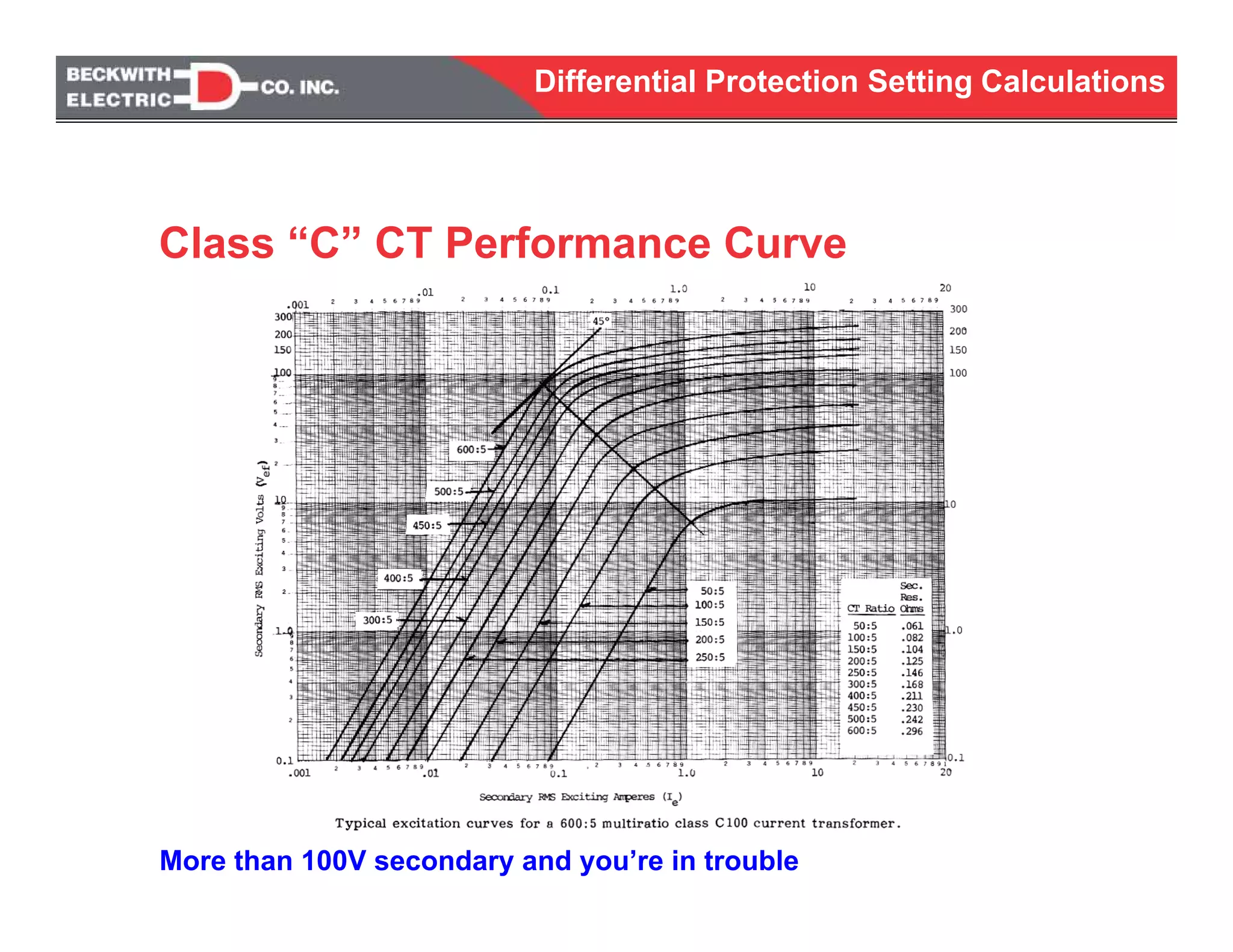
More than 100V secondary and you’re in trouble
Class “C” CT Performance Curve
Differential Protection Setting Calculations
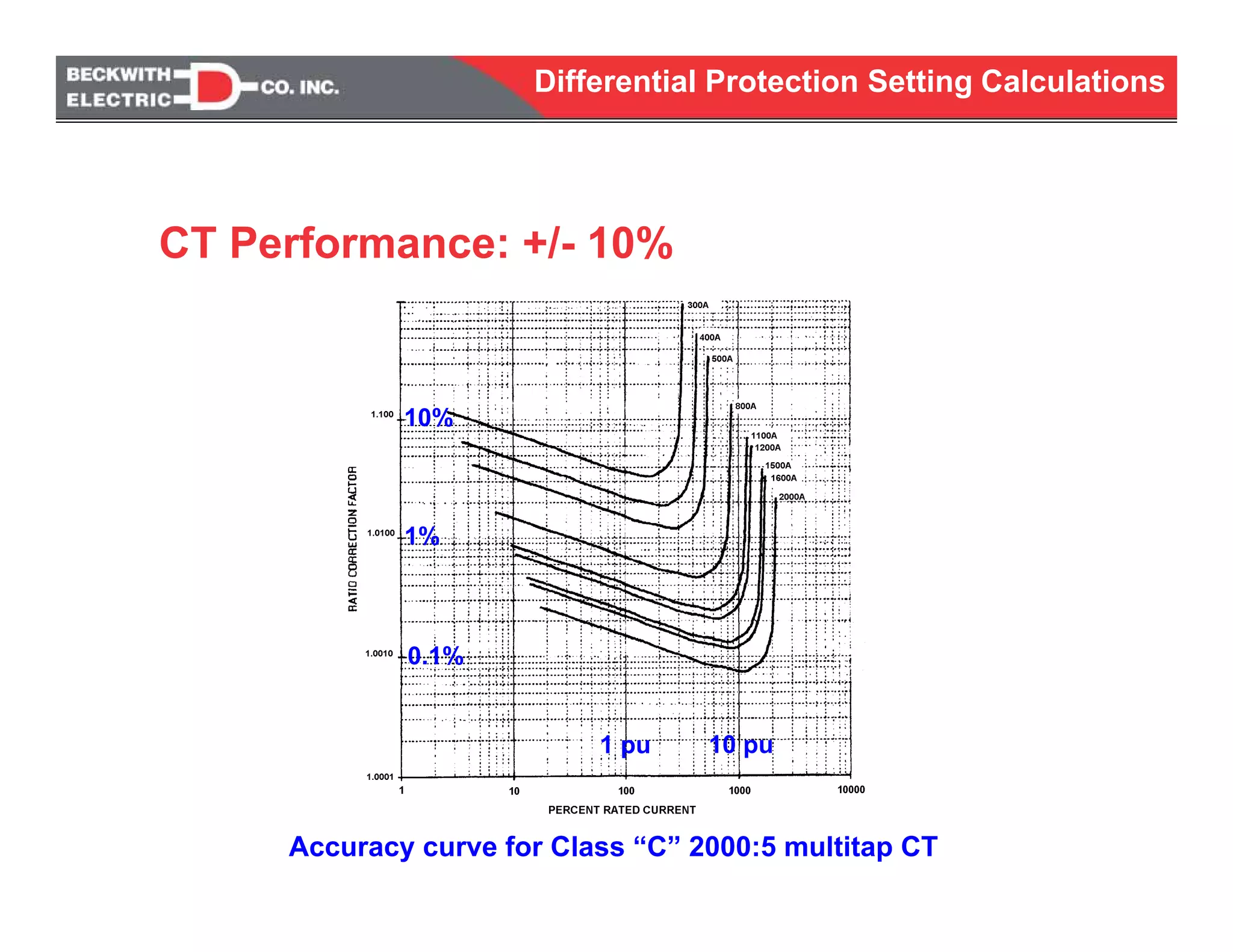
1 pu 10 pu
10%
1%
0.1%
Accuracy curve for Class “C” 2000:5 multitap CT
CT Performance: +/- 10%
Differential Protection Setting Calculations
0
0
tt
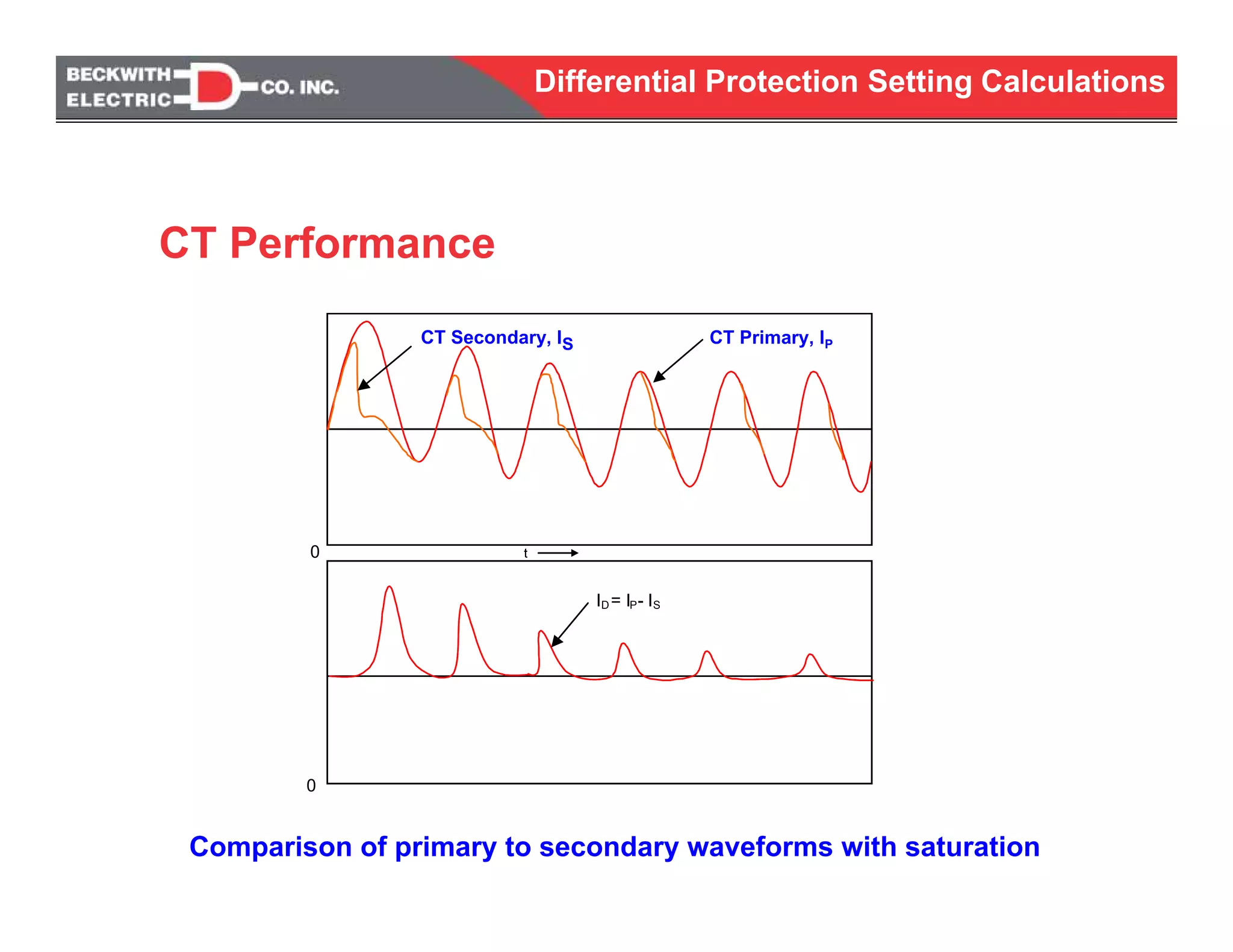
ID= IP- IS
CT Secondary, IS CT Primary, IP
Comparison of primary to secondary waveforms with saturation
CT Performance
Differential Protection Setting Calculations
Use with Class “C” CTs
Determine maximum primary phase and ground
fault current
Calculate secondary current based on CTR and CT
connection type (wye or delta)
Determine secondary CT circuit burden
Determine maximum secondary voltage produced
from burden with secondary fault currents
Check maximum secondary voltage against CT
capability
CT Performance Calculation
Differential Protection Setting Calculations
For WYE connected CTs, to obtain secondary current,
use: (1X) I PRI / CTR = I SEC
Fault Types and Currents in Secondary
Circuits
Transformer Setting Calculations
Differential Protection Setting Calculations
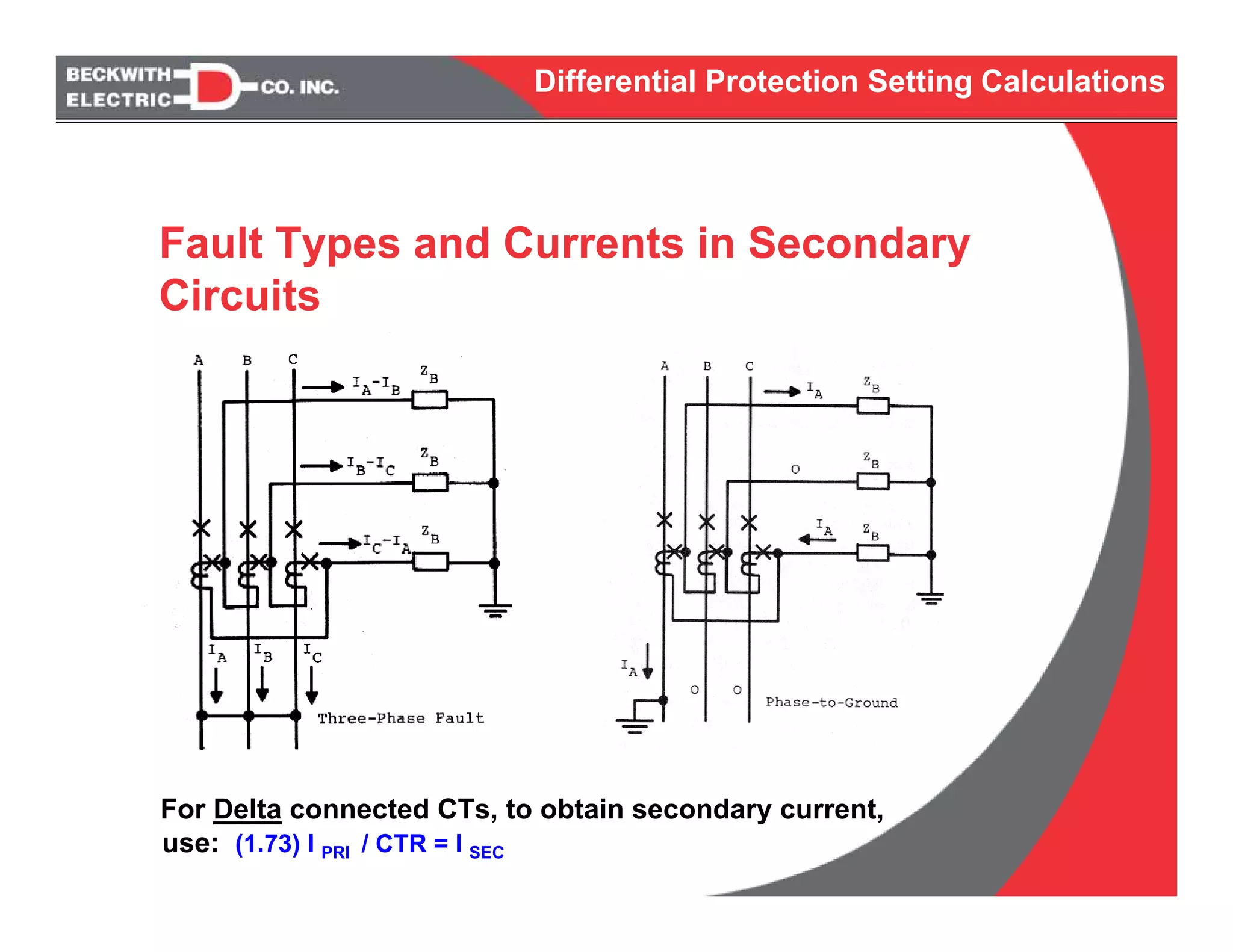
For Delta connected CTs, to obtain secondary current,
use: (1.73) I PRI / CTR = I SEC
Fault Types and Currents in Secondary
Circuits
Differential Protection Setting Calculations
Determine all device burdens in secondary circuit
- Relays, meters, instrumentation
Determine lead burden
- Use wire tables (AWG @ ohms/ft)
Determine CT impedance
Use CT data sheet (typ. 0.4 ohm or less)
Burden Calculation
Differential Protection Setting Calculations
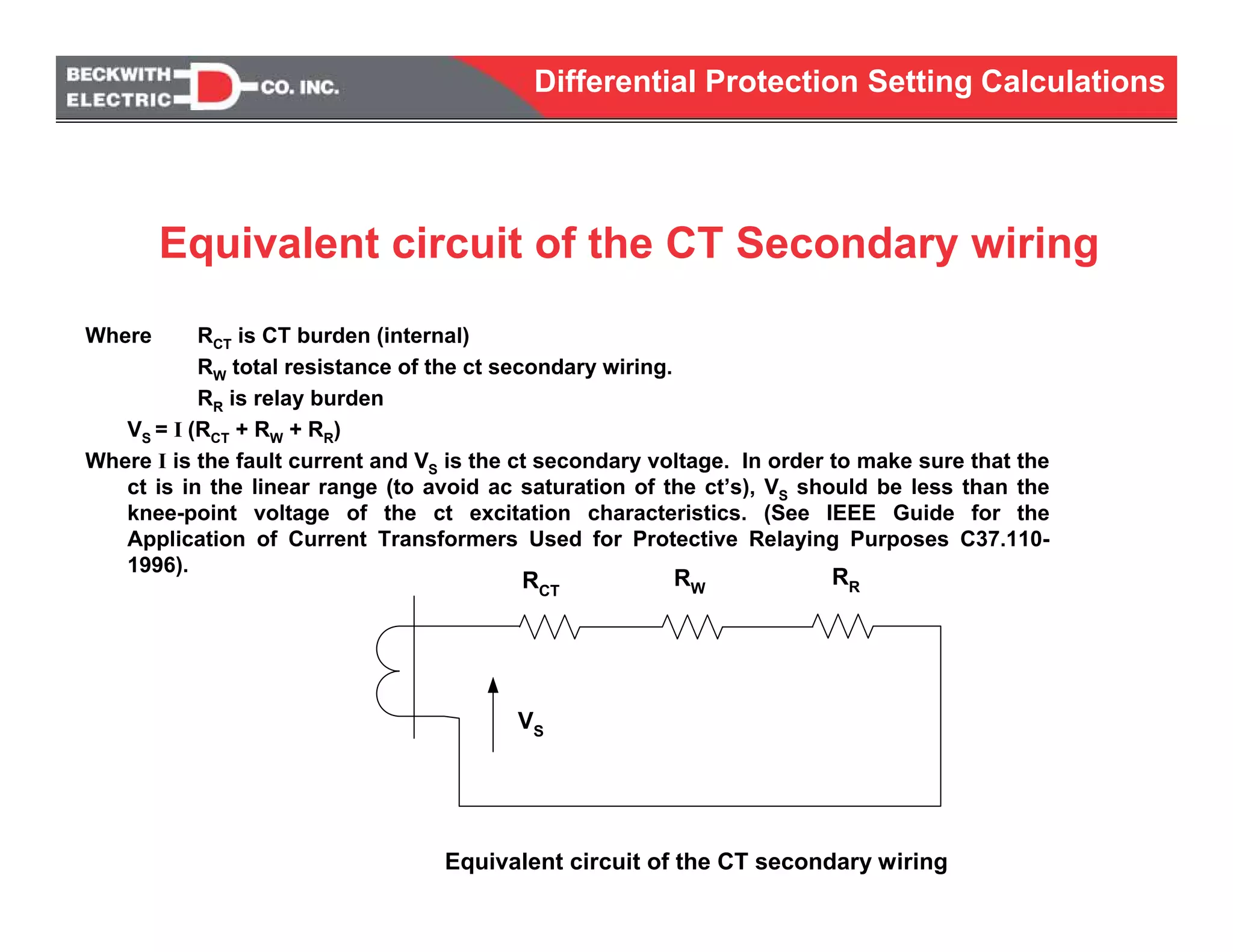
Where RCT is CT burden (internal)
RW total resistance of the ct secondary wiring.
RR is relay burden
VS = I (RCT + RW + RR)
Where I is the fault current and VS is the ct secondary voltage. In order to make sure that the
ct is in the linear range (to avoid ac saturation of the ct’s), VS should be less than the
knee-point voltage of the ct excitation characteristics. (See IEEE Guide for the
Application of Current Transformers Used for Protective Relaying Purposes C37.110-
1996).
VS
Equivalent circuit of the CT secondary wiring
RCT
RW
RR
Equivalent circuit of the CT Secondary wiring
Differential Protection Setting Calculations
Relay = 0.5VA @ 5 A
RR = VA/A2 , RR = 0.5/25 = 0.02 Ω
RW = 2 Ω (round trip)
RCT = 0.20 Ω
Total = 2.22 Ω
Burden Calculation
Example
Differential Protection Setting Calculations
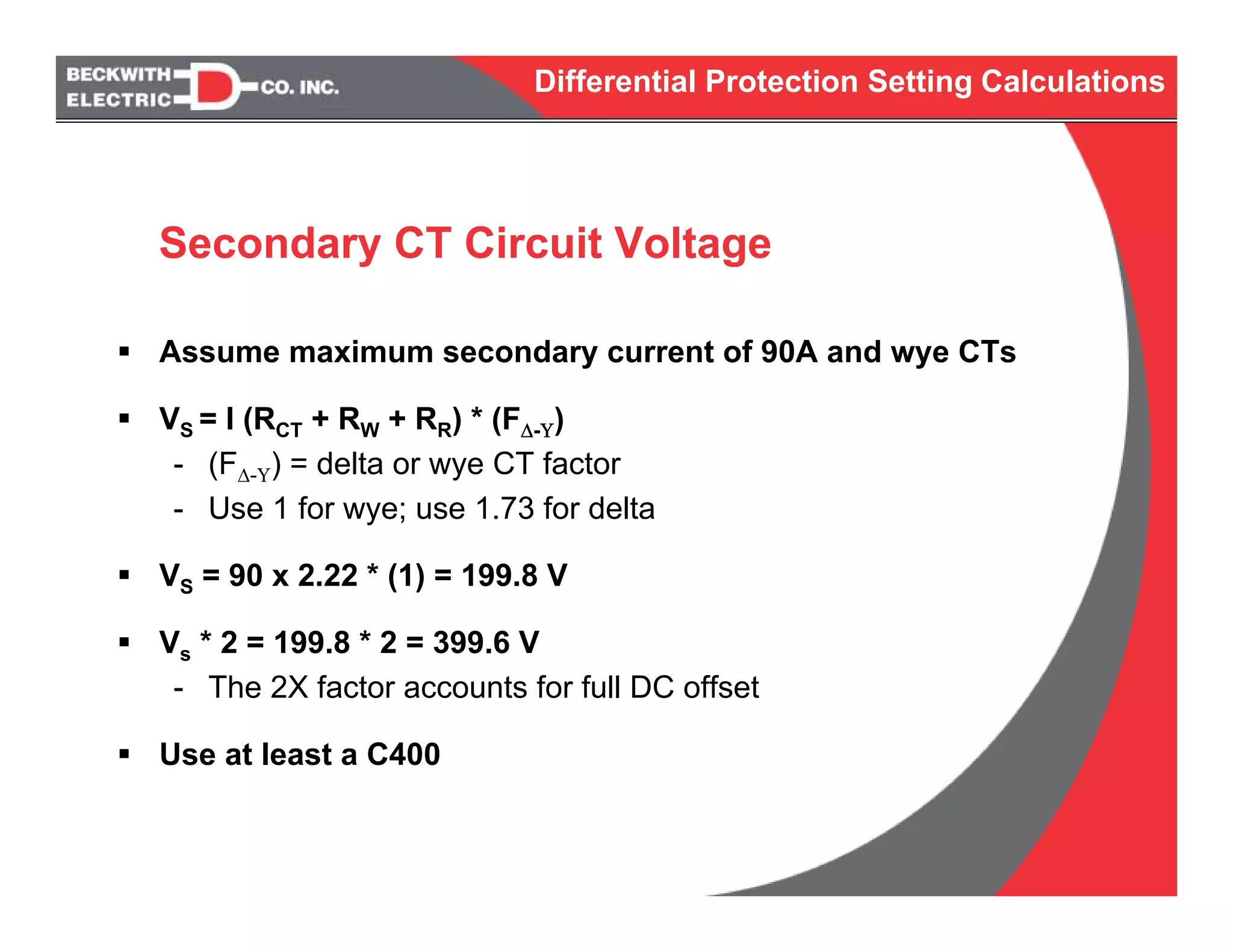
Assume maximum secondary current of 90A and wye CTs
VS = I (RCT + RW + RR) * (FΔ-Υ)
- (FΔ-Υ) = delta or wye CT factor
- Use 1 for wye; use 1.73 for delta
VS = 90 x 2.22 * (1) = 199.8 V
Vs * 2 = 199.8 * 2 = 399.6 V
- The 2X factor accounts for full DC offset
Use at least a C400
Secondary CT Circuit Voltage
Differential Protection Setting Calculations
Used to determine current at rated transformer capacity
- Normally pick highest rating of multiple MVA rated
transformers
Allows “nominalization” of the transformer windings
Used to obtain “tap” that is digitally set
Itap = VA / [√3 * VLL] * CTR
This accommodates:
- Transformer winding ratios
- CT ratios
Power-Current Conversion
Differential Protection Setting Calculations
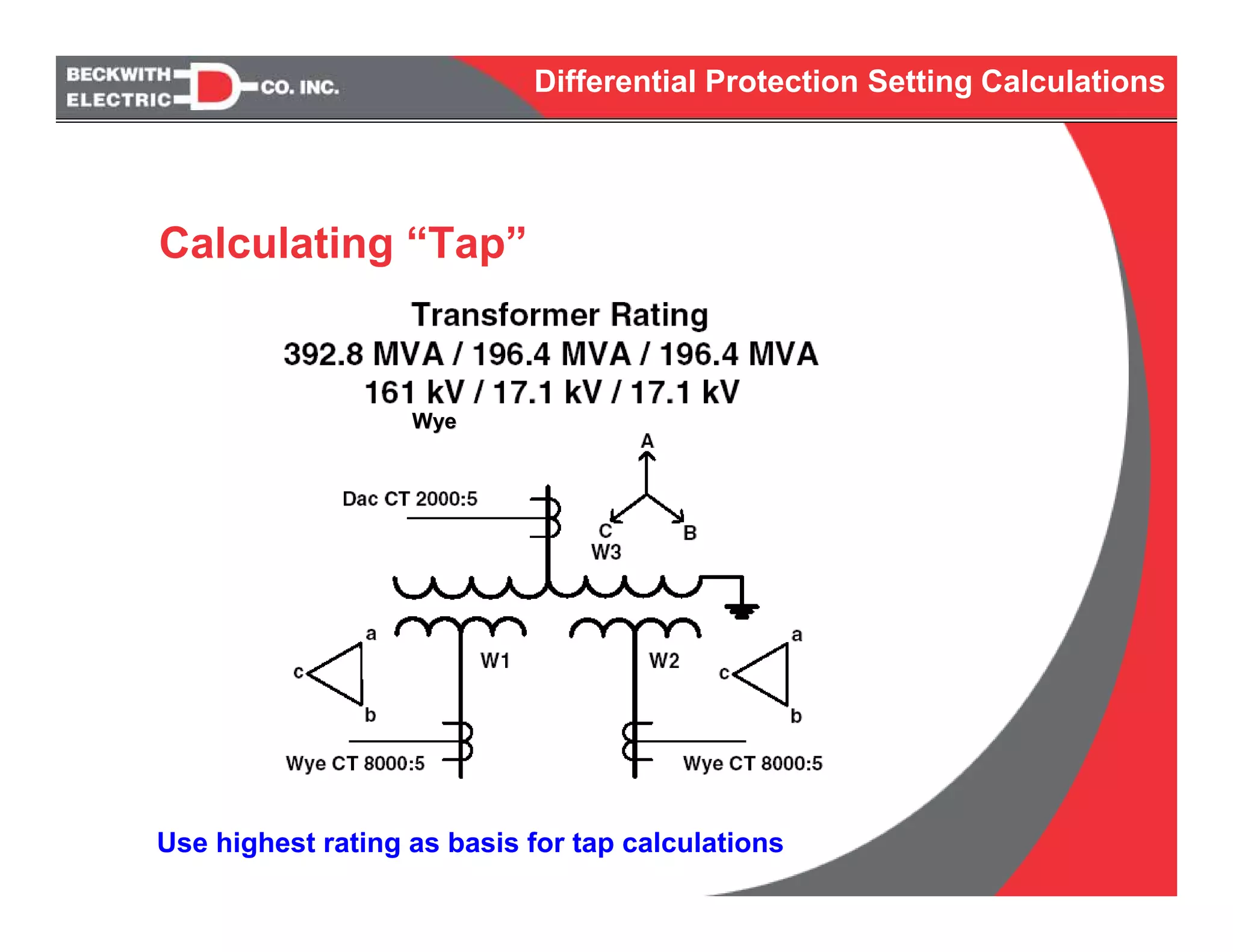
Use highest rating as basis for tap calculations
WyeWye
Calculating “Tap”
Differential Protection Setting Calculations
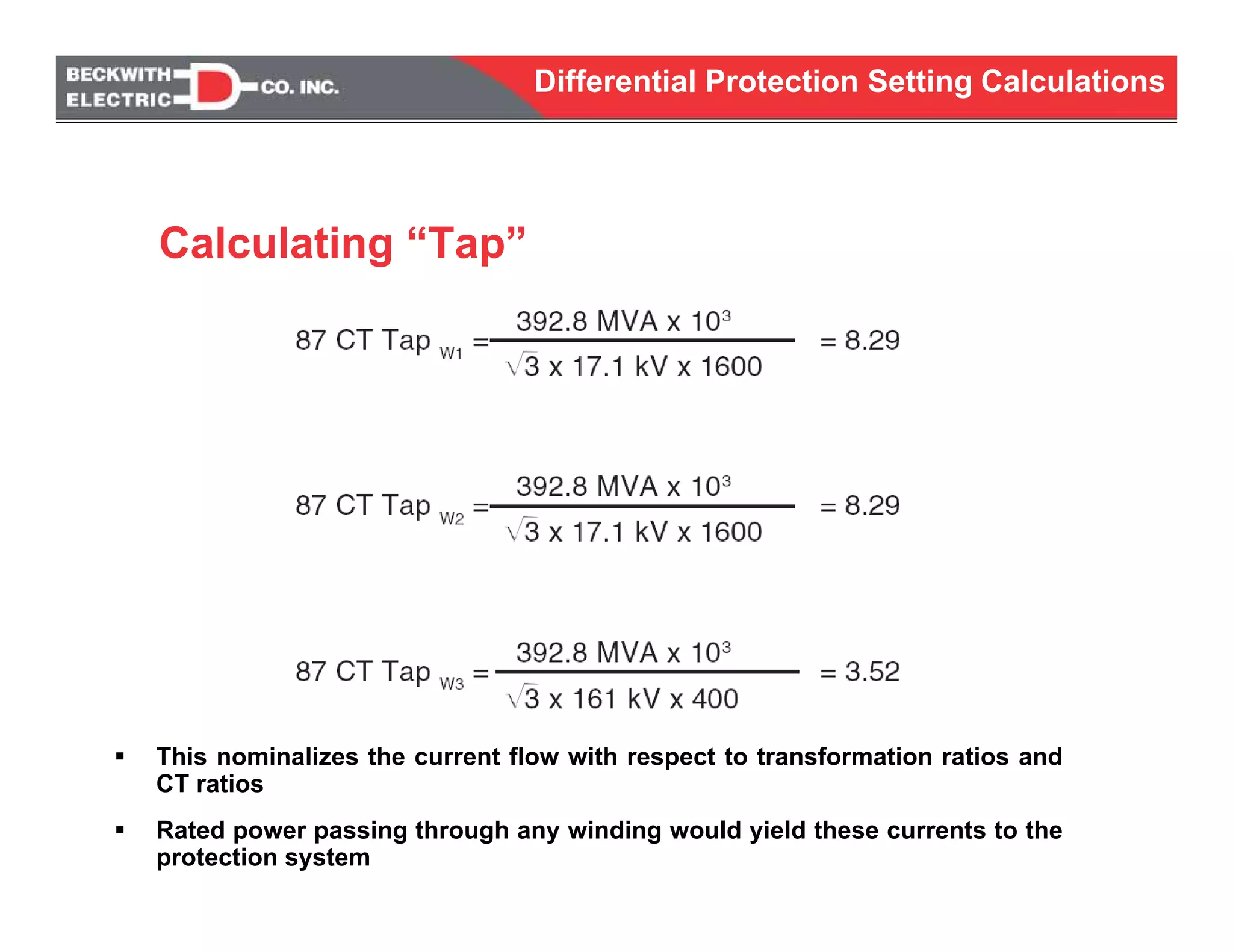
This nominalizes the current flow with respect to transformation ratios and
CT ratios
Rated power passing through any winding would yield these currents to the
protection system
Calculating “Tap”
Differential Protection Setting Calculations
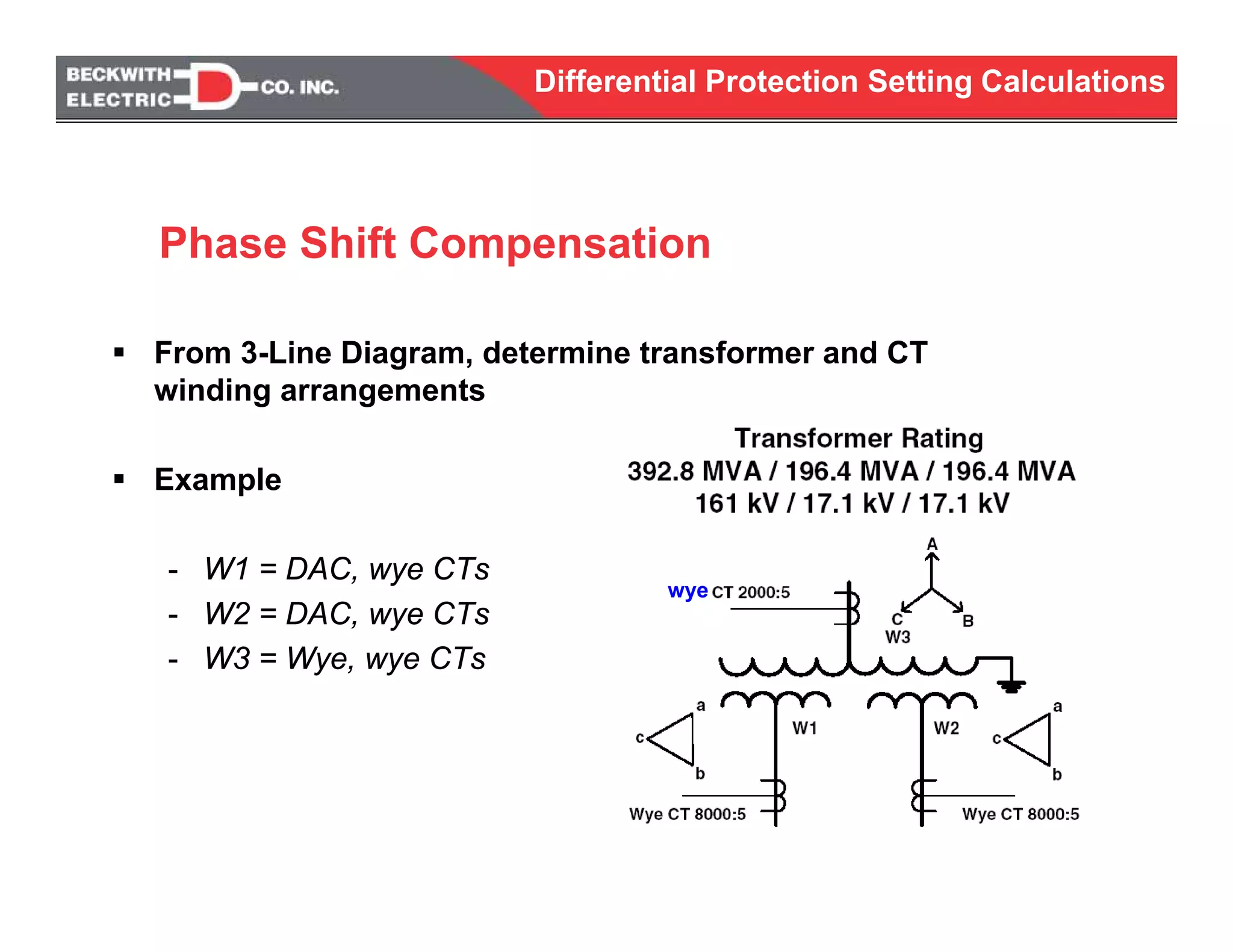
From 3-Line Diagram, determine transformer and CT
winding arrangements
Example
- W1 = DAC, wye CTs
- W2 = DAC, wye CTs
- W3 = Wye, wye CTs
wye
Phase Shift Compensation
Differential Protection Setting Calculations
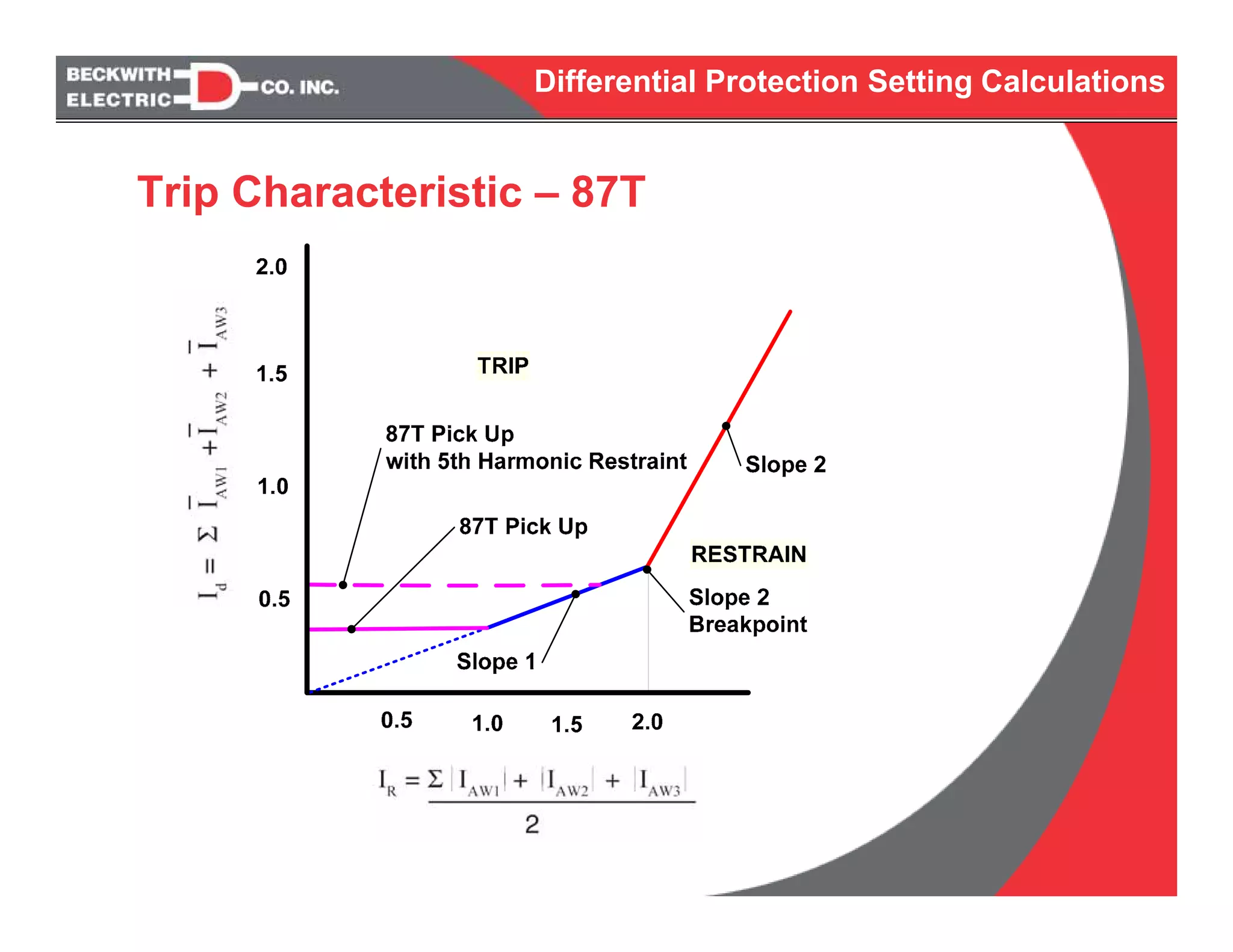
Trip Characteristic – 87T
Differential Protection Setting Calculations
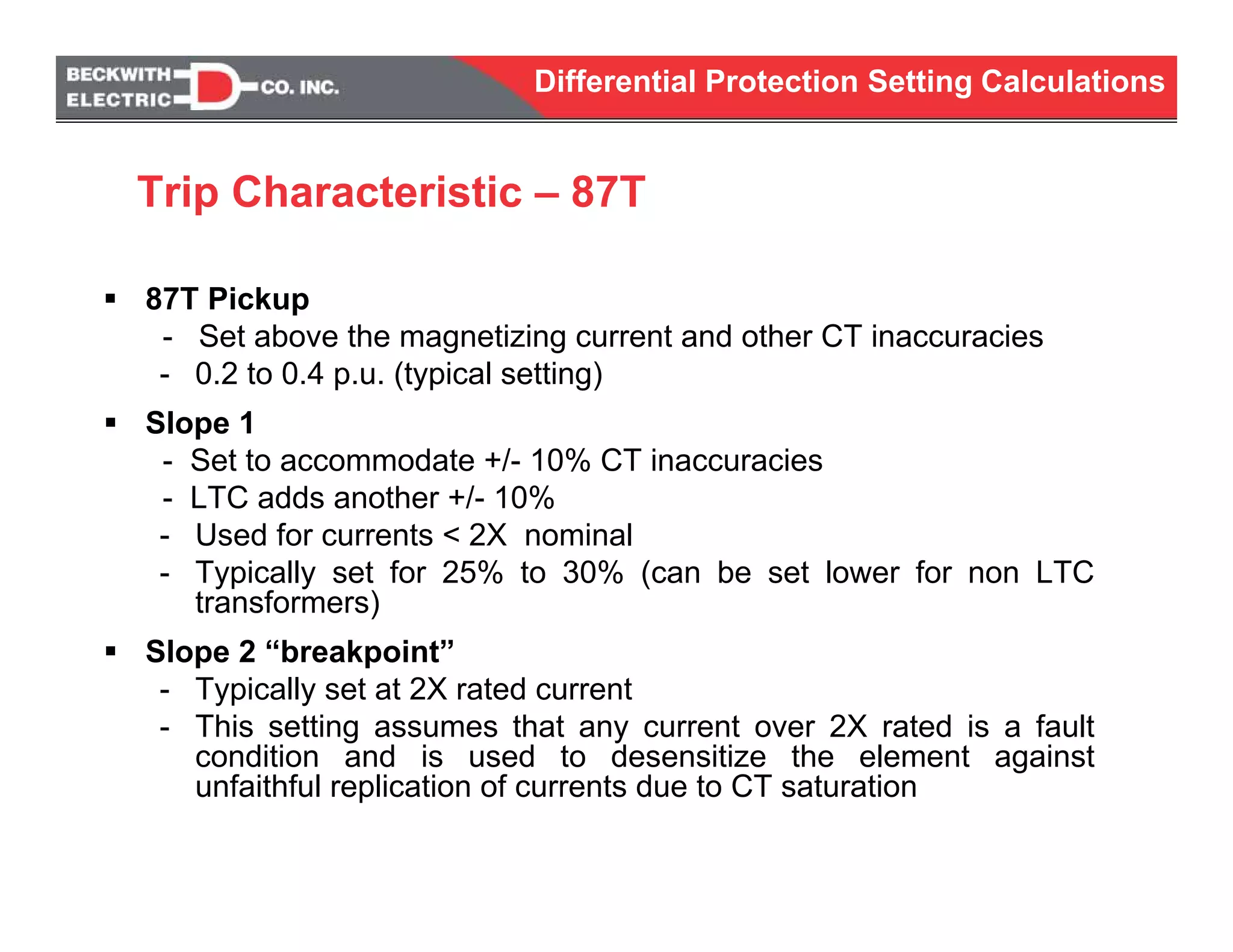
87T Pickup
- Set above the magnetizing current and other CT inaccuracies
- 0.2 to 0.4 p.u. (typical setting)
Slope 1
- Set to accommodate +/- 10% CT inaccuracies
- LTC adds another +/- 10%
- Used for currents < 2X nominal
- Typically set for 25% to 30% (can be set lower for non LTC
transformers)
Slope 2 “breakpoint”
- Typically set at 2X rated current
- This setting assumes that any current over 2X rated is a fault
condition and is used to desensitize the element against
unfaithful replication of currents due to CT saturation
Trip Characteristic – 87T
Differential Protection Setting Calculations
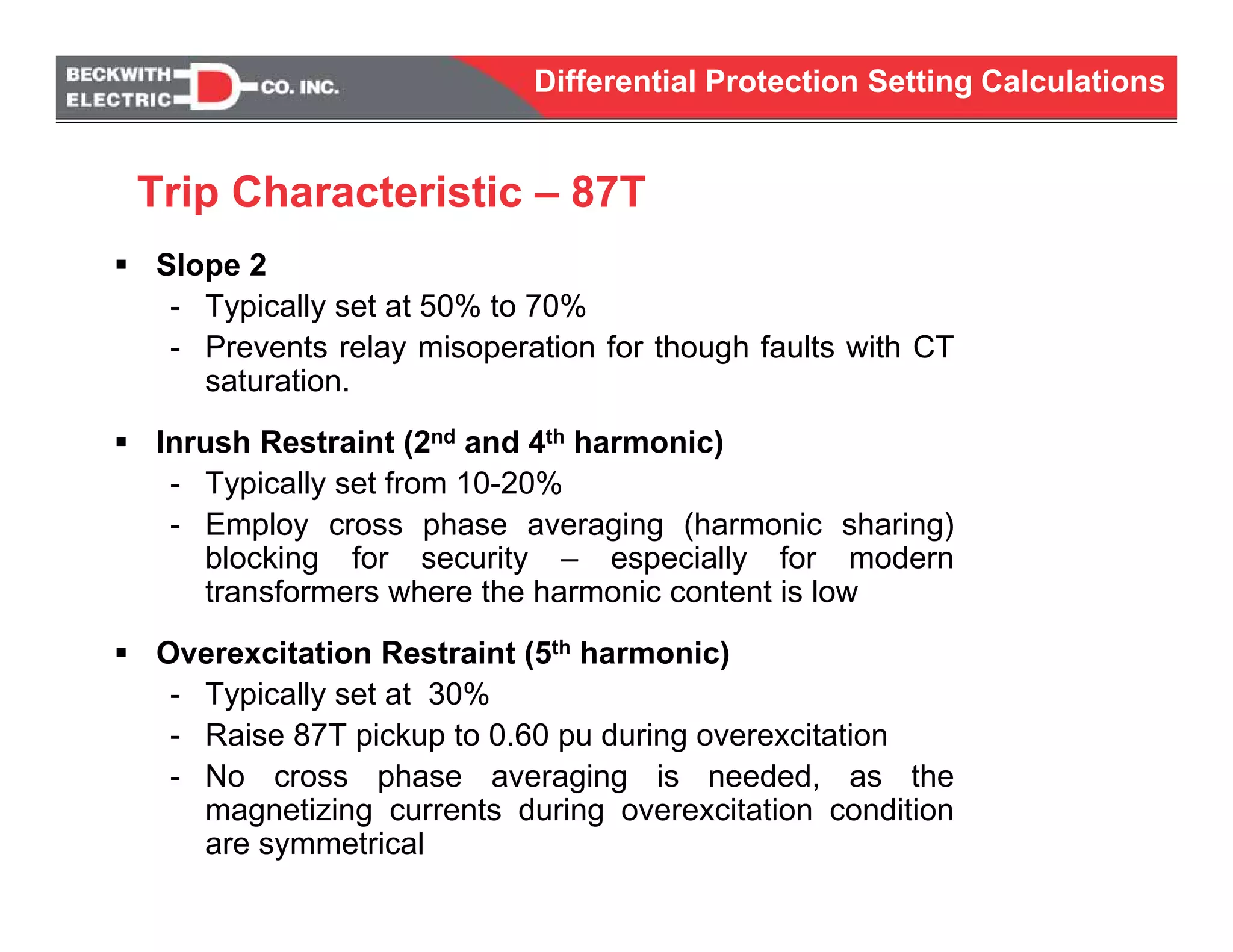
Slope 2
- Typically set at 50% to 70%
- Prevents relay misoperation for though faults with CT
saturation.
Inrush Restraint (2nd and 4th harmonic)
- Typically set from 10-20%
- Employ cross phase averaging (harmonic sharing)
blocking for security – especially for modern
transformers where the harmonic content is low
Overexcitation Restraint (5th harmonic)
- Typically set at 30%
- Raise 87T pickup to 0.60 pu during overexcitation
- No cross phase averaging is needed, as the
magnetizing currents during overexcitation condition
are symmetrical
Trip Characteristic – 87T
Differential Protection Setting Calculations
87H Pickup
- Typically set at 8 to 12 pu rated current
- This value should be set to above the maximum
possible inrush current.
- Relay oscillograph analysis software can be used
determine the inrush current level and fine tune the
setting.
- Also, need to know if the high set element uses
fundamental component of current (typically the case)
or total RMS current and set the pickup appropriately.
Trip Characteristic – 87H
Differential Protection Setting Calculations
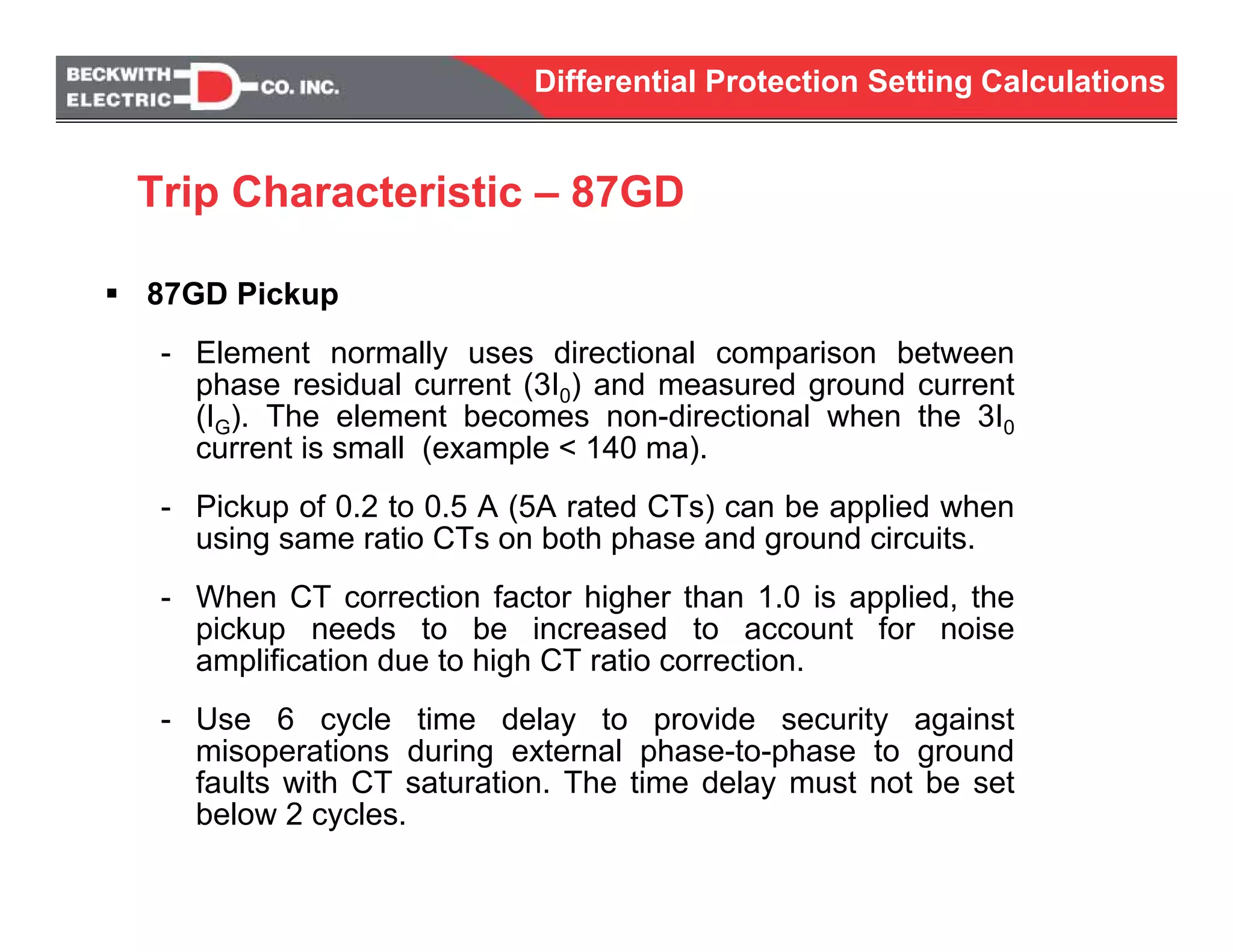
87GD Pickup
- Element normally uses directional comparison between
phase residual current (3I0) and measured ground current
(IG). The element becomes non-directional when the 3I0
current is small (example < 140 ma).
- Pickup of 0.2 to 0.5 A (5A rated CTs) can be applied when
using same ratio CTs on both phase and ground circuits.
- When CT correction factor higher than 1.0 is applied, the
pickup needs to be increased to account for noise
amplification due to high CT ratio correction.
- Use 6 cycle time delay to provide security against
misoperations during external phase-to-phase to ground
faults with CT saturation. The time delay must not be set
below 2 cycles.
Trip Characteristic – 87GD
Differential Protection Setting Calculations
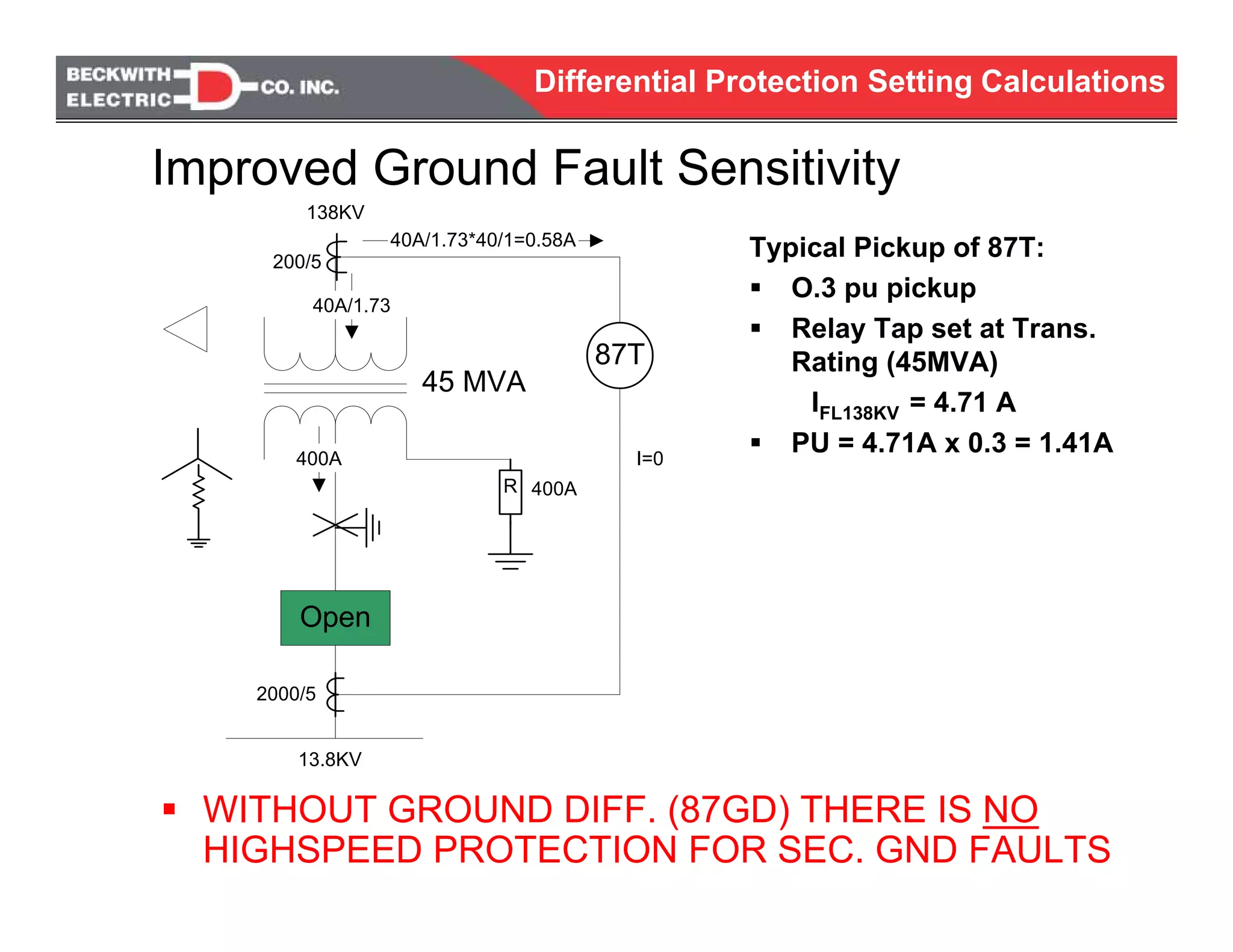
WITHOUT GROUND DIFF. (87GD) THERE IS NO
HIGHSPEED PROTECTION FOR SEC. GND FAULTS
Typical Pickup of 87T:
O.3 pu pickup
Relay Tap set at Trans.
Rating (45MVA)
IFL138KV = 4.71 A
PU = 4.71A x 0.3 = 1.41A
Open
R
87T
2000/5
200/5
400A
13.8KV
138KV
I=0
400A
40A/1.73
40A/1.73*40/1=0.58A
45 MVA
Improved Ground Fault Sensitivity
Differential Protection Setting Calculations
DIGITAL TRANSFORMER
DIFFERENTIAL RELAY SETTING EXAMPLE
Differential Protection Setting Calculations
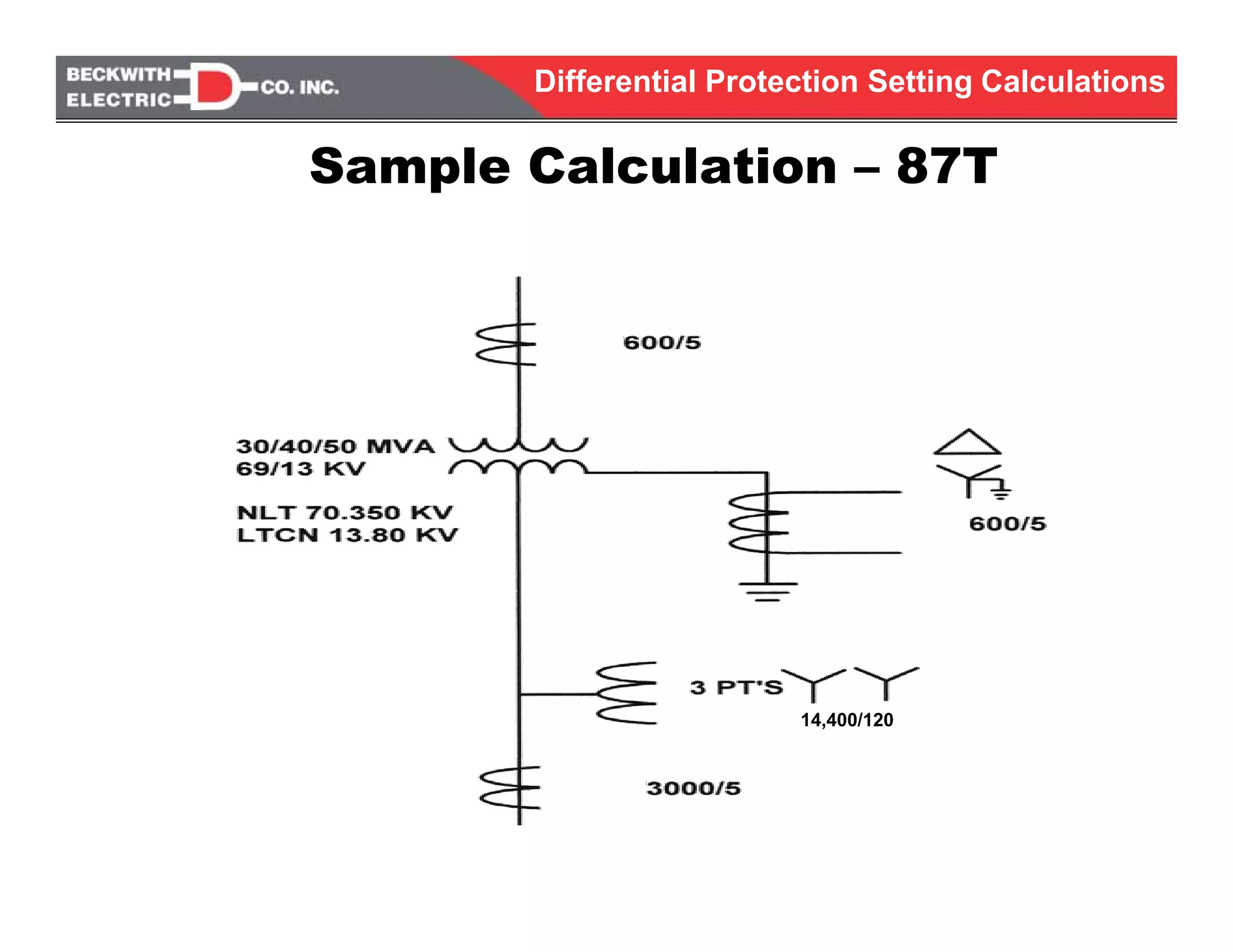
Sample Calculation – 87T
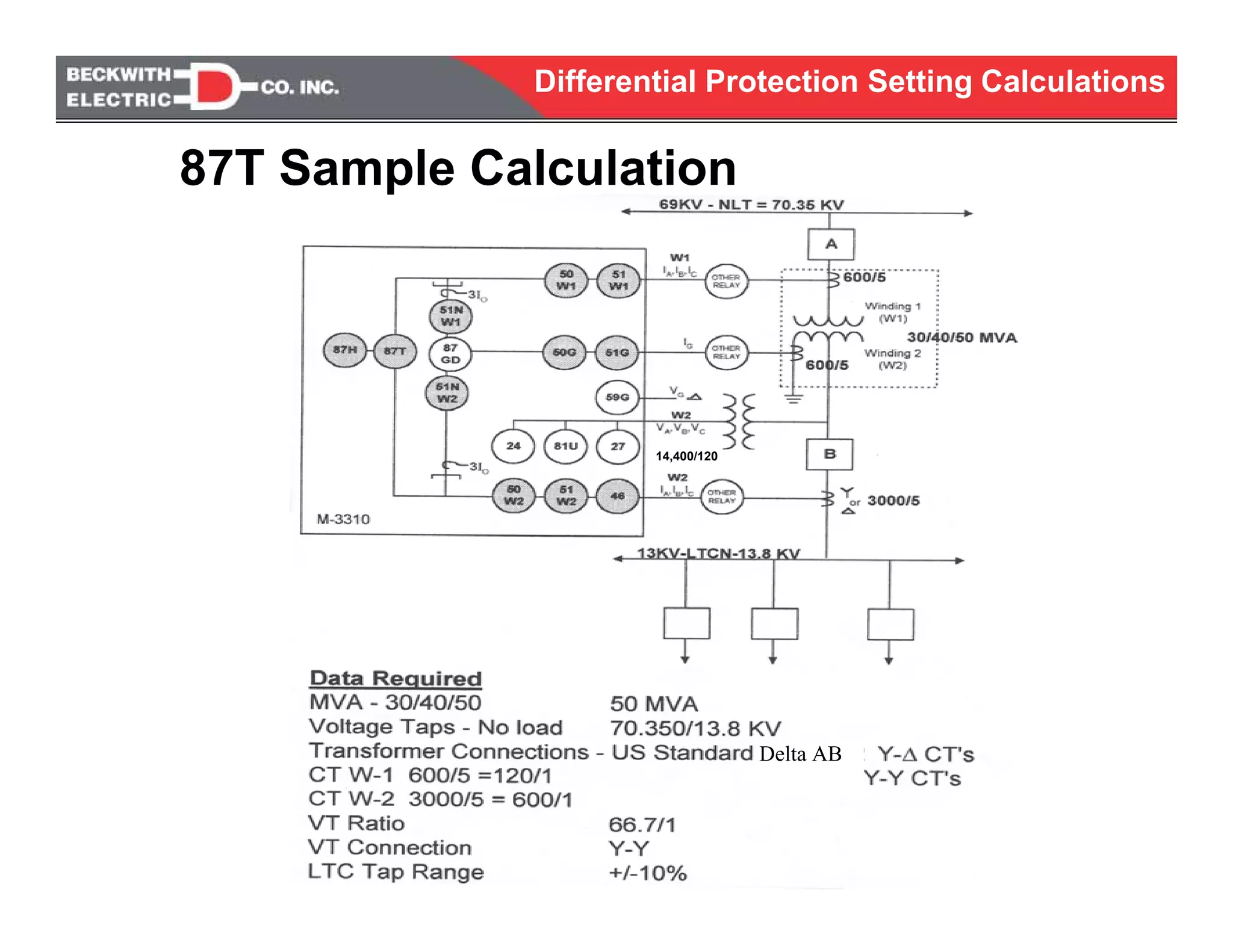
14,400/120
Differential Protection Setting Calculations
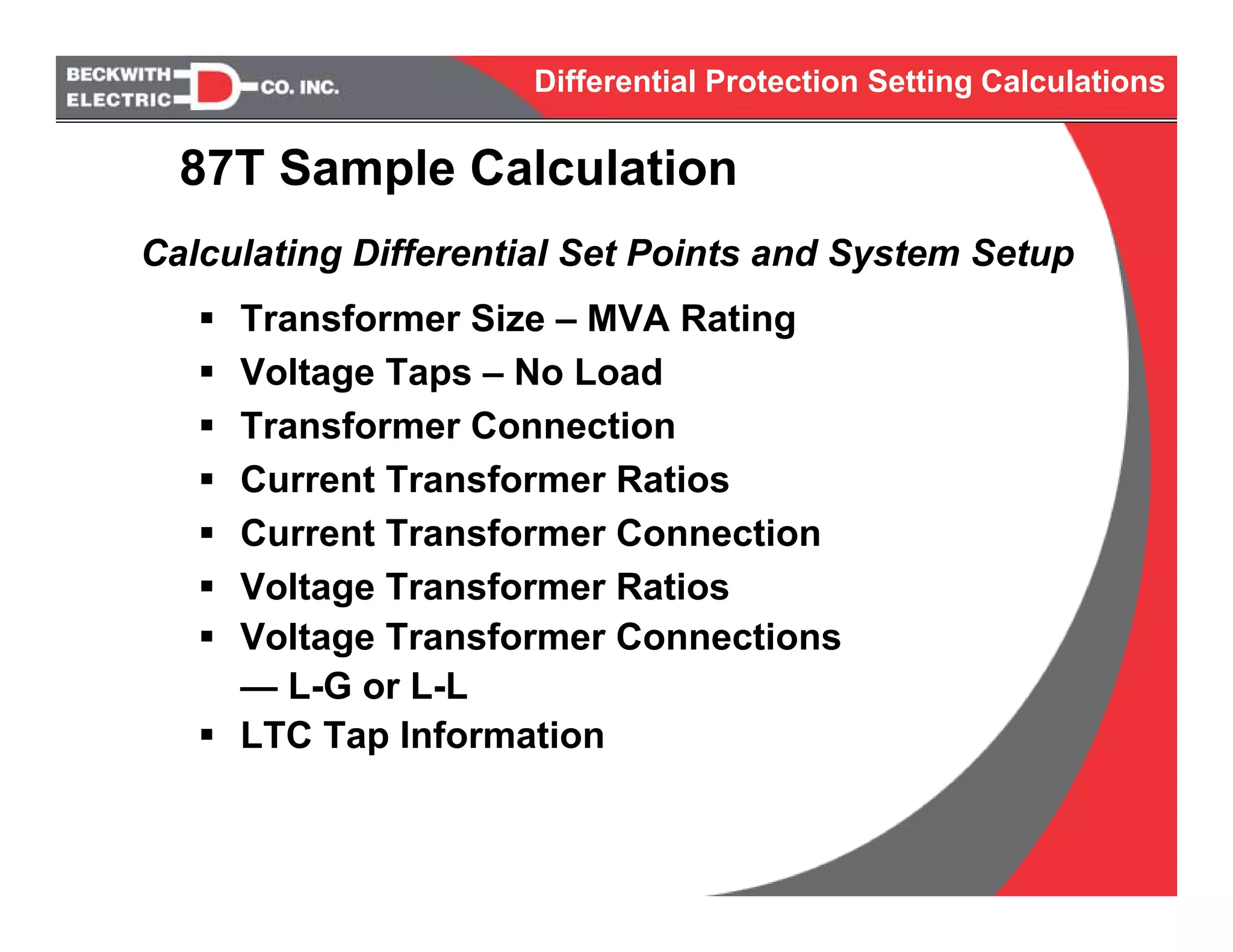
Transformer Size – MVA Rating
Voltage Taps – No Load
Transformer Connection
Current Transformer Ratios
Current Transformer Connection
Voltage Transformer Ratios
Voltage Transformer Connections
— L-G or L-L
LTC Tap Information
Calculating Differential Set Points and System Setup
87T Sample Calculation
Differential Protection Setting Calculations
Delta AB
14,400/120
87T Sample Calculation
Differential Protection Setting Calculations
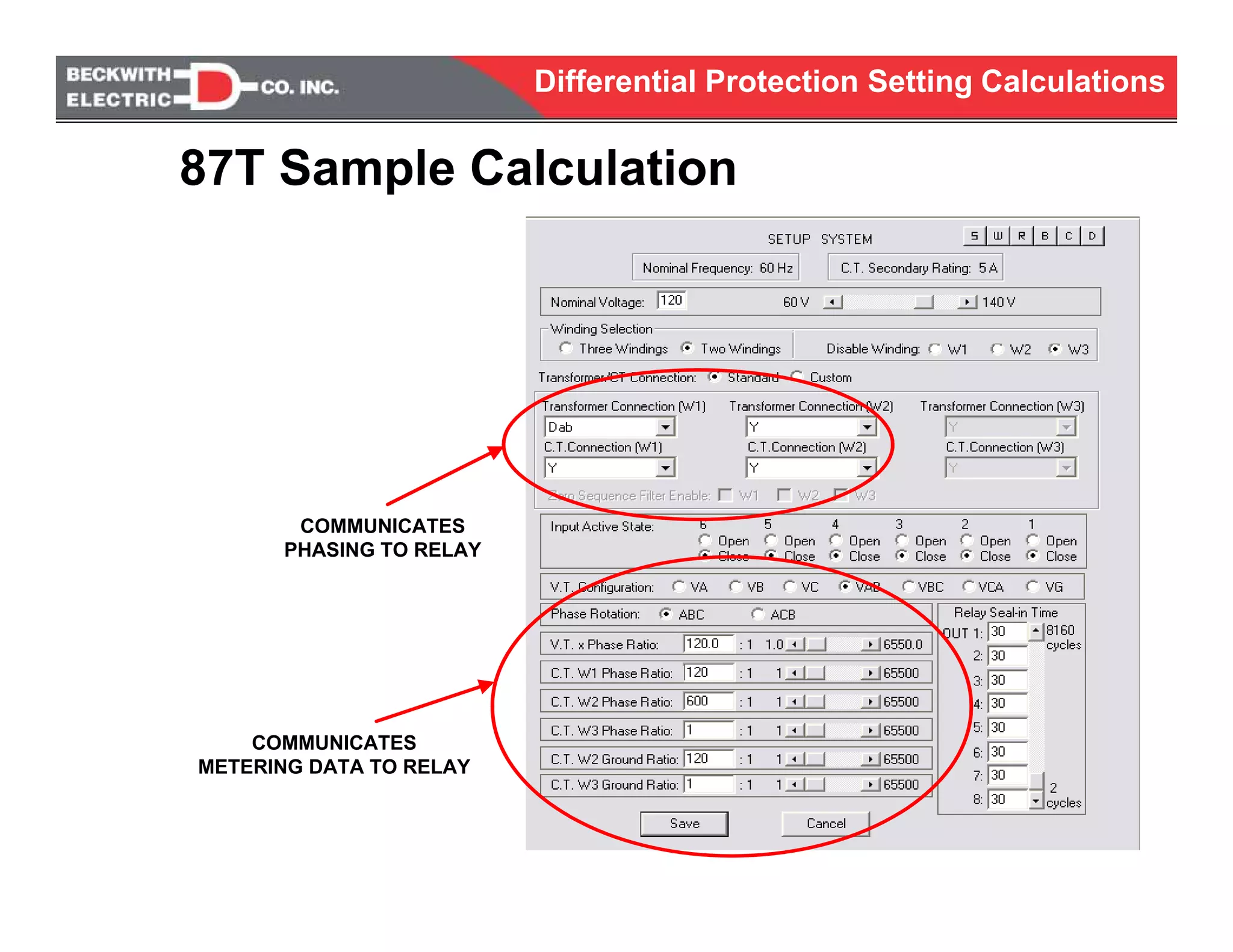
COMMUNICATES
PHASING TO RELAY
COMMUNICATES
METERING DATA TO RELAY
87T Sample Calculation
Differential Protection Setting Calculations
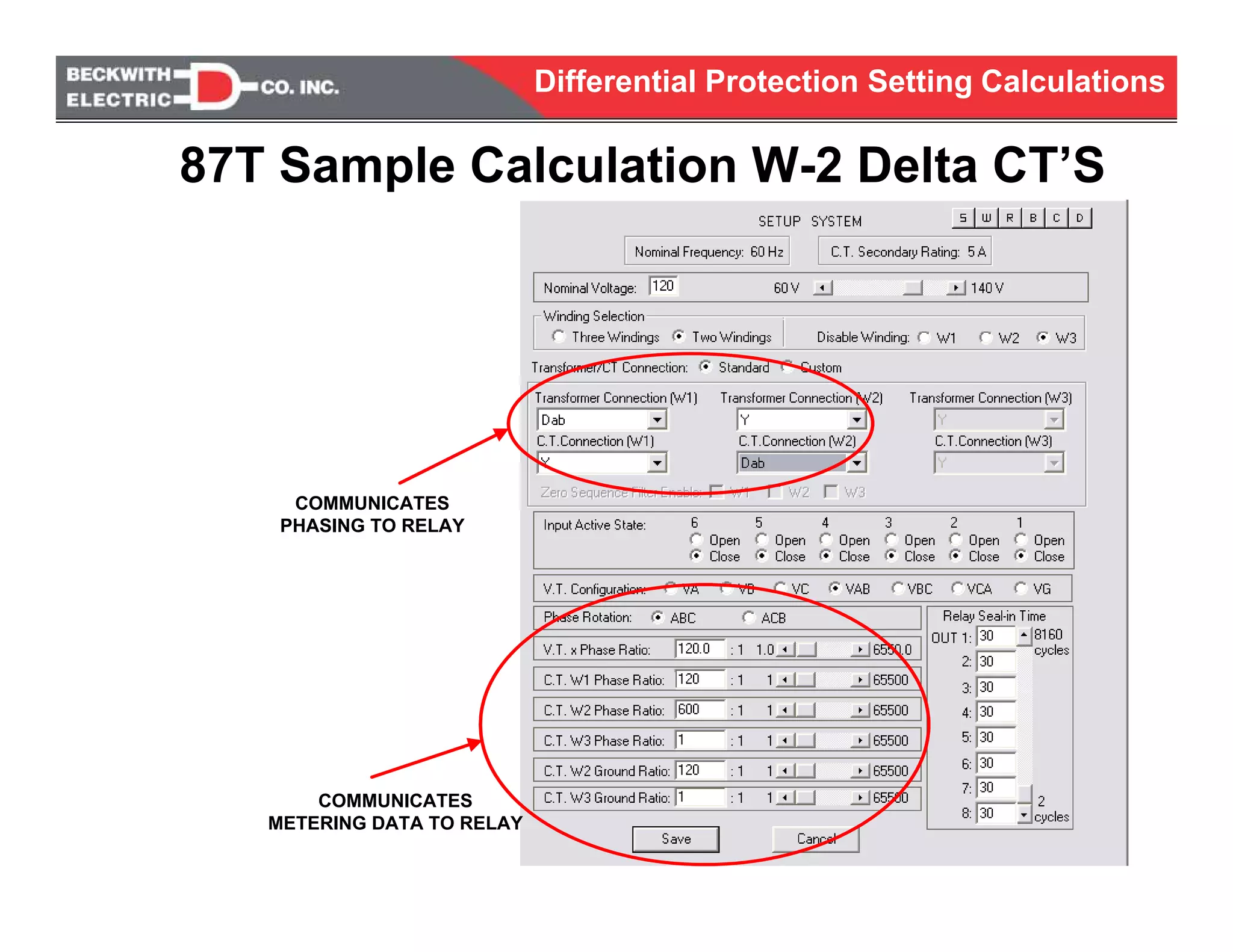
COMMUNICATES
PHASING TO RELAY
COMMUNICATES
METERING DATA TO RELAY
87T Sample Calculation W-2 Delta CT’S
Differential Protection Setting Calculations
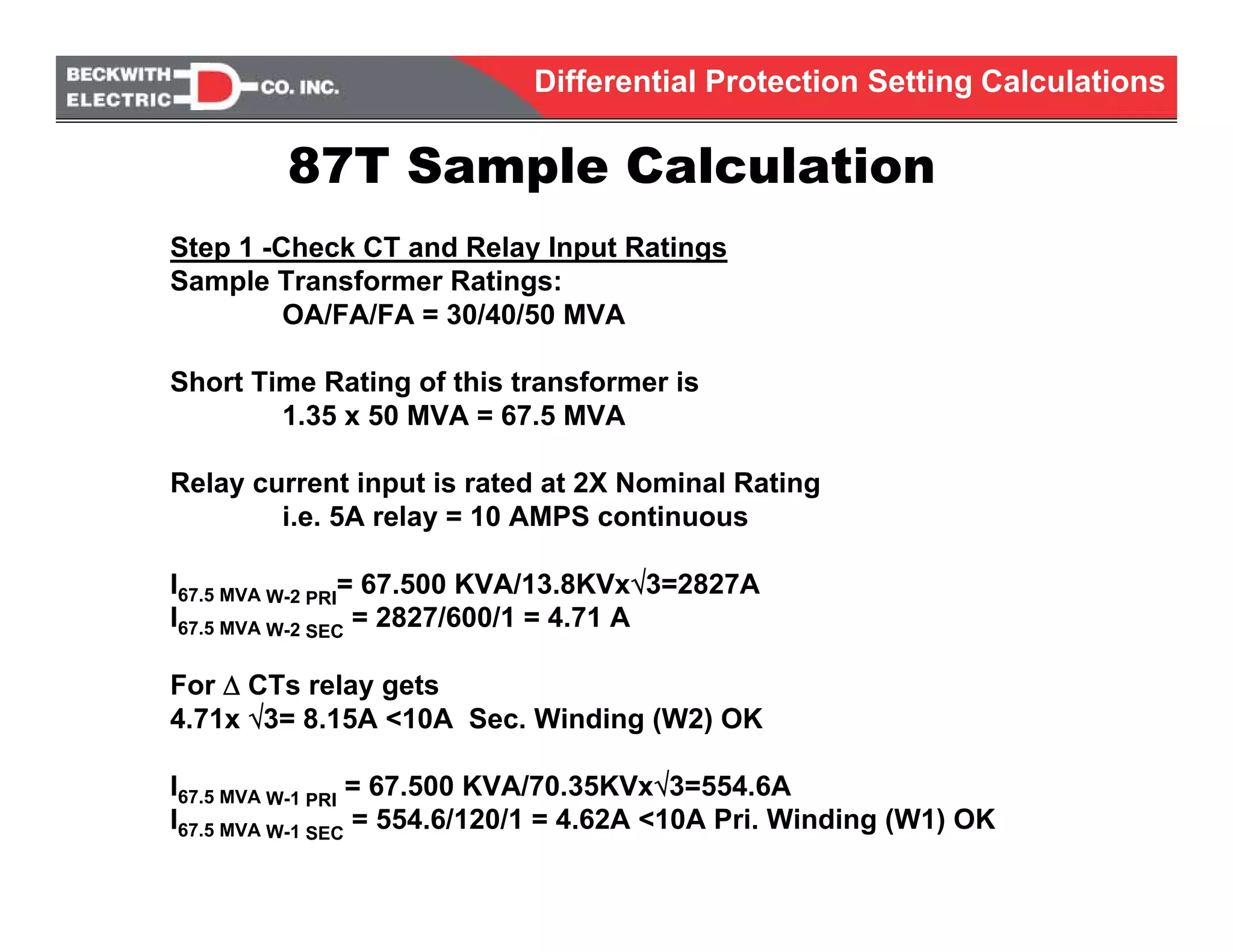
Step 1 -Check CT and Relay Input Ratings
Sample Transformer Ratings:
OA/FA/FA = 30/40/50 MVA
Short Time Rating of this transformer is
1.35 x 50 MVA = 67.5 MVA
Relay current input is rated at 2X Nominal Rating
i.e. 5A relay = 10 AMPS continuous
I67.5 MVA W-2 PRI
= 67.500 KVA/13.8KVx√3=2827A
I67.5 MVA W-2 SEC
= 2827/600/1 = 4.71 A
For Δ CTs relay gets
4.71x √3= 8.15A <10A Sec. Winding (W2) OK
I67.5 MVA W-1 PRI
= 67.500 KVA/70.35KVx√3=554.6A
I67.5 MVA W-1 SEC
= 554.6/120/1 = 4.62A <10A Pri. Winding (W1) OK
87T Sample Calculation
Differential Protection Setting Calculations
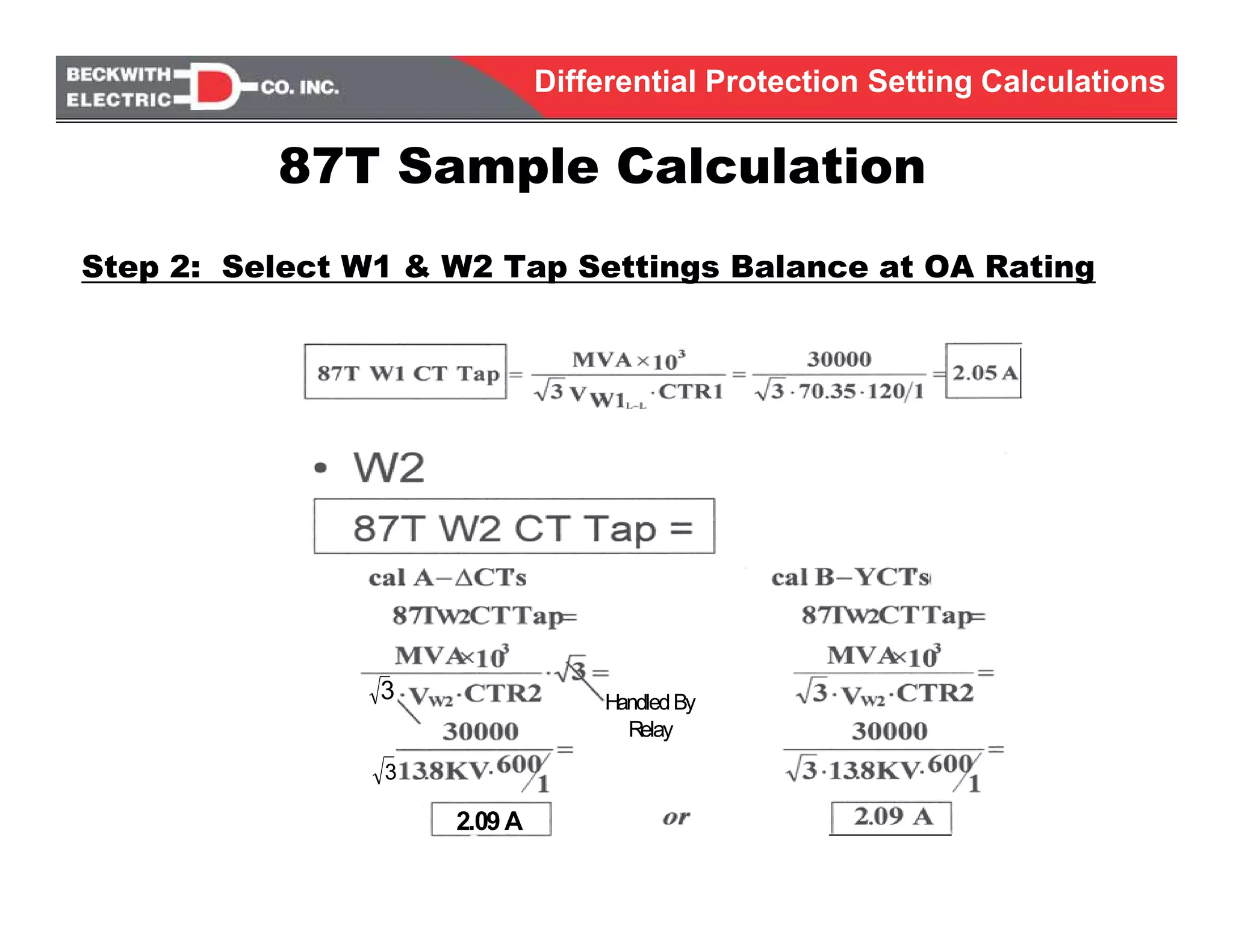
Step 2: Select W1 & W2 Tap Settings Balance at OA Rating
87T Sample Calculation
HandledBy
Relay
3
3
2.09 A
Differential Protection Setting Calculations
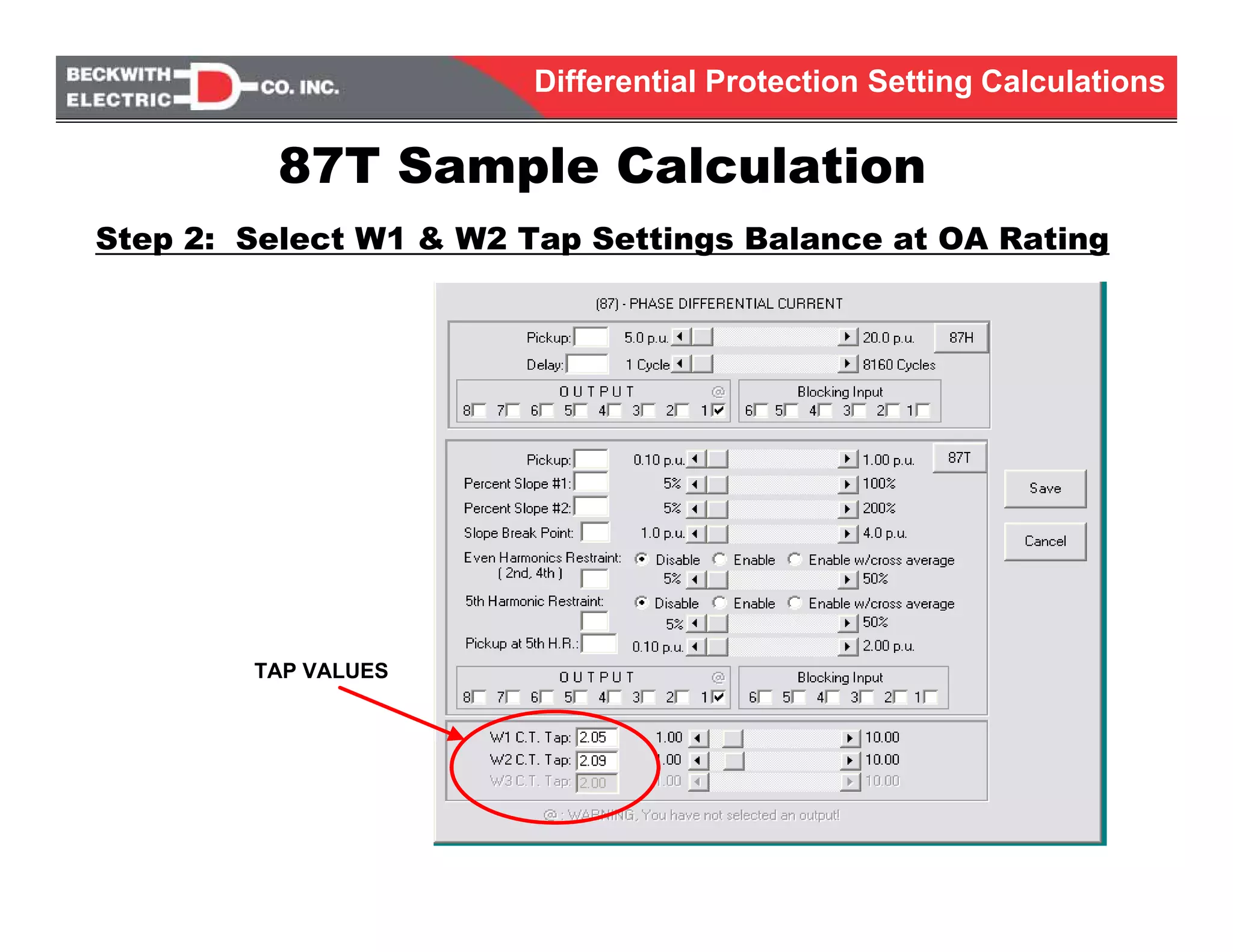
Step 2: Select W1 & W2 Tap Settings Balance at OA Rating
87T Sample Calculation
TAP VALUES
Differential Protection Setting Calculations
87T Sample Calculation
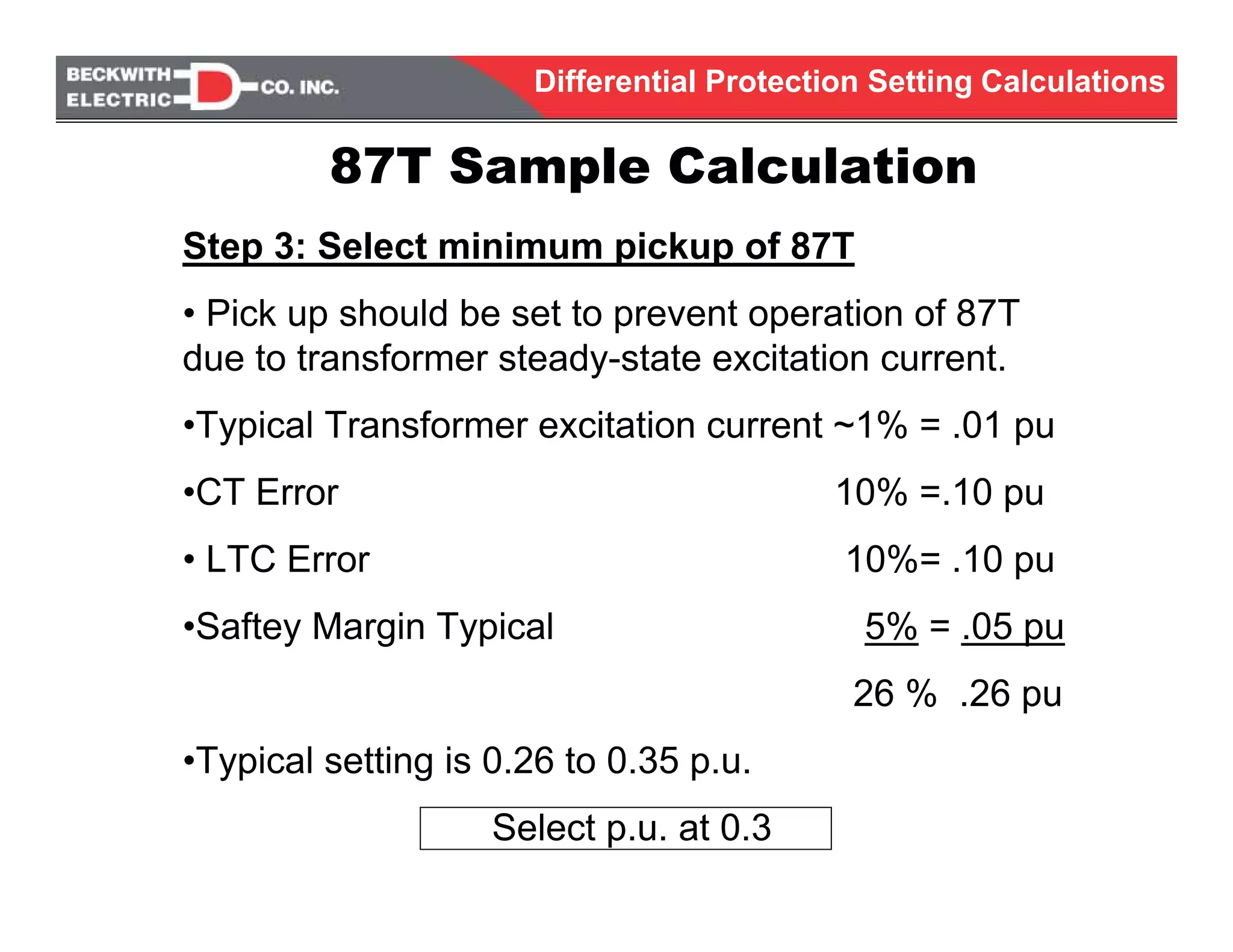
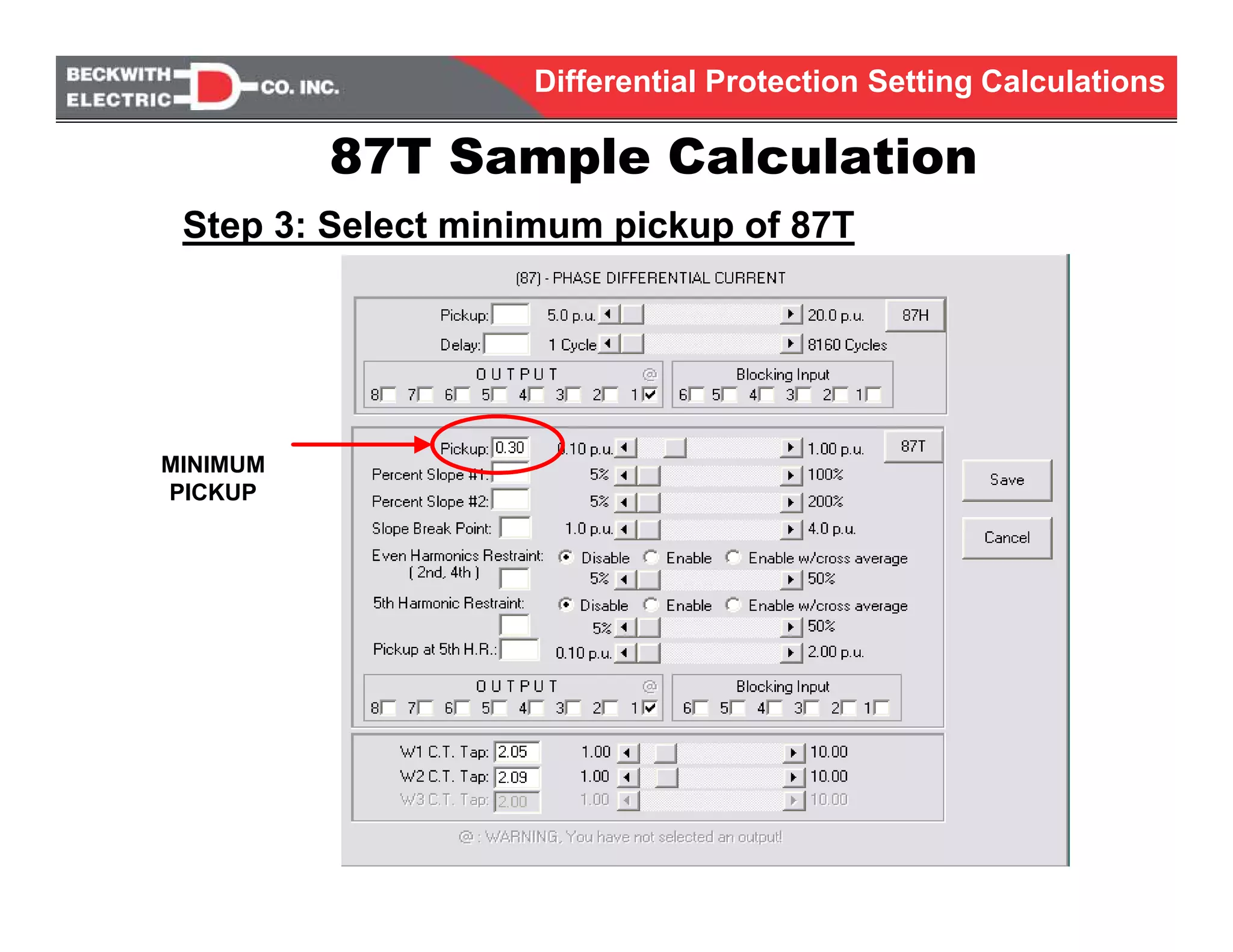
Step 3: Select minimum pickup of 87T
• Pick up should be set to prevent operation of 87T
due to transformer steady-state excitation current.
•Typical Transformer excitation current ~1% = .01 pu
•CT Error 10% =.10 pu
• LTC Error 10%= .10 pu
•Saftey Margin Typical 5% = .05 pu
26 % .26 pu
•Typical setting is 0.26 to 0.35 p.u.
Select p.u. at 0.3
Differential Protection Setting Calculations
87T Sample Calculation
Step 3: Select minimum pickup of 87T
MINIMUM
PICKUP
Differential Protection Setting Calculations
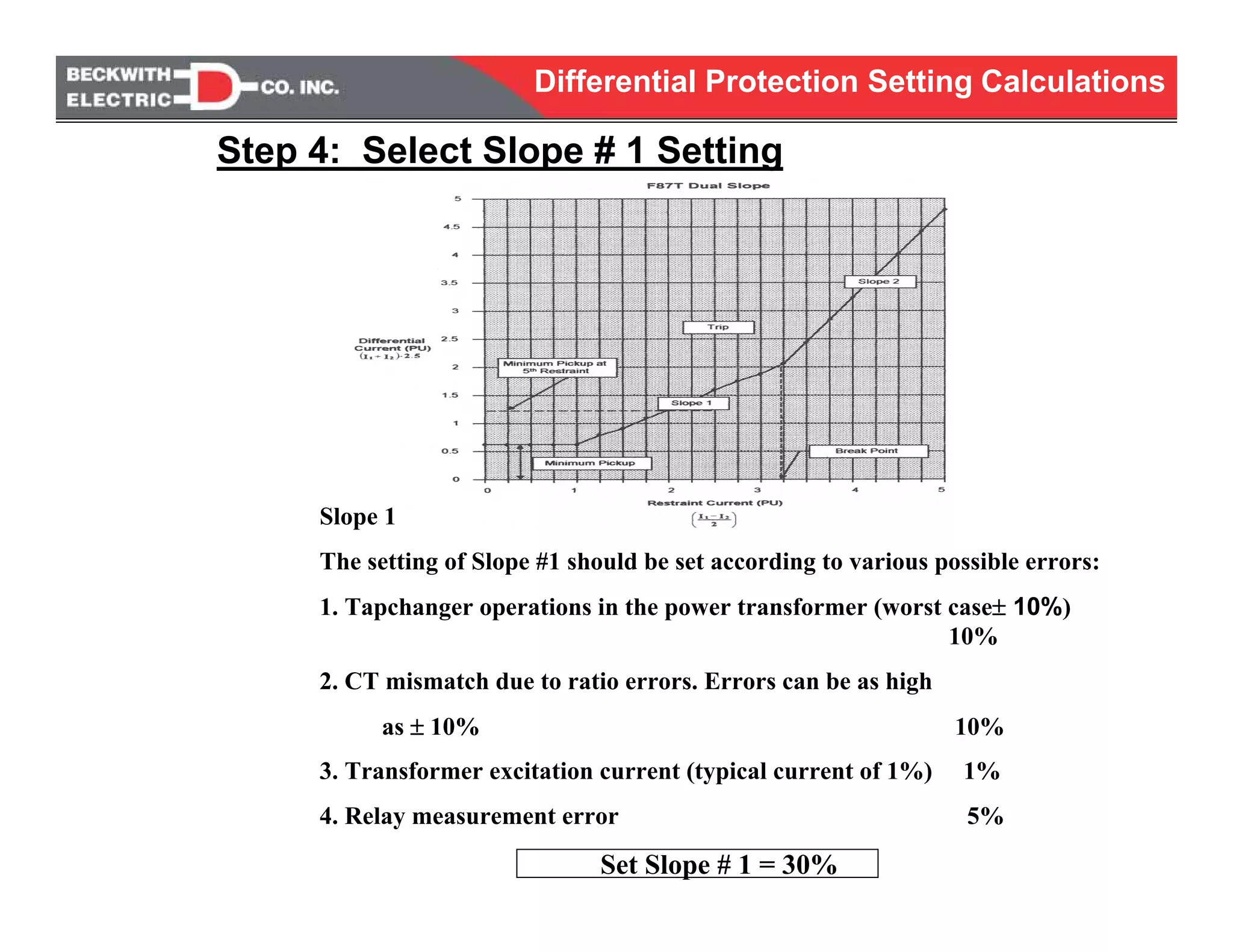
Step 4: Select Slope # 1 Setting
Slope 1
The setting of Slope #1 should be set according to various possible errors:
1. Tapchanger operations in the power transformer (worst case± 10%)
10%
2. CT mismatch due to ratio errors. Errors can be as high
as ± 10% 10%
3. Transformer excitation current (typical current of 1%) 1%
4. Relay measurement error 5%
Set Slope # 1 = 30%
Differential Protection Setting Calculations
Step 4: Select Slope # 1 Setting
SLOPE #1
SETTING
Differential Protection Setting Calculations
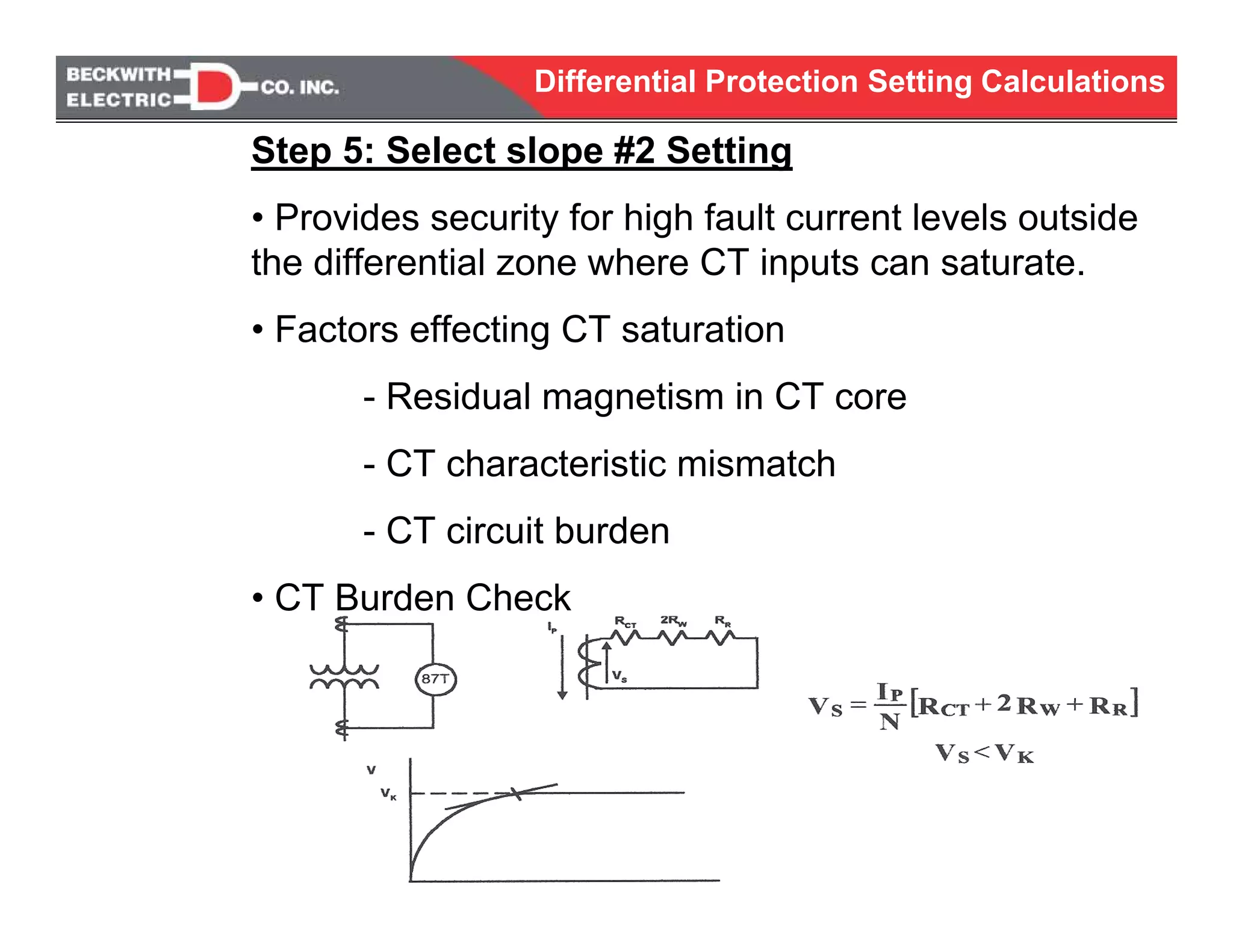
Step 5: Select slope #2 Setting
• Provides security for high fault current levels outside
the differential zone where CT inputs can saturate.
• Factors effecting CT saturation
- Residual magnetism in CT core
- CT characteristic mismatch
- CT circuit burden
• CT Burden Check
Differential Protection Setting Calculations
87T Sample Calculation
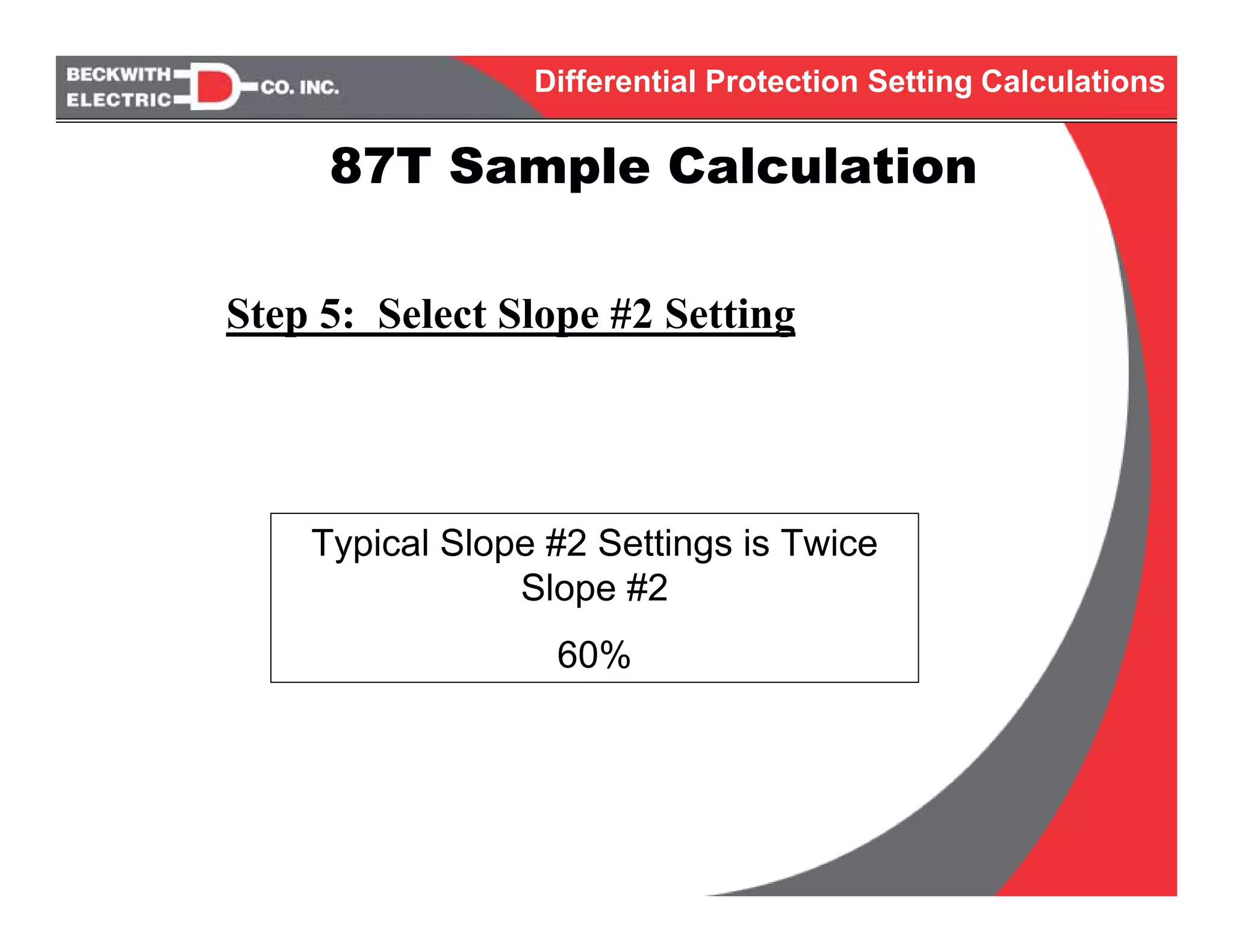
Step 5: Select Slope #2 Setting
Typical Slope #2 Settings is Twice
Slope #2
60%
Differential Protection Setting Calculations
87T Sample Calculation
Step 5: Select Slope #2 Setting
SLOPE #2
SETTING
Differential Protection Setting Calculations
87T Sample Calculation
Step 6: Select Break Point between Slope
1 and Slope 2
• Breakpoint is crossover from Slope 1 to Slope 2
Typical Breakpoint = 2.0
Differential Protection Setting Calculations
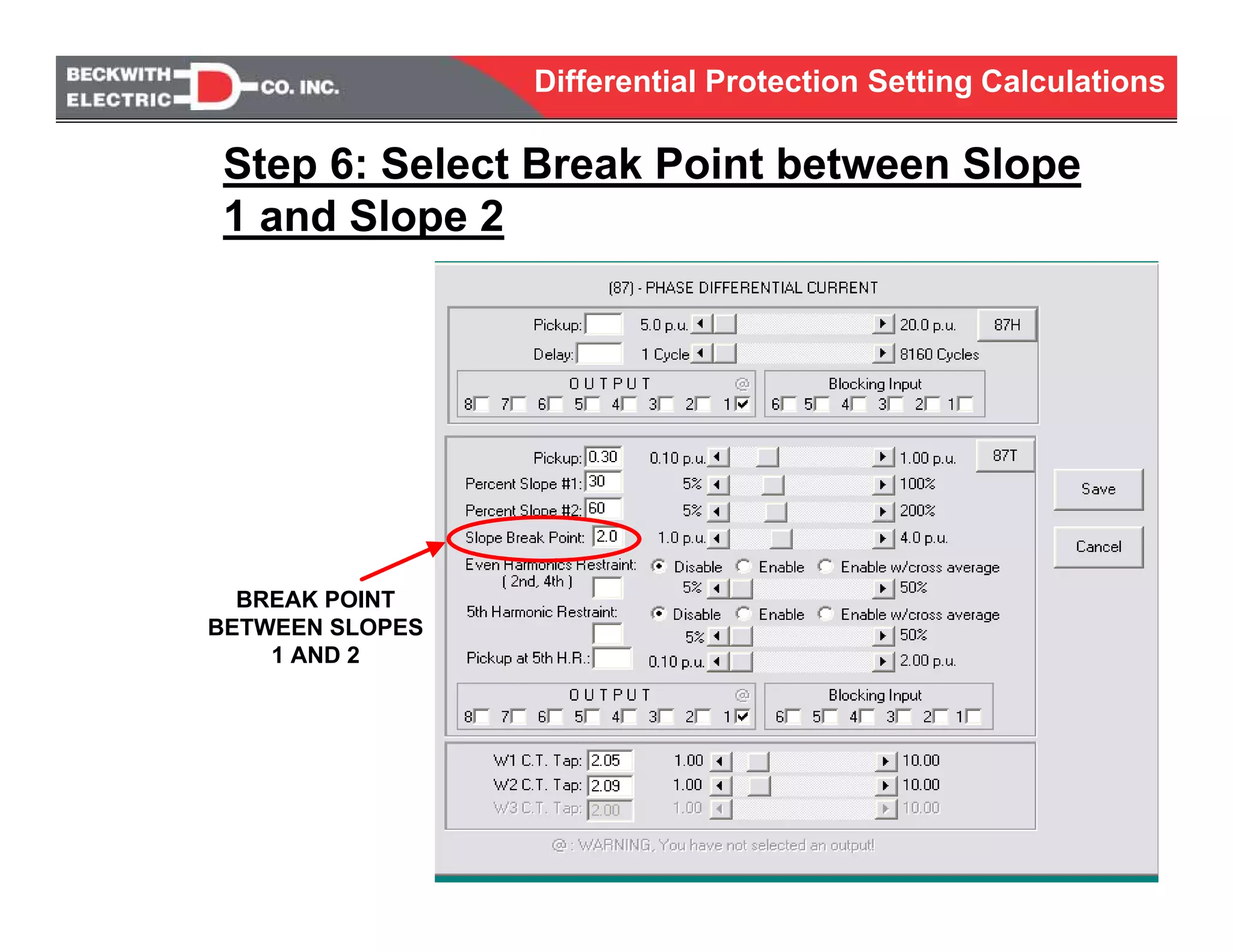
Step 6: Select Break Point between Slope
1 and Slope 2
BREAK POINT
BETWEEN SLOPES
1 AND 2
Differential Protection Setting Calculations
87T Sample Calculation
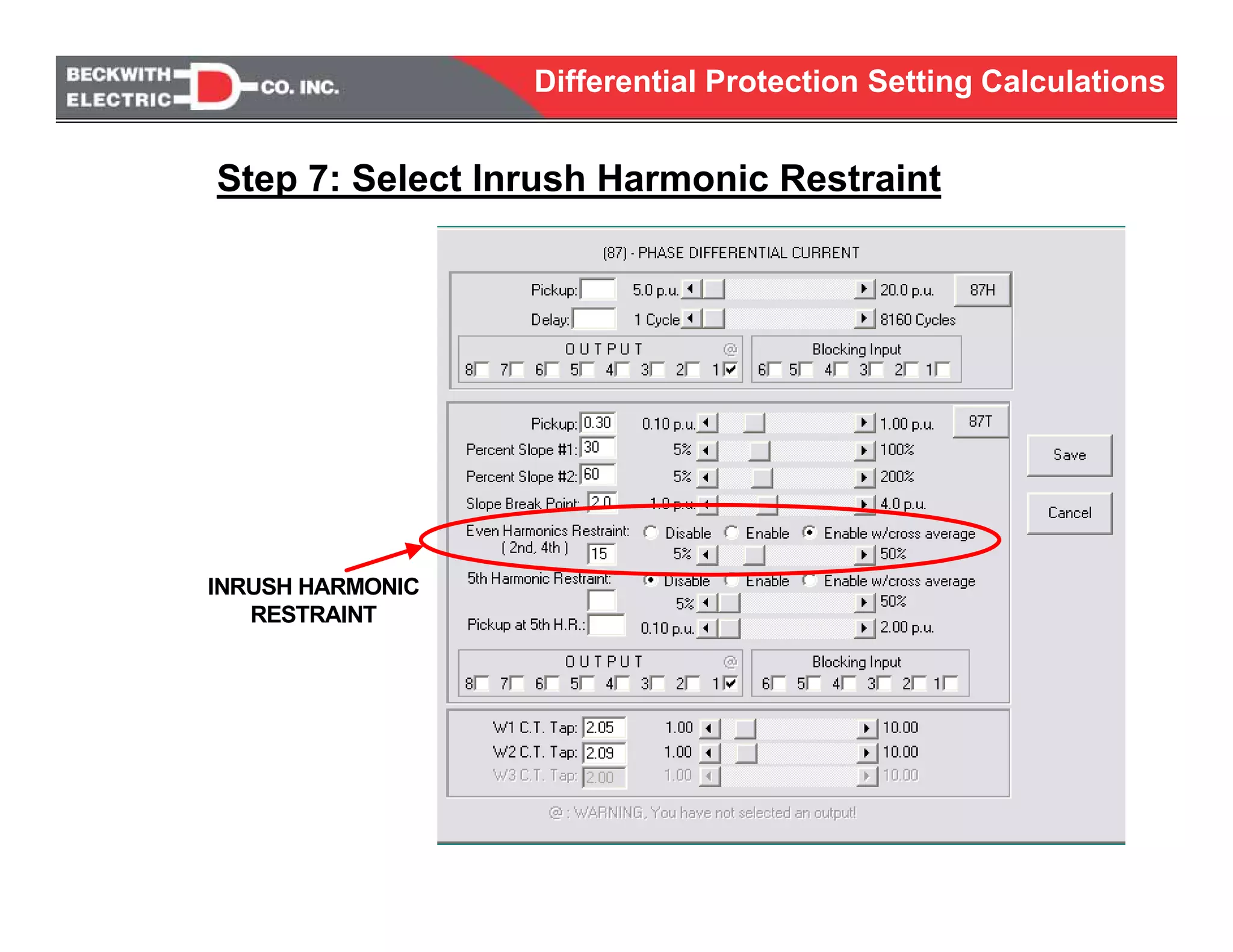
Step 7: Select Inrush Harmonic Restraint
• Relay uses 2nd and 4th harmonics
• Percent harmonics defined as –
• Amount of 2nd and 4th harmonics depend on:
- Magnetizing characteristics of transformer core
- Residual magnetism in core
• Typical Settings
-15% for most transformers
-can be 10% or lower on new transformers with low
core losses and steep magnetizing curves. Setting below 10%
risks blocking for internal faults.
Differential Protection Setting Calculations
87T Sample Calculation
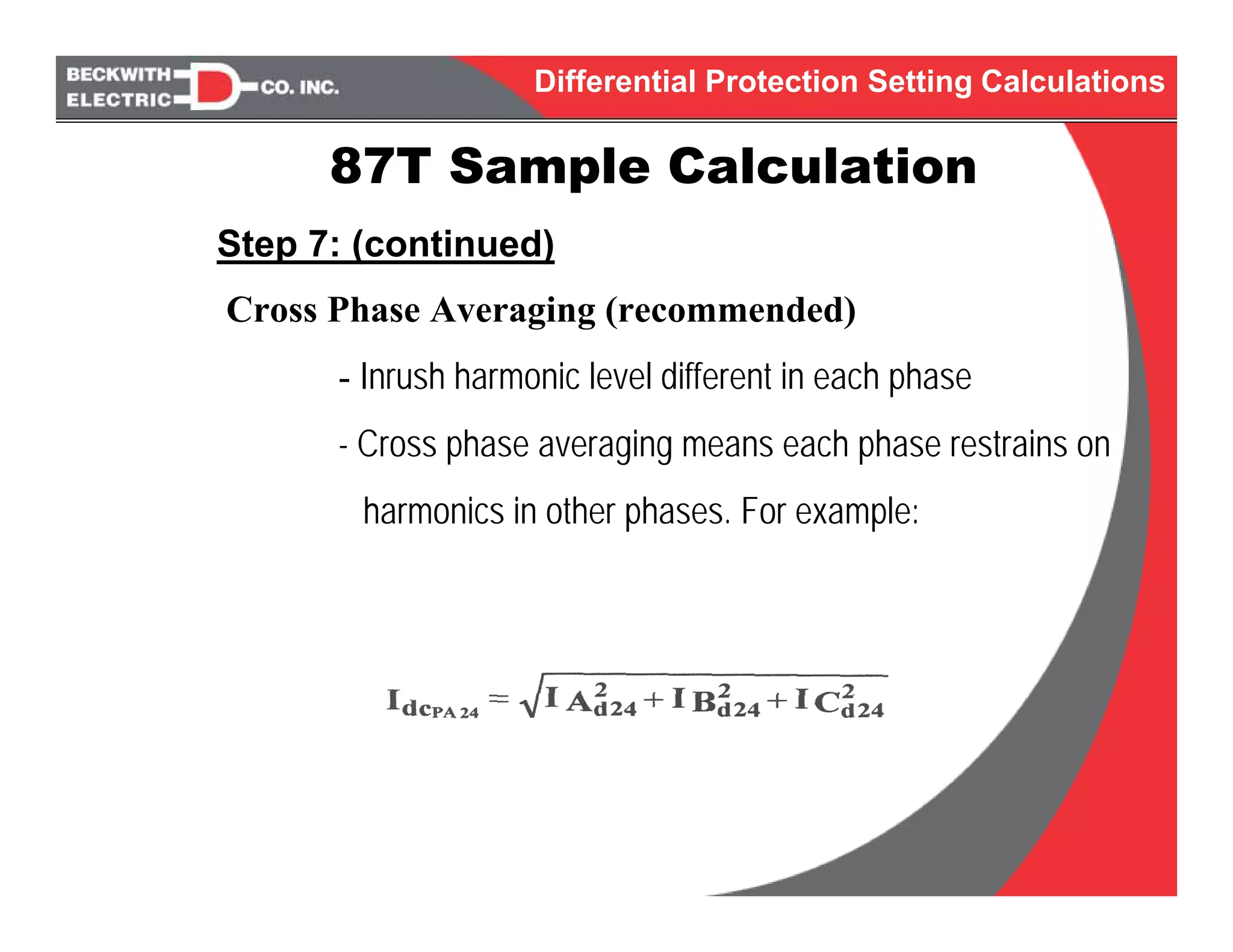
Step 7: (continued)
Cross Phase Averaging (recommended)
- Inrush harmonic level different in each phase
- Cross phase averaging means each phase restrains on
harmonics in other phases. For example:
Differential Protection Setting Calculations
Step 7: Select Inrush Harmonic Restraint
INRUSH HARMONIC
RESTRAINT
Differential Protection Setting Calculations
87T Sample Calculation
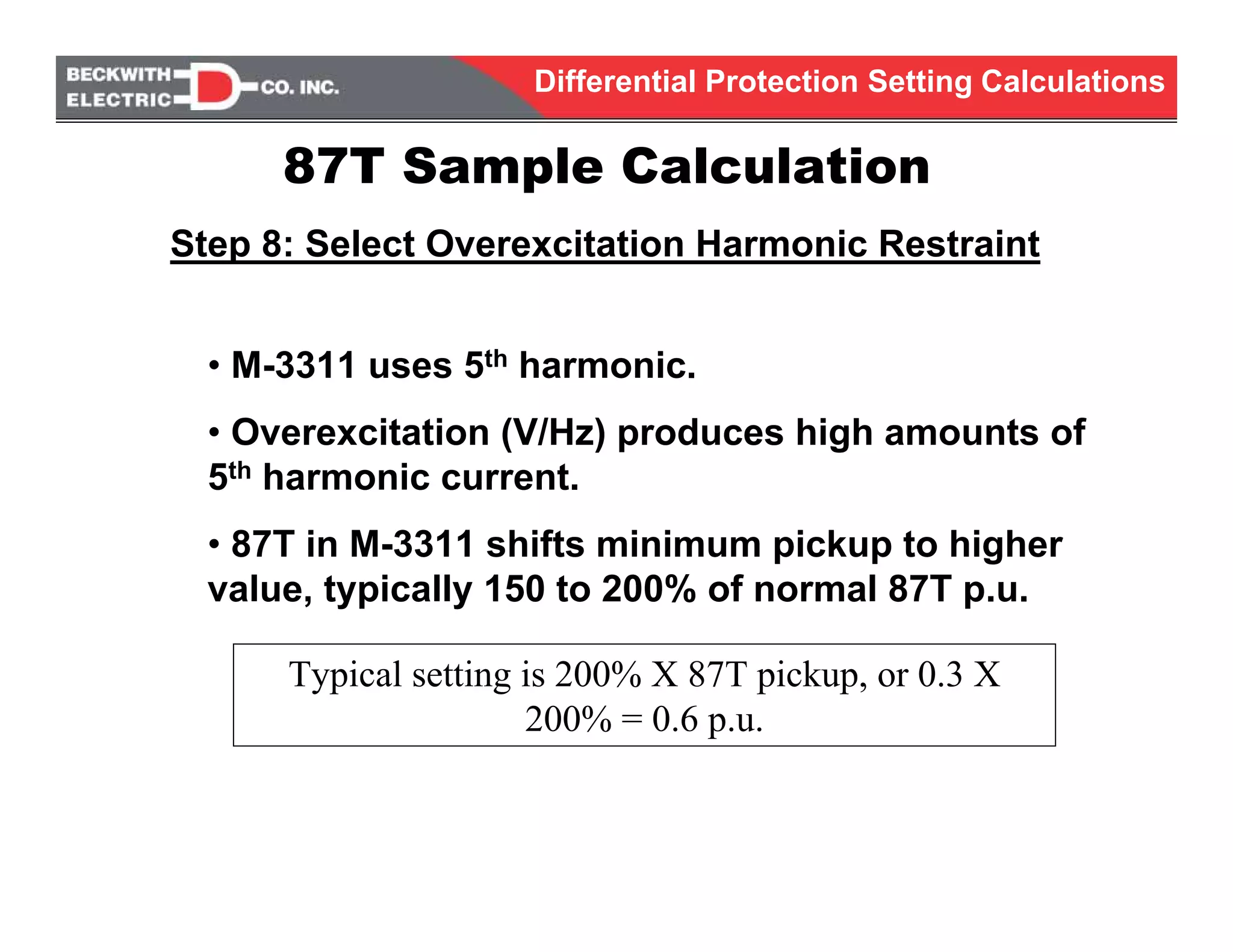
Step 8: Select Overexcitation Harmonic Restraint
• M-3311 uses 5th harmonic.
• Overexcitation (V/Hz) produces high amounts of
5th harmonic current.
• 87T in M-3311 shifts minimum pickup to higher
value, typically 150 to 200% of normal 87T p.u.
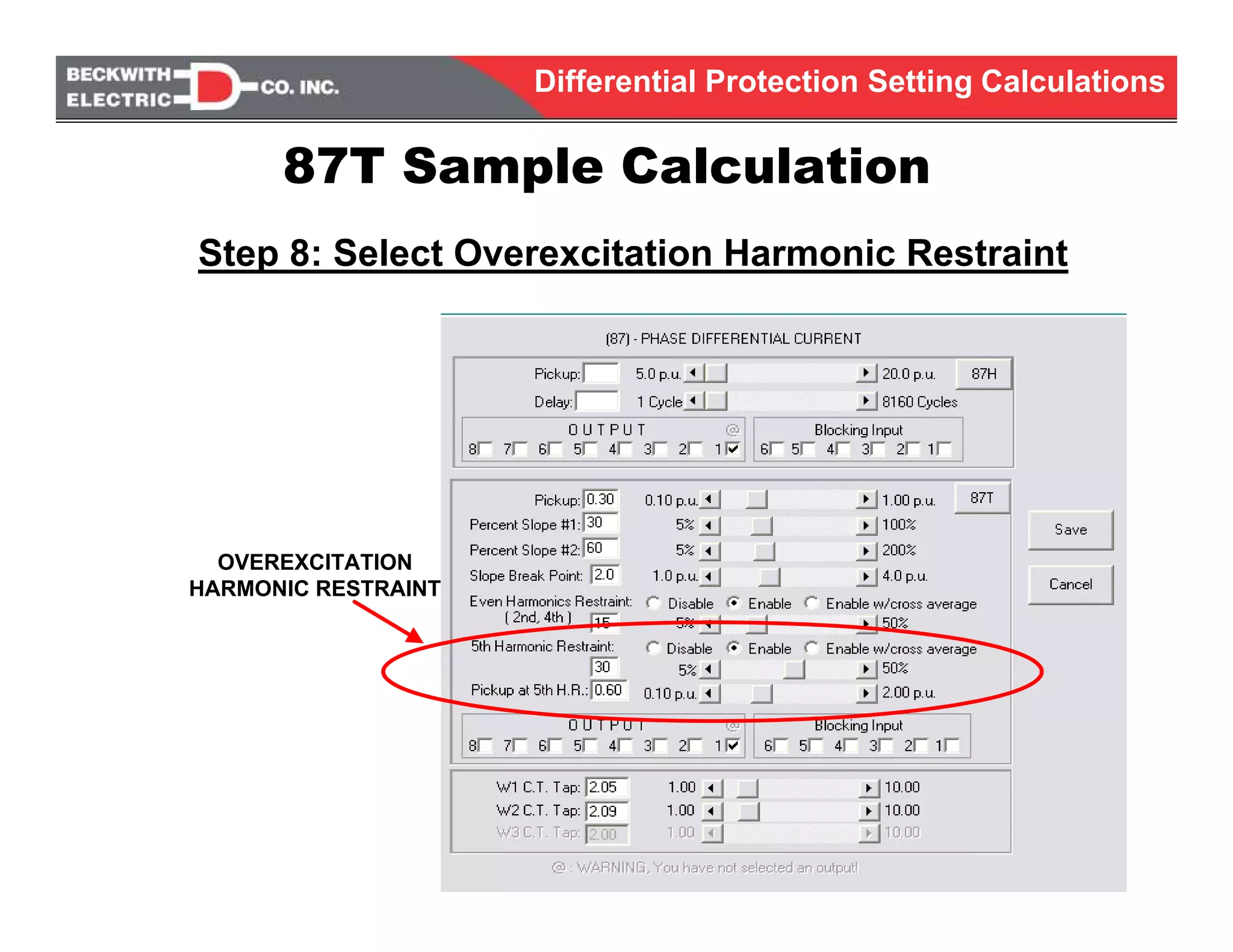
Typical setting is 200% X 87T pickup, or 0.3 X
200% = 0.6 p.u.
Differential Protection Setting Calculations
87T Sample Calculation
Step 8: (continued)
• Amount of 5th harmonic depends on transformer
core magnetizing characteristics.
• No cross phase averaging – Overexcitation is
symmetrical.
Typical setting is 30%
Differential Protection Setting Calculations
87T Sample Calculation
Step 8: Select Overexcitation Harmonic Restraint
OVEREXCITATION
HARMONIC RESTRAINT
Differential Protection Setting Calculations
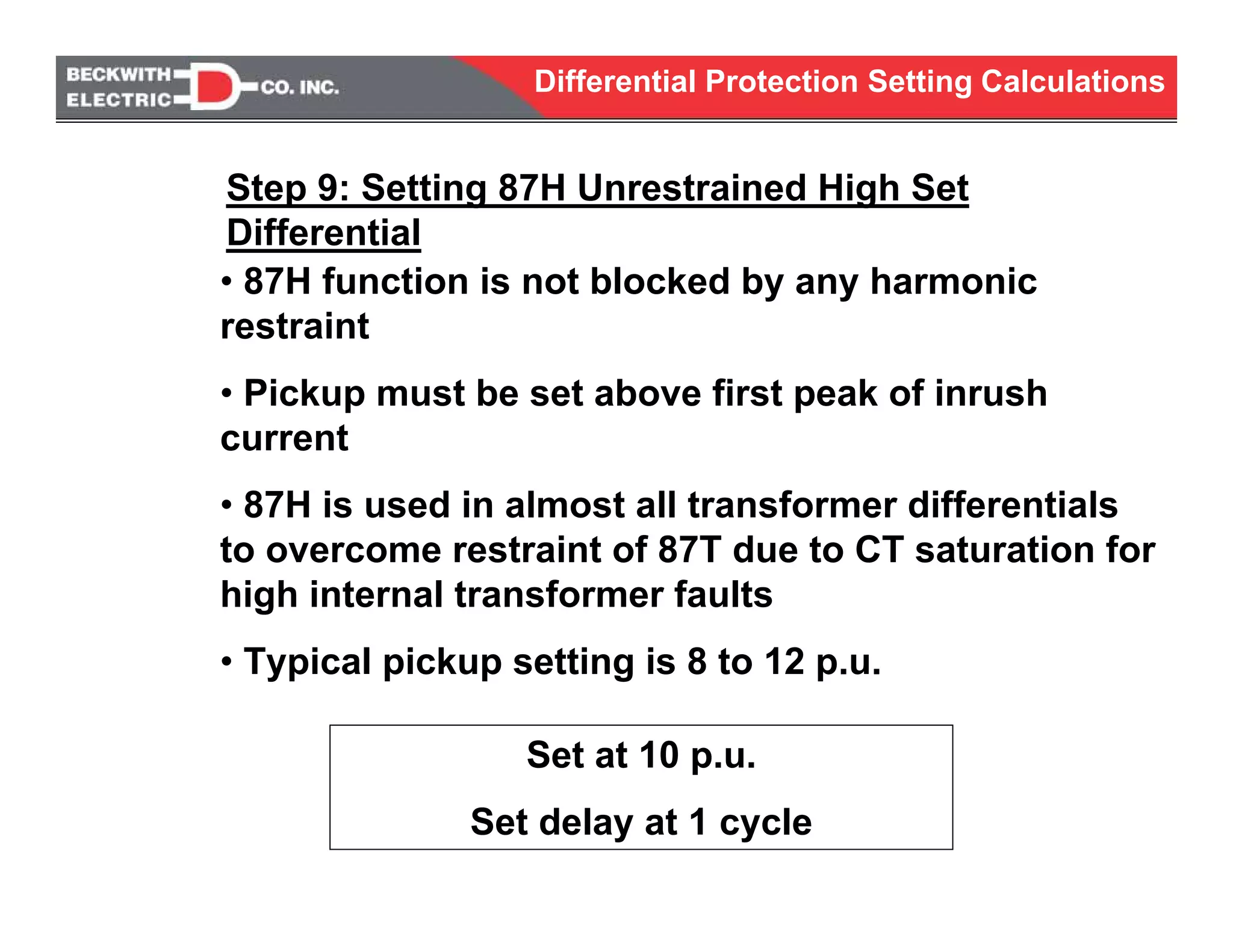
• 87H function is not blocked by any harmonic
restraint
• Pickup must be set above first peak of inrush
current
• 87H is used in almost all transformer differentials
to overcome restraint of 87T due to CT saturation for
high internal transformer faults
• Typical pickup setting is 8 to 12 p.u.
Set at 10 p.u.
Set delay at 1 cycle
Step 9: Setting 87H Unrestrained High Set
Differential
Differential Protection Setting Calculations
87T Sample Calculation
Step 9: Setting 87H Unrestrained High Set Differential
UNRESTRAINTED
HIGHSET DIFF.
©2008 Beckwith Electric Co., Inc.

Transformer differential protection

  • 1.
    Differential Protection SettingCalculations Transformer Differential Protection Setting Calculations Transformer Differential Protection Setting Calculations
  • 2.
    Differential Protection SettingCalculations Examine CT performance Calculate winding “tap” values Determine 87T pickup points - Determine variable percentage slope breakpoints - Determine harmonic restraint values Determine 87H pick up Determine 87GD pick up Objectives
  • 3.
    Differential Protection SettingCalculations Class “C” CTs have established secondary voltage/burden curves that are used to predict linear performance Operating a CT at values above the “kneepoint” on the curve invite unfaithful replication of the primary waveform and saturation Unfaithful replication (including saturation) between measurement CTs in a differential protection causes misoperation CT Performance
  • 4.
    Differential Protection SettingCalculations Class “C” CTs are designed to “faithfully” replicate primary currents to within +/- 10% Class designations designate maximum secondary CT circuit voltage at standard burden that can be applied to maintain accuracy - Zrated = Voltage Class / 20 * Rated Secondary Current - Zrated = C800 / 20 * 5A = 8 Ω, ∴ 800V at 8Ω burden - Zrated = C200 / 20 * 5A = 2 Ω, ∴ 200V at 2Ω burden Class “C” CTs
  • 5.
    Differential Protection SettingCalculations More than 100V secondary and you’re in trouble Class “C” CT Performance Curve
  • 6.
    Differential Protection SettingCalculations 1 pu 10 pu 10% 1% 0.1% Accuracy curve for Class “C” 2000:5 multitap CT CT Performance: +/- 10%
  • 7.
    Differential Protection SettingCalculations 0 0 tt ID= IP- IS CT Secondary, IS CT Primary, IP Comparison of primary to secondary waveforms with saturation CT Performance
  • 8.
    Differential Protection SettingCalculations Use with Class “C” CTs Determine maximum primary phase and ground fault current Calculate secondary current based on CTR and CT connection type (wye or delta) Determine secondary CT circuit burden Determine maximum secondary voltage produced from burden with secondary fault currents Check maximum secondary voltage against CT capability CT Performance Calculation
  • 9.
    Differential Protection SettingCalculations For WYE connected CTs, to obtain secondary current, use: (1X) I PRI / CTR = I SEC Fault Types and Currents in Secondary Circuits Transformer Setting Calculations
  • 10.
    Differential Protection SettingCalculations For Delta connected CTs, to obtain secondary current, use: (1.73) I PRI / CTR = I SEC Fault Types and Currents in Secondary Circuits
  • 11.
    Differential Protection SettingCalculations Determine all device burdens in secondary circuit - Relays, meters, instrumentation Determine lead burden - Use wire tables (AWG @ ohms/ft) Determine CT impedance Use CT data sheet (typ. 0.4 ohm or less) Burden Calculation
  • 12.
    Differential Protection SettingCalculations Where RCT is CT burden (internal) RW total resistance of the ct secondary wiring. RR is relay burden VS = I (RCT + RW + RR) Where I is the fault current and VS is the ct secondary voltage. In order to make sure that the ct is in the linear range (to avoid ac saturation of the ct’s), VS should be less than the knee-point voltage of the ct excitation characteristics. (See IEEE Guide for the Application of Current Transformers Used for Protective Relaying Purposes C37.110- 1996). VS Equivalent circuit of the CT secondary wiring RCT RW RR Equivalent circuit of the CT Secondary wiring
  • 13.
    Differential Protection SettingCalculations Relay = 0.5VA @ 5 A RR = VA/A2 , RR = 0.5/25 = 0.02 Ω RW = 2 Ω (round trip) RCT = 0.20 Ω Total = 2.22 Ω Burden Calculation Example
  • 14.
    Differential Protection SettingCalculations Assume maximum secondary current of 90A and wye CTs VS = I (RCT + RW + RR) * (FΔ-Υ) - (FΔ-Υ) = delta or wye CT factor - Use 1 for wye; use 1.73 for delta VS = 90 x 2.22 * (1) = 199.8 V Vs * 2 = 199.8 * 2 = 399.6 V - The 2X factor accounts for full DC offset Use at least a C400 Secondary CT Circuit Voltage
  • 15.
    Differential Protection SettingCalculations Used to determine current at rated transformer capacity - Normally pick highest rating of multiple MVA rated transformers Allows “nominalization” of the transformer windings Used to obtain “tap” that is digitally set Itap = VA / [√3 * VLL] * CTR This accommodates: - Transformer winding ratios - CT ratios Power-Current Conversion
  • 16.
    Differential Protection SettingCalculations Use highest rating as basis for tap calculations WyeWye Calculating “Tap”
  • 17.
    Differential Protection SettingCalculations This nominalizes the current flow with respect to transformation ratios and CT ratios Rated power passing through any winding would yield these currents to the protection system Calculating “Tap”
  • 18.
    Differential Protection SettingCalculations From 3-Line Diagram, determine transformer and CT winding arrangements Example - W1 = DAC, wye CTs - W2 = DAC, wye CTs - W3 = Wye, wye CTs wye Phase Shift Compensation
  • 19.
    Differential Protection SettingCalculations Trip Characteristic – 87T
  • 20.
    Differential Protection SettingCalculations 87T Pickup - Set above the magnetizing current and other CT inaccuracies - 0.2 to 0.4 p.u. (typical setting) Slope 1 - Set to accommodate +/- 10% CT inaccuracies - LTC adds another +/- 10% - Used for currents < 2X nominal - Typically set for 25% to 30% (can be set lower for non LTC transformers) Slope 2 “breakpoint” - Typically set at 2X rated current - This setting assumes that any current over 2X rated is a fault condition and is used to desensitize the element against unfaithful replication of currents due to CT saturation Trip Characteristic – 87T
  • 21.
    Differential Protection SettingCalculations Slope 2 - Typically set at 50% to 70% - Prevents relay misoperation for though faults with CT saturation. Inrush Restraint (2nd and 4th harmonic) - Typically set from 10-20% - Employ cross phase averaging (harmonic sharing) blocking for security – especially for modern transformers where the harmonic content is low Overexcitation Restraint (5th harmonic) - Typically set at 30% - Raise 87T pickup to 0.60 pu during overexcitation - No cross phase averaging is needed, as the magnetizing currents during overexcitation condition are symmetrical Trip Characteristic – 87T
  • 22.
    Differential Protection SettingCalculations 87H Pickup - Typically set at 8 to 12 pu rated current - This value should be set to above the maximum possible inrush current. - Relay oscillograph analysis software can be used determine the inrush current level and fine tune the setting. - Also, need to know if the high set element uses fundamental component of current (typically the case) or total RMS current and set the pickup appropriately. Trip Characteristic – 87H
  • 23.
    Differential Protection SettingCalculations 87GD Pickup - Element normally uses directional comparison between phase residual current (3I0) and measured ground current (IG). The element becomes non-directional when the 3I0 current is small (example < 140 ma). - Pickup of 0.2 to 0.5 A (5A rated CTs) can be applied when using same ratio CTs on both phase and ground circuits. - When CT correction factor higher than 1.0 is applied, the pickup needs to be increased to account for noise amplification due to high CT ratio correction. - Use 6 cycle time delay to provide security against misoperations during external phase-to-phase to ground faults with CT saturation. The time delay must not be set below 2 cycles. Trip Characteristic – 87GD
  • 24.
    Differential Protection SettingCalculations WITHOUT GROUND DIFF. (87GD) THERE IS NO HIGHSPEED PROTECTION FOR SEC. GND FAULTS Typical Pickup of 87T: O.3 pu pickup Relay Tap set at Trans. Rating (45MVA) IFL138KV = 4.71 A PU = 4.71A x 0.3 = 1.41A Open R 87T 2000/5 200/5 400A 13.8KV 138KV I=0 400A 40A/1.73 40A/1.73*40/1=0.58A 45 MVA Improved Ground Fault Sensitivity
  • 25.
    Differential Protection SettingCalculations DIGITAL TRANSFORMER DIFFERENTIAL RELAY SETTING EXAMPLE
  • 26.
    Differential Protection SettingCalculations Sample Calculation – 87T 14,400/120
  • 27.
    Differential Protection SettingCalculations Transformer Size – MVA Rating Voltage Taps – No Load Transformer Connection Current Transformer Ratios Current Transformer Connection Voltage Transformer Ratios Voltage Transformer Connections — L-G or L-L LTC Tap Information Calculating Differential Set Points and System Setup 87T Sample Calculation
  • 28.
    Differential Protection SettingCalculations Delta AB 14,400/120 87T Sample Calculation
  • 29.
    Differential Protection SettingCalculations COMMUNICATES PHASING TO RELAY COMMUNICATES METERING DATA TO RELAY 87T Sample Calculation
  • 30.
    Differential Protection SettingCalculations COMMUNICATES PHASING TO RELAY COMMUNICATES METERING DATA TO RELAY 87T Sample Calculation W-2 Delta CT’S
  • 31.
    Differential Protection SettingCalculations Step 1 -Check CT and Relay Input Ratings Sample Transformer Ratings: OA/FA/FA = 30/40/50 MVA Short Time Rating of this transformer is 1.35 x 50 MVA = 67.5 MVA Relay current input is rated at 2X Nominal Rating i.e. 5A relay = 10 AMPS continuous I67.5 MVA W-2 PRI = 67.500 KVA/13.8KVx√3=2827A I67.5 MVA W-2 SEC = 2827/600/1 = 4.71 A For Δ CTs relay gets 4.71x √3= 8.15A <10A Sec. Winding (W2) OK I67.5 MVA W-1 PRI = 67.500 KVA/70.35KVx√3=554.6A I67.5 MVA W-1 SEC = 554.6/120/1 = 4.62A <10A Pri. Winding (W1) OK 87T Sample Calculation
  • 32.
    Differential Protection SettingCalculations Step 2: Select W1 & W2 Tap Settings Balance at OA Rating 87T Sample Calculation HandledBy Relay 3 3 2.09 A
  • 33.
    Differential Protection SettingCalculations Step 2: Select W1 & W2 Tap Settings Balance at OA Rating 87T Sample Calculation TAP VALUES
  • 34.
    Differential Protection SettingCalculations 87T Sample Calculation Step 3: Select minimum pickup of 87T • Pick up should be set to prevent operation of 87T due to transformer steady-state excitation current. •Typical Transformer excitation current ~1% = .01 pu •CT Error 10% =.10 pu • LTC Error 10%= .10 pu •Saftey Margin Typical 5% = .05 pu 26 % .26 pu •Typical setting is 0.26 to 0.35 p.u. Select p.u. at 0.3
  • 35.
    Differential Protection SettingCalculations 87T Sample Calculation Step 3: Select minimum pickup of 87T MINIMUM PICKUP
  • 36.
    Differential Protection SettingCalculations Step 4: Select Slope # 1 Setting Slope 1 The setting of Slope #1 should be set according to various possible errors: 1. Tapchanger operations in the power transformer (worst case± 10%) 10% 2. CT mismatch due to ratio errors. Errors can be as high as ± 10% 10% 3. Transformer excitation current (typical current of 1%) 1% 4. Relay measurement error 5% Set Slope # 1 = 30%
  • 37.
    Differential Protection SettingCalculations Step 4: Select Slope # 1 Setting SLOPE #1 SETTING
  • 38.
    Differential Protection SettingCalculations Step 5: Select slope #2 Setting • Provides security for high fault current levels outside the differential zone where CT inputs can saturate. • Factors effecting CT saturation - Residual magnetism in CT core - CT characteristic mismatch - CT circuit burden • CT Burden Check
  • 39.
    Differential Protection SettingCalculations 87T Sample Calculation Step 5: Select Slope #2 Setting Typical Slope #2 Settings is Twice Slope #2 60%
  • 40.
    Differential Protection SettingCalculations 87T Sample Calculation Step 5: Select Slope #2 Setting SLOPE #2 SETTING
  • 41.
    Differential Protection SettingCalculations 87T Sample Calculation Step 6: Select Break Point between Slope 1 and Slope 2 • Breakpoint is crossover from Slope 1 to Slope 2 Typical Breakpoint = 2.0
  • 42.
    Differential Protection SettingCalculations Step 6: Select Break Point between Slope 1 and Slope 2 BREAK POINT BETWEEN SLOPES 1 AND 2
  • 43.
    Differential Protection SettingCalculations 87T Sample Calculation Step 7: Select Inrush Harmonic Restraint • Relay uses 2nd and 4th harmonics • Percent harmonics defined as – • Amount of 2nd and 4th harmonics depend on: - Magnetizing characteristics of transformer core - Residual magnetism in core • Typical Settings -15% for most transformers -can be 10% or lower on new transformers with low core losses and steep magnetizing curves. Setting below 10% risks blocking for internal faults.
  • 44.
    Differential Protection SettingCalculations 87T Sample Calculation Step 7: (continued) Cross Phase Averaging (recommended) - Inrush harmonic level different in each phase - Cross phase averaging means each phase restrains on harmonics in other phases. For example:
  • 45.
    Differential Protection SettingCalculations Step 7: Select Inrush Harmonic Restraint INRUSH HARMONIC RESTRAINT
  • 46.
    Differential Protection SettingCalculations 87T Sample Calculation Step 8: Select Overexcitation Harmonic Restraint • M-3311 uses 5th harmonic. • Overexcitation (V/Hz) produces high amounts of 5th harmonic current. • 87T in M-3311 shifts minimum pickup to higher value, typically 150 to 200% of normal 87T p.u. Typical setting is 200% X 87T pickup, or 0.3 X 200% = 0.6 p.u.
  • 47.
    Differential Protection SettingCalculations 87T Sample Calculation Step 8: (continued) • Amount of 5th harmonic depends on transformer core magnetizing characteristics. • No cross phase averaging – Overexcitation is symmetrical. Typical setting is 30%
  • 48.
    Differential Protection SettingCalculations 87T Sample Calculation Step 8: Select Overexcitation Harmonic Restraint OVEREXCITATION HARMONIC RESTRAINT
  • 49.
    Differential Protection SettingCalculations • 87H function is not blocked by any harmonic restraint • Pickup must be set above first peak of inrush current • 87H is used in almost all transformer differentials to overcome restraint of 87T due to CT saturation for high internal transformer faults • Typical pickup setting is 8 to 12 p.u. Set at 10 p.u. Set delay at 1 cycle Step 9: Setting 87H Unrestrained High Set Differential
  • 50.
    Differential Protection SettingCalculations 87T Sample Calculation Step 9: Setting 87H Unrestrained High Set Differential UNRESTRAINTED HIGHSET DIFF. ©2008 Beckwith Electric Co., Inc.