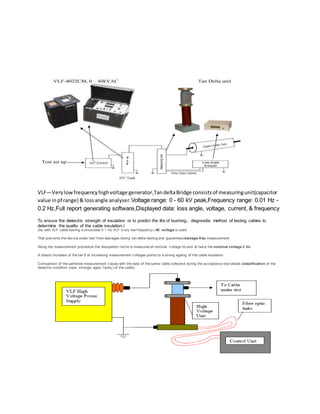
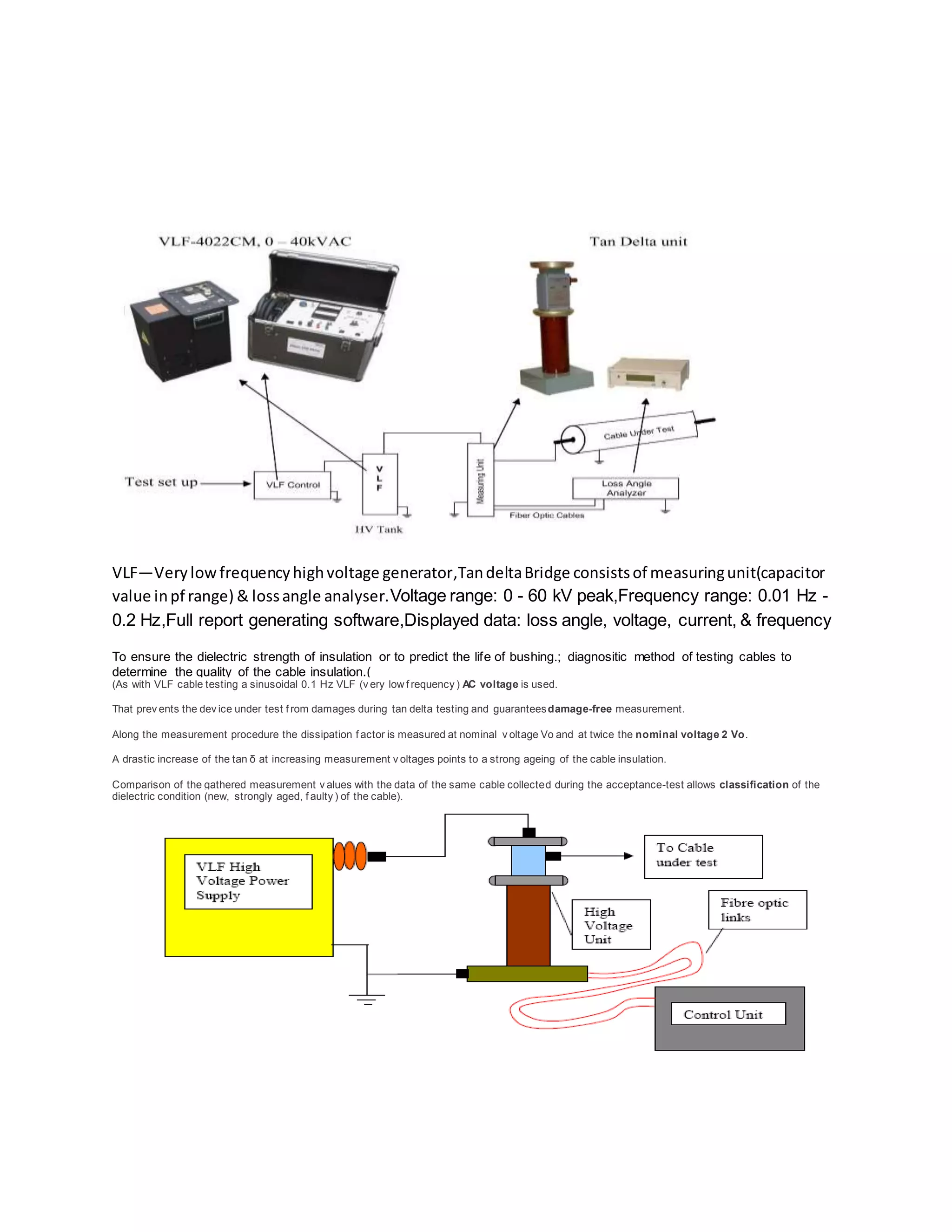
VLF—Verylowfrequencyhighvoltage generator,TandeltaBridge consistsof measuringunit(capacitor
value inpf range) & lossangle analyser.Voltage range: 0 - 60 kV peak,Frequency range: 0.01 Hz -
0.2 Hz,Full report generating software,Displayed data: loss angle, voltage, current, & frequency
To ensure the dielectric strength of insulation or to predict the life of bushing.; diagnositic method of testing cables to
determine the quality of the cable insulation.(
(As with VLF cable testing a sinusoidal 0.1 Hz VLF (v ery low f requency ) AC voltage is used.
That prev ents the dev ice under test f rom damages during tan delta testing and guaranteesdamage-free measurement.
Along the measurement procedure the dissipation f actor is measured at nominal v oltage Vo and at twice the nominal voltage 2 Vo.
A drastic increase of the tan δ at increasing measurement v oltages points to a strong ageing of the cable insulation.
Comparison of the gathered measurement v alues with the data of the same cable collected during the acceptance-test allows classification of the
dielectric condition (new, strongly aged, f aulty ) of the cable).
POWER TRANSFORMER TESTING
SPECIAL TESTS: -
1] Sweep Frequency Response Analysis (SFRA)
2] On Line Partial Discharge Test
3] Dielectric Response Measurement – by PDC or FDS technique.
4] Capacitance & Dissipation Factor ( Tan-Delta ) measurement.
5] 10KV Excitation Current Measurement
6] 10KV Turn Ratio Measurement
7] On Line Water Content Measurement
8] Transformer Oil Test – General Tests, DGA & FURAN
ROUTINE TESTS: -
1] Winding Resistance Measurement.
2] Insulation Resistance / Polarization Index.
3] Turns Ratio.
4] Voltage Ratio.
5] Open & Short Circuit.
6] Magnetic Balance.
7] Vector Group.
CT / PT Testing
1] Capacitance & Dissipation Factor ( Tan-Delta ) measurement..
2] Insulation Resistance / Polarization Index.
3] Polarity
4] Ratio
5] Primary Current Injection.
6] Knee Point Voltage Measurement.
CIRCUIT BREAKER TESTING
1] DCRM ( Dynamic Contact Resistance Measurement with Travel & Velocity)
2] CRM (Contact Resistance Measurement)
3] Timing Measurement Test.
4] Dew Point Measurement Test
5] Vidar Test for Vacuum Interrupter
4] Insulation Resistance
LIGHTENING ARRESSTORS ( L.A. ) TESTING
1] Capacitance & Dissipation Factor ( Tan-Delta ) measurement.
2] Insulation Resistance
3] On Line Leakage Current Measurement ( LCM )
H.T. MOTOR / GENERATOR TESTING
1] Capacitance & Dissipation Factor ( Tan-Delta ) measurement.
2] Insulation Resistance / Polarization Index.
3] Winding Resistance Measurement.
4] Partial Discharge Test.
5] Vibration & Current Signature Analysis.
6] Harmonic Analysis
7] Hi-Pot Test.
XLPE H.T. CABLE TESTING
1] Capacitance & Dissipation Factor ( Tan-Delta ) measurement.
2] VLF Hi-Pot Test
3] VLF Capacitance & Dissipation Factor ( Tan-Delta ) measurement.
4] VLF Partial Discharge Test
5] Insulation Resistance
6] D.C. Hi-Pot Test.
Ac hi-pot test--- portable 0.1 Hz VLF cable test
system for the testing of medium voltage cables.( output voltagesSinusoidal: 0 – 62 kV peak, 0 – 44 kV ef f ,DC:
± 0 - 60 kV
A low frequency causes a higher value of capacitive reactance which leads to lesser power requirement during
the test.Besides, the currents will be limited enabling easier measurement.
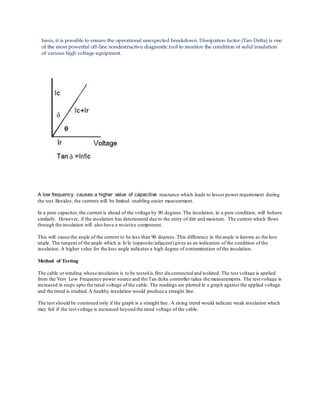
In a pure capacitor, the current is ahead of the voltage by 90 degrees.The insulation, in a pure condition, will behave
similarly. However, if the insulation has deteriorated due to the entry of dirt and moisture. The current which flows
through the insulation will also have a resistive component.
This will cause the angle of the current to be less than 90 degrees. This difference in the angle is known as the loss
angle. The tangent of the angle which is Ir/Ic (opposite/adjacent)gives us an indication of the condition of the
insulation. A higher value for the loss angle indicates a high degree of contamination of the insulation.
Method of Testing
The cable or winding whose insulation is to be tested is first disconnected and isolated. The test voltage is applied
from the Very Low Frequency power source and the Tan delta controller takes the measurements. The test voltage is
increased in steps upto the rated voltage of the cable. The readings are plotted in a graph against the applied voltage
and the trend is studied.A healthy insulation would produce a straight line.
The test should be continued only if the graph is a straight line. A rising trend would indicate weak insulation which
may fail if the test voltage is increased beyond the rated voltage of the cable.
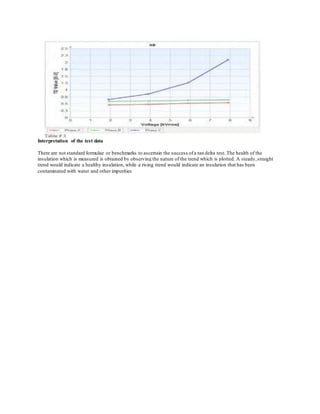
Interpretation of the test data
There are not standard formulae or benchmarks to ascertain the success ofa tan delta test.The health of the
insulation which is measured is obtained by observing the nature of the trend which is plotted. A steady,straight
trend would indicate a healthy insulation, while a rising trend would indicate an insulation that has been
contaminated with water and other impurities
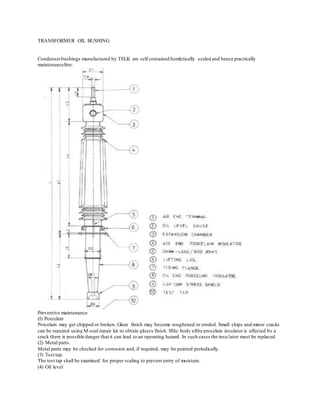
TRANSFORMER OIL BUSHING
Condenserbushings manufactured by TELK arc self contained hemlctically scaled and hence practically
maintenancefree.
Preventive maintenance
(I) Porcelain
Porcelain may get chipped or broken. Glaze finish may become roughened or eroded. Small chips and minor cracks
can be repaired using M-seal repair kit to obtain glossy finish. Ifthc body ufthe procelain insulator is affected by a
crack there is possible danger that it can lead to an operating hazard. In such cases the insu lator must be replaced.
(2) Metal parts.
Metal parts may be checked for corrosion and, if required, may be painted periodically.
(3) Test tap.
The test tap shall be examined for proper scaling to prevent entry of moisture.
(4) Oil level
Oil Iccl as indicated by the gungc glasS/lcvel indicalOrs shall be chl.:ckcd periodically. The gauge glasses should
be inspected regularly for cracks which might result from any mechanical cause.Ifthcrc is a leak it should be
repaired as per advice from TELK. If there is no leak, but oillevcl is too low, the problem may be internal and il may
be prudent to replace the bushing.
(5) Surface contamination
This is the naluml deposits or coating of early morning dew. salt fog in SC3 coast areas. smog and mdustrial
pollutants on the porcelain insulator. Build up of contamination can cause flash over ofbushmg ai nonnal voltage.
Danger of flash over occurs when the surface coating becomes partly conducting,usually with thc prcsence of
moisture.To prevent contamin;nioll flashovcr of porcelain insulator, the following methods may be used.
Iland Wiping
Wash,ng WITH cleall Wa!er
Dry Clcamng wlih AIr - blast materials.
Coating with suilnble siliconc compounds.
Bushing Troubles
Operating records show that about 90 percent of all preventable bushing failures are caused by moisture entering the
bushing through leaky gaskets or other openings.Close periodic inspection to find leaks and make repairs as needed
will prevent most outages due to bush-lng failures. Such an external inspection requires little time and expense and
will be well worth the effort. High-voltage bushings, if allowed to deteriorate, may explode with considerable
violence and cause extensive damages to adjacent equipment. Flashovers may be caused by deposits of dirt on the
bushings,particularly in areas where there are contaminants such as salts or conducting dusts in the air. These
deposits should be removed by periodic cleaning.
Testing

Testing

  • 1.
    VLF—Verylowfrequencyhighvoltage generator,TandeltaBridge consistsofmeasuringunit(capacitor value inpf range) & lossangle analyser.Voltage range: 0 - 60 kV peak,Frequency range: 0.01 Hz - 0.2 Hz,Full report generating software,Displayed data: loss angle, voltage, current, & frequency To ensure the dielectric strength of insulation or to predict the life of bushing.; diagnositic method of testing cables to determine the quality of the cable insulation.( (As with VLF cable testing a sinusoidal 0.1 Hz VLF (v ery low f requency ) AC voltage is used. That prev ents the dev ice under test f rom damages during tan delta testing and guaranteesdamage-free measurement. Along the measurement procedure the dissipation f actor is measured at nominal v oltage Vo and at twice the nominal voltage 2 Vo. A drastic increase of the tan δ at increasing measurement v oltages points to a strong ageing of the cable insulation. Comparison of the gathered measurement v alues with the data of the same cable collected during the acceptance-test allows classification of the dielectric condition (new, strongly aged, f aulty ) of the cable).
  • 2.
    POWER TRANSFORMER TESTING SPECIALTESTS: - 1] Sweep Frequency Response Analysis (SFRA) 2] On Line Partial Discharge Test 3] Dielectric Response Measurement – by PDC or FDS technique. 4] Capacitance & Dissipation Factor ( Tan-Delta ) measurement. 5] 10KV Excitation Current Measurement 6] 10KV Turn Ratio Measurement 7] On Line Water Content Measurement 8] Transformer Oil Test – General Tests, DGA & FURAN ROUTINE TESTS: - 1] Winding Resistance Measurement. 2] Insulation Resistance / Polarization Index. 3] Turns Ratio. 4] Voltage Ratio. 5] Open & Short Circuit. 6] Magnetic Balance. 7] Vector Group. CT / PT Testing
  • 3.
    1] Capacitance &Dissipation Factor ( Tan-Delta ) measurement.. 2] Insulation Resistance / Polarization Index. 3] Polarity 4] Ratio 5] Primary Current Injection. 6] Knee Point Voltage Measurement. CIRCUIT BREAKER TESTING 1] DCRM ( Dynamic Contact Resistance Measurement with Travel & Velocity) 2] CRM (Contact Resistance Measurement) 3] Timing Measurement Test. 4] Dew Point Measurement Test 5] Vidar Test for Vacuum Interrupter 4] Insulation Resistance LIGHTENING ARRESSTORS ( L.A. ) TESTING 1] Capacitance & Dissipation Factor ( Tan-Delta ) measurement. 2] Insulation Resistance 3] On Line Leakage Current Measurement ( LCM ) H.T. MOTOR / GENERATOR TESTING 1] Capacitance & Dissipation Factor ( Tan-Delta ) measurement. 2] Insulation Resistance / Polarization Index. 3] Winding Resistance Measurement. 4] Partial Discharge Test. 5] Vibration & Current Signature Analysis. 6] Harmonic Analysis 7] Hi-Pot Test. XLPE H.T. CABLE TESTING 1] Capacitance & Dissipation Factor ( Tan-Delta ) measurement. 2] VLF Hi-Pot Test 3] VLF Capacitance & Dissipation Factor ( Tan-Delta ) measurement. 4] VLF Partial Discharge Test 5] Insulation Resistance 6] D.C. Hi-Pot Test. Ac hi-pot test--- portable 0.1 Hz VLF cable test system for the testing of medium voltage cables.( output voltagesSinusoidal: 0 – 62 kV peak, 0 – 44 kV ef f ,DC: ± 0 - 60 kV
  • 4.
    A low frequencycauses a higher value of capacitive reactance which leads to lesser power requirement during the test.Besides, the currents will be limited enabling easier measurement. In a pure capacitor, the current is ahead of the voltage by 90 degrees.The insulation, in a pure condition, will behave similarly. However, if the insulation has deteriorated due to the entry of dirt and moisture. The current which flows through the insulation will also have a resistive component. This will cause the angle of the current to be less than 90 degrees. This difference in the angle is known as the loss angle. The tangent of the angle which is Ir/Ic (opposite/adjacent)gives us an indication of the condition of the insulation. A higher value for the loss angle indicates a high degree of contamination of the insulation. Method of Testing The cable or winding whose insulation is to be tested is first disconnected and isolated. The test voltage is applied from the Very Low Frequency power source and the Tan delta controller takes the measurements. The test voltage is increased in steps upto the rated voltage of the cable. The readings are plotted in a graph against the applied voltage and the trend is studied.A healthy insulation would produce a straight line. The test should be continued only if the graph is a straight line. A rising trend would indicate weak insulation which may fail if the test voltage is increased beyond the rated voltage of the cable.
  • 5.
    Interpretation of thetest data There are not standard formulae or benchmarks to ascertain the success ofa tan delta test.The health of the insulation which is measured is obtained by observing the nature of the trend which is plotted. A steady,straight trend would indicate a healthy insulation, while a rising trend would indicate an insulation that has been contaminated with water and other impurities
  • 6.
    TRANSFORMER OIL BUSHING Condenserbushingsmanufactured by TELK arc self contained hemlctically scaled and hence practically maintenancefree. Preventive maintenance (I) Porcelain Porcelain may get chipped or broken. Glaze finish may become roughened or eroded. Small chips and minor cracks can be repaired using M-seal repair kit to obtain glossy finish. Ifthc body ufthe procelain insulator is affected by a crack there is possible danger that it can lead to an operating hazard. In such cases the insu lator must be replaced. (2) Metal parts. Metal parts may be checked for corrosion and, if required, may be painted periodically. (3) Test tap. The test tap shall be examined for proper scaling to prevent entry of moisture. (4) Oil level
  • 7.
    Oil Iccl asindicated by the gungc glasS/lcvel indicalOrs shall be chl.:ckcd periodically. The gauge glasses should be inspected regularly for cracks which might result from any mechanical cause.Ifthcrc is a leak it should be repaired as per advice from TELK. If there is no leak, but oillevcl is too low, the problem may be internal and il may be prudent to replace the bushing. (5) Surface contamination This is the naluml deposits or coating of early morning dew. salt fog in SC3 coast areas. smog and mdustrial pollutants on the porcelain insulator. Build up of contamination can cause flash over ofbushmg ai nonnal voltage. Danger of flash over occurs when the surface coating becomes partly conducting,usually with thc prcsence of moisture.To prevent contamin;nioll flashovcr of porcelain insulator, the following methods may be used. Iland Wiping Wash,ng WITH cleall Wa!er Dry Clcamng wlih AIr - blast materials. Coating with suilnble siliconc compounds. Bushing Troubles Operating records show that about 90 percent of all preventable bushing failures are caused by moisture entering the bushing through leaky gaskets or other openings.Close periodic inspection to find leaks and make repairs as needed will prevent most outages due to bush-lng failures. Such an external inspection requires little time and expense and will be well worth the effort. High-voltage bushings, if allowed to deteriorate, may explode with considerable violence and cause extensive damages to adjacent equipment. Flashovers may be caused by deposits of dirt on the bushings,particularly in areas where there are contaminants such as salts or conducting dusts in the air. These deposits should be removed by periodic cleaning.