PROJECT : GENERAL CONDITION ASSESSMENT AND PREDICTING THE
REMNANT LIFE OF TRANSFORMER
CLIENT :
CONTRACTOR :
ORDER NO :
REPORT No :
DIAGNOSTIC TEST REPORT OF 22kV/0.4kV TRANSFORMER
A1 TR 19
Page2
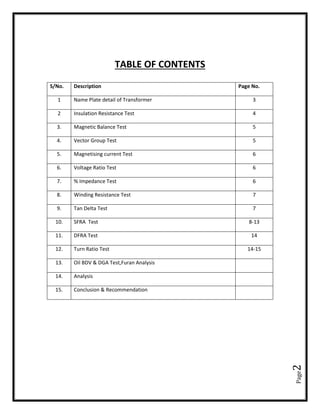
TABLE OF CONTENTS
S/No. Description Page No.
1 Name Plate detail of Transformer 3
2 Insulation Resistance Test 4
3. Magnetic Balance Test 5
4. Vector Group Test 5
5. Magnetising current Test 6
6. Voltage Ratio Test 6
7. % Impedance Test 6
8. Winding Resistance Test 7
9. Tan Delta Test 7
10. SFRA Test 8-13
11. DFRA Test 14
12. Turn Ratio Test 14-15
13. Oil BDV & DGA Test,Furan Analysis
14. Analysis
15. Conclusion & Recommendation
Page3
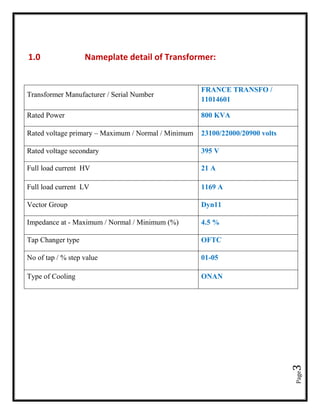
1.0 Nameplate detail of Transformer:
Transformer Manufacturer / Serial Number
FRANCE TRANSFO /
11014601
Rated Power 800 KVA
Rated voltage primary – Maximum / Normal / Minimum 23100/22000/20900 volts
Rated voltage secondary 395 V
Full load current HV 21 A
Full load current LV 1169 A
Vector Group Dyn11
Impedance at - Maximum / Normal / Minimum (%) 4.5 %
Tap Changer type OFTC
No of tap / % step value 01-05
Type of Cooling ONAN
Page4
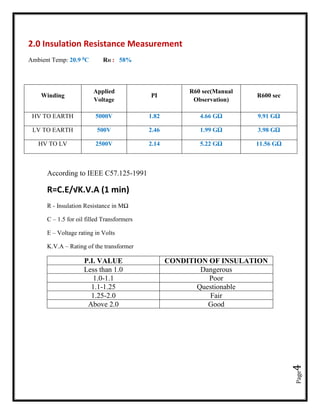
2.0 Insulation Resistance Measurement
Ambient Temp: 20.9 0C RH : 58%
Winding
Applied
Voltage
PI
R60 sec(Manual
Observation)
R600 sec
HV TO EARTH 5000V 1.82 4.66 GΩ 9.91 GΩ
LV TO EARTH 500V 2.46 1.99 GΩ 3.98 GΩ
HV TO LV 2500V 2.14 5.22 GΩ 11.56 GΩ
According to IEEE C57.125-1991
R=C.E/√K.V.A (1 min)
R - Insulation Resistance in MΩ
C – 1.5 for oil filled Transformers
E – Voltage rating in Volts
K.V.A – Rating of the transformer
P.I. VALUE CONDITION OF INSULATION
Less than 1.0 Dangerous
1.0-1.1 Poor
1.1-1.25 Questionable
1.25-2.0 Fair
Above 2.0 Good
Page5
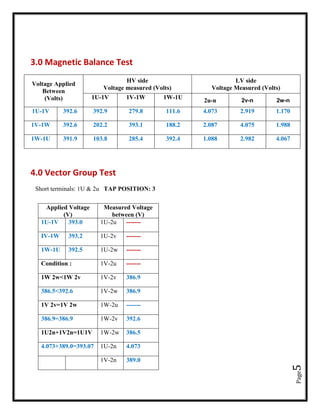
3.0 Magnetic Balance Test
Voltage Applied
Between
(Volts)
HV side
Voltage measured (Volts)
LV side
Voltage Measured (Volts)
1U-1V 1V-1W 1W-1U
2u-n 2v-n 2w-n
1U-1V 392.6 392.9 279.8 111.6 4.073 2.919 1.170
1V-1W 392.6 202.2 393.1 188.2 2.087 4.075 1.988
1W-1U 391.9 103.8 285.4 392.4 1.088 2.982 4.067
4.0 Vector Group Test
Short terminals: 1U & 2u TAP POSITION: 3
Applied Voltage
(V)
Measured Voltage
between (V)
1U-1V 393.0 1U-2u -------
IV-1W 393.2 1U-2v -------
1W-1U 392.5 1U-2w -------
Condition : 1V-2u -------
1W 2w<1W 2v 1V-2v 386.9
386.5<392.6 1V-2w 386.9
1V 2v=1V 2w 1W-2u -------
386.9=386.9 1W-2v 392.6
1U2n+1V2n=1U1V 1W-2w 386.5
4.073+389.0=393.07 1U-2n 4.073
1V-2n 389.0
Page6
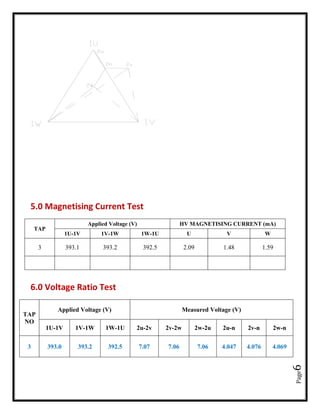
5.0 Magnetising Current Test
TAP
Applied Voltage (V) HV MAGNETISING CURRENT (mA)
1U-1V 1V-1W 1W-1U U V W
3 393.1 393.2 392.5 2.09 1.48 1.59
6.0 Voltage Ratio Test
TAP
NO
Applied Voltage (V) Measured Voltage (V)
1U-1V 1V-1W 1W-1U 2u-2v 2v-2w 2w-2u 2u-n 2v-n 2w-n
3 393.0 393.2 392.5 7.07 7.06 7.06 4.047 4.076 4.069
Page7
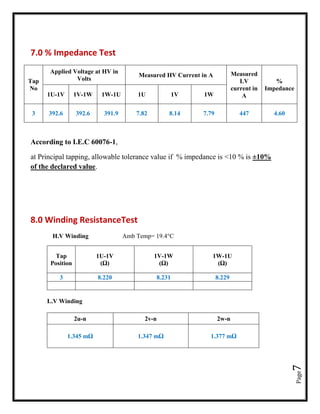
7.0 % Impedance Test
Tap
No
Applied Voltage at HV in
Volts
Measured HV Current in A Measured
LV
current in
A
%
Impedance
1U-1V 1V-1W 1W-1U 1U 1V 1W
3 392.6 392.6 391.9 7.82 8.14 7.79 447 4.60
According to I.E.C 60076-1,
at Principal tapping, allowable tolerance value if % impedance is <10 % is ±10%
of the declared value.
8.0 Winding ResistanceTest
H.V Winding Amb Temp= 19.4°C
Tap
Position
1U-1V
(Ω)
1V-1W
(Ω)
1W-1U
(Ω)
3 8.220 8.231 8.229
L.V Winding
2u-n 2v-n 2w-n
1.345 mΩ 1.347 mΩ 1.377 mΩ
Page8
9.0 Tan Delta and Capacitance Measurement:
Oil temp= 22°C RH%= 58.0% K Value – 0.97
Sr.
No
Capacitance
being
measured
Test
Mode
Measured
capacitance
(nF)
Insulation
P.F (%)
Insulatio
n P.F
(%)
Amp.
Temp˚C
Humidity
( RH) %
1 HV-E GST G 1.034 0.317 0.307 21.6 58
2 HV-LV UST Y 2.583 0.532
0.516
21.6 58
3 HV-LV+E GST YG 3.618 0.474
0.459
21.6 58
4 LV-E GST G 6.638 0.564
0.547
21.6 58
5 LV-HV UST Y 2.584 0.525
0.509
21.6 58
6 LV-HV+E GST YG 9.220 0.546
0.529
21.6 58
10.0 SFRA ANALYSIS:
1U-1V (LV OPEN)
-20
-30
-40
-50
-60
-70
-80
-90
Magnitude(dB)
100 1 k 10 k 100 k 1 M
Frequency (Hz)
[H1-H2 [open]]
Page9
1V-1W(LV OPEN)
1W-1U(LV OPEN)
1U,1V,1W(LV OPEN)
-10
-20
-30
-40
-50
-60
-70
-80
-90
Magnitude(dB)
100 1 k 10 k 100 k 1 M
Frequency (Hz)
[H2-H3 [open]]
-10
-20
-30
-40
-50
-60
-70
-80
-90
Magnitude(dB)
100 1 k 10 k 100 k 1 M
Frequency (Hz)
[H3-H1 [open] (1)]
Page10
X1-X0
X2-X0
-10
-20
-30
-40
-50
-60
-70
-80
-90
Magnitude(dB)
100 1 k 10 k 100 k 1 M
Frequency (Hz)
[H1-H2 [open]] [H2-H3 [open]] [H3-H1 [open] (1)]
0
-5
-10
-15
-20
Magnitude(dB)
100 1 k 10 k 100 k 1 M
Frequency (Hz)
[X1-X0 [open]]
Page11
X3-X0
0
-5
-10
-15
-20
Magnitude(dB)
100 1 k 10 k 100 k 1 M
Frequency (Hz)
[X2-X0 [open]]
0
-5
-10
-15
-20
Magnitude(dB)
100 1 k 10 k 100 k 1 M
Frequency (Hz)
[X3-X0 [open]]
Page12
X1-X0,X2-X0,X3-X0
1U-1V (LV SHORT)
1V – 1W(LV SHORT)
0
-5
-10
-15
-20
Magnitude(dB)
100 1 k 10 k 100 k 1 M
Frequency (Hz)
[X1-X0 [open]] [X2-X0 [open]] [X3-X0 [open]]
-10
-20
-30
-40
-50
-60
Magnitude(dB)
100 1 k 10 k 100 k 1 M
Frequency (Hz)
[H1-H2 [short X1-X2-X3]]
Page13
1W-1U (LV SHORT)
1U-1V,1V-1W,1W-1U (LV SHORT)
-10
-20
-30
-40
-50
-60
Magnitude(dB)
100 1 k 10 k 100 k 1 M
Frequency (Hz)
[H2-H3 [short X1-X2-X3]]
-10
-20
-30
-40
-50
-60
Magnitude(dB)
100 1 k 10 k 100 k 1 M
Frequency (Hz)
[H3-H1 [short X1-X2-X3]]
Page14
11.0 DFRA ANALYSIS:
Measured Graphs Vs Frequency (Attached Graphs)
✓ Oil Conductivity
✓ Polarisation Depolaraisation
✓ Tan Delta & Capacitance
✓ Tan Delta
✓ Powerfactor
✓ Impedance
-10
-20
-30
-40
-50
-60
Magnitude(dB)
100 1 k 10 k 100 k 1 M
Frequency (Hz)
[H1-H2 [short X1-X2-X3]] [H2-H3 [short X1-X2-X3]] [H3-H1 [short X1-X2-X3]]
Page15
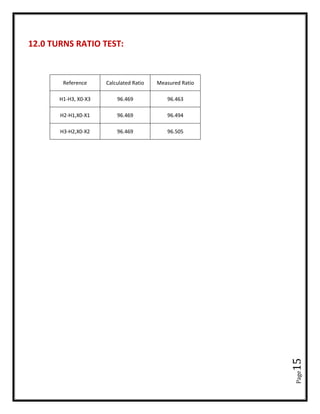
12.0 TURNS RATIO TEST:
Reference Calculated Ratio Measured Ratio
H1-H3, X0-X3 96.469 96.463
H2-H1,X0-X1 96.469 96.494
H3-H2,X0-X2 96.469 96.505
Page16
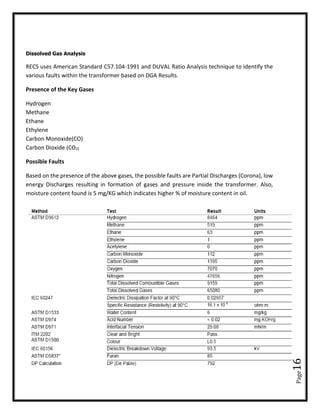
Dissolved Gas Analysis
RECS uses American Standard C57.104-1991 and DUVAL Ratio Analysis technique to identify the
various faults within the transformer based on DGA Results.
Presence of the Key Gases
Hydrogen
Methane
Ethane
Ethylene
Carbon Monoxide(CO)
Carbon Dioxide (CO2)
Possible Faults
Based on the presence of the above gases, the possible faults are Partial Discharges (Corona), low
energy Discharges resulting in formation of gases and pressure inside the transformer. Also,
moisture content found is 5 mg/KG which indicates higher % of moisture content in oil.
Page17
Possible Findings & Observation at Site.
The transformer winding is in good condition. The defect and possible cause of DGPT Alarm can
be summarised with the following points.
1. A1TR19 is hermatically sealed transformer. It was found that transformer LV Bushings was
leaking and had oil spillage. During high atmospheric pressure present outside in comparison
to transformer tank pressure , it is assumed that oil has been contaminated with moisture
and other contaminations. Moisture has level has been indicated in DGA Report ( 6mg/KG)
which is higher.
2. Because of the oil filling practices from the top of DGPT, it is noted that moisture and
contaminations of atmosphere is dissolved. Filling of the DGTP has certain method as per the
manufacturer. Please refer to the attached documents of the manufaturer (AUTOMATION
2000 FRANCE ).
3. Based on the presence of the TDCG gases, the possible faults are Partial Discharges (Corona),
low energy Discharges resulting in formation of gases and pressure inside the transformer.
This is the reason for the DGPT Alarm.
4. DGPT was not grounded.
5. Calibration of DGPT is not up to the mark. DGPT Calibration should be of 1 year validity.
Calibration date should be marked properly. Also, Fault simulation synchronised with DGTP
should be done after reinstalling of DGPT after calibration.
6. Transformer should have been retrofitted with Breather and Pressure Relief Device ( PRD).
7. The maintenance practice of O&M Dept. at Zirku was not up to satisfactory level. The
maintenance pratice adopted is lead to failure maintenance which is also not fololwing any
international standard and engineering pratice.
The process of predictive maintenance should be followed and data trending process should
be implemted.
Page18
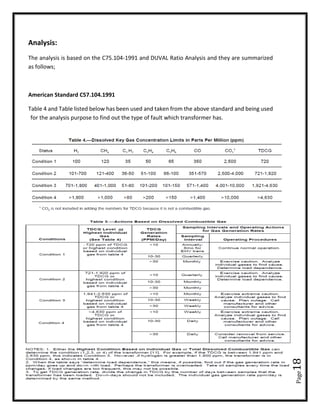
Analysis:
The analysis is based on the C75.104-1991 and DUVAL Ratio Analysis and they are summarized
as follows;
American Standard C57.104.1991
Table 4 and Table listed below has been used and taken from the above standard and being used
for the analysis purpose to find out the type of fault which transformer has.
Page19
DUVAL TRIANGLE:
The analysis using the DUVAL Triangle shows that the transformer has PD.
Conclusions and Recommendations:
1. It is concluded that the transformer is in Condition 4 and in critical stage. Transformer should
be taken out of service. The possible findings are weekend insulation due to electrical stress,
distintegration of paper insulation in oil with carbon and carbon tracking, possible loose
shield and poor grounding of metal objects.
2. Based on the above international standards and technique, It is concluded that there are
active fault inside the transformers. The Transformer should be isolated and should be taken
out of service.
3. It is recommeded to perform oil filtration, sludge bath with prescribed pressure and retrofit
the transformer.
4. While retrofitting , it should be fitted with Pressure Releif Device , Temperature Gauge,
Presssure Gauge & Breather .
5. It is recommeded to comply with DGPT Standard to fill the oil from the top. Hermatically
sealed transformer once opened by any means for e.g. DGPT are subject to oil filtration and
fault simulation of DGPT.
Page20
References
1. C57.104.1991
2. DUVAL Triangle
3. IEC 60076-1, IEC 60076-3, IEC 60076-5
4. CIGRE 342, 445, 343,349
Disclaimer

TRANSFORMER SAMPLE REPORT DGA PHYSICAL CONDITION

  • 1.
    PROJECT : GENERALCONDITION ASSESSMENT AND PREDICTING THE REMNANT LIFE OF TRANSFORMER CLIENT : CONTRACTOR : ORDER NO : REPORT No : DIAGNOSTIC TEST REPORT OF 22kV/0.4kV TRANSFORMER A1 TR 19
  • 2.
    Page2 TABLE OF CONTENTS S/No.Description Page No. 1 Name Plate detail of Transformer 3 2 Insulation Resistance Test 4 3. Magnetic Balance Test 5 4. Vector Group Test 5 5. Magnetising current Test 6 6. Voltage Ratio Test 6 7. % Impedance Test 6 8. Winding Resistance Test 7 9. Tan Delta Test 7 10. SFRA Test 8-13 11. DFRA Test 14 12. Turn Ratio Test 14-15 13. Oil BDV & DGA Test,Furan Analysis 14. Analysis 15. Conclusion & Recommendation
  • 3.
    Page3 1.0 Nameplate detailof Transformer: Transformer Manufacturer / Serial Number FRANCE TRANSFO / 11014601 Rated Power 800 KVA Rated voltage primary – Maximum / Normal / Minimum 23100/22000/20900 volts Rated voltage secondary 395 V Full load current HV 21 A Full load current LV 1169 A Vector Group Dyn11 Impedance at - Maximum / Normal / Minimum (%) 4.5 % Tap Changer type OFTC No of tap / % step value 01-05 Type of Cooling ONAN
  • 4.
    Page4 2.0 Insulation ResistanceMeasurement Ambient Temp: 20.9 0C RH : 58% Winding Applied Voltage PI R60 sec(Manual Observation) R600 sec HV TO EARTH 5000V 1.82 4.66 GΩ 9.91 GΩ LV TO EARTH 500V 2.46 1.99 GΩ 3.98 GΩ HV TO LV 2500V 2.14 5.22 GΩ 11.56 GΩ According to IEEE C57.125-1991 R=C.E/√K.V.A (1 min) R - Insulation Resistance in MΩ C – 1.5 for oil filled Transformers E – Voltage rating in Volts K.V.A – Rating of the transformer P.I. VALUE CONDITION OF INSULATION Less than 1.0 Dangerous 1.0-1.1 Poor 1.1-1.25 Questionable 1.25-2.0 Fair Above 2.0 Good
  • 5.
    Page5 3.0 Magnetic BalanceTest Voltage Applied Between (Volts) HV side Voltage measured (Volts) LV side Voltage Measured (Volts) 1U-1V 1V-1W 1W-1U 2u-n 2v-n 2w-n 1U-1V 392.6 392.9 279.8 111.6 4.073 2.919 1.170 1V-1W 392.6 202.2 393.1 188.2 2.087 4.075 1.988 1W-1U 391.9 103.8 285.4 392.4 1.088 2.982 4.067 4.0 Vector Group Test Short terminals: 1U & 2u TAP POSITION: 3 Applied Voltage (V) Measured Voltage between (V) 1U-1V 393.0 1U-2u ------- IV-1W 393.2 1U-2v ------- 1W-1U 392.5 1U-2w ------- Condition : 1V-2u ------- 1W 2w<1W 2v 1V-2v 386.9 386.5<392.6 1V-2w 386.9 1V 2v=1V 2w 1W-2u ------- 386.9=386.9 1W-2v 392.6 1U2n+1V2n=1U1V 1W-2w 386.5 4.073+389.0=393.07 1U-2n 4.073 1V-2n 389.0
  • 6.
    Page6 5.0 Magnetising CurrentTest TAP Applied Voltage (V) HV MAGNETISING CURRENT (mA) 1U-1V 1V-1W 1W-1U U V W 3 393.1 393.2 392.5 2.09 1.48 1.59 6.0 Voltage Ratio Test TAP NO Applied Voltage (V) Measured Voltage (V) 1U-1V 1V-1W 1W-1U 2u-2v 2v-2w 2w-2u 2u-n 2v-n 2w-n 3 393.0 393.2 392.5 7.07 7.06 7.06 4.047 4.076 4.069
  • 7.
    Page7 7.0 % ImpedanceTest Tap No Applied Voltage at HV in Volts Measured HV Current in A Measured LV current in A % Impedance 1U-1V 1V-1W 1W-1U 1U 1V 1W 3 392.6 392.6 391.9 7.82 8.14 7.79 447 4.60 According to I.E.C 60076-1, at Principal tapping, allowable tolerance value if % impedance is <10 % is ±10% of the declared value. 8.0 Winding ResistanceTest H.V Winding Amb Temp= 19.4°C Tap Position 1U-1V (Ω) 1V-1W (Ω) 1W-1U (Ω) 3 8.220 8.231 8.229 L.V Winding 2u-n 2v-n 2w-n 1.345 mΩ 1.347 mΩ 1.377 mΩ
  • 8.
    Page8 9.0 Tan Deltaand Capacitance Measurement: Oil temp= 22°C RH%= 58.0% K Value – 0.97 Sr. No Capacitance being measured Test Mode Measured capacitance (nF) Insulation P.F (%) Insulatio n P.F (%) Amp. Temp˚C Humidity ( RH) % 1 HV-E GST G 1.034 0.317 0.307 21.6 58 2 HV-LV UST Y 2.583 0.532 0.516 21.6 58 3 HV-LV+E GST YG 3.618 0.474 0.459 21.6 58 4 LV-E GST G 6.638 0.564 0.547 21.6 58 5 LV-HV UST Y 2.584 0.525 0.509 21.6 58 6 LV-HV+E GST YG 9.220 0.546 0.529 21.6 58 10.0 SFRA ANALYSIS: 1U-1V (LV OPEN) -20 -30 -40 -50 -60 -70 -80 -90 Magnitude(dB) 100 1 k 10 k 100 k 1 M Frequency (Hz) [H1-H2 [open]]
  • 9.
    Page9 1V-1W(LV OPEN) 1W-1U(LV OPEN) 1U,1V,1W(LVOPEN) -10 -20 -30 -40 -50 -60 -70 -80 -90 Magnitude(dB) 100 1 k 10 k 100 k 1 M Frequency (Hz) [H2-H3 [open]] -10 -20 -30 -40 -50 -60 -70 -80 -90 Magnitude(dB) 100 1 k 10 k 100 k 1 M Frequency (Hz) [H3-H1 [open] (1)]
  • 10.
    Page10 X1-X0 X2-X0 -10 -20 -30 -40 -50 -60 -70 -80 -90 Magnitude(dB) 100 1 k10 k 100 k 1 M Frequency (Hz) [H1-H2 [open]] [H2-H3 [open]] [H3-H1 [open] (1)] 0 -5 -10 -15 -20 Magnitude(dB) 100 1 k 10 k 100 k 1 M Frequency (Hz) [X1-X0 [open]]
  • 11.
    Page11 X3-X0 0 -5 -10 -15 -20 Magnitude(dB) 100 1 k10 k 100 k 1 M Frequency (Hz) [X2-X0 [open]] 0 -5 -10 -15 -20 Magnitude(dB) 100 1 k 10 k 100 k 1 M Frequency (Hz) [X3-X0 [open]]
  • 12.
    Page12 X1-X0,X2-X0,X3-X0 1U-1V (LV SHORT) 1V– 1W(LV SHORT) 0 -5 -10 -15 -20 Magnitude(dB) 100 1 k 10 k 100 k 1 M Frequency (Hz) [X1-X0 [open]] [X2-X0 [open]] [X3-X0 [open]] -10 -20 -30 -40 -50 -60 Magnitude(dB) 100 1 k 10 k 100 k 1 M Frequency (Hz) [H1-H2 [short X1-X2-X3]]
  • 13.
    Page13 1W-1U (LV SHORT) 1U-1V,1V-1W,1W-1U(LV SHORT) -10 -20 -30 -40 -50 -60 Magnitude(dB) 100 1 k 10 k 100 k 1 M Frequency (Hz) [H2-H3 [short X1-X2-X3]] -10 -20 -30 -40 -50 -60 Magnitude(dB) 100 1 k 10 k 100 k 1 M Frequency (Hz) [H3-H1 [short X1-X2-X3]]
  • 14.
    Page14 11.0 DFRA ANALYSIS: MeasuredGraphs Vs Frequency (Attached Graphs) ✓ Oil Conductivity ✓ Polarisation Depolaraisation ✓ Tan Delta & Capacitance ✓ Tan Delta ✓ Powerfactor ✓ Impedance -10 -20 -30 -40 -50 -60 Magnitude(dB) 100 1 k 10 k 100 k 1 M Frequency (Hz) [H1-H2 [short X1-X2-X3]] [H2-H3 [short X1-X2-X3]] [H3-H1 [short X1-X2-X3]]
  • 15.
    Page15 12.0 TURNS RATIOTEST: Reference Calculated Ratio Measured Ratio H1-H3, X0-X3 96.469 96.463 H2-H1,X0-X1 96.469 96.494 H3-H2,X0-X2 96.469 96.505
  • 16.
    Page16 Dissolved Gas Analysis RECSuses American Standard C57.104-1991 and DUVAL Ratio Analysis technique to identify the various faults within the transformer based on DGA Results. Presence of the Key Gases Hydrogen Methane Ethane Ethylene Carbon Monoxide(CO) Carbon Dioxide (CO2) Possible Faults Based on the presence of the above gases, the possible faults are Partial Discharges (Corona), low energy Discharges resulting in formation of gases and pressure inside the transformer. Also, moisture content found is 5 mg/KG which indicates higher % of moisture content in oil.
  • 17.
    Page17 Possible Findings &Observation at Site. The transformer winding is in good condition. The defect and possible cause of DGPT Alarm can be summarised with the following points. 1. A1TR19 is hermatically sealed transformer. It was found that transformer LV Bushings was leaking and had oil spillage. During high atmospheric pressure present outside in comparison to transformer tank pressure , it is assumed that oil has been contaminated with moisture and other contaminations. Moisture has level has been indicated in DGA Report ( 6mg/KG) which is higher. 2. Because of the oil filling practices from the top of DGPT, it is noted that moisture and contaminations of atmosphere is dissolved. Filling of the DGTP has certain method as per the manufacturer. Please refer to the attached documents of the manufaturer (AUTOMATION 2000 FRANCE ). 3. Based on the presence of the TDCG gases, the possible faults are Partial Discharges (Corona), low energy Discharges resulting in formation of gases and pressure inside the transformer. This is the reason for the DGPT Alarm. 4. DGPT was not grounded. 5. Calibration of DGPT is not up to the mark. DGPT Calibration should be of 1 year validity. Calibration date should be marked properly. Also, Fault simulation synchronised with DGTP should be done after reinstalling of DGPT after calibration. 6. Transformer should have been retrofitted with Breather and Pressure Relief Device ( PRD). 7. The maintenance practice of O&M Dept. at Zirku was not up to satisfactory level. The maintenance pratice adopted is lead to failure maintenance which is also not fololwing any international standard and engineering pratice. The process of predictive maintenance should be followed and data trending process should be implemted.
  • 18.
    Page18 Analysis: The analysis isbased on the C75.104-1991 and DUVAL Ratio Analysis and they are summarized as follows; American Standard C57.104.1991 Table 4 and Table listed below has been used and taken from the above standard and being used for the analysis purpose to find out the type of fault which transformer has.
  • 19.
    Page19 DUVAL TRIANGLE: The analysisusing the DUVAL Triangle shows that the transformer has PD. Conclusions and Recommendations: 1. It is concluded that the transformer is in Condition 4 and in critical stage. Transformer should be taken out of service. The possible findings are weekend insulation due to electrical stress, distintegration of paper insulation in oil with carbon and carbon tracking, possible loose shield and poor grounding of metal objects. 2. Based on the above international standards and technique, It is concluded that there are active fault inside the transformers. The Transformer should be isolated and should be taken out of service. 3. It is recommeded to perform oil filtration, sludge bath with prescribed pressure and retrofit the transformer. 4. While retrofitting , it should be fitted with Pressure Releif Device , Temperature Gauge, Presssure Gauge & Breather . 5. It is recommeded to comply with DGPT Standard to fill the oil from the top. Hermatically sealed transformer once opened by any means for e.g. DGPT are subject to oil filtration and fault simulation of DGPT.
  • 20.
    Page20 References 1. C57.104.1991 2. DUVALTriangle 3. IEC 60076-1, IEC 60076-3, IEC 60076-5 4. CIGRE 342, 445, 343,349 Disclaimer