

Taiga
Disambiguation
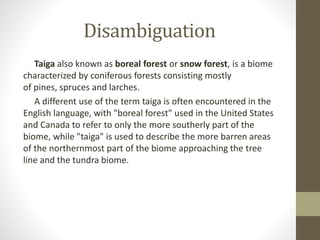
Taiga also known as boreal forest or snow forest, is a biome
characterized by coniferous forests consisting mostly
of pines, spruces and larches.
A different use of the term taiga is often encountered in the
English language, with "boreal forest" used in the United States
and Canada to refer to only the more southerly part of the
biome, while "taiga" is used to describe the more barren areas
of the northernmost part of the biome approaching the tree
line and the tundra biome.
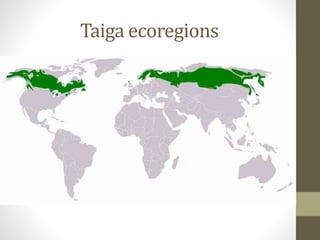
Taiga ecoregions
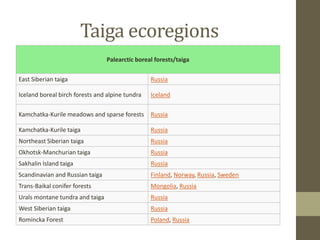
Taiga ecoregions
Palearctic boreal forests/taiga
East Siberian taiga Russia
Iceland boreal birch forests and alpine tundra Iceland
Kamchatka-Kurile meadows and sparse forests Russia
Kamchatka-Kurile taiga Russia
Northeast Siberian taiga Russia
Okhotsk-Manchurian taiga Russia
Sakhalin Island taiga Russia
Scandinavian and Russian taiga Finland, Norway, Russia, Sweden
Trans-Baikal conifer forests Mongolia, Russia
Urals montane tundra and taiga Russia
West Siberian taiga Russia
Romincka Forest Poland, Russia
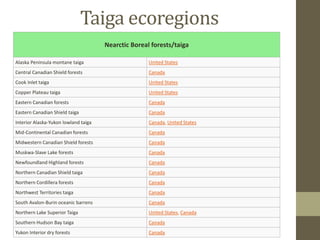
Taiga ecoregions
Nearctic Boreal forests/taiga
Alaska Peninsula montane taiga United States
Central Canadian Shield forests Canada
Cook Inlet taiga United States
Copper Plateau taiga United States
Eastern Canadian forests Canada
Eastern Canadian Shield taiga Canada
Interior Alaska-Yukon lowland taiga Canada, United States
Mid-Continental Canadian forests Canada
Midwestern Canadian Shield forests Canada
Muskwa-Slave Lake forests Canada
Newfoundland Highland forests Canada
Northern Canadian Shield taiga Canada
Northern Cordillera forests Canada
Northwest Territories taiga Canada
South Avalon-Burin oceanic barrens Canada
Northern Lake Superior Taiga United States, Canada
Southern Hudson Bay taiga Canada
Yukon Interior dry forests Canada
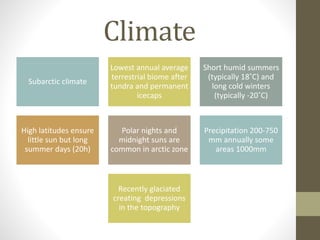
Climate
Subarctic climate
Lowest annual average
terrestrial biome after
tundra and permanent
icecaps
Short humid summers
(typically 18˚C) and
long cold winters
(typically -20˚C)
High latitudes ensure
little sun but long
summer days (20h)
Polar nights and
midnight suns are
common in arctic zone
Precipitation 200-750
mm annually some
areas 1000mm
Recently glaciated
creating depressions
in the topography
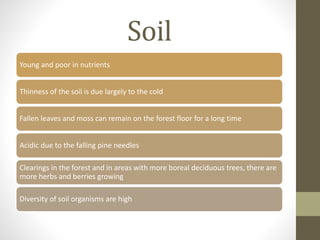
Soil
Young and poor in nutrients
Thinness of the soil is due largely to the cold
Fallen leaves and moss can remain on the forest floor for a long time
Acidic due to the falling pine needles
Clearings in the forest and in areas with more boreal deciduous trees, there are
more herbs and berries growing
Diversity of soil organisms are high
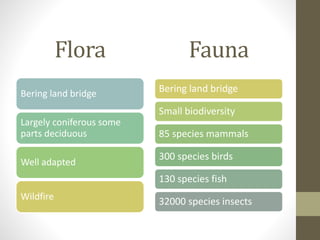
Flora
Bering land bridge
Largely coniferous some
parts deciduous
Well adapted
Wildfire
Fauna
Bering land bridge
Small biodiversity
85 species mammals
300 species birds
130 species fish
32000 species insects
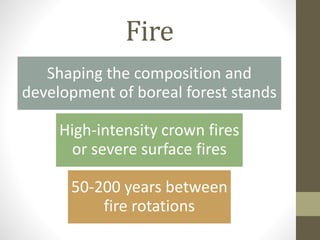
Fire
Shaping the composition and
development of boreal forest stands
High-intensity crown fires
or severe surface fires
50-200 years between
fire rotations
Threats
Human activities
Climate change
Insects
Pollution
Protection
Boreal Forest Conservation Framework
Wildfire suppression
Taiga rescue network
Replanting
Prohibition

Taiga

  • 1.
  • 2.
    Disambiguation Taiga also knownas boreal forest or snow forest, is a biome characterized by coniferous forests consisting mostly of pines, spruces and larches. A different use of the term taiga is often encountered in the English language, with "boreal forest" used in the United States and Canada to refer to only the more southerly part of the biome, while "taiga" is used to describe the more barren areas of the northernmost part of the biome approaching the tree line and the tundra biome.
  • 3.
  • 4.
    Taiga ecoregions Palearctic borealforests/taiga East Siberian taiga Russia Iceland boreal birch forests and alpine tundra Iceland Kamchatka-Kurile meadows and sparse forests Russia Kamchatka-Kurile taiga Russia Northeast Siberian taiga Russia Okhotsk-Manchurian taiga Russia Sakhalin Island taiga Russia Scandinavian and Russian taiga Finland, Norway, Russia, Sweden Trans-Baikal conifer forests Mongolia, Russia Urals montane tundra and taiga Russia West Siberian taiga Russia Romincka Forest Poland, Russia
  • 5.
    Taiga ecoregions Nearctic Borealforests/taiga Alaska Peninsula montane taiga United States Central Canadian Shield forests Canada Cook Inlet taiga United States Copper Plateau taiga United States Eastern Canadian forests Canada Eastern Canadian Shield taiga Canada Interior Alaska-Yukon lowland taiga Canada, United States Mid-Continental Canadian forests Canada Midwestern Canadian Shield forests Canada Muskwa-Slave Lake forests Canada Newfoundland Highland forests Canada Northern Canadian Shield taiga Canada Northern Cordillera forests Canada Northwest Territories taiga Canada South Avalon-Burin oceanic barrens Canada Northern Lake Superior Taiga United States, Canada Southern Hudson Bay taiga Canada Yukon Interior dry forests Canada
  • 6.
    Climate Subarctic climate Lowest annualaverage terrestrial biome after tundra and permanent icecaps Short humid summers (typically 18˚C) and long cold winters (typically -20˚C) High latitudes ensure little sun but long summer days (20h) Polar nights and midnight suns are common in arctic zone Precipitation 200-750 mm annually some areas 1000mm Recently glaciated creating depressions in the topography
  • 7.
    Soil Young and poorin nutrients Thinness of the soil is due largely to the cold Fallen leaves and moss can remain on the forest floor for a long time Acidic due to the falling pine needles Clearings in the forest and in areas with more boreal deciduous trees, there are more herbs and berries growing Diversity of soil organisms are high
  • 8.
    Flora Bering land bridge Largelyconiferous some parts deciduous Well adapted Wildfire Fauna Bering land bridge Small biodiversity 85 species mammals 300 species birds 130 species fish 32000 species insects
  • 9.
    Fire Shaping the compositionand development of boreal forest stands High-intensity crown fires or severe surface fires 50-200 years between fire rotations
  • 10.
  • 11.
    Protection Boreal Forest ConservationFramework Wildfire suppression Taiga rescue network Replanting Prohibition