TEMPERATE DECIDUOUS FOREST A2 World Biomes (Geography)
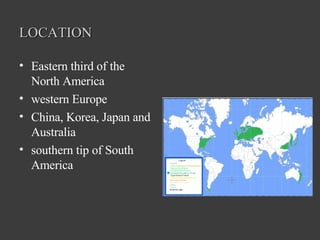
LOCATION Eastern third of the North America western Europe China, Korea, Japan and Australia  southern tip of South America
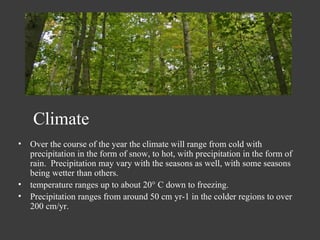
Over the course of the year the climate will range from cold with precipitation in the form of snow, to hot, with precipitation in the form of rain.  Precipitation may vary with the seasons as well, with some seasons being wetter than others. temperature ranges up to about 20° C down to freezing. Precipitation ranges from around 50 cm yr-1 in the colder regions to over 200 cm/yr.  Climate
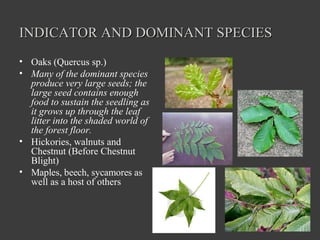
INDICATOR AND DOMINANT SPECIES Oaks (Quercus sp.) Many of the dominant species produce very large seeds; the large seed contains enough food to sustain the seedling as it grows up through the leaf litter into the shaded world of the forest floor. Hickories, walnuts and Chestnut (Before Chestnut Blight) Maples, beech, sycamores as well as a host of others
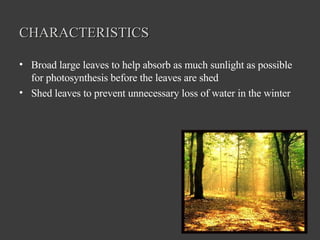
CHARACTERISTICS Broad large leaves to help absorb as much sunlight as possible for photosynthesis before the leaves are shed  Shed leaves to prevent unnecessary loss of water in the winter
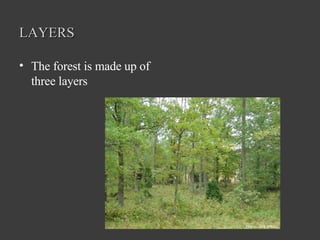
LAYERS The forest is made up of three layers
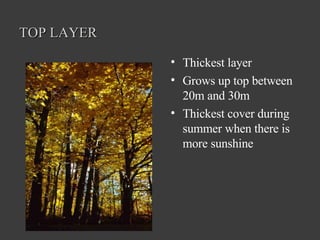
TOP LAYER Thickest layer  Grows up top between 20m and 30m Thickest cover during summer when there is more sunshine
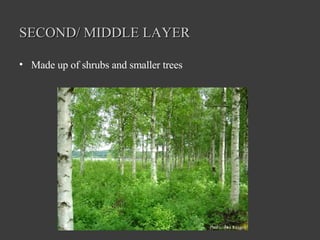
SECOND/ MIDDLE LAYER Made up of shrubs and smaller trees
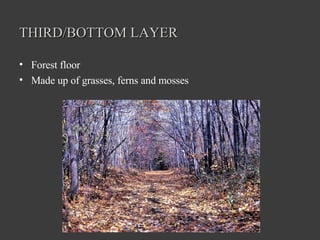
THIRD/BOTTOM LAYER Forest floor Made up of grasses, ferns and mosses
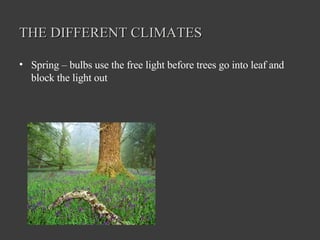
THE DIFFERENT CLIMATES Spring – bulbs use the free light before trees go into leaf and block the light out
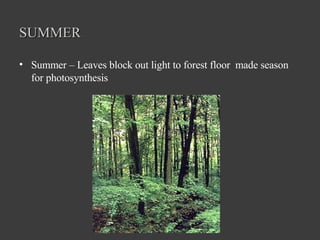
SUMMER Summer – Leaves block out light to forest floor  made season for photosynthesis
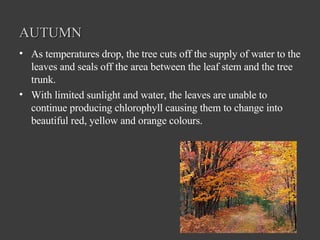
AUTUMN As temperatures drop, the tree cuts off the supply of water to the leaves and seals off the area between the leaf stem and the tree trunk.  With limited sunlight and water, the leaves are unable to continue producing chlorophyll causing them to change into beautiful red, yellow and orange colours.
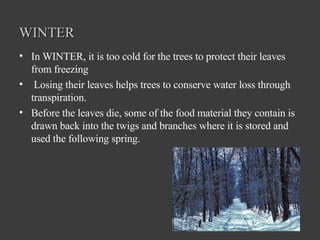
WINTER In WINTER, it is too cold for the trees to protect their leaves from freezing Losing their leaves helps trees to conserve water loss through transpiration.  Before the leaves die, some of the food material they contain is drawn back into the twigs and branches where it is stored and used the following spring.
MORE CHARACTERISTICS Less dense than rainforests Widely spaced trees Only a few types of trees such as Oak, Elm, Beech, Ash and Sycamore Leaf litter increased during autumn and decomposes over the year. Seasonal Changes Animals have to adapt to the changing seasons Migration and hibernation are two adaptations Some animals store food over the winter Rich soils good for agriculture
THREATS Human settlements are often found near these forests because of their rich soils and were easily converted to agricultural land The climate is warmer than the boreal forest, yet not so warm as the tropics Biggest threat to temperate forests is once again development and agriculture Other threats include logging; most trees are hardwoods, meaning they have a denser wood than most coniferous trees. They grow more slowly, meaning more pressure to cut the trees to maintain volume at the sawmill Acid Rain from coal-burning is another threat, as is global warming, which in particular may change rainfall patterns
 

Temperate Deciduous Forest

  • 1.
    TEMPERATE DECIDUOUS FORESTA2 World Biomes (Geography)
  • 2.
    LOCATION Eastern thirdof the North America western Europe China, Korea, Japan and Australia southern tip of South America
  • 3.
    Over the courseof the year the climate will range from cold with precipitation in the form of snow, to hot, with precipitation in the form of rain.  Precipitation may vary with the seasons as well, with some seasons being wetter than others. temperature ranges up to about 20° C down to freezing. Precipitation ranges from around 50 cm yr-1 in the colder regions to over 200 cm/yr.  Climate
  • 4.
    INDICATOR AND DOMINANTSPECIES Oaks (Quercus sp.) Many of the dominant species produce very large seeds; the large seed contains enough food to sustain the seedling as it grows up through the leaf litter into the shaded world of the forest floor. Hickories, walnuts and Chestnut (Before Chestnut Blight) Maples, beech, sycamores as well as a host of others
  • 5.
    CHARACTERISTICS Broad largeleaves to help absorb as much sunlight as possible for photosynthesis before the leaves are shed Shed leaves to prevent unnecessary loss of water in the winter
  • 6.
    LAYERS The forestis made up of three layers
  • 7.
    TOP LAYER Thickestlayer Grows up top between 20m and 30m Thickest cover during summer when there is more sunshine
  • 8.
    SECOND/ MIDDLE LAYERMade up of shrubs and smaller trees
  • 9.
    THIRD/BOTTOM LAYER Forestfloor Made up of grasses, ferns and mosses
  • 10.
    THE DIFFERENT CLIMATESSpring – bulbs use the free light before trees go into leaf and block the light out
  • 11.
    SUMMER Summer –Leaves block out light to forest floor made season for photosynthesis
  • 12.
    AUTUMN As temperaturesdrop, the tree cuts off the supply of water to the leaves and seals off the area between the leaf stem and the tree trunk. With limited sunlight and water, the leaves are unable to continue producing chlorophyll causing them to change into beautiful red, yellow and orange colours.
  • 13.
    WINTER In WINTER,it is too cold for the trees to protect their leaves from freezing Losing their leaves helps trees to conserve water loss through transpiration. Before the leaves die, some of the food material they contain is drawn back into the twigs and branches where it is stored and used the following spring.
  • 14.
    MORE CHARACTERISTICS Lessdense than rainforests Widely spaced trees Only a few types of trees such as Oak, Elm, Beech, Ash and Sycamore Leaf litter increased during autumn and decomposes over the year. Seasonal Changes Animals have to adapt to the changing seasons Migration and hibernation are two adaptations Some animals store food over the winter Rich soils good for agriculture
  • 15.
    THREATS Human settlementsare often found near these forests because of their rich soils and were easily converted to agricultural land The climate is warmer than the boreal forest, yet not so warm as the tropics Biggest threat to temperate forests is once again development and agriculture Other threats include logging; most trees are hardwoods, meaning they have a denser wood than most coniferous trees. They grow more slowly, meaning more pressure to cut the trees to maintain volume at the sawmill Acid Rain from coal-burning is another threat, as is global warming, which in particular may change rainfall patterns
  • 16.