21 issue for the 21st century
Changing the Face of Waste: Solving the Impending Scarcity
of Strategic Minerals and Avoiding Electronic Waste
Why a UNEP foresight project?
UNEP Science Strategy – UNEP stronger leadership role in identifying and
prioritizing emerging global environmental issues
Ensure that UN community and & environmental policy community are
aware of most critical emerging issues having to do with the environment
Help set policy agenda
Make identification of issues more systematic for POW
Input to Rio +20
What is the UNEP Foresight process?
A systematic procedure for canvassing top experts every
two years identify and rank critical emerging issues.
Coordination: Chief Scientists Office & DEWA. Foresight Panel –
22 distinguished scientists/experts – Broad regional &
disciplinary representation
21priority
issues
UNEP community identified
68 issues
Foresight Panel meeting
debated 98 issues
Broad Electronic
consultation 933 scientists
worldwide 428 responses
What is an emerging issue?
It is critical to the global environment, can be positive or negative.
Must be environmental in nature, or environmentally-related.
Should be given priority over the next one to three years in work programmes
of UNEP and/or other UN institutions and/or other international institutions
Has to be of large spatial scale (global, continental, "universal")
Must be recognized as very important by the scientific community, but has not
yet received adequate attention from the policy community. Hence it is
considered an "emerging issue" from the perspective of the policy community.
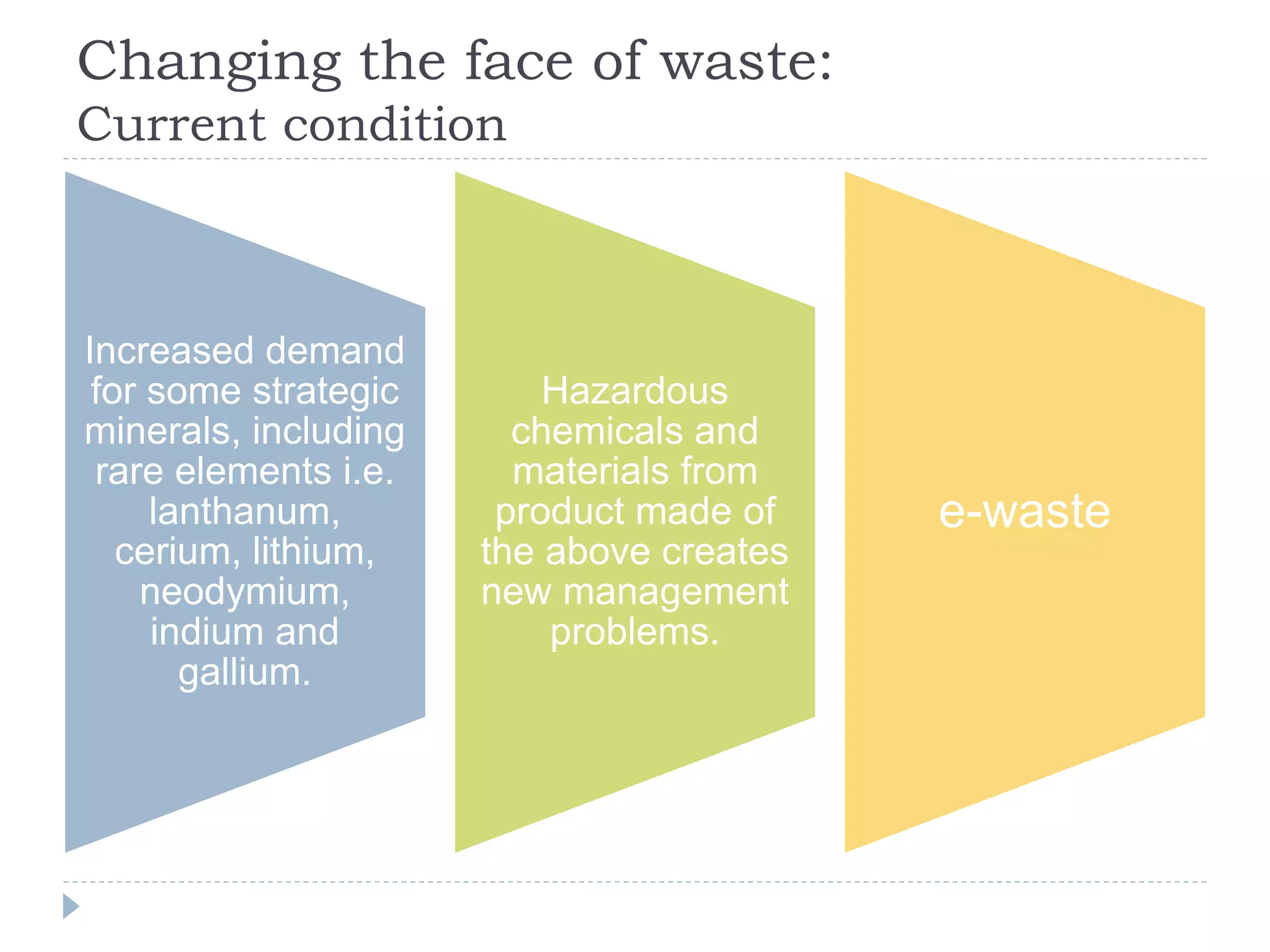
Changing the face of waste:
Current condition
Increased demand
for some strategic
minerals, including
rare elements i.e.
lanthanum,
cerium, lithium,
neodymium,
indium and
gallium.
Hazardous
chemicals and
materials from
product made of
the above creates
new management
problems.
e-waste
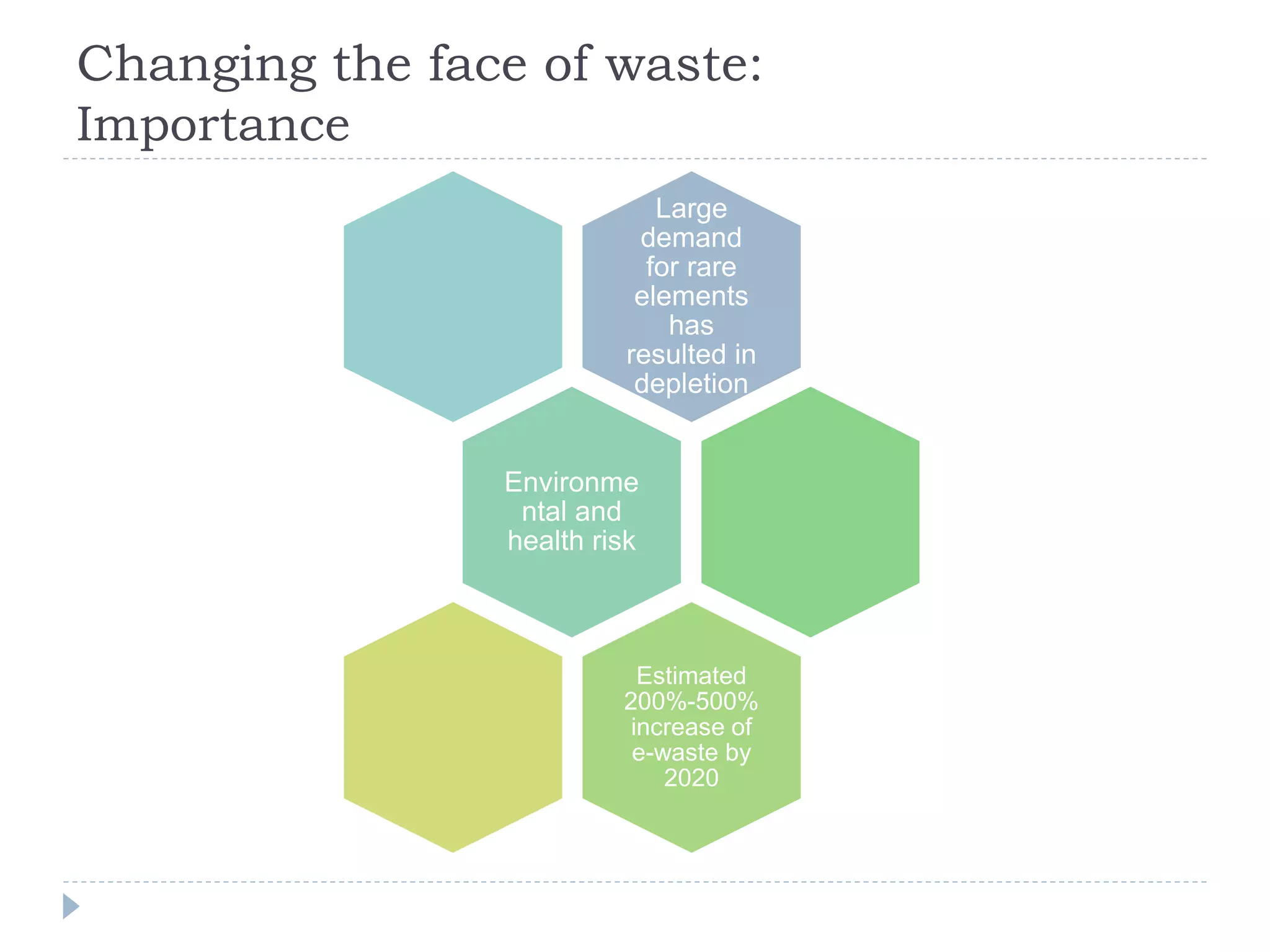
Changing the face of waste:
Importance
Large
demand
for rare
elements
has
resulted in
depletion
Environme
ntal and
health risk
Estimated
200%-500%
increase of
e-waste by
2020
Changing the face of waste:
Options for action
Resource
management
Mining Recycle
“Planned
capacity for
evolution”
Life cycle
approach
Changing the face of waste:
Consequences of inaction
Manufacturing trend continues next 10-20
years accelerated depletion of key minerals
Build up of hazardous and e-waste
Risk to public health and environment
Heightened competition of strategic mineral
References
 http://www.unep.org/science/chief-scientist/Portals/76/docs/alcamo-foresight-geneva-15-12-11.pdf
 European Union (EU). 2011. Waste electrical and electronic equipment. Directive on waste
electrical and electronic equipment. http://europa.eu/legislation_summaries/
environment/waste_management/l21210_en.htm
 GBI Research. 2010. E-waste Management Market to 2020 - Emerging Economies Poised to
Capitalize on E-waste Recovery and Recycling Market. The Electronic Industry Market Research
and Knowledge Network. GBI Research.
 Guiltinan, J. 2009. Creative destruction and destructive creations: environmental ethics and
planned obsolescence, Journal of Business Ethics, 89, 19-28 Humphries, M. 2010. Rare earth
elements: the global supply chain. CRS Report for Congress, Congressional Research Service.
http://www.fas.org/sgp/crs/natsec/R41347.pdf
 Long, K.R., Van Gosen, B.S., Foley, N.K., Cordier, D. 2010. The principal rare earth elements
deposits of the United States - a summary of domestic deposits and a global perspective. U.S.
Geological Survey Scientific Investigations Report 2010 – 5220.
http://pubs.usgs.gov./sir/2010/5220.
 Nnorom, I.C., Osibanjo, O. 2010. Overview of prospects in adopting remanufacturing of end-of-life
electronic products in the developing countries. International Journal of Innovation, Management
and Technology, 1, 328-338
 UNEP. 2009. Recycling – from e-waste to resources - solving the e-waste problem. Sustainable
innovation and technology transfer industrial sector studies. United Nations Environment
Programme. http://www.unep.org/PDF/PressReleases/E-
Waste_publication_screen_FINALVERSION-sml.pdf
 US Department of Energy (DOE). 2010. Critical materials strategy, US Department of Energy.
http://www.doe.gov/sites/prod/files/edg/news/documents/ criticalmaterialsstrategy.pdf

21 issue for the 21st century: e-waste

  • 1.
    21 issue forthe 21st century Changing the Face of Waste: Solving the Impending Scarcity of Strategic Minerals and Avoiding Electronic Waste
  • 2.
    Why a UNEPforesight project? UNEP Science Strategy – UNEP stronger leadership role in identifying and prioritizing emerging global environmental issues Ensure that UN community and & environmental policy community are aware of most critical emerging issues having to do with the environment Help set policy agenda Make identification of issues more systematic for POW Input to Rio +20
  • 3.
    What is theUNEP Foresight process? A systematic procedure for canvassing top experts every two years identify and rank critical emerging issues. Coordination: Chief Scientists Office & DEWA. Foresight Panel – 22 distinguished scientists/experts – Broad regional & disciplinary representation 21priority issues UNEP community identified 68 issues Foresight Panel meeting debated 98 issues Broad Electronic consultation 933 scientists worldwide 428 responses
  • 4.
    What is anemerging issue? It is critical to the global environment, can be positive or negative. Must be environmental in nature, or environmentally-related. Should be given priority over the next one to three years in work programmes of UNEP and/or other UN institutions and/or other international institutions Has to be of large spatial scale (global, continental, "universal") Must be recognized as very important by the scientific community, but has not yet received adequate attention from the policy community. Hence it is considered an "emerging issue" from the perspective of the policy community.
  • 5.
    Changing the faceof waste: Current condition Increased demand for some strategic minerals, including rare elements i.e. lanthanum, cerium, lithium, neodymium, indium and gallium. Hazardous chemicals and materials from product made of the above creates new management problems. e-waste
  • 6.
    Changing the faceof waste: Importance Large demand for rare elements has resulted in depletion Environme ntal and health risk Estimated 200%-500% increase of e-waste by 2020
  • 7.
    Changing the faceof waste: Options for action Resource management Mining Recycle “Planned capacity for evolution” Life cycle approach
  • 8.
    Changing the faceof waste: Consequences of inaction Manufacturing trend continues next 10-20 years accelerated depletion of key minerals Build up of hazardous and e-waste Risk to public health and environment Heightened competition of strategic mineral
  • 9.
    References  http://www.unep.org/science/chief-scientist/Portals/76/docs/alcamo-foresight-geneva-15-12-11.pdf  EuropeanUnion (EU). 2011. Waste electrical and electronic equipment. Directive on waste electrical and electronic equipment. http://europa.eu/legislation_summaries/ environment/waste_management/l21210_en.htm  GBI Research. 2010. E-waste Management Market to 2020 - Emerging Economies Poised to Capitalize on E-waste Recovery and Recycling Market. The Electronic Industry Market Research and Knowledge Network. GBI Research.  Guiltinan, J. 2009. Creative destruction and destructive creations: environmental ethics and planned obsolescence, Journal of Business Ethics, 89, 19-28 Humphries, M. 2010. Rare earth elements: the global supply chain. CRS Report for Congress, Congressional Research Service. http://www.fas.org/sgp/crs/natsec/R41347.pdf  Long, K.R., Van Gosen, B.S., Foley, N.K., Cordier, D. 2010. The principal rare earth elements deposits of the United States - a summary of domestic deposits and a global perspective. U.S. Geological Survey Scientific Investigations Report 2010 – 5220. http://pubs.usgs.gov./sir/2010/5220.  Nnorom, I.C., Osibanjo, O. 2010. Overview of prospects in adopting remanufacturing of end-of-life electronic products in the developing countries. International Journal of Innovation, Management and Technology, 1, 328-338  UNEP. 2009. Recycling – from e-waste to resources - solving the e-waste problem. Sustainable innovation and technology transfer industrial sector studies. United Nations Environment Programme. http://www.unep.org/PDF/PressReleases/E- Waste_publication_screen_FINALVERSION-sml.pdf  US Department of Energy (DOE). 2010. Critical materials strategy, US Department of Energy. http://www.doe.gov/sites/prod/files/edg/news/documents/ criticalmaterialsstrategy.pdf