GroupNo.3
BorealForest
or
Taiga
Boreal forest
Biophysical environments
Biotic interactions
Fire regimes & post-fire succession
Floodplain succession & paludification
Forest clearance and succession
Climate change: natural & anthropogenic
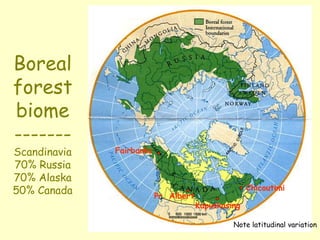
Boreal
forest
biome
-------
Scandinavia
70% Russia
70% Alaska
50% Canada
Fairbanks
Pr. Albert
Kapuskasing
Chicoutimi
Note latitudinal variation
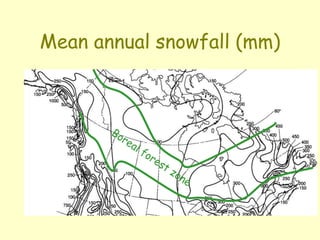
Mean annual snowfall (mm)
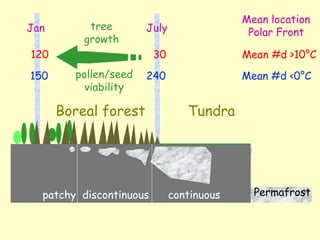
Boreal forest Tundra
Permafrostpatchy discontinuous continuous
Mean location
Polar FrontJulyJan
150 240 Mean #d <0°C
tree
growth
pollen/seed
viability
120 30 Mean #d >10°C
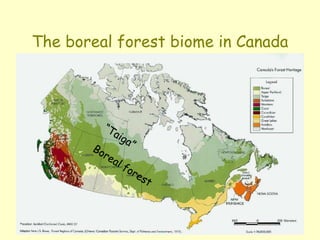
The boreal forest biome in Canada
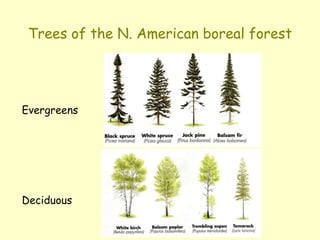
Trees of the N. American boreal forest
Evergreens
Deciduous
non-accessed
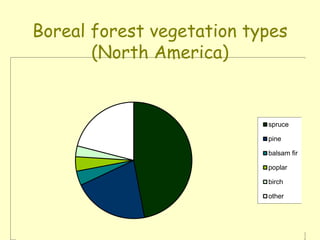
spruce
pine
balsam fir
poplar
birch
other
Boreal forest vegetation types
(North America)
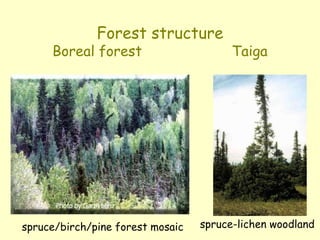
Forest structure
Boreal forest Taiga
spruce/birch/pine forest mosaic spruce-lichen woodland
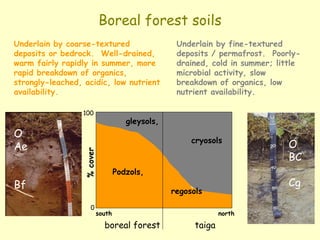
Boreal forest soils
south north
Podzols,
regosols
gleysols,
cryosols
Underlain by coarse-textured
deposits or bedrock. Well-drained,
warm fairly rapidly in summer, more
rapid breakdown of organics,
strongly-leached, acidic, low nutrient
availability.
Underlain by fine-textured
deposits / permafrost. Poorly-
drained, cold in summer; little
microbial activity, slow
breakdown of organics, low
nutrient availability.
boreal forest taiga
0
100
O
Ae
Bf
O
BC
Cg
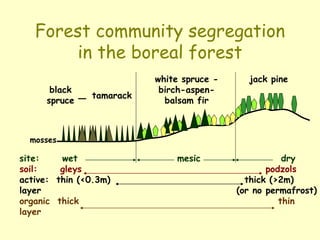
Forest community segregation
in the boreal forest
site: wet mesic dry
soil: gleys podzols
active: thin (<0.3m) thick (>2m)
layer (or no permafrost)
organic thick thin
layer
black
spruce
tamarack
white spruce -
birch-aspen-
balsam fir
jack pine
mosses
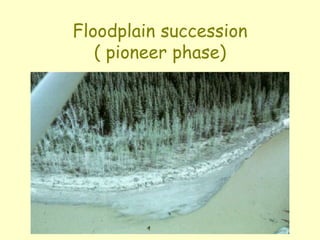
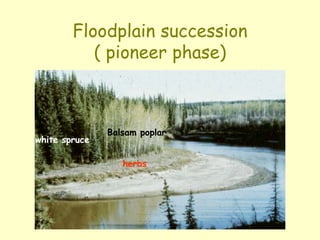
Floodplain succession
( pioneer phase)
Floodplain succession
( pioneer phase)
Balsam poplar
white spruce
herbs
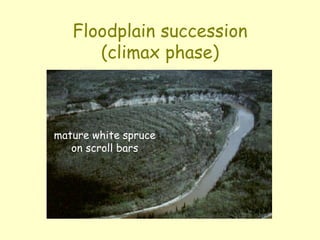
Floodplain succession
(climax phase)
mature white spruce
on scroll bars

Boreal forest