Biome Project
Boreal Forest

By Tom Kobelev
Abiotic Characteristics
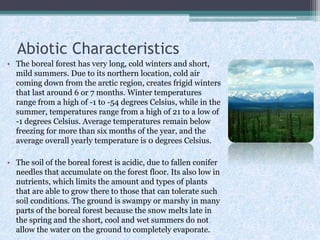
• The boreal forest has very long, cold winters and short,
mild summers. Due to its northern location, cold air
coming down from the arctic region, creates frigid winters
that last around 6 or 7 months. Winter temperatures
range from a high of -1 to -54 degrees Celsius, while in the
summer, temperatures range from a high of 21 to a low of
-1 degrees Celsius. Average temperatures remain below
freezing for more than six months of the year, and the
average overall yearly temperature is 0 degrees Celsius.
• The soil of the boreal forest is acidic, due to fallen conifer
needles that accumulate on the forest floor. Its also low in
nutrients, which limits the amount and types of plants
that are able to grow there to those that can tolerate such
soil conditions. The ground is swampy or marshy in many
parts of the boreal forest because the snow melts late in
the spring and the short, cool and wet summers do not
allow the water on the ground to completely evaporate.
Biotic Characteristics
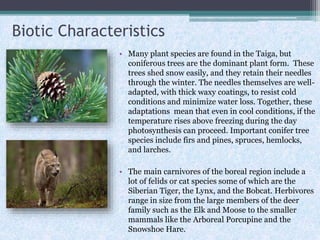
• Many plant species are found in the Taiga, but
coniferous trees are the dominant plant form. These
trees shed snow easily, and they retain their needles
through the winter. The needles themselves are welladapted, with thick waxy coatings, to resist cold
conditions and minimize water loss. Together, these
adaptations mean that even in cool conditions, if the
temperature rises above freezing during the day
photosynthesis can proceed. Important conifer tree
species include firs and pines, spruces, hemlocks,
and larches.
• The main carnivores of the boreal region include a
lot of felids or cat species some of which are the
Siberian Tiger, the Lynx, and the Bobcat. Herbivores
range in size from the large members of the deer
family such as the Elk and Moose to the smaller
mammals like the Arboreal Porcupine and the
Snowshoe Hare.
Climate
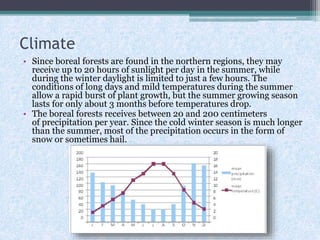
• Since boreal forests are found in the northern regions, they may
receive up to 20 hours of sunlight per day in the summer, while
during the winter daylight is limited to just a few hours. The
conditions of long days and mild temperatures during the summer
allow a rapid burst of plant growth, but the summer growing season
lasts for only about 3 months before temperatures drop.
• The boreal forests receives between 20 and 200 centimeters
of precipitation per year. Since the cold winter season is much longer
than the summer, most of the precipitation occurs in the form of
snow or sometimes hail.
World
Distribution
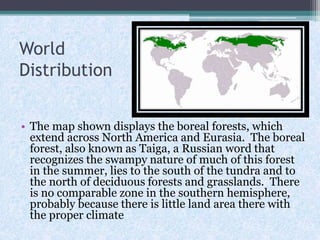
• The map shown displays the boreal forests, which
extend across North America and Eurasia. The boreal
forest, also known as Taiga, a Russian word that
recognizes the swampy nature of much of this forest
in the summer, lies to the south of the tundra and to
the north of deciduous forests and grasslands. There
is no comparable zone in the southern hemisphere,
probably because there is little land area there with
the proper climate
Bioaccumulation
• The abiotic factors in the boreal forest strongly affect the plants and animals
that live there, making it necessary for them to adapt to the conditions. The
vegetation of the boreal forest is dominated by evergreen conifer trees that have
needles rather than leaves. This type of tree conserves energy by not having to
re-grow its leaves every spring. Many of the animals of the boreal forest have
adaptations for cold and snow, such as thick fur, wide paws and coat colors that
change according to the season.
• The boreal forest today is greatly affected by exploration and development of oil
and natural gas reserves. From Alaska to Canada to Russia, it is estimated that
there are vast amounts of petroleum under these forests. As well as logging
always remains a threat to the boreal forests, the depletion of the trees is
removing the habitat of many animals including owls and other arctic birds.
• This shows the most intrusive species of all is the human. Humans are
inhabiting and exploring much of the boreal forests and stripping the forests of
their resources like their trees, their natural gasses, their minerals and some
species of animals that are poached like elk, white tailed deer, moose, and other
members of the deer family
• As the overall climate of our planet warms the southern regions of the boreal
forest will become warm enough for deciduous trees to outcompete the conifers
and replace them.
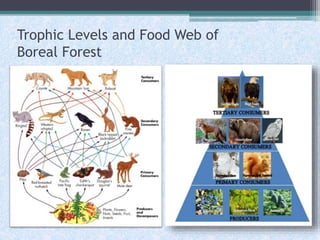
Trophic Levels and Food Web of
Boreal Forest
Biotic Relationships
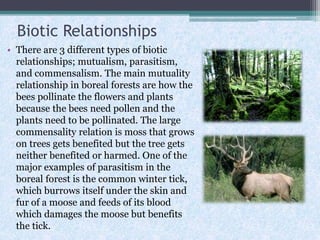
• There are 3 different types of biotic
relationships; mutualism, parasitism,
and commensalism. The main mutuality
relationship in boreal forests are how the
bees pollinate the flowers and plants
because the bees need pollen and the
plants need to be pollinated. The large
commensality relation is moss that grows
on trees gets benefited but the tree gets
neither benefited or harmed. One of the
major examples of parasitism in the
boreal forest is the common winter tick,
which burrows itself under the skin and
fur of a moose and feeds of its blood
which damages the moose but benefits
the tick.
Boreal Forest Succession
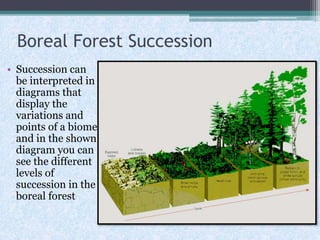
• Succession can
be interpreted in
diagrams that
display the
variations and
points of a biome
and in the shown
diagram you can
see the different
levels of
succession in the
boreal forest
Works Cited
• "Canadian Beacons Project." Canadian Beacons Project. N.p., n.d.
Web. 16 Feb. 2014.
• <http://www.beaconsproject.ca/boreal>.
• "Climate: ." The Boreal Forest Biome. N.p., n.d. Web. 16 Feb. 2014.
<http://www.marietta.edu/~biol/biomes/boreal.htm>.
• "Mutualism, Commensalism, and Parasitism Examples. - Boreal
Forest and Taiga." Boreal Forest and Taiga. N.p., n.d. Web. 16 Feb.
2014. <http://borealforestandtaiga.weebly.com/mutualismcommensalism-and-parasitism-examples.html>.
• "What Are Some Abiotic Factors in the Boreal Forest?" Bright Hub.
N.p., n.d. Web. 16 Feb. 2014.
<http://www.brighthub.com/environment/scienceenvironmental/articles/81812.aspx>.

Biome project sc10h

  • 1.
  • 2.
    Abiotic Characteristics • Theboreal forest has very long, cold winters and short, mild summers. Due to its northern location, cold air coming down from the arctic region, creates frigid winters that last around 6 or 7 months. Winter temperatures range from a high of -1 to -54 degrees Celsius, while in the summer, temperatures range from a high of 21 to a low of -1 degrees Celsius. Average temperatures remain below freezing for more than six months of the year, and the average overall yearly temperature is 0 degrees Celsius. • The soil of the boreal forest is acidic, due to fallen conifer needles that accumulate on the forest floor. Its also low in nutrients, which limits the amount and types of plants that are able to grow there to those that can tolerate such soil conditions. The ground is swampy or marshy in many parts of the boreal forest because the snow melts late in the spring and the short, cool and wet summers do not allow the water on the ground to completely evaporate.
  • 3.
    Biotic Characteristics • Manyplant species are found in the Taiga, but coniferous trees are the dominant plant form. These trees shed snow easily, and they retain their needles through the winter. The needles themselves are welladapted, with thick waxy coatings, to resist cold conditions and minimize water loss. Together, these adaptations mean that even in cool conditions, if the temperature rises above freezing during the day photosynthesis can proceed. Important conifer tree species include firs and pines, spruces, hemlocks, and larches. • The main carnivores of the boreal region include a lot of felids or cat species some of which are the Siberian Tiger, the Lynx, and the Bobcat. Herbivores range in size from the large members of the deer family such as the Elk and Moose to the smaller mammals like the Arboreal Porcupine and the Snowshoe Hare.
  • 4.
    Climate • Since borealforests are found in the northern regions, they may receive up to 20 hours of sunlight per day in the summer, while during the winter daylight is limited to just a few hours. The conditions of long days and mild temperatures during the summer allow a rapid burst of plant growth, but the summer growing season lasts for only about 3 months before temperatures drop. • The boreal forests receives between 20 and 200 centimeters of precipitation per year. Since the cold winter season is much longer than the summer, most of the precipitation occurs in the form of snow or sometimes hail.
  • 5.
    World Distribution • The mapshown displays the boreal forests, which extend across North America and Eurasia. The boreal forest, also known as Taiga, a Russian word that recognizes the swampy nature of much of this forest in the summer, lies to the south of the tundra and to the north of deciduous forests and grasslands. There is no comparable zone in the southern hemisphere, probably because there is little land area there with the proper climate
  • 6.
    Bioaccumulation • The abioticfactors in the boreal forest strongly affect the plants and animals that live there, making it necessary for them to adapt to the conditions. The vegetation of the boreal forest is dominated by evergreen conifer trees that have needles rather than leaves. This type of tree conserves energy by not having to re-grow its leaves every spring. Many of the animals of the boreal forest have adaptations for cold and snow, such as thick fur, wide paws and coat colors that change according to the season. • The boreal forest today is greatly affected by exploration and development of oil and natural gas reserves. From Alaska to Canada to Russia, it is estimated that there are vast amounts of petroleum under these forests. As well as logging always remains a threat to the boreal forests, the depletion of the trees is removing the habitat of many animals including owls and other arctic birds. • This shows the most intrusive species of all is the human. Humans are inhabiting and exploring much of the boreal forests and stripping the forests of their resources like their trees, their natural gasses, their minerals and some species of animals that are poached like elk, white tailed deer, moose, and other members of the deer family • As the overall climate of our planet warms the southern regions of the boreal forest will become warm enough for deciduous trees to outcompete the conifers and replace them.
  • 7.
    Trophic Levels andFood Web of Boreal Forest
  • 8.
    Biotic Relationships • Thereare 3 different types of biotic relationships; mutualism, parasitism, and commensalism. The main mutuality relationship in boreal forests are how the bees pollinate the flowers and plants because the bees need pollen and the plants need to be pollinated. The large commensality relation is moss that grows on trees gets benefited but the tree gets neither benefited or harmed. One of the major examples of parasitism in the boreal forest is the common winter tick, which burrows itself under the skin and fur of a moose and feeds of its blood which damages the moose but benefits the tick.
  • 9.
    Boreal Forest Succession •Succession can be interpreted in diagrams that display the variations and points of a biome and in the shown diagram you can see the different levels of succession in the boreal forest
  • 10.
    Works Cited • "CanadianBeacons Project." Canadian Beacons Project. N.p., n.d. Web. 16 Feb. 2014. • <http://www.beaconsproject.ca/boreal>. • "Climate: ." The Boreal Forest Biome. N.p., n.d. Web. 16 Feb. 2014. <http://www.marietta.edu/~biol/biomes/boreal.htm>. • "Mutualism, Commensalism, and Parasitism Examples. - Boreal Forest and Taiga." Boreal Forest and Taiga. N.p., n.d. Web. 16 Feb. 2014. <http://borealforestandtaiga.weebly.com/mutualismcommensalism-and-parasitism-examples.html>. • "What Are Some Abiotic Factors in the Boreal Forest?" Bright Hub. N.p., n.d. Web. 16 Feb. 2014. <http://www.brighthub.com/environment/scienceenvironmental/articles/81812.aspx>.