The Taiga


Connor Jara
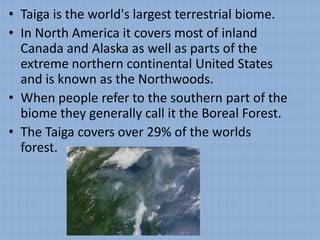
• Taiga is the world's largest terrestrial biome.
• In North America it covers most of inland
  Canada and Alaska as well as parts of the
  extreme northern continental United States
  and is known as the Northwoods.
• When people refer to the southern part of the
  biome they generally call it the Boreal Forest.
• The Taiga covers over 29% of the worlds
  forest.
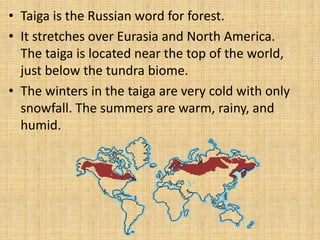
• Taiga is the Russian word for forest.
• It stretches over Eurasia and North America.
  The taiga is located near the top of the world,
  just below the tundra biome.
• The winters in the taiga are very cold with only
  snowfall. The summers are warm, rainy, and
  humid.
• The average temperature is below freezing for
  six months out of the year.
• The spring and autumn are so short, you
  hardly know they exist. It is either hot and
  humid or very cold in the taiga.
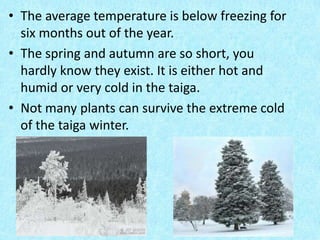
• Not many plants can survive the extreme cold
  of the taiga winter.
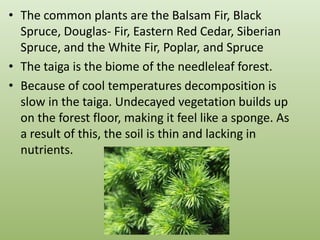
• The common plants are the Balsam Fir, Black
  Spruce, Douglas- Fir, Eastern Red Cedar, Siberian
  Spruce, and the White Fir, Poplar, and Spruce
• The taiga is the biome of the needleleaf forest.
• Because of cool temperatures decomposition is
  slow in the taiga. Undecayed vegetation builds up
  on the forest floor, making it feel like a sponge. As
  a result of this, the soil is thin and lacking in
  nutrients.
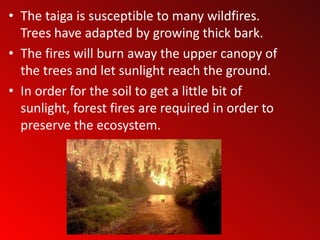
• The taiga is susceptible to many wildfires.
  Trees have adapted by growing thick bark.
• The fires will burn away the upper canopy of
  the trees and let sunlight reach the ground.
• In order for the soil to get a little bit of
  sunlight, forest fires are required in order to
  preserve the ecosystem.
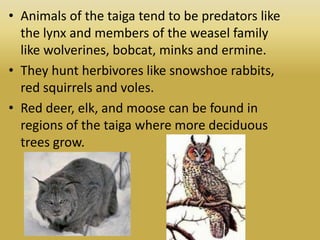
• Animals of the taiga tend to be predators like
  the lynx and members of the weasel family
  like wolverines, bobcat, minks and ermine.
• They hunt herbivores like snowshoe rabbits,
  red squirrels and voles.
• Red deer, elk, and moose can be found in
  regions of the taiga where more deciduous
  trees grow.
• The seasons of the Taiga vary little as mostly
  they just sway from extreme hot to bitter
  hold.
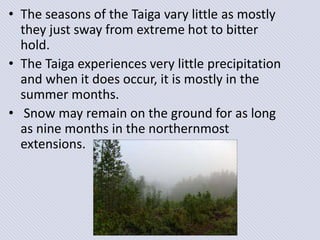
• The Taiga experiences very little precipitation
  and when it does occur, it is mostly in the
  summer months.
• Snow may remain on the ground for as long
  as nine months in the northernmost
  extensions.
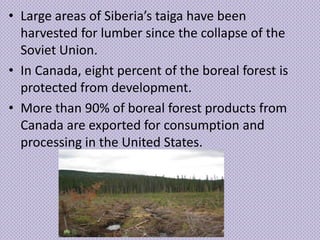
• Large areas of Siberia’s taiga have been
  harvested for lumber since the collapse of the
  Soviet Union.
• In Canada, eight percent of the boreal forest is
  protected from development.
• More than 90% of boreal forest products from
  Canada are exported for consumption and
  processing in the United States.
• The world's oldest trees can be found in the
  taiga.
• The taiga has fewer plant and animals species
  than most other biomes.
• This climate is classified as Dfc, Dwc, Dsc, Dfd
  and Dwd in the Köppen climate classification
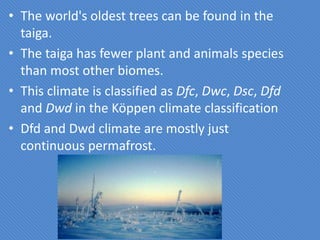
• Dfd and Dwd climate are mostly just
  continuous permafrost.
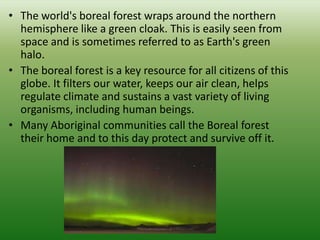
• The world's boreal forest wraps around the northern
  hemisphere like a green cloak. This is easily seen from
  space and is sometimes referred to as Earth's green
  halo.
• The boreal forest is a key resource for all citizens of this
  globe. It filters our water, keeps our air clean, helps
  regulate climate and sustains a vast variety of living
  organisms, including human beings.
• Many Aboriginal communities call the Boreal forest
  their home and to this day protect and survive off it.

The taiga 2

  • 1.
  • 2.
    • Taiga isthe world's largest terrestrial biome. • In North America it covers most of inland Canada and Alaska as well as parts of the extreme northern continental United States and is known as the Northwoods. • When people refer to the southern part of the biome they generally call it the Boreal Forest. • The Taiga covers over 29% of the worlds forest.
  • 3.
    • Taiga isthe Russian word for forest. • It stretches over Eurasia and North America. The taiga is located near the top of the world, just below the tundra biome. • The winters in the taiga are very cold with only snowfall. The summers are warm, rainy, and humid.
  • 4.
    • The averagetemperature is below freezing for six months out of the year. • The spring and autumn are so short, you hardly know they exist. It is either hot and humid or very cold in the taiga. • Not many plants can survive the extreme cold of the taiga winter.
  • 5.
    • The commonplants are the Balsam Fir, Black Spruce, Douglas- Fir, Eastern Red Cedar, Siberian Spruce, and the White Fir, Poplar, and Spruce • The taiga is the biome of the needleleaf forest. • Because of cool temperatures decomposition is slow in the taiga. Undecayed vegetation builds up on the forest floor, making it feel like a sponge. As a result of this, the soil is thin and lacking in nutrients.
  • 6.
    • The taigais susceptible to many wildfires. Trees have adapted by growing thick bark. • The fires will burn away the upper canopy of the trees and let sunlight reach the ground. • In order for the soil to get a little bit of sunlight, forest fires are required in order to preserve the ecosystem.
  • 7.
    • Animals ofthe taiga tend to be predators like the lynx and members of the weasel family like wolverines, bobcat, minks and ermine. • They hunt herbivores like snowshoe rabbits, red squirrels and voles. • Red deer, elk, and moose can be found in regions of the taiga where more deciduous trees grow.
  • 8.
    • The seasonsof the Taiga vary little as mostly they just sway from extreme hot to bitter hold. • The Taiga experiences very little precipitation and when it does occur, it is mostly in the summer months. • Snow may remain on the ground for as long as nine months in the northernmost extensions.
  • 9.
    • Large areasof Siberia’s taiga have been harvested for lumber since the collapse of the Soviet Union. • In Canada, eight percent of the boreal forest is protected from development. • More than 90% of boreal forest products from Canada are exported for consumption and processing in the United States.
  • 10.
    • The world'soldest trees can be found in the taiga. • The taiga has fewer plant and animals species than most other biomes. • This climate is classified as Dfc, Dwc, Dsc, Dfd and Dwd in the Köppen climate classification • Dfd and Dwd climate are mostly just continuous permafrost.
  • 11.
    • The world'sboreal forest wraps around the northern hemisphere like a green cloak. This is easily seen from space and is sometimes referred to as Earth's green halo. • The boreal forest is a key resource for all citizens of this globe. It filters our water, keeps our air clean, helps regulate climate and sustains a vast variety of living organisms, including human beings. • Many Aboriginal communities call the Boreal forest their home and to this day protect and survive off it.