Deserts are areas that receive very little
precipitation.
Some deserts are very hot, with daytime; other
deserts have cold winters or are cold year-round.
One thing all deserts have in common is that they
are arid, or dry.
In all deserts, there is little water available for
plants and other organisms.
Deserts are found on every continent and cover
about one-fifth of Earth’s land area.
Some deserts are mountainous. Others are dry
expanses of rock, sand, or salt flats.
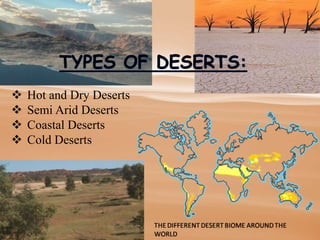
 Hot and Dry Deserts
 Semi Arid Deserts
 Coastal Deserts
 Cold Deserts
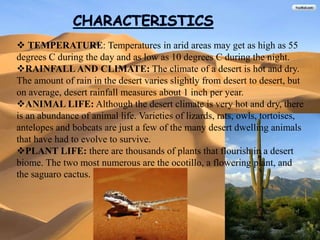
 TEMPERATURE: Temperatures in arid areas may get as high as 55
degrees C during the day and as low as 10 degrees C during the night.
RAINFALLAND CLIMATE: The climate of a desert is hot and dry.
The amount of rain in the desert varies slightly from desert to desert, but
on average, desert rainfall measures about 1 inch per year.
ANIMAL LIFE: Although the desert climate is very hot and dry, there
is an abundance of animal life. Varieties of lizards, rats, owls, tortoises,
antelopes and bobcats are just a few of the many desert dwelling animals
that have had to evolve to survive.
PLANT LIFE: there are thousands of plants that flourish in a desert
biome. The two most numerous are the ocotillo, a flowering plant, and
the saguaro cactus.
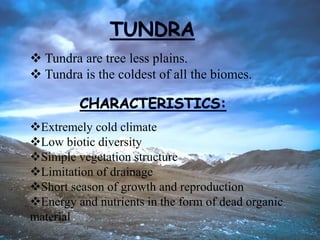
 Tundra are tree less plains.
 Tundra is the coldest of all the biomes.
Extremely cold climate
Low biotic diversity
Simple vegetation structure
Limitation of drainage
Short season of growth and reproduction
Energy and nutrients in the form of dead organic
material
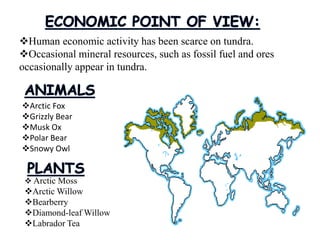
Human economic activity has been scarce on tundra.
Occasional mineral resources, such as fossil fuel and ores
occasionally appear in tundra.
Arctic Fox
Grizzly Bear
Musk Ox
Polar Bear
Snowy Owl
 Arctic Moss
Arctic Willow
Bearberry
Diamond-leaf Willow
Labrador Tea

Desert biome

  • 2.
    Deserts are areasthat receive very little precipitation. Some deserts are very hot, with daytime; other deserts have cold winters or are cold year-round. One thing all deserts have in common is that they are arid, or dry. In all deserts, there is little water available for plants and other organisms. Deserts are found on every continent and cover about one-fifth of Earth’s land area. Some deserts are mountainous. Others are dry expanses of rock, sand, or salt flats.
  • 3.
     Hot andDry Deserts  Semi Arid Deserts  Coastal Deserts  Cold Deserts
  • 4.
     TEMPERATURE: Temperaturesin arid areas may get as high as 55 degrees C during the day and as low as 10 degrees C during the night. RAINFALLAND CLIMATE: The climate of a desert is hot and dry. The amount of rain in the desert varies slightly from desert to desert, but on average, desert rainfall measures about 1 inch per year. ANIMAL LIFE: Although the desert climate is very hot and dry, there is an abundance of animal life. Varieties of lizards, rats, owls, tortoises, antelopes and bobcats are just a few of the many desert dwelling animals that have had to evolve to survive. PLANT LIFE: there are thousands of plants that flourish in a desert biome. The two most numerous are the ocotillo, a flowering plant, and the saguaro cactus.
  • 5.
     Tundra aretree less plains.  Tundra is the coldest of all the biomes. Extremely cold climate Low biotic diversity Simple vegetation structure Limitation of drainage Short season of growth and reproduction Energy and nutrients in the form of dead organic material
  • 6.
    Human economic activityhas been scarce on tundra. Occasional mineral resources, such as fossil fuel and ores occasionally appear in tundra. Arctic Fox Grizzly Bear Musk Ox Polar Bear Snowy Owl  Arctic Moss Arctic Willow Bearberry Diamond-leaf Willow Labrador Tea