Temperate Grasslands
Manjunatha S
M.Sc(Botany)
University of Mysore,
Mysuru
Contents
 Introduction
 Temperate grasslands and its nature
 Steppes
 Praire
 Pampas
 Veldt
 Food chain pattern
 Gersmehl diagram
 Destruction of grasslands
 Conservation strategies
 Conclusion
 References
Introduction
• Grasslands cover one fourth of the Earth's land and can be
found on every continent except for Antarctica (Singh et al,
1983).
• Grasslands occur where it is too wet for deserts but too dry for
forests.
• Can be sub divided into a) Tropical grasslands
b) Temperate grasslands
• Grasslands get about 10 to 24 inches of precipitation per year,
although some tropical grasslands can get over 40 inches of
rain a year.
• Grasslands are considered the transitional biome. This means
that they are usually found between deserts and forests.
Temperate Grasslands
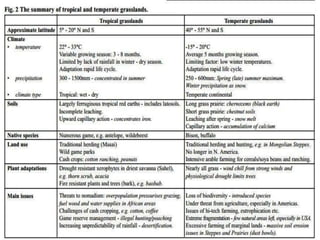
Temperate grasslands are located north of the Tropic of Cancer (23.5 0
North) and south of the Tropic of Capricorn (23.50 South).
 The major temperate grasslands include a) The Veldts of Africa,
b) The Pampas of South America,
c) The Steppes of Eurasia,
d) The Prairie of North America
 Temperate grasslands are hot in the summer and cold in the winter.
Temperature and Precipitation
Summer
In Prairies, temperature often rise to more than 1000 F, no rain for 2
months are common, they adapted well with their slender leaves, deep root
systems. They overcome grassland fires with more vigorous growth with the
help of deep roots.
Winter
They turn brown in winter and often have a dusting of snow.
Temperature plummet well below 00 F. Plants use winter snow as insulation,
trapping it among leaves and stems
Temperature
Rain and snow
Most of them found in the interior of continents and in rain
shadows. So these areas receive between 9.8 and 35 inches of rain and snow
each year. Most of the precipitation falls in winter and spring.
Soil
 Nutrient-rich from the growth and decay of deep, many-
branched grass roots.
 The rotted roots hold the soil together and provide a food
source for living plants.
 The world's most fertile soils underlie the eastern prairies of
the U.S., the pampas of South America, and the steppes of
Ukraine and Russia.
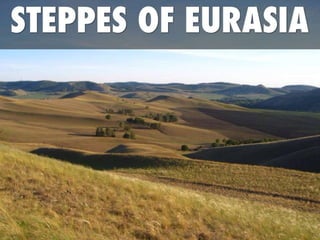
Steppes• Largest temperate grassland extending
from Hungary to China.
• The most famous trade route on the
Eurasian steppe is the Silk road, connecting
China, India, and Europe.
Animals: Antelopes, Bos taurus, Horse, two
humped Camel, burrowing rodents like jerboas,
marmots and pikas.
Birds: Bustards, quails, sand grouse, red-legged
hobby
Plants: feather grass, fescue, wormwood,
tipachak- an oat like grass, salt grass
(solyanka), sage, haloxyon, steppe tulips,
Veronica.
Wild horse on the steppe of Kyrgyzstan, Central Asia
Antelopes
Feather grass
Prairies of North America
Blue stem Switch grass Indian grass
Water fowlferruginous hawkBurrowing owl
• Prairies form a triangular area from Alberta, Saskatchewan and Manitoba
down through the great plains to southern Texas and Mexico.
•On moving from east to west, the rainfall decreases. Climates are moist
towards east, north and close to mountains and driest in central portions.
•Leading to creation of 1. Tall grass prairie (True prairie)- wetter parts
2. Mixed-grass prairie- central great plains
3. Short grass prairie- rain shadow of Rocky
mountains.
• Tall grass prairie: dominated by bluestem, switch grass and Indian grass
•Short grass prairie: grama, needle grass and wheatgrass. Further north
into Canada the natural vegetation of this area is characterized by spear
grass, blue grama grass and to a lesser extent, June grass and dryland
sedge.
• Mixed prairie: grama, little bluestem , needle-and-thread grass,
wheatgrass, Carex filifolia, junegrass , Poa secunda.
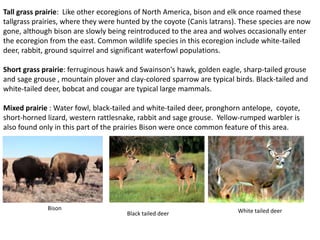
Tall grass prairie: Like other ecoregions of North America, bison and elk once roamed these
tallgrass prairies, where they were hunted by the coyote (Canis latrans). These species are now
gone, although bison are slowly being reintroduced to the area and wolves occasionally enter
the ecoregion from the east. Common wildlife species in this ecoregion include white-tailed
deer, rabbit, ground squirrel and significant waterfowl populations.
Short grass prairie: ferruginous hawk and Swainson's hawk, golden eagle, sharp-tailed grouse
and sage grouse , mountain plover and clay-colored sparrow are typical birds. Black-tailed and
white-tailed deer, bobcat and cougar are typical large mammals.
Mixed prairie : Water fowl, black-tailed and white-tailed deer, pronghorn antelope, coyote,
short-horned lizard, western rattlesnake, rabbit and sage grouse. Yellow-rumped warbler is
also found only in this part of the prairies Bison were once common feature of this area.
Bison
Black tailed deer White tailed deer
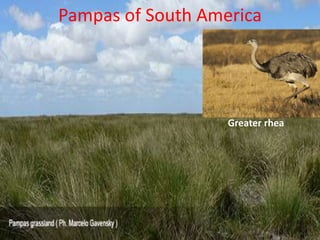
Pampas of South America
Greater rhea
Grasses: dominated by species of Stipa, Piptochaetium, Aristida, melica,
Briza, Bromus, Eragrostis and Poa
Animals: Puma, Geoffroy’s cat, Pampa fox, Pampa deer, Grison, Opposum,
Guanaco , greater Rhea.
Pampa deer
Cortadaeria selloana
 The natural vegetation in the area is composed of grasslands and xeric woodland
Location : Argentina, Uruguay, parts of Brazil
 highly prone to grassland fires, so trees are very rare (except Ombu).
Veldt of Africa
Acacia sieberiana
Sporobolus pyramidalisHyparrhenia hirta
• Location : Southern Africa. it is bordered by the Drakensberg in the east, the arid
Karoo and Kalahari in the west, and the low-lying bushveld to the north.
• The landscape is traversed by many meandering rivers, with the grassland community
historically playing an important role in natural water purification of the westward
flowing rivers that originate on the Drakensberg escarpment
Plants: Dominant and diagnostic grass species are Hyparrhenia hirta and Sporobolus
pyramidalis. Non-grassy forbs include Acacia sieberiana, Rhus rehmanniana, Walafrida
densiflora, Spermacoce natalensis, Kohautia cynanchica, and Phyllanthus glaucophyllus
Birds & Animals: Botha’s lark (Endemic bird), whitewinged flufftail , blue korhan, yellow-
breasted pipit, orange mouse, golden mole, brown hyena, African civet, leopard, pangolin ,
honey badger, striped weasel , aardwolf , mountain zebra , black wildebeest and white rhino.
Botha’s lark Golden mole Brown hyaena
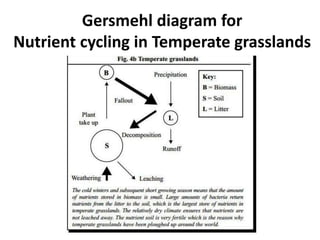
Gersmehl diagram for
Nutrient cycling in Temperate grasslands
Temperate grasslands depleting
fast……!!!!!!
 As grain crops are all grasses, this environment is well-
suited for them.
 Over grazing by livestock.
 Invasive weeds.
 loss of keystone species such as Bisnon (slaughter in
1800s), saiga, and prairie dogs (poisoning) can have
major impacts on animal and plant communities.
 Urbanisation and fragmentation.
What can be done….?
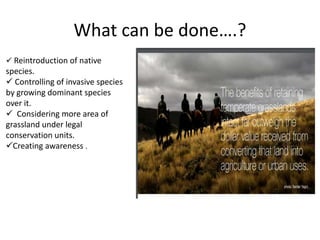
 Reintroduction of native
species.
 Controlling of invasive species
by growing dominant species
over it.
 Considering more area of
grassland under legal
conservation units.
Creating awareness .
Conclusion
Grasslands are the transitional
ecosystem from rainforests to deserts (Cold
or hot), it has rich nutritious soil, they
harbor great diversity of flora and fauna,
there is an urgent need to conserve plants
and animals and their habitat otherwise
future will be only desert desert
desert………
References
Geo fact sheet- Grassland biomes, number 125, Debra
jowitt, Geo press, Birmingham.
Temperate Grasslands Conservation Initiative (TGCI),
news letter, July 2010, IUCN, WCPA.
F. Stuart Chapin, Osvaldo E Sala, Elisabeth Global
Biodiversity in a changing environment: Scenarios for
the 21st century, 2001, Springer Science and Business
media, New york.
http://scienceing.com/temperature-precipitation-
temperate-grasslands-8498038.html
http://www.defenders.org/grasslands/temperate-
grasslands
http://www.nhptv.org/natureworks/nwep8d.html
https://www.worldwildlife.org/biomes/temperate-
grasslands-savannas-and-shrublands

Temperate grasslands

  • 1.
  • 2.
    Contents  Introduction  Temperategrasslands and its nature  Steppes  Praire  Pampas  Veldt  Food chain pattern  Gersmehl diagram  Destruction of grasslands  Conservation strategies  Conclusion  References
  • 3.
    Introduction • Grasslands coverone fourth of the Earth's land and can be found on every continent except for Antarctica (Singh et al, 1983). • Grasslands occur where it is too wet for deserts but too dry for forests. • Can be sub divided into a) Tropical grasslands b) Temperate grasslands • Grasslands get about 10 to 24 inches of precipitation per year, although some tropical grasslands can get over 40 inches of rain a year. • Grasslands are considered the transitional biome. This means that they are usually found between deserts and forests.
  • 4.
    Temperate Grasslands Temperate grasslandsare located north of the Tropic of Cancer (23.5 0 North) and south of the Tropic of Capricorn (23.50 South).  The major temperate grasslands include a) The Veldts of Africa, b) The Pampas of South America, c) The Steppes of Eurasia, d) The Prairie of North America  Temperate grasslands are hot in the summer and cold in the winter.
  • 6.
    Temperature and Precipitation Summer InPrairies, temperature often rise to more than 1000 F, no rain for 2 months are common, they adapted well with their slender leaves, deep root systems. They overcome grassland fires with more vigorous growth with the help of deep roots. Winter They turn brown in winter and often have a dusting of snow. Temperature plummet well below 00 F. Plants use winter snow as insulation, trapping it among leaves and stems Temperature Rain and snow Most of them found in the interior of continents and in rain shadows. So these areas receive between 9.8 and 35 inches of rain and snow each year. Most of the precipitation falls in winter and spring.
  • 7.
    Soil  Nutrient-rich fromthe growth and decay of deep, many- branched grass roots.  The rotted roots hold the soil together and provide a food source for living plants.  The world's most fertile soils underlie the eastern prairies of the U.S., the pampas of South America, and the steppes of Ukraine and Russia.
  • 9.
    Steppes• Largest temperategrassland extending from Hungary to China. • The most famous trade route on the Eurasian steppe is the Silk road, connecting China, India, and Europe. Animals: Antelopes, Bos taurus, Horse, two humped Camel, burrowing rodents like jerboas, marmots and pikas. Birds: Bustards, quails, sand grouse, red-legged hobby Plants: feather grass, fescue, wormwood, tipachak- an oat like grass, salt grass (solyanka), sage, haloxyon, steppe tulips, Veronica. Wild horse on the steppe of Kyrgyzstan, Central Asia Antelopes Feather grass
  • 10.
    Prairies of NorthAmerica Blue stem Switch grass Indian grass Water fowlferruginous hawkBurrowing owl
  • 11.
    • Prairies forma triangular area from Alberta, Saskatchewan and Manitoba down through the great plains to southern Texas and Mexico. •On moving from east to west, the rainfall decreases. Climates are moist towards east, north and close to mountains and driest in central portions. •Leading to creation of 1. Tall grass prairie (True prairie)- wetter parts 2. Mixed-grass prairie- central great plains 3. Short grass prairie- rain shadow of Rocky mountains. • Tall grass prairie: dominated by bluestem, switch grass and Indian grass •Short grass prairie: grama, needle grass and wheatgrass. Further north into Canada the natural vegetation of this area is characterized by spear grass, blue grama grass and to a lesser extent, June grass and dryland sedge. • Mixed prairie: grama, little bluestem , needle-and-thread grass, wheatgrass, Carex filifolia, junegrass , Poa secunda.
  • 12.
    Tall grass prairie:Like other ecoregions of North America, bison and elk once roamed these tallgrass prairies, where they were hunted by the coyote (Canis latrans). These species are now gone, although bison are slowly being reintroduced to the area and wolves occasionally enter the ecoregion from the east. Common wildlife species in this ecoregion include white-tailed deer, rabbit, ground squirrel and significant waterfowl populations. Short grass prairie: ferruginous hawk and Swainson's hawk, golden eagle, sharp-tailed grouse and sage grouse , mountain plover and clay-colored sparrow are typical birds. Black-tailed and white-tailed deer, bobcat and cougar are typical large mammals. Mixed prairie : Water fowl, black-tailed and white-tailed deer, pronghorn antelope, coyote, short-horned lizard, western rattlesnake, rabbit and sage grouse. Yellow-rumped warbler is also found only in this part of the prairies Bison were once common feature of this area. Bison Black tailed deer White tailed deer
  • 13.
    Pampas of SouthAmerica Greater rhea
  • 14.
    Grasses: dominated byspecies of Stipa, Piptochaetium, Aristida, melica, Briza, Bromus, Eragrostis and Poa Animals: Puma, Geoffroy’s cat, Pampa fox, Pampa deer, Grison, Opposum, Guanaco , greater Rhea. Pampa deer Cortadaeria selloana  The natural vegetation in the area is composed of grasslands and xeric woodland Location : Argentina, Uruguay, parts of Brazil  highly prone to grassland fires, so trees are very rare (except Ombu).
  • 15.
    Veldt of Africa Acaciasieberiana Sporobolus pyramidalisHyparrhenia hirta
  • 16.
    • Location :Southern Africa. it is bordered by the Drakensberg in the east, the arid Karoo and Kalahari in the west, and the low-lying bushveld to the north. • The landscape is traversed by many meandering rivers, with the grassland community historically playing an important role in natural water purification of the westward flowing rivers that originate on the Drakensberg escarpment Plants: Dominant and diagnostic grass species are Hyparrhenia hirta and Sporobolus pyramidalis. Non-grassy forbs include Acacia sieberiana, Rhus rehmanniana, Walafrida densiflora, Spermacoce natalensis, Kohautia cynanchica, and Phyllanthus glaucophyllus Birds & Animals: Botha’s lark (Endemic bird), whitewinged flufftail , blue korhan, yellow- breasted pipit, orange mouse, golden mole, brown hyena, African civet, leopard, pangolin , honey badger, striped weasel , aardwolf , mountain zebra , black wildebeest and white rhino. Botha’s lark Golden mole Brown hyaena
  • 18.
    Gersmehl diagram for Nutrientcycling in Temperate grasslands
  • 19.
    Temperate grasslands depleting fast……!!!!!! As grain crops are all grasses, this environment is well- suited for them.  Over grazing by livestock.  Invasive weeds.  loss of keystone species such as Bisnon (slaughter in 1800s), saiga, and prairie dogs (poisoning) can have major impacts on animal and plant communities.  Urbanisation and fragmentation.
  • 21.
    What can bedone….?  Reintroduction of native species.  Controlling of invasive species by growing dominant species over it.  Considering more area of grassland under legal conservation units. Creating awareness .
  • 23.
    Conclusion Grasslands are thetransitional ecosystem from rainforests to deserts (Cold or hot), it has rich nutritious soil, they harbor great diversity of flora and fauna, there is an urgent need to conserve plants and animals and their habitat otherwise future will be only desert desert desert………
  • 24.
    References Geo fact sheet-Grassland biomes, number 125, Debra jowitt, Geo press, Birmingham. Temperate Grasslands Conservation Initiative (TGCI), news letter, July 2010, IUCN, WCPA. F. Stuart Chapin, Osvaldo E Sala, Elisabeth Global Biodiversity in a changing environment: Scenarios for the 21st century, 2001, Springer Science and Business media, New york. http://scienceing.com/temperature-precipitation- temperate-grasslands-8498038.html http://www.defenders.org/grasslands/temperate- grasslands http://www.nhptv.org/natureworks/nwep8d.html https://www.worldwildlife.org/biomes/temperate- grasslands-savannas-and-shrublands