Taiga
Suresh Budhram
Merina Cage
Tyler Tacornal
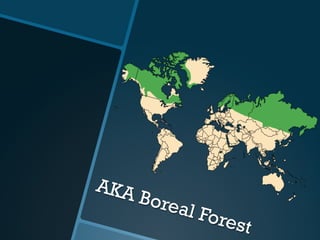
AKA Boreal Forest
Location
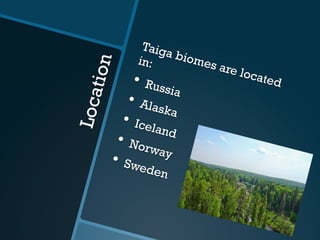
Taiga biomes are located
in:
•  Russia
•  Alaska
•  Iceland
•  Norway
•  Sweden
Climate
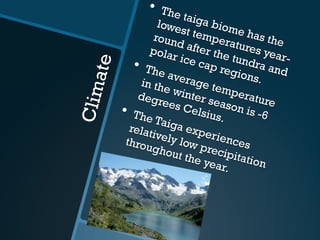
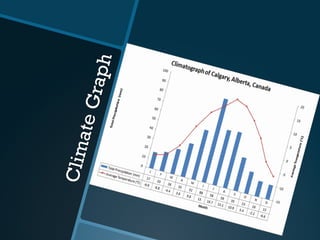
•  The taiga biome has the
lowest temperatures year-
round after the tundra and
polar ice cap regions.
•  The average temperature
in the winter season is -6
degrees Celsius.
•  The Taiga experiences
relatively low precipitation
throughout the year.
SoilType
The soil in the Taiga is
nutrient-poor. In other
areas, a layer of bedrock
lies just beneath the soil.
Both permafrost and rock
prevent water from
draining from the top
layers of soil.This creates
shallow bogs known as
muskegs, which are
covered with moss, short
grass, and trees
ClimateGraph
NutrientCycles
Animalsinthe
Taiga
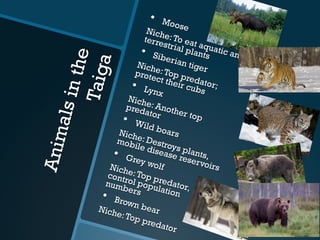
•  MooseNiche:To eat aquatic and
terrestrial plants•  Siberian tigerNiche:Top predator;
protect their cubs
•  Lynx
Niche: Another top
predator
•  Wild boarsNiche: Destroys plants,
mobile disease reservoirs
•  Grey wolfNiche:Top predator,
control population
numbers
•  Brown bearNiche:Top predator
PlantsintheTaiga
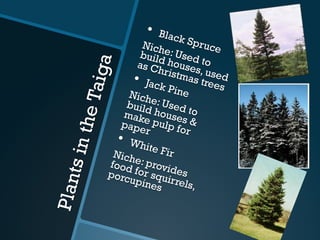
•  Black SpruceNiche: Used to
build houses, used
as Christmas trees
•  Jack PineNiche: Used to
build houses &
make pulp for
paper
•  White FirNiche: provides
food for squirrels,
porcupines
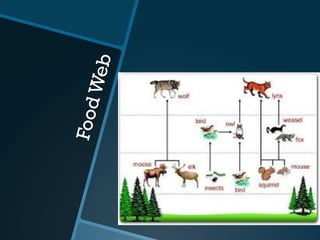
FoodWeb
FoodChain
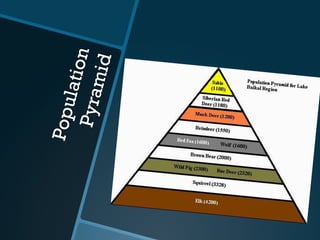
PopulationPyramid
PrimaryProductivity
•  Forest productivity in the middle
and northern taiga zones is
directly related to soil
temperature.Warmer soils
decompose organic matter more
quickly, releasing nutrients for
new plant growth and creating a
more productive site. Productive
forest types occupy warmer,
south-facing slopes and river
terraces, and less productive
dwarf or sparse forest occupies
the north-facing and basin sites.
•  GPP: 1144.3 g /m2/yr
•  NPP: 408 g/m2/yr
PrimarySuccession
•  The pioneers came and
colonized the areas in the taiga
with fungi, lichen, grasses, and
wildflowers.These factors
started to react and recreated
the soil, which allowed small
vascular plants to grow. As the
plants grew and grew into
larger plants like trees, they
started to bring in animals
along into the biome.
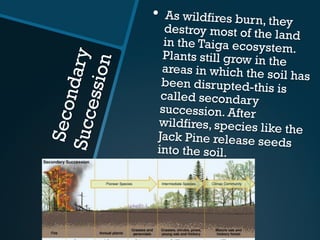
SecondarySuccession
•  As wildfires burn, they
destroy most of the land
in the Taiga ecosystem.
Plants still grow in the
areas in which the soil hasbeen disrupted-this is
called secondary
succession. After
wildfires, species like the
Jack Pine release seeds
into the soil.
HumanNegativeImpact
•  The taiga isn’t affected by humans
as much as the other biomes. In
the taiga, logging is probably the
main source of destruction.
•  Another industry that threatens
taiga species is hunting.The
Siberian tiger for example is
almost extinct due to poachers
hunting for its incredible coat.
Brown bears have seen a large
decline due to hunting and so
have many other large mammals
like the wolf, cougar, caribou,
moose etc. 
HumanPositiveImpact
•  Humans also have a positive
impact on the taiga. Some people
are trying to reduce the amount
of hunting so animals will
proceed to live in the taiga.
•  The Forest Stewardship Council
is a logging organization that
ensures that the forest it logs
from are logged sustainably and
safely for the people who live in
the area and most certainly the
animals.•  The World Wildlife Foundation is
also working endlessly to keep
the Siberian tiger from going
extinct.

Taiga PERIOD 5

  • 1.
  • 2.
  • 3.
    Location Taiga biomes arelocated in: •  Russia •  Alaska •  Iceland •  Norway •  Sweden
  • 4.
    Climate •  The taigabiome has the lowest temperatures year- round after the tundra and polar ice cap regions. •  The average temperature in the winter season is -6 degrees Celsius. •  The Taiga experiences relatively low precipitation throughout the year.
  • 5.
    SoilType The soil inthe Taiga is nutrient-poor. In other areas, a layer of bedrock lies just beneath the soil. Both permafrost and rock prevent water from draining from the top layers of soil.This creates shallow bogs known as muskegs, which are covered with moss, short grass, and trees
  • 6.
  • 7.
  • 8.
    Animalsinthe Taiga •  MooseNiche:To eataquatic and terrestrial plants•  Siberian tigerNiche:Top predator; protect their cubs •  Lynx Niche: Another top predator •  Wild boarsNiche: Destroys plants, mobile disease reservoirs •  Grey wolfNiche:Top predator, control population numbers •  Brown bearNiche:Top predator
  • 9.
    PlantsintheTaiga •  Black SpruceNiche:Used to build houses, used as Christmas trees •  Jack PineNiche: Used to build houses & make pulp for paper •  White FirNiche: provides food for squirrels, porcupines
  • 10.
  • 11.
  • 12.
  • 13.
    PrimaryProductivity •  Forest productivityin the middle and northern taiga zones is directly related to soil temperature.Warmer soils decompose organic matter more quickly, releasing nutrients for new plant growth and creating a more productive site. Productive forest types occupy warmer, south-facing slopes and river terraces, and less productive dwarf or sparse forest occupies the north-facing and basin sites. •  GPP: 1144.3 g /m2/yr •  NPP: 408 g/m2/yr
  • 14.
    PrimarySuccession •  The pioneerscame and colonized the areas in the taiga with fungi, lichen, grasses, and wildflowers.These factors started to react and recreated the soil, which allowed small vascular plants to grow. As the plants grew and grew into larger plants like trees, they started to bring in animals along into the biome.
  • 15.
    SecondarySuccession •  As wildfiresburn, they destroy most of the land in the Taiga ecosystem. Plants still grow in the areas in which the soil hasbeen disrupted-this is called secondary succession. After wildfires, species like the Jack Pine release seeds into the soil.
  • 16.
    HumanNegativeImpact •  The taigaisn’t affected by humans as much as the other biomes. In the taiga, logging is probably the main source of destruction. •  Another industry that threatens taiga species is hunting.The Siberian tiger for example is almost extinct due to poachers hunting for its incredible coat. Brown bears have seen a large decline due to hunting and so have many other large mammals like the wolf, cougar, caribou, moose etc. 
  • 17.
    HumanPositiveImpact •  Humans alsohave a positive impact on the taiga. Some people are trying to reduce the amount of hunting so animals will proceed to live in the taiga. •  The Forest Stewardship Council is a logging organization that ensures that the forest it logs from are logged sustainably and safely for the people who live in the area and most certainly the animals.•  The World Wildlife Foundation is also working endlessly to keep the Siberian tiger from going extinct.