FOREST
PRESENTED BY:
OMAR
ARYA
ZAKI
ABRIEL
ELANG
ARSYIL
Definition of forest
• a large area covered chiefly with trees and undergrowth.
• "a pine forest"
• synonyms: wood(s), woodland, timberland, trees, bush, plantation;
More
• a large number or dense mass of vertical or tangled objects.
• "a forest of connecting wires"
• historical
• (in England) an area, typically owned by the sovereign and partly
wooded, kept for hunting and having its own laws.
Characteristics of forest
• Forests account for 75% of the gross primary productivity of the Earth's biosphere, and contain
80% of the Earth's plant biomass.[7] Forest ecosystems can be found in all regions capable of
sustaining tree growth, at altitudes up to the tree line, except where natural fire frequency or
other disturbance is too high, or where the environment has been altered by human activity.
• The latitudes 10° north and south of the equator are mostly covered in tropical rainforest, and the
latitudes between 53°N and 67°N have boreal forest. As a general rule, forests dominated by
angiosperms (broadleaf forests) are more species-rich than those dominated by gymnosperms
(conifer, montane, or needle leaf forests), although exceptions exist.
• Forests sometimes contain many tree species only within a small area (as in tropical rain and
temperate deciduous forests), or relatively few species over large areas (e.g., taiga and arid
montane coniferous forests). Forests are often home to many animal and plant species, and
biomass per unit area is high compared to other vegetation communities. Much of this biomass
occurs below ground in the root systems and as partially decomposed plant detritus. The woody
component of a forest contains lignin, which is relatively slow to decompose compared with other
organic materials such as cellulose or carbohydrate.
Types of forest
Tropical rainforest
Temperate Deciduous Forest
Temperate Coniferous Forest Boreal (taiga) Forest
Locations of forest
Location: The tropical rainforests contain the
greatest diversity of species of all biomes on
earth. They are found around the equator,
between 23.5 degrees N latitude and 23.5
degrees S latitude.
Tropical Rainforest
Location: Eastern United States
and Canada, Western Europe and
parts of Russia, China and Japan.
Temperate Deciduous Forest
Location: Temperate coniferous forests are typically found in
coastal areas with mild winters and heavy rainfall or in in-
land mountainous areas with mild climates. Examples of
where these forests are found are Pacific Northwestern
United States and Canada, southwestern South America,
Southern Japan, New Zealand and small parts of
northwestern Europe (Ireland, Scotland, Iceland and
Norway).
Temperate Coniferous Forest
Location: This is the northern most forest type
and is found between 50 and 60 degrees N
latitude. Boreal forests are found in Canada,
northern Asia, Siberia and Scandinavia (Denmark,
Norway, Sweden, Finland). About two-thirds of
the world's boreal forests are found in
Scandinavia.
Boreal (taiga) Forest
Forest animals
Tropical rainforest Temperate Deciduous Forest
Temperate Coniferous Forest Boreal (taiga) Forest
Forest plants
Tropical rainforest Temperate Deciduous Forest Temperate Coniferous Forest
Boreal (taiga) Forest
Forest climate
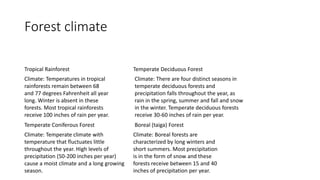
Climate: Temperatures in tropical
rainforests remain between 68
and 77 degrees Fahrenheit all year
long. Winter is absent in these
forests. Most tropical rainforests
receive 100 inches of rain per year.
Tropical Rainforest Temperate Deciduous Forest
Climate: There are four distinct seasons in
temperate deciduous forests and
precipitation falls throughout the year, as
rain in the spring, summer and fall and snow
in the winter. Temperate deciduous forests
receive 30-60 inches of rain per year.
Temperate Coniferous Forest
Climate: Temperate climate with
temperature that fluctuates little
throughout the year. High levels of
precipitation (50-200 inches per year)
cause a moist climate and a long growing
season.
Boreal (taiga) Forest
Climate: Boreal forests are
characterized by long winters and
short summers. Most precipitation
is in the form of snow and these
forests receive between 15 and 40
inches of precipitation per year.
Thank You

FOREST.pptx

  • 1.
  • 2.
    Definition of forest •a large area covered chiefly with trees and undergrowth. • "a pine forest" • synonyms: wood(s), woodland, timberland, trees, bush, plantation; More • a large number or dense mass of vertical or tangled objects. • "a forest of connecting wires" • historical • (in England) an area, typically owned by the sovereign and partly wooded, kept for hunting and having its own laws.
  • 3.
    Characteristics of forest •Forests account for 75% of the gross primary productivity of the Earth's biosphere, and contain 80% of the Earth's plant biomass.[7] Forest ecosystems can be found in all regions capable of sustaining tree growth, at altitudes up to the tree line, except where natural fire frequency or other disturbance is too high, or where the environment has been altered by human activity. • The latitudes 10° north and south of the equator are mostly covered in tropical rainforest, and the latitudes between 53°N and 67°N have boreal forest. As a general rule, forests dominated by angiosperms (broadleaf forests) are more species-rich than those dominated by gymnosperms (conifer, montane, or needle leaf forests), although exceptions exist. • Forests sometimes contain many tree species only within a small area (as in tropical rain and temperate deciduous forests), or relatively few species over large areas (e.g., taiga and arid montane coniferous forests). Forests are often home to many animal and plant species, and biomass per unit area is high compared to other vegetation communities. Much of this biomass occurs below ground in the root systems and as partially decomposed plant detritus. The woody component of a forest contains lignin, which is relatively slow to decompose compared with other organic materials such as cellulose or carbohydrate.
  • 4.
    Types of forest Tropicalrainforest Temperate Deciduous Forest Temperate Coniferous Forest Boreal (taiga) Forest
  • 5.
    Locations of forest Location:The tropical rainforests contain the greatest diversity of species of all biomes on earth. They are found around the equator, between 23.5 degrees N latitude and 23.5 degrees S latitude. Tropical Rainforest Location: Eastern United States and Canada, Western Europe and parts of Russia, China and Japan. Temperate Deciduous Forest Location: Temperate coniferous forests are typically found in coastal areas with mild winters and heavy rainfall or in in- land mountainous areas with mild climates. Examples of where these forests are found are Pacific Northwestern United States and Canada, southwestern South America, Southern Japan, New Zealand and small parts of northwestern Europe (Ireland, Scotland, Iceland and Norway). Temperate Coniferous Forest Location: This is the northern most forest type and is found between 50 and 60 degrees N latitude. Boreal forests are found in Canada, northern Asia, Siberia and Scandinavia (Denmark, Norway, Sweden, Finland). About two-thirds of the world's boreal forests are found in Scandinavia. Boreal (taiga) Forest
  • 6.
    Forest animals Tropical rainforestTemperate Deciduous Forest Temperate Coniferous Forest Boreal (taiga) Forest
  • 7.
    Forest plants Tropical rainforestTemperate Deciduous Forest Temperate Coniferous Forest Boreal (taiga) Forest
  • 8.
    Forest climate Climate: Temperaturesin tropical rainforests remain between 68 and 77 degrees Fahrenheit all year long. Winter is absent in these forests. Most tropical rainforests receive 100 inches of rain per year. Tropical Rainforest Temperate Deciduous Forest Climate: There are four distinct seasons in temperate deciduous forests and precipitation falls throughout the year, as rain in the spring, summer and fall and snow in the winter. Temperate deciduous forests receive 30-60 inches of rain per year. Temperate Coniferous Forest Climate: Temperate climate with temperature that fluctuates little throughout the year. High levels of precipitation (50-200 inches per year) cause a moist climate and a long growing season. Boreal (taiga) Forest Climate: Boreal forests are characterized by long winters and short summers. Most precipitation is in the form of snow and these forests receive between 15 and 40 inches of precipitation per year.
  • 9.