Contents
1. Introduction
2. Scientific classification
3. Characteristics
4. Ethology
5. Interaction with
humans
6. Research methods
7. Small rodents in
Mongolia
8. Anomaluromorpha
9. Castorimorpha
10.Myomorpha
11.Sciuromorpha
12.Hystricomorpha
13.Reference
2
1. Introduction
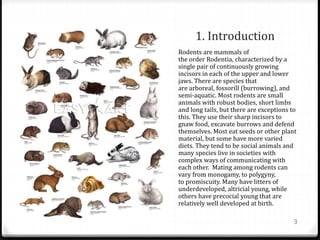
Rodents are mammals of
the order Rodentia, characterized by a
single pair of continuously growing
incisors in each of the upper and lower
jaws. There are species that
are arboreal, fossorill (burrowing), and
semi-aquatic. Most rodents are small
animals with robust bodies, short limbs
and long tails, but there are exceptions to
this. They use their sharp incisors to
gnaw food, excavate burrows and defend
themselves. Most eat seeds or other plant
material, but some have more varied
diets. They tend to be social animals and
many species live in societies with
complex ways of communicating with
each other. Mating among rodents can
vary from monogamy, to polygyny,
to promiscuity. Many have litters of
underdeveloped, altricial young, while
others have precocial young that are
relatively well developed at birth.
3
2. Scientific classification
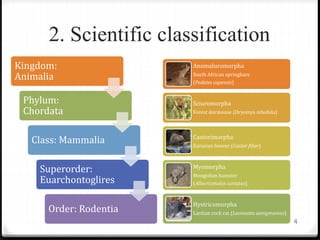
Kingdom:
Animalia
Phylum:
Chordata
Class: Mammalia
Superorder:
Euarchontoglires
Order: Rodentia
Anomaluromorpha
South African springhare
(Pedetes capensis)
Sciuromorpha
Forest dormouse (Dryomys nitedula)
Castorimorpha
Eurasian beaver (Castor fiber)
Myomorpha
Mongolian hamster
(Allocricetulus curtatus)
Hystricomorpha
Laotian rock rat (Laonastes aenigmamus)
4
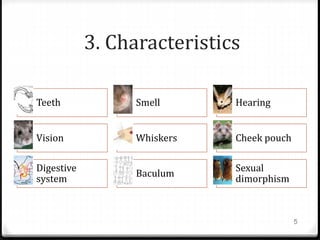
3. Characteristics
Teeth Smell Hearing
Vision Whiskers Cheek pouch
Digestive
system
Baculum
Sexual
dimorphism
5
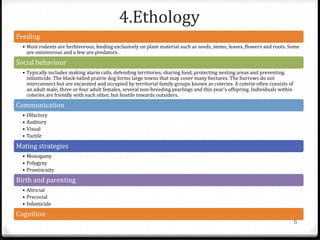
4.Ethology
Feeding
• Most rodents are herbivorous, feeding exclusively on plant material such as seeds, stems, leaves, flowers and roots. Some
are omnivorous and a few are predators.
Social behaviour
• Typically includes making alarm calls, defending territories, sharing food, protecting nesting areas and preventing
infanticide. The black-tailed prairie dog forms large towns that may cover many hectares. The burrows do not
interconnect but are excavated and occupied by territorial family groups known as coteries. A coterie often consists of
an adult male, three or four adult females, several non-breeding yearlings and this year's offspring. Individuals within
coteries are friendly with each other, but hostile towards outsiders.
Communication
• Olfactory
• Auditory
• Visual
• Tactile
Mating strategies
• Monogamy
• Polygyny
• Promiscuity
Birth and parenting
• Altricial
• Precocial
• Infanticide
Cognition
6
5. Interaction with humans
Conservation Uses
Pests &
Disease
vectors
7
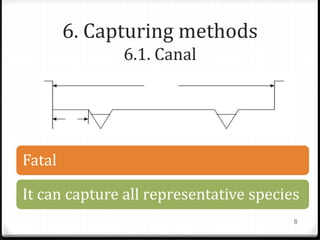
6. Capturing methods
6.1. Canal
Fatal
It can capture all representative species
8
6. Capturing methods
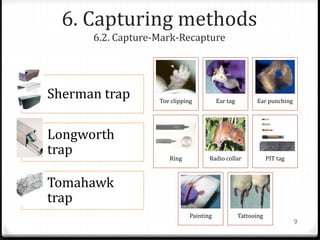
6.2. Capture-Mark-Recapture
Sherman trap
Longworth
trap
Tomahawk
trap
Toe clipping Ear tag Ear punching
Ring Radio collar PIT tag
Painting Tattooing
9
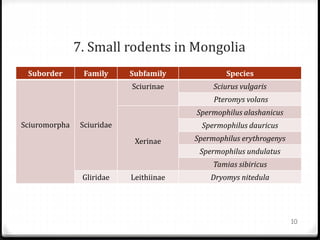
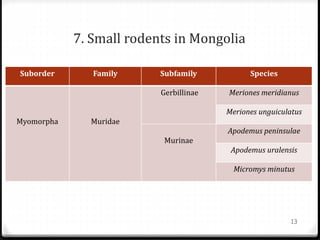
7. Small rodents in Mongolia
Suborder Family Subfamily Species
Sciuromorpha Sciuridae
Sciurinae Sciurus vulgaris
Pteromys volans
Xerinae
Spermophilus alashanicus
Spermophilus dauricus
Spermophilus erythrogenys
Spermophilus undulatus
Tamias sibiricus
Gliridae Leithiinae Dryomys nitedula
10
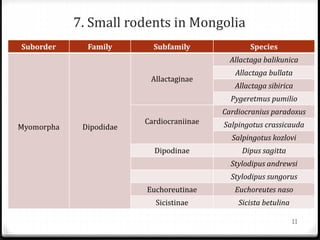
Suborder Family Subfamily Species
Myomorpha Dipodidae
Allactaginae
Allactaga balikunica
Allactaga bullata
Allactaga sibirica
Pygeretmus pumilio
Cardiocraniinae
Cardiocranius paradoxus
Salpingotus crassicauda
Salpingotus kozlovi
Dipodinae Dipus sagitta
Stylodipus andrewsi
Stylodipus sungorus
Euchoreutinae Euchoreutes naso
Sicistinae Sicista betulina
7. Small rodents in Mongolia
11
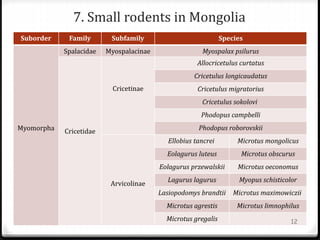
7. Small rodents in Mongolia
Suborder Family Subfamily Species
Myomorpha
Spalacidae Myospalacinae Myospalax psilurus
Cricetidae
Cricetinae
Allocricetulus curtatus
Cricetulus longicaudatus
Cricetulus migratorius
Cricetulus sokolovi
Phodopus campbelli
Phodopus roborovskii
Arvicolinae
Ellobius tancrei Microtus mongolicus
Eolagurus luteus Microtus obscurus
Eolagurus przewalskii Microtus oeconomus
Lagurus lagurus Myopus schisticolor
Lasiopodomys brandtii Microtus maximowiczii
Microtus agrestis Microtus limnophilus
Microtus gregalis 12
7. Small rodents in Mongolia
Suborder Family Subfamily Species
Myomorpha Muridae
Gerbillinae Meriones meridianus
Meriones unguiculatus
Murinae
Apodemus peninsulae
Apodemus uralensis
Micromys minutus
13
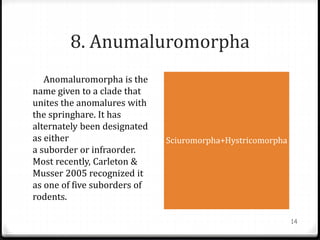
8. Anumaluromorpha
Anomaluromorpha is the
name given to a clade that
unites the anomalures with
the springhare. It has
alternately been designated
as either
a suborder or infraorder.
Most recently, Carleton &
Musser 2005 recognized it
as one of five suborders of
rodents.
Sciuromorpha+Hystricomorpha
14
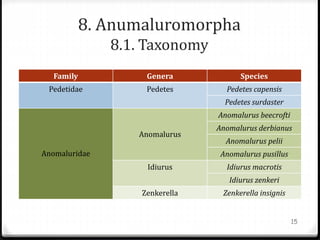
8. Anumaluromorpha
8.1. Taxonomy
Family Genera Species
Pedetidae Pedetes Pedetes capensis
Pedetes surdaster
Anomaluridae
Anomalurus
Anomalurus beecrofti
Anomalurus derbianus
Anomalurus pelii
Anomalurus pusillus
Idiurus Idiurus macrotis
Idiurus zenkeri
Zenkerella Zenkerella insignis
15
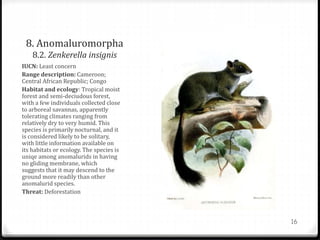
8. Anomaluromorpha
8.2. Zenkerella insignis
IUCN: Least concern
Range description: Cameroon;
Central African Republic; Congo
Habitat and ecology: Tropical moist
forest and semi-deciudous forest,
with a few individuals collected close
to arboreal savannas, apparently
tolerating climates ranging from
relatively dry to very humid. This
species is primarily nocturnal, and it
is considered likely to be solitary,
with little information available on
its habitats or ecology. The species is
uniqe among anomalurids in having
no gliding membrane, which
suggests that it may descend to the
ground more readily than other
anomalurid species.
Threat: Deforestation
16
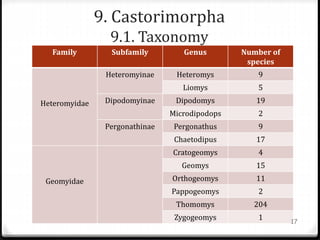
9. Castorimorpha
9.1. Taxonomy
Family Subfamily Genus Number of
species
Heteromyidae
Heteromyinae Heteromys 9
Liomys 5
Dipodomyinae Dipodomys 19
Microdipodops 2
Pergonathinae Pergonathus 9
Chaetodipus 17
Geomyidae
Cratogeomys 4
Geomys 15
Orthogeomys 11
Pappogeomys 2
Thomomys 204
Zygogeomys 1 17
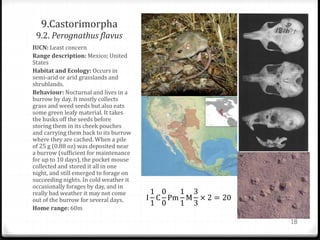
9.Castorimorpha
9.2. Perognathus flavus
IUCN: Least concern
Range description: Mexico; United
States
Habitat and Ecology: Occurs in
semi-arid or arid grasslands and
shrublands.
Behaviour: Nocturnal and lives in a
burrow by day. It mostly collects
grass and weed seeds but also eats
some green leafy material. It takes
the husks off the seeds before
storing them in its cheek pouches
and carrying them back to its burrow
where they are cached. When a pile
of 25 g (0.88 oz) was deposited near
a burrow (sufficient for maintenance
for up to 10 days), the pocket mouse
collected and stored it all in one
night, and still emerged to forage on
succeeding nights. In cold weather it
occasionally forages by day, and in
really bad weather it may not come
out of the burrow for several days.
Home range: 60m
I
1
1
C
0
0
Pm
1
1
M
3
3
× 2 = 20
18
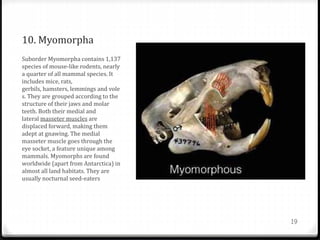
10. Myomorpha
Suborder Myomorpha contains 1,137
species of mouse-like rodents, nearly
a quarter of all mammal species. It
includes mice, rats,
gerbils, hamsters, lemmings and vole
s. They are grouped according to the
structure of their jaws and molar
teeth. Both their medial and
lateral masseter muscles are
displaced forward, making them
adept at gnawing. The medial
masseter muscle goes through the
eye socket, a feature unique among
mammals. Myomorphs are found
worldwide (apart from Antarctica) in
almost all land habitats. They are
usually nocturnal seed-eaters
19
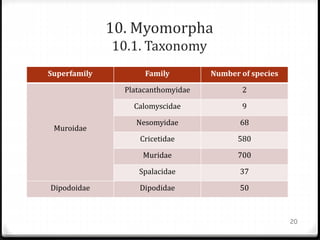
10. Myomorpha
10.1. Taxonomy
Superfamily Family Number of species
Muroidae
Platacanthomyidae 2
Calomyscidae 9
Nesomyidae 68
Cricetidae 580
Muridae 700
Spalacidae 37
Dipodoidae Dipodidae 50
20
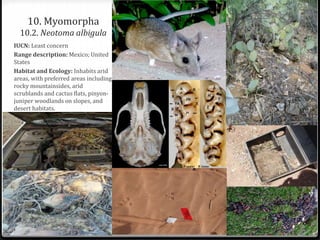
10. Myomorpha
10.2. Neotoma albigula
IUCN: Least concern
Range description: Mexico; United
States
Habitat and Ecology: Inhabits arid
areas, with preferred areas including
rocky mountainsides, arid
scrublands and cactus flats, pinyon-
juniper woodlands on slopes, and
desert habitats.
21
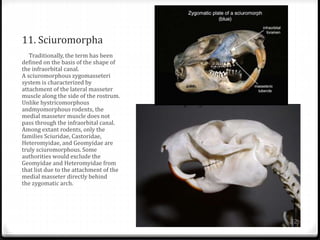
11. Sciuromorpha
Traditionally, the term has been
defined on the basis of the shape of
the infraorbital canal.
A sciuromorphous zygomasseteri
system is characterized by
attachment of the lateral masseter
muscle along the side of the rostrum.
Unlike hystricomorphous
andmyomorphous rodents, the
medial masseter muscle does not
pass through the infraorbital canal.
Among extant rodents, only the
families Sciuridae, Castoridae,
Heteromyidae, and Geomyidae are
truly sciuromorphous. Some
authorities would exclude the
Geomyidae and Heteromyidae from
that list due to the attachment of the
medial masseter directly behind
the zygomatic arch.
22
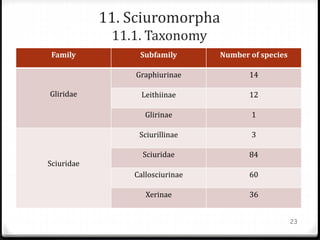
11. Sciuromorpha
11.1. Taxonomy
Family Subfamily Number of species
Gliridae
Graphiurinae 14
Leithiinae 12
Glirinae 1
Sciuridae
Sciurillinae 3
Sciuridae 84
Callosciurinae 60
Xerinae 36
23
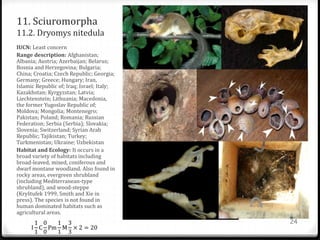
11. Sciuromorpha
11.2. Dryomys nitedula
IUCN: Least concern
Range description: Afghanistan;
Albania; Austria; Azerbaijan; Belarus;
Bosnia and Herzegovina; Bulgaria;
China; Croatia; Czech Republic; Georgia;
Germany; Greece; Hungary; Iran,
Islamic Republic of; Iraq; Israel; Italy;
Kazakhstan; Kyrgyzstan; Latvia;
Liechtenstein; Lithuania; Macedonia,
the former Yugoslav Republic of;
Moldova; Mongolia; Montenegro;
Pakistan; Poland; Romania; Russian
Federation; Serbia (Serbia); Slovakia;
Slovenia; Switzerland; Syrian Arab
Republic; Tajikistan; Turkey;
Turkmenistan; Ukraine; Uzbekistan
Habitat and Ecology: It occurs in a
broad variety of habitats including
broad-leaved, mixed, coniferous and
dwarf montane woodland. Also found in
rocky areas, evergreen shrubland
(including Mediterranean-type
shrubland), and wood-steppe
(Kryštufek 1999, Smith and Xie in
press). The species is not found in
human dominated habitats such as
agricultural areas.
I
1
1
C
0
0
Pm
1
1
M
3
3
× 2 = 20
24
12. Hystricomorpha
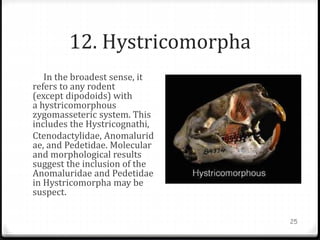
In the broadest sense, it
refers to any rodent
(except dipodoids) with
a hystricomorphous
zygomasseteric system. This
includes the Hystricognathi,
Ctenodactylidae, Anomalurid
ae, and Pedetidae. Molecular
and morphological results
suggest the inclusion of the
Anomaluridae and Pedetidae
in Hystricomorpha may be
suspect.
25
12. Hystricomorpha
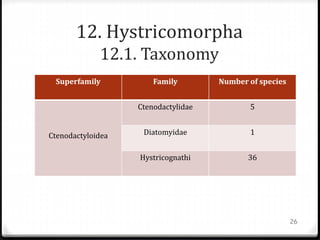
12.1. Taxonomy
Superfamily Family Number of species
Ctenodactyloidea
Ctenodactylidae 5
Diatomyidae 1
Hystricognathi 36
26
12. Hystricomorpha
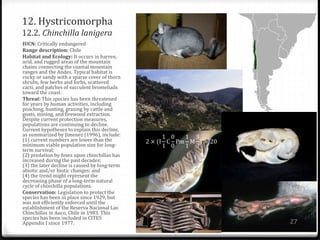
12.2. Chinchilla lanigera
IUCN: Critically endangered
Range description: Chile
Habitat and Ecology: It occurs in barren,
arid, and rugged areas of the mountain
chains connecting the coastal mountain
ranges and the Andes. Typical habitat is
rocky or sandy with a sparse cover of thorn
shrubs, few herbs and forbs, scattered
cacti, and patches of succulent bromeliads
toward the coast.
Threat: This species has been threatened
for years by human activities, including
poaching, hunting, grazing by cattle and
goats, mining, and firewood extraction.
Despite current protection measures,
populations are continuing to decline.
Current hypotheses to explain this decline,
as summarized by Jimenez (1996), include:
(1) current numbers are lower than the
minimum viable population size for long-
term survival;
(2) predation by foxes upon chinchillas has
increased during the past decades;
(3) the later decline is caused by long-term
abiotic and/or biotic changes; and
(4) the trend might represent the
decreasing phase of a long-term natural
cycle of chinchilla populations.
Conservation: Legislation to protect the
species has been in place since 1929, but
was not efficiently enforced until the
establishment of the Reserva Nacional Las
Chinchillas in Auco, Chile in 1983. This
species has been included in CITES
Appendix I since 1977.
2 × (I
1
1
C
0
0
Pm
1
1
M
3
3
) = 20
27
13. References
0 http://www.science.smith.edu/msi/pdf/i0076-3519-
471-01-0001.pdf
0 www.wikipedi.org
0 www.google.com
0 www.iucn.org
0 www.awc.org
0 Dr.Charlotte Uhlenburk “Animals and their lives”
0 Red list of Mongolia
0 http://vdt.ugent.be/sites/default/files/art79503.pdf
28

Small rodents

  • 2.
    Contents 1. Introduction 2. Scientificclassification 3. Characteristics 4. Ethology 5. Interaction with humans 6. Research methods 7. Small rodents in Mongolia 8. Anomaluromorpha 9. Castorimorpha 10.Myomorpha 11.Sciuromorpha 12.Hystricomorpha 13.Reference 2
  • 3.
    1. Introduction Rodents aremammals of the order Rodentia, characterized by a single pair of continuously growing incisors in each of the upper and lower jaws. There are species that are arboreal, fossorill (burrowing), and semi-aquatic. Most rodents are small animals with robust bodies, short limbs and long tails, but there are exceptions to this. They use their sharp incisors to gnaw food, excavate burrows and defend themselves. Most eat seeds or other plant material, but some have more varied diets. They tend to be social animals and many species live in societies with complex ways of communicating with each other. Mating among rodents can vary from monogamy, to polygyny, to promiscuity. Many have litters of underdeveloped, altricial young, while others have precocial young that are relatively well developed at birth. 3
  • 4.
    2. Scientific classification Kingdom: Animalia Phylum: Chordata Class:Mammalia Superorder: Euarchontoglires Order: Rodentia Anomaluromorpha South African springhare (Pedetes capensis) Sciuromorpha Forest dormouse (Dryomys nitedula) Castorimorpha Eurasian beaver (Castor fiber) Myomorpha Mongolian hamster (Allocricetulus curtatus) Hystricomorpha Laotian rock rat (Laonastes aenigmamus) 4
  • 5.
    3. Characteristics Teeth SmellHearing Vision Whiskers Cheek pouch Digestive system Baculum Sexual dimorphism 5
  • 6.
    4.Ethology Feeding • Most rodentsare herbivorous, feeding exclusively on plant material such as seeds, stems, leaves, flowers and roots. Some are omnivorous and a few are predators. Social behaviour • Typically includes making alarm calls, defending territories, sharing food, protecting nesting areas and preventing infanticide. The black-tailed prairie dog forms large towns that may cover many hectares. The burrows do not interconnect but are excavated and occupied by territorial family groups known as coteries. A coterie often consists of an adult male, three or four adult females, several non-breeding yearlings and this year's offspring. Individuals within coteries are friendly with each other, but hostile towards outsiders. Communication • Olfactory • Auditory • Visual • Tactile Mating strategies • Monogamy • Polygyny • Promiscuity Birth and parenting • Altricial • Precocial • Infanticide Cognition 6
  • 7.
    5. Interaction withhumans Conservation Uses Pests & Disease vectors 7
  • 8.
    6. Capturing methods 6.1.Canal Fatal It can capture all representative species 8
  • 9.
    6. Capturing methods 6.2.Capture-Mark-Recapture Sherman trap Longworth trap Tomahawk trap Toe clipping Ear tag Ear punching Ring Radio collar PIT tag Painting Tattooing 9
  • 10.
    7. Small rodentsin Mongolia Suborder Family Subfamily Species Sciuromorpha Sciuridae Sciurinae Sciurus vulgaris Pteromys volans Xerinae Spermophilus alashanicus Spermophilus dauricus Spermophilus erythrogenys Spermophilus undulatus Tamias sibiricus Gliridae Leithiinae Dryomys nitedula 10
  • 11.
    Suborder Family SubfamilySpecies Myomorpha Dipodidae Allactaginae Allactaga balikunica Allactaga bullata Allactaga sibirica Pygeretmus pumilio Cardiocraniinae Cardiocranius paradoxus Salpingotus crassicauda Salpingotus kozlovi Dipodinae Dipus sagitta Stylodipus andrewsi Stylodipus sungorus Euchoreutinae Euchoreutes naso Sicistinae Sicista betulina 7. Small rodents in Mongolia 11
  • 12.
    7. Small rodentsin Mongolia Suborder Family Subfamily Species Myomorpha Spalacidae Myospalacinae Myospalax psilurus Cricetidae Cricetinae Allocricetulus curtatus Cricetulus longicaudatus Cricetulus migratorius Cricetulus sokolovi Phodopus campbelli Phodopus roborovskii Arvicolinae Ellobius tancrei Microtus mongolicus Eolagurus luteus Microtus obscurus Eolagurus przewalskii Microtus oeconomus Lagurus lagurus Myopus schisticolor Lasiopodomys brandtii Microtus maximowiczii Microtus agrestis Microtus limnophilus Microtus gregalis 12
  • 13.
    7. Small rodentsin Mongolia Suborder Family Subfamily Species Myomorpha Muridae Gerbillinae Meriones meridianus Meriones unguiculatus Murinae Apodemus peninsulae Apodemus uralensis Micromys minutus 13
  • 14.
    8. Anumaluromorpha Anomaluromorpha isthe name given to a clade that unites the anomalures with the springhare. It has alternately been designated as either a suborder or infraorder. Most recently, Carleton & Musser 2005 recognized it as one of five suborders of rodents. Sciuromorpha+Hystricomorpha 14
  • 15.
    8. Anumaluromorpha 8.1. Taxonomy FamilyGenera Species Pedetidae Pedetes Pedetes capensis Pedetes surdaster Anomaluridae Anomalurus Anomalurus beecrofti Anomalurus derbianus Anomalurus pelii Anomalurus pusillus Idiurus Idiurus macrotis Idiurus zenkeri Zenkerella Zenkerella insignis 15
  • 16.
    8. Anomaluromorpha 8.2. Zenkerellainsignis IUCN: Least concern Range description: Cameroon; Central African Republic; Congo Habitat and ecology: Tropical moist forest and semi-deciudous forest, with a few individuals collected close to arboreal savannas, apparently tolerating climates ranging from relatively dry to very humid. This species is primarily nocturnal, and it is considered likely to be solitary, with little information available on its habitats or ecology. The species is uniqe among anomalurids in having no gliding membrane, which suggests that it may descend to the ground more readily than other anomalurid species. Threat: Deforestation 16
  • 17.
    9. Castorimorpha 9.1. Taxonomy FamilySubfamily Genus Number of species Heteromyidae Heteromyinae Heteromys 9 Liomys 5 Dipodomyinae Dipodomys 19 Microdipodops 2 Pergonathinae Pergonathus 9 Chaetodipus 17 Geomyidae Cratogeomys 4 Geomys 15 Orthogeomys 11 Pappogeomys 2 Thomomys 204 Zygogeomys 1 17
  • 18.
    9.Castorimorpha 9.2. Perognathus flavus IUCN:Least concern Range description: Mexico; United States Habitat and Ecology: Occurs in semi-arid or arid grasslands and shrublands. Behaviour: Nocturnal and lives in a burrow by day. It mostly collects grass and weed seeds but also eats some green leafy material. It takes the husks off the seeds before storing them in its cheek pouches and carrying them back to its burrow where they are cached. When a pile of 25 g (0.88 oz) was deposited near a burrow (sufficient for maintenance for up to 10 days), the pocket mouse collected and stored it all in one night, and still emerged to forage on succeeding nights. In cold weather it occasionally forages by day, and in really bad weather it may not come out of the burrow for several days. Home range: 60m I 1 1 C 0 0 Pm 1 1 M 3 3 × 2 = 20 18
  • 19.
    10. Myomorpha Suborder Myomorphacontains 1,137 species of mouse-like rodents, nearly a quarter of all mammal species. It includes mice, rats, gerbils, hamsters, lemmings and vole s. They are grouped according to the structure of their jaws and molar teeth. Both their medial and lateral masseter muscles are displaced forward, making them adept at gnawing. The medial masseter muscle goes through the eye socket, a feature unique among mammals. Myomorphs are found worldwide (apart from Antarctica) in almost all land habitats. They are usually nocturnal seed-eaters 19
  • 20.
    10. Myomorpha 10.1. Taxonomy SuperfamilyFamily Number of species Muroidae Platacanthomyidae 2 Calomyscidae 9 Nesomyidae 68 Cricetidae 580 Muridae 700 Spalacidae 37 Dipodoidae Dipodidae 50 20
  • 21.
    10. Myomorpha 10.2. Neotomaalbigula IUCN: Least concern Range description: Mexico; United States Habitat and Ecology: Inhabits arid areas, with preferred areas including rocky mountainsides, arid scrublands and cactus flats, pinyon- juniper woodlands on slopes, and desert habitats. 21
  • 22.
    11. Sciuromorpha Traditionally, theterm has been defined on the basis of the shape of the infraorbital canal. A sciuromorphous zygomasseteri system is characterized by attachment of the lateral masseter muscle along the side of the rostrum. Unlike hystricomorphous andmyomorphous rodents, the medial masseter muscle does not pass through the infraorbital canal. Among extant rodents, only the families Sciuridae, Castoridae, Heteromyidae, and Geomyidae are truly sciuromorphous. Some authorities would exclude the Geomyidae and Heteromyidae from that list due to the attachment of the medial masseter directly behind the zygomatic arch. 22
  • 23.
    11. Sciuromorpha 11.1. Taxonomy FamilySubfamily Number of species Gliridae Graphiurinae 14 Leithiinae 12 Glirinae 1 Sciuridae Sciurillinae 3 Sciuridae 84 Callosciurinae 60 Xerinae 36 23
  • 24.
    11. Sciuromorpha 11.2. Dryomysnitedula IUCN: Least concern Range description: Afghanistan; Albania; Austria; Azerbaijan; Belarus; Bosnia and Herzegovina; Bulgaria; China; Croatia; Czech Republic; Georgia; Germany; Greece; Hungary; Iran, Islamic Republic of; Iraq; Israel; Italy; Kazakhstan; Kyrgyzstan; Latvia; Liechtenstein; Lithuania; Macedonia, the former Yugoslav Republic of; Moldova; Mongolia; Montenegro; Pakistan; Poland; Romania; Russian Federation; Serbia (Serbia); Slovakia; Slovenia; Switzerland; Syrian Arab Republic; Tajikistan; Turkey; Turkmenistan; Ukraine; Uzbekistan Habitat and Ecology: It occurs in a broad variety of habitats including broad-leaved, mixed, coniferous and dwarf montane woodland. Also found in rocky areas, evergreen shrubland (including Mediterranean-type shrubland), and wood-steppe (Kryštufek 1999, Smith and Xie in press). The species is not found in human dominated habitats such as agricultural areas. I 1 1 C 0 0 Pm 1 1 M 3 3 × 2 = 20 24
  • 25.
    12. Hystricomorpha In thebroadest sense, it refers to any rodent (except dipodoids) with a hystricomorphous zygomasseteric system. This includes the Hystricognathi, Ctenodactylidae, Anomalurid ae, and Pedetidae. Molecular and morphological results suggest the inclusion of the Anomaluridae and Pedetidae in Hystricomorpha may be suspect. 25
  • 26.
    12. Hystricomorpha 12.1. Taxonomy SuperfamilyFamily Number of species Ctenodactyloidea Ctenodactylidae 5 Diatomyidae 1 Hystricognathi 36 26
  • 27.
    12. Hystricomorpha 12.2. Chinchillalanigera IUCN: Critically endangered Range description: Chile Habitat and Ecology: It occurs in barren, arid, and rugged areas of the mountain chains connecting the coastal mountain ranges and the Andes. Typical habitat is rocky or sandy with a sparse cover of thorn shrubs, few herbs and forbs, scattered cacti, and patches of succulent bromeliads toward the coast. Threat: This species has been threatened for years by human activities, including poaching, hunting, grazing by cattle and goats, mining, and firewood extraction. Despite current protection measures, populations are continuing to decline. Current hypotheses to explain this decline, as summarized by Jimenez (1996), include: (1) current numbers are lower than the minimum viable population size for long- term survival; (2) predation by foxes upon chinchillas has increased during the past decades; (3) the later decline is caused by long-term abiotic and/or biotic changes; and (4) the trend might represent the decreasing phase of a long-term natural cycle of chinchilla populations. Conservation: Legislation to protect the species has been in place since 1929, but was not efficiently enforced until the establishment of the Reserva Nacional Las Chinchillas in Auco, Chile in 1983. This species has been included in CITES Appendix I since 1977. 2 × (I 1 1 C 0 0 Pm 1 1 M 3 3 ) = 20 27
  • 28.
    13. References 0 http://www.science.smith.edu/msi/pdf/i0076-3519- 471-01-0001.pdf 0www.wikipedi.org 0 www.google.com 0 www.iucn.org 0 www.awc.org 0 Dr.Charlotte Uhlenburk “Animals and their lives” 0 Red list of Mongolia 0 http://vdt.ugent.be/sites/default/files/art79503.pdf 28