Typical Climate of the Taiga
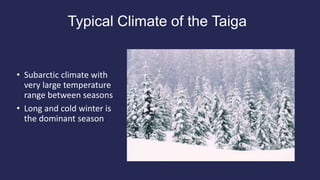
• Subarctic climate with
very large temperature
range between seasons
• Long and cold winter is
the dominant season
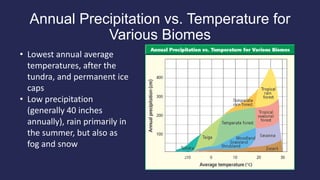
Annual Precipitation vs. Temperature for
Various Biomes
• Lowest annual average
temperatures, after the
tundra, and permanent ice
caps
• Low precipitation
(generally 40 inches
annually), rain primarily in
the summer, but also as
fog and snow
Types of Plants
• Evergreens
• Spruce
• Fir
• Pine
• Tamarack
• Birch
• Aspen
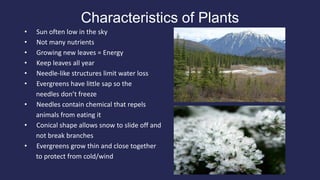
Characteristics of Plants
• Sun often low in the sky
• Not many nutrients
• Growing new leaves = Energy
• Keep leaves all year
• Needle-like structures limit water loss
• Evergreens have little sap so the
needles don’t freeze
• Needles contain chemical that repels
animals from eating it
• Conical shape allows snow to slide off and
not break branches
• Evergreens grow thin and close together
to protect from cold/wind
Types of Animals
• American Black Bear
• Bald Eagle
• Bobcat
• Canadian Lynx
• Gray Wolf
• Grizzly Bear
• River Otter
• Wolverine
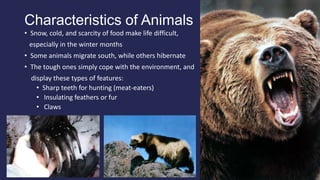
Characteristics of Animals
• Snow, cold, and scarcity of food make life difficult,
especially in the winter months
• Some animals migrate south, while others hibernate
• The tough ones simply cope with the environment, and
display these types of features:
• Sharp teeth for hunting (meat-eaters)
• Insulating feathers or fur
• Claws
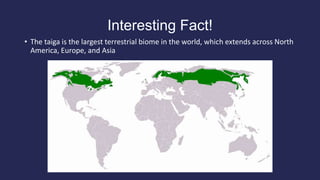
Interesting Fact!
• The taiga is the largest terrestrial biome in the world, which extends across North
America, Europe, and Asia
More Interesting Facts!
• Trees of the taiga make up about 29% of the world’s forest cover
• Fires are very common in the taiga, but are necessary
• The taiga stores more Carbon than the temperate and tropical forest
combined
References
• http://www.public-domain-image.com/flora-plants-public-domain-images-pictures/trees-public-domain-images-pictures/conifer-
spruce-trees-pictures/frost-on-spruce.jpg.html
• http://hdw.eweb4.com/out/735078.html
• http://espacepourlavie.ca/en/northern-territory-taiga-and-tundra
• http://www.public-domain-image.com/fauna-animals-public-domain-images-pictures/bears-public-domain-images-
pictures/grizzly-bear-on-a-rock-overlooking.jpg.html
• http://www.public-domain-image.com/fauna-animals-public-domain-images-pictures/lynx-cat-public-domain-images-
pictures/bobcat-sitting-in-tree.jpg.html
• http://www.public-domain-image.com/fauna-animals-public-domain-images-pictures/foxes-and-wolves-public-domain-images-
pictures/an-endangered-gray-wolf-peers-out-from-a-snow-covered-shelter.jpg.html
• http://upload.wikimedia.org/wikipedia/commons/8/8c/Wolverine_on_rock.jpg
• http://www.museevirtuel-
virtualmuseum.ca/edu/ViewLoitDa.do%3Bjsessionid=0F069167ED924C06AF1F13ECF024E753?method=preview&lang=EN&id=124
0
• http://www.public-domain-image.com/flora-plants-public-domain-images-pictures/trees-public-domain-images-pictures/aspen-
trees-pictres/aspen-woods.jpg.html
• http://www.public-domain-image.com/flora-plants-public-domain-images-pictures/trees-public-domain-images-pictures/conifer-
spruce-trees-pictures/spruce-tree-in-mountains.jpg.html
• http://en.wikipedia.org/wiki/File:Abies_fabri_in_mist.jpg
• http://www.cotf.edu/ete/modules/msese/earthsysflr/taigaP.html
• http://www.blueplanetbiomes.org/taiga.htm
• Www.blueplanetbiomes.org/taiga_animal_page.htm
• http://www.glencoe.com/qe/qe136nationaltest.php?qi=4309&st

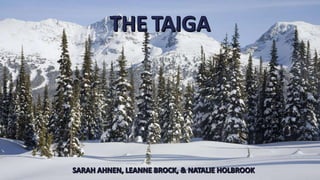
The Taiga Biome

  • 2.
    Typical Climate ofthe Taiga • Subarctic climate with very large temperature range between seasons • Long and cold winter is the dominant season
  • 3.
    Annual Precipitation vs.Temperature for Various Biomes • Lowest annual average temperatures, after the tundra, and permanent ice caps • Low precipitation (generally 40 inches annually), rain primarily in the summer, but also as fog and snow
  • 4.
    Types of Plants •Evergreens • Spruce • Fir • Pine • Tamarack • Birch • Aspen
  • 5.
    Characteristics of Plants •Sun often low in the sky • Not many nutrients • Growing new leaves = Energy • Keep leaves all year • Needle-like structures limit water loss • Evergreens have little sap so the needles don’t freeze • Needles contain chemical that repels animals from eating it • Conical shape allows snow to slide off and not break branches • Evergreens grow thin and close together to protect from cold/wind
  • 6.
    Types of Animals •American Black Bear • Bald Eagle • Bobcat • Canadian Lynx • Gray Wolf • Grizzly Bear • River Otter • Wolverine
  • 7.
    Characteristics of Animals •Snow, cold, and scarcity of food make life difficult, especially in the winter months • Some animals migrate south, while others hibernate • The tough ones simply cope with the environment, and display these types of features: • Sharp teeth for hunting (meat-eaters) • Insulating feathers or fur • Claws
  • 8.
    Interesting Fact! • Thetaiga is the largest terrestrial biome in the world, which extends across North America, Europe, and Asia
  • 9.
    More Interesting Facts! •Trees of the taiga make up about 29% of the world’s forest cover • Fires are very common in the taiga, but are necessary • The taiga stores more Carbon than the temperate and tropical forest combined
  • 10.
    References • http://www.public-domain-image.com/flora-plants-public-domain-images-pictures/trees-public-domain-images-pictures/conifer- spruce-trees-pictures/frost-on-spruce.jpg.html • http://hdw.eweb4.com/out/735078.html •http://espacepourlavie.ca/en/northern-territory-taiga-and-tundra • http://www.public-domain-image.com/fauna-animals-public-domain-images-pictures/bears-public-domain-images- pictures/grizzly-bear-on-a-rock-overlooking.jpg.html • http://www.public-domain-image.com/fauna-animals-public-domain-images-pictures/lynx-cat-public-domain-images- pictures/bobcat-sitting-in-tree.jpg.html • http://www.public-domain-image.com/fauna-animals-public-domain-images-pictures/foxes-and-wolves-public-domain-images- pictures/an-endangered-gray-wolf-peers-out-from-a-snow-covered-shelter.jpg.html • http://upload.wikimedia.org/wikipedia/commons/8/8c/Wolverine_on_rock.jpg • http://www.museevirtuel- virtualmuseum.ca/edu/ViewLoitDa.do%3Bjsessionid=0F069167ED924C06AF1F13ECF024E753?method=preview&lang=EN&id=124 0 • http://www.public-domain-image.com/flora-plants-public-domain-images-pictures/trees-public-domain-images-pictures/aspen- trees-pictres/aspen-woods.jpg.html • http://www.public-domain-image.com/flora-plants-public-domain-images-pictures/trees-public-domain-images-pictures/conifer- spruce-trees-pictures/spruce-tree-in-mountains.jpg.html • http://en.wikipedia.org/wiki/File:Abies_fabri_in_mist.jpg • http://www.cotf.edu/ete/modules/msese/earthsysflr/taigaP.html • http://www.blueplanetbiomes.org/taiga.htm • Www.blueplanetbiomes.org/taiga_animal_page.htm • http://www.glencoe.com/qe/qe136nationaltest.php?qi=4309&st

Editor's Notes

  • #3 -60 F in the winter and up to 70 F in the summer. Less than 4 months have an average temperature over 50 F
  • #10 Fires help rid the forest of old, sick trees.