

11/3/2019 1
Samina khan
Fazaia Degree College Risalpur
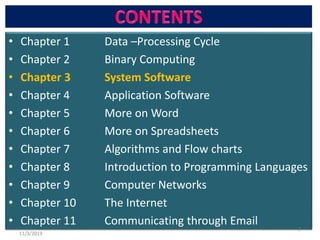
• Chapter 1 Data –Processing Cycle
• Chapter 2 Binary Computing
• Chapter 3 System Software
• Chapter 4 Application Software
• Chapter 5 More on Word
• Chapter 6 More on Spreadsheets
• Chapter 7 Algorithms and Flow charts
• Chapter 8 Introduction to Programming Languages
• Chapter 9 Computer Networks
• Chapter 10 The Internet
• Chapter 11 Communicating through Email
11/3/2019
2
CHAPTER 3
Objectives
• Explain system software and its types
• Explain BIOS
• Explain the function, components and types of
operating system.
• Explain some common utility programs and
software development tools.
11/3/2019 4
System software
• Set of programs
• Enables a computer to perform routing tasks
such as starting up, managing files and shutting
down.
• There are several types of operating system
depending on the type of task they perform.
BIOS
• This program is stored on a read-only chip on
the motherboard.
• It provides the software framework for
controlling items, such as the cooling system's
temperature, fan speed, the details of how the
processor will run and which hard drive (if the
computer has more than one) to boot from.
• It acts as the interface between the operating
system and the hardware.
Operating system
• Once the operating system and system devices
have been activated, the BIOS transfers control
of the computer to the operating system.
• The operating system is a very important system
software.
• It consists of a set of programs and data for
performing general tasks on a computer.
Functions of operating system
• Operating system perform several important
tasks:
• Booting up and providing a user interface
• Managing programs
• Managing files and directories
• Controlling system devices
• Multitasking
Booting up & providing a user interface
• The operating system also helps in booting up
process.
• Once the computer has been booted up, the
user can work on it.
• User interface allows a user to communicate
with the computer.
Managing programs
• Operating system runs all system & application
software stored on computer.
• Any problem in operating system means that
neither system nor application software can run
properly.
Managing files and directories
• It maintains files and folders by storing each file
at a unique location in its memory.
• It can also change the location of file if required
by user.
• It also allows the same file to be used by two
different application programs.
Controlling system devices
• It controls system devices such as peripherals
and drives.
• It ensures that the devices perform the exact
function that is needed by the user.
• It coordinates between the devices & application
programs.
Multitasking
• Multitasking means doing two or more things at
the same time.
• The operating system lets users use several
devices & work on several application programs
at the same time.
Components of an operating system
• Operating system has many important parts to
perform its functions
• The loader
• Programs and instructions
• The user computer interface
The loader
• Loads all programs and instructions from backup
storage to main memory.
• Once the programs have been loaded, the user
can start work on them.
• Instructions are followed by the computer to
perform the tasks required by the user.
• The loader also activates other devices and
components.
Programs and instructions
• The operating system contains several programs
that can be run by the computer.
• The operating system also contains instructions
that the computer can follow to run the
programs.
• The device driver is a program that automatically
runs the system devices.
• These devices are installed through drivers.
• The device manager tells the user whether their
drivers are updated or not.
The user-computer interface
• The user interface allows the user to
communicate with the operating system.
• There are two types of interface.
1. Command Line Interface(CLI)
2. Graphical User Interface(GUI)
• CLI is faster but GUI is simpler to use.
Command Line Interface
• A CLI is a mechanism for interacting with a
computer operating system by typing commands
to perform specific tasks.
• This method of instructing a computer to
perform a given task is referred to as "entering"
a command.
• Accept input via keyboard only.
• DOS operating system is based on CLI that follow
the typed commands
• Not suitable for beginners.
Graphical User Interface
• Microsoft Windows operating system based on
GUI.
• It is easy to use because the user can click on
any icon to move to a desired file or folder.
• GUI is also called WIMP(windows, Icons, Menus,
Pointing device) interface.
Types of Operating system
• Some operating systems like Microsoft Windows
can be used on personal computers while other
operating systems can be used on embedded
microprocessors or servers.
• Most operating systems don’t allow users to
change the instructions that are part of the
software. Instructions can only be changed by
company.
• Some operating systems allow user to make
changes . Such software is called open source
software e.g Linux
Types of Operating system
• There are special operating systems for
universities, businesses, engineering firms,
companies and military agencies that perform
their specific task required by the user.
UTILITY PROGRAMS
Utility programs
• Utility programs enables users to perform its
tasks efficiently.
• Some common utility programs are:
1. The file manager
2. The image viewer
3. The disk scanner
4. The disk defragmenter
5. The virus scanner
6. Backup software
1. The File manager
• It allows users to interact with the files stored on
the computer.
• We use it to create, edit, access, move, delete or
replace files.
2. The image viewer
• The image viewer can store images.
• It also has features such as zooming, rotation,
previews, slide show, thumbnails, display, full
screen display and so on.
3. The disk scanner
• It searches the hard disk for unnecessary or
damaged files and suggest what to do about
them.
• It also manages folders like Temporary
• Internet Files to release space for essential data.
• Microsoft Disk Cleanup is a common disk
scanner.
4. The disk defragmenter
• Sometimes different parts of the same file might
be stored at different locations in the memory of
computer. The file is said to be fragmented.
• A disk defragmenter moves all the fragments of
the file to consecutive locations for quicker
access.
5. The virus scanner
• It scans the system for viruses and deletes them
before they can cause any more damages.
6. Back-up software
• We can lose our entire data because of hard
disk failure or sometime we might accidently
delete some important files.
• Back-up software helps avoid permanent data
loss in such situations.
• It makes copies of data so that if the original
files are deleted, the data can be restored from
back-up.
SOFTWARE DEVELOPMENT TOOLS
Software development tools
• These programs are used to improve system or
application software.
• There are three common types of software
development tools:
1. Compiler
2. Linker
3. Debugger
1. Compiler
• It converts instructions in high-level
programming language into binary code.
• The instructions in programming language are
called source code.
• The converted instructions in binary code are
called object code.
• A set of code in binary language is called an
object file.
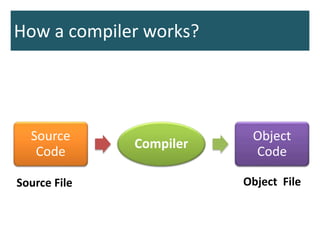
How a compiler works?
Source
Code
Compiler
Object
Code
Source File Object File
2. Linker
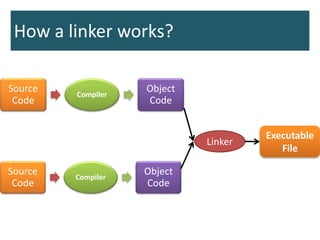
• It combines two or more related object files
into a single file.
How a linker works?
Source
Code
Compiler
Object
Code
Source
Code
Compiler
Object
Code
Linker
Executable
File
3. Debugger
• The object file created by the compiler might
contain some errors. Such errors are called
bugs.
• A debugger is a program that tests the object
file for bugs and remove them.
• The process of removing bugs from a program
is called debugging.
System software and its types

System software and its types

  • 1.
    11/3/2019 1 Samina khan FazaiaDegree College Risalpur
  • 2.
    • Chapter 1Data –Processing Cycle • Chapter 2 Binary Computing • Chapter 3 System Software • Chapter 4 Application Software • Chapter 5 More on Word • Chapter 6 More on Spreadsheets • Chapter 7 Algorithms and Flow charts • Chapter 8 Introduction to Programming Languages • Chapter 9 Computer Networks • Chapter 10 The Internet • Chapter 11 Communicating through Email 11/3/2019 2
  • 3.
  • 4.
    Objectives • Explain systemsoftware and its types • Explain BIOS • Explain the function, components and types of operating system. • Explain some common utility programs and software development tools. 11/3/2019 4
  • 5.
    System software • Setof programs • Enables a computer to perform routing tasks such as starting up, managing files and shutting down. • There are several types of operating system depending on the type of task they perform.
  • 6.
    BIOS • This programis stored on a read-only chip on the motherboard. • It provides the software framework for controlling items, such as the cooling system's temperature, fan speed, the details of how the processor will run and which hard drive (if the computer has more than one) to boot from. • It acts as the interface between the operating system and the hardware.
  • 7.
    Operating system • Oncethe operating system and system devices have been activated, the BIOS transfers control of the computer to the operating system. • The operating system is a very important system software. • It consists of a set of programs and data for performing general tasks on a computer.
  • 8.
    Functions of operatingsystem • Operating system perform several important tasks: • Booting up and providing a user interface • Managing programs • Managing files and directories • Controlling system devices • Multitasking
  • 9.
    Booting up &providing a user interface • The operating system also helps in booting up process. • Once the computer has been booted up, the user can work on it. • User interface allows a user to communicate with the computer.
  • 10.
    Managing programs • Operatingsystem runs all system & application software stored on computer. • Any problem in operating system means that neither system nor application software can run properly.
  • 11.
    Managing files anddirectories • It maintains files and folders by storing each file at a unique location in its memory. • It can also change the location of file if required by user. • It also allows the same file to be used by two different application programs.
  • 12.
    Controlling system devices •It controls system devices such as peripherals and drives. • It ensures that the devices perform the exact function that is needed by the user. • It coordinates between the devices & application programs.
  • 13.
    Multitasking • Multitasking meansdoing two or more things at the same time. • The operating system lets users use several devices & work on several application programs at the same time.
  • 14.
    Components of anoperating system • Operating system has many important parts to perform its functions • The loader • Programs and instructions • The user computer interface
  • 15.
    The loader • Loadsall programs and instructions from backup storage to main memory. • Once the programs have been loaded, the user can start work on them. • Instructions are followed by the computer to perform the tasks required by the user. • The loader also activates other devices and components.
  • 16.
    Programs and instructions •The operating system contains several programs that can be run by the computer. • The operating system also contains instructions that the computer can follow to run the programs. • The device driver is a program that automatically runs the system devices. • These devices are installed through drivers. • The device manager tells the user whether their drivers are updated or not.
  • 17.
    The user-computer interface •The user interface allows the user to communicate with the operating system. • There are two types of interface. 1. Command Line Interface(CLI) 2. Graphical User Interface(GUI) • CLI is faster but GUI is simpler to use.
  • 18.
    Command Line Interface •A CLI is a mechanism for interacting with a computer operating system by typing commands to perform specific tasks. • This method of instructing a computer to perform a given task is referred to as "entering" a command. • Accept input via keyboard only. • DOS operating system is based on CLI that follow the typed commands • Not suitable for beginners.
  • 19.
    Graphical User Interface •Microsoft Windows operating system based on GUI. • It is easy to use because the user can click on any icon to move to a desired file or folder. • GUI is also called WIMP(windows, Icons, Menus, Pointing device) interface.
  • 20.
    Types of Operatingsystem • Some operating systems like Microsoft Windows can be used on personal computers while other operating systems can be used on embedded microprocessors or servers. • Most operating systems don’t allow users to change the instructions that are part of the software. Instructions can only be changed by company. • Some operating systems allow user to make changes . Such software is called open source software e.g Linux
  • 21.
    Types of Operatingsystem • There are special operating systems for universities, businesses, engineering firms, companies and military agencies that perform their specific task required by the user.
  • 22.
  • 23.
    Utility programs • Utilityprograms enables users to perform its tasks efficiently. • Some common utility programs are: 1. The file manager 2. The image viewer 3. The disk scanner 4. The disk defragmenter 5. The virus scanner 6. Backup software
  • 24.
    1. The Filemanager • It allows users to interact with the files stored on the computer. • We use it to create, edit, access, move, delete or replace files.
  • 25.
    2. The imageviewer • The image viewer can store images. • It also has features such as zooming, rotation, previews, slide show, thumbnails, display, full screen display and so on.
  • 26.
    3. The diskscanner • It searches the hard disk for unnecessary or damaged files and suggest what to do about them. • It also manages folders like Temporary • Internet Files to release space for essential data. • Microsoft Disk Cleanup is a common disk scanner.
  • 27.
    4. The diskdefragmenter • Sometimes different parts of the same file might be stored at different locations in the memory of computer. The file is said to be fragmented. • A disk defragmenter moves all the fragments of the file to consecutive locations for quicker access.
  • 28.
    5. The virusscanner • It scans the system for viruses and deletes them before they can cause any more damages.
  • 29.
    6. Back-up software •We can lose our entire data because of hard disk failure or sometime we might accidently delete some important files. • Back-up software helps avoid permanent data loss in such situations. • It makes copies of data so that if the original files are deleted, the data can be restored from back-up.
  • 30.
  • 31.
    Software development tools •These programs are used to improve system or application software. • There are three common types of software development tools: 1. Compiler 2. Linker 3. Debugger
  • 32.
    1. Compiler • Itconverts instructions in high-level programming language into binary code. • The instructions in programming language are called source code. • The converted instructions in binary code are called object code. • A set of code in binary language is called an object file.
  • 33.
    How a compilerworks? Source Code Compiler Object Code Source File Object File
  • 34.
    2. Linker • Itcombines two or more related object files into a single file.
  • 35.
    How a linkerworks? Source Code Compiler Object Code Source Code Compiler Object Code Linker Executable File
  • 36.
    3. Debugger • Theobject file created by the compiler might contain some errors. Such errors are called bugs. • A debugger is a program that tests the object file for bugs and remove them. • The process of removing bugs from a program is called debugging.