
SCAFFOLDING
IN TEACHING
PRESENTED BY: SAMINA
KHAN
FDC RISALPUR
Outline
What is meant by Scaffolding?
Scaffolding in education
Instructional scaffolding
Effective scaffolding
Advantages of scaffolding.
What is meant by Scaffolding?
A scaffold is any temporary, elevated work platform and its
supporting structure used for holding people, materials, or both.
Simply we can say that it is the gradual release of responsibility.
Scaffolding in education
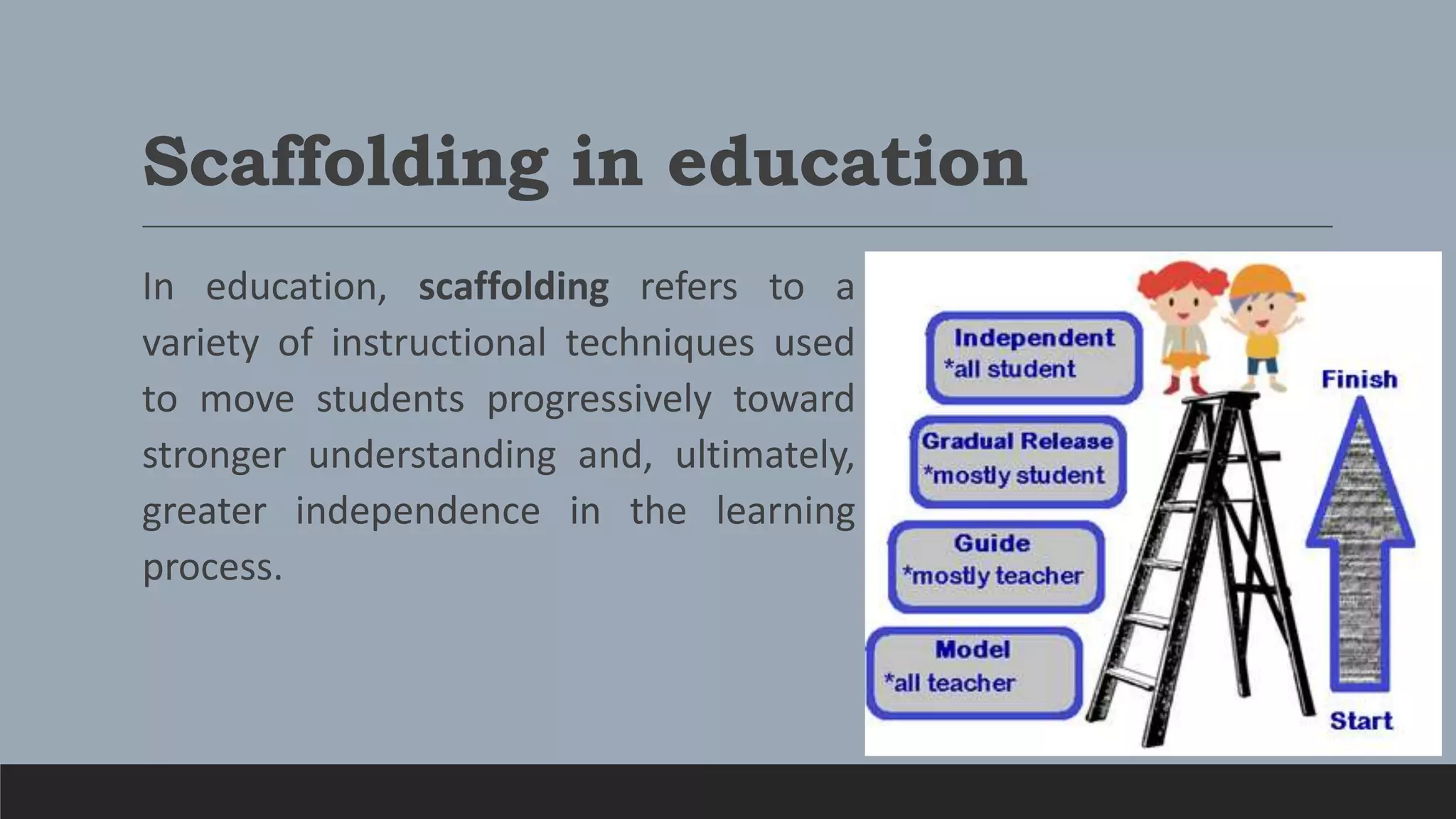
In education, scaffolding refers to a
variety of instructional techniques used
to move students progressively toward
stronger understanding and, ultimately,
greater independence in the learning
process.
Scaffolding in education
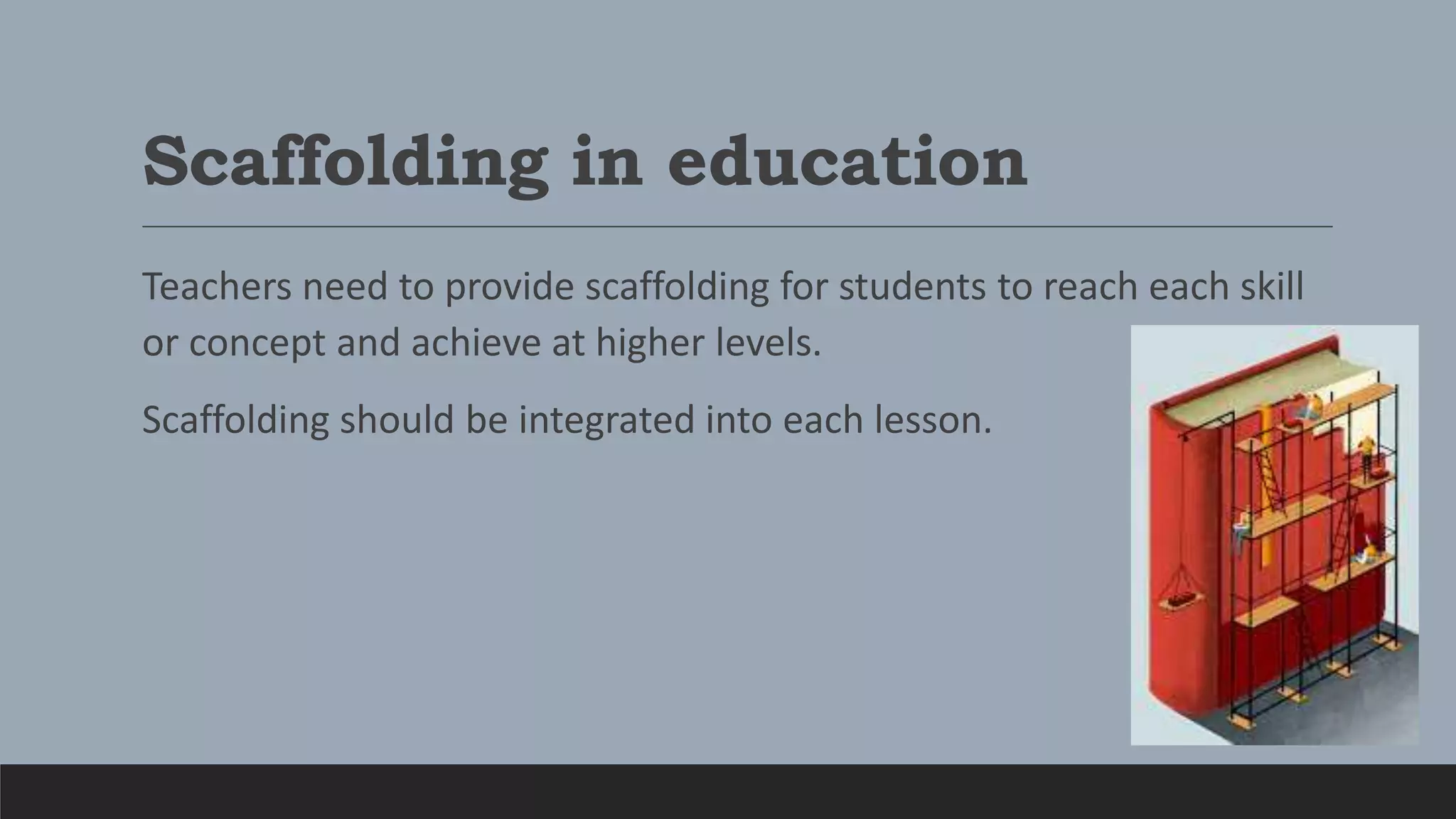
Teachers need to provide scaffolding for students to reach each skill
or concept and achieve at higher levels.
Scaffolding should be integrated into each lesson.
Instructional scaffolding
Instructional scaffolding is the support given to a student by an
instructor throughout the learning process. This support is specifically
specifically tailored to each student; this instructional approach
allows students to experience student-centered learning, which tends
tends to facilitate more efficient learning than teacher-centered
learning
Instructional scaffolding
Instructional scaffolding provides sufficient support to
promote learning when concepts and skills are being first introduced
to students. These supports may include resource, compelling task,
templates and guides, and/or guidance on the development
of cognitive and social skills. Instructional scaffolding could be
employed through modeling a task, giving advice, and/or
providing coaching.
Instructional scaffolding
These supports are gradually removed as students
develop autonomous learning strategies, thus promoting their
own cognitive, affective and psychomotor learning skills and
knowledge. Teachers help the students master a task or a concept by
providing support. The support can take many forms such as
outlines, recommended documents, storyboards, or key questions.
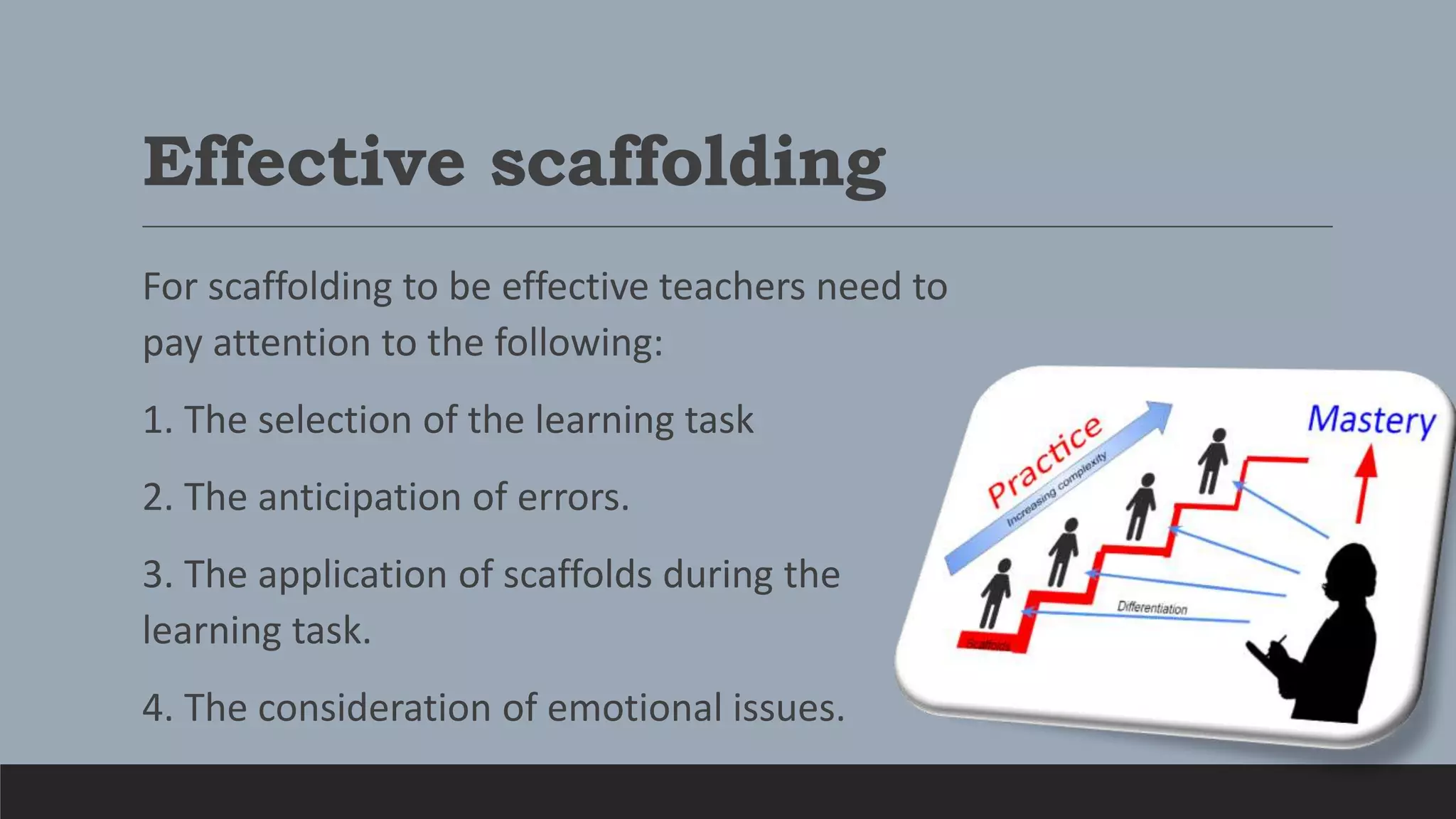
Effective scaffolding
For scaffolding to be effective teachers need to
pay attention to the following:
1. The selection of the learning task
2. The anticipation of errors.
3. The application of scaffolds during the
learning task.
4. The consideration of emotional issues.
Advantages of scaffolding
It provides support to learners so that they can achieve what alone
would have been too difficult.
Keep students engaged and make learning more fun.
Give students opportunities to be successful when learning new
material.
Builds confidence and decrease learning frustration.
References
https://www.safeopedia.com/definition/4959/scaffolding
https://www.edglossary.org/scaffolding/
https://en.wikipedia.org/wiki/Instructional_scaffolding

scaffolding in teaching.pptx

  • 2.
    SCAFFOLDING IN TEACHING PRESENTED BY:SAMINA KHAN FDC RISALPUR
  • 3.
    Outline What is meantby Scaffolding? Scaffolding in education Instructional scaffolding Effective scaffolding Advantages of scaffolding.
  • 4.
    What is meantby Scaffolding? A scaffold is any temporary, elevated work platform and its supporting structure used for holding people, materials, or both. Simply we can say that it is the gradual release of responsibility.
  • 5.
    Scaffolding in education Ineducation, scaffolding refers to a variety of instructional techniques used to move students progressively toward stronger understanding and, ultimately, greater independence in the learning process.
  • 6.
    Scaffolding in education Teachersneed to provide scaffolding for students to reach each skill or concept and achieve at higher levels. Scaffolding should be integrated into each lesson.
  • 7.
    Instructional scaffolding Instructional scaffoldingis the support given to a student by an instructor throughout the learning process. This support is specifically specifically tailored to each student; this instructional approach allows students to experience student-centered learning, which tends tends to facilitate more efficient learning than teacher-centered learning
  • 8.
    Instructional scaffolding Instructional scaffoldingprovides sufficient support to promote learning when concepts and skills are being first introduced to students. These supports may include resource, compelling task, templates and guides, and/or guidance on the development of cognitive and social skills. Instructional scaffolding could be employed through modeling a task, giving advice, and/or providing coaching.
  • 9.
    Instructional scaffolding These supportsare gradually removed as students develop autonomous learning strategies, thus promoting their own cognitive, affective and psychomotor learning skills and knowledge. Teachers help the students master a task or a concept by providing support. The support can take many forms such as outlines, recommended documents, storyboards, or key questions.
  • 10.
    Effective scaffolding For scaffoldingto be effective teachers need to pay attention to the following: 1. The selection of the learning task 2. The anticipation of errors. 3. The application of scaffolds during the learning task. 4. The consideration of emotional issues.
  • 11.
    Advantages of scaffolding Itprovides support to learners so that they can achieve what alone would have been too difficult. Keep students engaged and make learning more fun. Give students opportunities to be successful when learning new material. Builds confidence and decrease learning frustration.
  • 13.