Functions and Principles of
School Administration
DENNIS MARK A. DELA CRUZ
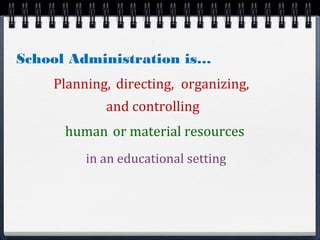
School Administration is…
in an educational setting
Planning, organizing,directing,
and controlling
human or material resources
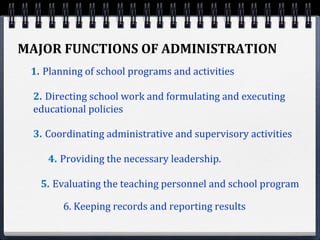
MAJOR FUNCTIONS OF ADMINISTRATION
1. Planning of school programs and activities
2. Directing school work and formulating and executing
educational policies
3. Coordinating administrative and supervisory activities
4. Providing the necessary leadership.
5. Evaluating the teaching personnel and school program
6. Keeping records and reporting results
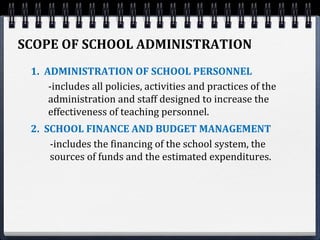
SCOPE OF SCHOOL ADMINISTRATION
1. ADMINISTRATION OF SCHOOL PERSONNEL
-includes all policies, activities and practices of the
administration and staff designed to increase the
effectiveness of teaching personnel.
2. SCHOOL FINANCE AND BUDGET MANAGEMENT
-includes the financing of the school system, the
sources of funds and the estimated expenditures.
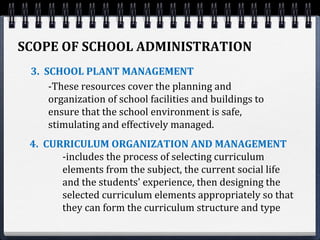
SCOPE OF SCHOOL ADMINISTRATION
3. SCHOOL PLANT MANAGEMENT
-These resources cover the planning and
organization of school facilities and buildings to
ensure that the school environment is safe,
stimulating and effectively managed.
4. CURRICULUM ORGANIZATION AND MANAGEMENT
-includes the process of selecting curriculum
elements from the subject, the current social life
and the students' experience, then designing the
selected curriculum elements appropriately so that
they can form the curriculum structure and type
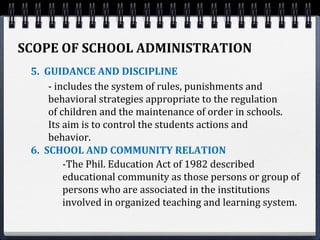
SCOPE OF SCHOOL ADMINISTRATION
5. GUIDANCE AND DISCIPLINE
- includes the system of rules, punishments and
behavioral strategies appropriate to the regulation
of children and the maintenance of order in schools.
Its aim is to control the students actions and
behavior.
6. SCHOOL AND COMMUNITY RELATION
-The Phil. Education Act of 1982 described
educational community as those persons or group of
persons who are associated in the institutions
involved in organized teaching and learning system.
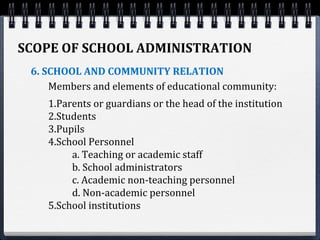
SCOPE OF SCHOOL ADMINISTRATION
6. SCHOOL AND COMMUNITY RELATION
Members and elements of educational community:
1.Parents or guardians or the head of the institution
2.Students
3.Pupils
4.School Personnel
a. Teaching or academic staff
b. School administrators
c. Academic non-teaching personnel
d. Non-academic personnel
5.School institutions
SCOPE OF SCHOOL ADMINISTRATION
7. NON-FORMAL EDUCATION
8. EVALUATING RESULTS OF SCHOOL ADMINISTRATION
- includes organized school-based educational
activities aimed at attaining specific learning
objectives for a particular clientele, especially the
illiterate adults and out-of-school youths.
- includes evaluation of desirable school and
teaching personnel performance as outcomes of
policies, activities and practices of administration
and staff.
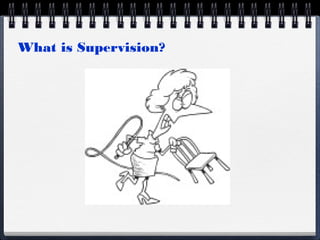
What is Supervision?
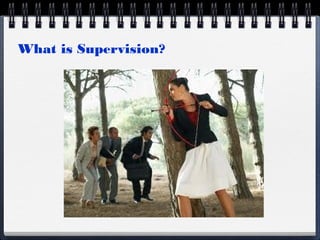
What is Supervisión?
 Supervision of any school ordinarily refers to
the ___________________ of the TOTAL TEACHING
AND LEARNING SITUATION and the
_________________ that affect them.
IMPROVEMENT
CONDITIONS
• It is a __________________________________
to improve instruction by working
with the people who are working
with the students/pupils.
SOCIALIZED FUNCTION DESIGN
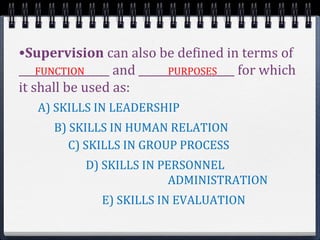
•Supervision can also be defined in terms of
_________________ and __________________ for which
it shall be used as:
FUNCTION PURPOSES
A) SKILLS IN LEADERSHIP
B) SKILLS IN HUMAN RELATION
C) SKILLS IN GROUP PROCESS
D) SKILLS IN PERSONNEL
ADMINISTRATION
E) SKILLS IN EVALUATION
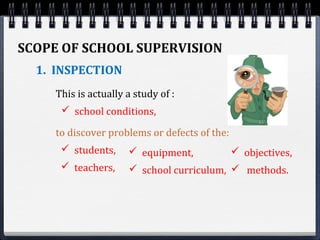
SCOPE OF SCHOOL SUPERVISION
1. INSPECTION
This is actually a study of :
 school conditions,
to discover problems or defects of the:
 students,
 teachers,
 equipment,
 school curriculum,
 objectives,
 methods.
SCOPE OF SCHOOL SUPERVISION
This could be done via:
 actual observation,
 educational tests,
 questionnaires
 checklists.
 conference,
SCOPE OF SCHOOL SUPERVISION
2. RESEARCH
-to remedy the weaknesses of the solution to
solve problems discovered.
The supervisor should conduct research to
discover means, methods and procedure
fundamental to the success of supervision. The
solutions discovered are then passed on the
teachers.
SCOPE OF SCHOOL SUPERVISION
3. TRAINING
-acquainting teachers with solutions discovered
in research through training.
Training may be in the form of:
 demonstration teaching,
 workshops,
 seminars,
 classroom observations,
 individual or group conferences,
 intervisitation,
 professional classes
 use of bulletin board and circulars
 writing suggestions in BPS Form 178.
SCOPE OF SCHOOL SUPERVISION
4. GUIDANCE
-involved personal help given by someone.
It is the function of supervision to:
and devices.
stimulate, direct, guide encourage
the teachers to apply
instructional procedures,
techniques,
principles
SCOPE OF SCHOOL SUPERVISION
5. EVALUATION
-appraises the outcomes and the
factors conditioning the
outcomes of instructions and to
improve the products and
processes of instructions.
SCOPE OF SCHOOL SUPERVISION
selecting and organizing materials
for instructions;
performing semi-administrative duties.
 survey of the school system;
improvement of classroom teaching;
in-service education of teachers;
researching the problems of teaching;
determining the desirable physical
condition of teaching
ACTIVITIES OF SUPERVISION
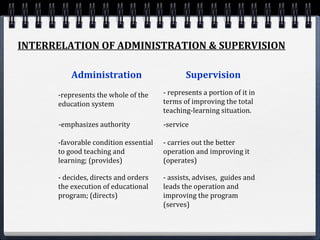
INTERRELATION OF ADMINISTRATION & SUPERVISION
Administration Supervision
-represents the whole of the
education system
- represents a portion of it in
terms of improving the total
teaching-learning situation.
-emphasizes authority -service
-favorable condition essential
to good teaching and
learning; (provides)
- carries out the better
operation and improving it
(operates)
- decides, directs and orders
the execution of educational
program; (directs)
- assists, advises, guides and
leads the operation and
improving the program
(serves)
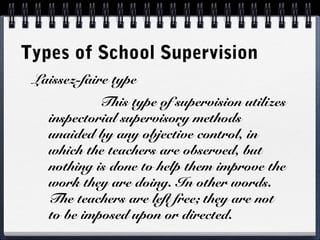
Types of School Supervision
Laissez-faire type
This type of supervision utilizes
inspectorial supervisory methods
unaided by any objective control, in
which the teachers are observed, but
nothing is done to help them improve the
work they are doing. In other words.
The teachers are left free; they are not
to be imposed upon or directed.
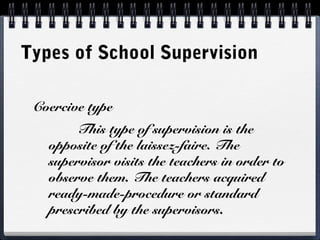
Types of School Supervision
Coercive type
This type of supervision is the
opposite of the laissez-faire. The
supervisor visits the teachers in order to
observe them. The teachers acquired
ready-made-procedure or standard
prescribed by the supervisors.
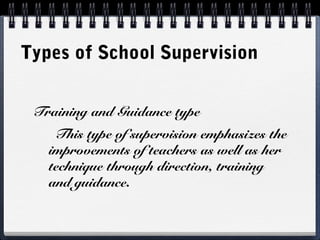
Types of School Supervision
Training and Guidance type
This type of supervision emphasizes the
improvements of teachers as well as her
technique through direction, training
and guidance.
Types of School Supervision
Democratic leadership type
It consists of the teacher’s cooperation in
the formulation of policies, plans and
procedures. Supervisor observes teacher inside
the classroom setting with the aim of
improving the teaching-learning situation via
cooperation process or group action. The
teachers, supervisors and administrators are
regarded as co-workers in a common task.
Basis of Administrative and Supervisory
Principle
Principle is an accepted fundamental truth. It
can be a law, a doctrine. A policy or deep
seated belief which governs the conduct of
various types of human endeavors. In
administration and supervision, principles
becomes part of a philosophy which serves to
determine and evaluate his educational
objectives, attitudes, practices and outcomes.
General Principles of Administration and
Supervision
School administration and supervision…
1. must be democratic … is recognizing individual differences,
respect personality and extend consideration to all;
2. must be cooperative in character … in that cooperation is
synonymous to group action;
3. to be effective … must be scientific, that is, research oriented
activity to discover solution to problem;
4. must be based on accepted educational philosophy;
General Principles of Administration and Supervision
School administration and supervision…
5. must be creative … means initiating, devising, inventing or producing
something new;
6. must be evaluated in the light of results;
7. must be preventive and constructive … that is helping teachers to avoid
committing mistakes, anticipating difficulties, building self confidence,
by discovering their own weaknesses;
8. must be centered on child growth and development … in terms of
growth mentally, physically, morally, emotionally and socially; and
9. must be flexible … in terms of school building, curriculum, teaching
objectives and procedures, instructional material and devices, school
requirements and standard norms.
‘The walls of the world expand,
the scope of our possibilities opens
and widens for the duration of
the stanza. We go beyond our
normal cognitive bounds and
sense a new element where we are
not alien but liberated, more
alive to ourselves, more drawn
out, more educated.’ (S Heaney 1983)
References/Bibliography
1. www.openuni-
clsu.edu.ph/openfiles/modules/ed852/We
ek12.doc.Retrieved: July 17, 2015
2.http://www.slideshare.net/tootsy_roll200
3/report-9780999Retrieved: July 17,
2015

Functions and principles of school administration

  • 1.
    Functions and Principlesof School Administration DENNIS MARK A. DELA CRUZ
  • 2.
    School Administration is… inan educational setting Planning, organizing,directing, and controlling human or material resources
  • 3.
    MAJOR FUNCTIONS OFADMINISTRATION 1. Planning of school programs and activities 2. Directing school work and formulating and executing educational policies 3. Coordinating administrative and supervisory activities 4. Providing the necessary leadership. 5. Evaluating the teaching personnel and school program 6. Keeping records and reporting results
  • 4.
    SCOPE OF SCHOOLADMINISTRATION 1. ADMINISTRATION OF SCHOOL PERSONNEL -includes all policies, activities and practices of the administration and staff designed to increase the effectiveness of teaching personnel. 2. SCHOOL FINANCE AND BUDGET MANAGEMENT -includes the financing of the school system, the sources of funds and the estimated expenditures.
  • 5.
    SCOPE OF SCHOOLADMINISTRATION 3. SCHOOL PLANT MANAGEMENT -These resources cover the planning and organization of school facilities and buildings to ensure that the school environment is safe, stimulating and effectively managed. 4. CURRICULUM ORGANIZATION AND MANAGEMENT -includes the process of selecting curriculum elements from the subject, the current social life and the students' experience, then designing the selected curriculum elements appropriately so that they can form the curriculum structure and type
  • 6.
    SCOPE OF SCHOOLADMINISTRATION 5. GUIDANCE AND DISCIPLINE - includes the system of rules, punishments and behavioral strategies appropriate to the regulation of children and the maintenance of order in schools. Its aim is to control the students actions and behavior. 6. SCHOOL AND COMMUNITY RELATION -The Phil. Education Act of 1982 described educational community as those persons or group of persons who are associated in the institutions involved in organized teaching and learning system.
  • 7.
    SCOPE OF SCHOOLADMINISTRATION 6. SCHOOL AND COMMUNITY RELATION Members and elements of educational community: 1.Parents or guardians or the head of the institution 2.Students 3.Pupils 4.School Personnel a. Teaching or academic staff b. School administrators c. Academic non-teaching personnel d. Non-academic personnel 5.School institutions
  • 8.
    SCOPE OF SCHOOLADMINISTRATION 7. NON-FORMAL EDUCATION 8. EVALUATING RESULTS OF SCHOOL ADMINISTRATION - includes organized school-based educational activities aimed at attaining specific learning objectives for a particular clientele, especially the illiterate adults and out-of-school youths. - includes evaluation of desirable school and teaching personnel performance as outcomes of policies, activities and practices of administration and staff.
  • 9.
  • 10.
  • 11.
    What is Supervisión? Supervision of any school ordinarily refers to the ___________________ of the TOTAL TEACHING AND LEARNING SITUATION and the _________________ that affect them. IMPROVEMENT CONDITIONS • It is a __________________________________ to improve instruction by working with the people who are working with the students/pupils. SOCIALIZED FUNCTION DESIGN
  • 12.
    •Supervision can alsobe defined in terms of _________________ and __________________ for which it shall be used as: FUNCTION PURPOSES A) SKILLS IN LEADERSHIP B) SKILLS IN HUMAN RELATION C) SKILLS IN GROUP PROCESS D) SKILLS IN PERSONNEL ADMINISTRATION E) SKILLS IN EVALUATION
  • 13.
    SCOPE OF SCHOOLSUPERVISION 1. INSPECTION This is actually a study of :  school conditions, to discover problems or defects of the:  students,  teachers,  equipment,  school curriculum,  objectives,  methods.
  • 14.
    SCOPE OF SCHOOLSUPERVISION This could be done via:  actual observation,  educational tests,  questionnaires  checklists.  conference,
  • 15.
    SCOPE OF SCHOOLSUPERVISION 2. RESEARCH -to remedy the weaknesses of the solution to solve problems discovered. The supervisor should conduct research to discover means, methods and procedure fundamental to the success of supervision. The solutions discovered are then passed on the teachers.
  • 16.
    SCOPE OF SCHOOLSUPERVISION 3. TRAINING -acquainting teachers with solutions discovered in research through training. Training may be in the form of:  demonstration teaching,  workshops,  seminars,  classroom observations,  individual or group conferences,  intervisitation,  professional classes  use of bulletin board and circulars  writing suggestions in BPS Form 178.
  • 17.
    SCOPE OF SCHOOLSUPERVISION 4. GUIDANCE -involved personal help given by someone. It is the function of supervision to: and devices. stimulate, direct, guide encourage the teachers to apply instructional procedures, techniques, principles
  • 18.
    SCOPE OF SCHOOLSUPERVISION 5. EVALUATION -appraises the outcomes and the factors conditioning the outcomes of instructions and to improve the products and processes of instructions.
  • 19.
    SCOPE OF SCHOOLSUPERVISION selecting and organizing materials for instructions; performing semi-administrative duties.  survey of the school system; improvement of classroom teaching; in-service education of teachers; researching the problems of teaching; determining the desirable physical condition of teaching ACTIVITIES OF SUPERVISION
  • 20.
    INTERRELATION OF ADMINISTRATION& SUPERVISION Administration Supervision -represents the whole of the education system - represents a portion of it in terms of improving the total teaching-learning situation. -emphasizes authority -service -favorable condition essential to good teaching and learning; (provides) - carries out the better operation and improving it (operates) - decides, directs and orders the execution of educational program; (directs) - assists, advises, guides and leads the operation and improving the program (serves)
  • 21.
    Types of SchoolSupervision Laissez-faire type This type of supervision utilizes inspectorial supervisory methods unaided by any objective control, in which the teachers are observed, but nothing is done to help them improve the work they are doing. In other words. The teachers are left free; they are not to be imposed upon or directed.
  • 22.
    Types of SchoolSupervision Coercive type This type of supervision is the opposite of the laissez-faire. The supervisor visits the teachers in order to observe them. The teachers acquired ready-made-procedure or standard prescribed by the supervisors.
  • 23.
    Types of SchoolSupervision Training and Guidance type This type of supervision emphasizes the improvements of teachers as well as her technique through direction, training and guidance.
  • 24.
    Types of SchoolSupervision Democratic leadership type It consists of the teacher’s cooperation in the formulation of policies, plans and procedures. Supervisor observes teacher inside the classroom setting with the aim of improving the teaching-learning situation via cooperation process or group action. The teachers, supervisors and administrators are regarded as co-workers in a common task.
  • 25.
    Basis of Administrativeand Supervisory Principle Principle is an accepted fundamental truth. It can be a law, a doctrine. A policy or deep seated belief which governs the conduct of various types of human endeavors. In administration and supervision, principles becomes part of a philosophy which serves to determine and evaluate his educational objectives, attitudes, practices and outcomes.
  • 26.
    General Principles ofAdministration and Supervision School administration and supervision… 1. must be democratic … is recognizing individual differences, respect personality and extend consideration to all; 2. must be cooperative in character … in that cooperation is synonymous to group action; 3. to be effective … must be scientific, that is, research oriented activity to discover solution to problem; 4. must be based on accepted educational philosophy;
  • 27.
    General Principles ofAdministration and Supervision School administration and supervision… 5. must be creative … means initiating, devising, inventing or producing something new; 6. must be evaluated in the light of results; 7. must be preventive and constructive … that is helping teachers to avoid committing mistakes, anticipating difficulties, building self confidence, by discovering their own weaknesses; 8. must be centered on child growth and development … in terms of growth mentally, physically, morally, emotionally and socially; and 9. must be flexible … in terms of school building, curriculum, teaching objectives and procedures, instructional material and devices, school requirements and standard norms.
  • 28.
    ‘The walls ofthe world expand, the scope of our possibilities opens and widens for the duration of the stanza. We go beyond our normal cognitive bounds and sense a new element where we are not alien but liberated, more alive to ourselves, more drawn out, more educated.’ (S Heaney 1983)
  • 29.
    References/Bibliography 1. www.openuni- clsu.edu.ph/openfiles/modules/ed852/We ek12.doc.Retrieved: July17, 2015 2.http://www.slideshare.net/tootsy_roll200 3/report-9780999Retrieved: July 17, 2015