SYSTEMATIC
APPROACH TO
TEACHING
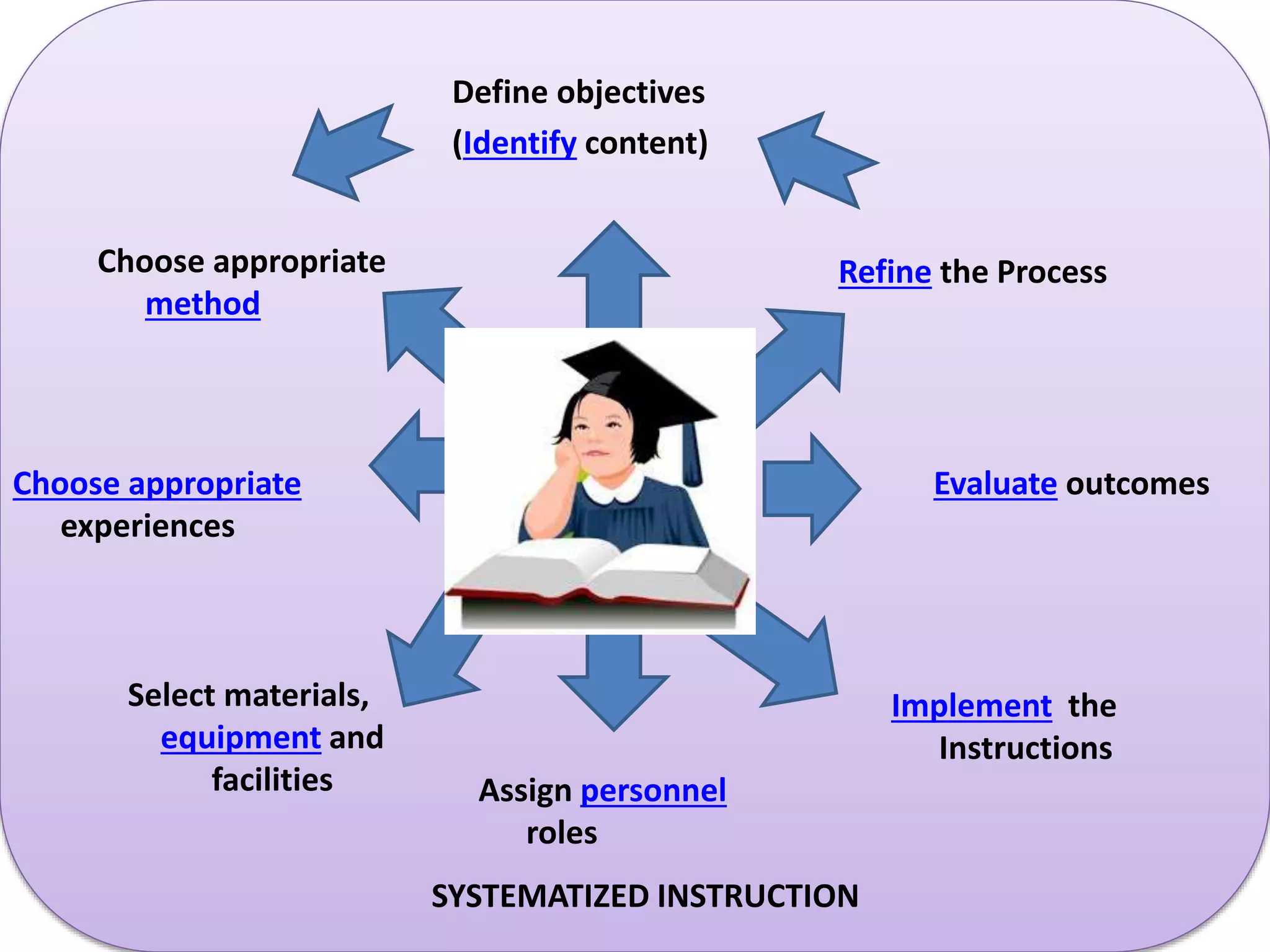
Refine the Process
Choose appropriate
experiences
Select materials,
equipment and
facilities Assign personnel
roles
Implement the
Instructions
Evaluate outcomes
Define objectives
(Identify content)
Choose appropriate
method
SYSTEMATIZED INSTRUCTION
Guide questions for discussion
1. Who is at the center of the chart?
What does the central location in
the chart mean?
2. What are the steps of the
instructional process or the parts of
a systematic instruction?
3. What does each step mean?
the focus of systematic
instructional planning is
the student.
Define objectives- Instruction
begins with the definition of
instructional objectives that
consider the students’ needs,
interest, and readiness.
Choose appropriate methods-
On the basis of this objective,
the teacher selects the
appropriate teaching methods
to be used.
Select materials, equipments
and facilities- The use of
learning materials, equipment
and facilities necessitates
assigning the personnel to
assist the teacher.
Assign personal roles-
Defining the role of any
personnel involved in the
preparation, setting and
returning of this learning
resources would also help in
the learning process.
Implement the instruction- With
the instructional objectives in mind,
the teacher implements planned
instructions with the use of the
selective teaching method, learning
activities, and learning materials
with the help of other personnel
whose role has been defined by the
teacher.
Evaluate outcomes-
After instructions,
teacher evaluates the
outcome of instruction. From
the evaluation results, teacher
comes to know if the
instructional objective was
attained.
Refine the process- If the instructional
objective was attained, teacher
proceeds to the next lesson going
through the same cycle once more. If
instructional objectives was not attained
, then teacher diagnoses was not
learned and finds out why it was not
learned in order to introduced a
remedial measure for improved student
performance and attainment of
instructional objectives
Instruction begins with the definition of
instructional objectives that consider the
students’ needs, interest, and readiness.
On the basis of this objective, the
teacher selects the appropriate teaching
methods to be used and, in turn, based
on the teaching method selected, the
appropriate learning experiences and
appropriate materials, equipment and
facilities will also be selected.
The system approach views the entire
educational program as a system of
closely interrelated parts. It is an
orchestrated learning pattern with all
parts harmoniously integrated into the
whole: the school, the teacher, the
students, the objectives, the media, the
materials, and assessment tools and
procedures
The system’s approach
to instruction is simple
in theory but far from
being simplistic in
practice.
ELEMENTS OR FACTORS
THAT THE TEACHER HAS
TO TAKE
CONSIDERATION
-Student’s needs
-interest
-home background
-prior experiences
-developmental stage
The Teacher must
consider:
-Appropriate teaching method
-learning activities
-nature of subject matter
-availability of resources
-capability
-lesson objective
The phases or elements
are connected with
each other.
The purpose of a system
instructional design is to
ensure orderly relationships
and interaction of human,
technical, and environmental
resources to fulfill the goals
which have been established
for instruction (Brown, 1969)
Phases of a
Systematic Approach
to Teaching
1. Formulation of
Instructional
Objectives
2. Process of
Instructional
Objectives
A. Planning for Instruction
B. Implementation of the plan
3. Assessment of
learning
SCOPE OF
EDUCATIONAL
TECHNOLOGY
1.Instructional Technology
Inclusive are those aspects of
educational Technology, that are
primarily concerned with instruction
or the teaching- learning process
rather than the operation of
educational institutions.
2.Instructional Media
These are the means of
communication available for the
educational purpose other than the
teacher. The term media emphasizes
the interaction that occurs between
the teacher and the learner.
3.Instructional Aids
The term aids emphasize the
assistance or help of the
instructional media in bringing out
an effective teaching-learning
situation.
4. Audiovisual aids
These are materials for instruction
that employ the use of the sense of
sight, hearing or a combination of
these modalities.
5.Instructional Materials
These are the tools or equipment
used by the teacher as media to aid
in the teaching-learning process.

Systematic approach to teaching

  • 1.
  • 2.
    Refine the Process Chooseappropriate experiences Select materials, equipment and facilities Assign personnel roles Implement the Instructions Evaluate outcomes Define objectives (Identify content) Choose appropriate method SYSTEMATIZED INSTRUCTION
  • 3.
    Guide questions fordiscussion 1. Who is at the center of the chart? What does the central location in the chart mean? 2. What are the steps of the instructional process or the parts of a systematic instruction? 3. What does each step mean?
  • 4.
    the focus ofsystematic instructional planning is the student.
  • 5.
    Define objectives- Instruction beginswith the definition of instructional objectives that consider the students’ needs, interest, and readiness.
  • 6.
    Choose appropriate methods- Onthe basis of this objective, the teacher selects the appropriate teaching methods to be used.
  • 7.
    Select materials, equipments andfacilities- The use of learning materials, equipment and facilities necessitates assigning the personnel to assist the teacher.
  • 8.
    Assign personal roles- Definingthe role of any personnel involved in the preparation, setting and returning of this learning resources would also help in the learning process.
  • 9.
    Implement the instruction-With the instructional objectives in mind, the teacher implements planned instructions with the use of the selective teaching method, learning activities, and learning materials with the help of other personnel whose role has been defined by the teacher.
  • 10.
    Evaluate outcomes- After instructions, teacherevaluates the outcome of instruction. From the evaluation results, teacher comes to know if the instructional objective was attained.
  • 11.
    Refine the process-If the instructional objective was attained, teacher proceeds to the next lesson going through the same cycle once more. If instructional objectives was not attained , then teacher diagnoses was not learned and finds out why it was not learned in order to introduced a remedial measure for improved student performance and attainment of instructional objectives
  • 12.
    Instruction begins withthe definition of instructional objectives that consider the students’ needs, interest, and readiness. On the basis of this objective, the teacher selects the appropriate teaching methods to be used and, in turn, based on the teaching method selected, the appropriate learning experiences and appropriate materials, equipment and facilities will also be selected.
  • 13.
    The system approachviews the entire educational program as a system of closely interrelated parts. It is an orchestrated learning pattern with all parts harmoniously integrated into the whole: the school, the teacher, the students, the objectives, the media, the materials, and assessment tools and procedures
  • 14.
    The system’s approach toinstruction is simple in theory but far from being simplistic in practice.
  • 15.
    ELEMENTS OR FACTORS THATTHE TEACHER HAS TO TAKE CONSIDERATION
  • 16.
  • 17.
    The Teacher must consider: -Appropriateteaching method -learning activities -nature of subject matter -availability of resources -capability -lesson objective
  • 18.
    The phases orelements are connected with each other.
  • 19.
    The purpose ofa system instructional design is to ensure orderly relationships and interaction of human, technical, and environmental resources to fulfill the goals which have been established for instruction (Brown, 1969)
  • 20.
    Phases of a SystematicApproach to Teaching
  • 21.
  • 22.
    2. Process of Instructional Objectives A.Planning for Instruction B. Implementation of the plan
  • 23.
  • 24.
  • 25.
    1.Instructional Technology Inclusive arethose aspects of educational Technology, that are primarily concerned with instruction or the teaching- learning process rather than the operation of educational institutions.
  • 26.
    2.Instructional Media These arethe means of communication available for the educational purpose other than the teacher. The term media emphasizes the interaction that occurs between the teacher and the learner.
  • 27.
    3.Instructional Aids The termaids emphasize the assistance or help of the instructional media in bringing out an effective teaching-learning situation.
  • 28.
    4. Audiovisual aids Theseare materials for instruction that employ the use of the sense of sight, hearing or a combination of these modalities.
  • 29.
    5.Instructional Materials These arethe tools or equipment used by the teacher as media to aid in the teaching-learning process.