PRESENTEDBY,
JYOTI SONWANI
MSC [N] 1st YEAR
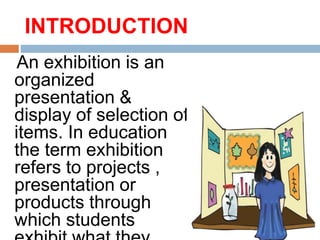
INTRODUCTION
An exhibition is an
organized
presentation &
display of selection of
items. In education
the term exhibition
refers to projects ,
presentation or
products through
which students
MEANING
 The word “exhibition” is used for
display a collection of items or
selection of items sometimes
“exhibit” is synonymous with
“exhibition”but “exhibit generally
refers to a single item being
exhibited within exhibition.
DEFINITION
 “Exhibition are a form of Audiovisual
material to display the projects done
by students and invite others to see
them and interect with them”.
 “Exhibitions are planned display of
models, specimens, charts, posters
etc. presented the public view for
instructions , judging in a competition
, advertising or entertainment.”
PURPOSE
 To introduce students to a new unit of
work.
 To develop creative thinking .
 To evaluate students via courses or
units.
 To give recognition to people or
institution by enabling them to display.
 To influence people to adopt better
OBJECTIVES
 Creates awareness and develops
relationship with new prospects
 Provides product demonstrations
 An opportunity to reach an audience with a
distinct interest the field and the products.
 Determine and stimulate needs of
customers
 Gathers competitive intelligence
 Introduce a new products
REQUISITES
 Central theme to a particular concept
 Clean and labled proprly
 Colour and size concept
 Visualizable
 Well lighted
 AV aids should be displayed relevent to
the theme
 Provision of integrated learning
FORMS OF EXHIBITION
 Senior exhibition : A multifaceted
assignments that serves as a
culminating academic and
intellectual experience for students
at the end of the academic
programme
FORMS OF EXHIBITION
 Student exhibition :A project
presentation or products that
teachers use as a form of
summative assessment i.e an
evaluating of student learning skill,
acquisition and academic
achievement at the end of the
conclusion of a defined instructional
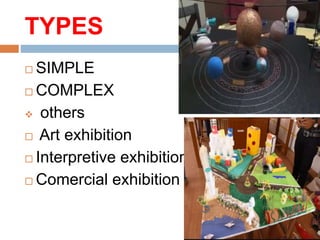
TYPES
 SIMPLE
 COMPLEX
 others
 Art exhibition
 Interpretive exhibition
 Comercial exhibition
ADVANTAGES
 It inspires to learn self.
 It gives sense of accomplishment and
achievement.
 It develops social skills of
communication cooperation and
coordination.
 It fostering a batter college or institution.
 It Diffuse and disseminate knowledge.
 It foster creativity.
DISADVANAGES
 Need intensive planning
 Time consuming
 Costlier
 Need imagination to prepare
 Need carefully intention on
central theme
INTRODUCTION
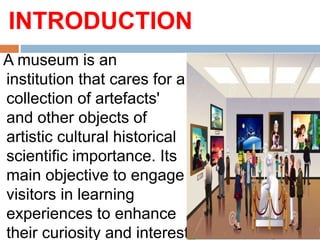
A museum is an
institution that cares for a
collection of artefacts'
and other objects of
artistic cultural historical
scientific importance. Its
main objective to engage
visitors in learning
experiences to enhance
their curiosity and interest
MEANING
 The word “museum” comes from
the Greek word “Muses means
arts ” and the Latin word “musea”
which means a building or
displaying a collection of arts or
historical relics thus it can also
called works of arts , works of
sciences, works of literatures.
DEFINITION
 Building in which objects of historical scientific,
artistic or cultural interest are stored and
exhibited.
 A museum is a nonprofit permanent institution
in the service of society and its development
open to the public which acquires, conserves,
communicates and exhibits the tangible and
nontangible heritage of humanity and its
environment for the purpose of education study
and enjoyment.
PURPOSE
 To collect, preserve, interpret and display items
of artistic, cultural or scientific significants for
the education of the public.
 To learn about the history of different countries.
 Enriches the educational process.
 To impact cultural education effectivity.
 Encourages and promote best of cultural and
democratic ideas of nation.
 Promotion of heritage of nation.
 To reflect mirror events in society.
CATEGORIES
A. FINE ARTS
B. ARCHAEOLOGY
C. ANTHROPOLOGY
D. ETHNOOLOGY
E. BIOGRAPHY
F. BOTANICAL GARDENS
G. ZOOLOGICAL GARDENS
H. NATURAL HISTORY
I. CHILDREN’S MUSEUM
J. TECHNOLOGY
K. WAR MUSEUMS
ADVANTAGES
 It enables peple to explore
collection for inspiration learning
and enjoyment.
 Inspires children to try new
things.
 It helps the people to learn from
the past.
 They hold trust for society.
DISADVANTAGES
 Community acceptance
 Museum / centre illiteracy
 Inaccesible infrastructure
> physical access
> redistribution of
powers
CONCLUSION
Exhibition is an organized presentation of
display of a selected item. While , museum
is an institution caring for collection of
artifacts and other objects of artistic, cultural,
historical or scientific importance. There are
multiple pre-requisites for arranging
exhibitions and making museums. both the
aviates are of great importance as they
induces better and integrated learning and
for reflecting mirror events.

Exhibition

  • 1.
  • 3.
    INTRODUCTION An exhibition isan organized presentation & display of selection of items. In education the term exhibition refers to projects , presentation or products through which students
  • 4.
    MEANING  The word“exhibition” is used for display a collection of items or selection of items sometimes “exhibit” is synonymous with “exhibition”but “exhibit generally refers to a single item being exhibited within exhibition.
  • 5.
    DEFINITION  “Exhibition area form of Audiovisual material to display the projects done by students and invite others to see them and interect with them”.  “Exhibitions are planned display of models, specimens, charts, posters etc. presented the public view for instructions , judging in a competition , advertising or entertainment.”
  • 6.
    PURPOSE  To introducestudents to a new unit of work.  To develop creative thinking .  To evaluate students via courses or units.  To give recognition to people or institution by enabling them to display.  To influence people to adopt better
  • 7.
    OBJECTIVES  Creates awarenessand develops relationship with new prospects  Provides product demonstrations  An opportunity to reach an audience with a distinct interest the field and the products.  Determine and stimulate needs of customers  Gathers competitive intelligence  Introduce a new products
  • 8.
    REQUISITES  Central themeto a particular concept  Clean and labled proprly  Colour and size concept  Visualizable  Well lighted  AV aids should be displayed relevent to the theme  Provision of integrated learning
  • 9.
    FORMS OF EXHIBITION Senior exhibition : A multifaceted assignments that serves as a culminating academic and intellectual experience for students at the end of the academic programme
  • 10.
    FORMS OF EXHIBITION Student exhibition :A project presentation or products that teachers use as a form of summative assessment i.e an evaluating of student learning skill, acquisition and academic achievement at the end of the conclusion of a defined instructional
  • 11.
    TYPES  SIMPLE  COMPLEX others  Art exhibition  Interpretive exhibition  Comercial exhibition
  • 14.
    ADVANTAGES  It inspiresto learn self.  It gives sense of accomplishment and achievement.  It develops social skills of communication cooperation and coordination.  It fostering a batter college or institution.  It Diffuse and disseminate knowledge.  It foster creativity.
  • 15.
    DISADVANAGES  Need intensiveplanning  Time consuming  Costlier  Need imagination to prepare  Need carefully intention on central theme
  • 17.
    INTRODUCTION A museum isan institution that cares for a collection of artefacts' and other objects of artistic cultural historical scientific importance. Its main objective to engage visitors in learning experiences to enhance their curiosity and interest
  • 18.
    MEANING  The word“museum” comes from the Greek word “Muses means arts ” and the Latin word “musea” which means a building or displaying a collection of arts or historical relics thus it can also called works of arts , works of sciences, works of literatures.
  • 19.
    DEFINITION  Building inwhich objects of historical scientific, artistic or cultural interest are stored and exhibited.  A museum is a nonprofit permanent institution in the service of society and its development open to the public which acquires, conserves, communicates and exhibits the tangible and nontangible heritage of humanity and its environment for the purpose of education study and enjoyment.
  • 20.
    PURPOSE  To collect,preserve, interpret and display items of artistic, cultural or scientific significants for the education of the public.  To learn about the history of different countries.  Enriches the educational process.  To impact cultural education effectivity.  Encourages and promote best of cultural and democratic ideas of nation.  Promotion of heritage of nation.  To reflect mirror events in society.
  • 21.
    CATEGORIES A. FINE ARTS B.ARCHAEOLOGY C. ANTHROPOLOGY D. ETHNOOLOGY E. BIOGRAPHY F. BOTANICAL GARDENS G. ZOOLOGICAL GARDENS H. NATURAL HISTORY I. CHILDREN’S MUSEUM J. TECHNOLOGY K. WAR MUSEUMS
  • 22.
    ADVANTAGES  It enablespeple to explore collection for inspiration learning and enjoyment.  Inspires children to try new things.  It helps the people to learn from the past.  They hold trust for society.
  • 23.
    DISADVANTAGES  Community acceptance Museum / centre illiteracy  Inaccesible infrastructure > physical access > redistribution of powers
  • 24.
    CONCLUSION Exhibition is anorganized presentation of display of a selected item. While , museum is an institution caring for collection of artifacts and other objects of artistic, cultural, historical or scientific importance. There are multiple pre-requisites for arranging exhibitions and making museums. both the aviates are of great importance as they induces better and integrated learning and for reflecting mirror events.