NITHI KRISHNA P P
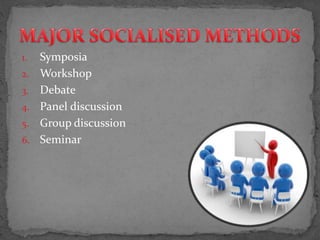
1. Symposia
2. Workshop
3. Debate
4. Panel discussion
5. Group discussion
6. Seminar
WHAT IS SYMPOSIUM?
 Discussion by different speakers on the same topic
emphasizing different aspects
 Chairman and speakers discuss the various aspects of a
theme in advance an allot to each one a particular
aspects
 Chairman co-ordinates the different presentations
 Total number of speakers not exceed 5 excluding
chairman
 Audience participation
WHEN SHOULD A SYMPOSIUM BE USED?
Several sides of one question
To stimulate fresh thinking on a topic
WHO ARE INVOLVED IN A SYMPOSIUM?
The theme
The chairman
The speaker
The audience
ADVANTAGES OF THE SYMPOSIUM
 Symposium brings together knowledgeable
speakers who present various opinions on a given
topic
 The problems can be explored quite thoroughly
by the symposium method
 The audience has the benefit of hearing different
points of view that can be challenging and
stimulating
DISADVANTAGES OF SYMPOSIUM
The formal structure tends to promote passivity
among audience since there is little scope for active
participation
Sometimes the symposium members fail to check the
scope with each other prior to the meeting which
results in repetition of information, confusion and
deviations from the assigned topic
It is sometimes difficult to find enough competent
speakers to cover the topic adequately
 The term workshop has been borrowed from ‘engineering’
 MEANING: In a workshop persons have to engage in some
productive task to produce something tangible. The
product may be some equipment, instructional material
,an action plan, etc.
 DEFINITION: “ Workshop is an assembled
group of ten to twenty five persons who share a common
interest or problem. They meet together to improve their
individual proficiency to solve a problem or to externalize
knowledge and skill of a subject through intensive practical
work and discussions.”
OBJECTIVE OF THE WORKSHOP
To improve the psychomotor skill of the learner
To make the subject matter interesting to the students
To motivate the students for a particular topic
To give training to teachers in specific areas
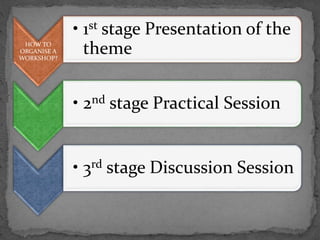
HOW TO
ORGANISE A
WORKSHOP?
• 1st stage Presentation of the
theme
• 2nd stage Practical Session
• 3rd stage Discussion Session
ADVANTAGES OF WORKSHOP TECHNIQUE
It is used to realise the cognitive and psychomotor
objectives
It helps to develop practical and realistic knowledge
regarding the topic concerned
It develops the feeling of co-operation and group work
It develops creativity of the students
It helps to avoid the fear to face a problematic situation
It results in the production of tangible material that
could be used by others
DISADVANTAGES OF WORKSHOP TECHNIQUE
Lack of motivation from the part of teacher may
adversely affect the workshop
Lack of availability of resource persons as well as
materials may create difficulty in conducting a
workshop
It is time consuming
Special room and facilities required may be absent in
school situation
Debate involve students in researching and
analysing a controversial topic based on a
stance which will lead to a series of oral
presentation of standpoints and arguments
by the two opposite teams
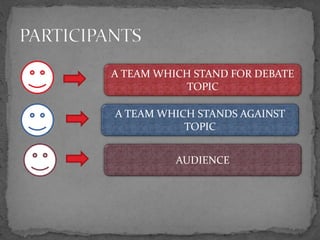
A TEAM WHICH STAND FOR DEBATE
TOPIC
A TEAM WHICH STANDS AGAINST
TOPIC
AUDIENCE
ADVANTAGES
Allow students to look at both sides of an issue
Improve students communication & expression
skills in a public setting
Enhance techniques of searching information
Foster appreciation of opposing viewpoints
Enhance debating/ arguing techniques against
opposing opinions
Allow more interactive exchange among students
and teachers
DISADVANTAGES
Students may not be familiar with debates as an
assessment method
Debates are time consuming
Students who do not like public speaking would be
less motivated in participating
socialised methods of teaching

socialised methods of teaching

  • 1.
  • 3.
    1. Symposia 2. Workshop 3.Debate 4. Panel discussion 5. Group discussion 6. Seminar
  • 4.
    WHAT IS SYMPOSIUM? Discussion by different speakers on the same topic emphasizing different aspects  Chairman and speakers discuss the various aspects of a theme in advance an allot to each one a particular aspects  Chairman co-ordinates the different presentations  Total number of speakers not exceed 5 excluding chairman  Audience participation
  • 5.
    WHEN SHOULD ASYMPOSIUM BE USED? Several sides of one question To stimulate fresh thinking on a topic
  • 7.
    WHO ARE INVOLVEDIN A SYMPOSIUM? The theme The chairman The speaker The audience
  • 8.
    ADVANTAGES OF THESYMPOSIUM  Symposium brings together knowledgeable speakers who present various opinions on a given topic  The problems can be explored quite thoroughly by the symposium method  The audience has the benefit of hearing different points of view that can be challenging and stimulating
  • 9.
    DISADVANTAGES OF SYMPOSIUM Theformal structure tends to promote passivity among audience since there is little scope for active participation Sometimes the symposium members fail to check the scope with each other prior to the meeting which results in repetition of information, confusion and deviations from the assigned topic It is sometimes difficult to find enough competent speakers to cover the topic adequately
  • 10.
     The termworkshop has been borrowed from ‘engineering’  MEANING: In a workshop persons have to engage in some productive task to produce something tangible. The product may be some equipment, instructional material ,an action plan, etc.  DEFINITION: “ Workshop is an assembled group of ten to twenty five persons who share a common interest or problem. They meet together to improve their individual proficiency to solve a problem or to externalize knowledge and skill of a subject through intensive practical work and discussions.”
  • 12.
    OBJECTIVE OF THEWORKSHOP To improve the psychomotor skill of the learner To make the subject matter interesting to the students To motivate the students for a particular topic To give training to teachers in specific areas
  • 13.
    HOW TO ORGANISE A WORKSHOP? •1st stage Presentation of the theme • 2nd stage Practical Session • 3rd stage Discussion Session
  • 14.
    ADVANTAGES OF WORKSHOPTECHNIQUE It is used to realise the cognitive and psychomotor objectives It helps to develop practical and realistic knowledge regarding the topic concerned It develops the feeling of co-operation and group work It develops creativity of the students It helps to avoid the fear to face a problematic situation It results in the production of tangible material that could be used by others
  • 15.
    DISADVANTAGES OF WORKSHOPTECHNIQUE Lack of motivation from the part of teacher may adversely affect the workshop Lack of availability of resource persons as well as materials may create difficulty in conducting a workshop It is time consuming Special room and facilities required may be absent in school situation
  • 16.
    Debate involve studentsin researching and analysing a controversial topic based on a stance which will lead to a series of oral presentation of standpoints and arguments by the two opposite teams
  • 17.
    A TEAM WHICHSTAND FOR DEBATE TOPIC A TEAM WHICH STANDS AGAINST TOPIC AUDIENCE
  • 18.
    ADVANTAGES Allow students tolook at both sides of an issue Improve students communication & expression skills in a public setting Enhance techniques of searching information Foster appreciation of opposing viewpoints Enhance debating/ arguing techniques against opposing opinions Allow more interactive exchange among students and teachers
  • 19.
    DISADVANTAGES Students may notbe familiar with debates as an assessment method Debates are time consuming Students who do not like public speaking would be less motivated in participating