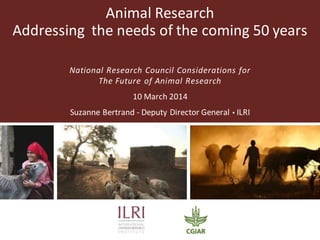
Animal Research
Addressing the needs of the coming 50 years
National Research Council Considerations for
The Future of Animal Research
10 March 2014
Suzanne Bertrand - Deputy Director General  ILRI
Animal agriculture to 2050:
TRENDS
GLOBAL TRENDS:
Livestock demand and
production are increasing rapidly
in developing countries
• Unprecedented rising demand
for livestock commodities will
continue over the coming 5
decades
• Where and how most
livestock commodities are
produced, sold and consumed
is changing significantly
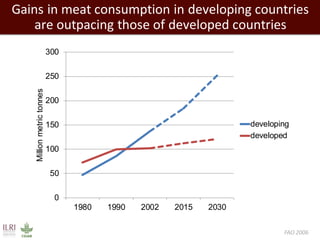
Gains in meat consumption in developing countries
are outpacing those of developed countries
0
50
100
150
200
250
300
1980 1990 2002 2015 2030
Millionmetrictonnes
developing
developed
FAO 2006
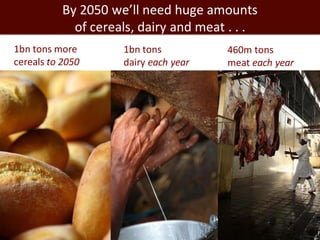
1bn tons more
cereals to 2050
1bn tons
dairy each year
460m tons
meat each year
By 2050 we’ll need huge amounts
of cereals, dairy and meat . . .
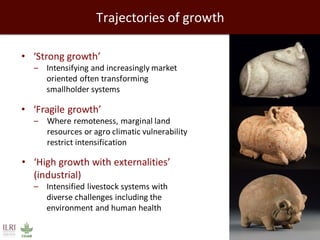
Trajectories of growth
• ‘Strong growth’
– Intensifying and increasingly market
oriented often transforming
smallholder systems
• ‘Fragile growth’
– Where remoteness, marginal land
resources or agro climatic vulnerability
restrict intensification
• ‘High growth with externalities’
(industrial)
– Intensified livestock systems with
diverse challenges including the
environment and human health
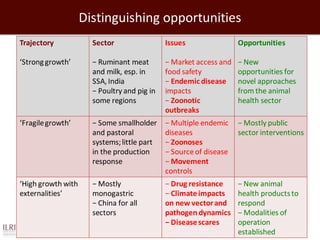
Trajectory
‘Stronggrowth’
Sector
− Ruminant meat
and milk, esp. in
SSA,India
− Poultry and pig in
some regions
Issues
− Market access and
food safety
− Endemicdisease
impacts
− Zoonotic
outbreaks
Opportunities
− New
opportunities for
novel approaches
from the animal
health sector
‘Fragilegrowth’ − Some smallholder
and pastoral
systems;little part
in the production
response
− Multiple endemic
diseases
− Zoonoses
− Source of disease
− Movement
controls
− Mostly public
sector interventions
‘High growth with
externalities’
− Mostly
monogastric
− China for all
sectors
− Drug resistance
− Climateimpacts
on new vectorand
pathogen dynamics
− Diseasescares
− New animal
health productsto
respond
− Modalities of
operation
established
Distinguishing opportunities
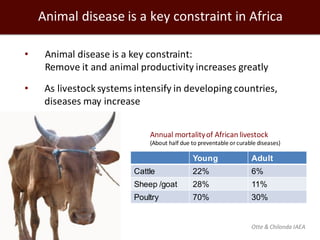
• Animal disease is a key constraint:
Remove it and animal productivity increases greatly
• As livestocksystems intensify in developing countries,
diseases may increase
Young Adult
Cattle 22% 6%
Sheep /goat 28% 11%
Poultry 70% 30%
Otte & Chilonda IAEA
Annual mortalityof African livestock
(About half due to preventable orcurable diseases)
Animal disease is a key constraint in Africa
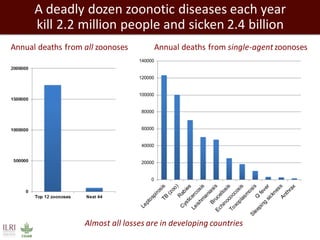
Almost all losses are in developing countries
A deadly dozen zoonotic diseases each year
kill 2.2 million people and sicken 2.4 billion
0
20000
40000
60000
80000
100000
120000
140000
Annual deaths from all zoonoses Annual deaths from single-agentzoonoses
Innovations, incentives and institutions
for addressing food safety
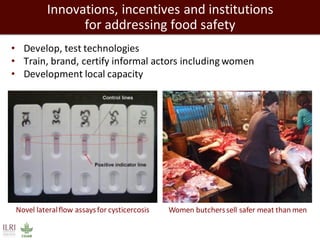
• Develop, test technologies
• Train, brand, certify informal actors including women
• Development local capacity
Novel lateralflow assaysfor cysticercosis Women butcherssell safer meat than men
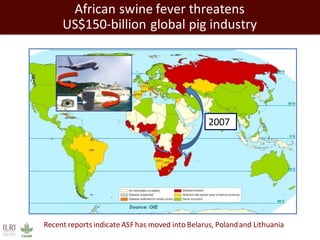
199
8
2007
African swine fever threatens
US$150-billion global pig industry
Recent reports indicate ASFhas moved into Belarus, Polandand Lithuania
Animal feed markets:
Opportunities in developing countries
• Feed technology
– Food-feed crops
– Ration formulation;
processing and storage
– Forage seed production
and marketing
• Institutional and market issues
• Feed regulatory policies
• Animal numbers and productivity
Livestock scenario: Climate catastrophe
• With broad acceptance that a +2oC climate increase has
occurred, drastic policies are put in place to prevent a further
rise to +4oC
– The livestock sector
is heavily taxed for
its contributions to
GHG emissions
– Prices for livestock
commodities skyrocket
– Livestock production,
sales and consumption
all plummet, leading
to increased poverty,
hunger and malnutrition
Thank you
The presentation has a Creative Commons licence. You are free to re-use or distribute this work, provided credit is given to ILRI.
better lives through livestock
ilri.org

Animal research: Addressing the needs of the coming 50 years

  • 1.
    Animal Research Addressing theneeds of the coming 50 years National Research Council Considerations for The Future of Animal Research 10 March 2014 Suzanne Bertrand - Deputy Director General  ILRI
  • 2.
    Animal agriculture to2050: TRENDS GLOBAL TRENDS: Livestock demand and production are increasing rapidly in developing countries • Unprecedented rising demand for livestock commodities will continue over the coming 5 decades • Where and how most livestock commodities are produced, sold and consumed is changing significantly
  • 3.
    Gains in meatconsumption in developing countries are outpacing those of developed countries 0 50 100 150 200 250 300 1980 1990 2002 2015 2030 Millionmetrictonnes developing developed FAO 2006
  • 4.
    1bn tons more cerealsto 2050 1bn tons dairy each year 460m tons meat each year By 2050 we’ll need huge amounts of cereals, dairy and meat . . .
  • 5.
    Trajectories of growth •‘Strong growth’ – Intensifying and increasingly market oriented often transforming smallholder systems • ‘Fragile growth’ – Where remoteness, marginal land resources or agro climatic vulnerability restrict intensification • ‘High growth with externalities’ (industrial) – Intensified livestock systems with diverse challenges including the environment and human health
  • 6.
    Trajectory ‘Stronggrowth’ Sector − Ruminant meat andmilk, esp. in SSA,India − Poultry and pig in some regions Issues − Market access and food safety − Endemicdisease impacts − Zoonotic outbreaks Opportunities − New opportunities for novel approaches from the animal health sector ‘Fragilegrowth’ − Some smallholder and pastoral systems;little part in the production response − Multiple endemic diseases − Zoonoses − Source of disease − Movement controls − Mostly public sector interventions ‘High growth with externalities’ − Mostly monogastric − China for all sectors − Drug resistance − Climateimpacts on new vectorand pathogen dynamics − Diseasescares − New animal health productsto respond − Modalities of operation established Distinguishing opportunities
  • 7.
    • Animal diseaseis a key constraint: Remove it and animal productivity increases greatly • As livestocksystems intensify in developing countries, diseases may increase Young Adult Cattle 22% 6% Sheep /goat 28% 11% Poultry 70% 30% Otte & Chilonda IAEA Annual mortalityof African livestock (About half due to preventable orcurable diseases) Animal disease is a key constraint in Africa
  • 8.
    Almost all lossesare in developing countries A deadly dozen zoonotic diseases each year kill 2.2 million people and sicken 2.4 billion 0 20000 40000 60000 80000 100000 120000 140000 Annual deaths from all zoonoses Annual deaths from single-agentzoonoses
  • 9.
    Innovations, incentives andinstitutions for addressing food safety • Develop, test technologies • Train, brand, certify informal actors including women • Development local capacity Novel lateralflow assaysfor cysticercosis Women butcherssell safer meat than men
  • 10.
    199 8 2007 African swine feverthreatens US$150-billion global pig industry Recent reports indicate ASFhas moved into Belarus, Polandand Lithuania
  • 11.
    Animal feed markets: Opportunitiesin developing countries • Feed technology – Food-feed crops – Ration formulation; processing and storage – Forage seed production and marketing • Institutional and market issues • Feed regulatory policies • Animal numbers and productivity
  • 12.
    Livestock scenario: Climatecatastrophe • With broad acceptance that a +2oC climate increase has occurred, drastic policies are put in place to prevent a further rise to +4oC – The livestock sector is heavily taxed for its contributions to GHG emissions – Prices for livestock commodities skyrocket – Livestock production, sales and consumption all plummet, leading to increased poverty, hunger and malnutrition
  • 13.
  • 14.
    The presentation hasa Creative Commons licence. You are free to re-use or distribute this work, provided credit is given to ILRI. better lives through livestock ilri.org