Ensuring livestock livelihoods and animal
source food security
20th IMS World Meat Congress,
Beijing, China, 14–16 June 2014
Steve Staal  Representative for E and SE Asia  ILRI
Outline
• Growing demand
• Role of smallholder producers
• Importance of livestock for smallholder
producers
• Smallholder competitiveness
• Key constraints
• The trajectories for livestock development
• Ensuring the continued role of livestock in rural
development
Animal agriculture to 2050:
TRENDS
GLOBAL TRENDS:
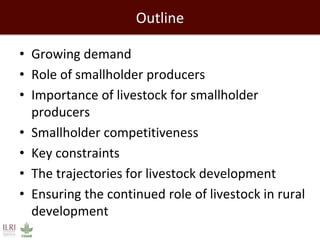
• Livestock have played a key role in
people’s livelihoods for millennia
• Unprecedented rising demand for
livestock commodities will
continue over the coming 5
decades
• Where and how most livestock
commodities are produced, sold
and consumed is changing
significantly; much of it still
smallholder
Rosegrant et al. 2009
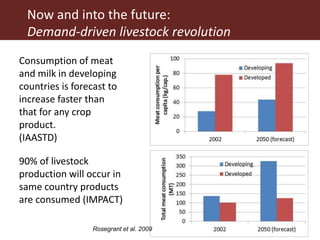
90% of livestock
production will occur in
same country products
are consumed (IMPACT)
Consumption of meat
and milk in developing
countries is forecast to
increase faster than
that for any crop
product.
(IAASTD)
Now and into the future:
Demand-driven livestock revolution
Livestock in developing countries
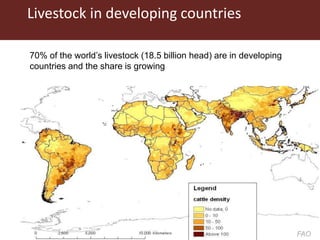
70% of the world’s livestock (18.5 billion head) are in developing
countries and the share is growing
FAO
Livestock keepers in developing countries
Density of poor
livestock keepers
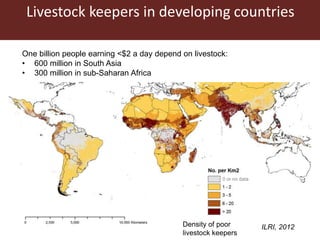
One billion people earning <$2 a day depend on livestock:
• 600 million in South Asia
• 300 million in sub-Saharan Africa
0 or no data
Density of poor
livestock keepers
ILRI, 2012
Livestock and livelihoods
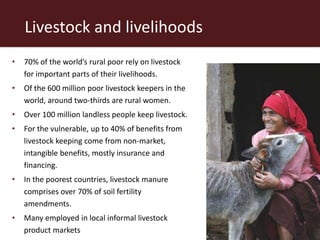
• 70% of the world’s rural poor rely on livestock
for important parts of their livelihoods.
• Of the 600 million poor livestock keepers in the
world, around two-thirds are rural women.
• Over 100 million landless people keep livestock.
• For the vulnerable, up to 40% of benefits from
livestock keeping come from non-market,
intangible benefits, mostly insurance and
financing.
• In the poorest countries, livestock manure
comprises over 70% of soil fertility
amendments.
• Many employed in local informal livestock
product markets
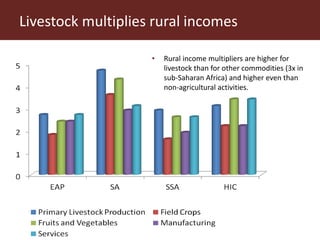
Livestock multiplies rural incomes
• Rural income multipliers are higher for
livestock than for other commodities (3x in
sub-Saharan Africa) and higher even than
non-agricultural activities.
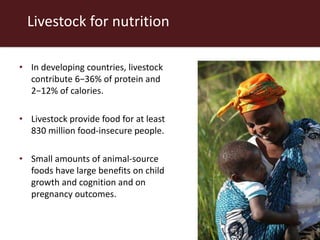
Livestock for nutrition
• In developing countries, livestock
contribute 6−36% of protein and
2−12% of calories.
• Livestock provide food for at least
830 million food-insecure people.
• Small amounts of animal-source
foods have large benefits on child
growth and cognition and on
pregnancy outcomes.
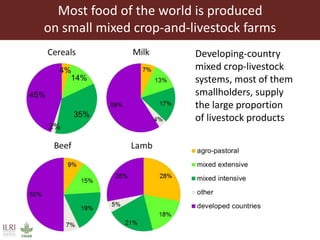
Most food of the world is produced
on small mixed crop-and-livestock farms
Developing-country
mixed crop-livestock
systems, most of them
smallholders, supply
the large proportion
of livestock products
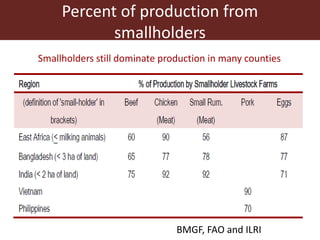
Percent of production from
smallholders
BMGF, FAO and ILRI
Smallholders still dominate production in many counties
Smallholder competitiveness
• The “household model” of production (multiple
objectives, multiple benefits).
• Multiple benefits, maximum use of low cost resources and farm synergies,
interactions, not completely dependent on profits, up to 40% non-market
“return”
• The large scale “enterprise model” of production (1
objective and benefit=profit)
• Capital intensive , mechanization and economies of scale advantages only
work when labor costs are high
• Multiple studies across continents demonstrates
reasons for underlying competitiveness
• limited economies of scale in production
• Often comparable unit costs of production, small vs large
• Fresh product markets also buffer import competition
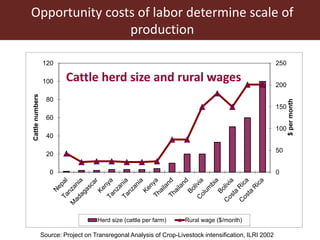
Opportunity costs of labor determine scale of
production
Source: Project on Transregonal Analysis of Crop-Livestock intensification, ILRI 2002
0
50
100
150
200
250
0
20
40
60
80
100
120
$permonth
Cattlenumbers
Herd size (cattle per farm) Rural wage ($/month)
Cattle herd size and rural wages
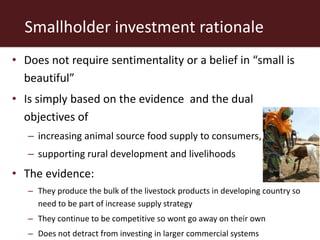
Smallholder investment rationale
• Does not require sentimentality or a belief in “small is
beautiful”
• Is simply based on the evidence and the dual
objectives of
– increasing animal source food supply to consumers,
– supporting rural development and livelihoods
• The evidence:
– They produce the bulk of the livestock products in developing country so
need to be part of increase supply strategy
– They continue to be competitive so wont go away on their own
– Does not detract from investing in larger commercial systems
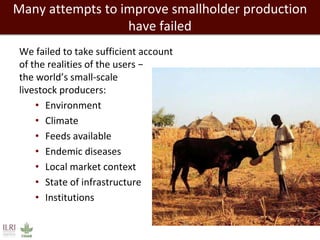
Many attempts to improve smallholder production
have failed
We failed to take sufficient account
of the realities of the users −
the world’s small-scale
livestock producers:
• Environment
• Climate
• Feeds available
• Endemic diseases
• Local market context
• State of infrastructure
• Institutions
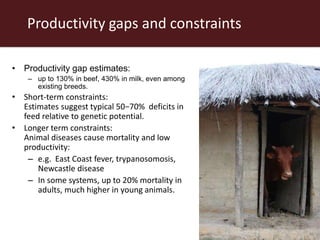
Productivity gaps and constraints
• Productivity gap estimates:
– up to 130% in beef, 430% in milk, even among
existing breeds.
• Short-term constraints:
Estimates suggest typical 50−70% deficits in
feed relative to genetic potential.
• Longer term constraints:
Animal diseases cause mortality and low
productivity:
– e.g. East Coast fever, trypanosomosis,
Newcastle disease
– In some systems, up to 20% mortality in
adults, much higher in young animals.
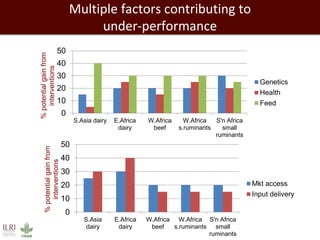
Multiple factors contributing to
under-performance
0
10
20
30
40
50
S.Asia dairy E.Africa
dairy
W.Africa
beef
W.Africa
s.ruminants
S'n Africa
small
ruminants
%potentialgainfrom
interventions
Genetics
Health
Feed
0
10
20
30
40
50
S.Asia
dairy
E.Africa
dairy
W.Africa
beef
W.Africa
s.ruminants
S'n Africa
small
ruminants
%potentialgainfrom
interventions
Mkt access
Input delivery
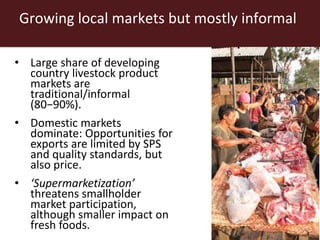
Growing local markets but mostly informal
• Large share of developing
country livestock product
markets are
traditional/informal
(80−90%).
• Domestic markets
dominate: Opportunities for
exports are limited by SPS
and quality standards, but
also price.
• ‘Supermarketization’
threatens smallholder
market participation,
although smaller impact on
fresh foods.
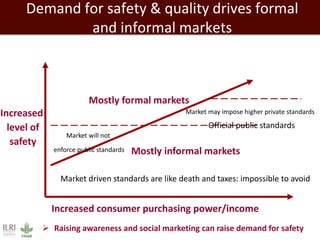
Demand for safety & quality drives formal
and informal markets
Increased
level of
safety
Increased consumer purchasing power/income
Market will not
enforce public standards
Market may impose higher private standards
Market driven standards are like death and taxes: impossible to avoid
 Raising awareness and social marketing can raise demand for safety
Official public standards
Mostly formal markets
Mostly informal markets
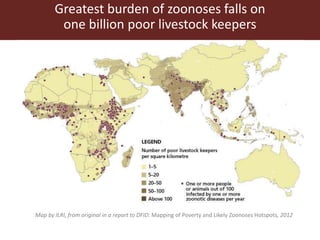
Greatest burden of zoonoses falls on
one billion poor livestock keepers
Map by ILRI, from original in a report to DFID: Mapping of Poverty and Likely Zoonoses Hotspots, 2012
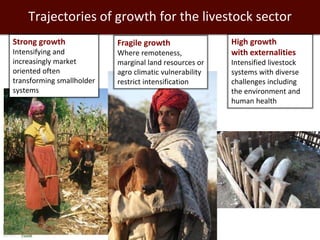
Trajectories of growth for the livestock sector
Strong growth
Intensifying and
increasingly market
oriented often
transforming smallholder
systems
Fragile growth
Where remoteness,
marginal land resources or
agro climatic vulnerability
restrict intensification
High growth
with externalities
Intensified livestock
systems with diverse
challenges including
the environment and
human health
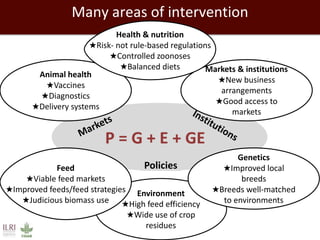
Many areas of intervention
Policies
Animal health
★Vaccines
★Diagnostics
★Delivery systems
Markets & institutions
★New business
arrangements
★Good access to
markets
Health & nutrition
★Risk- not rule-based regulations
★Controlled zoonoses
★Balanced diets
Environment
★High feed efficiency
★Wide use of crop
residues
Feed
★Viable feed markets
★Improved feeds/feed strategies
★Judicious biomass use
Genetics
★Improved local
breeds
★Breeds well-matched
to environments
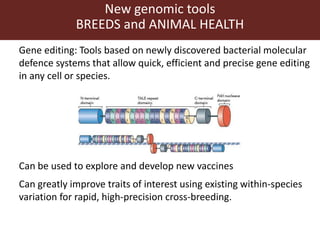
New genomic tools
BREEDS and ANIMAL HEALTH
Gene editing: Tools based on newly discovered bacterial molecular
defence systems that allow quick, efficient and precise gene editing
in any cell or species.
Can be used to explore and develop new vaccines
Can greatly improve traits of interest using existing within-species
variation for rapid, high-precision cross-breeding.
Opportunities
FOOD-FEED CROPS
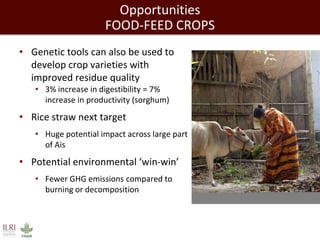
• Genetic tools can also be used to
develop crop varieties with
improved residue quality
• 3% increase in digestibility = 7%
increase in productivity (sorghum)
• Rice straw next target
• Huge potential impact across large part
of Ais
• Potential environmental ‘win-win’
• Fewer GHG emissions compared to
burning or decomposition
Opportunities
MARKETS
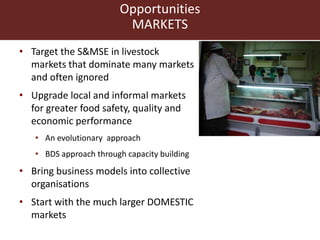
• Target the S&MSE in livestock
markets that dominate many markets
and often ignored
• Upgrade local and informal markets
for greater food safety, quality and
economic performance
• An evolutionary approach
• BDS approach through capacity building
• Bring business models into collective
organisations
• Start with the much larger DOMESTIC
markets
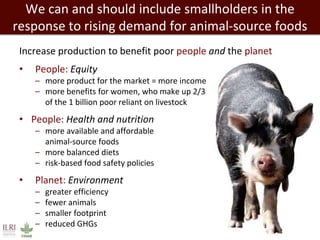
We can and should include smallholders in the
response to rising demand for animal-source foods
Increase production to benefit poor people and the planet
• People: Equity
– more product for the market = more income
– more benefits for women, who make up 2/3
of the 1 billion poor reliant on livestock
• People: Health and nutrition
– more available and affordable
animal-source foods
– more balanced diets
– risk-based food safety policies
• Planet: Environment
– greater efficiency
– fewer animals
– smaller footprint
– reduced GHGs
Key messages
1 Unprecedented demand for animal-source foods in developing
countries will continue to rise
2 Most meat, milk and eggs in developing countries come from
smallholders and are produced and consumed in the same
country
3 Big transitions in the world’s smallholder livestock systems
present big opportunities to address both technical and
institutional issues, benefiting both people and planet
4 Working with and through both smallholder and commercial
systems will both improve animal-source food supply and
transform rural livelihoods
The presentation has a Creative Commons licence. You are free to re-use or distribute this work, provided credit is given to ILRI.
better lives through livestock
ilri.org

Ensuring livestock livelihoods and animal source food security

  • 1.
    Ensuring livestock livelihoodsand animal source food security 20th IMS World Meat Congress, Beijing, China, 14–16 June 2014 Steve Staal  Representative for E and SE Asia  ILRI
  • 2.
    Outline • Growing demand •Role of smallholder producers • Importance of livestock for smallholder producers • Smallholder competitiveness • Key constraints • The trajectories for livestock development • Ensuring the continued role of livestock in rural development
  • 3.
    Animal agriculture to2050: TRENDS GLOBAL TRENDS: • Livestock have played a key role in people’s livelihoods for millennia • Unprecedented rising demand for livestock commodities will continue over the coming 5 decades • Where and how most livestock commodities are produced, sold and consumed is changing significantly; much of it still smallholder
  • 4.
    Rosegrant et al.2009 90% of livestock production will occur in same country products are consumed (IMPACT) Consumption of meat and milk in developing countries is forecast to increase faster than that for any crop product. (IAASTD) Now and into the future: Demand-driven livestock revolution
  • 5.
    Livestock in developingcountries 70% of the world’s livestock (18.5 billion head) are in developing countries and the share is growing FAO
  • 6.
    Livestock keepers indeveloping countries Density of poor livestock keepers One billion people earning <$2 a day depend on livestock: • 600 million in South Asia • 300 million in sub-Saharan Africa 0 or no data Density of poor livestock keepers ILRI, 2012
  • 7.
    Livestock and livelihoods •70% of the world’s rural poor rely on livestock for important parts of their livelihoods. • Of the 600 million poor livestock keepers in the world, around two-thirds are rural women. • Over 100 million landless people keep livestock. • For the vulnerable, up to 40% of benefits from livestock keeping come from non-market, intangible benefits, mostly insurance and financing. • In the poorest countries, livestock manure comprises over 70% of soil fertility amendments. • Many employed in local informal livestock product markets
  • 8.
    Livestock multiplies ruralincomes • Rural income multipliers are higher for livestock than for other commodities (3x in sub-Saharan Africa) and higher even than non-agricultural activities.
  • 9.
    Livestock for nutrition •In developing countries, livestock contribute 6−36% of protein and 2−12% of calories. • Livestock provide food for at least 830 million food-insecure people. • Small amounts of animal-source foods have large benefits on child growth and cognition and on pregnancy outcomes.
  • 10.
    Most food ofthe world is produced on small mixed crop-and-livestock farms Developing-country mixed crop-livestock systems, most of them smallholders, supply the large proportion of livestock products
  • 11.
    Percent of productionfrom smallholders BMGF, FAO and ILRI Smallholders still dominate production in many counties
  • 12.
    Smallholder competitiveness • The“household model” of production (multiple objectives, multiple benefits). • Multiple benefits, maximum use of low cost resources and farm synergies, interactions, not completely dependent on profits, up to 40% non-market “return” • The large scale “enterprise model” of production (1 objective and benefit=profit) • Capital intensive , mechanization and economies of scale advantages only work when labor costs are high • Multiple studies across continents demonstrates reasons for underlying competitiveness • limited economies of scale in production • Often comparable unit costs of production, small vs large • Fresh product markets also buffer import competition
  • 13.
    Opportunity costs oflabor determine scale of production Source: Project on Transregonal Analysis of Crop-Livestock intensification, ILRI 2002 0 50 100 150 200 250 0 20 40 60 80 100 120 $permonth Cattlenumbers Herd size (cattle per farm) Rural wage ($/month) Cattle herd size and rural wages
  • 14.
    Smallholder investment rationale •Does not require sentimentality or a belief in “small is beautiful” • Is simply based on the evidence and the dual objectives of – increasing animal source food supply to consumers, – supporting rural development and livelihoods • The evidence: – They produce the bulk of the livestock products in developing country so need to be part of increase supply strategy – They continue to be competitive so wont go away on their own – Does not detract from investing in larger commercial systems
  • 15.
    Many attempts toimprove smallholder production have failed We failed to take sufficient account of the realities of the users − the world’s small-scale livestock producers: • Environment • Climate • Feeds available • Endemic diseases • Local market context • State of infrastructure • Institutions
  • 16.
    Productivity gaps andconstraints • Productivity gap estimates: – up to 130% in beef, 430% in milk, even among existing breeds. • Short-term constraints: Estimates suggest typical 50−70% deficits in feed relative to genetic potential. • Longer term constraints: Animal diseases cause mortality and low productivity: – e.g. East Coast fever, trypanosomosis, Newcastle disease – In some systems, up to 20% mortality in adults, much higher in young animals.
  • 17.
    Multiple factors contributingto under-performance 0 10 20 30 40 50 S.Asia dairy E.Africa dairy W.Africa beef W.Africa s.ruminants S'n Africa small ruminants %potentialgainfrom interventions Genetics Health Feed 0 10 20 30 40 50 S.Asia dairy E.Africa dairy W.Africa beef W.Africa s.ruminants S'n Africa small ruminants %potentialgainfrom interventions Mkt access Input delivery
  • 18.
    Growing local marketsbut mostly informal • Large share of developing country livestock product markets are traditional/informal (80−90%). • Domestic markets dominate: Opportunities for exports are limited by SPS and quality standards, but also price. • ‘Supermarketization’ threatens smallholder market participation, although smaller impact on fresh foods.
  • 19.
    Demand for safety& quality drives formal and informal markets Increased level of safety Increased consumer purchasing power/income Market will not enforce public standards Market may impose higher private standards Market driven standards are like death and taxes: impossible to avoid  Raising awareness and social marketing can raise demand for safety Official public standards Mostly formal markets Mostly informal markets
  • 20.
    Greatest burden ofzoonoses falls on one billion poor livestock keepers Map by ILRI, from original in a report to DFID: Mapping of Poverty and Likely Zoonoses Hotspots, 2012
  • 21.
    Trajectories of growthfor the livestock sector Strong growth Intensifying and increasingly market oriented often transforming smallholder systems Fragile growth Where remoteness, marginal land resources or agro climatic vulnerability restrict intensification High growth with externalities Intensified livestock systems with diverse challenges including the environment and human health
  • 22.
    Many areas ofintervention Policies Animal health ★Vaccines ★Diagnostics ★Delivery systems Markets & institutions ★New business arrangements ★Good access to markets Health & nutrition ★Risk- not rule-based regulations ★Controlled zoonoses ★Balanced diets Environment ★High feed efficiency ★Wide use of crop residues Feed ★Viable feed markets ★Improved feeds/feed strategies ★Judicious biomass use Genetics ★Improved local breeds ★Breeds well-matched to environments
  • 23.
    New genomic tools BREEDSand ANIMAL HEALTH Gene editing: Tools based on newly discovered bacterial molecular defence systems that allow quick, efficient and precise gene editing in any cell or species. Can be used to explore and develop new vaccines Can greatly improve traits of interest using existing within-species variation for rapid, high-precision cross-breeding.
  • 24.
    Opportunities FOOD-FEED CROPS • Genetictools can also be used to develop crop varieties with improved residue quality • 3% increase in digestibility = 7% increase in productivity (sorghum) • Rice straw next target • Huge potential impact across large part of Ais • Potential environmental ‘win-win’ • Fewer GHG emissions compared to burning or decomposition
  • 25.
    Opportunities MARKETS • Target theS&MSE in livestock markets that dominate many markets and often ignored • Upgrade local and informal markets for greater food safety, quality and economic performance • An evolutionary approach • BDS approach through capacity building • Bring business models into collective organisations • Start with the much larger DOMESTIC markets
  • 26.
    We can andshould include smallholders in the response to rising demand for animal-source foods Increase production to benefit poor people and the planet • People: Equity – more product for the market = more income – more benefits for women, who make up 2/3 of the 1 billion poor reliant on livestock • People: Health and nutrition – more available and affordable animal-source foods – more balanced diets – risk-based food safety policies • Planet: Environment – greater efficiency – fewer animals – smaller footprint – reduced GHGs
  • 27.
    Key messages 1 Unprecedenteddemand for animal-source foods in developing countries will continue to rise 2 Most meat, milk and eggs in developing countries come from smallholders and are produced and consumed in the same country 3 Big transitions in the world’s smallholder livestock systems present big opportunities to address both technical and institutional issues, benefiting both people and planet 4 Working with and through both smallholder and commercial systems will both improve animal-source food supply and transform rural livelihoods
  • 28.
    The presentation hasa Creative Commons licence. You are free to re-use or distribute this work, provided credit is given to ILRI. better lives through livestock ilri.org