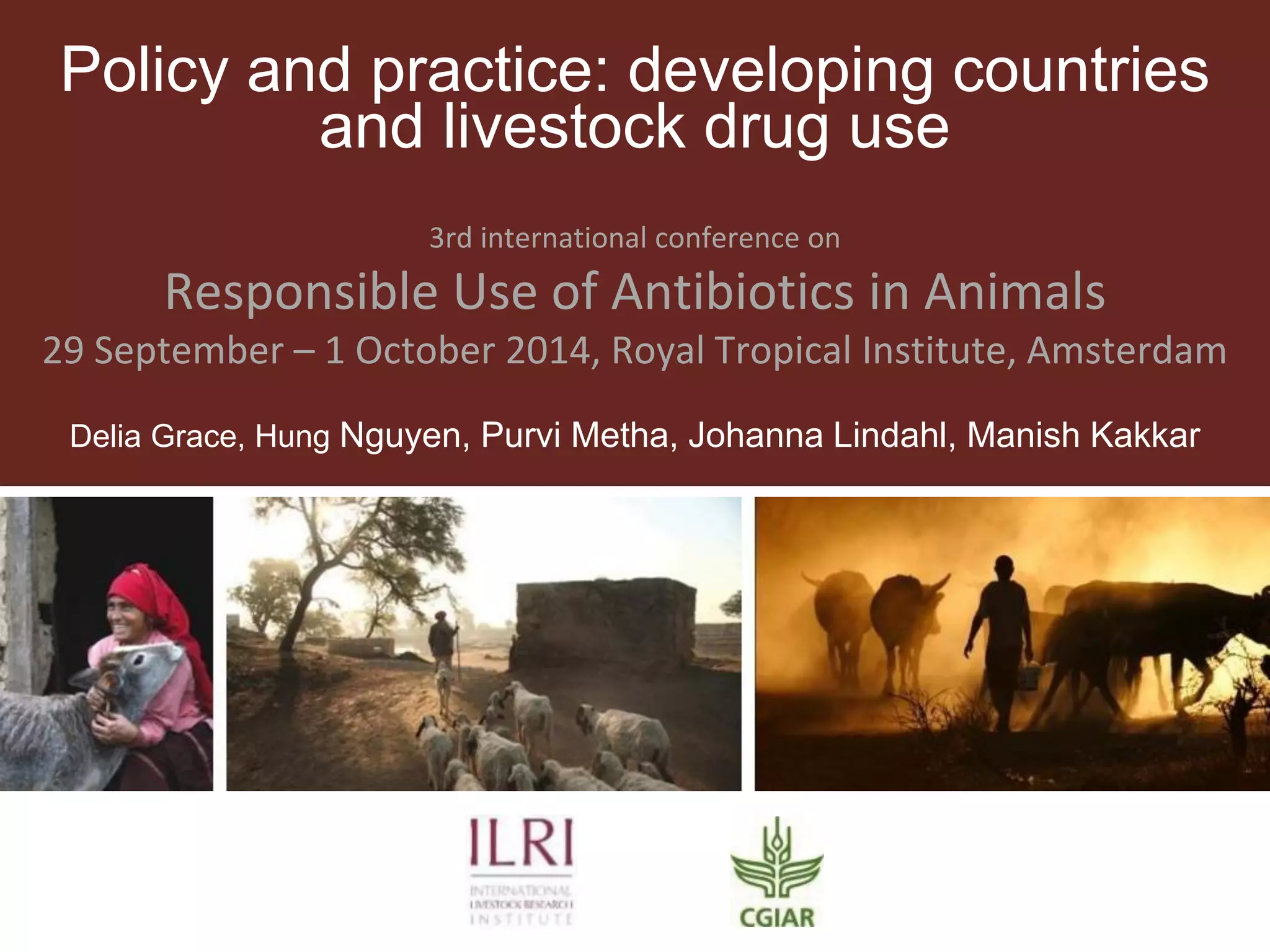
Policy and practice: developing countries and livestock drug use 
3rd international conference on 
Responsible Use of Antibiotics in Animals 
29 September – 1 October 2014, Royal Tropical Institute, Amsterdam 
Delia Grace, Hung Nguyen, Purvi Metha, Johanna Lindahl, Manish Kakkar
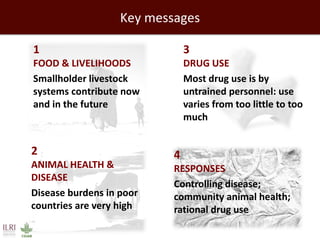
Key messages 
1 FOOD & LIVELIHOODS 
Smallholder livestock systems contribute now and in the future 
3 DRUG USE 
Most drug use is by untrained personnel: use varies from too little to too much 
2 ANIMAL HEALTH & DISEASE 
Disease burdens in poor countries are very high 
4 RESPONSES 
Controlling disease; community animal health; rational drug use
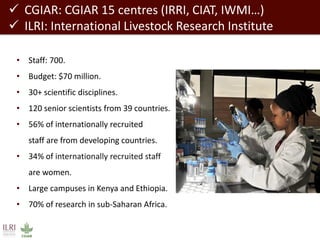
CGIAR: CGIAR 15 centres (IRRI, CIAT, IWMI…) 
ILRI: International Livestock Research Institute 
•Staff: 700. 
•Budget: $70 million. 
•30+ scientific disciplines. 
•120 senior scientists from 39 countries. 
•56% of internationally recruited staff are from developing countries. 
•34% of internationally recruited staff are women. 
•Large campuses in Kenya and Ethiopia. 
•70% of research in sub-Saharan Africa.
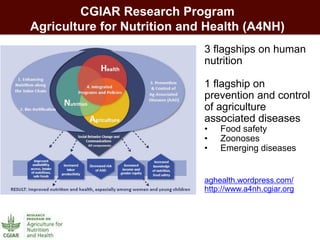
•3 flagships on human nutrition 
•1 flagship on prevention and control of agriculture associated diseases 
•Food safety 
•Zoonoses 
•Emerging diseases 
aghealth.wordpress.com/ 
http://www.a4nh.cgiar.org 
CGIAR Research Program Agriculture for Nutrition and Health (A4NH)
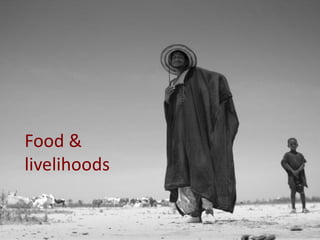
Food & livelihoods
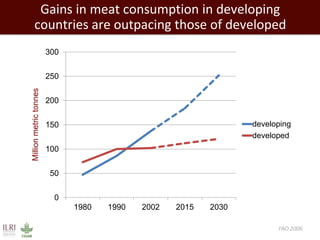
Gains in meat consumption in developing countries are outpacing those of developed 
0 
50 
100 
150 
200 
250 
300 
1980 
1990 
2002 
2015 
2030 
Million metric tonnes 
developing 
developed 
FAO 2006
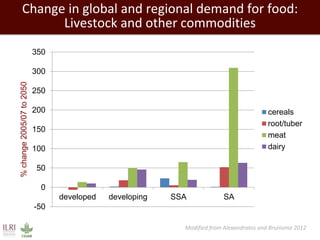
Change in global and regional demand for food: Livestock and other commodities 
-50 
0 
50 
100 
150 
200 
250 
300 
350 
developed 
developing 
SSA 
SA 
% change 2005/07 to 2050 
cereals 
root/tuber 
meat 
dairy 
Modified from Alexandratos and Bruinsma 2012
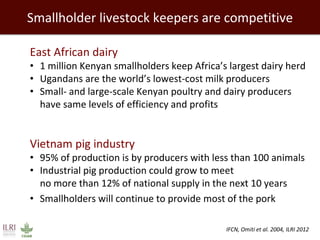
Smallholder livestock keepers are competitive 
East African dairy 
•1 million Kenyan smallholders keep Africa’s largest dairy herd 
•Ugandans are the world’s lowest-cost milk producers 
•Small- and large-scale Kenyan poultry and dairy producers have same levels of efficiency and profits 
Vietnam pig industry 
•95% of production is by producers with less than 100 animals 
•Industrial pig production could grow to meet no more than 12% of national supply in the next 10 years 
•Smallholders will continue to provide most of the pork 
IFCN, Omiti et al. 2004, ILRI 2012
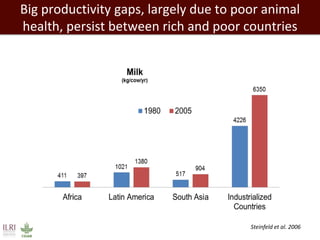
Steinfeld et al. 2006 
Big productivity gaps, largely due to poor animal health, persist between rich and poor countries
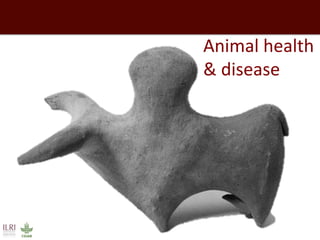
Animal health & disease
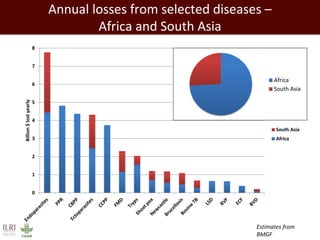
Annual losses from selected diseases – Africa and South Asia Estimates from BMGF 
0 
1 
2 
3 
4 
5 
6 
7 
8 
Billion $ lost yearly 
South Asia 
Africa 
Africa 
South Asia
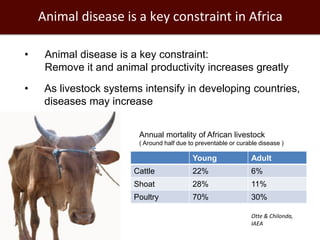
•Animal disease is a key constraint: Remove it and animal productivity increases greatly 
•As livestock systems intensify in developing countries, diseases may increase 
Young 
Adult 
Cattle 
22% 
6% 
Shoat 
28% 
11% 
Poultry 
70% 
30% 
Otte & Chilonda, IAEA 
Annual mortality of African livestock 
( Around half due to preventable or curable disease ) 
Animal disease is a key constraint in Africa
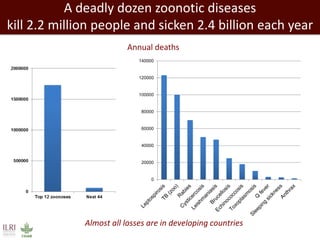
Almost all losses are in developing countries A deadly dozen zoonotic diseases kill 2.2 million people and sicken 2.4 billion each year 
0 
20000 
40000 
60000 
80000 
100000 
120000 
140000 
Annual deaths
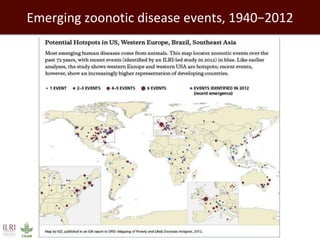
Emerging zoonotic disease events, 1940−2012
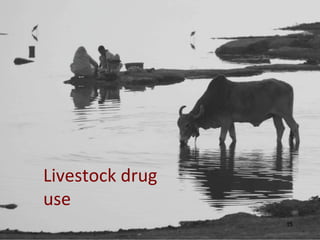
Livestock drug use 15
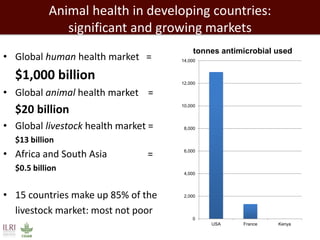
•Global human health market = $1,000 billion 
•Global animal health market = $20 billion 
•Global livestock health market = $13 billion 
•Africa and South Asia = $0.5 billion 
•15 countries make up 85% of the livestock market: most not poor 
Animal health in developing countries: 
significant and growing markets 
0 
2,000 
4,000 
6,000 
8,000 
10,000 
12,000 
14,000 
USA 
France 
Kenya 
tonnes antimicrobial used
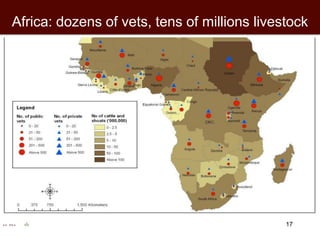
17 Africa: dozens of vets, tens of millions livestock
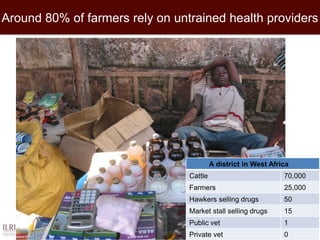
Around 80% of farmers rely on untrained health providers 
A district in West Africa 
Cattle 
70,000 
Farmers 
25,000 
Hawkers selling drugs 
50 
Market stall selling drugs 
15 
Public vet 
1 
Private vet 
0
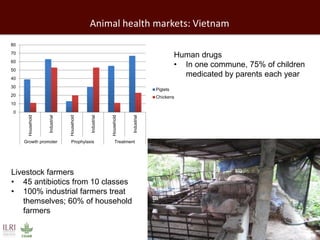
19 Animal health markets: Vietnam 
0 
10 
20 
30 
40 
50 
60 
70 
80 
Household 
Industrial 
Household 
Industrial 
Household 
Industrial 
Growth promoter 
Prophylaxis 
Treatment 
Piglets 
Chickens 
Livestock farmers 
•45 antibiotics from 10 classes 
•100% industrial farmers treat themselves; 60% of household farmers 
Human drugs 
•In one commune, 75% of children medicated by parents each year
RESPONSES
Research 4 development responses 
Risk assessment 
Survey residues 
Survey AMR organisms 
Survey drug use 
Examine relations between livestock & human AMR 
21 
Risk management 
Disease control 
Disease prevention 
–Vaccines 
–Resistant animals 
Community animal health 
Food quality improvements 
Rational drug use
22
23
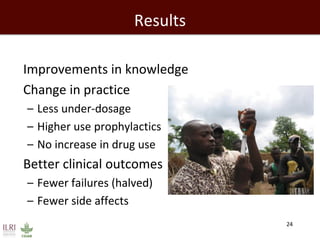
24 Results 
Improvements in knowledge 
Change in practice 
–Less under-dosage 
–Higher use prophylactics 
–No increase in drug use 
Better clinical outcomes 
–Fewer failures (halved) 
–Fewer side affects
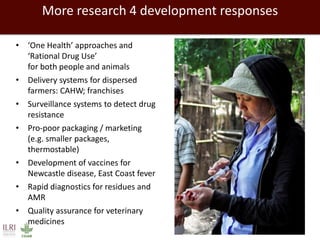
More research 4 development responses 
•‘One Health’ approaches and ‘Rational Drug Use’ for both people and animals 
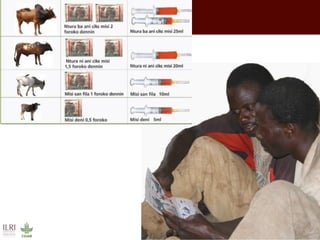
•Delivery systems for dispersed farmers: CAHW; franchises 
•Surveillance systems to detect drug resistance 
•Pro-poor packaging / marketing (e.g. smaller packages, thermostable) 
•Development of vaccines for Newcastle disease, East Coast fever 
•Rapid diagnostics for residues and AMR 
•Quality assurance for veterinary medicines
Policy responses 
Vietnam 
One health task force 
Situational analysis 
Policy workshops 
Member of regional initiatives 
Compliance international norms (export only) 
National Action plan 
26 
Kenya 
One health taskforce 
Global partnerships 
Situational analysis 
Compliance: export only
Key messages 
1 FOOD SECURITY 
Smallholder livestock essential 
2 DRUG USE 
Most drugs given by untrained; too little drug use a problem 
3 ANIMAL HEALTH 
Disease a heavy burden 
4 SUCCESSES EXIST 
CAHW, RDU, Vaccines
Acknowledgements 
This work was partially supported by IDRC, Canada through the PROMOTING HEALTH, LIVELIHOOD, AND SUSTAINABLE LIVESTOCK SYSTEMS project and by the CGIAR Research program on Agriculture for Nutrition and Health led by IFPRI, USA 
28
The presentation has a Creative Commons licence. You are free to re-use or distribute this work, provided credit is 
given to ILRI. 
Better lives through livestock 
ilri.org

Policy and practice: Developing countries and livestock drug use

  • 1.
    Policy and practice:developing countries and livestock drug use 3rd international conference on Responsible Use of Antibiotics in Animals 29 September – 1 October 2014, Royal Tropical Institute, Amsterdam Delia Grace, Hung Nguyen, Purvi Metha, Johanna Lindahl, Manish Kakkar
  • 2.
    Key messages 1FOOD & LIVELIHOODS Smallholder livestock systems contribute now and in the future 3 DRUG USE Most drug use is by untrained personnel: use varies from too little to too much 2 ANIMAL HEALTH & DISEASE Disease burdens in poor countries are very high 4 RESPONSES Controlling disease; community animal health; rational drug use
  • 3.
    CGIAR: CGIAR 15centres (IRRI, CIAT, IWMI…) ILRI: International Livestock Research Institute •Staff: 700. •Budget: $70 million. •30+ scientific disciplines. •120 senior scientists from 39 countries. •56% of internationally recruited staff are from developing countries. •34% of internationally recruited staff are women. •Large campuses in Kenya and Ethiopia. •70% of research in sub-Saharan Africa.
  • 4.
    •3 flagships onhuman nutrition •1 flagship on prevention and control of agriculture associated diseases •Food safety •Zoonoses •Emerging diseases aghealth.wordpress.com/ http://www.a4nh.cgiar.org CGIAR Research Program Agriculture for Nutrition and Health (A4NH)
  • 5.
  • 6.
    Gains in meatconsumption in developing countries are outpacing those of developed 0 50 100 150 200 250 300 1980 1990 2002 2015 2030 Million metric tonnes developing developed FAO 2006
  • 7.
    Change in globaland regional demand for food: Livestock and other commodities -50 0 50 100 150 200 250 300 350 developed developing SSA SA % change 2005/07 to 2050 cereals root/tuber meat dairy Modified from Alexandratos and Bruinsma 2012
  • 8.
    Smallholder livestock keepersare competitive East African dairy •1 million Kenyan smallholders keep Africa’s largest dairy herd •Ugandans are the world’s lowest-cost milk producers •Small- and large-scale Kenyan poultry and dairy producers have same levels of efficiency and profits Vietnam pig industry •95% of production is by producers with less than 100 animals •Industrial pig production could grow to meet no more than 12% of national supply in the next 10 years •Smallholders will continue to provide most of the pork IFCN, Omiti et al. 2004, ILRI 2012
  • 9.
    Steinfeld et al.2006 Big productivity gaps, largely due to poor animal health, persist between rich and poor countries
  • 10.
  • 11.
    Annual losses fromselected diseases – Africa and South Asia Estimates from BMGF 0 1 2 3 4 5 6 7 8 Billion $ lost yearly South Asia Africa Africa South Asia
  • 12.
    •Animal disease isa key constraint: Remove it and animal productivity increases greatly •As livestock systems intensify in developing countries, diseases may increase Young Adult Cattle 22% 6% Shoat 28% 11% Poultry 70% 30% Otte & Chilonda, IAEA Annual mortality of African livestock ( Around half due to preventable or curable disease ) Animal disease is a key constraint in Africa
  • 13.
    Almost all lossesare in developing countries A deadly dozen zoonotic diseases kill 2.2 million people and sicken 2.4 billion each year 0 20000 40000 60000 80000 100000 120000 140000 Annual deaths
  • 14.
    Emerging zoonotic diseaseevents, 1940−2012
  • 15.
  • 16.
    •Global human healthmarket = $1,000 billion •Global animal health market = $20 billion •Global livestock health market = $13 billion •Africa and South Asia = $0.5 billion •15 countries make up 85% of the livestock market: most not poor Animal health in developing countries: significant and growing markets 0 2,000 4,000 6,000 8,000 10,000 12,000 14,000 USA France Kenya tonnes antimicrobial used
  • 17.
    17 Africa: dozensof vets, tens of millions livestock
  • 18.
    Around 80% offarmers rely on untrained health providers A district in West Africa Cattle 70,000 Farmers 25,000 Hawkers selling drugs 50 Market stall selling drugs 15 Public vet 1 Private vet 0
  • 19.
    19 Animal healthmarkets: Vietnam 0 10 20 30 40 50 60 70 80 Household Industrial Household Industrial Household Industrial Growth promoter Prophylaxis Treatment Piglets Chickens Livestock farmers •45 antibiotics from 10 classes •100% industrial farmers treat themselves; 60% of household farmers Human drugs •In one commune, 75% of children medicated by parents each year
  • 20.
  • 21.
    Research 4 developmentresponses Risk assessment Survey residues Survey AMR organisms Survey drug use Examine relations between livestock & human AMR 21 Risk management Disease control Disease prevention –Vaccines –Resistant animals Community animal health Food quality improvements Rational drug use
  • 22.
  • 23.
  • 24.
    24 Results Improvementsin knowledge Change in practice –Less under-dosage –Higher use prophylactics –No increase in drug use Better clinical outcomes –Fewer failures (halved) –Fewer side affects
  • 25.
    More research 4development responses •‘One Health’ approaches and ‘Rational Drug Use’ for both people and animals •Delivery systems for dispersed farmers: CAHW; franchises •Surveillance systems to detect drug resistance •Pro-poor packaging / marketing (e.g. smaller packages, thermostable) •Development of vaccines for Newcastle disease, East Coast fever •Rapid diagnostics for residues and AMR •Quality assurance for veterinary medicines
  • 26.
    Policy responses Vietnam One health task force Situational analysis Policy workshops Member of regional initiatives Compliance international norms (export only) National Action plan 26 Kenya One health taskforce Global partnerships Situational analysis Compliance: export only
  • 27.
    Key messages 1FOOD SECURITY Smallholder livestock essential 2 DRUG USE Most drugs given by untrained; too little drug use a problem 3 ANIMAL HEALTH Disease a heavy burden 4 SUCCESSES EXIST CAHW, RDU, Vaccines
  • 28.
    Acknowledgements This workwas partially supported by IDRC, Canada through the PROMOTING HEALTH, LIVELIHOOD, AND SUSTAINABLE LIVESTOCK SYSTEMS project and by the CGIAR Research program on Agriculture for Nutrition and Health led by IFPRI, USA 28
  • 29.
    The presentation hasa Creative Commons licence. You are free to re-use or distribute this work, provided credit is given to ILRI. Better lives through livestock ilri.org