Livestock Research Contributions to the SDGs
Starting with the End in Mind:
Real-world evidence for real-world solutions
Jimmy Smith, ILRI Director General
Centre for Tropical Livestock Genetics and Health 2017 Annual Meeting,
Edinburgh, 26–29 September 2017
LIVESTOCK ARE ESSENTIAL
TO ACHIEVING THE SDGS—
which are now the currency
of development
across the whole world
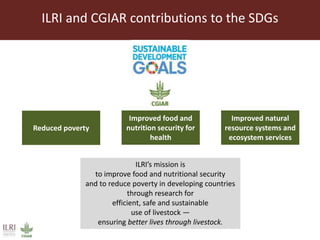
Improved food and
nutrition security for
health
Improved natural
resource systems and
ecosystem services
Reduced poverty
ILRI and CGIAR contributions to the SDGs
ILRI’s mission is
to improve food and nutritional security
and to reduce poverty in developing countries
through research for
efficient, safe and sustainable
use of livestock —
ensuring better lives through livestock.
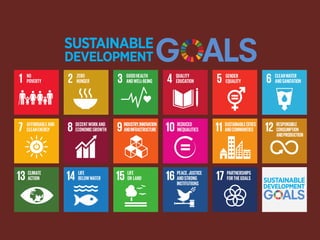
4 LIVESTOCK PATHWAYS
HELP MEET
ALL THE SDGS
with partnerships
at the centre
of each
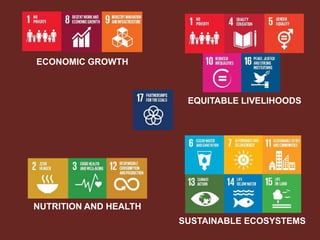
ECONOMIC GROWTH
EQUITABLE LIVELIHOODS
NUTRITION AND HEALTH
SUSTAINABLE ECOSYSTEMS
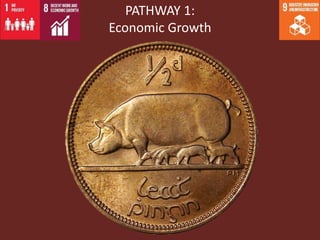
PATHWAY 1:
Economic Growth
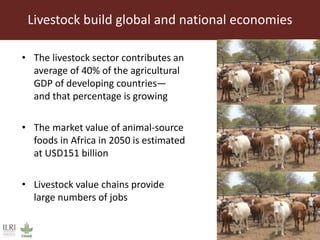
Livestock build global and national economies
• The livestock sector contributes an
average of 40% of the agricultural
GDP of developing countries—
and that percentage is growing
• The market value of animal-source
foods in Africa in 2050 is estimated
at USD151 billion
• Livestock value chains provide
large numbers of jobs
Herrero et al. 2014
Various sources:
BMGF, FAO and ILRI
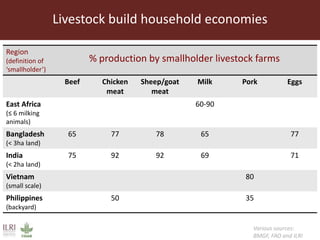
Livestock build household economies
Region
(definition of
‘smallholder’)
% production by smallholder livestock farms
Beef Chicken
meat
Sheep/goat
meat
Milk Pork Eggs
East Africa
(≤ 6 milking
animals)
60-90
Bangladesh
(< 3ha land)
65 77 78 65 77
India
(< 2ha land)
75 92 92 69 71
Vietnam
(small scale)
80
Philippines
(backyard)
50 35
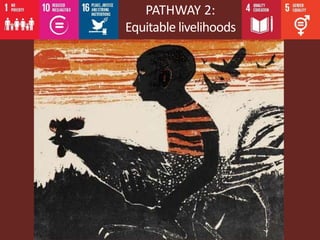
PATHWAY 2:
Equitable livelihoods
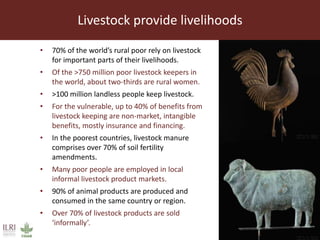
Livestock provide livelihoods
• 70% of the world’s rural poor rely on livestock
for important parts of their livelihoods.
• Of the >750 million poor livestock keepers in
the world, about two-thirds are rural women.
• >100 million landless people keep livestock.
• For the vulnerable, up to 40% of benefits from
livestock keeping are non-market, intangible
benefits, mostly insurance and financing.
• In the poorest countries, livestock manure
comprises over 70% of soil fertility
amendments.
• Many poor people are employed in local
informal livestock product markets.
• 90% of animal products are produced and
consumed in the same country or region.
• Over 70% of livestock products are sold
‘informally’.
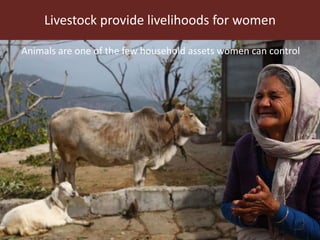
Livestock provide livelihoods for women
Animals are one of the few household assets women can control
PATHWAY 3:
Nutrition and health
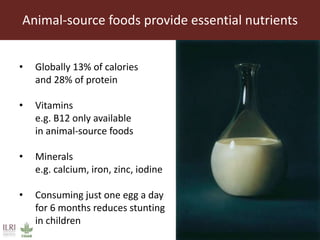
Animal-source foods provide essential nutrients
• Globally 13% of calories
and 28% of protein
• Vitamins
e.g. B12 only available
in animal-source foods
• Minerals
e.g. calcium, iron, zinc, iodine
• Consuming just one egg a day
for 6 months reduces stunting
in children
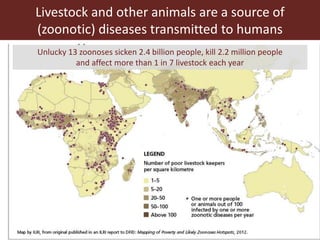
Unlucky 13 zoonoses sicken 2.4 billion people, kill 2.2 million people
and affect more than 1 in 7 livestock each year
Livestock and other animals are a source of
(zoonotic) diseases transmitted to humans
PATHWAY 4:
Ecosystem health
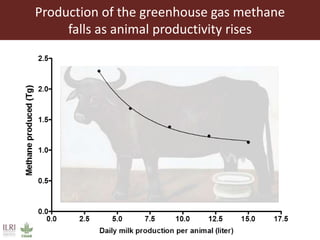
Production of the greenhouse gas methane
falls as animal productivity rises
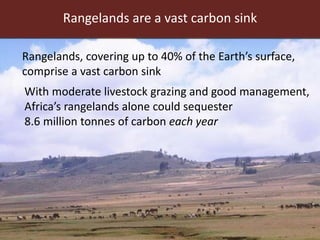
Rangelands are a vast carbon sink
Rangelands, covering up to 40% of the Earth’s surface,
comprise a vast carbon sink
With moderate livestock grazing and good management,
Africa’s rangelands alone could sequester
8.6 million tonnes of carbon each year
DELIVERING LIVESTOCK RESEARCH
‘WITH THE END IN MIND’
PATHWAY 1:
Economic Growth
PATHWAY 1:
Economic Growth
Advanced
bovine immunology
research resulted in an
infection-and-treatment
method of immunization
that prevents the disease
East Coast fever in cattle,
which occurs in 11 countries
of Africa, annually killing
1 million animals and
costing the region
$300 million.
PATHWAY 1:
Economic Growth
Can today’s
state-of-the-art
genetics,
immunology
and health research
be employed to spur
economic growth
?
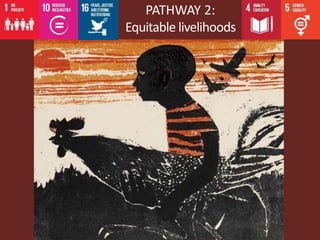
PATHWAY 2:
Equitable livelihoods
PATHWAY 2:
Equitable livelihoods
Development of a thermostable version
of the current effective vaccine
against sheep and goat plague
(‘peste des petits ruminants’),
can improve the livelihoods
of hundreds of millions of poor people
by preventing the morbidity and mortality
of some 30 million animals annually,
with losses valued at $1.2 billion each year.
Can the new gene,
genomics and vaccine
sciences and technologies
be used to develop
‘scale-neutral’ solutions
that help ensure a transition
to more equitable livelihoods
?
PATHWAY 2:
Equitable livelihoods
PATHWAY 3:
Nutrition and health
International research teams
used state-of-the-art models
to determine the first-ever
global assessment of
the extent of use of
antimicrobial drugs.
Worldwide livestock anti-
microbial consumption is
expected to rise 67%
between 2010 and 2030.
PATHWAY 3:
Nutrition and health
Can today’s
genetics and health research
come up with new means
of preventing animal diseases,
thereby enhancing the
responsible and fair use
of antimicrobials in livestock
production systems
?
PATHWAY 3:
Nutrition and health
PATHWAY 4:
Ecosystem health
New technologies in animal nutrition,
breeding and health led to a
63% reduction in the total
carbon footprint per unit of milk
in the US over a 60-year period.
Similar feasible improvements
in animal feeds, health and husbandry
in South Asia are expected to reduce
mixed dairy farming greenhouse
gas emissions by 38%.
PATHWAY 4:
Ecosystem health
What kinds of
technology
breakthroughs
could deliver further
significant efficiency gains
while also reducing
the carbon footprint of
animal agriculture still further
?
PATHWAY 4:
Ecosystem health
IMPERATIVES FOR
CONDUCTING LIVESTOCK RESEARCH
‘WITH THE END IN MIND’
So research is an imperative—
but not just any research
I’ve argued that livestock research
is an imperative for delivering on the SDGs.
But it’s not just any research that’s required.
Here are some of my thoughts on what doing
research
‘with the end in mind’ looks like.
1 Deliver solutions
for today as well as tomorrow
Demonstrate that research
is delivering results over the:
short
medium
longer
terms
2 Conduct research with the future in mind
The developing world’s livestock systems
are in big transition and transformation.
Our research solutions should ensure
that today’s smallholder producers contribute
to tomorrow’s sustainable livestock systems.
3 Ensure research is informed by
the evolving smallholder context
Understand the context in which
research-based interventions will be used
and the trajectories smallholders are taking.
Put smallholders at the centre of our research
for development: Transforming smallholder
agriculture is key to meeting the SDGs.
Tackle livestock development challenges
from the perspectives of ‘whole systems’.
Change what we do
to ensure that our research
complements and adds value
to other research components.
4 Avoid disciplinary insularity
5 Avoid blanket solutions
Take account of important trade-offs
as well as potential synergies.
Tailor solutions to reflect the diversity
of how farm animals worldwide are raised
and how their products are processed,
sold and consumed.
6 Harness the diverse priorities
of our diverse investors
Different donors have different priorities and
ambitions—e.g. upstream, mid-stream or
downstream; technical, biological or social;
community-based, institutional or political.
While serving the specific interests of donors,
let’s harness this diversity to ensure
that it adds up to holistic solutions covering
short- to medium- to long-term interventions.
ILRI is delighted to be working
in this productive partnership
providing real-world evidence
for real-world solutions
for achieving the SDGs
This presentation is licensed for use under the Creative Commons Attribution 4.0 International Licence.
better lives through livestock
ilri.org
ILRI thanks all donors and organizations who globally supported its work through their contributions
to the CGIAR system

Livestock research contributions to the SDGs—Starting with the End in Mind: Real-world evidence for real-world solutions

  • 1.
    Livestock Research Contributionsto the SDGs Starting with the End in Mind: Real-world evidence for real-world solutions Jimmy Smith, ILRI Director General Centre for Tropical Livestock Genetics and Health 2017 Annual Meeting, Edinburgh, 26–29 September 2017
  • 2.
    LIVESTOCK ARE ESSENTIAL TOACHIEVING THE SDGS— which are now the currency of development across the whole world
  • 3.
    Improved food and nutritionsecurity for health Improved natural resource systems and ecosystem services Reduced poverty ILRI and CGIAR contributions to the SDGs ILRI’s mission is to improve food and nutritional security and to reduce poverty in developing countries through research for efficient, safe and sustainable use of livestock — ensuring better lives through livestock.
  • 5.
    4 LIVESTOCK PATHWAYS HELPMEET ALL THE SDGS with partnerships at the centre of each
  • 6.
    ECONOMIC GROWTH EQUITABLE LIVELIHOODS NUTRITIONAND HEALTH SUSTAINABLE ECOSYSTEMS
  • 7.
  • 8.
    Livestock build globaland national economies • The livestock sector contributes an average of 40% of the agricultural GDP of developing countries— and that percentage is growing • The market value of animal-source foods in Africa in 2050 is estimated at USD151 billion • Livestock value chains provide large numbers of jobs Herrero et al. 2014
  • 9.
    Various sources: BMGF, FAOand ILRI Livestock build household economies Region (definition of ‘smallholder’) % production by smallholder livestock farms Beef Chicken meat Sheep/goat meat Milk Pork Eggs East Africa (≤ 6 milking animals) 60-90 Bangladesh (< 3ha land) 65 77 78 65 77 India (< 2ha land) 75 92 92 69 71 Vietnam (small scale) 80 Philippines (backyard) 50 35
  • 10.
  • 11.
    Livestock provide livelihoods •70% of the world’s rural poor rely on livestock for important parts of their livelihoods. • Of the >750 million poor livestock keepers in the world, about two-thirds are rural women. • >100 million landless people keep livestock. • For the vulnerable, up to 40% of benefits from livestock keeping are non-market, intangible benefits, mostly insurance and financing. • In the poorest countries, livestock manure comprises over 70% of soil fertility amendments. • Many poor people are employed in local informal livestock product markets. • 90% of animal products are produced and consumed in the same country or region. • Over 70% of livestock products are sold ‘informally’.
  • 12.
    Livestock provide livelihoodsfor women Animals are one of the few household assets women can control
  • 13.
  • 14.
    Animal-source foods provideessential nutrients • Globally 13% of calories and 28% of protein • Vitamins e.g. B12 only available in animal-source foods • Minerals e.g. calcium, iron, zinc, iodine • Consuming just one egg a day for 6 months reduces stunting in children
  • 15.
    Unlucky 13 zoonosessicken 2.4 billion people, kill 2.2 million people and affect more than 1 in 7 livestock each year Livestock and other animals are a source of (zoonotic) diseases transmitted to humans
  • 16.
  • 17.
    Production of thegreenhouse gas methane falls as animal productivity rises
  • 18.
    Rangelands are avast carbon sink Rangelands, covering up to 40% of the Earth’s surface, comprise a vast carbon sink With moderate livestock grazing and good management, Africa’s rangelands alone could sequester 8.6 million tonnes of carbon each year
  • 19.
  • 20.
  • 21.
    PATHWAY 1: Economic Growth Advanced bovineimmunology research resulted in an infection-and-treatment method of immunization that prevents the disease East Coast fever in cattle, which occurs in 11 countries of Africa, annually killing 1 million animals and costing the region $300 million.
  • 22.
    PATHWAY 1: Economic Growth Cantoday’s state-of-the-art genetics, immunology and health research be employed to spur economic growth ?
  • 23.
  • 24.
    PATHWAY 2: Equitable livelihoods Developmentof a thermostable version of the current effective vaccine against sheep and goat plague (‘peste des petits ruminants’), can improve the livelihoods of hundreds of millions of poor people by preventing the morbidity and mortality of some 30 million animals annually, with losses valued at $1.2 billion each year.
  • 25.
    Can the newgene, genomics and vaccine sciences and technologies be used to develop ‘scale-neutral’ solutions that help ensure a transition to more equitable livelihoods ? PATHWAY 2: Equitable livelihoods
  • 26.
  • 27.
    International research teams usedstate-of-the-art models to determine the first-ever global assessment of the extent of use of antimicrobial drugs. Worldwide livestock anti- microbial consumption is expected to rise 67% between 2010 and 2030. PATHWAY 3: Nutrition and health
  • 28.
    Can today’s genetics andhealth research come up with new means of preventing animal diseases, thereby enhancing the responsible and fair use of antimicrobials in livestock production systems ? PATHWAY 3: Nutrition and health
  • 29.
  • 30.
    New technologies inanimal nutrition, breeding and health led to a 63% reduction in the total carbon footprint per unit of milk in the US over a 60-year period. Similar feasible improvements in animal feeds, health and husbandry in South Asia are expected to reduce mixed dairy farming greenhouse gas emissions by 38%. PATHWAY 4: Ecosystem health
  • 31.
    What kinds of technology breakthroughs coulddeliver further significant efficiency gains while also reducing the carbon footprint of animal agriculture still further ? PATHWAY 4: Ecosystem health
  • 32.
    IMPERATIVES FOR CONDUCTING LIVESTOCKRESEARCH ‘WITH THE END IN MIND’
  • 33.
    So research isan imperative— but not just any research I’ve argued that livestock research is an imperative for delivering on the SDGs. But it’s not just any research that’s required. Here are some of my thoughts on what doing research ‘with the end in mind’ looks like.
  • 34.
    1 Deliver solutions fortoday as well as tomorrow Demonstrate that research is delivering results over the: short medium longer terms
  • 35.
    2 Conduct researchwith the future in mind The developing world’s livestock systems are in big transition and transformation. Our research solutions should ensure that today’s smallholder producers contribute to tomorrow’s sustainable livestock systems.
  • 36.
    3 Ensure researchis informed by the evolving smallholder context Understand the context in which research-based interventions will be used and the trajectories smallholders are taking. Put smallholders at the centre of our research for development: Transforming smallholder agriculture is key to meeting the SDGs.
  • 37.
    Tackle livestock developmentchallenges from the perspectives of ‘whole systems’. Change what we do to ensure that our research complements and adds value to other research components. 4 Avoid disciplinary insularity
  • 38.
    5 Avoid blanketsolutions Take account of important trade-offs as well as potential synergies. Tailor solutions to reflect the diversity of how farm animals worldwide are raised and how their products are processed, sold and consumed.
  • 39.
    6 Harness thediverse priorities of our diverse investors Different donors have different priorities and ambitions—e.g. upstream, mid-stream or downstream; technical, biological or social; community-based, institutional or political. While serving the specific interests of donors, let’s harness this diversity to ensure that it adds up to holistic solutions covering short- to medium- to long-term interventions.
  • 40.
    ILRI is delightedto be working in this productive partnership providing real-world evidence for real-world solutions for achieving the SDGs
  • 41.
    This presentation islicensed for use under the Creative Commons Attribution 4.0 International Licence. better lives through livestock ilri.org ILRI thanks all donors and organizations who globally supported its work through their contributions to the CGIAR system

Editor's Notes

  • #9 Business and livelihoods in African livestock. Investments to overcome information gaps, 2014. An output of the Livestock data innovation in Africa Project. Sponsored by the BMGF and jointly implemented by the World Bank, FAO, ILRI and AU-IBAR. World Bank Report no. 86093-AFR.
  • #10 Vietnam Small Scale Farming with Low Biosecurity                              1-2 sows, <20 pigs Small Scale Farming with Minimum Biosecurity                   50-20 sow, <100 pigs   Philippines Backyard  - any farm or household raising at least one head of animal and does not qualify as a commercial farm. Commercial - if it satisfies at least one of the following conditions: a) at least 21 heads of adults and zero young b) at least 41 heads of young animals c) at least 10 heads of adults and 22 heads of young.
  • #20 Starting with the end in mind, livestock-research-for-development works to achieve gains and impacts over the: Short Medium and Longer terms
  • #33 Starting with the end in mind, livestock-research-for-development works to achieve gains and impacts over the: Short Medium and Longer terms
  • #34 Research allows us: To take whole systems approaches To tap into many kinds of science to generate many kinds of science products To overcome siloed-thinking, insularities (of mandates and disciplines) (when you have a hammer, everything looks like a nail)
  • #35 Research allows us: To start with the end in mind so as to achieve gains and impacts over the: Short Medium Longer terms
  • #36 Research allows us: To understand context, guide observations and avoid pitfalls (if you haven’t experienced something, you can’t see it) For example, to understand that smallholders are competitive
  • #37 Research allows us: To understand context, guide observations and avoid pitfalls (if you haven’t experienced something, you can’t see it) For example, to understand that smallholders are competitive
  • #38 Research allows us: To take whole systems approaches To tap into many kinds of science to generate many kinds of science products To overcome siloed-thinking, insularities (of mandates and disciplines) (when you have a hammer, everything looks like a nail)
  • #39 Research allows us: To take whole systems approaches To tap into many kinds of science to generate many kinds of science products To overcome siloed-thinking, insularities (of mandates and disciplines) (when you have a hammer, everything looks like a nail)
  • #40 Research allows us: To start with the end in mind so as to achieve gains and impacts over the: Short Medium Longer terms
  • #41 Research allows us: To work in partnerships so as to achieve gains and impacts over the: Short Medium Longer terms