Assessment of pasta making quality parameters
  in Ethiopian durum wheat (Triticum turgidum
  L. var. durum) genotypes


       Mohammed Abinasa, Geremew Bultosa and Amsalu Ayana


     Wheat for Food Security in Africa Conference


                                                  October 8-12, 2012
                                    United Nations Conference Center,
                                                Addis Ababa, Ethiopia
Outline

 Introduction

 Materials and Methods
  Quality Analysis
  Statistical Analyses

 Results and Discussion

   Variations, heritability and genetic advance
   Genotype performance for quality parameters
   Correlation and path coefficient analysis

 Conclusions
Introduction
Wheat (Triticum spp.) is the most important cereal cultivated in Ethiopia.

Ethiopia is the largest wheat producing country in sub-Saharan Africa
and the third largest in Africa after Egypt and Algeria (FAOSTAT, 2010).

Both bread and durum wheats are produced in Ethiopia.

Durum wheats have been under cultivation in Ethiopia since ancient
times.

Various researchers (Simane, et al., 1993; Messele, 2001) reported the
uniqueness of the Ethiopian tetraploid wheat germplasm for different
useful traits.

Durum wheat is best adapted to regions having a relatively dry climate,
with hot days and cool nights during the growing season, typical of
Mediterranean and temperate climates.
Introduction…
Bale highlands of Southeastern Ethiopia are some of the
regions which are highly suitable for durum wheat
production.

Compositional and physical grain attributes distinguish
durum wheat from bread wheat and make it suitable to
produce high quality products such as pasta, semolina
and cuscous.

The acceptability of durum wheat varieties is greatly
influenced by its quality characteristics as it is an
important aspect of durum wheat.
Introduction
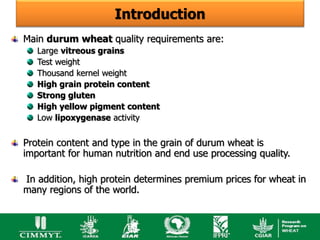
Main durum wheat quality requirements are:
   Large vitreous grains
   Test weight
   Thousand kernel weight
   High grain protein content
   Strong gluten
   High yellow pigment content
   Low lipoxygenase activity


Protein content and type in the grain of durum wheat is
important for human nutrition and end use processing quality.

In addition, high protein determines premium prices for wheat in
many regions of the world.
Introduction
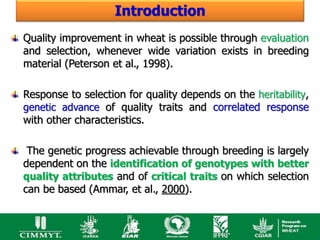
Quality improvement in wheat is possible through evaluation
and selection, whenever wide variation exists in breeding
material (Peterson et al., 1998).

Response to selection for quality depends on the heritability,
genetic advance of quality traits and correlated response
with other characteristics.

 The genetic progress achievable through breeding is largely
dependent on the identification of genotypes with better
quality attributes and of critical traits on which selection
can be based (Ammar, et al., 2000).
Introduction
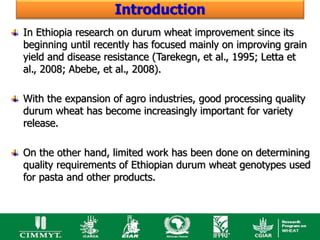
In Ethiopia research on durum wheat improvement since its
beginning until recently has focused mainly on improving grain
yield and disease resistance (Tarekegn, et al., 1995; Letta et
al., 2008; Abebe, et al., 2008).

With the expansion of agro industries, good processing quality
durum wheat has become increasingly important for variety
release.

On the other hand, limited work has been done on determining
quality requirements of Ethiopian durum wheat genotypes used
for pasta and other products.
Objectives

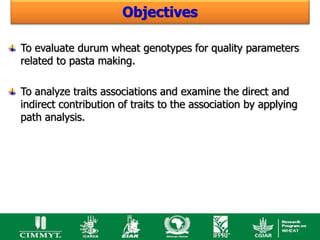
To evaluate durum wheat genotypes for quality parameters
related to pasta making.

To analyze traits associations and examine the direct and
indirect contribution of traits to the association by applying
path analysis.
Materials and Methods
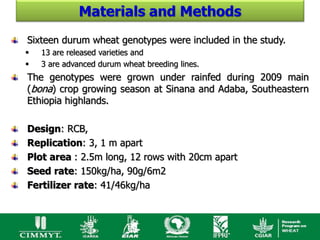
Sixteen durum wheat genotypes were included in the study.
   13 are released varieties and
   3 are advanced durum wheat breeding lines.
The genotypes were grown under rainfed during 2009 main
(bona) crop growing season at Sinana and Adaba, Southeastern
Ethiopia highlands.

Design: RCB,
Replication: 3, 1 m apart
Plot area : 2.5m long, 12 rows with 20cm apart
Seed rate: 150kg/ha, 90g/6m2
Fertilizer rate: 41/46kg/ha
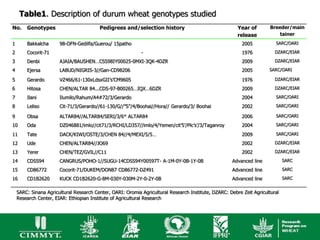
Table1. Description of durum wheat genotypes studied
No.     Genotypes                        Pedigrees and/selection history                                Year of        Breeder/main
                                                                                                        release            tainer
1       Bakkalcha      98-OFN-Gedilfa/Guerou/ 15patho                                                     2005           SARC/OARI

2       Cocorit-71                                          -                                             1976           DZARC/EIAR

3       Denbi          AJAIA/BAUSHEN…CSS98IY00025-0MXI-3QK-4DZR                                           2009           DZARC/EIAR

4       Ejersa         LABUD/NIGRIS-3//Gan-CD98206                                                        2005        SARC/OARI

5       Gerardo        VZ466/61-130xLdsxGII’s’CM9605                                                      1976           DZARC/EIAR

6       Hitosa         CHEN/ALTAR 84...CDS-97-B00265…IQX…6DZR                                             2009           DZARC/EIAR

7       Ilani          Ilumilo/Rahum/A4#72/3/Gerardo                                                      2004           SARC/OARI

8       Leliso         Cit-71/3/Gerardo//61-130/G//”S”/4/Boohai//Hora// Gerardo/3/ Boohai                 2002           SARC/OARI

9       Obsa           ALTAR84//ALTAR84/SERI/3/6* ALTAR84                                                 2006           SARC/OARI

10      Oda            DZ046881/imlo//cit71/3/RCHI/LD357//imlo/4/Yemen/cit’5’/Plc’s’/3/Taganroy           2004           SARC/OARI

11      Tate           DACK/KIWI/OSTE/3/CHEN 84//4/MEXI/5/5…                                              2009           SARC/OARI

12      Ude            CHEN/ALTAR84//JO69                                                                 2002           DZARC/EIAR

13      Yerer          CHEN/TEZ/GVIL//C11                                                                 2002           DZARC/EIAR

14      CDSS94         CANGRUS/POHO-1//SUGU-14CDSS94Y00597T- A-1M-0Y-0B-1Y-0B                        Advanced line            SARC

15      CD86772        Cocorit-71/DUKEM/DON87 CD86772-DZ491                                          Advanced line            SARC

16      CD1B2620       KUCK CD1B2620-G-8M-030Y-030M-2Y-0-2Y-0B                                       Advanced line            SARC


    SARC: Sinana Agricultural Research Center, OARI: Oromia Agricultural Research Institute, DZARC: Debre Zeit Agricultural
    Research Center, EIAR: Ethiopian Institute of Agricultural Research
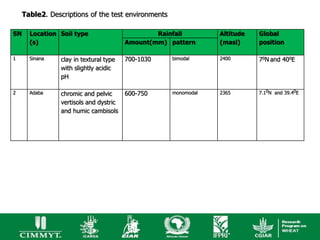
Table2. Descriptions of the test environments

SN     Location Soil type                        Rainfall        Altitude   Global
       (s)                               Amount(mm) pattern      (masl)     position

1      Sinana    clay in textural type   700-1030    bimodal     2400       70N and 400E
                 with slightly acidic
                 pH

2      Adaba     chromic and pelvic      600-750     monomodal   2365       7.10N and 39.40E

                 vertisols and dystric
                 and humic cambisols
Materials and Methods…
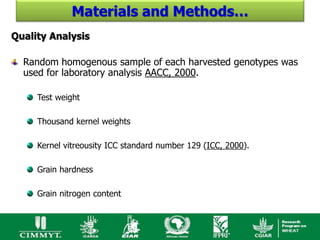
Quality Analysis

  Random homogenous sample of each harvested genotypes was
  used for laboratory analysis AACC, 2000.

     Test weight

     Thousand kernel weights

     Kernel vitreousity ICC standard number 129 (ICC, 2000).

     Grain hardness

     Grain nitrogen content
Materials and Methods…
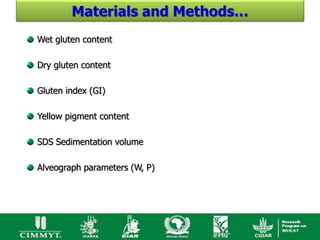
Wet gluten content

Dry gluten content

Gluten index (GI)

Yellow pigment content

SDS Sedimentation volume

Alveograph parameters (W, P)
Materials and Methods…

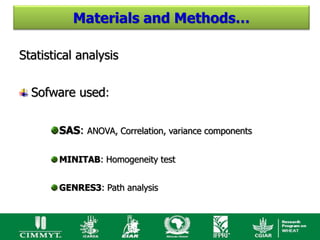
Statistical analysis

  Sofware used:


        SAS: ANOVA, Correlation, variance components

        MINITAB: Homogeneity test


        GENRES3: Path analysis
Materials and Methods…
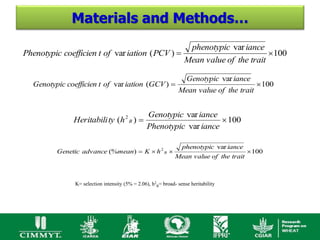
                                                                   phenotypic var iance
Phenotypic coefficien t of var iation ( PCV )                                            100
                                                                  Mean value of the trait

                                                                   Genotypic var iance
  Genotypic coefficien t of var iation (GCV )                                              100
                                                               Mean value of the trait


                                                Genotypic var iance
               Heritabili ty (h 2 B )                                100
                                                Phenotypic var iance

                                                                 phenotypic var iance
          Genetic advance (%mean)  K  h 2 B                                           100
                                                              Mean value of the trait


               K= selection intensity (5% = 2.06), h2B= broad- sense heritability
Results and Discussion
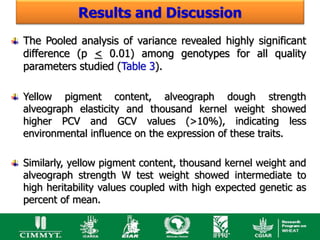
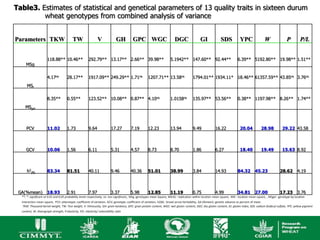
The Pooled analysis of variance revealed highly significant
difference (p < 0.01) among genotypes for all quality
parameters studied (Table 3).

Yellow pigment content, alveograph dough strength
alveograph elasticity and thousand kernel weight showed
higher PCV and GCV values (>10%), indicating less
environmental influence on the expression of these traits.

Similarly, yellow pigment content, thousand kernel weight and
alveograph strength W test weight showed intermediate to
high heritability values coupled with high expected genetic as
percent of mean.
Table3. Estimates of statistical and genetical parameters of 13 quality traits in sixteen durum
         wheat genotypes from combined analysis of variance


Parameters TKW                              TW                   V              GH         GPC WGC                          DGC                  GI              SDS             YPC                W                 P          P/L


                       118.88** 10.46**                  292.79** 13.17** 2.66** 39.98**                                 5.1942** 147.60** 92.44**                             6.39** 5192.80** 19.98** 1.51**
     MSg

                       4.17ns          28.17**           1917.09** 249.29** 1.71ns                     1207.71** 13.58ns                   1794.01** 1934.11* 18.46** 61357.59** 43.85ns 3.76ns
      MSl

                       8.35**          0.55**            123.52** 10.08** 0.87** 4.10ns                                  1.0158ns          135.97** 53.56**                    0.38** 1197.98** 8.26** 1.74**
    MSgxl


     PCV               11.02           1.73              9.64               17.27        7.19          12.23             13.94             9.49              16.22               20.04            28.98           29.22 43.58


     GCV               10.06           1.56              6.11               5.31         4.57          8.73              8.70              1.86              6.27                18.40            19.49           15.63 8.92


      h2(B)            83.34           81.51             40.11              9.46         40.36         51.01             38.99             3.84              14.93             84.32         45.23               28.62         4.19


 GA(%mean)             18.93           2.91              7.97               3.37         5.98          12.85             11.19             0.75              4.99              34.81         27.00               17.23         3.76
  **, *: significant at 0.01 and 0.05 probability levels respectively, ns: non significant,, MSg :genotypes mean Square, MSr(l) : replication within location mean square, MSl : location mean square, , MSgxl : genotype by location
  interaction mean square, PCV: phenotypic coefficient of variation, GCV; genotypic coefficient of variation, h2(B) : broad sense heritability, GA (%mean): genetic advance as percent of mean
   TKW: Thousand kernel weight, TW: Test weight, V: Vitreousity, GH: grain hardness, GPC: grain protein content, WGC: wet gluten content, DGC: dry gluten content, GI: gluten index, SDS: sodium Dodecyl sulfate, YPC: yellow pigment
  content, W: Alveograph strength, P:elasticity, P/L: elasticity/ extensibility ratio
Results and Discussion…
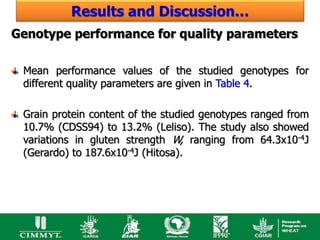
Genotype performance for quality parameters

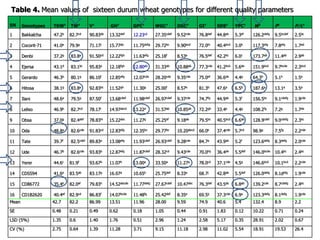
 Mean performance values of the studied genotypes for
 different quality parameters are given in Table 4.

 Grain protein content of the studied genotypes ranged from
 10.7% (CDSS94) to 13.2% (Leliso). The study also showed
 variations in gluten strength W, ranging from 64.3x10⁻⁴J
 (Gerardo) to 187.6x10⁻⁴J (Hitosa).
Table 4. Mean values of sixteen durum wheat genotypes for different quality parameters

SN     Genotypes    TKW‡     TW‡        V‡        GH‡          GPC‡        WGC‡        DGC‡        GI‡       SDS‡      YPC‡     W‡          P‡         P/L‡
1      Bakkalcha    47.2b    82.7cd     90.83de   13.32def     12.23cd     27.35cdef   9.52cde     76.8def   44.8ab    5.3ef    126.2defg   9.5bcdef   2.5bc

2      Cocorit-71   41.0e    79.9g      71.17j    15.77ab      11.75defg   29.72bc     9.90bcd     72.0hi    40.4bcd   3.0h     117.3efg    7.8efg     1.7ed

3      Denbi        37.2g    83.8a      91.50cd   12.22fgh     11.63efg    25.18f      8.53e       76.5def   42.2bc    6.0c     173.7ab     11.4ab     2.9ab

4      Ejersa       43.1d    83.1bc     95.83a    12.18fgh     12.80ab     31.33ab     10.88ab     77.3cde   41.2bcd   5.6de    151.9bcd    9.7bcde    2.3bcd

5      Gerardo      46.3b    80.1g      86.10f    12.85efg     12.07cde    28.20cde    9.35cde     75.0ef    36.6de    4.4g     64.3h       5.1h       1.5e

6      Hitosa       38.1g    83.8a      92.83bc   11.52gh      11.30g      25.00f      8.57e       81.3b     47.6a     6.5b     187.6a      13.1a      3.5a

7      Ilani        48.6a    79.5g      87.50f    13.68cdef    11.98cdef   26.97cdef   9.37cde     74.7fg    44.9ab    5.3f     156.5bc     9.1cdefg   1.9cde

8      Leliso       46.9b    82.7cd     78.17i    14.97abcd    13.22a      31.57ab     10.85ab     72.2gh    33.4e     4.4g     108.2fg     7.2g       1.7de

9      Obsa         37.0g    82.4def    78.83hi   15.22abc     11.27g      25.25ef     9.18de      79.5bc    40.5bcd   6.6ab    128.9cdef   9.0cdefg   2.3bc

10     Oda          48.8a    82.6cde    91.83cd   12.83efg     12.35bc     29.77bc     10.20abcd   66.0k     37.4cde   5.7cd    98.9g       7.5fg      2.2cde

11     Tate         39.7f    82.5cdef   89.83e    13.08efg     11.93cdef   26.93cdef   9.28cde     84.7a     43.9ab    5.2f     123.6defg   8.3defg    2.0cde

12     Ude          46.7b    82.6cde    93.83b    12.87efg     11.87cdef   28.32cd     9.43cde     70.0hij   36.4de    5.5def   146.0bcde   10.4bc     2.4bc

13     Yerer        44.6c    81.9f      93.67b    11.07h       13.00a      33.50a      11.27a      78.0cd    37.1cde   4.5g     146.6bcd    10.1bcd    2.2cde

14     CDSS94       41.6e    83.5ab     83.17g    16.07a       10.65h      25.75def    8.33e       68.7j     42.8ab    5.5def   126.0defg   8.1defg    1.9cde

15     CD86772      35.4h    82.0ef     79.83h    14.52abcde   11.77defg   27.67cdef   10.47abc    76.3def   43.5ab    6.8ab    139.2cde    8.7cdefg   2.4bc

16     CD1B2620     40.4ef   82.9cd     86.83f    14.07bcde    11.48fg     25.42def    8.35e       69.5ij    37.3cde   6.9a     123.3defg   8.1defg    1.9cde
Mean                42.7     82.2       86.99     13.51        11.96       28.00       9.59        74.9      40.6      5.4      132.4       8.9        2.2

SE                  0.48     0.21       0.49      0.62         0.18        1.05        0.44        0.91      1.83      0.12     10.22       0.71       0.24

LSD (5%)            1.35     0.6        1.40      1.76         0.51        2.96        1.24        2.58      5.17      0.35     28.91       2.02       0.67

CV (%)              2.75     0.64       1.39      11.28        3.71        9.15        11.18       2.98      11.02     5.54     18.91       19.53      26.4
Results and Discussion…
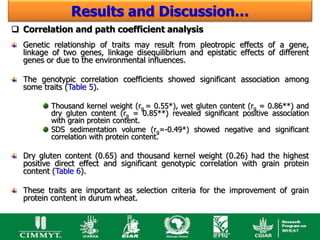
 Correlation and path coefficient analysis
  Genetic relationship of traits may result from pleotropic effects of a gene,
  linkage of two genes, linkage disequilibrium and epistatic effects of different
  genes or due to the environmental influences.

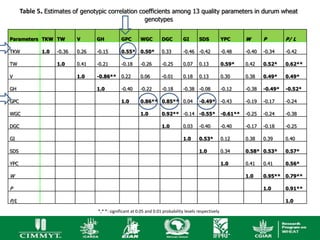
  The genotypic correlation coefficients showed significant association among
  some traits (Table 5).

         Thousand kernel weight (rg = 0.55*), wet gluten content (rg = 0.86**) and
         dry gluten content (rg = 0.85**) revealed significant positive association
         with grain protein content.
         SDS sedimentation volume (rg=-0.49*) showed negative and significant
         correlation with protein content.

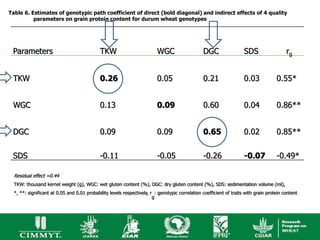
  Dry gluten content (0.65) and thousand kernel weight (0.26) had the highest
  positive direct effect and significant genotypic correlation with grain protein
  content (Table 6).

  These traits are important as selection criteria for the improvement of grain
  protein content in durum wheat.
Table 5. Estimates of genotypic correlation coefficients among 13 quality parameters in durum wheat
                                                           genotypes


Parameters TKW TW          V      GH          GPC        WGC         DGC         GI      SDS            YPC       W       P        P/ L

TKW          1.0   -0.36   0.26   -0.15       0.55*      0.50*       0.33        -0.46 -0.42            -0.48     -0.40   -0.34    -0.42

TW                 1.0     0.41   -0.21       -0.18      -0.26       -0.25       0.07    0.13           0.59*     0.42    0.52*    0.62**

V                          1.0    -0.86**     0.22       0.06        -0.01       0.18    0.13           0.30      0.38    0.49*    0.49*

GH                                1.0         -0.40      -0.22       -0.18       -0.38 -0.08            -0.12     -0.38   -0.49*   -0.52*

GPC                                           1.0        0.86** 0.85** 0.04              -0.49*         -0.43     -0.19   -0.17    -0.24

WGC                                                      1.0         0.92** -0.14 -0.55*                -0.61**   -0.25   -0.24    -0.38

DGC                                                                  1.0         0.03    -0.40          -0.40     -0.17   -0.18    -0.25

GI                                                                               1.0     0.53*          0.12      0.38    0.39     0.40

SDS                                                                                      1.0            0.34      0.58* 0.53*      0.57*

YPC                                                                                                     1.0       0.41    0.41     0.56*

W                                                                                                                 1.0     0.95**   0.79**

P                                                                                                                         1.0      0.91**

P/L                                                                                                                                1.0

                                  *,* *: significant at 0.05 and 0.01 probability levels respectively
Table 6. Estimates of genotypic path coefficient of direct (bold diagonal) and indirect effects of 4 quality
          parameters on grain protein content for durum wheat genotypes


 Parameters                                  TKW                          WGC                    DGC                  SDS                  rg


 TKW                                         0.26                         0.05                   0.21                 0.03            0.55*


 WGC                                         0.13                         0.09                   0.60                 0.04            0.86**


 DGC                                         0.09                         0.09                   0.65                 0.02            0.85**


 SDS                                         -0.11                        -0.05                  -0.26                -0.07           -0.49*

  Residual effect =0.44
  TKW: thousand kernel weight (g), WGC: wet gluten content (%), DGC: dry gluten content (%), SDS: sedimentation volume (ml),
  *, **: significant at 0.05 and 0.01 probability levels respectively, r : genotypic correlation coefficient of traits with grain protein content
                                                                        g
Conclusions
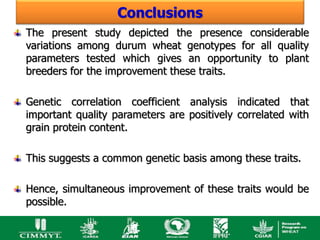
The present study depicted the presence considerable
variations among durum wheat genotypes for all quality
parameters tested which gives an opportunity to plant
breeders for the improvement these traits.

Genetic correlation coefficient analysis indicated that
important quality parameters are positively correlated with
grain protein content.

This suggests a common genetic basis among these traits.

Hence, simultaneous improvement of these traits would be
possible.
Conclusions
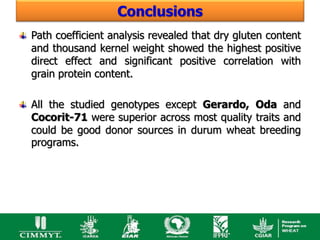
Path coefficient analysis revealed that dry gluten content
and thousand kernel weight showed the highest positive
direct effect and significant positive correlation with
grain protein content.

All the studied genotypes except Gerardo, Oda and
Cocorit-71 were superior across most quality traits and
could be good donor sources in durum wheat breeding
programs.
Future Research

The need for multi-environment trial (combinations of
locations and years)
Assessment of pasta making quality parameters in Ethiopian durum wheat (Triticum turgidum L. var. durum)

Assessment of pasta making quality parameters in Ethiopian durum wheat (Triticum turgidum L. var. durum)

  • 1.
    Assessment of pastamaking quality parameters in Ethiopian durum wheat (Triticum turgidum L. var. durum) genotypes Mohammed Abinasa, Geremew Bultosa and Amsalu Ayana Wheat for Food Security in Africa Conference October 8-12, 2012 United Nations Conference Center, Addis Ababa, Ethiopia
  • 2.
    Outline Introduction Materialsand Methods  Quality Analysis  Statistical Analyses Results and Discussion  Variations, heritability and genetic advance  Genotype performance for quality parameters  Correlation and path coefficient analysis Conclusions
  • 3.
    Introduction Wheat (Triticum spp.)is the most important cereal cultivated in Ethiopia. Ethiopia is the largest wheat producing country in sub-Saharan Africa and the third largest in Africa after Egypt and Algeria (FAOSTAT, 2010). Both bread and durum wheats are produced in Ethiopia. Durum wheats have been under cultivation in Ethiopia since ancient times. Various researchers (Simane, et al., 1993; Messele, 2001) reported the uniqueness of the Ethiopian tetraploid wheat germplasm for different useful traits. Durum wheat is best adapted to regions having a relatively dry climate, with hot days and cool nights during the growing season, typical of Mediterranean and temperate climates.
  • 4.
    Introduction… Bale highlands ofSoutheastern Ethiopia are some of the regions which are highly suitable for durum wheat production. Compositional and physical grain attributes distinguish durum wheat from bread wheat and make it suitable to produce high quality products such as pasta, semolina and cuscous. The acceptability of durum wheat varieties is greatly influenced by its quality characteristics as it is an important aspect of durum wheat.
  • 5.
    Introduction Main durum wheatquality requirements are: Large vitreous grains Test weight Thousand kernel weight High grain protein content Strong gluten High yellow pigment content Low lipoxygenase activity Protein content and type in the grain of durum wheat is important for human nutrition and end use processing quality. In addition, high protein determines premium prices for wheat in many regions of the world.
  • 6.
    Introduction Quality improvement inwheat is possible through evaluation and selection, whenever wide variation exists in breeding material (Peterson et al., 1998). Response to selection for quality depends on the heritability, genetic advance of quality traits and correlated response with other characteristics. The genetic progress achievable through breeding is largely dependent on the identification of genotypes with better quality attributes and of critical traits on which selection can be based (Ammar, et al., 2000).
  • 7.
    Introduction In Ethiopia researchon durum wheat improvement since its beginning until recently has focused mainly on improving grain yield and disease resistance (Tarekegn, et al., 1995; Letta et al., 2008; Abebe, et al., 2008). With the expansion of agro industries, good processing quality durum wheat has become increasingly important for variety release. On the other hand, limited work has been done on determining quality requirements of Ethiopian durum wheat genotypes used for pasta and other products.
  • 8.
    Objectives To evaluate durumwheat genotypes for quality parameters related to pasta making. To analyze traits associations and examine the direct and indirect contribution of traits to the association by applying path analysis.
  • 9.
    Materials and Methods Sixteendurum wheat genotypes were included in the study.  13 are released varieties and  3 are advanced durum wheat breeding lines. The genotypes were grown under rainfed during 2009 main (bona) crop growing season at Sinana and Adaba, Southeastern Ethiopia highlands. Design: RCB, Replication: 3, 1 m apart Plot area : 2.5m long, 12 rows with 20cm apart Seed rate: 150kg/ha, 90g/6m2 Fertilizer rate: 41/46kg/ha
  • 10.
    Table1. Description ofdurum wheat genotypes studied No. Genotypes Pedigrees and/selection history Year of Breeder/main release tainer 1 Bakkalcha 98-OFN-Gedilfa/Guerou/ 15patho 2005 SARC/OARI 2 Cocorit-71 - 1976 DZARC/EIAR 3 Denbi AJAIA/BAUSHEN…CSS98IY00025-0MXI-3QK-4DZR 2009 DZARC/EIAR 4 Ejersa LABUD/NIGRIS-3//Gan-CD98206 2005 SARC/OARI 5 Gerardo VZ466/61-130xLdsxGII’s’CM9605 1976 DZARC/EIAR 6 Hitosa CHEN/ALTAR 84...CDS-97-B00265…IQX…6DZR 2009 DZARC/EIAR 7 Ilani Ilumilo/Rahum/A4#72/3/Gerardo 2004 SARC/OARI 8 Leliso Cit-71/3/Gerardo//61-130/G//”S”/4/Boohai//Hora// Gerardo/3/ Boohai 2002 SARC/OARI 9 Obsa ALTAR84//ALTAR84/SERI/3/6* ALTAR84 2006 SARC/OARI 10 Oda DZ046881/imlo//cit71/3/RCHI/LD357//imlo/4/Yemen/cit’5’/Plc’s’/3/Taganroy 2004 SARC/OARI 11 Tate DACK/KIWI/OSTE/3/CHEN 84//4/MEXI/5/5… 2009 SARC/OARI 12 Ude CHEN/ALTAR84//JO69 2002 DZARC/EIAR 13 Yerer CHEN/TEZ/GVIL//C11 2002 DZARC/EIAR 14 CDSS94 CANGRUS/POHO-1//SUGU-14CDSS94Y00597T- A-1M-0Y-0B-1Y-0B Advanced line SARC 15 CD86772 Cocorit-71/DUKEM/DON87 CD86772-DZ491 Advanced line SARC 16 CD1B2620 KUCK CD1B2620-G-8M-030Y-030M-2Y-0-2Y-0B Advanced line SARC SARC: Sinana Agricultural Research Center, OARI: Oromia Agricultural Research Institute, DZARC: Debre Zeit Agricultural Research Center, EIAR: Ethiopian Institute of Agricultural Research
  • 11.
    Table2. Descriptions ofthe test environments SN Location Soil type Rainfall Altitude Global (s) Amount(mm) pattern (masl) position 1 Sinana clay in textural type 700-1030 bimodal 2400 70N and 400E with slightly acidic pH 2 Adaba chromic and pelvic 600-750 monomodal 2365 7.10N and 39.40E vertisols and dystric and humic cambisols
  • 12.
    Materials and Methods… QualityAnalysis Random homogenous sample of each harvested genotypes was used for laboratory analysis AACC, 2000. Test weight Thousand kernel weights Kernel vitreousity ICC standard number 129 (ICC, 2000). Grain hardness Grain nitrogen content
  • 13.
    Materials and Methods… Wetgluten content Dry gluten content Gluten index (GI) Yellow pigment content SDS Sedimentation volume Alveograph parameters (W, P)
  • 14.
    Materials and Methods… Statisticalanalysis Sofware used: SAS: ANOVA, Correlation, variance components MINITAB: Homogeneity test GENRES3: Path analysis
  • 15.
    Materials and Methods… phenotypic var iance Phenotypic coefficien t of var iation ( PCV )  100 Mean value of the trait Genotypic var iance Genotypic coefficien t of var iation (GCV )   100 Mean value of the trait Genotypic var iance Heritabili ty (h 2 B )   100 Phenotypic var iance phenotypic var iance Genetic advance (%mean)  K  h 2 B   100 Mean value of the trait K= selection intensity (5% = 2.06), h2B= broad- sense heritability
  • 16.
    Results and Discussion ThePooled analysis of variance revealed highly significant difference (p < 0.01) among genotypes for all quality parameters studied (Table 3). Yellow pigment content, alveograph dough strength alveograph elasticity and thousand kernel weight showed higher PCV and GCV values (>10%), indicating less environmental influence on the expression of these traits. Similarly, yellow pigment content, thousand kernel weight and alveograph strength W test weight showed intermediate to high heritability values coupled with high expected genetic as percent of mean.
  • 17.
    Table3. Estimates ofstatistical and genetical parameters of 13 quality traits in sixteen durum wheat genotypes from combined analysis of variance Parameters TKW TW V GH GPC WGC DGC GI SDS YPC W P P/L 118.88** 10.46** 292.79** 13.17** 2.66** 39.98** 5.1942** 147.60** 92.44** 6.39** 5192.80** 19.98** 1.51** MSg 4.17ns 28.17** 1917.09** 249.29** 1.71ns 1207.71** 13.58ns 1794.01** 1934.11* 18.46** 61357.59** 43.85ns 3.76ns MSl 8.35** 0.55** 123.52** 10.08** 0.87** 4.10ns 1.0158ns 135.97** 53.56** 0.38** 1197.98** 8.26** 1.74** MSgxl PCV 11.02 1.73 9.64 17.27 7.19 12.23 13.94 9.49 16.22 20.04 28.98 29.22 43.58 GCV 10.06 1.56 6.11 5.31 4.57 8.73 8.70 1.86 6.27 18.40 19.49 15.63 8.92 h2(B) 83.34 81.51 40.11 9.46 40.36 51.01 38.99 3.84 14.93 84.32 45.23 28.62 4.19 GA(%mean) 18.93 2.91 7.97 3.37 5.98 12.85 11.19 0.75 4.99 34.81 27.00 17.23 3.76 **, *: significant at 0.01 and 0.05 probability levels respectively, ns: non significant,, MSg :genotypes mean Square, MSr(l) : replication within location mean square, MSl : location mean square, , MSgxl : genotype by location interaction mean square, PCV: phenotypic coefficient of variation, GCV; genotypic coefficient of variation, h2(B) : broad sense heritability, GA (%mean): genetic advance as percent of mean TKW: Thousand kernel weight, TW: Test weight, V: Vitreousity, GH: grain hardness, GPC: grain protein content, WGC: wet gluten content, DGC: dry gluten content, GI: gluten index, SDS: sodium Dodecyl sulfate, YPC: yellow pigment content, W: Alveograph strength, P:elasticity, P/L: elasticity/ extensibility ratio
  • 18.
    Results and Discussion… Genotypeperformance for quality parameters Mean performance values of the studied genotypes for different quality parameters are given in Table 4. Grain protein content of the studied genotypes ranged from 10.7% (CDSS94) to 13.2% (Leliso). The study also showed variations in gluten strength W, ranging from 64.3x10⁻⁴J (Gerardo) to 187.6x10⁻⁴J (Hitosa).
  • 19.
    Table 4. Meanvalues of sixteen durum wheat genotypes for different quality parameters SN Genotypes TKW‡ TW‡ V‡ GH‡ GPC‡ WGC‡ DGC‡ GI‡ SDS‡ YPC‡ W‡ P‡ P/L‡ 1 Bakkalcha 47.2b 82.7cd 90.83de 13.32def 12.23cd 27.35cdef 9.52cde 76.8def 44.8ab 5.3ef 126.2defg 9.5bcdef 2.5bc 2 Cocorit-71 41.0e 79.9g 71.17j 15.77ab 11.75defg 29.72bc 9.90bcd 72.0hi 40.4bcd 3.0h 117.3efg 7.8efg 1.7ed 3 Denbi 37.2g 83.8a 91.50cd 12.22fgh 11.63efg 25.18f 8.53e 76.5def 42.2bc 6.0c 173.7ab 11.4ab 2.9ab 4 Ejersa 43.1d 83.1bc 95.83a 12.18fgh 12.80ab 31.33ab 10.88ab 77.3cde 41.2bcd 5.6de 151.9bcd 9.7bcde 2.3bcd 5 Gerardo 46.3b 80.1g 86.10f 12.85efg 12.07cde 28.20cde 9.35cde 75.0ef 36.6de 4.4g 64.3h 5.1h 1.5e 6 Hitosa 38.1g 83.8a 92.83bc 11.52gh 11.30g 25.00f 8.57e 81.3b 47.6a 6.5b 187.6a 13.1a 3.5a 7 Ilani 48.6a 79.5g 87.50f 13.68cdef 11.98cdef 26.97cdef 9.37cde 74.7fg 44.9ab 5.3f 156.5bc 9.1cdefg 1.9cde 8 Leliso 46.9b 82.7cd 78.17i 14.97abcd 13.22a 31.57ab 10.85ab 72.2gh 33.4e 4.4g 108.2fg 7.2g 1.7de 9 Obsa 37.0g 82.4def 78.83hi 15.22abc 11.27g 25.25ef 9.18de 79.5bc 40.5bcd 6.6ab 128.9cdef 9.0cdefg 2.3bc 10 Oda 48.8a 82.6cde 91.83cd 12.83efg 12.35bc 29.77bc 10.20abcd 66.0k 37.4cde 5.7cd 98.9g 7.5fg 2.2cde 11 Tate 39.7f 82.5cdef 89.83e 13.08efg 11.93cdef 26.93cdef 9.28cde 84.7a 43.9ab 5.2f 123.6defg 8.3defg 2.0cde 12 Ude 46.7b 82.6cde 93.83b 12.87efg 11.87cdef 28.32cd 9.43cde 70.0hij 36.4de 5.5def 146.0bcde 10.4bc 2.4bc 13 Yerer 44.6c 81.9f 93.67b 11.07h 13.00a 33.50a 11.27a 78.0cd 37.1cde 4.5g 146.6bcd 10.1bcd 2.2cde 14 CDSS94 41.6e 83.5ab 83.17g 16.07a 10.65h 25.75def 8.33e 68.7j 42.8ab 5.5def 126.0defg 8.1defg 1.9cde 15 CD86772 35.4h 82.0ef 79.83h 14.52abcde 11.77defg 27.67cdef 10.47abc 76.3def 43.5ab 6.8ab 139.2cde 8.7cdefg 2.4bc 16 CD1B2620 40.4ef 82.9cd 86.83f 14.07bcde 11.48fg 25.42def 8.35e 69.5ij 37.3cde 6.9a 123.3defg 8.1defg 1.9cde Mean 42.7 82.2 86.99 13.51 11.96 28.00 9.59 74.9 40.6 5.4 132.4 8.9 2.2 SE 0.48 0.21 0.49 0.62 0.18 1.05 0.44 0.91 1.83 0.12 10.22 0.71 0.24 LSD (5%) 1.35 0.6 1.40 1.76 0.51 2.96 1.24 2.58 5.17 0.35 28.91 2.02 0.67 CV (%) 2.75 0.64 1.39 11.28 3.71 9.15 11.18 2.98 11.02 5.54 18.91 19.53 26.4
  • 20.
    Results and Discussion… Correlation and path coefficient analysis Genetic relationship of traits may result from pleotropic effects of a gene, linkage of two genes, linkage disequilibrium and epistatic effects of different genes or due to the environmental influences. The genotypic correlation coefficients showed significant association among some traits (Table 5). Thousand kernel weight (rg = 0.55*), wet gluten content (rg = 0.86**) and dry gluten content (rg = 0.85**) revealed significant positive association with grain protein content. SDS sedimentation volume (rg=-0.49*) showed negative and significant correlation with protein content. Dry gluten content (0.65) and thousand kernel weight (0.26) had the highest positive direct effect and significant genotypic correlation with grain protein content (Table 6). These traits are important as selection criteria for the improvement of grain protein content in durum wheat.
  • 21.
    Table 5. Estimatesof genotypic correlation coefficients among 13 quality parameters in durum wheat genotypes Parameters TKW TW V GH GPC WGC DGC GI SDS YPC W P P/ L TKW 1.0 -0.36 0.26 -0.15 0.55* 0.50* 0.33 -0.46 -0.42 -0.48 -0.40 -0.34 -0.42 TW 1.0 0.41 -0.21 -0.18 -0.26 -0.25 0.07 0.13 0.59* 0.42 0.52* 0.62** V 1.0 -0.86** 0.22 0.06 -0.01 0.18 0.13 0.30 0.38 0.49* 0.49* GH 1.0 -0.40 -0.22 -0.18 -0.38 -0.08 -0.12 -0.38 -0.49* -0.52* GPC 1.0 0.86** 0.85** 0.04 -0.49* -0.43 -0.19 -0.17 -0.24 WGC 1.0 0.92** -0.14 -0.55* -0.61** -0.25 -0.24 -0.38 DGC 1.0 0.03 -0.40 -0.40 -0.17 -0.18 -0.25 GI 1.0 0.53* 0.12 0.38 0.39 0.40 SDS 1.0 0.34 0.58* 0.53* 0.57* YPC 1.0 0.41 0.41 0.56* W 1.0 0.95** 0.79** P 1.0 0.91** P/L 1.0 *,* *: significant at 0.05 and 0.01 probability levels respectively
  • 22.
    Table 6. Estimatesof genotypic path coefficient of direct (bold diagonal) and indirect effects of 4 quality parameters on grain protein content for durum wheat genotypes Parameters TKW WGC DGC SDS rg TKW 0.26 0.05 0.21 0.03 0.55* WGC 0.13 0.09 0.60 0.04 0.86** DGC 0.09 0.09 0.65 0.02 0.85** SDS -0.11 -0.05 -0.26 -0.07 -0.49* Residual effect =0.44 TKW: thousand kernel weight (g), WGC: wet gluten content (%), DGC: dry gluten content (%), SDS: sedimentation volume (ml), *, **: significant at 0.05 and 0.01 probability levels respectively, r : genotypic correlation coefficient of traits with grain protein content g
  • 23.
    Conclusions The present studydepicted the presence considerable variations among durum wheat genotypes for all quality parameters tested which gives an opportunity to plant breeders for the improvement these traits. Genetic correlation coefficient analysis indicated that important quality parameters are positively correlated with grain protein content. This suggests a common genetic basis among these traits. Hence, simultaneous improvement of these traits would be possible.
  • 24.
    Conclusions Path coefficient analysisrevealed that dry gluten content and thousand kernel weight showed the highest positive direct effect and significant positive correlation with grain protein content. All the studied genotypes except Gerardo, Oda and Cocorit-71 were superior across most quality traits and could be good donor sources in durum wheat breeding programs.
  • 25.
    Future Research The needfor multi-environment trial (combinations of locations and years)