By Chad SchwaberowThe case for Animal Experimentation
4 Primary Reasons Why Animal Experimentation SHOULD be allowed“Without animal research, medicine as we know it today wouldn’t exist.”“Animal research hasn’t benefited humans alone.”Animal researchers focus largely upon animals with shorter life-spans and greater rates of reproduction.Human life has been saved! (Diseases that have been cured because of animal experimentation.)
http://www.pro-test.org.uk/2006/03/facts-about-animal-research.html  by Kristina CookBenefits“Without animal research, medicine as we know it today wouldn’t exist. Animal research has enabled us to find treatments for cancer, antibiotics for infections, vaccines to prevent some of the most deadly and debilitating viruses and surgery for injuries, illnesses and deformities.”According to the US based, Foundation for Biomedical Research: “Animal research has played a vital role in virtually every major medical advance of the last century - for both human and veterinary health. From antibiotics to blood transfusions, from dialysis to organ transplantation, from vaccinations to chemotherapy, bypass surgery and joint replacement, practically every present-day protocol for the prevention, treatment, cure and control of disease, pain and suffering is based on knowledge attained through research with lab animals.”[1]Reason #1:“Without animal research, medicine as we know it today wouldn’t exist.”
Reason #2:“Animal research hasn’t benefited humans alone.”“Animals also have improved healthcare and a longer lifespan. Farm animals, household pets, wild species and endangered species are all benefiting from the research conducted through animals. There are vaccines for rabies, distemper, tetanus, parvo virus and numerous other illnesses in cats, dogs and countless other domesticated animals. Cats now have a treatment for Feline Leukemia. It’s obvious that animal research benefits all living species and that we are all able to live longer, healthier, happier lives because of it.”http://www.pro-test.org.uk/2006/03/facts-about-animal-research.html  by Kristina Cook
Nobel Prizes in Medicine given for Animal ExperimentationIn fact, seven out of the ten most recent Nobel Prizes in medicine, were based on animal research. Here’s a link citing a list of 71 of the Nobel Prizes won in the last 103 years using animal models, including what animal they used.http://www.pro-test.org.uk/2006/03/facts-about-animal-research.html  by Kristina Cook
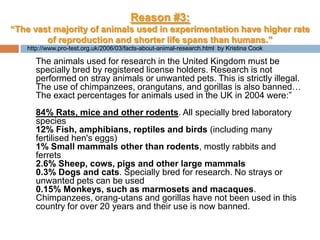
Reason #3:“The vast majority of animals used in experimentation have higher rate of reproduction and shorter life spans than humans.”	The animals used for research in the United Kingdom must be specially bred by registered license holders. Research is not performed on stray animals or unwanted pets. This is strictly illegal. The use of chimpanzees, orangutans, and gorillas is also banned… The exact percentages for animals used in the UK in 2004 were:”84% Rats, mice and other rodents. All specially bred laboratory species12% Fish, amphibians, reptiles and birds (including many fertilised hen's eggs)1% Small mammals other than rodents, mostly rabbits and ferrets2.6% Sheep, cows, pigs and other large mammals0.3% Dogs and cats. Specially bred for research. No strays or unwanted pets can be used0.15% Monkeys, such as marmosets and macaques. Chimpanzees, orang-utans and gorillas have not been used in this country for over 20 years and their use is now banned.http://www.pro-test.org.uk/2006/03/facts-about-animal-research.html  by Kristina Cook
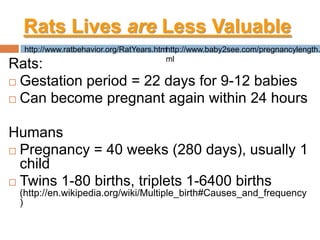
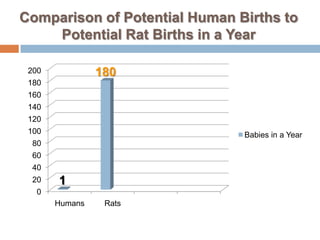
Rats Lives are Less Valuablehttp://www.ratbehavior.org/RatYears.htmhttp://www.baby2see.com/pregnancylength.htmlRats:Gestation period = 22 days for 9-12 babiesCan become pregnant again within 24 hoursHumansPregnancy = 40 weeks (280 days), usually 1 child Twins 1-80 births, triplets 1-6400 births (http://en.wikipedia.org/wiki/Multiple_birth#Causes_and_frequency)
Comparison of Potential Human Births to Potential Rat Births in a Year
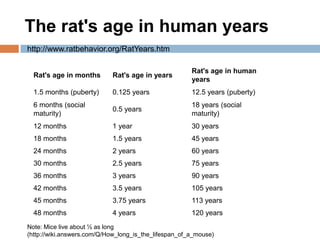
The rat's age in human yearshttp://www.ratbehavior.org/RatYears.htmNote: Mice live about ½ as long  (http://wiki.answers.com/Q/How_long_is_the_lifespan_of_a_mouse)
Reason #4:“(Animal Experimentation) has improved and outright saved the lives of millions.”- Justin Moscarello, researcherwww.dailynexus.com/article.php?a=5030Smallpox (cow) has now been eradicated from earthPolio has been eradicated from North America and people in countries all over the world are being successfully treated (mouse and monkey).Insulin is now able to help control diabetes (dog, fish). There are vaccines for tetanus (horse), rubella (monkey), anthrax (sheep), and rabies (dog, rabbit).The discovery of anticoagulants (cat), penicillin (mouse), open heart surgery and cardiac pacemakers (dog), lithium (rat, guinea pig), treatment for leprosy (armadillo), organ transplantations (dog, sheep, cow, pig), laproscopic surgical techniques (pig), and a drug for AIDS treatment (monkey)
4 Primary Reasons Why Animal Experimentation SHOULD be allowed“Without animal research, medicine as we know it today wouldn’t exist.”“Animal research hasn’t benefited humans alone.”Animal researchers focus largely upon animals with shorter life-spans and greater rates of reproduction.Human life has been saved! (Diseases that have been cured because of animal experimentation.)
BibliographyFor Animal Experimentation:http://www.pro-test.org.uk/2006/03/facts-about-animal-research.html  by Kristina Cookhttp://www.ratbehavior.org/RatYears.htmhttp://www.baby2see.com/pregnancylength.htmlwww.dailynexus.com/article.php?a=5030Against Animal Experimentation:http://www.debate.org/debates/Animal-Testing/5/http://www.stopanimaltests.com/f-pointcounterpoint.asp#point1http://www.smokinganimals.com/facts.html

The Case For Animal Experimentation 2

  • 1.
    By Chad SchwaberowThecase for Animal Experimentation
  • 2.
    4 Primary ReasonsWhy Animal Experimentation SHOULD be allowed“Without animal research, medicine as we know it today wouldn’t exist.”“Animal research hasn’t benefited humans alone.”Animal researchers focus largely upon animals with shorter life-spans and greater rates of reproduction.Human life has been saved! (Diseases that have been cured because of animal experimentation.)
  • 3.
    http://www.pro-test.org.uk/2006/03/facts-about-animal-research.html byKristina CookBenefits“Without animal research, medicine as we know it today wouldn’t exist. Animal research has enabled us to find treatments for cancer, antibiotics for infections, vaccines to prevent some of the most deadly and debilitating viruses and surgery for injuries, illnesses and deformities.”According to the US based, Foundation for Biomedical Research: “Animal research has played a vital role in virtually every major medical advance of the last century - for both human and veterinary health. From antibiotics to blood transfusions, from dialysis to organ transplantation, from vaccinations to chemotherapy, bypass surgery and joint replacement, practically every present-day protocol for the prevention, treatment, cure and control of disease, pain and suffering is based on knowledge attained through research with lab animals.”[1]Reason #1:“Without animal research, medicine as we know it today wouldn’t exist.”
  • 4.
    Reason #2:“Animal researchhasn’t benefited humans alone.”“Animals also have improved healthcare and a longer lifespan. Farm animals, household pets, wild species and endangered species are all benefiting from the research conducted through animals. There are vaccines for rabies, distemper, tetanus, parvo virus and numerous other illnesses in cats, dogs and countless other domesticated animals. Cats now have a treatment for Feline Leukemia. It’s obvious that animal research benefits all living species and that we are all able to live longer, healthier, happier lives because of it.”http://www.pro-test.org.uk/2006/03/facts-about-animal-research.html by Kristina Cook
  • 5.
    Nobel Prizes inMedicine given for Animal ExperimentationIn fact, seven out of the ten most recent Nobel Prizes in medicine, were based on animal research. Here’s a link citing a list of 71 of the Nobel Prizes won in the last 103 years using animal models, including what animal they used.http://www.pro-test.org.uk/2006/03/facts-about-animal-research.html by Kristina Cook
  • 6.
    Reason #3:“The vastmajority of animals used in experimentation have higher rate of reproduction and shorter life spans than humans.” The animals used for research in the United Kingdom must be specially bred by registered license holders. Research is not performed on stray animals or unwanted pets. This is strictly illegal. The use of chimpanzees, orangutans, and gorillas is also banned… The exact percentages for animals used in the UK in 2004 were:”84% Rats, mice and other rodents. All specially bred laboratory species12% Fish, amphibians, reptiles and birds (including many fertilised hen's eggs)1% Small mammals other than rodents, mostly rabbits and ferrets2.6% Sheep, cows, pigs and other large mammals0.3% Dogs and cats. Specially bred for research. No strays or unwanted pets can be used0.15% Monkeys, such as marmosets and macaques. Chimpanzees, orang-utans and gorillas have not been used in this country for over 20 years and their use is now banned.http://www.pro-test.org.uk/2006/03/facts-about-animal-research.html by Kristina Cook
  • 7.
    Rats Lives areLess Valuablehttp://www.ratbehavior.org/RatYears.htmhttp://www.baby2see.com/pregnancylength.htmlRats:Gestation period = 22 days for 9-12 babiesCan become pregnant again within 24 hoursHumansPregnancy = 40 weeks (280 days), usually 1 child Twins 1-80 births, triplets 1-6400 births (http://en.wikipedia.org/wiki/Multiple_birth#Causes_and_frequency)
  • 8.
    Comparison of PotentialHuman Births to Potential Rat Births in a Year
  • 9.
    The rat's agein human yearshttp://www.ratbehavior.org/RatYears.htmNote: Mice live about ½ as long (http://wiki.answers.com/Q/How_long_is_the_lifespan_of_a_mouse)
  • 10.
    Reason #4:“(Animal Experimentation)has improved and outright saved the lives of millions.”- Justin Moscarello, researcherwww.dailynexus.com/article.php?a=5030Smallpox (cow) has now been eradicated from earthPolio has been eradicated from North America and people in countries all over the world are being successfully treated (mouse and monkey).Insulin is now able to help control diabetes (dog, fish). There are vaccines for tetanus (horse), rubella (monkey), anthrax (sheep), and rabies (dog, rabbit).The discovery of anticoagulants (cat), penicillin (mouse), open heart surgery and cardiac pacemakers (dog), lithium (rat, guinea pig), treatment for leprosy (armadillo), organ transplantations (dog, sheep, cow, pig), laproscopic surgical techniques (pig), and a drug for AIDS treatment (monkey)
  • 11.
    4 Primary ReasonsWhy Animal Experimentation SHOULD be allowed“Without animal research, medicine as we know it today wouldn’t exist.”“Animal research hasn’t benefited humans alone.”Animal researchers focus largely upon animals with shorter life-spans and greater rates of reproduction.Human life has been saved! (Diseases that have been cured because of animal experimentation.)
  • 12.
    BibliographyFor Animal Experimentation:http://www.pro-test.org.uk/2006/03/facts-about-animal-research.html by Kristina Cookhttp://www.ratbehavior.org/RatYears.htmhttp://www.baby2see.com/pregnancylength.htmlwww.dailynexus.com/article.php?a=5030Against Animal Experimentation:http://www.debate.org/debates/Animal-Testing/5/http://www.stopanimaltests.com/f-pointcounterpoint.asp#point1http://www.smokinganimals.com/facts.html