What limits power flow through an overhead
transmission line?
The answer is – it depends. It depends on what is limiting the power flow and how much of an
increase is needed to solve the problem. In most circumstances, power flow limits are the result
of concerns over electrical phase shift, voltage drop or thermal effects in lines, cables or
substation equipment.
Surge Impedance Loading Limits
As power flows along a transmission line, there is an electrical phase shift, which
increases with distance and with power flow. As this phase shift increases, the system in
which the line is embedded can become increasingly unstable during electrical
disturbances. Typically, for very long lines, the power flow must be limited to what is
commonly called the Surge Impedance Loading (SIL) of the line.
Surge Impedance Loading is equal to the product of the end bus voltages divided by the
characteristic impedance of the line. Since the characteristic impedance of various HV
and EHV lines is not dissimilar, the SIL depends approximately on the square of system
voltage.
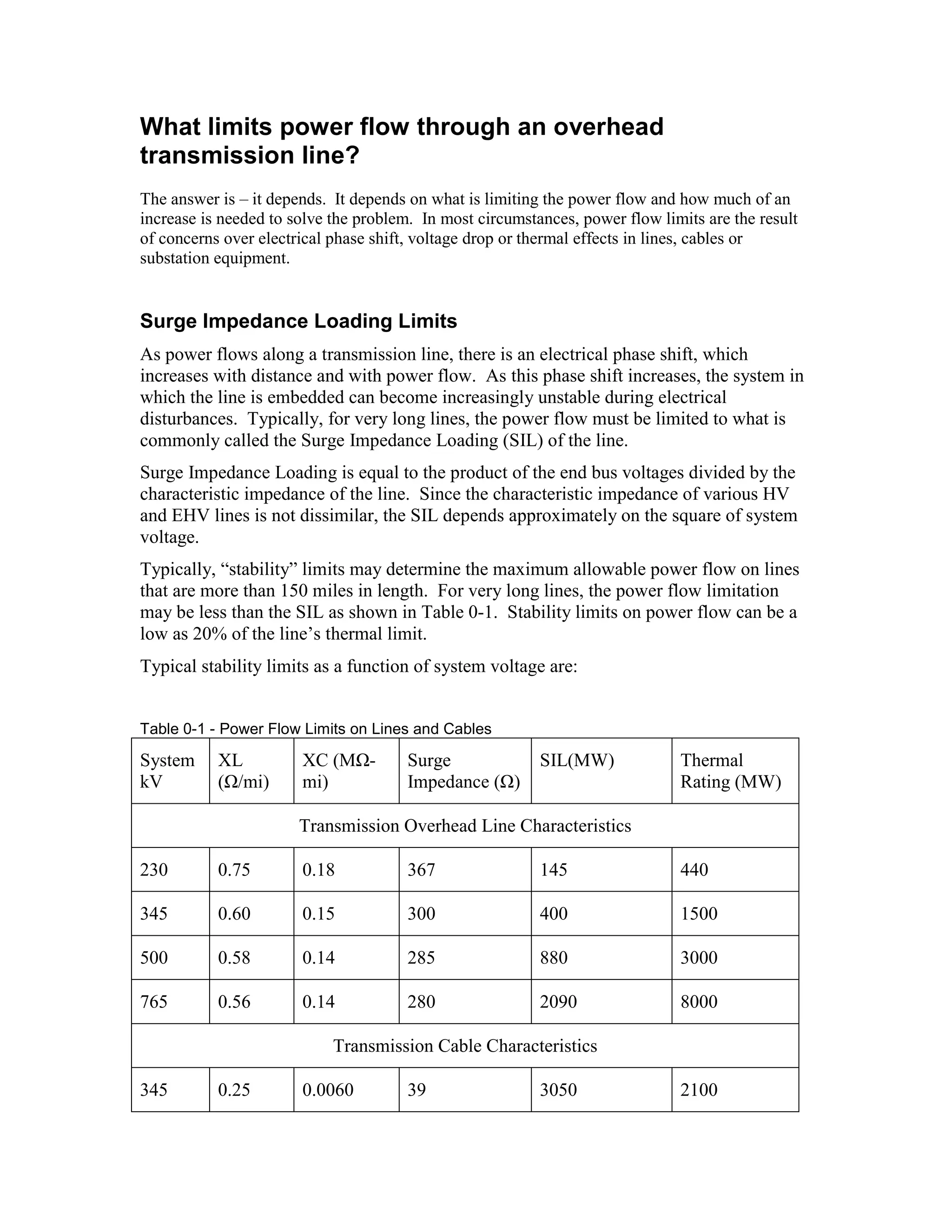
Typically, “stability” limits may determine the maximum allowable power flow on lines
that are more than 150 miles in length. For very long lines, the power flow limitation
may be less than the SIL as shown in Table 0-1. Stability limits on power flow can be a
low as 20% of the line’s thermal limit.
Typical stability limits as a function of system voltage are:
Table 0-1 - Power Flow Limits on Lines and Cables
System
kV
XL
(Ω/mi)
XC (MΩ-
mi)
Surge
Impedance (Ω)
SIL(MW) Thermal
Rating (MW)
Transmission Overhead Line Characteristics
230 0.75 0.18 367 145 440
345 0.60 0.15 300 400 1500
500 0.58 0.14 285 880 3000
765 0.56 0.14 280 2090 8000
Transmission Cable Characteristics
345 0.25 0.0060 39 3050 2100
Voltage Drop Limits
In addition to electrical phase shift, voltage magnitude decreases with distance.
Generally, for transmission lines, the maximum allowable drop in voltage is limited to
between 5% and 10% of the sending end bus voltage. The power flow (in MVA or MW)
that corresponds to the maximum allowable decrease in voltage magnitude is called the
line’s voltage drop limit. As with phase shift, a transmission line’s “voltage drop limit”
decreases with transmission distance and is generally higher than the line’s thermal limit
for short lines but less than the line’s stability limit for very long lines.
“Voltage drop” normally limits power flow on HV or EHV lines that are between 50 and
150 miles in length. Voltage drop limits on power flow can be as low as 40% of the
line’s thermal limit.
Voltage drop limits may be increased by the addition of shunt capacitors at the end of the
line. Such solutions are typically much cheaper than rebuilding the line.
Thermal Limits
Thermal power flow limits on overhead lines are intended to limit the temperature
attained by the energized conductors and the resulting sag and loss of tensile strength. In
most cases, the maximum conductor temperature applied to modern transmission lines
reflect ground clearance concerns rather than annealing of aluminum.
Thermal limits, as typically calculated, are not a function of line length. Thus for a given
line design, a line 1 km long and one 500 km long typically have the same thermal limit.
Thermal limits usually determine the maximum power flow for lines less than 50 miles in
length.
There are a number of possible methods by which the MVA thermal capacity of an
existing line may be increased. Some of these methods are technically straightforward,
such as reinforcing the structures and restringing the line with a larger conductor. These
methods come at a price, however. In addition to the dollar cost involved, there is
construction out on the line, and either outage time or special construction methods to
allow service while the work is in progress.
Other methods of thermal uprating, such as the use of weather dependent dynamic
thermal ratings or voltage uprating by reduction from normal phase spacing, may require
little or no line outage time and less capital investment than reconductoring and
reinforcing the structures. The price here lies in the greater degree of technical
sophistication required to ensure safe and reliable operation at higher loadings.

Surge impedance sil

  • 1.
    What limits powerflow through an overhead transmission line? The answer is – it depends. It depends on what is limiting the power flow and how much of an increase is needed to solve the problem. In most circumstances, power flow limits are the result of concerns over electrical phase shift, voltage drop or thermal effects in lines, cables or substation equipment. Surge Impedance Loading Limits As power flows along a transmission line, there is an electrical phase shift, which increases with distance and with power flow. As this phase shift increases, the system in which the line is embedded can become increasingly unstable during electrical disturbances. Typically, for very long lines, the power flow must be limited to what is commonly called the Surge Impedance Loading (SIL) of the line. Surge Impedance Loading is equal to the product of the end bus voltages divided by the characteristic impedance of the line. Since the characteristic impedance of various HV and EHV lines is not dissimilar, the SIL depends approximately on the square of system voltage. Typically, “stability” limits may determine the maximum allowable power flow on lines that are more than 150 miles in length. For very long lines, the power flow limitation may be less than the SIL as shown in Table 0-1. Stability limits on power flow can be a low as 20% of the line’s thermal limit. Typical stability limits as a function of system voltage are: Table 0-1 - Power Flow Limits on Lines and Cables System kV XL (Ω/mi) XC (MΩ- mi) Surge Impedance (Ω) SIL(MW) Thermal Rating (MW) Transmission Overhead Line Characteristics 230 0.75 0.18 367 145 440 345 0.60 0.15 300 400 1500 500 0.58 0.14 285 880 3000 765 0.56 0.14 280 2090 8000 Transmission Cable Characteristics 345 0.25 0.0060 39 3050 2100
  • 2.
    Voltage Drop Limits Inaddition to electrical phase shift, voltage magnitude decreases with distance. Generally, for transmission lines, the maximum allowable drop in voltage is limited to between 5% and 10% of the sending end bus voltage. The power flow (in MVA or MW) that corresponds to the maximum allowable decrease in voltage magnitude is called the line’s voltage drop limit. As with phase shift, a transmission line’s “voltage drop limit” decreases with transmission distance and is generally higher than the line’s thermal limit for short lines but less than the line’s stability limit for very long lines. “Voltage drop” normally limits power flow on HV or EHV lines that are between 50 and 150 miles in length. Voltage drop limits on power flow can be as low as 40% of the line’s thermal limit. Voltage drop limits may be increased by the addition of shunt capacitors at the end of the line. Such solutions are typically much cheaper than rebuilding the line. Thermal Limits Thermal power flow limits on overhead lines are intended to limit the temperature attained by the energized conductors and the resulting sag and loss of tensile strength. In most cases, the maximum conductor temperature applied to modern transmission lines reflect ground clearance concerns rather than annealing of aluminum. Thermal limits, as typically calculated, are not a function of line length. Thus for a given line design, a line 1 km long and one 500 km long typically have the same thermal limit. Thermal limits usually determine the maximum power flow for lines less than 50 miles in length. There are a number of possible methods by which the MVA thermal capacity of an existing line may be increased. Some of these methods are technically straightforward, such as reinforcing the structures and restringing the line with a larger conductor. These methods come at a price, however. In addition to the dollar cost involved, there is construction out on the line, and either outage time or special construction methods to allow service while the work is in progress. Other methods of thermal uprating, such as the use of weather dependent dynamic thermal ratings or voltage uprating by reduction from normal phase spacing, may require little or no line outage time and less capital investment than reconductoring and reinforcing the structures. The price here lies in the greater degree of technical sophistication required to ensure safe and reliable operation at higher loadings.