A Presentation On…..FACTS DEVICES
Mr. P Bala Krishna
Asst. Professor
UNIT - 1
Course Objectives:
To learn the basics of power flow control in transmission
lines using FACTS controllers
To explain operation and control of voltage source
converter.
To learn the method of shunt compensation using static
VAR compensators.
To learn the methods of compensation using series
compensators
To explain operation of Unified Power Flow Controller
(UPFC) and Interline Power flow Controller (IPFC).
Text Books:
1. “Understanding FACTS” N.G.Hingorani and L.Guygi,
IEEE Press.Indian Edition is available:––Standard
Publications, 2001.
Reference Books:
1. “Flexible ac transmission system (FACTS)” Edited by Yong
Hue Song and Allan T Johns, Institution of Electrical
Engineers, London.
2. Thyristor-based FACTS Controllers for Electrical
Transmission Systems, by R. Mohan Mathur and Rajiv
K.Varma, Wiley.
UNIT - I
Introduction to FACTS
Power flow in an AC System – Loading capability limits –
Dynamic stability considerations – Importance of
controllable parameters – Basic types of FACTS controllers
– Benefits from FACTS controllers – Requirements and
characteristics of high power devices – Voltage and current
rating – Losses and speed of switching – Parameter trade–off
devices.
FACTS
Flexible AC Transmission System (FACTS) is a new integrated
concept based on power electronic switching converters and
dynamic controllers to enhance the system utilization and
power transfer capacity as well as the stability, security,
reliability and power quality of AC system interconnections.
 Flexible Alternating Current Transmission System (FACTS).
 FACTS as they are generally known, are new devices that
improve transmission systems.
 FACTS is a static equipment used for the AC transmission of
electrical energy.
 It is generally a power electronics based device.
 Meant to enhance controllability and increase power transfer
capability.
1.0 INTRODUCTION
1.1 Why we need Transmission interconnections
Almost in every country of the world electric supply system is widely
interconnected, involving connections inside utilities.
The main reason behind interconnections are:
Economic
To reduce the cost of the electricity
To improve reliability of power supply
Now, we will see in detail why we do transmission interconnection ?
Apart from delivery of electric power, the main purpose of the
transmission interconnection network is to pool power plants and load
centers in order to minimize the total power generation
capacity and fuel cost.
Transmission interconnection also enable taking advantage of

Diversity of loads,

Availability of sources,

Fuel price in order to supply electricity to the loads at minimum cost
with a required reliability.
 In general, if a power delivery system was made up of radial lines
from individual local generators without being part of a grid system
that is without interconnections, many more generation resources
would be needed to serve the load with the same reliability, and the
cost of electricity would be much higher.
 With that perspective, transmission is often an alternative to a new
generation resource. Less transmission capability means that more
generation resources would be required regardless of whether the
system is made up of large or small power plants.
 In fact, small distributed generation becomes more economically
feasible if there is a backbone of a transmission grid.
 One cannot be really sure about what the optimum balance in between
generation and transmission unless the system planners use advanced
methods of analysis which integrate transmission planing into an
integrated value-based transmission/generation planning scenario.
 The cost of the transmission lines and losses, as well as
difficulties encountered in building new transmission capacity,
and would often limit the available transmission capacity.
 There are many cases where economic energy or reserve sharing
is constrained by transmission capacity, and the situation is not
getting any better.
1.2. FLOW OF POWER IN AN AC SYSTEM
In AC power systems, given the insignificant electrical storage, the
electrical generation and load must balance at all times
If generation is less than load, the voltage and frequency drop, and
there by the load, goes down to equal the generation minus the
transmission losses
If voltage is propped up with reactive power support, then the load
will go up, and consequently frequency will keep dropping, and the
system will collapse
Alternately, if there is inadequate(less) reactive power, the system
can have voltage collapse
The flow of power in an AC system can either be in parallel paths or
in meshed connections
 Power Flow In Parallel Paths
 Power Flow In a Meshed System
Cont..
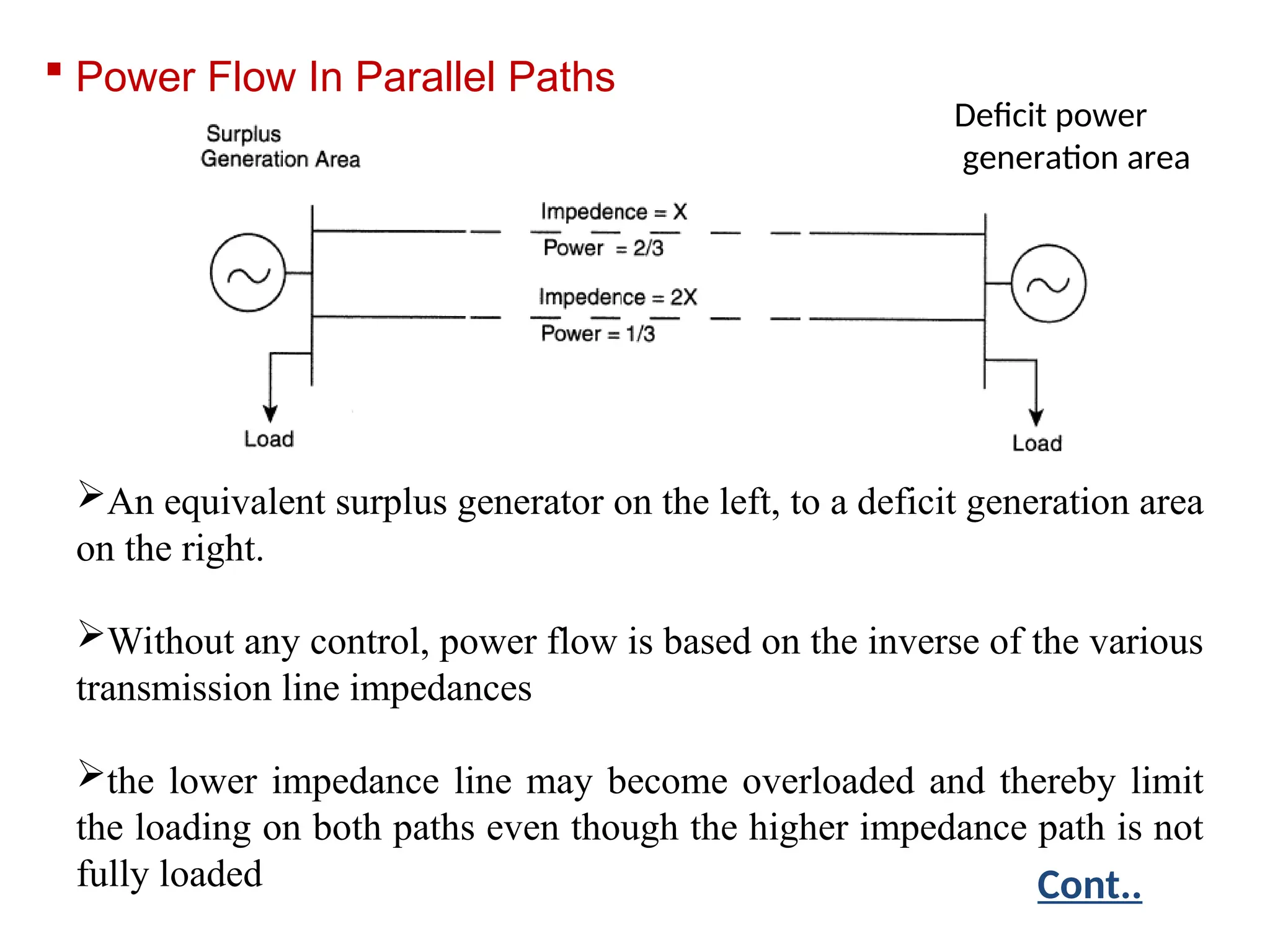
 Power Flow In Parallel Paths
An equivalent surplus generator on the left, to a deficit generation area
on the right.
Without any control, power flow is based on the inverse of the various
transmission line impedances
the lower impedance line may become overloaded and thereby limit
the loading on both paths even though the higher impedance path is not
fully loaded
Deficit power
generation area
Cont..
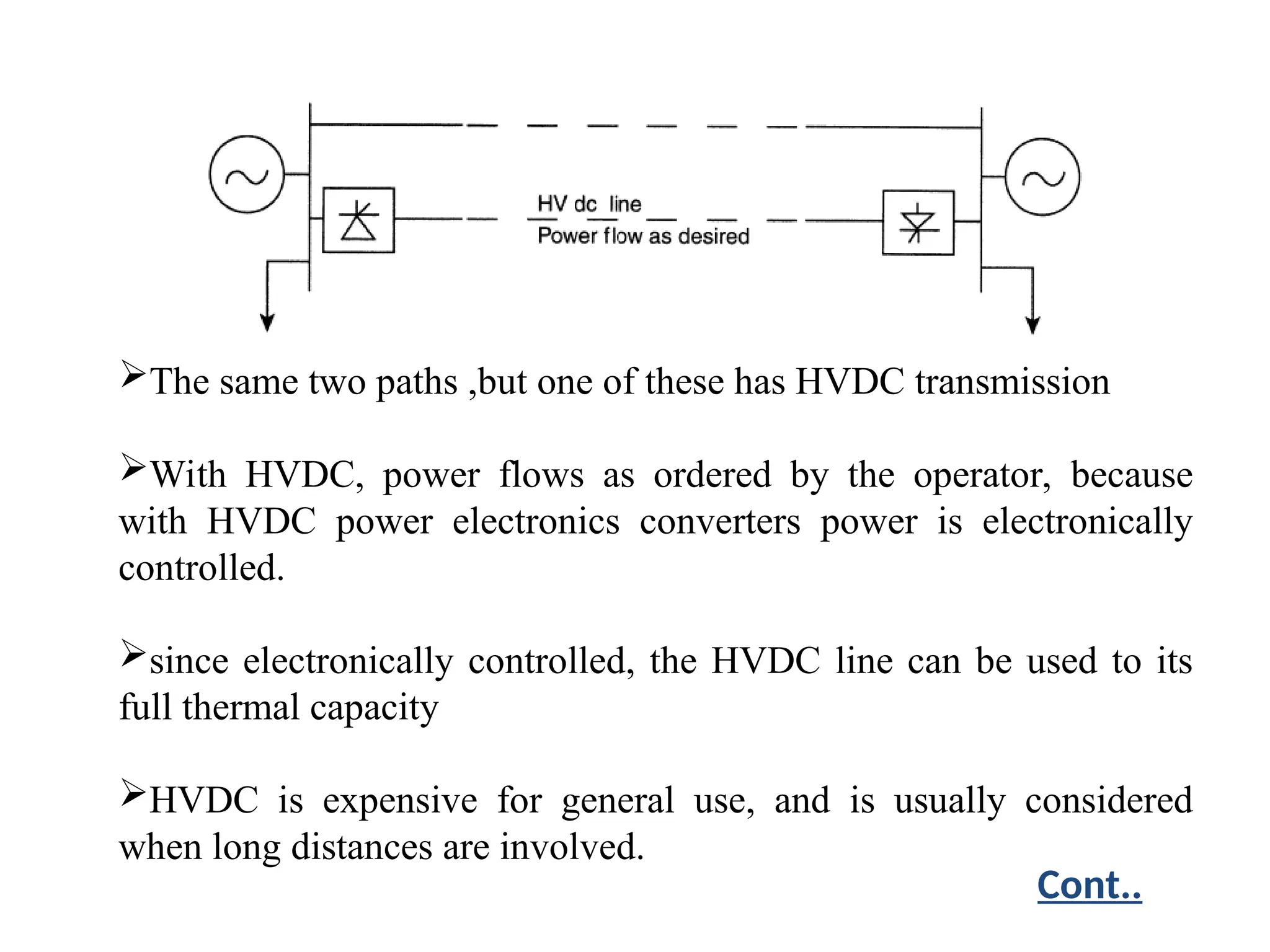
The same two paths ,but one of these has HVDC transmission
With HVDC, power flows as ordered by the operator, because
with HVDC power electronics converters power is electronically
controlled.
since electronically controlled, the HVDC line can be used to its
full thermal capacity
HVDC is expensive for general use, and is usually considered
when long distances are involved.
Cont..
By means of controlling impedance [Figure (c)] or phase angle
[Figure (d)], or series injection of appropriate voltage (not shown) a
Facts Controller can control the power flow as required.
Maximum power flow can in fact be limited to its rated limit under
contingency conditions when this line is expected to carry more
power due to the loss of a parallel line.
Cont..
 Power Flow In a Meshed System
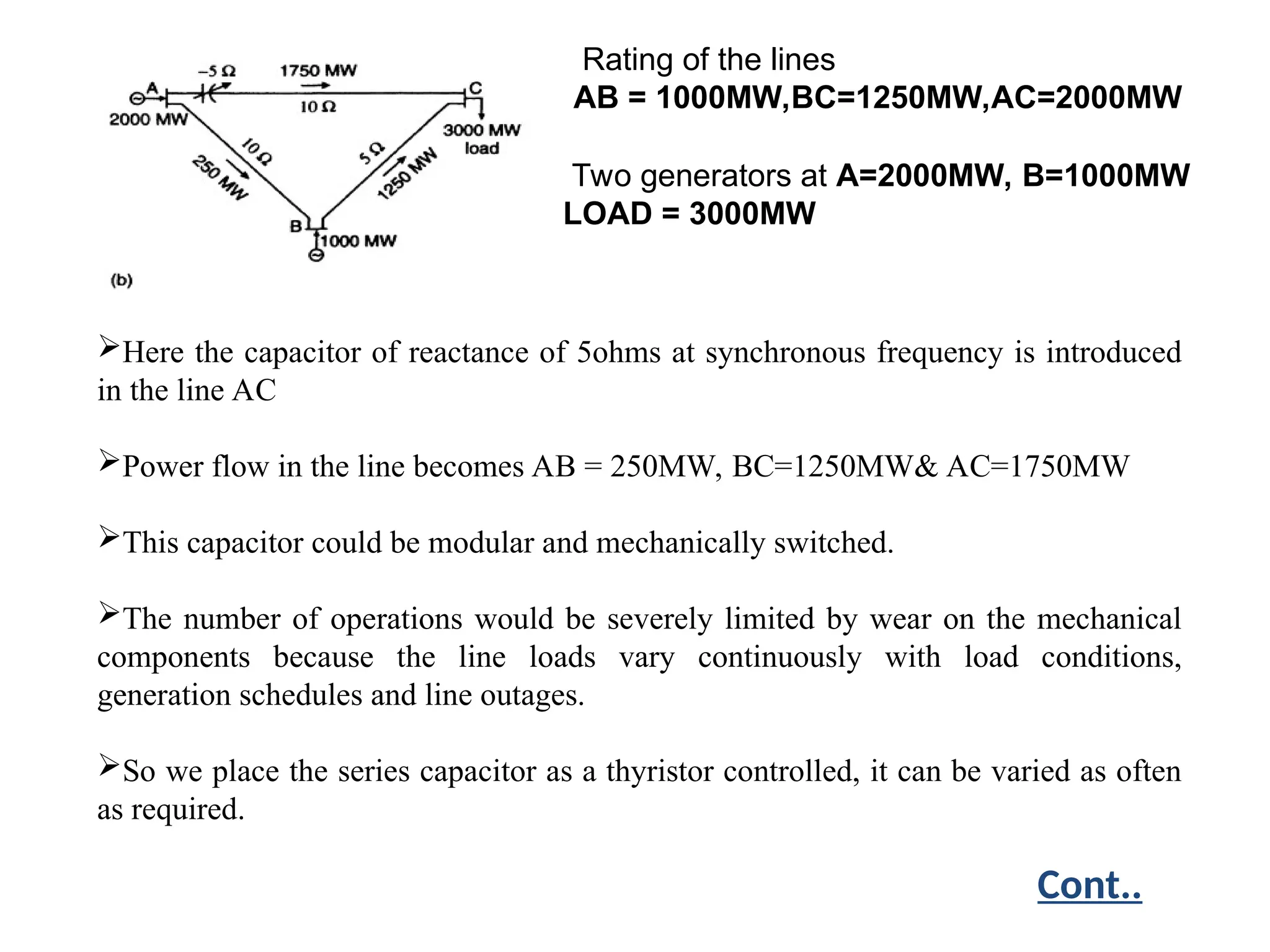
Rating of the lines
AB = 1000MW,BC=1250MW,AC=2000MW
Let us consider the rating be twice their continuous rating for a period, in case
of losses of one of these lines.
Impedance of the line be AB=10ohms, BC=5ohms & CA = 10ohms
As assumed impedance AB,BC & AC carry power 600MW, 1600MW &
1400MW
BC is overloaded as its rating is 1250MW but carrying 1600MW.
To meet the load without overloaded, A is increased and B is decreased
Here the power flow depends on only series impedance but not on thermal
limits and transmission losses.
Two generators at A=2000MW, B=1000MW
LOAD = 3000MW
Cont..
Rating of the lines
AB = 1000MW,BC=1250MW,AC=2000MW
Two generators at A=2000MW, B=1000MW
LOAD = 3000MW
Here the capacitor of reactance of 5ohms at synchronous frequency is introduced
in the line AC
Power flow in the line becomes AB = 250MW, BC=1250MW& AC=1750MW
This capacitor could be modular and mechanically switched.
The number of operations would be severely limited by wear on the mechanical
components because the line loads vary continuously with load conditions,
generation schedules and line outages.
So we place the series capacitor as a thyristor controlled, it can be varied as often
as required.
Cont..
Rating of the lines
AB = 1000MW,BC=1250MW,AC=2000MW
Two generators at A=2000MW, B=1000MW
LOAD = 3000MW
The reactance of 7ohms is connected in series with the line BC
The power carrying by the line AB is increased to 1750MW
A series inductance that is partly mechanically and partly thyristor-controlled.
The steady state power flow can be adjusted
The unwanted oscillations can be damped by series inductor
Cont..
Rating of the lines
AB = 1000MW,C=1250MW,AC=2000MW
Two generators at A=2000MW, B=1000MW
LOAD = 3000MW
A phase angle regulator serves the same purpose as that served by a series
capacitor or by a series reactor
The total phase angle difference along the line from 8.5 degrees to 4.26
degrees
Here the cost is minimum as compare with series capacitor and inductance
A similar control can be achieved by introducing a variable voltage in one
of the line
1.3. LIMITS THE LOADING CAPABILITY
The loading capability limits of transmission line are
 Thermal capability limit
 Dielectric limit
 Stability limit
THERMAL CAPABILITY LIMIT
•Thermal capability of the overhead transmission line is a function of wind
conditions, condition of conductor, environmental temperature and ground
clearance
•The condition may vary from season to season
•In summer season -temperature is high - sag will increase - low tension
•In winter season the temperature is low and effect of ice which increases the
weight of the conductor.
•The OFF line and ON line loading monitors are used to know the real time
loading capability
Cont..
DIELECTRIC LIMIT
•Insulation level of many lines are conservative
•Each line is specified with voltage rating and +10% variation in this voltage is
acceptable
•i.e for 500KV it can vary upto 500+50=550KV
•Care is needed to ensure that dynamic and transient over voltages are with in
limit
•The FACTS technology could be used to ensure acceptable over-voltage and
power flow conditions
Cont..
STABILITY LIMIT
 The maximum power that can be transferred by the system form source to load
under stable conditions is known as stability limit
 Depending upon the nature and magnitude of disturbance, the stability is
classified as
 Steady state stability
 Transient state stability
 Dynamic stability
Steady state stability:
 The ability of a power system to maintain synchronism after being
subjected to small and gradual disturbances is known as steady state
stability.
 To maintain steady state stability, the system should operate below this
limit
Cont..
Transient state stability
 The ability of a power system to maintain synchronism after being
subjected to large and sudden disturbances is known as Transient state
stability.
 The disturbance may occur due to sudden load variation, clearing of
faults, unintentional tripping of lines and generators etc...
 Transient stability limit is less than the steady state stability limit
Dynamic stability
 The ability of a power system to maintain synchronism after transient
stabilty period till the system attains a new steady state equilibrium
condition is know as dyanamic stability
 It is concerned with small disturbances for a long time which occurs due
to short circuit or loss of generator.
1.4. POWER FLOW AND DYNAMIC STABILITY
CONSIDERATIONS OF A TRANSMISSION INTERCONNECTION
Cont..
Figure (c), corresponding to Figure (b), shows a phasor
diagram of the relationship between the active and reactive
currents with reference to the voltages at the two ends.
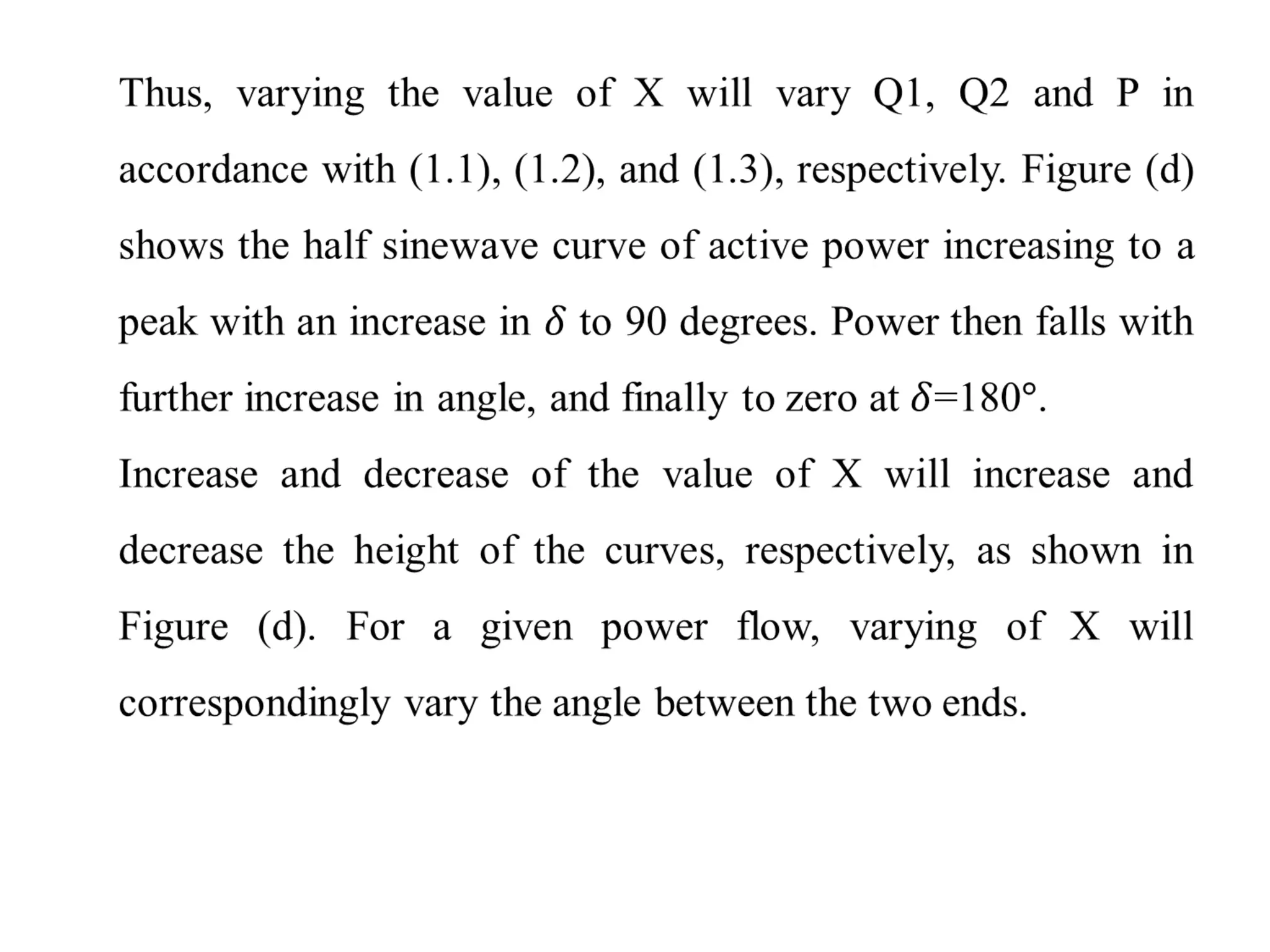
Power/current flow can also be controlled by regulating the
magnitude of voltage phasor El or voltage phasor E2. However, it
is seen from Figure (e) that with change in the magnitude of E1,
the magnitude of the driving voltage phasor E1 – E2 does not
change by much, but its phase angle does.
This also means that regulation of the magnitude of voltage
phasor E1 and/or E2 has much more influence over the reactive
power flow than the active power flow, as seen from the two
current phasors corresponding to the two driving voltage phasors
E1 – E2 shown in Figure (e).
Current flow and hence power flow can also be changed by
injecting voltage in series with the line. It is seen from Figure
(f) that when the injected voltage is in phase quadrature with the
current, it directly influences the magnitude of the current flow,
and with small angle influences substantially the active power
flow.
Alternatively, the voltage injected in series can be a
phasor with variable magnitude and phase relationship with the
line voltage [Figure (g)]. It is seen that varying the amplitude
and phase angle of the voltage injected in series, both the active
and reactive current flow can be influenced.
1.5. IMPORTANCE OF CONTROLLABLE
PARAMETERS
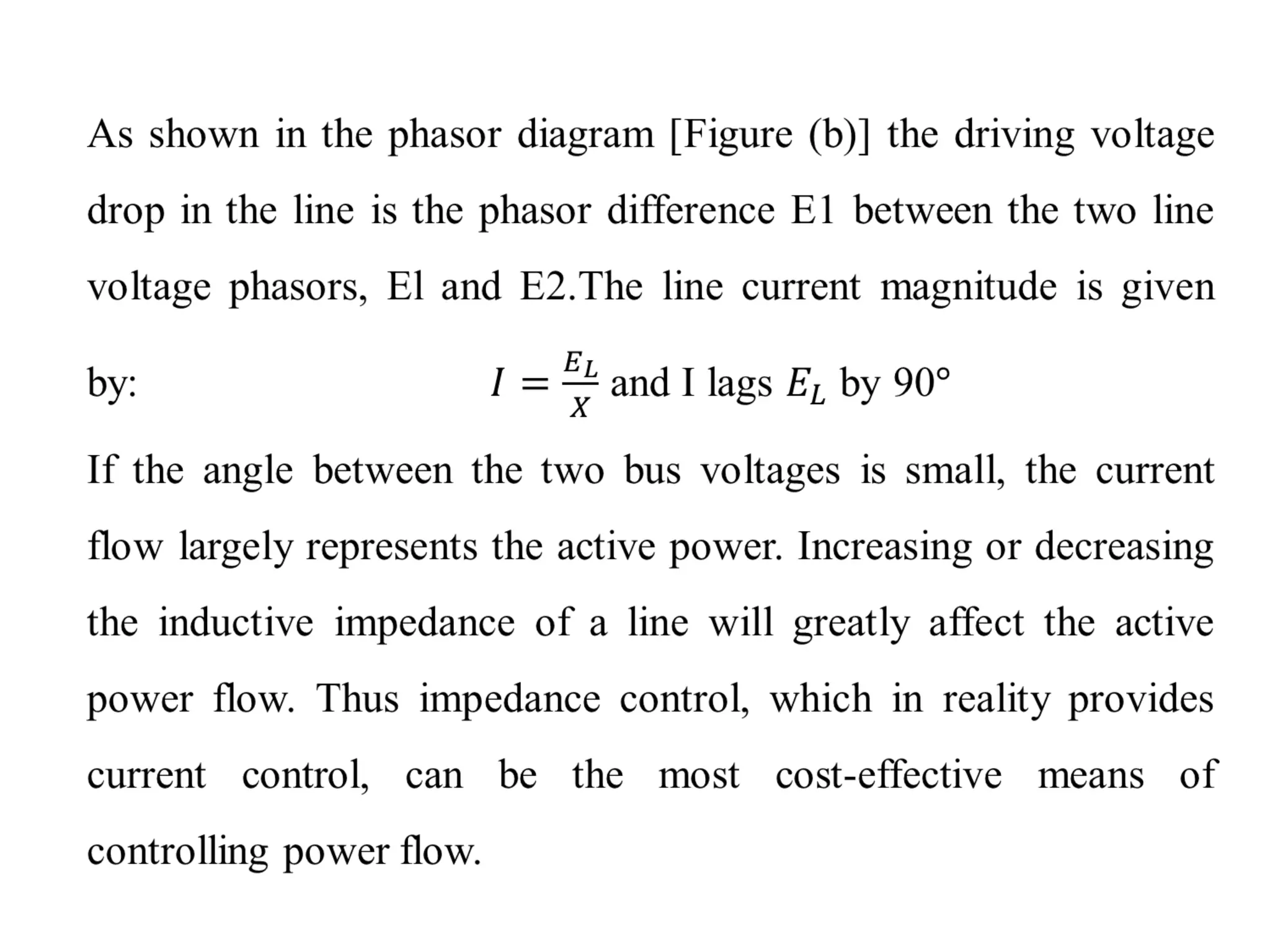
•Control of the line impedance X (e.g., with a thyristor-controlled series
capacitor) can provide a powerful means of current control.
•When the angle is not large, which is often the case, control of X or the angle
substantially provides the control of active power.
•Control of angle which in turn controls the driving voltage, provides a
powerful means of controlling the current flow and hence active power flow
when the angle is not large
•Injecting a voltage in series with the line and perpendicular to the current
flow, can increase or decrease the magnitude of current flow. Since the
current flow lags the driving voltage by 90 degrees, this means injection of
reactive power in series, (e.g., with static synchronous series compensation)
can provide a powerful means of controlling the line current, and hence the
active power when the angle is not large.
Cont..
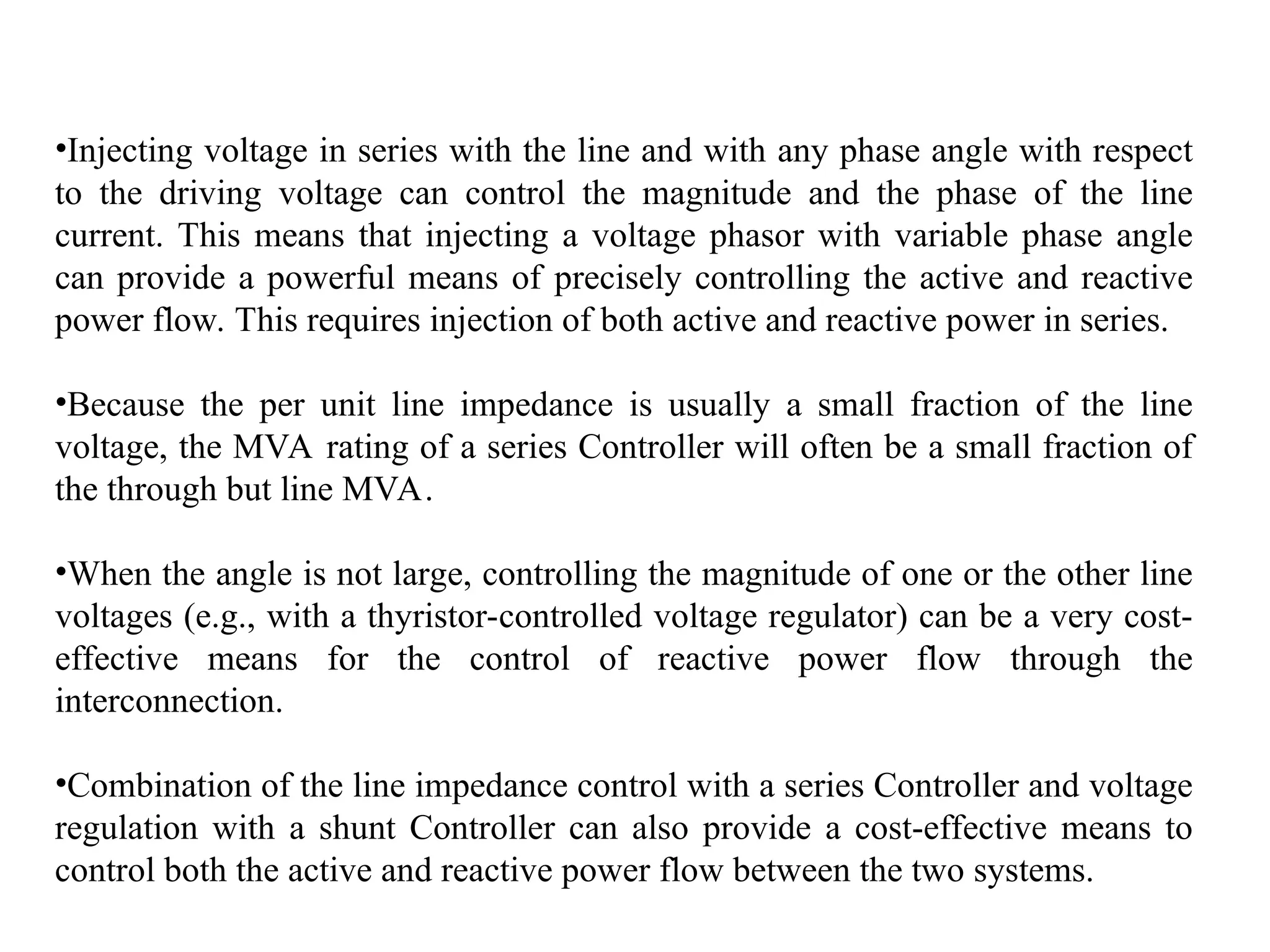
•Injecting voltage in series with the line and with any phase angle with respect
to the driving voltage can control the magnitude and the phase of the line
current. This means that injecting a voltage phasor with variable phase angle
can provide a powerful means of precisely controlling the active and reactive
power flow. This requires injection of both active and reactive power in series.
•Because the per unit line impedance is usually a small fraction of the line
voltage, the MVA rating of a series Controller will often be a small fraction of
the through but line MVA.
•When the angle is not large, controlling the magnitude of one or the other line
voltages (e.g., with a thyristor-controlled voltage regulator) can be a very cost-
effective means for the control of reactive power flow through the
interconnection.
•Combination of the line impedance control with a series Controller and voltage
regulation with a shunt Controller can also provide a cost-effective means to
control both the active and reactive power flow between the two systems.
1.6. Basic types of FACTS controllers
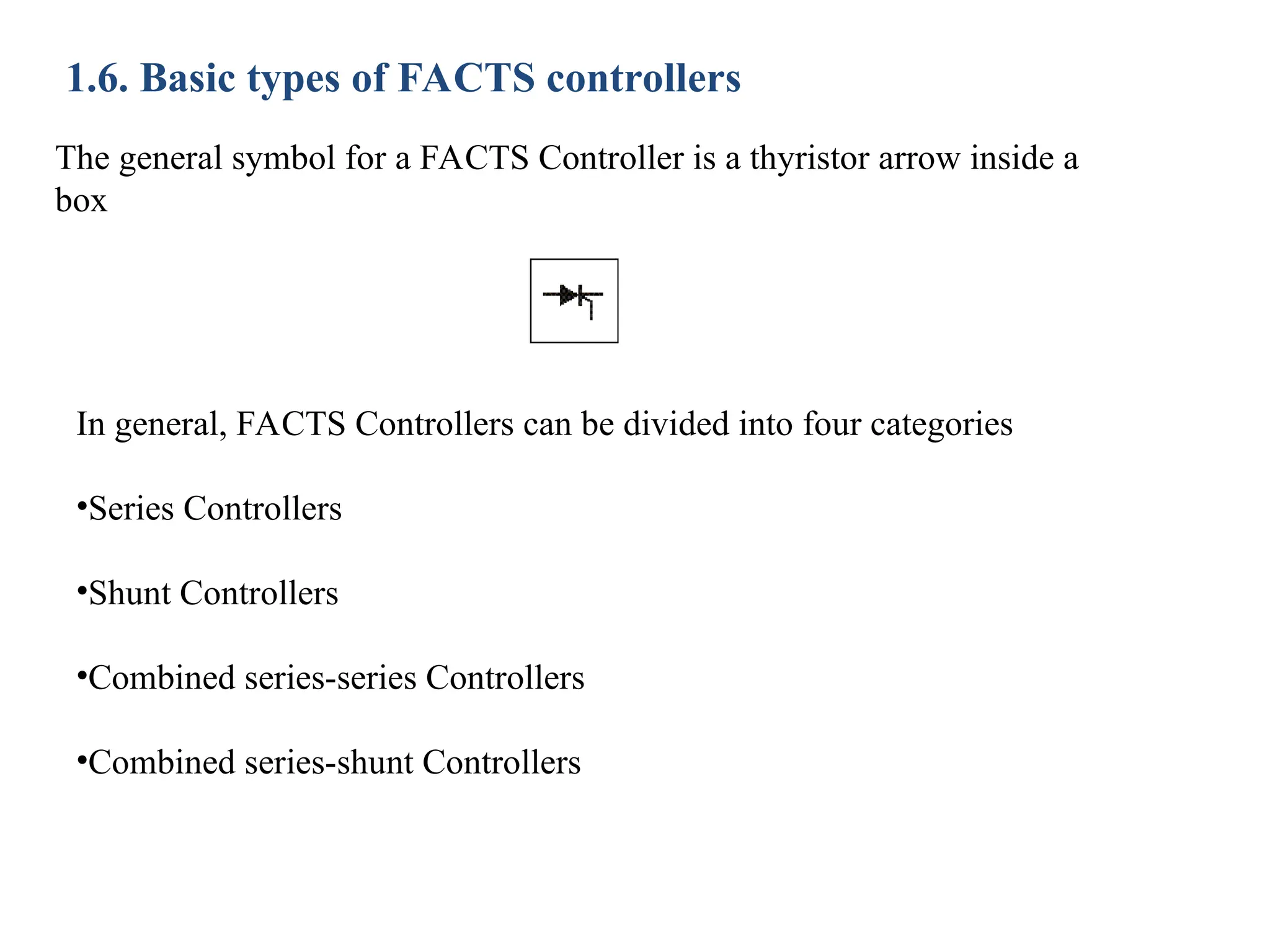
The general symbol for a FACTS Controller is a thyristor arrow inside a
box
In general, FACTS Controllers can be divided into four categories
•Series Controllers
•Shunt Controllers
•Combined series-series Controllers
•Combined series-shunt Controllers
Series Controllers
•The series Controller could be variable impedance, such as capacitor, reactor,
etc., or power electronics based variable source of main frequency, sub
synchronous and harmonic frequencies (or a combination) to serve the desired
need.
•In principle, all series Controllers inject voltage in series with the line.
• Even a variable impedance multiplied by the current flow through it, represents
an injected series voltage in the line.
• As long as the voltage is in phase quadrature with the line current, the series
Controller only supplies or consumes variable reactive power.
• Any other phase relationship will involve handling of real power as well.
Shunt controllers
•As in the case of series Controllers, the shunt Controllers may be variable
impedance, variable source, or a combination of these.
•In principle, all shunt Controllers inject current into the system at the point of
connection.
•Even a variable shunt impedance connected to the line voltage causes a
variable current flow and hence represents injection of current into the line.
•As long as the injected current is in phase quadrature with the line voltage,
the shunt Controller only supplies or consumes variable reactive power.
•Any other phase relationship will involve handling of real power as well.
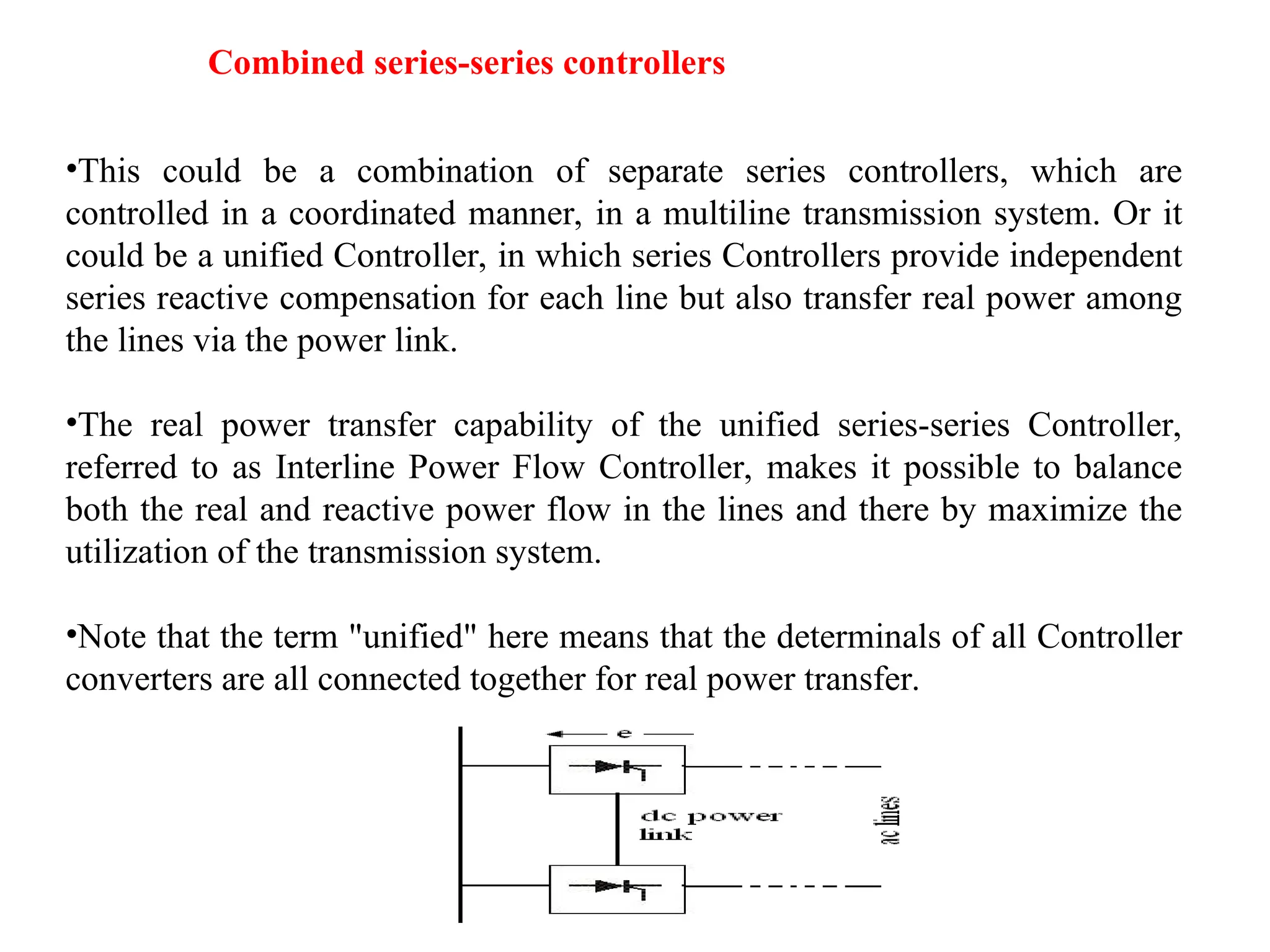
Combined series-series controllers
•This could be a combination of separate series controllers, which are
controlled in a coordinated manner, in a multiline transmission system. Or it
could be a unified Controller, in which series Controllers provide independent
series reactive compensation for each line but also transfer real power among
the lines via the power link.
•The real power transfer capability of the unified series-series Controller,
referred to as Interline Power Flow Controller, makes it possible to balance
both the real and reactive power flow in the lines and there by maximize the
utilization of the transmission system.
•Note that the term "unified" here means that the determinals of all Controller
converters are all connected together for real power transfer.
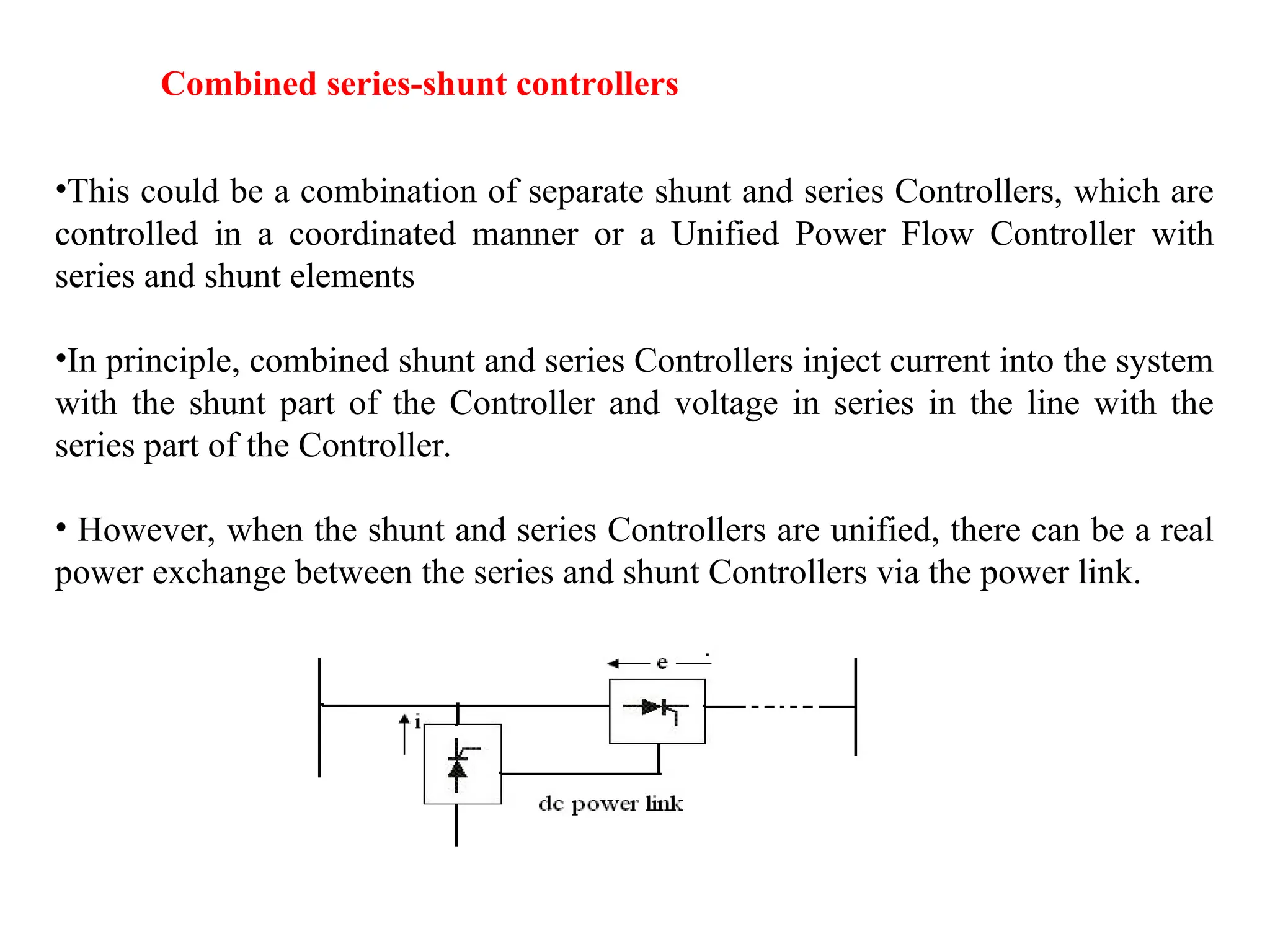
Combined series-shunt controllers
•This could be a combination of separate shunt and series Controllers, which are
controlled in a coordinated manner or a Unified Power Flow Controller with
series and shunt elements
•In principle, combined shunt and series Controllers inject current into the system
with the shunt part of the Controller and voltage in series in the line with the
series part of the Controller.
• However, when the shunt and series Controllers are unified, there can be a real
power exchange between the series and shunt Controllers via the power link.
1.7 BRIEF DESCRIPTION AND DEFINITIONS OF FACTS
CONTROLLERS
Shunt-connected Controllers:
Static Synchronous
Compensator
(STATCOM) based
on voltage-sourced
converters
Static Synchronous
Compensator
(STATCOM) based on
current-sourced
converters
STATCOM with storage,
i.e., Battery Energy
Storage System (BESS)
Superconducting Magnet
Energy Storage and large
de capacitor
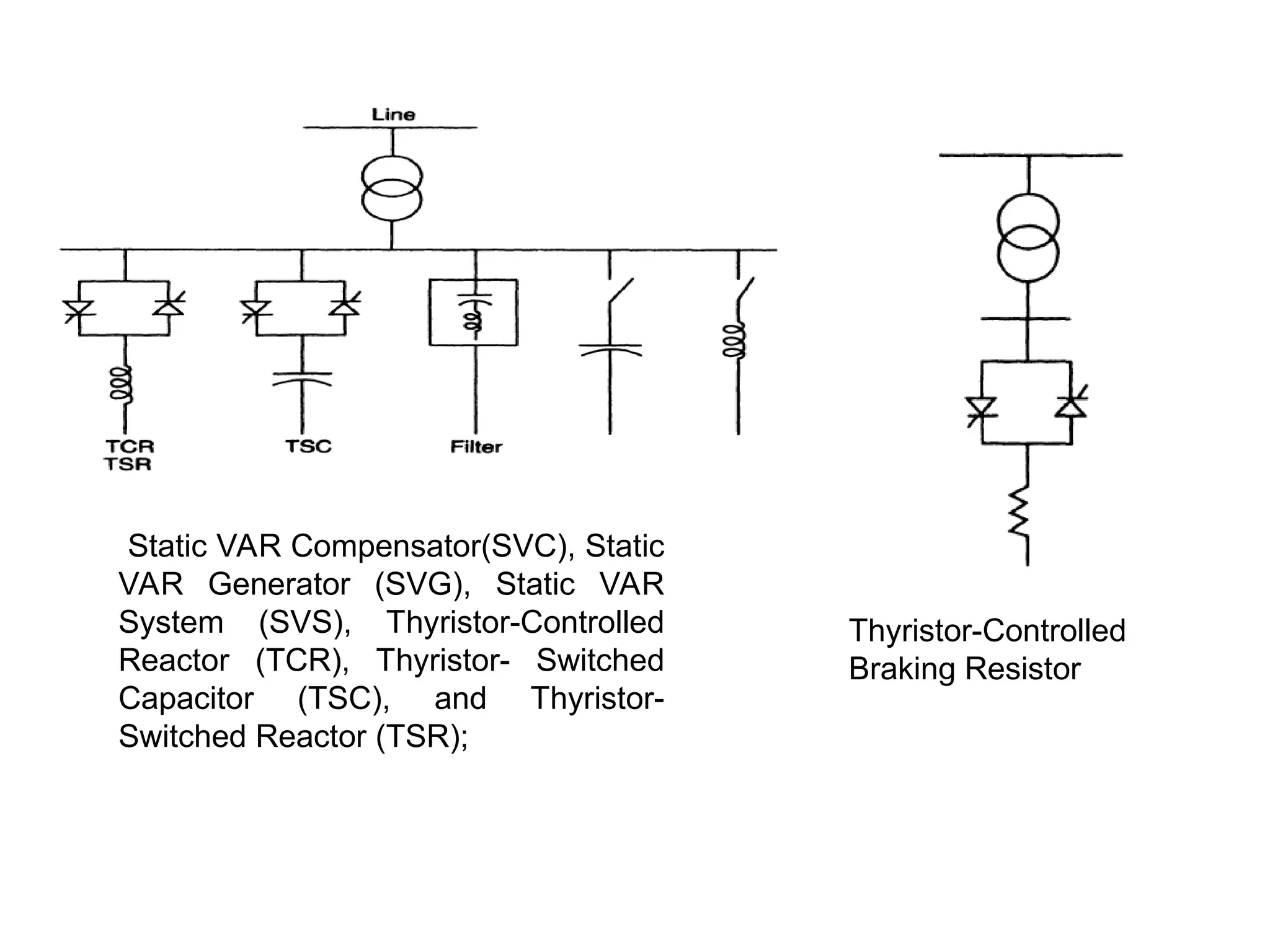
Static VAR Compensator(SVC), Static
VAR Generator (SVG), Static VAR
System (SVS), Thyristor-Controlled
Reactor (TCR), Thyristor- Switched
Capacitor (TSC), and Thyristor-
Switched Reactor (TSR);
Thyristor-Controlled
Braking Resistor
Series Connected Controllers
(Thyristor-Controlled Series Reactor (TCSR) and
Thyristor-Switched Series Reactor (TSSR).
Static Synchronous
Series Compensator
(SSSC)
SSSC with storage;
Thyristor-Controlled
Series Capacitor
(TCSC) and
Thyristor Switched
Series Capacitor
(TSSC)
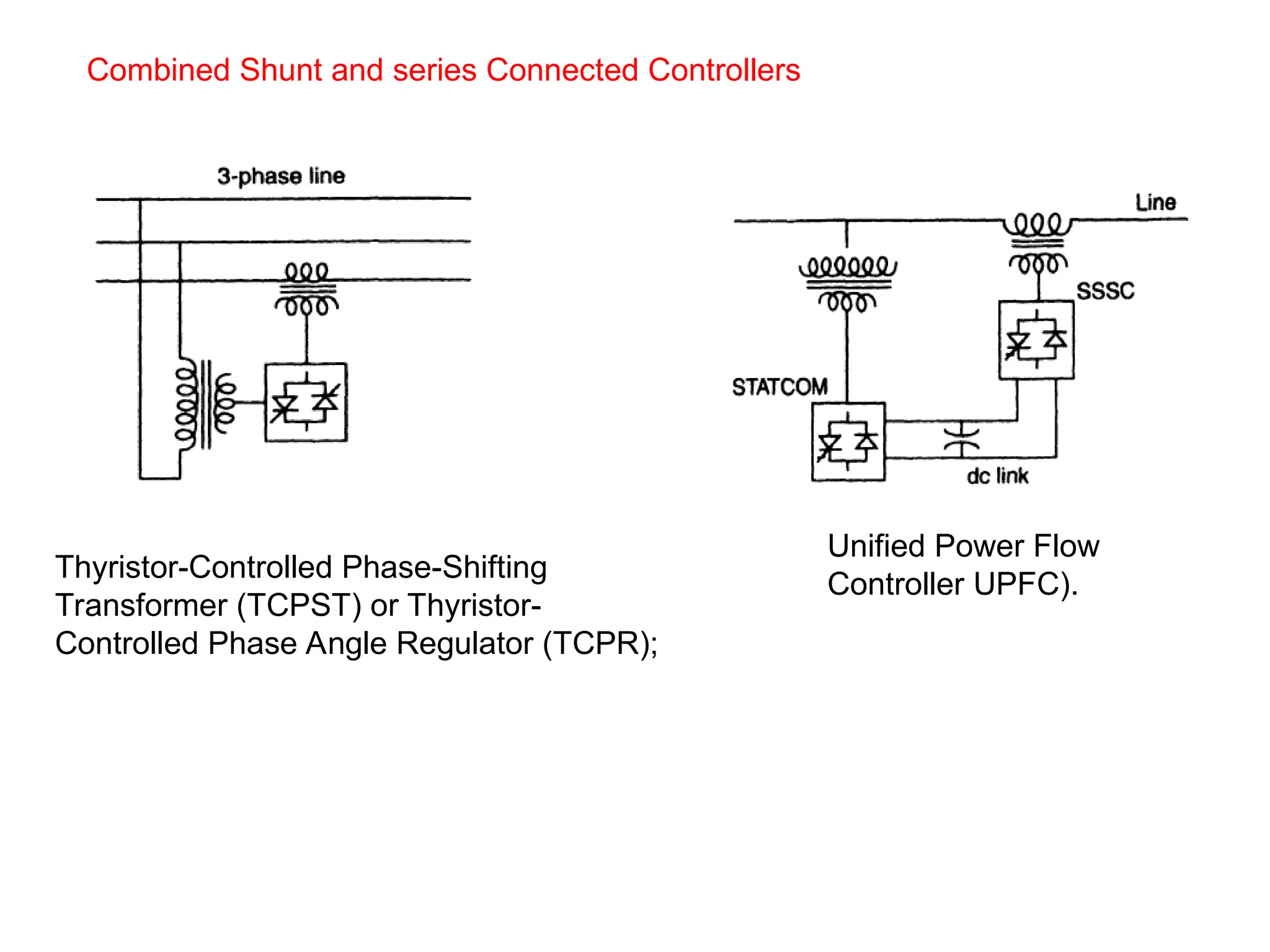
Combined Shunt and series Connected Controllers
Thyristor-Controlled Phase-Shifting
Transformer (TCPST) or Thyristor-
Controlled Phase Angle Regulator (TCPR);
Unified Power Flow
Controller UPFC).
1.8. BENEFITS OF FACTS DEVICES
•Control of power flow as ordered. The use of control of the power flow
may be to follow a contract, meet the utilities' own needs, ensure optimum
power flow, ride through emergency conditions, or a combination there of.
•Increase the loading capability of lines to their thermal capabilities,
including short term and seasonal. This can be accomplished by
overcoming other limitations, and sharing of power among lines according
to their capability. It is also important to note that thermal capability of a
line varies by a very large margin based on the environmental conditions
and loading history.
•Increase the system security through raising the transient stability limit,
limiting short-circuit currents and overloads, managing cascading blackouts
and damping electromechanical oscillations of power systems and
machines.
•Provide secure tie line connections to neighboring utilities and regions
there by decreasing over all generation reserve requirements on both
sides.
•Provide greater flexibility in siting new generation.
•Upgrade of lines.
•Reduce reactive power flows, thus allowing the lines to carry more active
power.
•Reduce loop flows.
•Increase utilization of lowest cost generation. One of the principal
reasons for transmission interconnections is to utilize lowest cost
generation. When this cannot be done, it follows that there is not enough
cost-effective transmission capacity. Cost-effective enhancement of
capacity will therefore allow increased use of lowest cost generation.
1.9 Requirements and characteristics of high power devices
The requirements and characteristics of high power devies can be explained
as follows
•Voltage and current rating
•Losses and speed of switching
• Parameter trade–off devices
Voltage and current rating
All the high-power semiconductor devices have definite limits of their
capabilities.
Exceeding these limits even for a short time will result in the failure or loss
of control.
Therefore the devices have to be used within their limits and this must
include extreme conditions which may exist during the transient and steady
state conditions.
In case of high power devices these ratings include voltage and current
ratings
It is essential that the voltage capability of a device is not exceeded during
its operations, even for a very small period of time
The voltage rating of the device should be high enough to withstand the
anticipated voltage transients as well as the repetitive OFF state and reverse
blocking voltages.
The various voltage rating of a thyristor are peak working forward OFF
state voltage, peak working reverse voltage, gate triggering voltage, ON
state-voltage, forward dv/dt rating
In an SCR the temperature at the junctions determines its current carrying
ability.
Even for small over currents the junction temperature may rise above the
rated value.
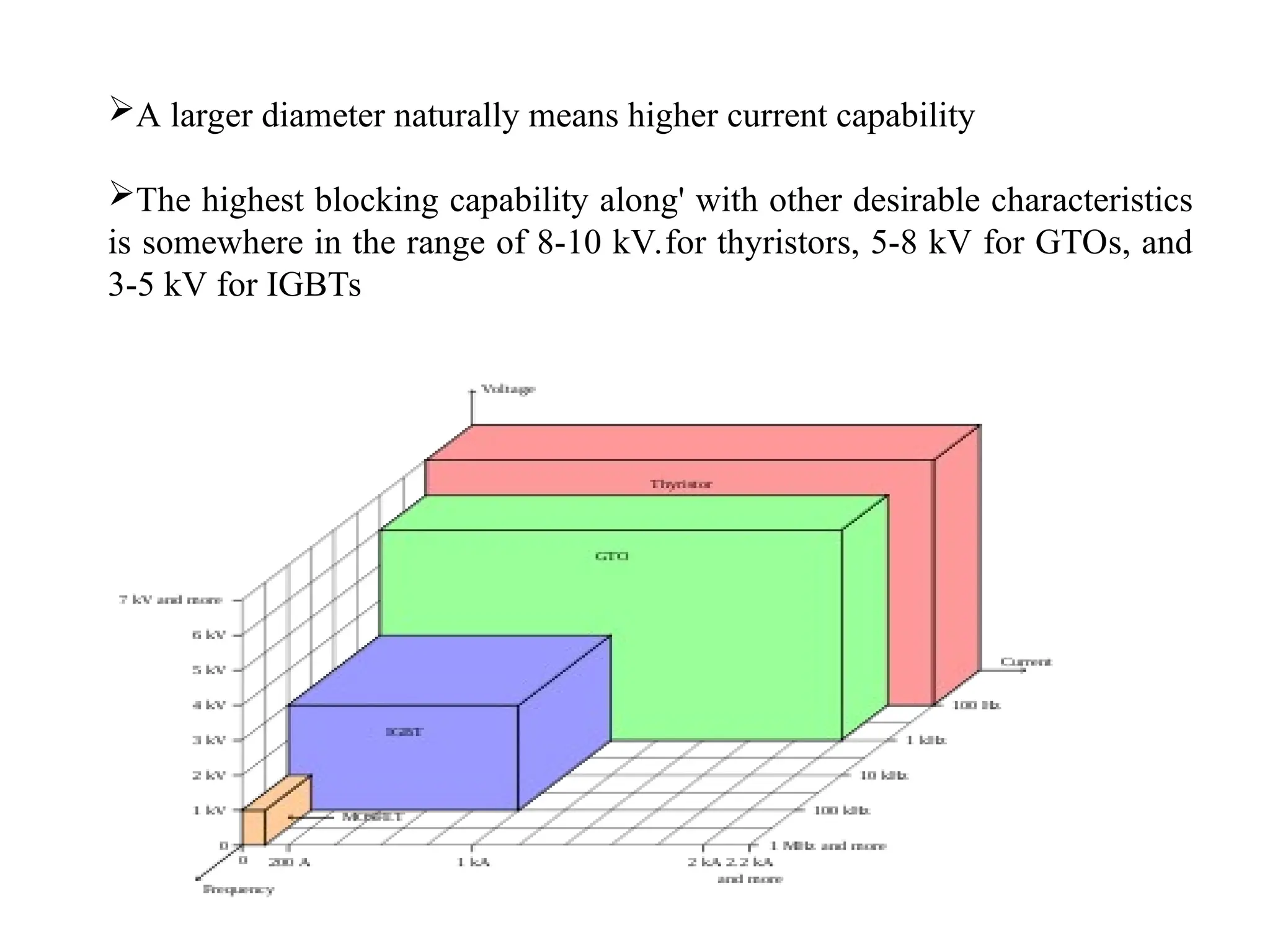
A larger diameter naturally means higher current capability
The highest blocking capability along' with other desirable characteristics
is somewhere in the range of 8-10 kV.for thyristors, 5-8 kV for GTOs, and
3-5 kV for IGBTs
Losses and speed of switching
Forward-voltage drop and consequent losses during full conducting state
(ON state losses)
Losses have to be rapidly removed from the wafer through the package
and ultimately to the cooling medium and removing that heat represents a
high cost
Speed of switching
Transition from a fully conducting to a fully non conducting state (turn-off)
with corresponding high dv/dt just after turn-off, and from a fully non
conducting to a fully conducting state (turn-on) with corresponding high di/dt
during the turn-off are very important parameters.
They dictate the size, cost, and losses of snubber circuits needed to soften
high dv/dt and di/dt, ease of series connection of devices, and the useable
device current and voltage rating.
Switching losses
During the turn-on, the forward current rises; before the forward voltage
falls and during turn-off of the turn-off devices, the forward voltage rises
before the current falls.
Simultaneous existence of high voltage and current in the device represents
power losses.
Being repetitive, they represent a significant part of the losses, and often
exceed the on-state conduction losses.
In a power semiconductor design, there is a trade-off between switching
losses and forward voltage drop (on-state losses), which also means that the
optimization of device design is a function of the application circuit topology
A type of converters called "pulse-width modulation (PWM)" converters
have high internal frequency of hundreds of Hz, to even a few kilo-Hz for
high-power applications. With many times more switching events, the
switching losses can become a dominant part of the total losses in PWM
converters
The gate-driver power and the energy requirement
The gate-driver power and the energy requirement are a very important part
of the losses and total equipment cost.
 With large and long current pulse requirements, for turn-on and turn-off,
not only can these losses be important in relation to the total losses, the cost
of the driver circuit and power supply can be higher than the device itself.
 The size of all components that accompany a power device increases the
stray inductance and capacitance, which in turn impacts the stresses on the
devices, switching time and snubber losses.
Given the high importance of coordination of the device and the driver
design and packaging, the future trend is to purchase the device and the driver
as a single package from the device supplier.
Parameter Trade-Off of Devices
• power requirements for the gate
• di/dt capability
• dv/dt capability
• turn-on time and turn-off time
• turn-on and turn-off capability (so-called Safe Operating Area [SOA])
• .uniformity of characteristics
• quality of starting silicon wafers
• class of clean environment for manufacturing of devices, etc
Apart from the trade-off between voltage and current capability, other tradeoff
parameters include
Advanced design and processing methods have been developed and continue
to be developed.
Cost of the devices is the major parameter in trade-off devices as the
manufactures not only deal with individual customers for small industrial
applications but also with the both individual large customer projects such as
HVDC and FACTS projects
The current pulse required to turn ON and OFF the device depends on
switching losses, switching speed, cost of driver circuit and power supply which
can be greater than the cost of device
The stray capacitance and inductance gets increased by the size of components
that are used in power device
Due to this the snubber losses, switching time, speed and cost gets affected
Hence it is economical to purchase the device and driver circuit as a single
package as the cost of driver circuit is higher than the device cost.
It is with this intent that the U.S. Office of Naval Research (ONR), undertook
a power electronics program named Power Electronics Building Block (PEBB),
addressing all aspects of integration including the device, gate driver, packaging,
and bus-work, which have leverage on reduction of overall conversion cost,
losses, weight, and size.

Flexible ac transmission system unit - I.ppt

  • 1.
    A Presentation On…..FACTSDEVICES Mr. P Bala Krishna Asst. Professor UNIT - 1
  • 2.
    Course Objectives: To learnthe basics of power flow control in transmission lines using FACTS controllers To explain operation and control of voltage source converter. To learn the method of shunt compensation using static VAR compensators. To learn the methods of compensation using series compensators To explain operation of Unified Power Flow Controller (UPFC) and Interline Power flow Controller (IPFC).
  • 3.
    Text Books: 1. “UnderstandingFACTS” N.G.Hingorani and L.Guygi, IEEE Press.Indian Edition is available:––Standard Publications, 2001. Reference Books: 1. “Flexible ac transmission system (FACTS)” Edited by Yong Hue Song and Allan T Johns, Institution of Electrical Engineers, London. 2. Thyristor-based FACTS Controllers for Electrical Transmission Systems, by R. Mohan Mathur and Rajiv K.Varma, Wiley.
  • 4.
    UNIT - I Introductionto FACTS Power flow in an AC System – Loading capability limits – Dynamic stability considerations – Importance of controllable parameters – Basic types of FACTS controllers – Benefits from FACTS controllers – Requirements and characteristics of high power devices – Voltage and current rating – Losses and speed of switching – Parameter trade–off devices.
  • 5.
    FACTS Flexible AC TransmissionSystem (FACTS) is a new integrated concept based on power electronic switching converters and dynamic controllers to enhance the system utilization and power transfer capacity as well as the stability, security, reliability and power quality of AC system interconnections.
  • 6.
     Flexible AlternatingCurrent Transmission System (FACTS).  FACTS as they are generally known, are new devices that improve transmission systems.  FACTS is a static equipment used for the AC transmission of electrical energy.  It is generally a power electronics based device.  Meant to enhance controllability and increase power transfer capability. 1.0 INTRODUCTION
  • 7.
    1.1 Why weneed Transmission interconnections Almost in every country of the world electric supply system is widely interconnected, involving connections inside utilities. The main reason behind interconnections are: Economic To reduce the cost of the electricity To improve reliability of power supply Now, we will see in detail why we do transmission interconnection ? Apart from delivery of electric power, the main purpose of the transmission interconnection network is to pool power plants and load centers in order to minimize the total power generation capacity and fuel cost. Transmission interconnection also enable taking advantage of  Diversity of loads,  Availability of sources,  Fuel price in order to supply electricity to the loads at minimum cost with a required reliability.
  • 8.
     In general,if a power delivery system was made up of radial lines from individual local generators without being part of a grid system that is without interconnections, many more generation resources would be needed to serve the load with the same reliability, and the cost of electricity would be much higher.  With that perspective, transmission is often an alternative to a new generation resource. Less transmission capability means that more generation resources would be required regardless of whether the system is made up of large or small power plants.  In fact, small distributed generation becomes more economically feasible if there is a backbone of a transmission grid.  One cannot be really sure about what the optimum balance in between generation and transmission unless the system planners use advanced methods of analysis which integrate transmission planing into an integrated value-based transmission/generation planning scenario.
  • 9.
     The costof the transmission lines and losses, as well as difficulties encountered in building new transmission capacity, and would often limit the available transmission capacity.  There are many cases where economic energy or reserve sharing is constrained by transmission capacity, and the situation is not getting any better.
  • 10.
    1.2. FLOW OFPOWER IN AN AC SYSTEM In AC power systems, given the insignificant electrical storage, the electrical generation and load must balance at all times If generation is less than load, the voltage and frequency drop, and there by the load, goes down to equal the generation minus the transmission losses If voltage is propped up with reactive power support, then the load will go up, and consequently frequency will keep dropping, and the system will collapse Alternately, if there is inadequate(less) reactive power, the system can have voltage collapse The flow of power in an AC system can either be in parallel paths or in meshed connections  Power Flow In Parallel Paths  Power Flow In a Meshed System Cont..
  • 11.
     Power FlowIn Parallel Paths An equivalent surplus generator on the left, to a deficit generation area on the right. Without any control, power flow is based on the inverse of the various transmission line impedances the lower impedance line may become overloaded and thereby limit the loading on both paths even though the higher impedance path is not fully loaded Deficit power generation area Cont..
  • 12.
    The same twopaths ,but one of these has HVDC transmission With HVDC, power flows as ordered by the operator, because with HVDC power electronics converters power is electronically controlled. since electronically controlled, the HVDC line can be used to its full thermal capacity HVDC is expensive for general use, and is usually considered when long distances are involved. Cont..
  • 13.
    By means ofcontrolling impedance [Figure (c)] or phase angle [Figure (d)], or series injection of appropriate voltage (not shown) a Facts Controller can control the power flow as required. Maximum power flow can in fact be limited to its rated limit under contingency conditions when this line is expected to carry more power due to the loss of a parallel line. Cont..
  • 14.
     Power FlowIn a Meshed System Rating of the lines AB = 1000MW,BC=1250MW,AC=2000MW Let us consider the rating be twice their continuous rating for a period, in case of losses of one of these lines. Impedance of the line be AB=10ohms, BC=5ohms & CA = 10ohms As assumed impedance AB,BC & AC carry power 600MW, 1600MW & 1400MW BC is overloaded as its rating is 1250MW but carrying 1600MW. To meet the load without overloaded, A is increased and B is decreased Here the power flow depends on only series impedance but not on thermal limits and transmission losses. Two generators at A=2000MW, B=1000MW LOAD = 3000MW Cont..
  • 15.
    Rating of thelines AB = 1000MW,BC=1250MW,AC=2000MW Two generators at A=2000MW, B=1000MW LOAD = 3000MW Here the capacitor of reactance of 5ohms at synchronous frequency is introduced in the line AC Power flow in the line becomes AB = 250MW, BC=1250MW& AC=1750MW This capacitor could be modular and mechanically switched. The number of operations would be severely limited by wear on the mechanical components because the line loads vary continuously with load conditions, generation schedules and line outages. So we place the series capacitor as a thyristor controlled, it can be varied as often as required. Cont..
  • 16.
    Rating of thelines AB = 1000MW,BC=1250MW,AC=2000MW Two generators at A=2000MW, B=1000MW LOAD = 3000MW The reactance of 7ohms is connected in series with the line BC The power carrying by the line AB is increased to 1750MW A series inductance that is partly mechanically and partly thyristor-controlled. The steady state power flow can be adjusted The unwanted oscillations can be damped by series inductor Cont..
  • 17.
    Rating of thelines AB = 1000MW,C=1250MW,AC=2000MW Two generators at A=2000MW, B=1000MW LOAD = 3000MW A phase angle regulator serves the same purpose as that served by a series capacitor or by a series reactor The total phase angle difference along the line from 8.5 degrees to 4.26 degrees Here the cost is minimum as compare with series capacitor and inductance A similar control can be achieved by introducing a variable voltage in one of the line
  • 18.
    1.3. LIMITS THELOADING CAPABILITY The loading capability limits of transmission line are  Thermal capability limit  Dielectric limit  Stability limit THERMAL CAPABILITY LIMIT •Thermal capability of the overhead transmission line is a function of wind conditions, condition of conductor, environmental temperature and ground clearance •The condition may vary from season to season •In summer season -temperature is high - sag will increase - low tension •In winter season the temperature is low and effect of ice which increases the weight of the conductor. •The OFF line and ON line loading monitors are used to know the real time loading capability Cont..
  • 19.
    DIELECTRIC LIMIT •Insulation levelof many lines are conservative •Each line is specified with voltage rating and +10% variation in this voltage is acceptable •i.e for 500KV it can vary upto 500+50=550KV •Care is needed to ensure that dynamic and transient over voltages are with in limit •The FACTS technology could be used to ensure acceptable over-voltage and power flow conditions Cont..
  • 20.
    STABILITY LIMIT  Themaximum power that can be transferred by the system form source to load under stable conditions is known as stability limit  Depending upon the nature and magnitude of disturbance, the stability is classified as  Steady state stability  Transient state stability  Dynamic stability Steady state stability:  The ability of a power system to maintain synchronism after being subjected to small and gradual disturbances is known as steady state stability.  To maintain steady state stability, the system should operate below this limit Cont..
  • 21.
    Transient state stability The ability of a power system to maintain synchronism after being subjected to large and sudden disturbances is known as Transient state stability.  The disturbance may occur due to sudden load variation, clearing of faults, unintentional tripping of lines and generators etc...  Transient stability limit is less than the steady state stability limit Dynamic stability  The ability of a power system to maintain synchronism after transient stabilty period till the system attains a new steady state equilibrium condition is know as dyanamic stability  It is concerned with small disturbances for a long time which occurs due to short circuit or loss of generator.
  • 22.
    1.4. POWER FLOWAND DYNAMIC STABILITY CONSIDERATIONS OF A TRANSMISSION INTERCONNECTION Cont..
  • 25.
    Figure (c), correspondingto Figure (b), shows a phasor diagram of the relationship between the active and reactive currents with reference to the voltages at the two ends.
  • 28.
    Power/current flow canalso be controlled by regulating the magnitude of voltage phasor El or voltage phasor E2. However, it is seen from Figure (e) that with change in the magnitude of E1, the magnitude of the driving voltage phasor E1 – E2 does not change by much, but its phase angle does. This also means that regulation of the magnitude of voltage phasor E1 and/or E2 has much more influence over the reactive power flow than the active power flow, as seen from the two current phasors corresponding to the two driving voltage phasors E1 – E2 shown in Figure (e).
  • 29.
    Current flow andhence power flow can also be changed by injecting voltage in series with the line. It is seen from Figure (f) that when the injected voltage is in phase quadrature with the current, it directly influences the magnitude of the current flow, and with small angle influences substantially the active power flow. Alternatively, the voltage injected in series can be a phasor with variable magnitude and phase relationship with the line voltage [Figure (g)]. It is seen that varying the amplitude and phase angle of the voltage injected in series, both the active and reactive current flow can be influenced.
  • 30.
    1.5. IMPORTANCE OFCONTROLLABLE PARAMETERS •Control of the line impedance X (e.g., with a thyristor-controlled series capacitor) can provide a powerful means of current control. •When the angle is not large, which is often the case, control of X or the angle substantially provides the control of active power. •Control of angle which in turn controls the driving voltage, provides a powerful means of controlling the current flow and hence active power flow when the angle is not large •Injecting a voltage in series with the line and perpendicular to the current flow, can increase or decrease the magnitude of current flow. Since the current flow lags the driving voltage by 90 degrees, this means injection of reactive power in series, (e.g., with static synchronous series compensation) can provide a powerful means of controlling the line current, and hence the active power when the angle is not large. Cont..
  • 31.
    •Injecting voltage inseries with the line and with any phase angle with respect to the driving voltage can control the magnitude and the phase of the line current. This means that injecting a voltage phasor with variable phase angle can provide a powerful means of precisely controlling the active and reactive power flow. This requires injection of both active and reactive power in series. •Because the per unit line impedance is usually a small fraction of the line voltage, the MVA rating of a series Controller will often be a small fraction of the through but line MVA. •When the angle is not large, controlling the magnitude of one or the other line voltages (e.g., with a thyristor-controlled voltage regulator) can be a very cost- effective means for the control of reactive power flow through the interconnection. •Combination of the line impedance control with a series Controller and voltage regulation with a shunt Controller can also provide a cost-effective means to control both the active and reactive power flow between the two systems.
  • 32.
    1.6. Basic typesof FACTS controllers The general symbol for a FACTS Controller is a thyristor arrow inside a box In general, FACTS Controllers can be divided into four categories •Series Controllers •Shunt Controllers •Combined series-series Controllers •Combined series-shunt Controllers
  • 33.
    Series Controllers •The seriesController could be variable impedance, such as capacitor, reactor, etc., or power electronics based variable source of main frequency, sub synchronous and harmonic frequencies (or a combination) to serve the desired need. •In principle, all series Controllers inject voltage in series with the line. • Even a variable impedance multiplied by the current flow through it, represents an injected series voltage in the line. • As long as the voltage is in phase quadrature with the line current, the series Controller only supplies or consumes variable reactive power. • Any other phase relationship will involve handling of real power as well.
  • 34.
    Shunt controllers •As inthe case of series Controllers, the shunt Controllers may be variable impedance, variable source, or a combination of these. •In principle, all shunt Controllers inject current into the system at the point of connection. •Even a variable shunt impedance connected to the line voltage causes a variable current flow and hence represents injection of current into the line. •As long as the injected current is in phase quadrature with the line voltage, the shunt Controller only supplies or consumes variable reactive power. •Any other phase relationship will involve handling of real power as well.
  • 35.
    Combined series-series controllers •Thiscould be a combination of separate series controllers, which are controlled in a coordinated manner, in a multiline transmission system. Or it could be a unified Controller, in which series Controllers provide independent series reactive compensation for each line but also transfer real power among the lines via the power link. •The real power transfer capability of the unified series-series Controller, referred to as Interline Power Flow Controller, makes it possible to balance both the real and reactive power flow in the lines and there by maximize the utilization of the transmission system. •Note that the term "unified" here means that the determinals of all Controller converters are all connected together for real power transfer.
  • 36.
    Combined series-shunt controllers •Thiscould be a combination of separate shunt and series Controllers, which are controlled in a coordinated manner or a Unified Power Flow Controller with series and shunt elements •In principle, combined shunt and series Controllers inject current into the system with the shunt part of the Controller and voltage in series in the line with the series part of the Controller. • However, when the shunt and series Controllers are unified, there can be a real power exchange between the series and shunt Controllers via the power link.
  • 37.
    1.7 BRIEF DESCRIPTIONAND DEFINITIONS OF FACTS CONTROLLERS Shunt-connected Controllers: Static Synchronous Compensator (STATCOM) based on voltage-sourced converters Static Synchronous Compensator (STATCOM) based on current-sourced converters STATCOM with storage, i.e., Battery Energy Storage System (BESS) Superconducting Magnet Energy Storage and large de capacitor
  • 38.
    Static VAR Compensator(SVC),Static VAR Generator (SVG), Static VAR System (SVS), Thyristor-Controlled Reactor (TCR), Thyristor- Switched Capacitor (TSC), and Thyristor- Switched Reactor (TSR); Thyristor-Controlled Braking Resistor
  • 39.
    Series Connected Controllers (Thyristor-ControlledSeries Reactor (TCSR) and Thyristor-Switched Series Reactor (TSSR). Static Synchronous Series Compensator (SSSC) SSSC with storage; Thyristor-Controlled Series Capacitor (TCSC) and Thyristor Switched Series Capacitor (TSSC)
  • 40.
    Combined Shunt andseries Connected Controllers Thyristor-Controlled Phase-Shifting Transformer (TCPST) or Thyristor- Controlled Phase Angle Regulator (TCPR); Unified Power Flow Controller UPFC).
  • 41.
    1.8. BENEFITS OFFACTS DEVICES •Control of power flow as ordered. The use of control of the power flow may be to follow a contract, meet the utilities' own needs, ensure optimum power flow, ride through emergency conditions, or a combination there of. •Increase the loading capability of lines to their thermal capabilities, including short term and seasonal. This can be accomplished by overcoming other limitations, and sharing of power among lines according to their capability. It is also important to note that thermal capability of a line varies by a very large margin based on the environmental conditions and loading history. •Increase the system security through raising the transient stability limit, limiting short-circuit currents and overloads, managing cascading blackouts and damping electromechanical oscillations of power systems and machines.
  • 42.
    •Provide secure tieline connections to neighboring utilities and regions there by decreasing over all generation reserve requirements on both sides. •Provide greater flexibility in siting new generation. •Upgrade of lines. •Reduce reactive power flows, thus allowing the lines to carry more active power. •Reduce loop flows. •Increase utilization of lowest cost generation. One of the principal reasons for transmission interconnections is to utilize lowest cost generation. When this cannot be done, it follows that there is not enough cost-effective transmission capacity. Cost-effective enhancement of capacity will therefore allow increased use of lowest cost generation.
  • 43.
    1.9 Requirements andcharacteristics of high power devices The requirements and characteristics of high power devies can be explained as follows •Voltage and current rating •Losses and speed of switching • Parameter trade–off devices Voltage and current rating All the high-power semiconductor devices have definite limits of their capabilities. Exceeding these limits even for a short time will result in the failure or loss of control. Therefore the devices have to be used within their limits and this must include extreme conditions which may exist during the transient and steady state conditions.
  • 44.
    In case ofhigh power devices these ratings include voltage and current ratings It is essential that the voltage capability of a device is not exceeded during its operations, even for a very small period of time The voltage rating of the device should be high enough to withstand the anticipated voltage transients as well as the repetitive OFF state and reverse blocking voltages. The various voltage rating of a thyristor are peak working forward OFF state voltage, peak working reverse voltage, gate triggering voltage, ON state-voltage, forward dv/dt rating In an SCR the temperature at the junctions determines its current carrying ability. Even for small over currents the junction temperature may rise above the rated value.
  • 46.
    A larger diameternaturally means higher current capability The highest blocking capability along' with other desirable characteristics is somewhere in the range of 8-10 kV.for thyristors, 5-8 kV for GTOs, and 3-5 kV for IGBTs
  • 48.
    Losses and speedof switching Forward-voltage drop and consequent losses during full conducting state (ON state losses) Losses have to be rapidly removed from the wafer through the package and ultimately to the cooling medium and removing that heat represents a high cost Speed of switching Transition from a fully conducting to a fully non conducting state (turn-off) with corresponding high dv/dt just after turn-off, and from a fully non conducting to a fully conducting state (turn-on) with corresponding high di/dt during the turn-off are very important parameters. They dictate the size, cost, and losses of snubber circuits needed to soften high dv/dt and di/dt, ease of series connection of devices, and the useable device current and voltage rating.
  • 49.
    Switching losses During theturn-on, the forward current rises; before the forward voltage falls and during turn-off of the turn-off devices, the forward voltage rises before the current falls. Simultaneous existence of high voltage and current in the device represents power losses. Being repetitive, they represent a significant part of the losses, and often exceed the on-state conduction losses. In a power semiconductor design, there is a trade-off between switching losses and forward voltage drop (on-state losses), which also means that the optimization of device design is a function of the application circuit topology A type of converters called "pulse-width modulation (PWM)" converters have high internal frequency of hundreds of Hz, to even a few kilo-Hz for high-power applications. With many times more switching events, the switching losses can become a dominant part of the total losses in PWM converters
  • 50.
    The gate-driver powerand the energy requirement The gate-driver power and the energy requirement are a very important part of the losses and total equipment cost.  With large and long current pulse requirements, for turn-on and turn-off, not only can these losses be important in relation to the total losses, the cost of the driver circuit and power supply can be higher than the device itself.  The size of all components that accompany a power device increases the stray inductance and capacitance, which in turn impacts the stresses on the devices, switching time and snubber losses. Given the high importance of coordination of the device and the driver design and packaging, the future trend is to purchase the device and the driver as a single package from the device supplier.
  • 51.
    Parameter Trade-Off ofDevices • power requirements for the gate • di/dt capability • dv/dt capability • turn-on time and turn-off time • turn-on and turn-off capability (so-called Safe Operating Area [SOA]) • .uniformity of characteristics • quality of starting silicon wafers • class of clean environment for manufacturing of devices, etc Apart from the trade-off between voltage and current capability, other tradeoff parameters include Advanced design and processing methods have been developed and continue to be developed. Cost of the devices is the major parameter in trade-off devices as the manufactures not only deal with individual customers for small industrial applications but also with the both individual large customer projects such as HVDC and FACTS projects
  • 52.
    The current pulserequired to turn ON and OFF the device depends on switching losses, switching speed, cost of driver circuit and power supply which can be greater than the cost of device The stray capacitance and inductance gets increased by the size of components that are used in power device Due to this the snubber losses, switching time, speed and cost gets affected Hence it is economical to purchase the device and driver circuit as a single package as the cost of driver circuit is higher than the device cost. It is with this intent that the U.S. Office of Naval Research (ONR), undertook a power electronics program named Power Electronics Building Block (PEBB), addressing all aspects of integration including the device, gate driver, packaging, and bus-work, which have leverage on reduction of overall conversion cost, losses, weight, and size.