CHAPTER-3
CHARACTERISTIC AND PERFORMANCE OF
POWER TRANSMISSION LINES
 The important considerations in the design and operation
of a transmission line are the determination of voltage
drop, line losses and efficiency of transmission.
 These values are greatly influenced by the line constants
R, L and C of the transmission line. For instance, the
voltage drop in the line depends upon the values of above
three line constants.
 Similarly, the resistance of transmission line conductors
is the most important cause of power loss in the line and
determines the transmission efficiency
Cont…
 In this chapter, we shall develop formulas by which
we can calculate voltage regulation, line losses and
efficiency of transmission lines.
 These formulas are important for two principal
reasons.
 Firstly, they provide an opportunity to understand
the effects of the parameters of the line on bus
voltages and the flow of power.
 Secondly, they help in developing an overall
understanding of what is occurring on electric power
system.
Classification of Overhead Transmission Lines
 A transmission line has three constants R, L and C
distributed uniformly along the whole length of the
line.
 The resistance and inductance form the series
impedance. The capacitance existing between
conductors for 1-phase line or from a conductor to
neutral for a 3-phase line forms a shunt path
throughout the length of the line.
 Therefore, capacitance effects introduce complications
in transmission line calculations.
Classification of Overhead Transmission Lines
 Depending upon the manner in which capacitance is taken into
account, the overhead transmission lines are classified as
I) Short transmission lines.
 When the length of an overhead transmission line is up to
about 80km and the line voltage is comparatively low (< 20
kV), it is usually considered as a short transmission line.
 Due to smaller length and lower voltage, the capacitance
effects are small and hence can be neglected.
 Therefore, while studying the performance of a short
transmission line, only resistance and inductance of the line
are taken into account.
II-Medium transmission lines
 Medium transmission lines: when the length of an
overhead transmission line is about 80-240 km and
the line voltage is moderately high (>20 kV < 100
kV), it is considered as a medium transmission line.
 Due to sufficient length and voltage of the line, the
capacitance effects are taken into account. For
purposes of calculations, the distributed capacitance
of the line is divided and lumped in the form of
condensers shunted across the line at one or more
points.
III. Long transmission lines
 Long transmission lines. When the length of an
overhead transmission line is more than 240km and
line voltage is very high (> 100 kV), it is considered
as a long transmission line.
 For the treatment of such a line, the line constants are
considered uniformly distributed over the whole
length of the line and rigorous methods are employed
for solution.
Important terms
 While studying the performance of a transmission
line, it is desirable to determine its voltage regulation
and transmission efficiency. We shall explain these
two terms
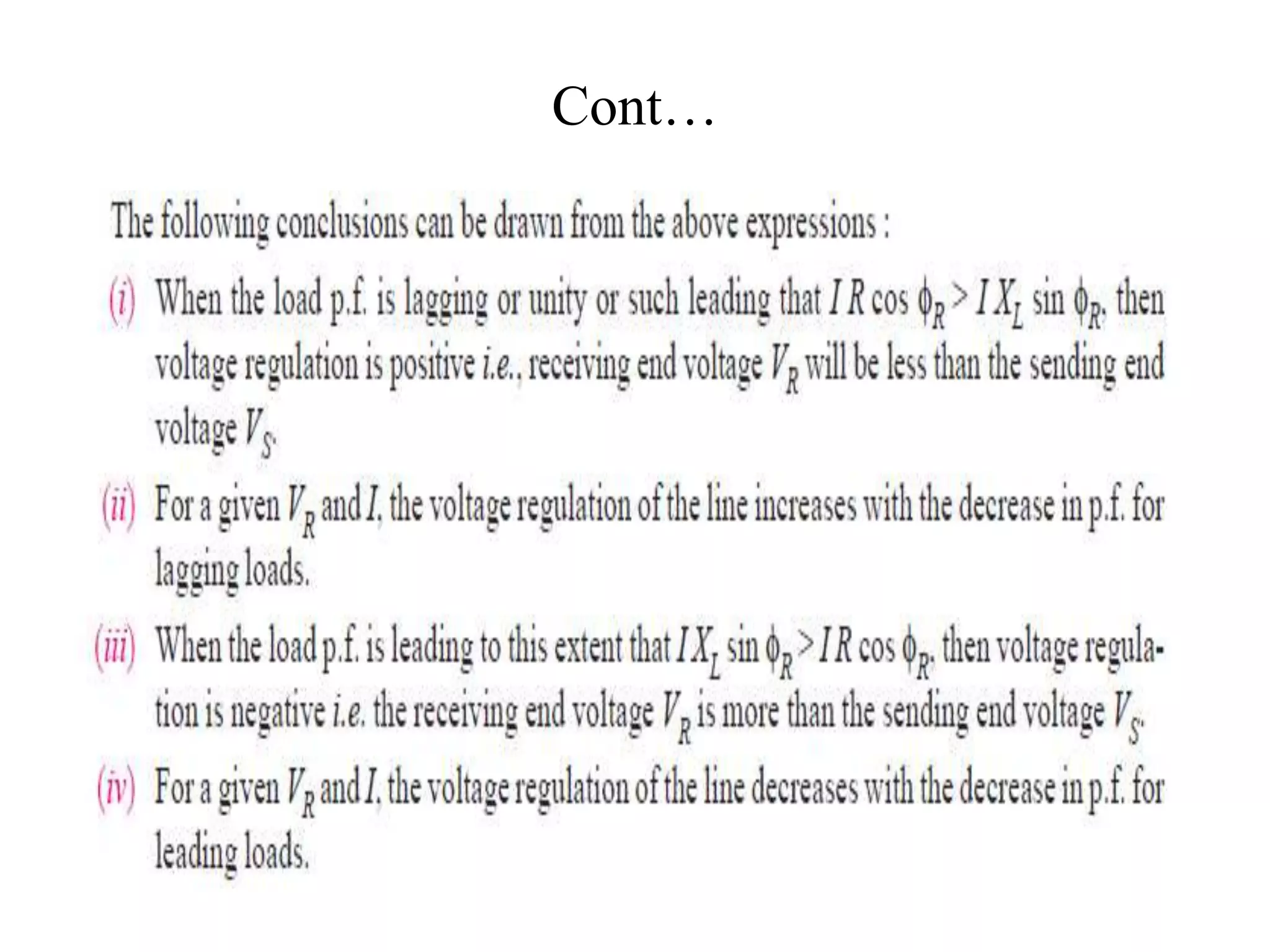
(i) Voltage regulation. When a transmission line is
carrying current, there is a voltage drop in the line
due to resistance and inductance of the line. The
result is that receiving end voltage (VR) of the line is
generally less than the sending end voltage (VS). This
voltage drop (VS−VR) in the line is expressed as a
percentage of receiving end voltage VR and is called
voltage regulation.
 The difference in voltage at the receiving end of a
transmission line between conditions of no load and
full load is called voltage regulation and is expressed
as a percentage of the receiving end voltage.
Cont…
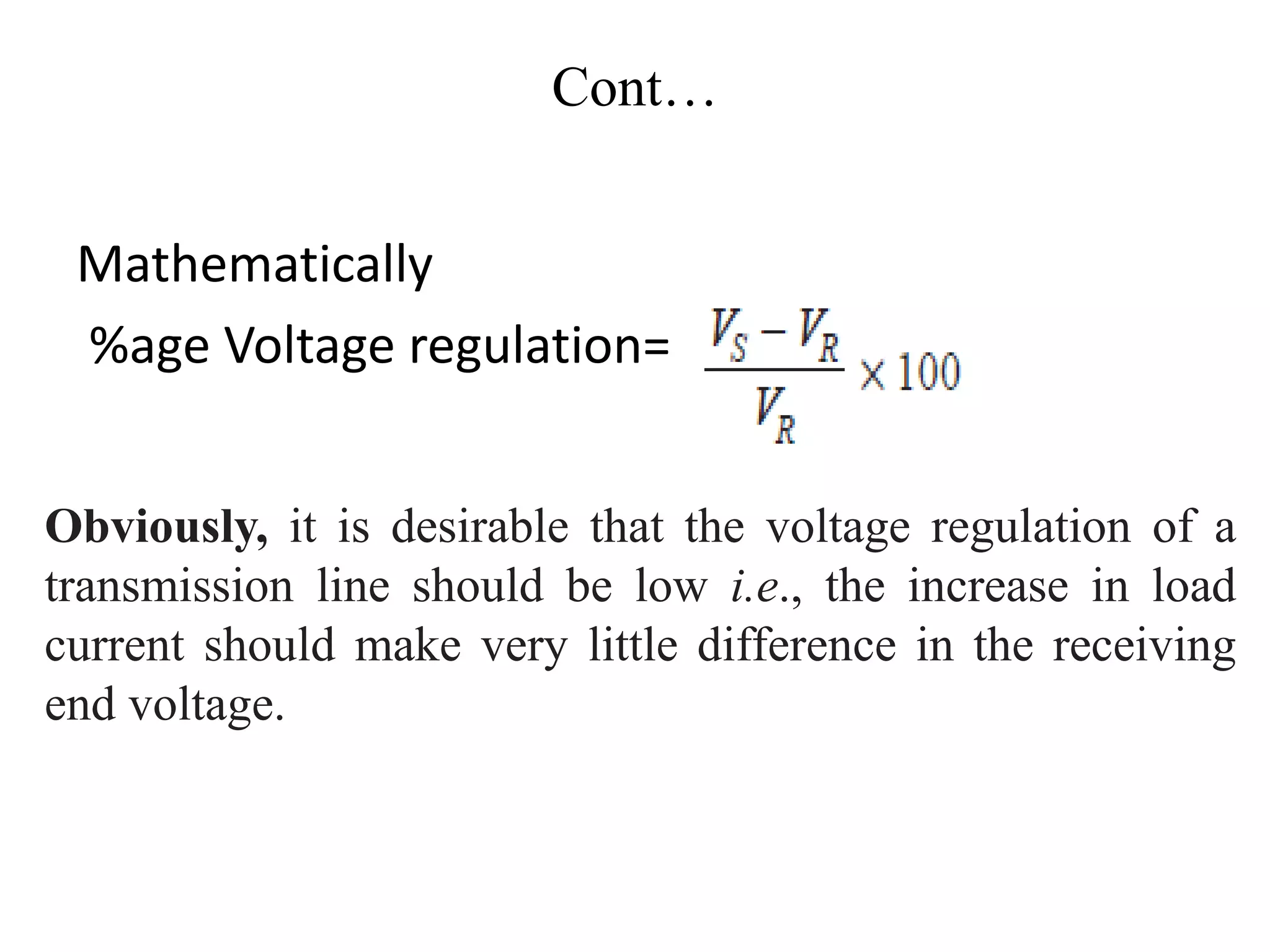
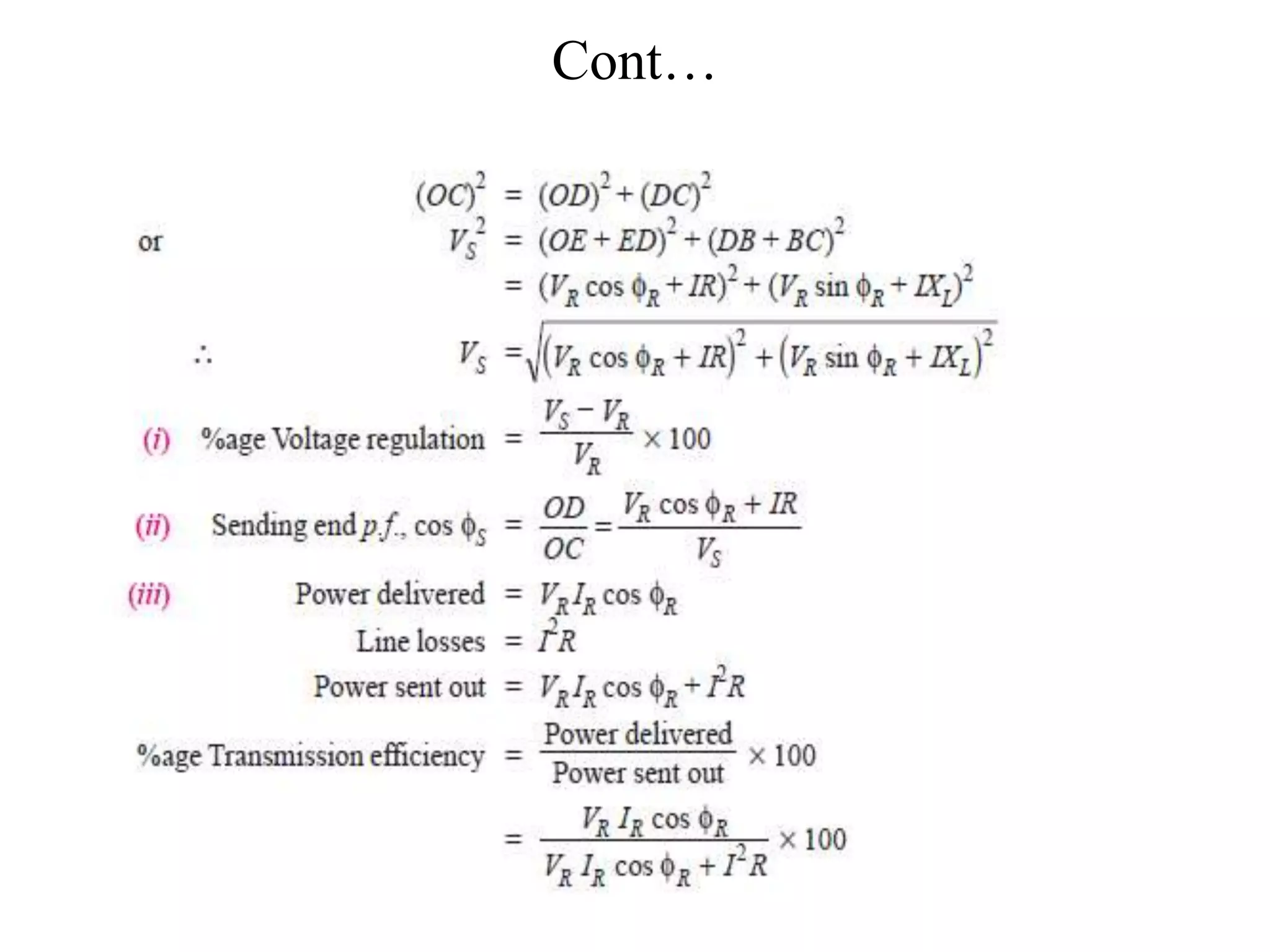
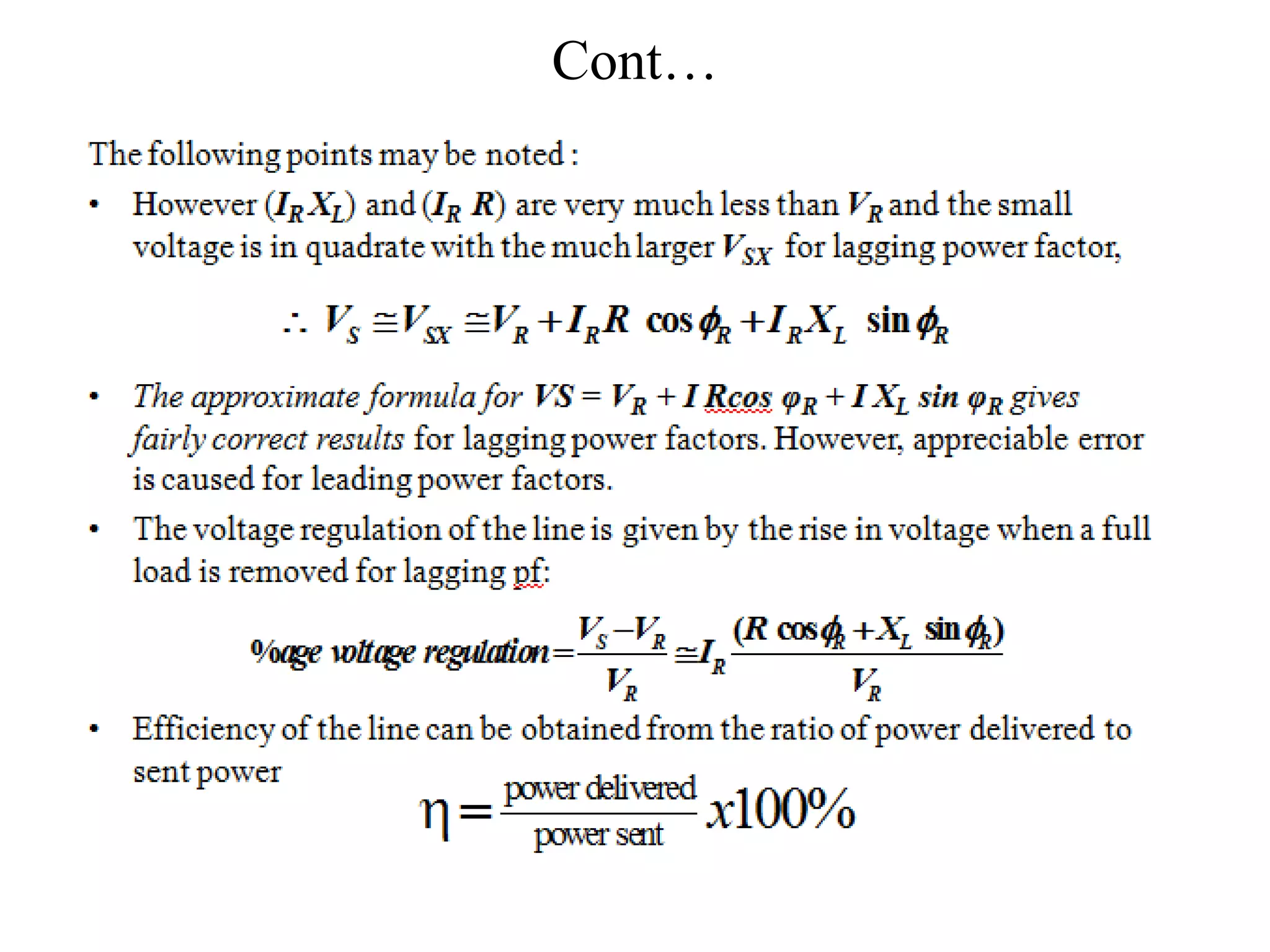
Mathematically
%age Voltage regulation=
Obviously, it is desirable that the voltage regulation of a
transmission line should be low i.e., the increase in load
current should make very little difference in the receiving
end voltage.
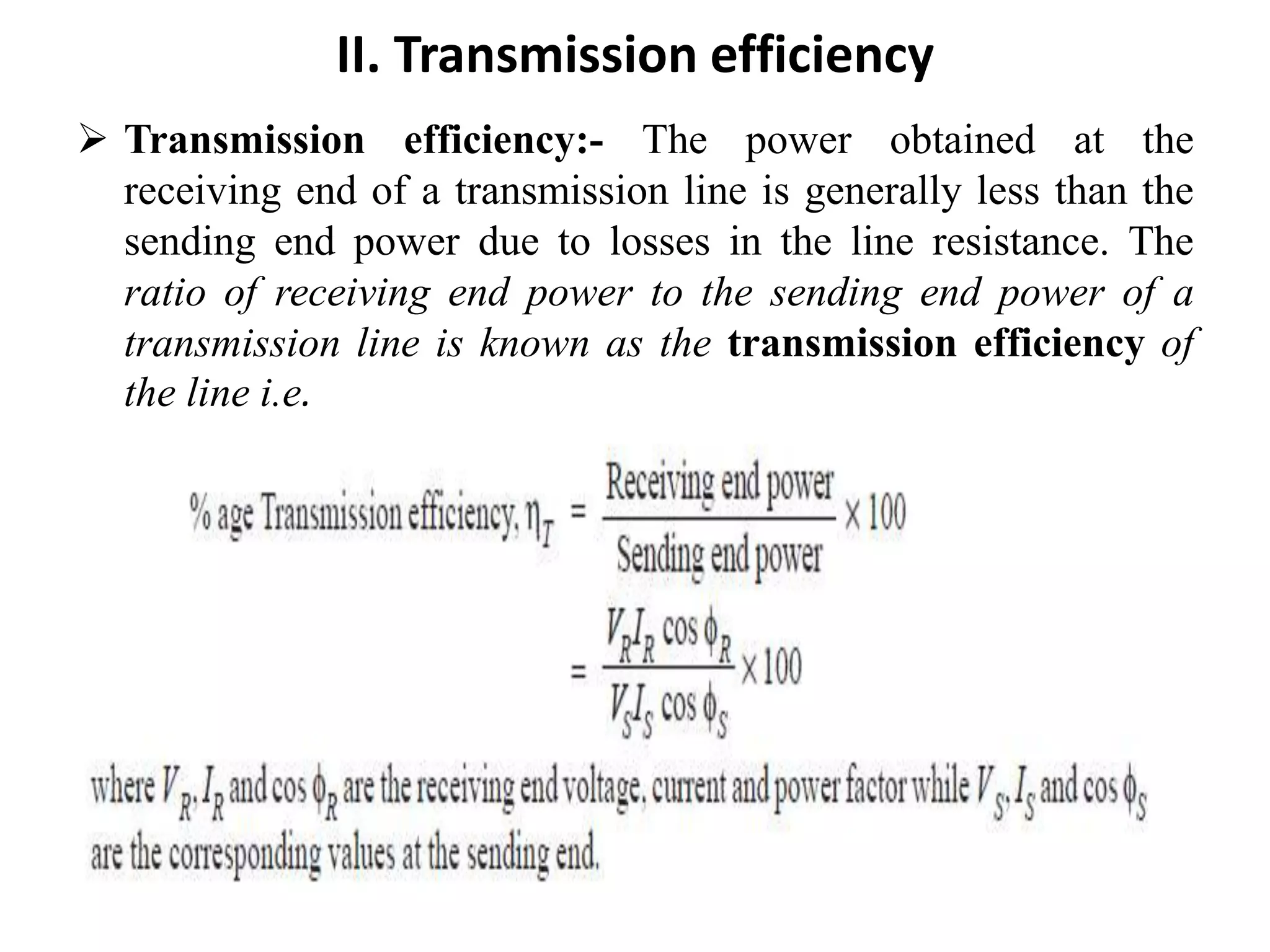
II. Transmission efficiency
 Transmission efficiency:- The power obtained at the
receiving end of a transmission line is generally less than the
sending end power due to losses in the line resistance. The
ratio of receiving end power to the sending end power of a
transmission line is known as the transmission efficiency of
the line i.e.
Performance of Single Phase Short Transmission Lines
 As stated earlier, the effects of line capacitance are
neglected for a short transmission line. Therefore,
while studying the performance of such a line, only
resistance and inductance of the line are taken into
account.
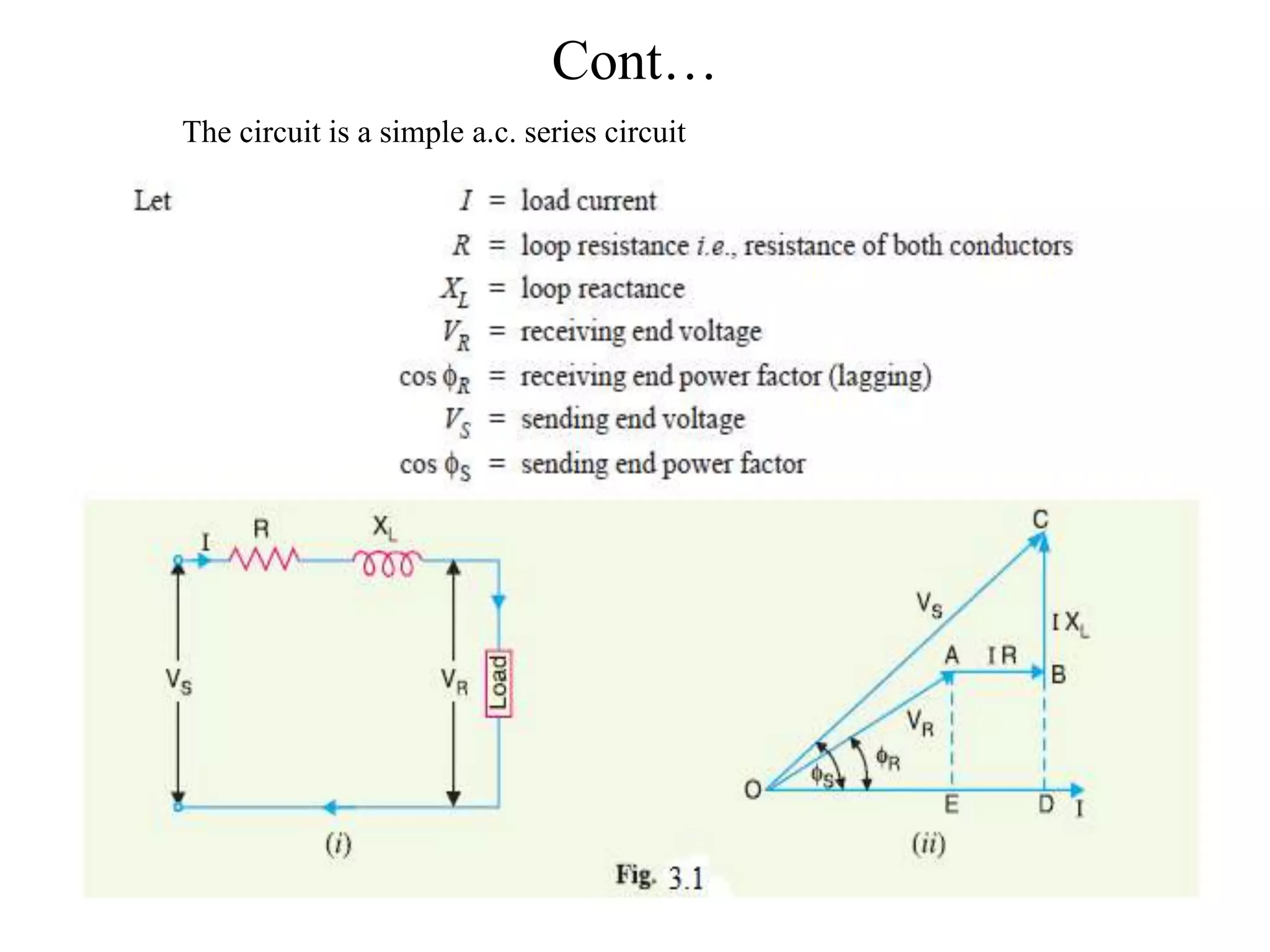
 The equivalent circuit of a single phase short
transmission line is shown in Fig. 3.1 (i).Here, the
total line resistance and inductance are shown as
concentrated or lumped instead of being distributed.
Cont…
The circuit is a simple a.c. series circuit
Cont…
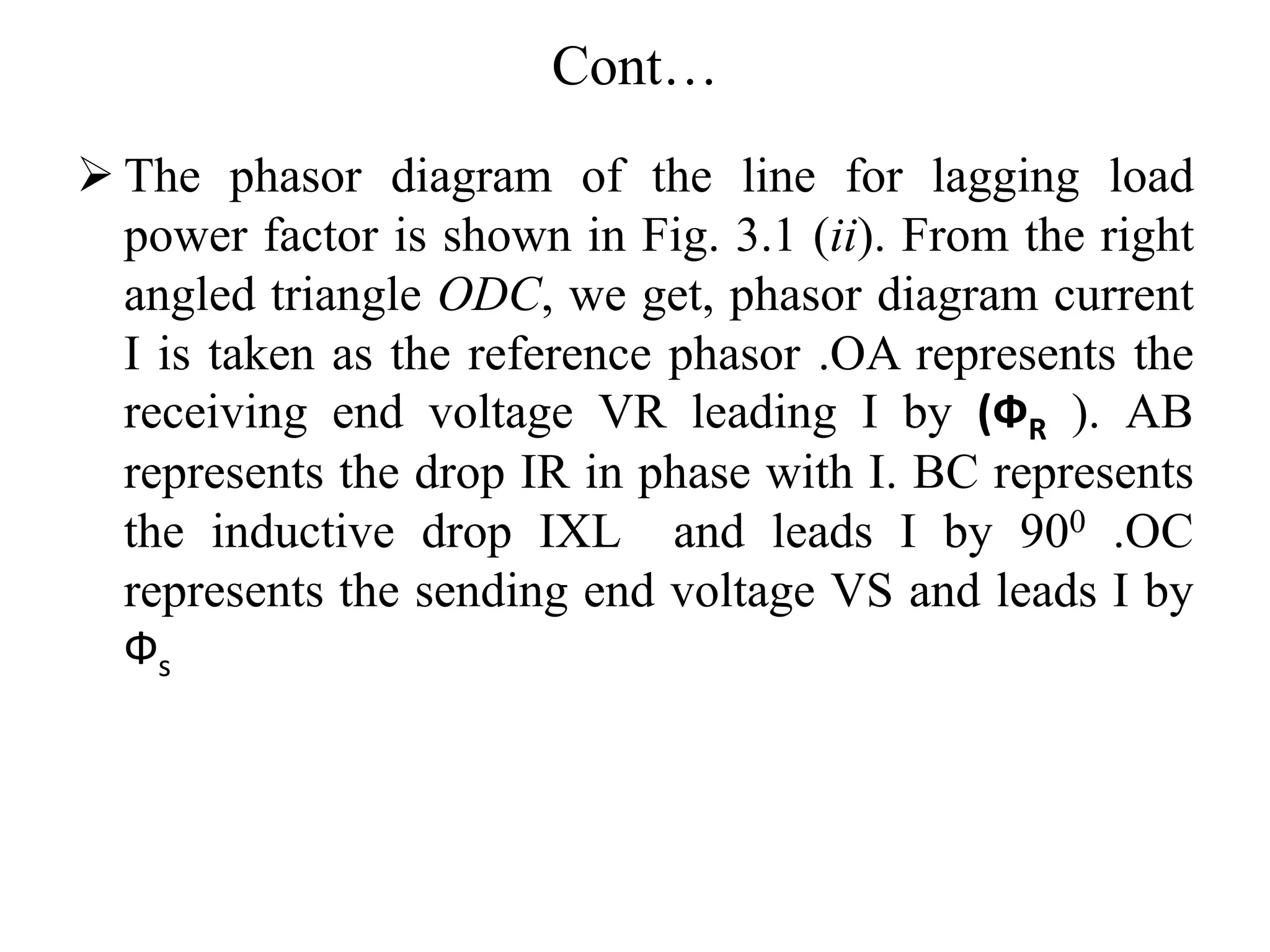
 The phasor diagram of the line for lagging load
power factor is shown in Fig. 3.1 (ii). From the right
angled triangle ODC, we get, phasor diagram current
I is taken as the reference phasor .OA represents the
receiving end voltage VR leading I by (ФR ). AB
represents the drop IR in phase with I. BC represents
the inductive drop IXL and leads I by 900 .OC
represents the sending end voltage VS and leads I by
Фs
Cont…
Cont…
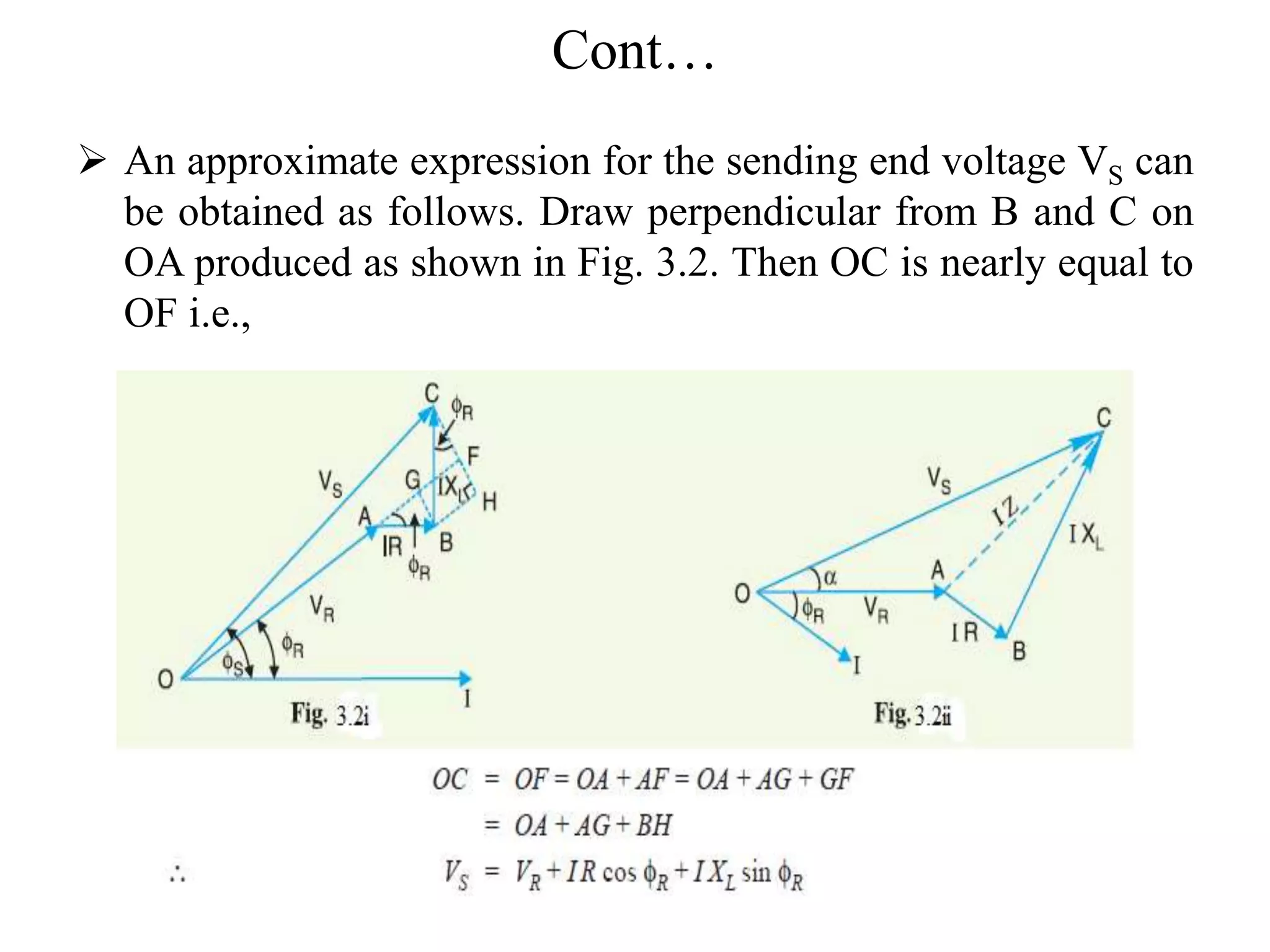
 An approximate expression for the sending end voltage VS can
be obtained as follows. Draw perpendicular from B and C on
OA produced as shown in Fig. 3.2. Then OC is nearly equal to
OF i.e.,
Cont…
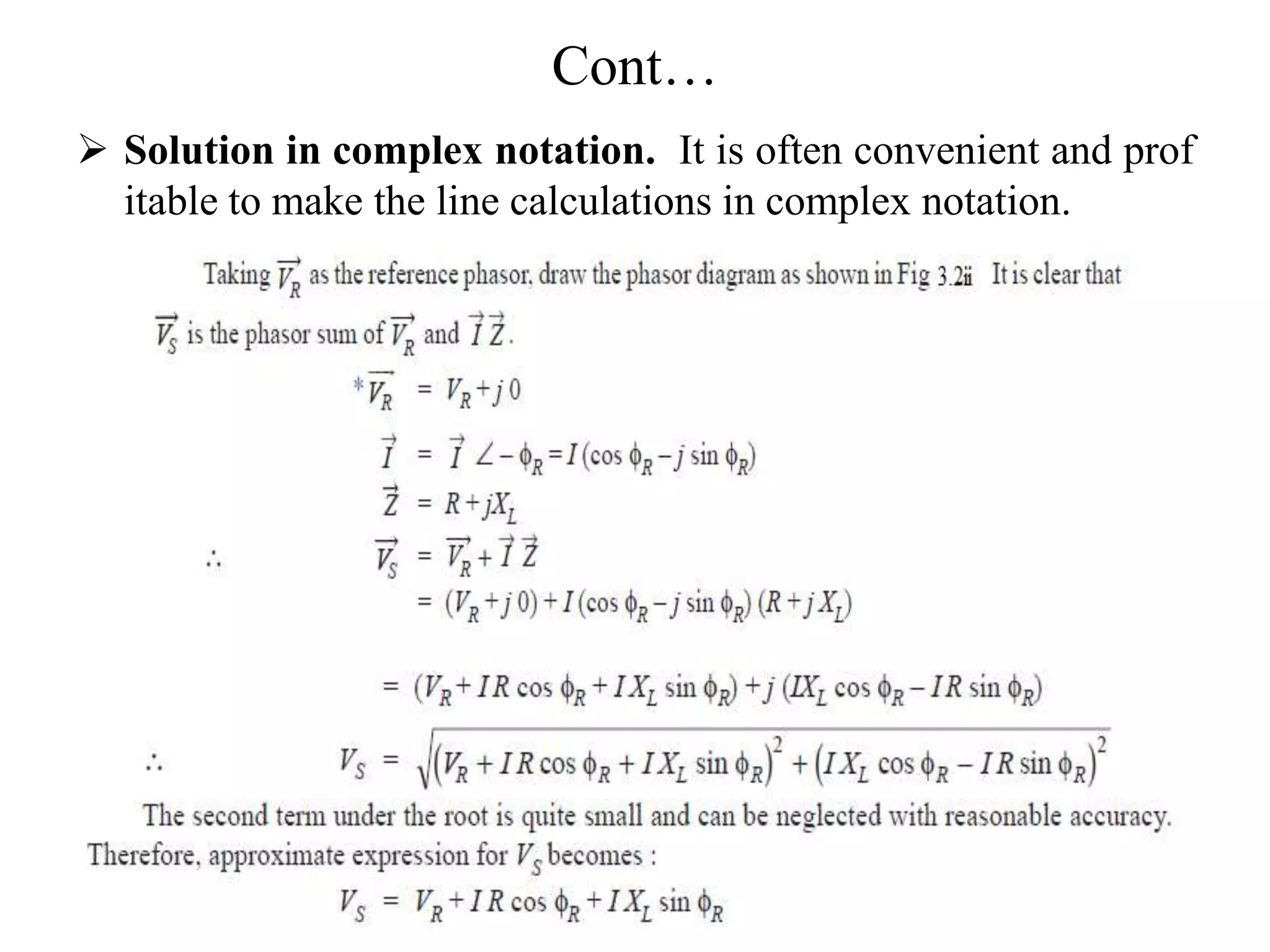
 Solution in complex notation. It is often convenient and prof
itable to make the line calculations in complex notation.
Cont…
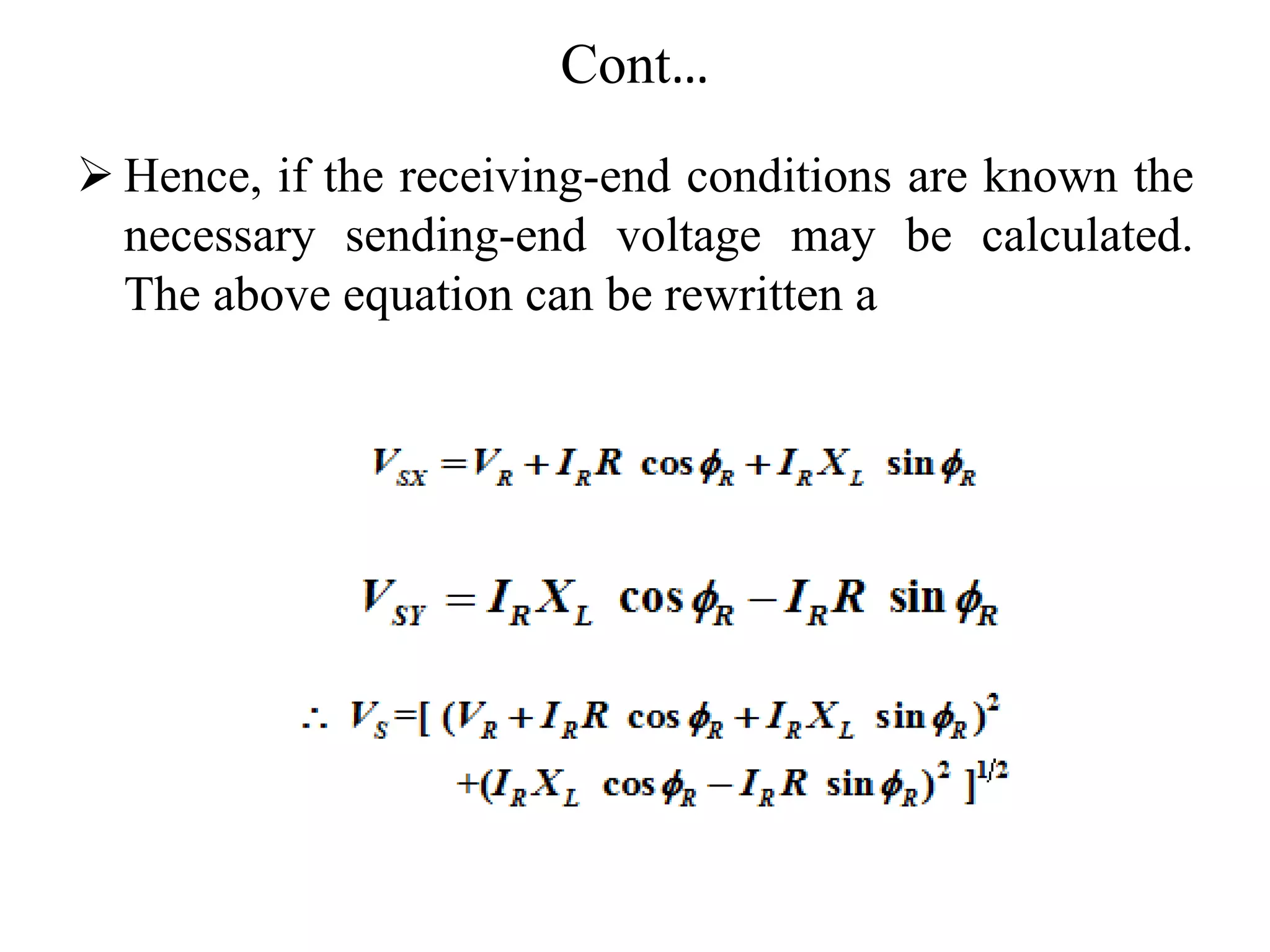
 Hence, if the receiving-end conditions are known the
necessary sending-end voltage may be calculated.
The above equation can be rewritten a
Cont…
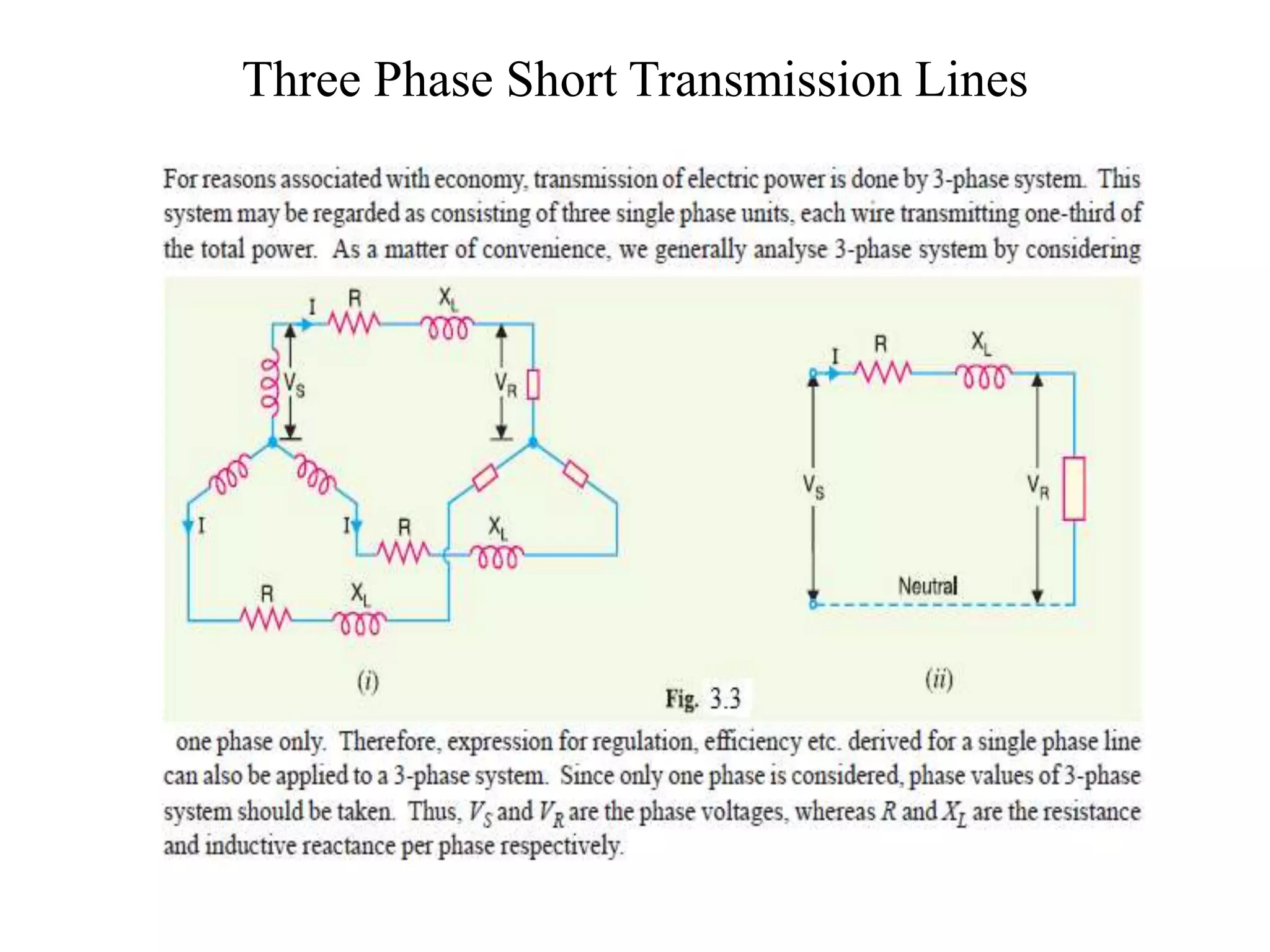
Three Phase Short Transmission Lines
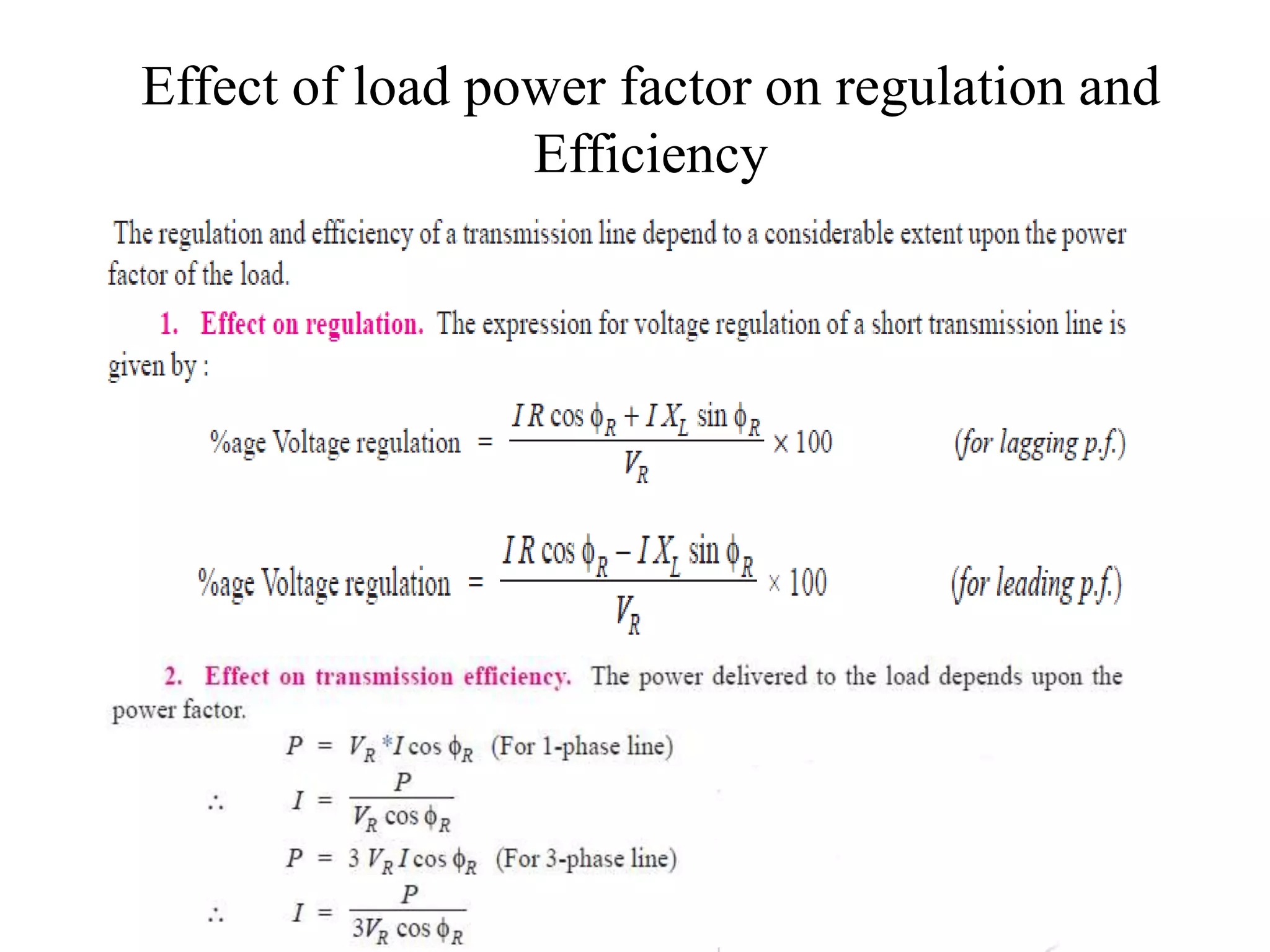
Effect of load power factor on regulation and
Efficiency
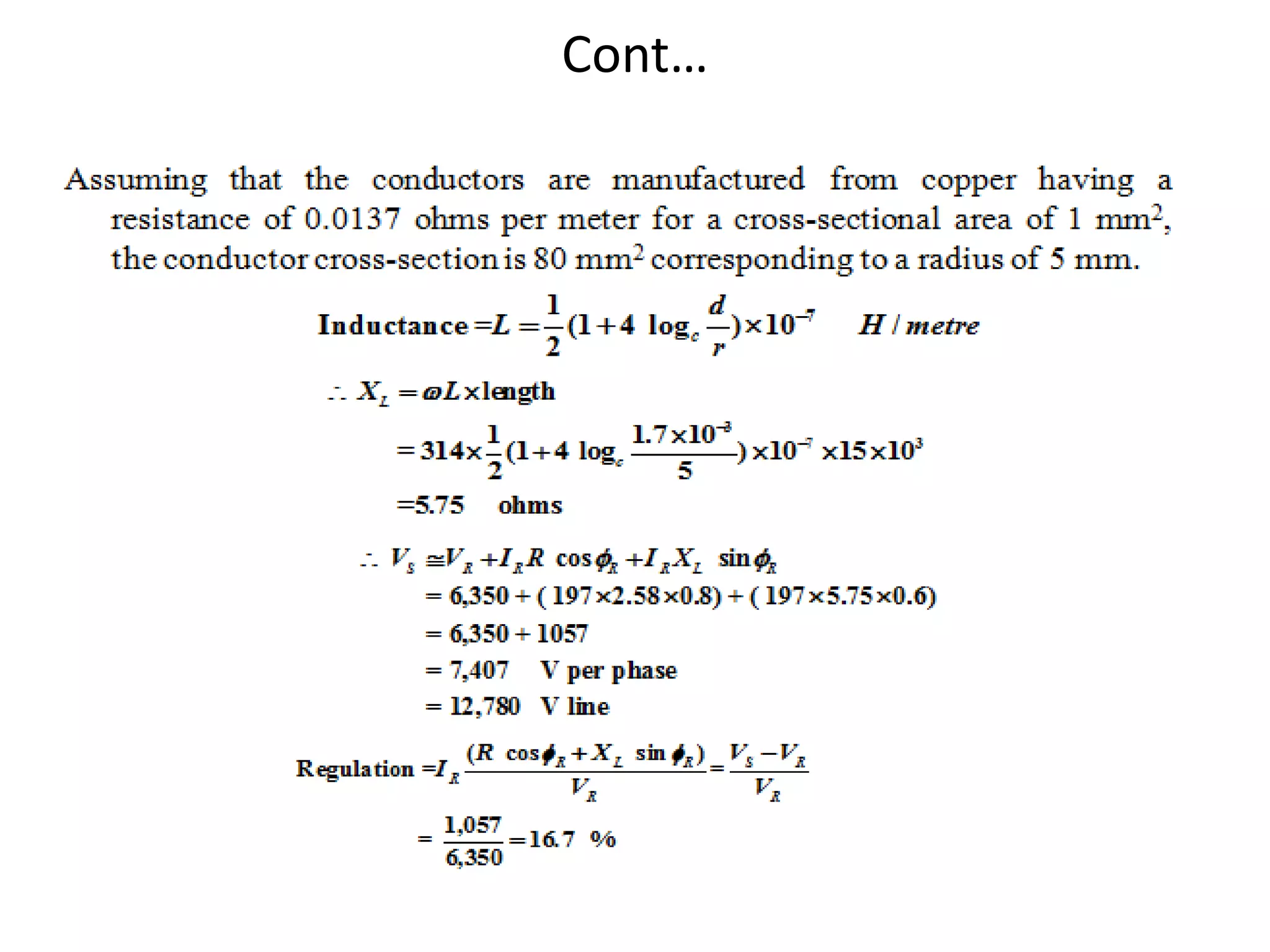
Cont…
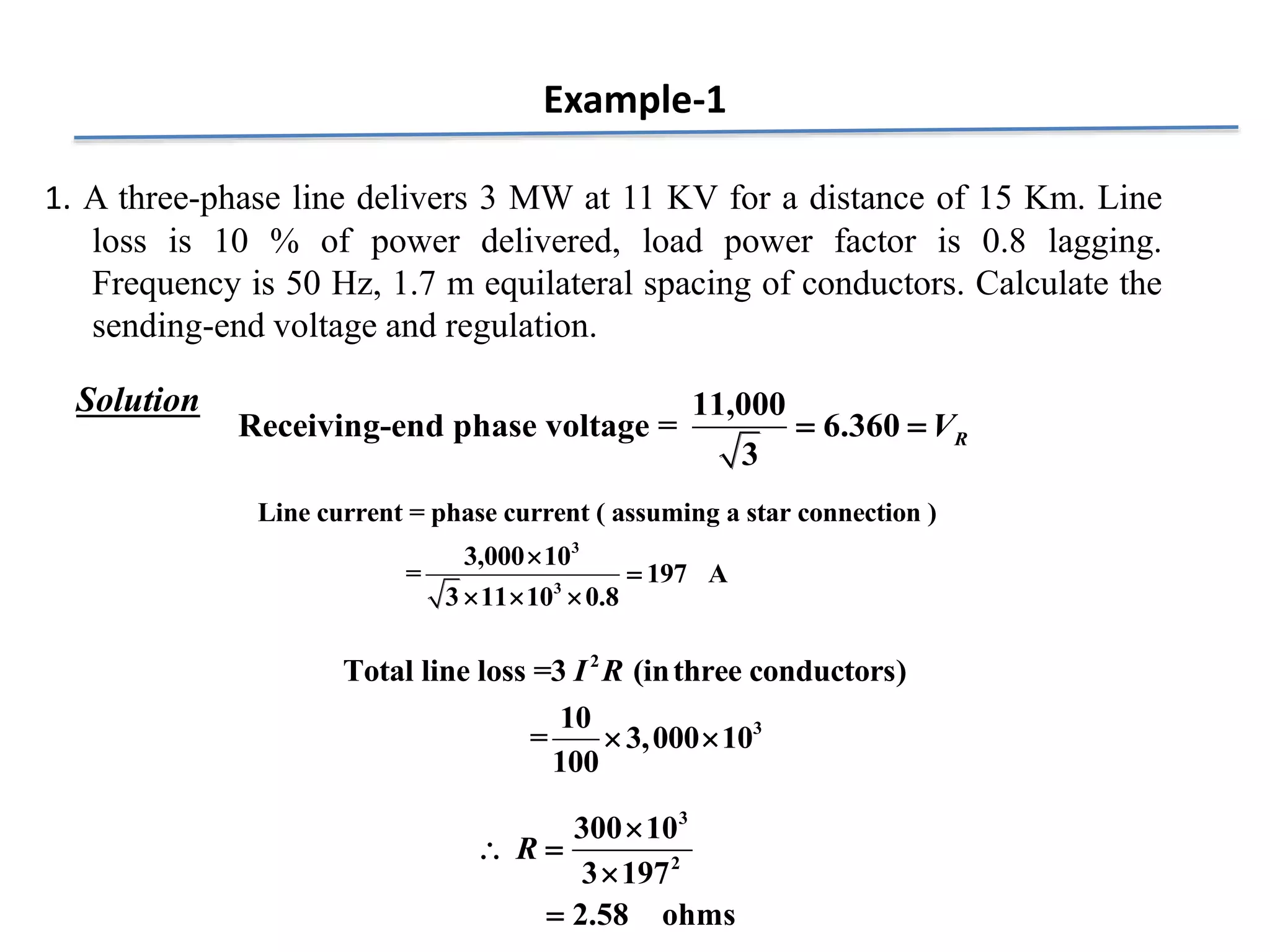
Example-1
1. A three-phase line delivers 3 MW at 11 KV for a distance of 15 Km. Line
loss is 10 % of power delivered, load power factor is 0.8 lagging.
Frequency is 50 Hz, 1.7 m equilateral spacing of conductors. Calculate the
sending-end voltage and regulation.
11,000
Receiving-end phase voltage = 6.360
3
R
V
 
3
3
Line current = phase current ( assuming a star connection )
3,000 10
= 197 A
3 11 10 0.8


  
2
3
Total line loss =3 (inthree conductors)
10
= 3,000 10
100
I R
 
Solution
3
2
300 10
3 197
2.58 ohms
R

 


Cont…
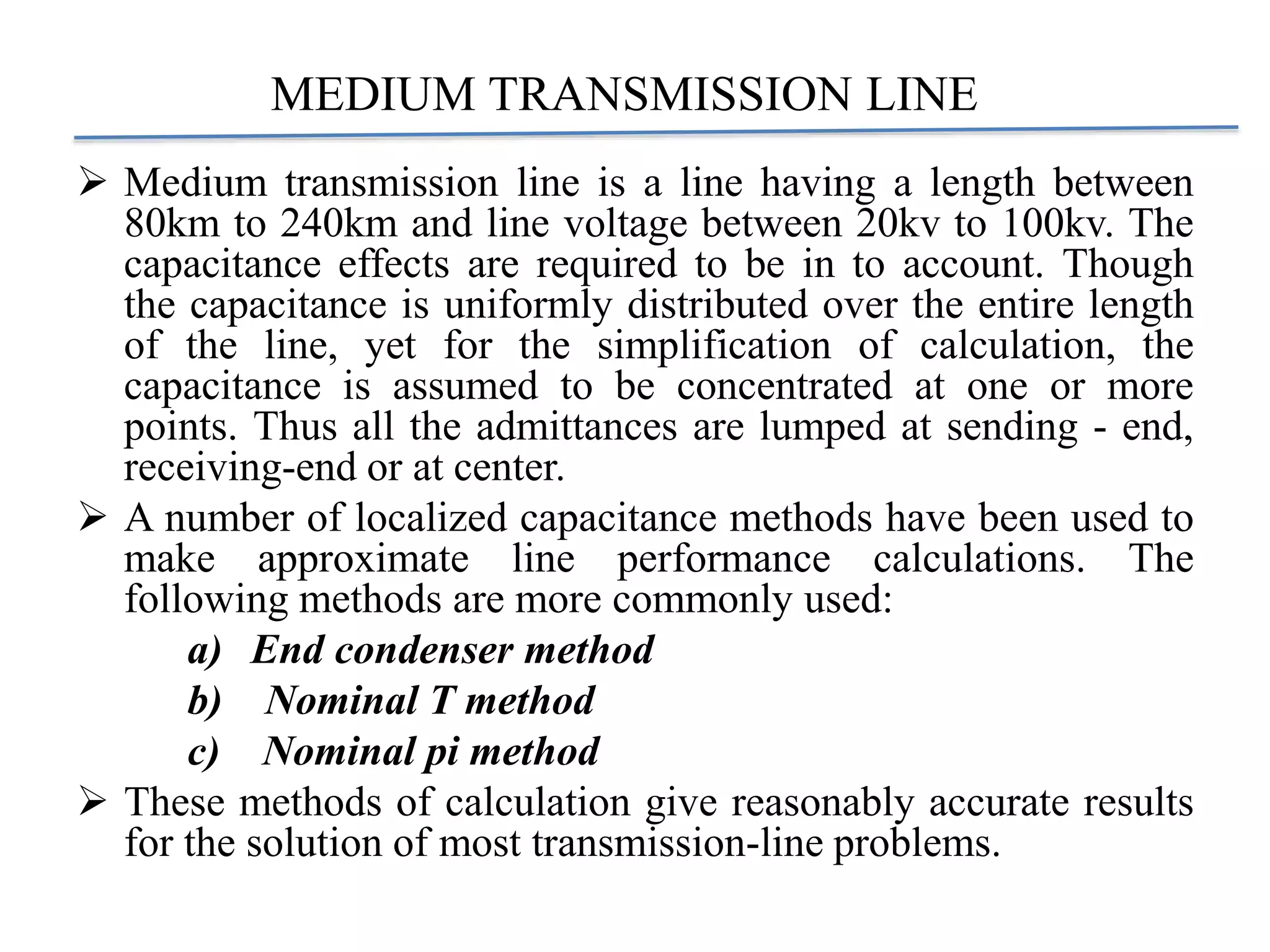
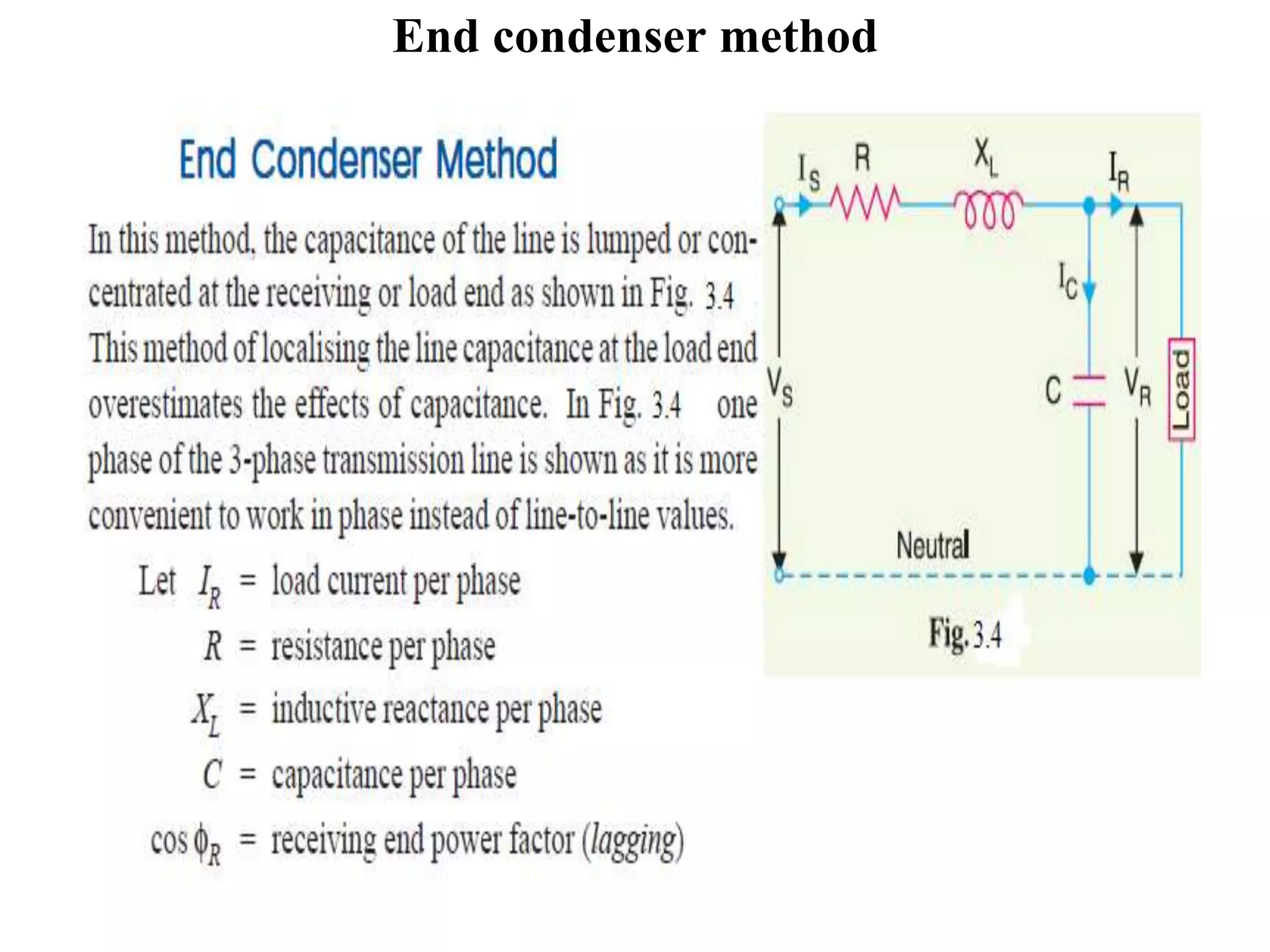
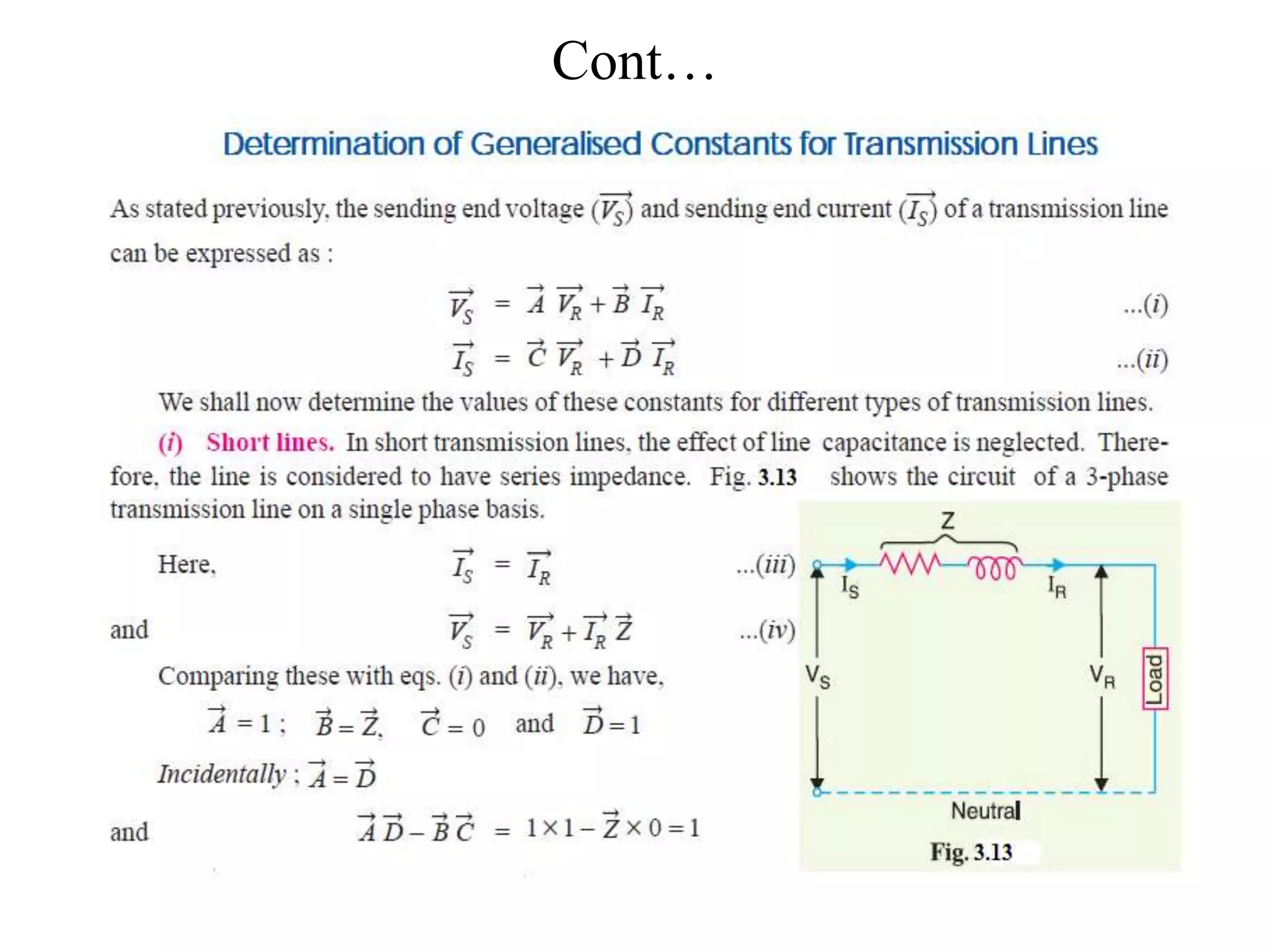
MEDIUM TRANSMISSION LINE
 Medium transmission line is a line having a length between
80km to 240km and line voltage between 20kv to 100kv. The
capacitance effects are required to be in to account. Though
the capacitance is uniformly distributed over the entire length
of the line, yet for the simplification of calculation, the
capacitance is assumed to be concentrated at one or more
points. Thus all the admittances are lumped at sending - end,
receiving-end or at center.
 A number of localized capacitance methods have been used to
make approximate line performance calculations. The
following methods are more commonly used:
a) End condenser method
b) Nominal T method
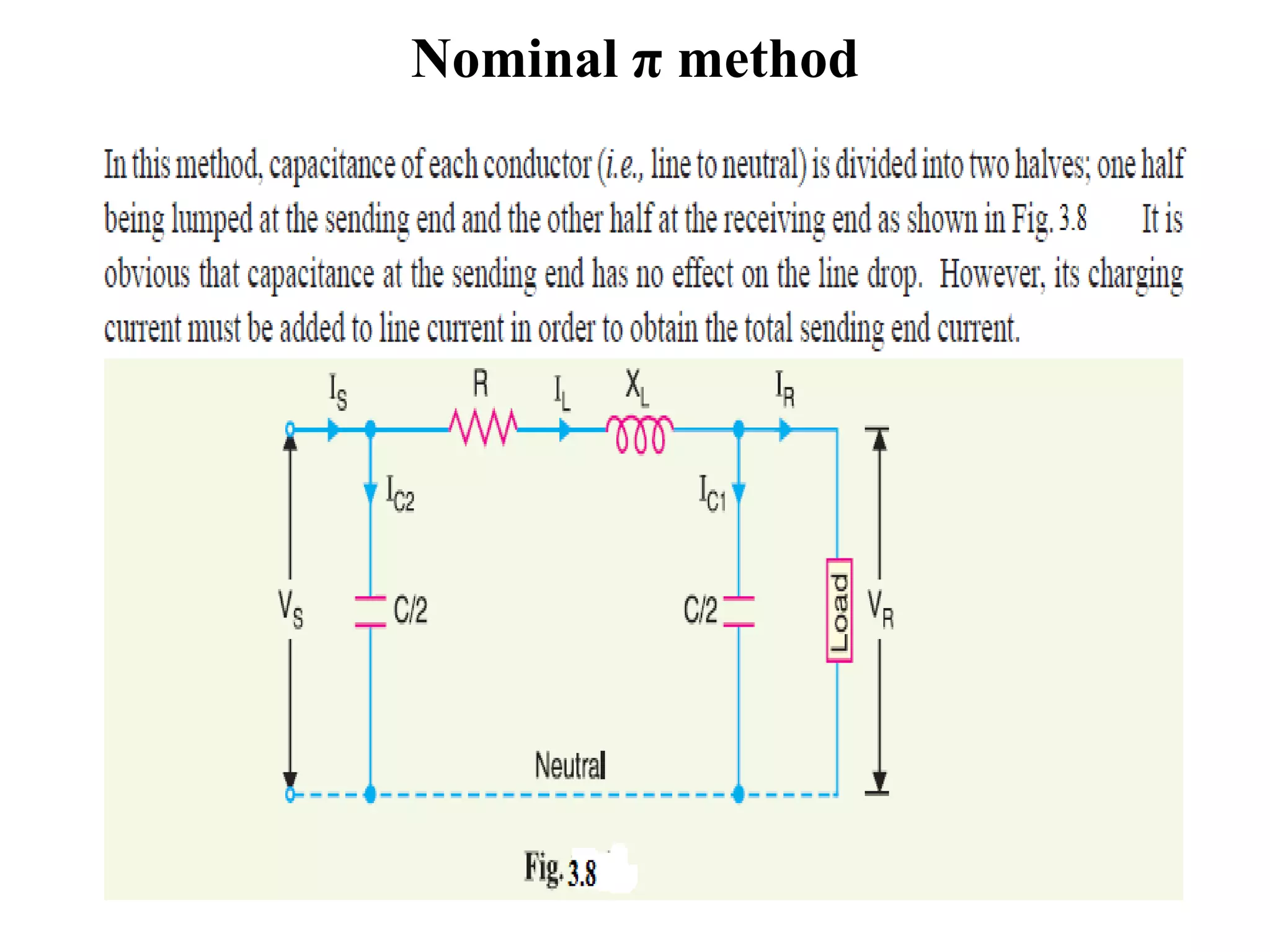
c) Nominal pi method
 These methods of calculation give reasonably accurate results
for the solution of most transmission-line problems.
End condenser method
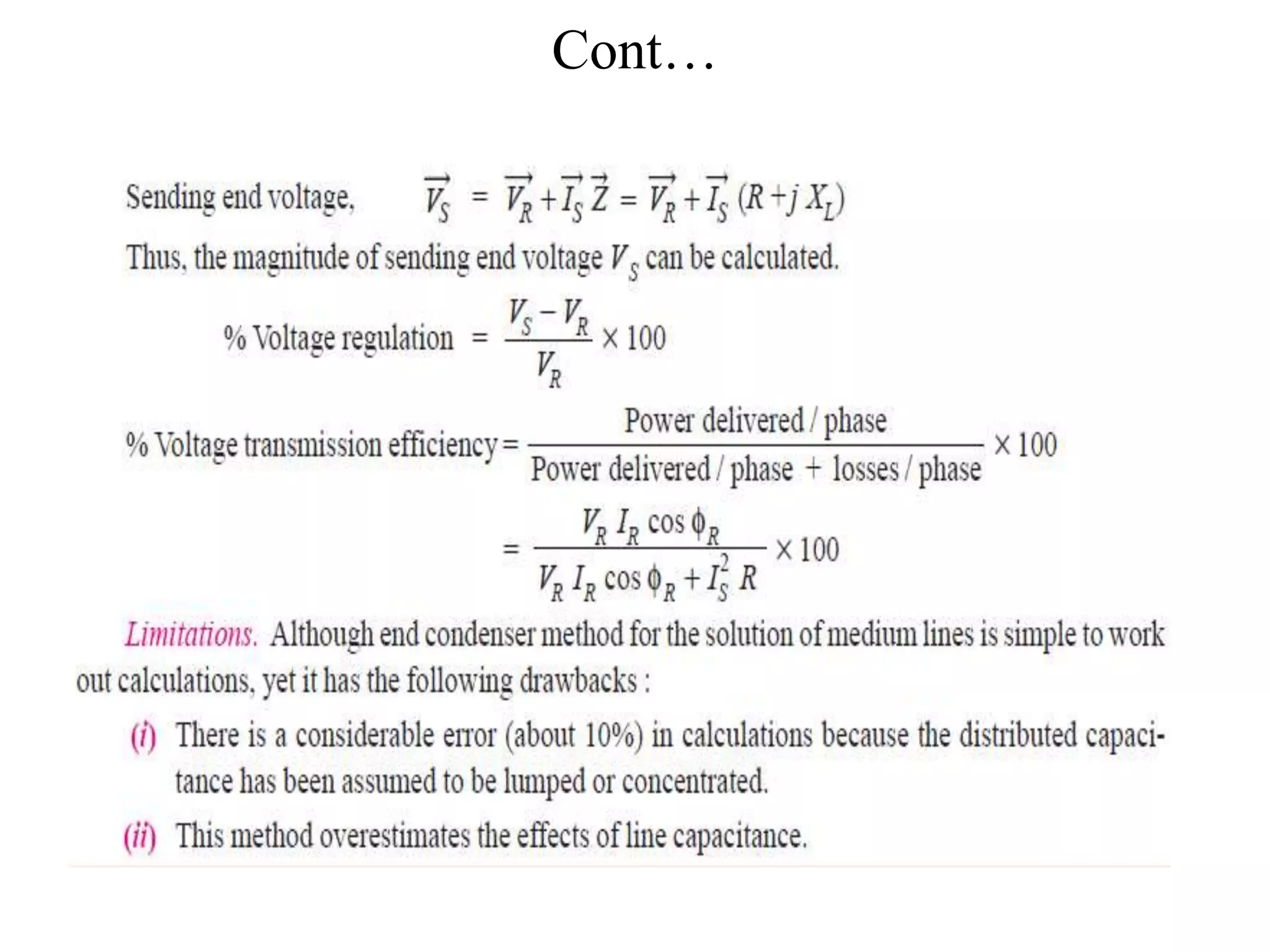
Cont…
Cont…
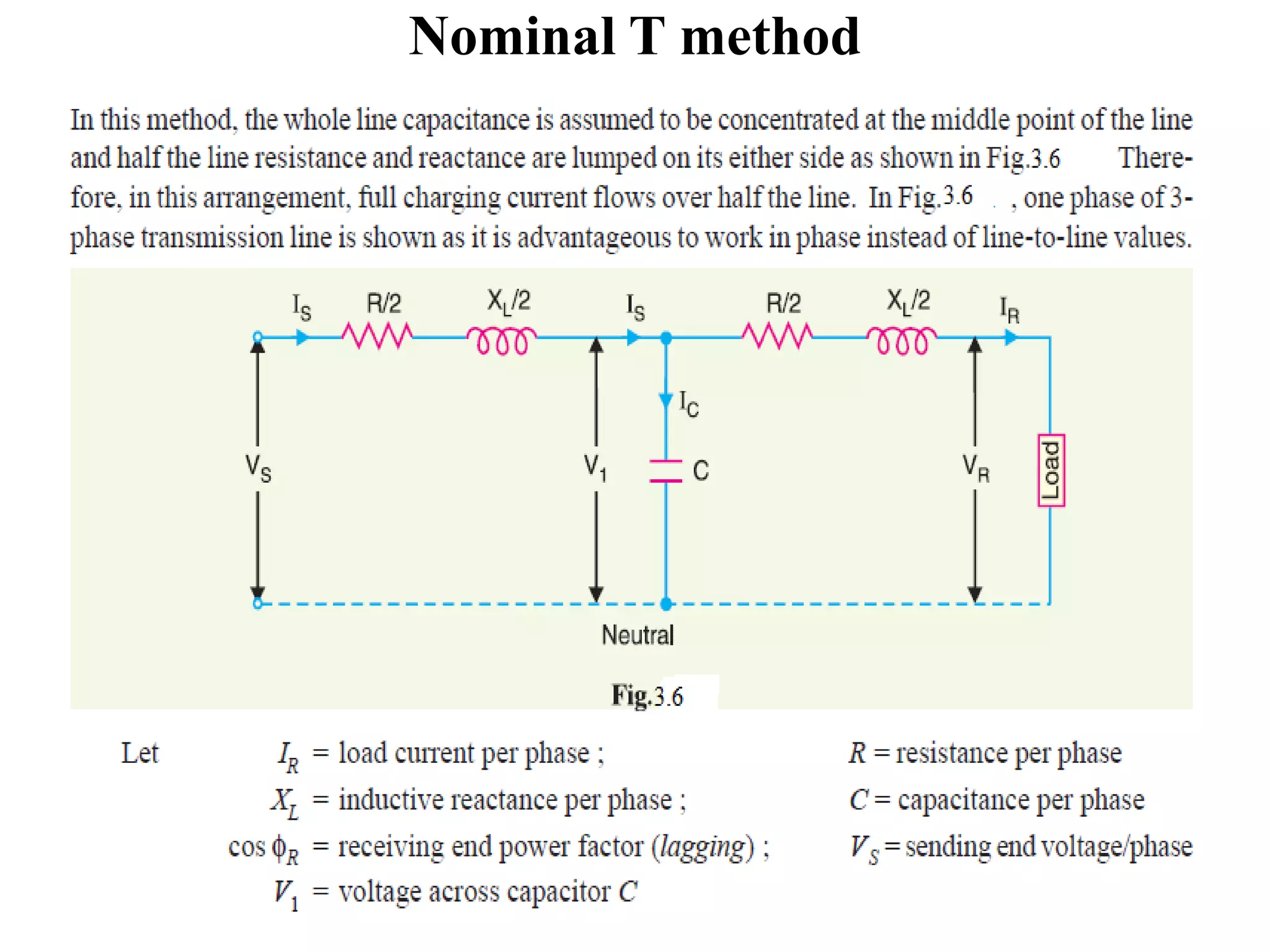
Nominal T method
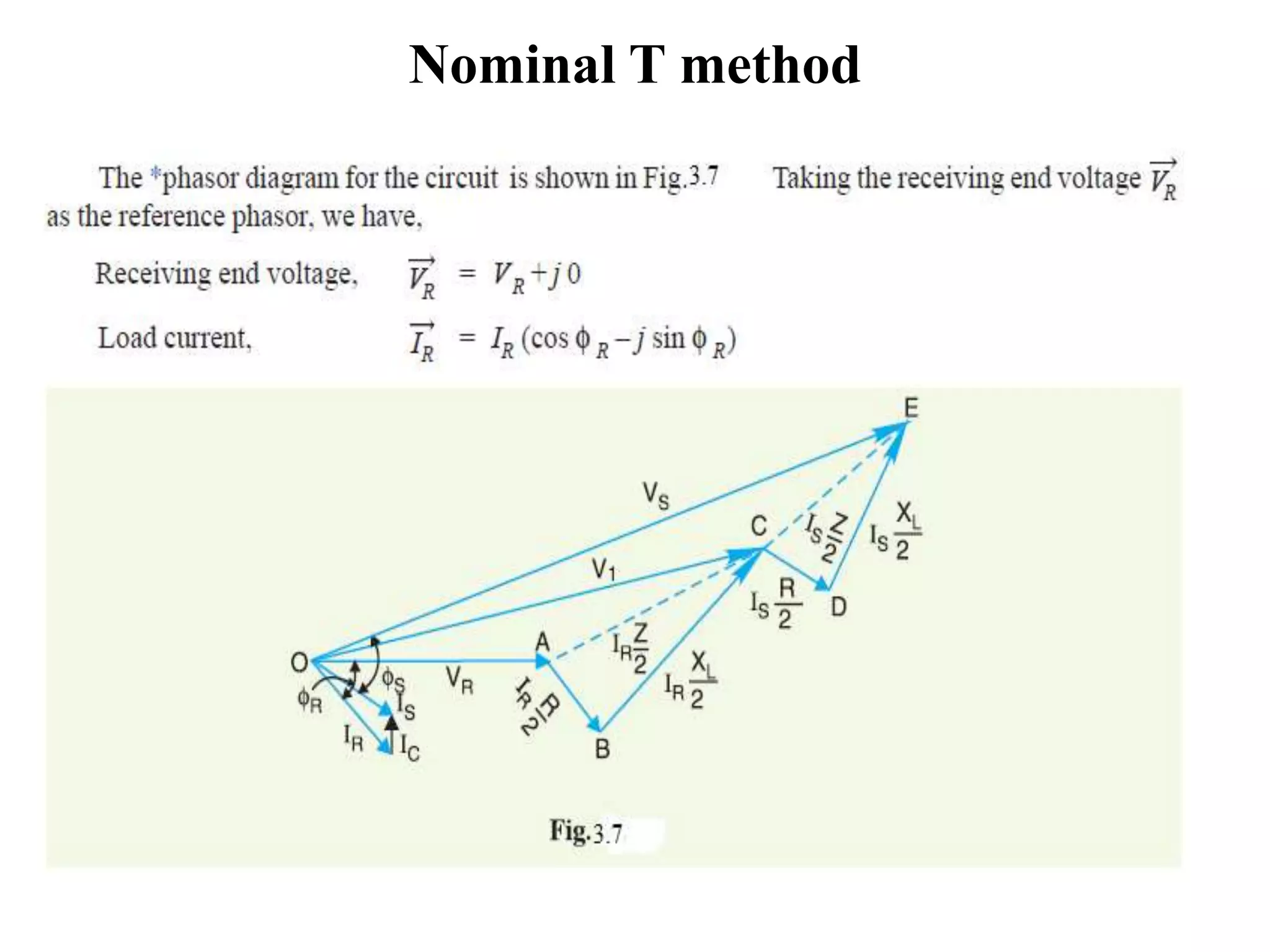
Nominal T method
Cont…
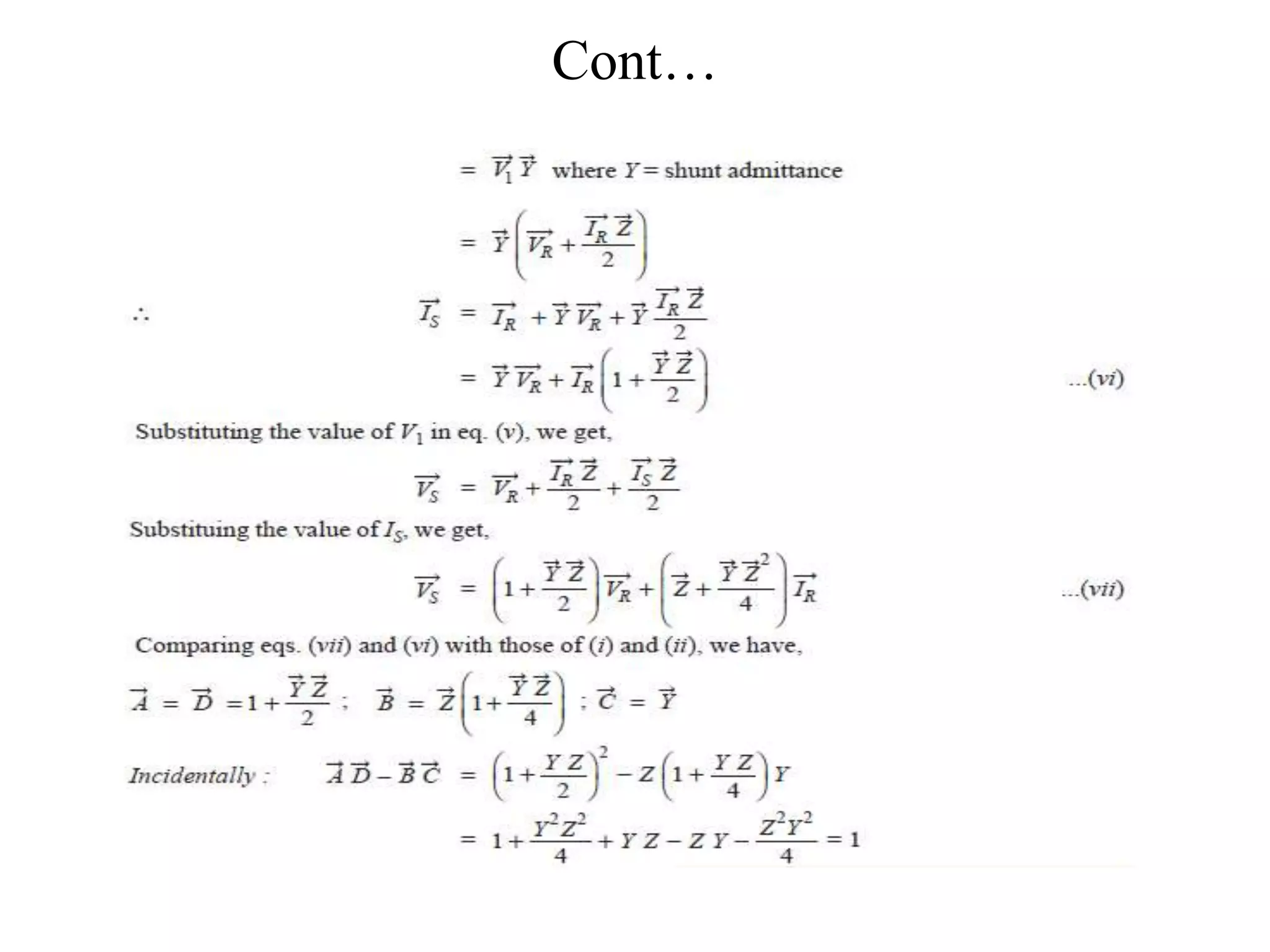
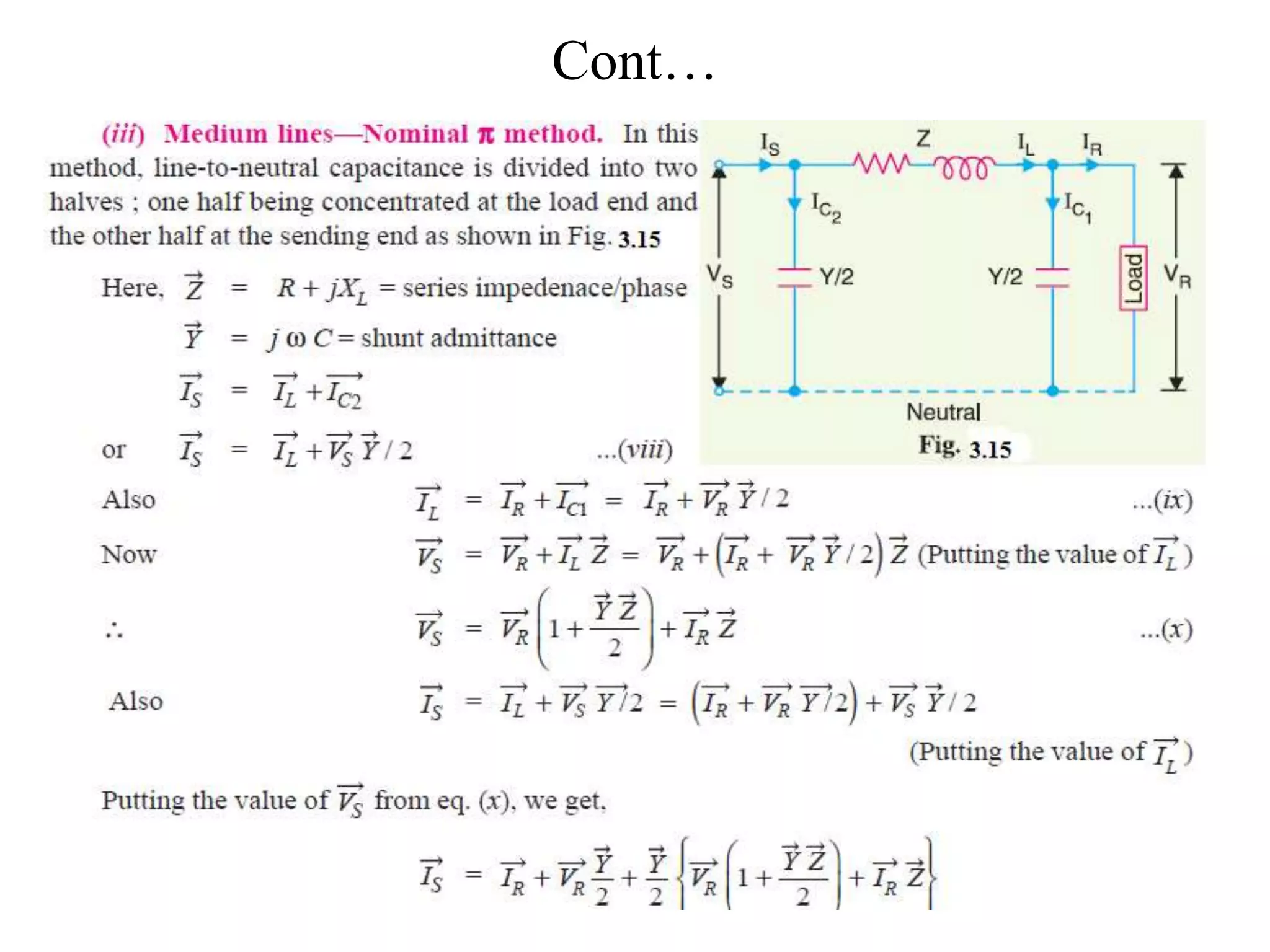
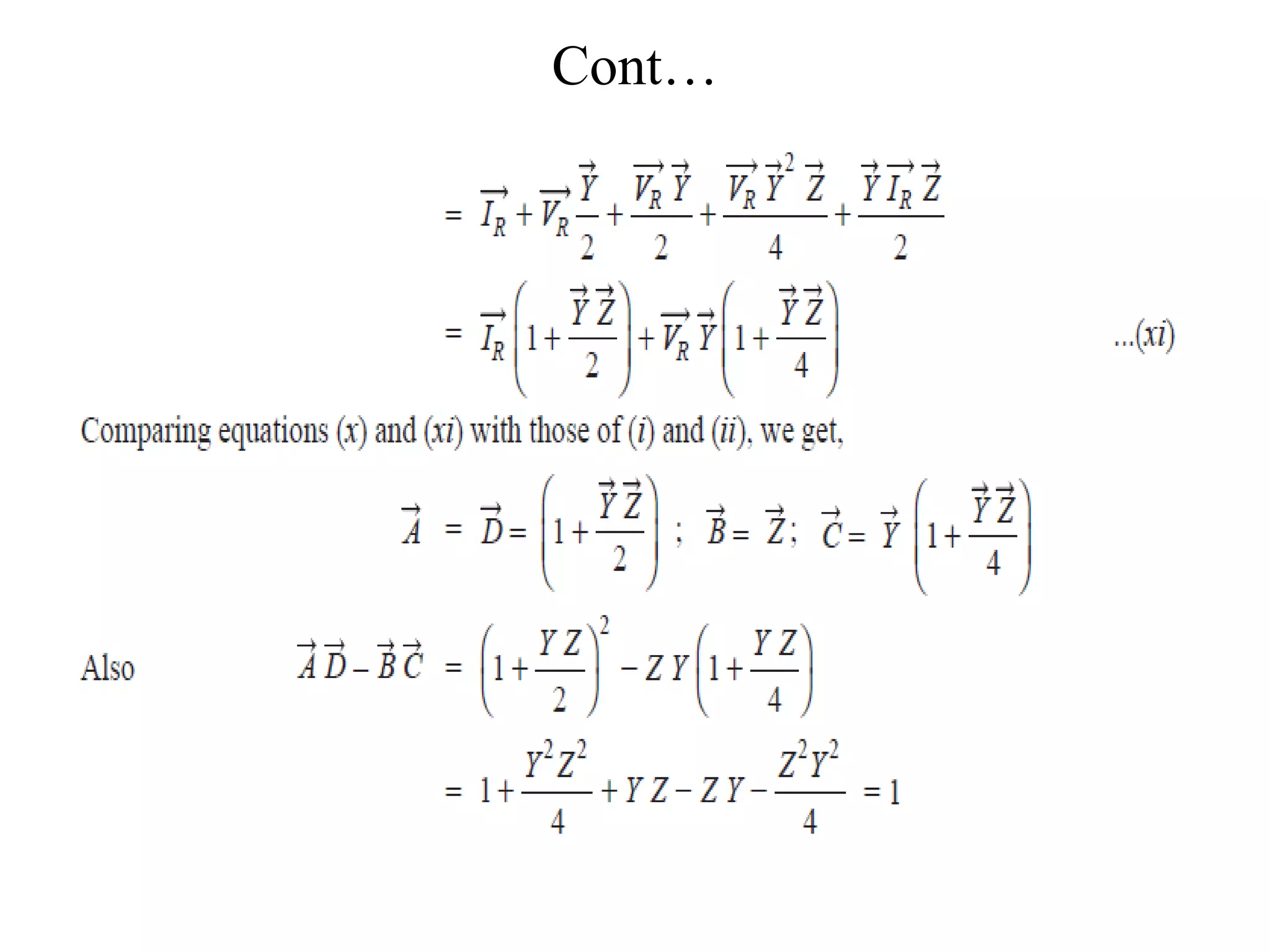
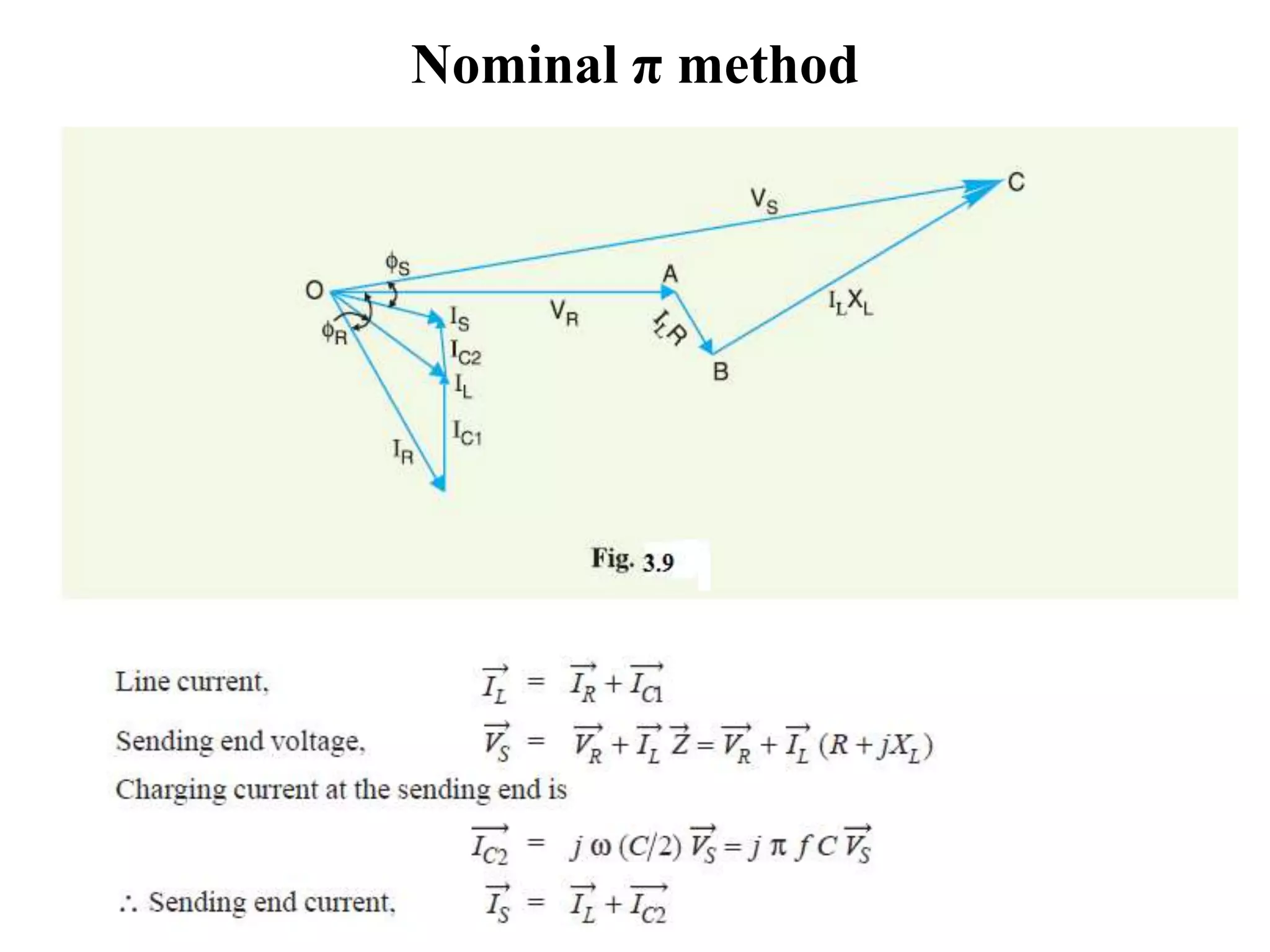
Nominal π method
Nominal π method
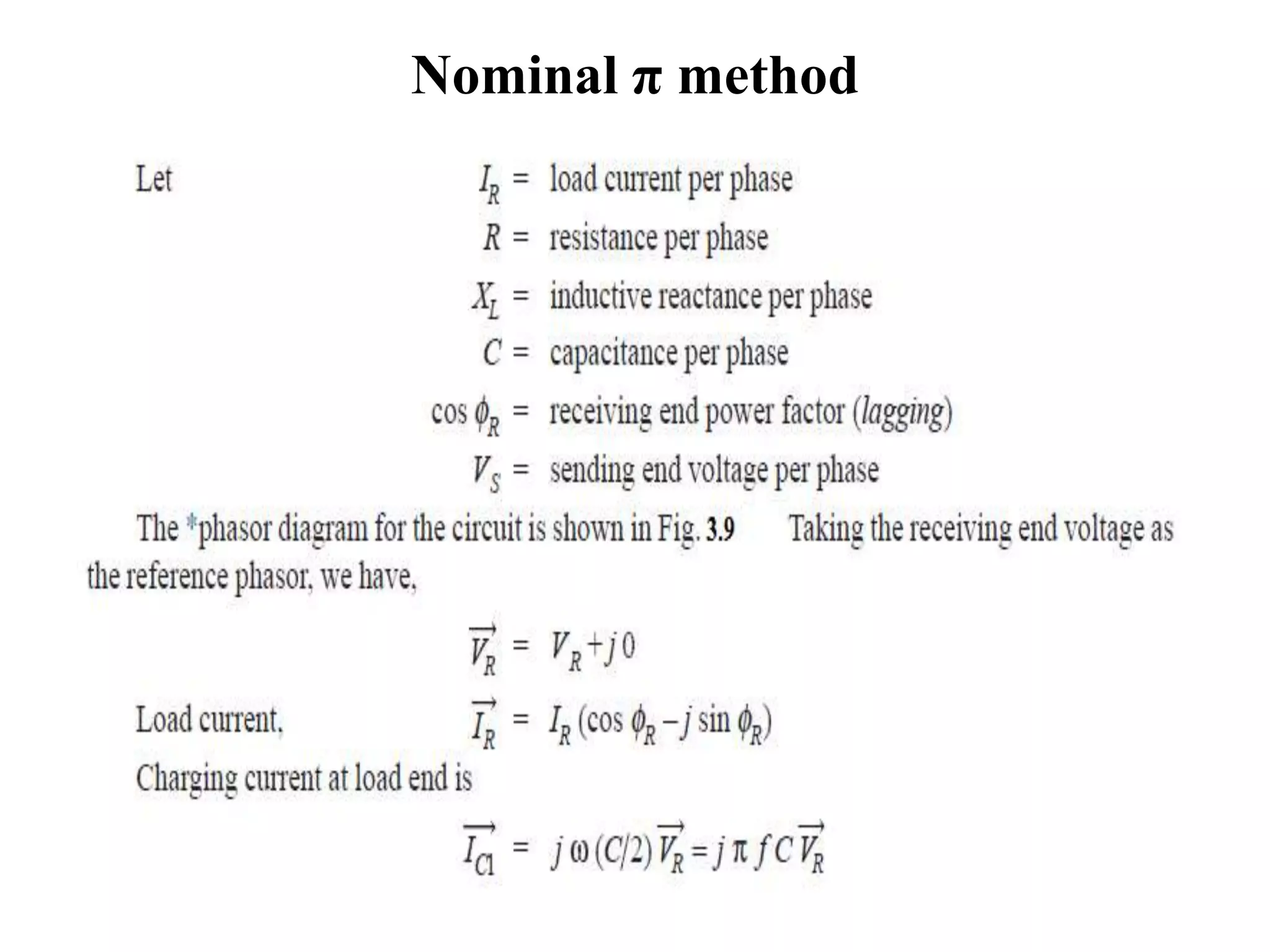
Nominal π method
Example-2
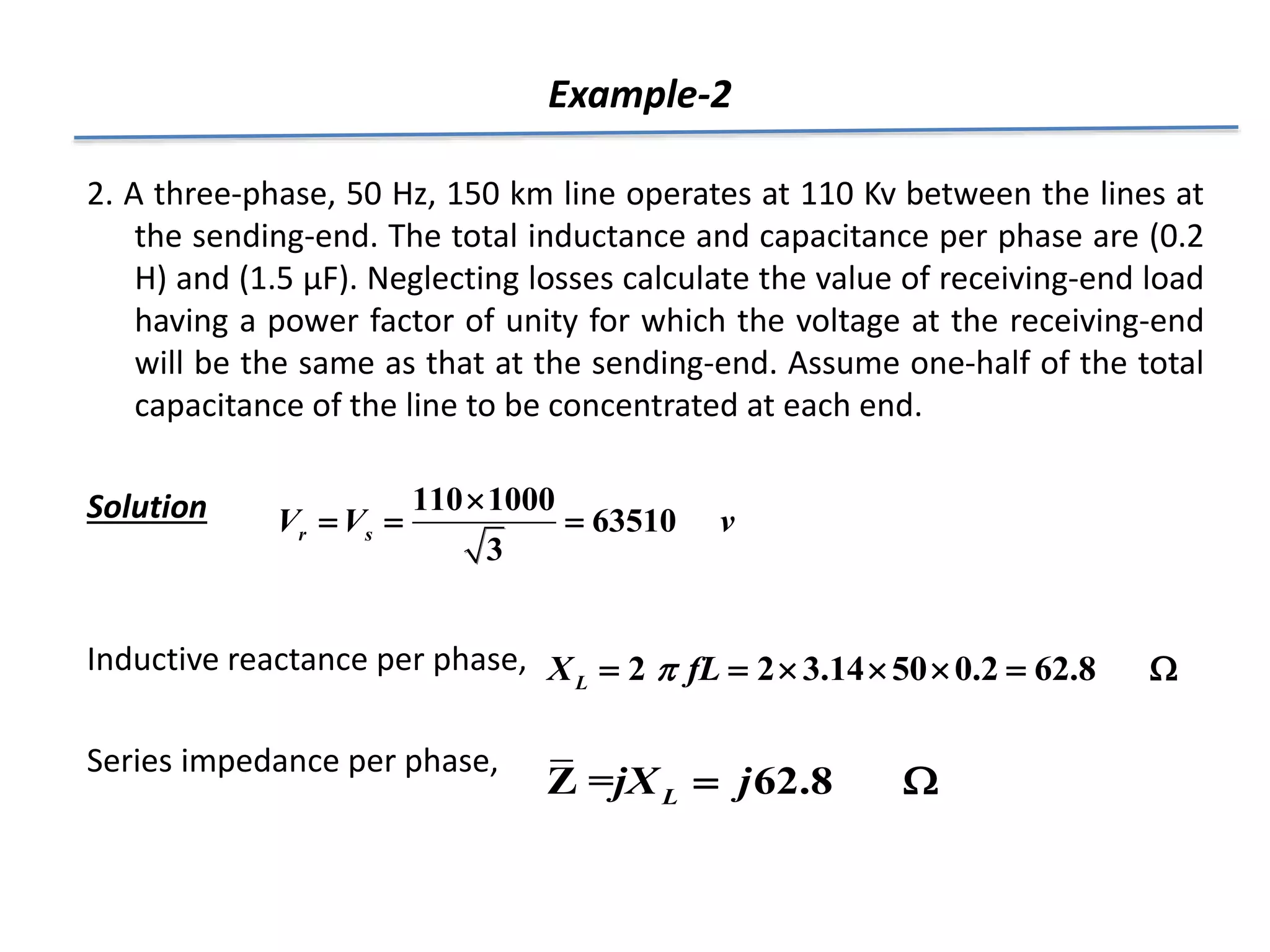
2. A three-phase, 50 Hz, 150 km line operates at 110 Kv between the lines at
the sending-end. The total inductance and capacitance per phase are (0.2
H) and (1.5 μF). Neglecting losses calculate the value of receiving-end load
having a power factor of unity for which the voltage at the receiving-end
will be the same as that at the sending-end. Assume one-half of the total
capacitance of the line to be concentrated at each end.
Solution
Inductive reactance per phase,
Series impedance per phase,
110 1000
63510
3
r s
V V v

  
2 2 3.14 50 0.2 62.8
L
X fL

      
Z = 62.8
L
jX j
 
Shunt admittance per phase, 6
4
4
2 2 3.14 50 1.5 10
4.71 10 siemins
Y= 4.71 10
Y fC
j
 


     
 

V 0
r r
V j
 
Figure 3.10 Pi nominal model
Example-2 cont’d
Current in the load-end capacitor,
Let the load current be Ir. Since the load power factor is unity,
Current through the inductive reactance,
4
ab
Y 4.71
I V 10 63510 14.96
2 2
r j j A

    
r ab
r
I =I I
I 14.96
j

 
Example-2 cont’d
Sending-end voltage,
r
V V I Z
= 0 (I 14.96)( 62.8)
=( -939.5)+ 62.8
s r
r
r r
V j j j
V j I
 
  
2 2 2
2 2 2
2 6
=( -939.5) (62.8 )
(63510) =(63510-939.5) (62.8 )
(62.8 ) 118 10
s r r
r
r
V V I
I
I


 
10862
173
62.8
r
I A
  
Example-2 cont’d
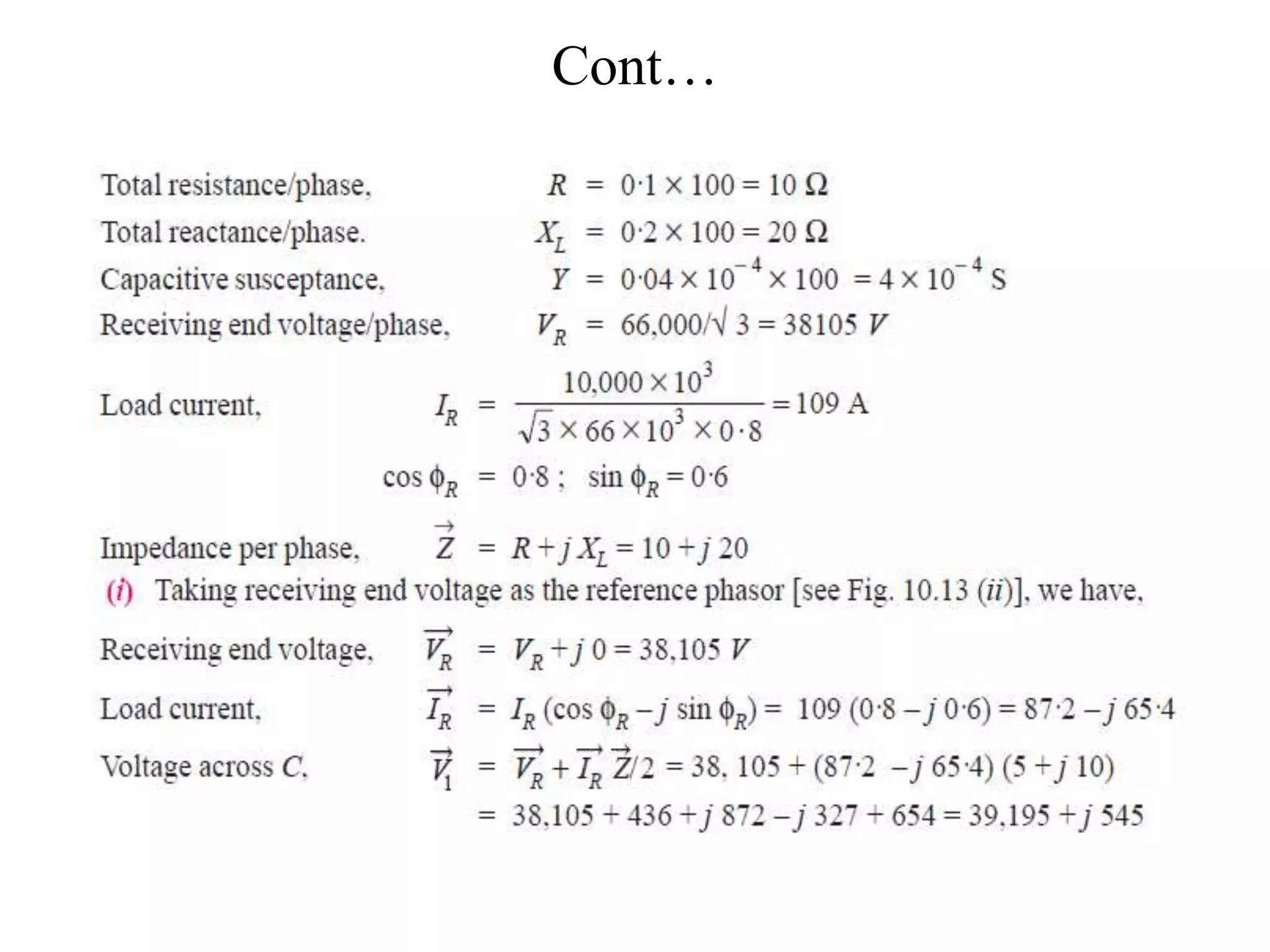
3. A 3-phase, 50-Hz overhead transmission line 100 km long has the following
constants :
Resistance/km/phase = 0.1 Ω
Inductive reactance/km/phase = 0·2 Ω
Capacitive susceptance/km/phase = 0·04 × 10 −4 siemen
Determine (i) the sending end current (ii) sending end voltage (iii) sending
end power factor and (iv) transmission efficiency when supplying a balanced
load of 10,000 kW at 66 kV, p.f. 0·8 lagging. Use nominal T method.
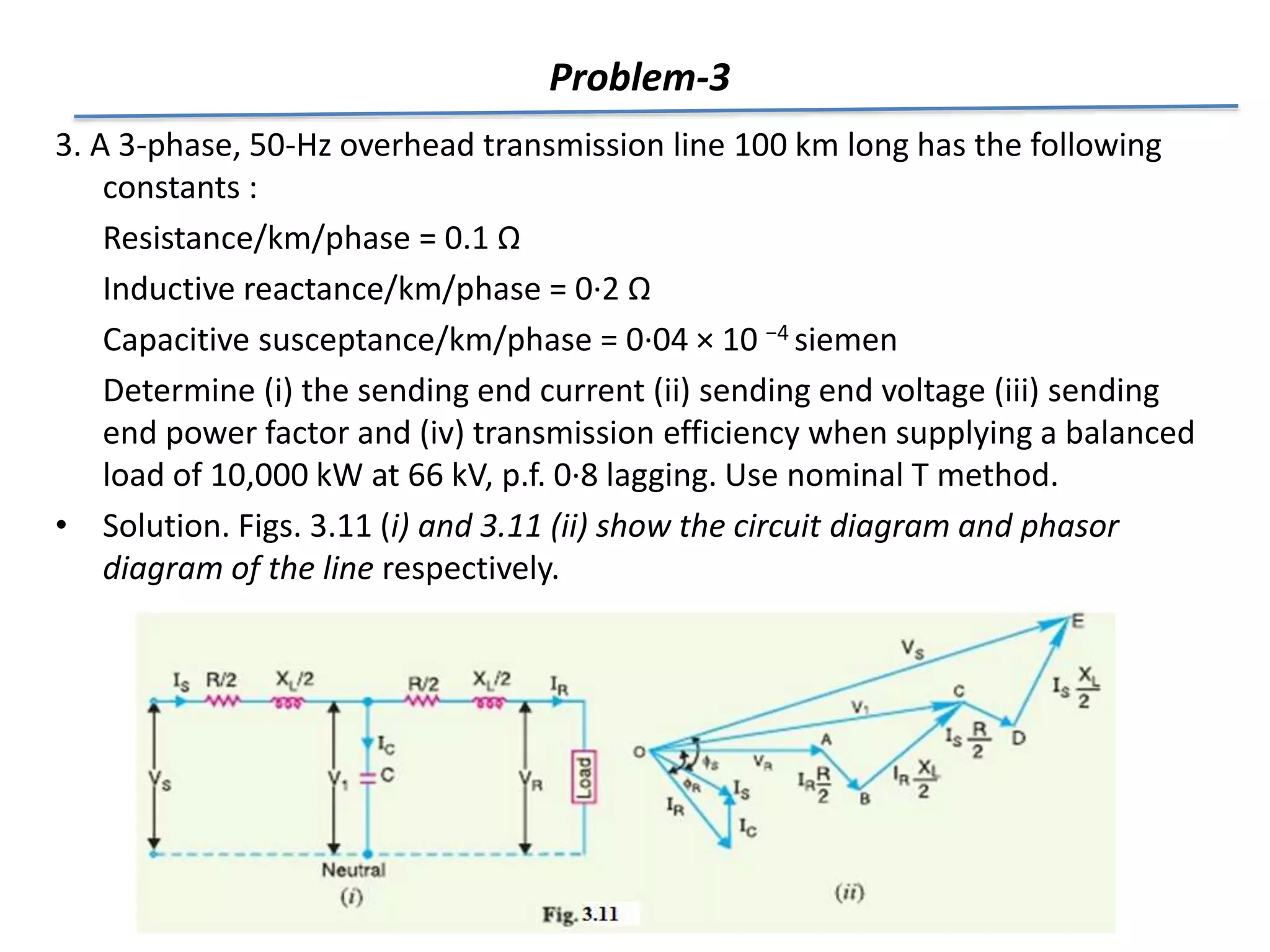
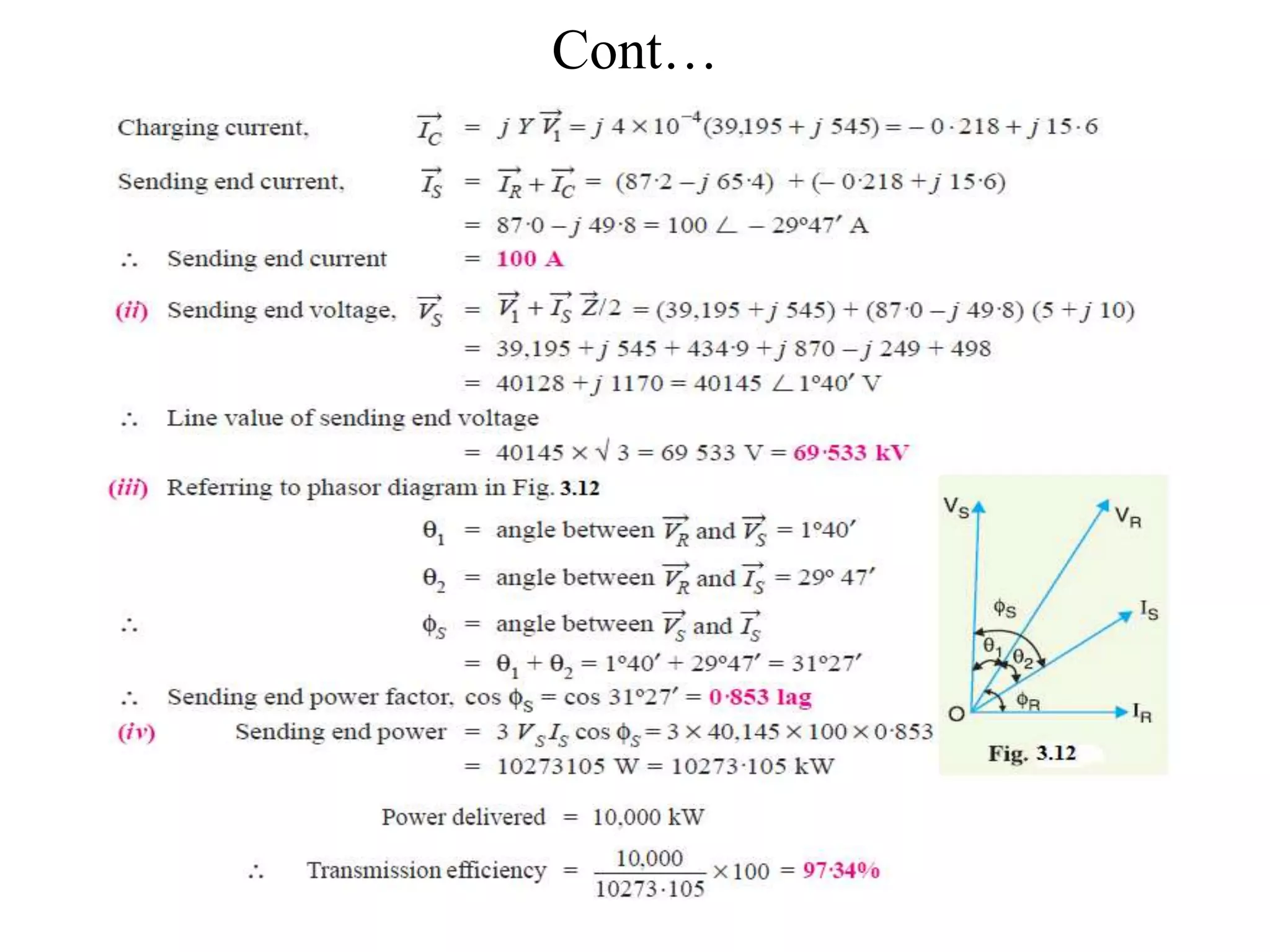
• Solution. Figs. 3.11 (i) and 3.11 (ii) show the circuit diagram and phasor
diagram of the line respectively.
Problem-3
Cont…
Cont…
Long Transmission Line
• Reading Assignment
General Network Constants
Cont…
Cont…
Cont…
Cont…
Cont…
Cont…
END

Chapter 3 transmission line performance

  • 1.
    CHAPTER-3 CHARACTERISTIC AND PERFORMANCEOF POWER TRANSMISSION LINES  The important considerations in the design and operation of a transmission line are the determination of voltage drop, line losses and efficiency of transmission.  These values are greatly influenced by the line constants R, L and C of the transmission line. For instance, the voltage drop in the line depends upon the values of above three line constants.  Similarly, the resistance of transmission line conductors is the most important cause of power loss in the line and determines the transmission efficiency
  • 2.
    Cont…  In thischapter, we shall develop formulas by which we can calculate voltage regulation, line losses and efficiency of transmission lines.  These formulas are important for two principal reasons.  Firstly, they provide an opportunity to understand the effects of the parameters of the line on bus voltages and the flow of power.  Secondly, they help in developing an overall understanding of what is occurring on electric power system.
  • 3.
    Classification of OverheadTransmission Lines  A transmission line has three constants R, L and C distributed uniformly along the whole length of the line.  The resistance and inductance form the series impedance. The capacitance existing between conductors for 1-phase line or from a conductor to neutral for a 3-phase line forms a shunt path throughout the length of the line.  Therefore, capacitance effects introduce complications in transmission line calculations.
  • 4.
    Classification of OverheadTransmission Lines  Depending upon the manner in which capacitance is taken into account, the overhead transmission lines are classified as I) Short transmission lines.  When the length of an overhead transmission line is up to about 80km and the line voltage is comparatively low (< 20 kV), it is usually considered as a short transmission line.  Due to smaller length and lower voltage, the capacitance effects are small and hence can be neglected.  Therefore, while studying the performance of a short transmission line, only resistance and inductance of the line are taken into account.
  • 5.
    II-Medium transmission lines Medium transmission lines: when the length of an overhead transmission line is about 80-240 km and the line voltage is moderately high (>20 kV < 100 kV), it is considered as a medium transmission line.  Due to sufficient length and voltage of the line, the capacitance effects are taken into account. For purposes of calculations, the distributed capacitance of the line is divided and lumped in the form of condensers shunted across the line at one or more points.
  • 6.
    III. Long transmissionlines  Long transmission lines. When the length of an overhead transmission line is more than 240km and line voltage is very high (> 100 kV), it is considered as a long transmission line.  For the treatment of such a line, the line constants are considered uniformly distributed over the whole length of the line and rigorous methods are employed for solution.
  • 7.
    Important terms  Whilestudying the performance of a transmission line, it is desirable to determine its voltage regulation and transmission efficiency. We shall explain these two terms (i) Voltage regulation. When a transmission line is carrying current, there is a voltage drop in the line due to resistance and inductance of the line. The result is that receiving end voltage (VR) of the line is generally less than the sending end voltage (VS). This voltage drop (VS−VR) in the line is expressed as a percentage of receiving end voltage VR and is called voltage regulation.  The difference in voltage at the receiving end of a transmission line between conditions of no load and full load is called voltage regulation and is expressed as a percentage of the receiving end voltage.
  • 8.
    Cont… Mathematically %age Voltage regulation= Obviously,it is desirable that the voltage regulation of a transmission line should be low i.e., the increase in load current should make very little difference in the receiving end voltage.
  • 9.
    II. Transmission efficiency Transmission efficiency:- The power obtained at the receiving end of a transmission line is generally less than the sending end power due to losses in the line resistance. The ratio of receiving end power to the sending end power of a transmission line is known as the transmission efficiency of the line i.e.
  • 10.
    Performance of SinglePhase Short Transmission Lines  As stated earlier, the effects of line capacitance are neglected for a short transmission line. Therefore, while studying the performance of such a line, only resistance and inductance of the line are taken into account.  The equivalent circuit of a single phase short transmission line is shown in Fig. 3.1 (i).Here, the total line resistance and inductance are shown as concentrated or lumped instead of being distributed.
  • 11.
    Cont… The circuit isa simple a.c. series circuit
  • 12.
    Cont…  The phasordiagram of the line for lagging load power factor is shown in Fig. 3.1 (ii). From the right angled triangle ODC, we get, phasor diagram current I is taken as the reference phasor .OA represents the receiving end voltage VR leading I by (ФR ). AB represents the drop IR in phase with I. BC represents the inductive drop IXL and leads I by 900 .OC represents the sending end voltage VS and leads I by Фs
  • 13.
  • 14.
    Cont…  An approximateexpression for the sending end voltage VS can be obtained as follows. Draw perpendicular from B and C on OA produced as shown in Fig. 3.2. Then OC is nearly equal to OF i.e.,
  • 15.
    Cont…  Solution incomplex notation. It is often convenient and prof itable to make the line calculations in complex notation.
  • 16.
    Cont…  Hence, ifthe receiving-end conditions are known the necessary sending-end voltage may be calculated. The above equation can be rewritten a
  • 17.
  • 18.
    Three Phase ShortTransmission Lines
  • 19.
    Effect of loadpower factor on regulation and Efficiency
  • 20.
  • 21.
    Example-1 1. A three-phaseline delivers 3 MW at 11 KV for a distance of 15 Km. Line loss is 10 % of power delivered, load power factor is 0.8 lagging. Frequency is 50 Hz, 1.7 m equilateral spacing of conductors. Calculate the sending-end voltage and regulation. 11,000 Receiving-end phase voltage = 6.360 3 R V   3 3 Line current = phase current ( assuming a star connection ) 3,000 10 = 197 A 3 11 10 0.8      2 3 Total line loss =3 (inthree conductors) 10 = 3,000 10 100 I R   Solution 3 2 300 10 3 197 2.58 ohms R     
  • 22.
  • 23.
    MEDIUM TRANSMISSION LINE Medium transmission line is a line having a length between 80km to 240km and line voltage between 20kv to 100kv. The capacitance effects are required to be in to account. Though the capacitance is uniformly distributed over the entire length of the line, yet for the simplification of calculation, the capacitance is assumed to be concentrated at one or more points. Thus all the admittances are lumped at sending - end, receiving-end or at center.  A number of localized capacitance methods have been used to make approximate line performance calculations. The following methods are more commonly used: a) End condenser method b) Nominal T method c) Nominal pi method  These methods of calculation give reasonably accurate results for the solution of most transmission-line problems.
  • 24.
  • 25.
  • 26.
  • 27.
  • 28.
  • 29.
  • 30.
  • 31.
  • 32.
  • 33.
    Example-2 2. A three-phase,50 Hz, 150 km line operates at 110 Kv between the lines at the sending-end. The total inductance and capacitance per phase are (0.2 H) and (1.5 μF). Neglecting losses calculate the value of receiving-end load having a power factor of unity for which the voltage at the receiving-end will be the same as that at the sending-end. Assume one-half of the total capacitance of the line to be concentrated at each end. Solution Inductive reactance per phase, Series impedance per phase, 110 1000 63510 3 r s V V v     2 2 3.14 50 0.2 62.8 L X fL         Z = 62.8 L jX j  
  • 34.
    Shunt admittance perphase, 6 4 4 2 2 3.14 50 1.5 10 4.71 10 siemins Y= 4.71 10 Y fC j              V 0 r r V j   Figure 3.10 Pi nominal model Example-2 cont’d
  • 35.
    Current in theload-end capacitor, Let the load current be Ir. Since the load power factor is unity, Current through the inductive reactance, 4 ab Y 4.71 I V 10 63510 14.96 2 2 r j j A       r ab r I =I I I 14.96 j    Example-2 cont’d
  • 36.
    Sending-end voltage, r V VI Z = 0 (I 14.96)( 62.8) =( -939.5)+ 62.8 s r r r r V j j j V j I      2 2 2 2 2 2 2 6 =( -939.5) (62.8 ) (63510) =(63510-939.5) (62.8 ) (62.8 ) 118 10 s r r r r V V I I I     10862 173 62.8 r I A    Example-2 cont’d
  • 37.
    3. A 3-phase,50-Hz overhead transmission line 100 km long has the following constants : Resistance/km/phase = 0.1 Ω Inductive reactance/km/phase = 0·2 Ω Capacitive susceptance/km/phase = 0·04 × 10 −4 siemen Determine (i) the sending end current (ii) sending end voltage (iii) sending end power factor and (iv) transmission efficiency when supplying a balanced load of 10,000 kW at 66 kV, p.f. 0·8 lagging. Use nominal T method. • Solution. Figs. 3.11 (i) and 3.11 (ii) show the circuit diagram and phasor diagram of the line respectively. Problem-3
  • 38.
  • 39.
  • 40.
    Long Transmission Line •Reading Assignment
  • 41.
  • 42.
  • 43.
  • 44.
  • 45.
  • 46.
  • 47.
  • 48.

Editor's Notes