SURFACTANT (SURFACE
ACTIVE AGENT) & CLASSIFICATION
Submitted By: Rahul Pal, Prachi Pandey Submitted To: Dr. Himmat Singh Chawra
M. Pharm (Pharmaceutics), IInd Sem.
Subject: Cosmetics and Cosmeceuticals (MPH204T)
Department of Pharmaceutics, NIMS Institute of Pharmacy, NIMS University Jaipur, Rajasthan, India, 303121
INTRODUCTION
 Surfactants, are wetting agent that lowers the surface tension of a liquid, allowing easier spreading,
dispersion and also lower the interfacial tension between the two liquids.
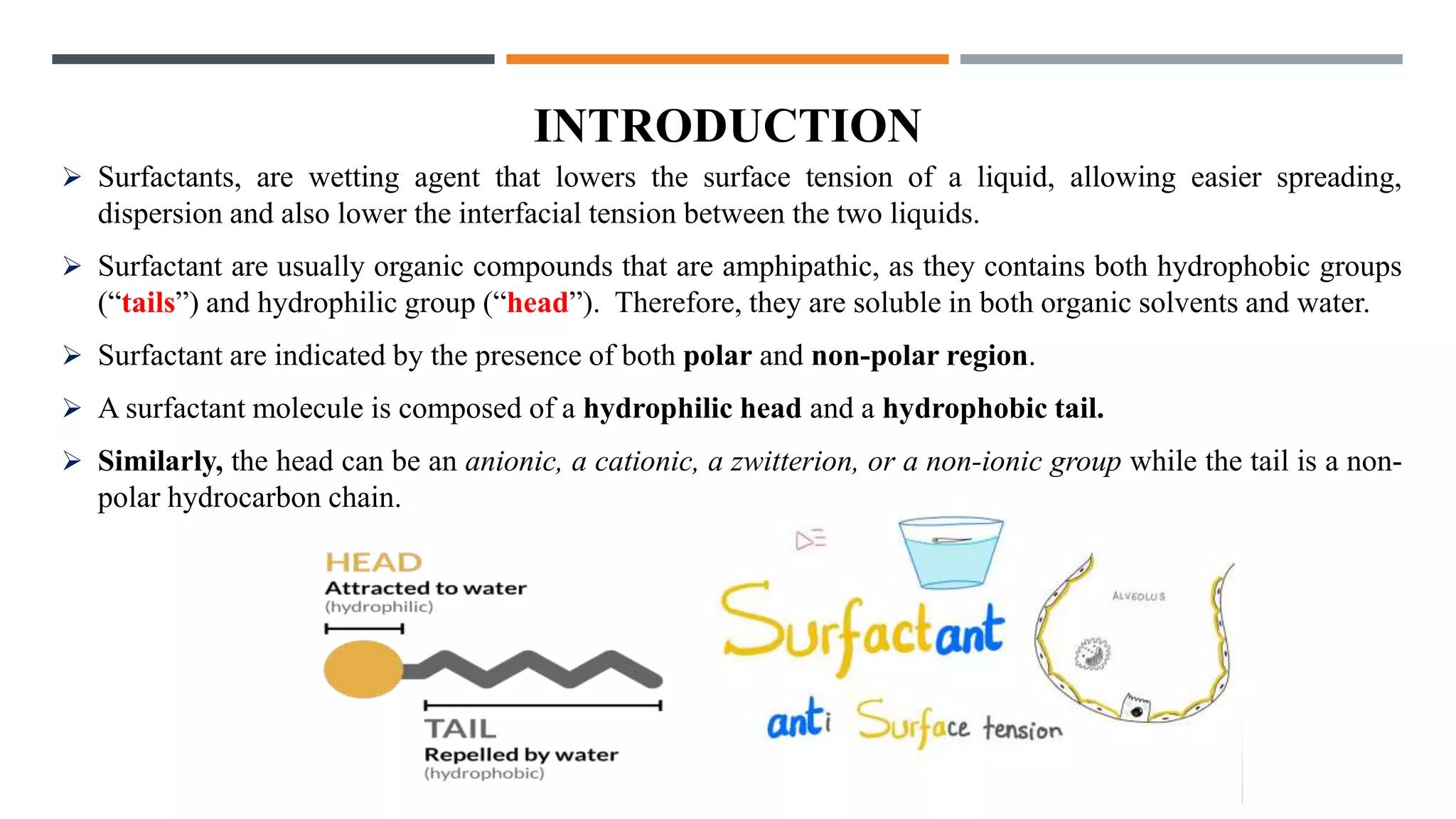
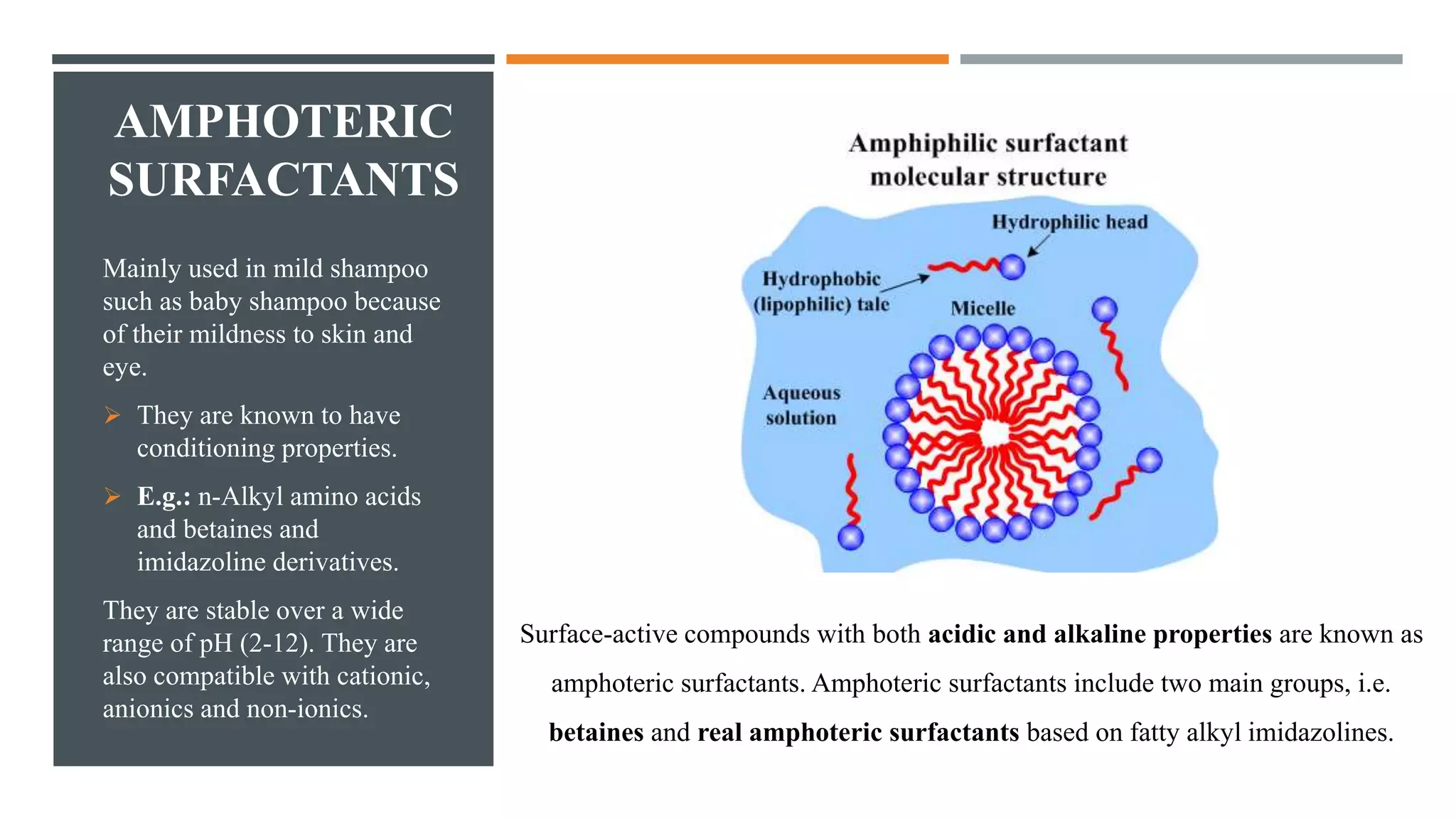
 Surfactant are usually organic compounds that are amphipathic, as they contains both hydrophobic groups
(“tails”) and hydrophilic group (“head”). Therefore, they are soluble in both organic solvents and water.
 Surfactant are indicated by the presence of both polar and non-polar region.
 A surfactant molecule is composed of a hydrophilic head and a hydrophobic tail.
 Similarly, the head can be an anionic, a cationic, a zwitterion, or a non-ionic group while the tail is a non-
polar hydrocarbon chain.
CLASSIFICATION OF SURFACTANT
According to the nature of the hydrophilic group surfactants are mainly classified as:
 Anionic
 Cationic
 Non-ionic
 Ampholytic
ANIONIC SURFACTANT
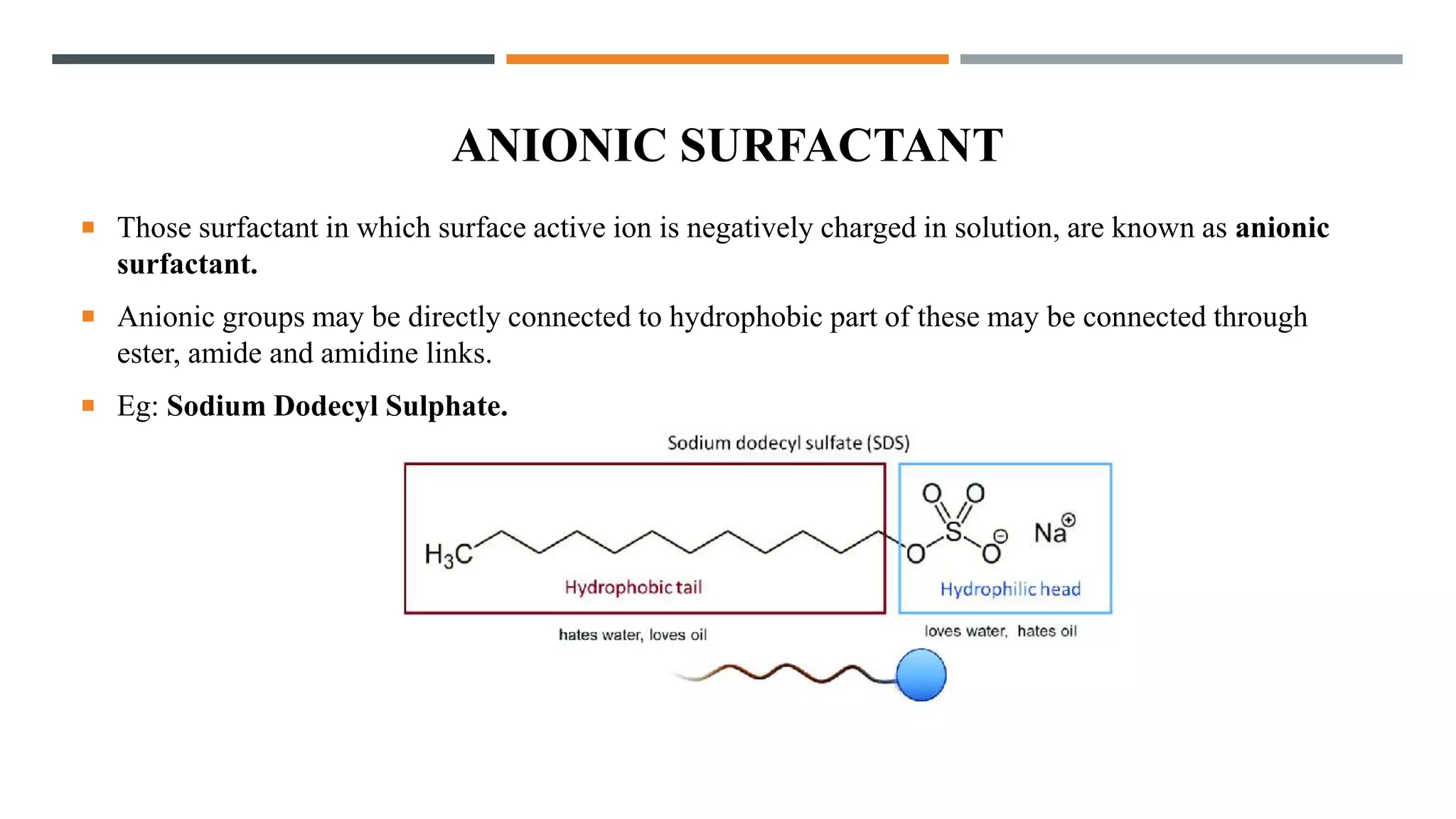
 Those surfactant in which surface active ion is negatively charged in solution, are known as anionic
surfactant.
 Anionic groups may be directly connected to hydrophobic part of these may be connected through
ester, amide and amidine links.
 Eg: Sodium Dodecyl Sulphate.
 Surfactant having anionic groups connected directly to the hydrophobic unit.
Ex: Fatty acid soaps, alkyl sulphonates, alkyl sulphates, alkyl aryl sulphonates and alkyl phosphates.
 Surfactant having anionic groups connected through ester links.
Ex: Monoglyceride sulphates, dialkyl sulphosuccinate, polyethylene glycol ester and sulphate isoethionates.
 Surfactant having anionic groups connected through ether links.
Ex: Alkyl ether sulphate, phenol ether sulphates and alkyl ether carboxylates.
 Surfactant having anionic groups connected through amide links.
Ex: Alkalonamide sulphates, taurined and sarcosinates.
 Surfactant having anionic groups connected through amidine links.
Ex: Imidazole sulphate
CATIONIC SURFACTANT
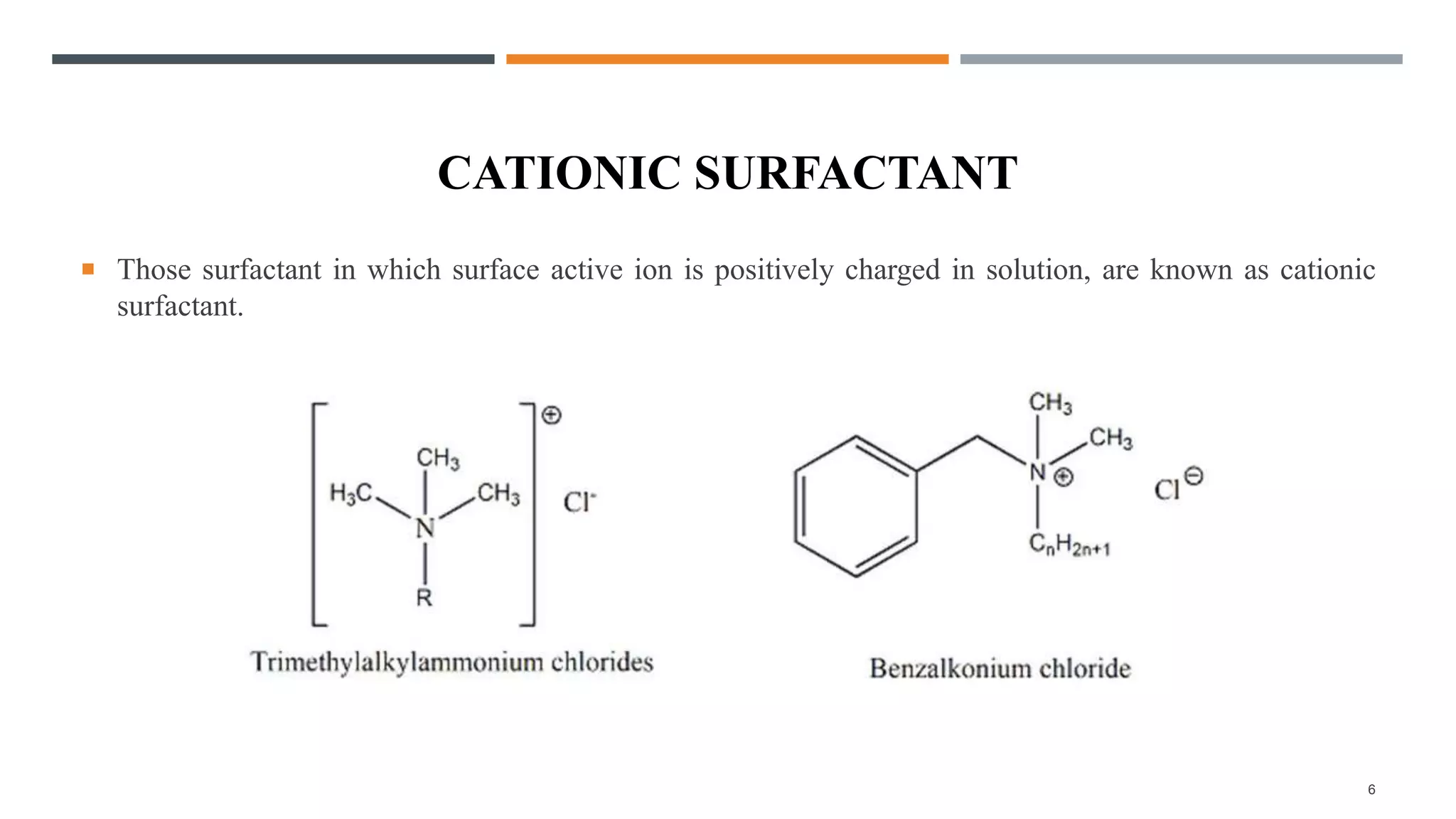
 Those surfactant in which surface active ion is positively charged in solution, are known as cationic
surfactant.
6
NITROGENOUS SURFACTANT
 Quaternary ammonium salts in which nitrogen is directly attached to the hydrophobic part. Eg. Alkyl
trimethyl ammonium salts, dialkyl dimethyl ammonium salts, alkyl dimethyl benzyl ammonium salts,
ethoxylated alkyl-dimethyl ammonium salts.
 Surfactants in which the cationic group separated from the hydrophobic group. Eg. Quarternized
amides of ethylene diamine, quartemized amides of polyethyleneamine.
 Surfactant in which cationic group is located in a heterocyclic ring. Eg. Alkyl pyridium salts, alkyl
mophoinium salts and alkyl imidaxolinium salts.
 Dicationic surfactant: eg. Quarternized diamine salts.
 Non-Nitrogenous Surfactant: Eg. Sulphonium salts, phosphonium salts.
NON-IONIC SURFACTANT
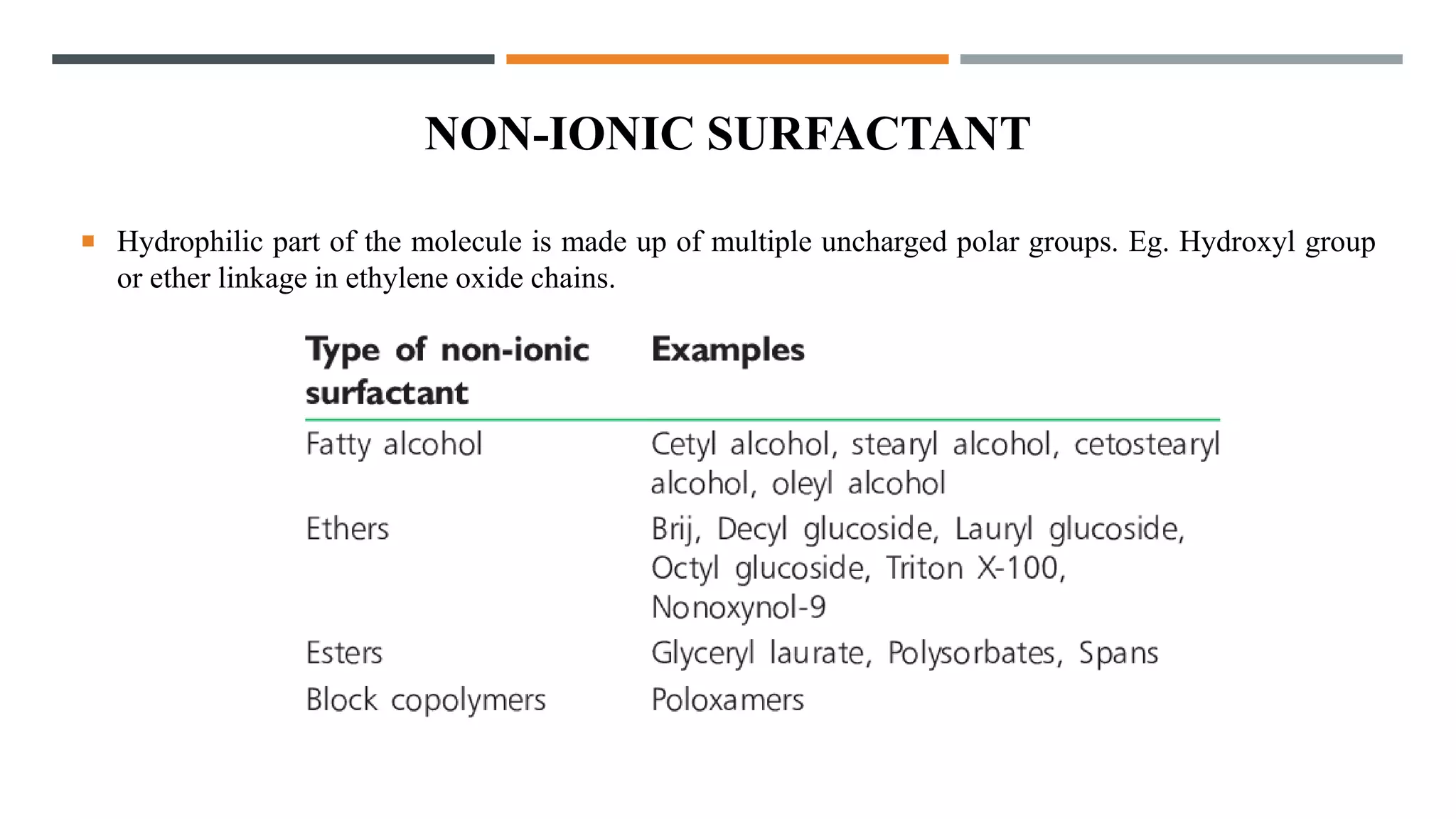
 Hydrophilic part of the molecule is made up of multiple uncharged polar groups. Eg. Hydroxyl group
or ether linkage in ethylene oxide chains.
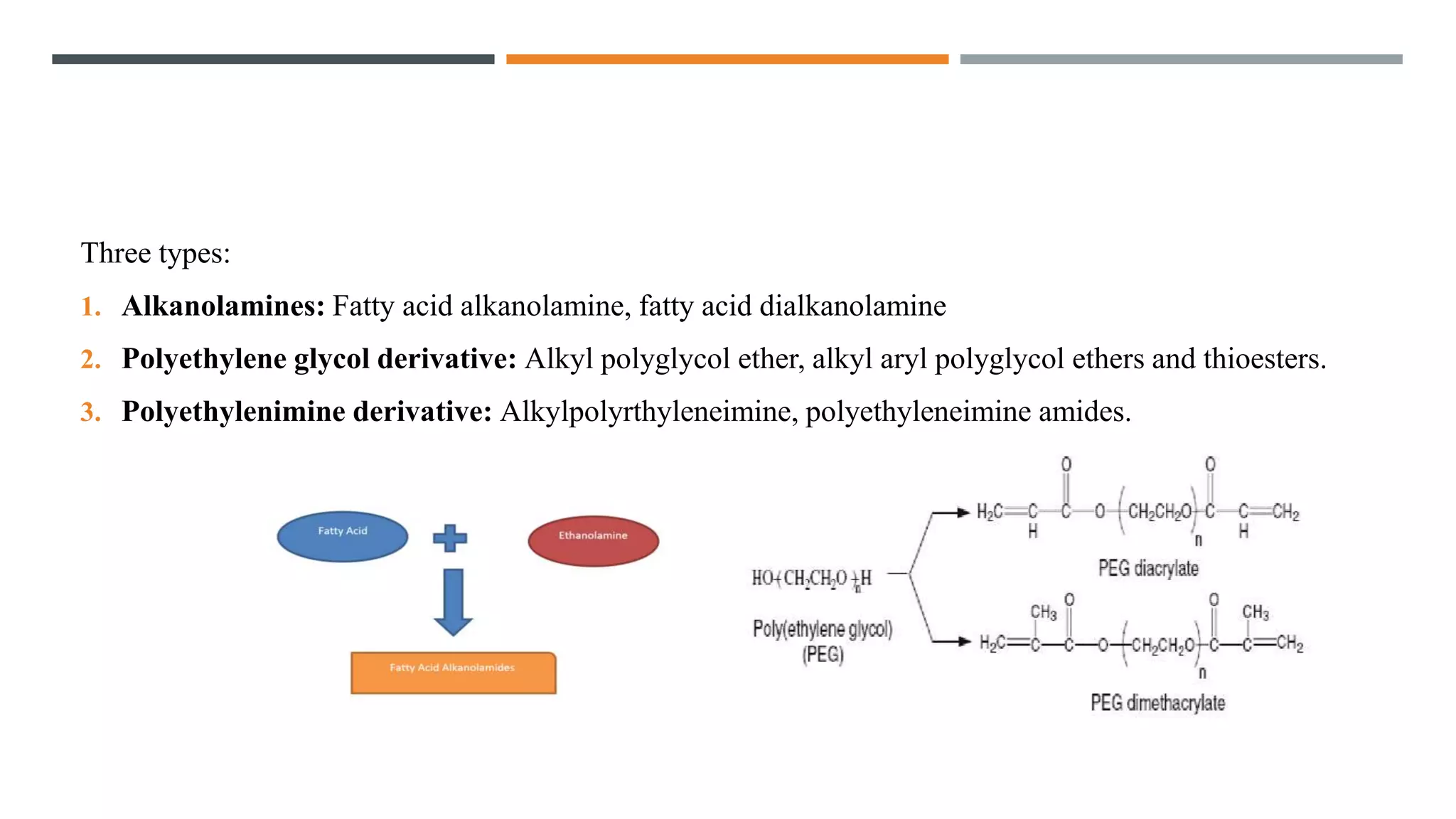
Three types:
1. Alkanolamines: Fatty acid alkanolamine, fatty acid dialkanolamine
2. Polyethylene glycol derivative: Alkyl polyglycol ether, alkyl aryl polyglycol ethers and thioesters.
3. Polyethylenimine derivative: Alkylpolyrthyleneimine, polyethyleneimine amides.
AMPHOTERIC (ZWITTER-IONIC) SURFACTANT
Its able to form a surface active ion with both positive and negative charge.
 Three types:
01. Alkyl B aminopropionates, betaines.
02. Acylaminoacids: Acyl B amino propionates, acyl peptides.
03. Alkylimidazolines.
APPLICATION OF SURFACTANTS
“EMULSIFICATION PURPOSE”
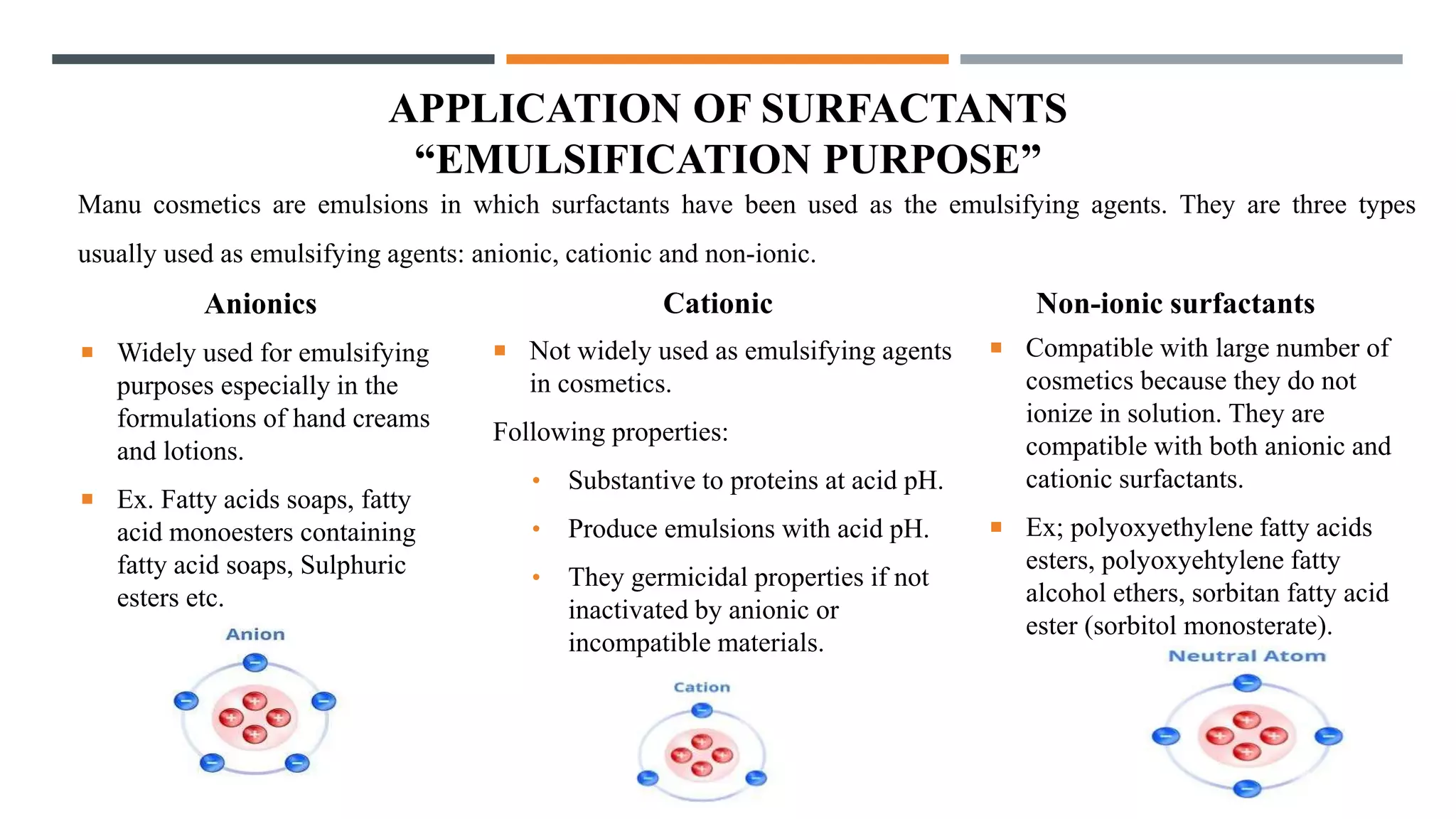
Anionics
 Widely used for emulsifying
purposes especially in the
formulations of hand creams
and lotions.
 Ex. Fatty acids soaps, fatty
acid monoesters containing
fatty acid soaps, Sulphuric
esters etc.
Cationic
 Not widely used as emulsifying agents
in cosmetics.
Following properties:
• Substantive to proteins at acid pH.
• Produce emulsions with acid pH.
• They germicidal properties if not
inactivated by anionic or
incompatible materials.
Non-ionic surfactants
 Compatible with large number of
cosmetics because they do not
ionize in solution. They are
compatible with both anionic and
cationic surfactants.
 Ex; polyoxyethylene fatty acids
esters, polyoxyehtylene fatty
alcohol ethers, sorbitan fatty acid
ester (sorbitol monosterate).
Manu cosmetics are emulsions in which surfactants have been used as the emulsifying agents. They are three types
usually used as emulsifying agents: anionic, cationic and non-ionic.
FOAMING AND CLEANSING PURPOSE
Anionic surfactants
 Most widely used for laundering,
dishwashing liquids and shampoos
because of its excellent cleaning
properties.
 In the shampoo the anions such as
alkaline sulphonates and alkaline
benzene sulphonates and fatty
acids soaps are not used.
 Sulphosuccinates are known for
the mild effects and less irritant to
eyes and used in mild shampoo as
auxiliary surfactants.
 Methyl taurides and acyl peptides
may be used.
Cationic surfactants
 They are not goof foaming
agents or detergent.
 Also irritant to eyes and interact
with proteins, thus they causes
dirt re-disposition on hair shaft.
 They can be used as additives
for germicidal in 5% shampoo.
 Ex. Alkyl trimethyl ammoniums
and cetyl pyridinium salts.
Non-Ionic Surfactant
 Good detergent and used as
principle surfactants.
 Polyglyceryl ethers have good
detergency and foaming
properties.
 Non-ionic used for increasing
the stability and viscosity.
 Alkanolaminde as non-ionic
surfactant but not used as
detergents but produce
conditioning effects.
 Ex. Pluronics and sorbitol
esters
For this purpose, surfactants are used mostly in shampoo, in which the principle ingredients are surfactants. For
foaming and cleansing anionics, cationic, non-ionic and amphoteric surfactant are used.
AMPHOTERIC
SURFACTANTS
Mainly used in mild shampoo
such as baby shampoo because
of their mildness to skin and
eye.
 They are known to have
conditioning properties.
 E.g.: n-Alkyl amino acids
and betaines and
imidazoline derivatives.
They are stable over a wide
range of pH (2-12). They are
also compatible with cationic,
anionics and non-ionics.
Surface-active compounds with both acidic and alkaline properties are known as
amphoteric surfactants. Amphoteric surfactants include two main groups, i.e.
betaines and real amphoteric surfactants based on fatty alkyl imidazolines.
APPLICATIONS
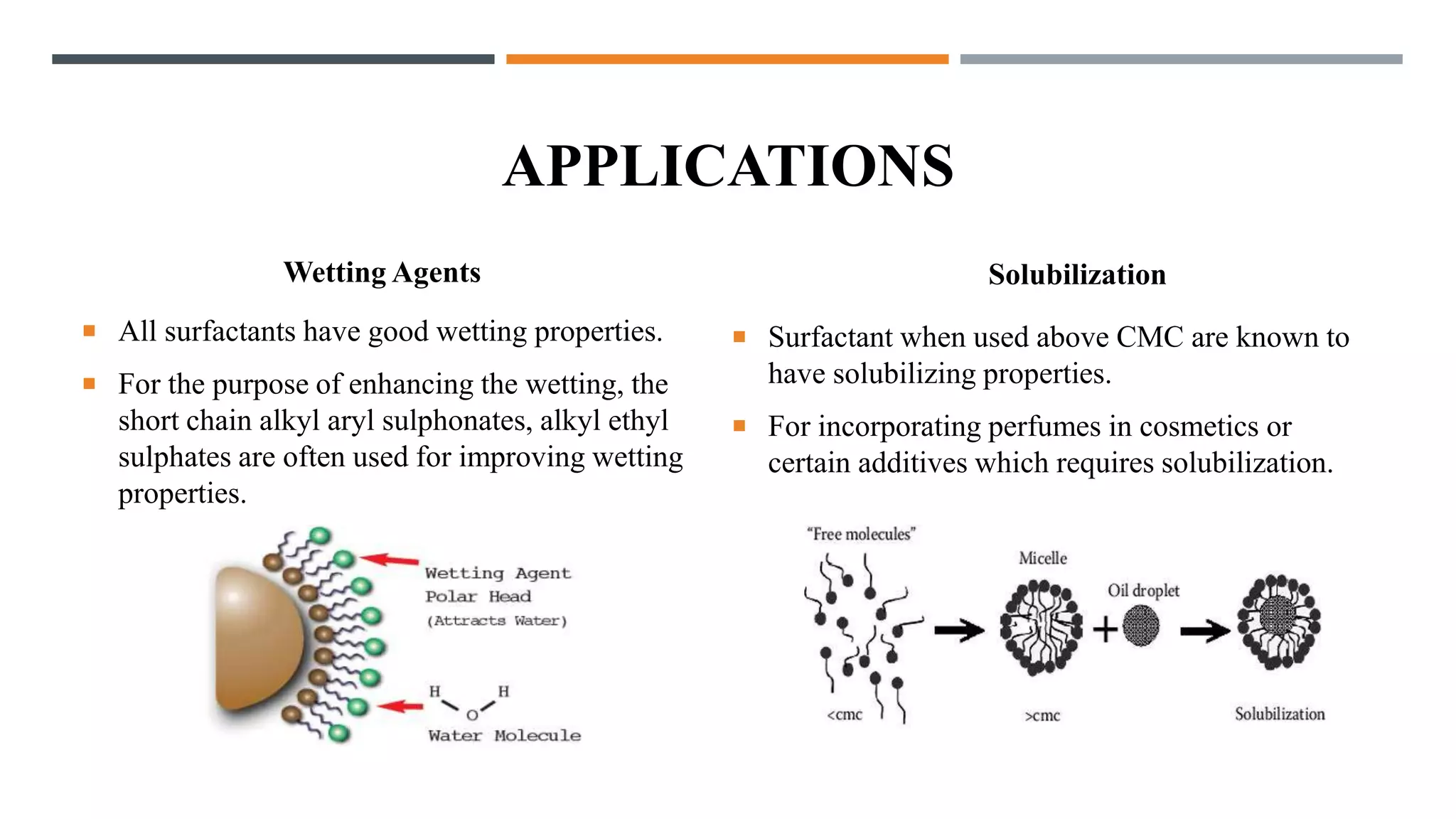
Wetting Agents
 All surfactants have good wetting properties.
 For the purpose of enhancing the wetting, the
short chain alkyl aryl sulphonates, alkyl ethyl
sulphates are often used for improving wetting
properties.
Solubilization
 Surfactant when used above CMC are known to
have solubilizing properties.
 For incorporating perfumes in cosmetics or
certain additives which requires solubilization.
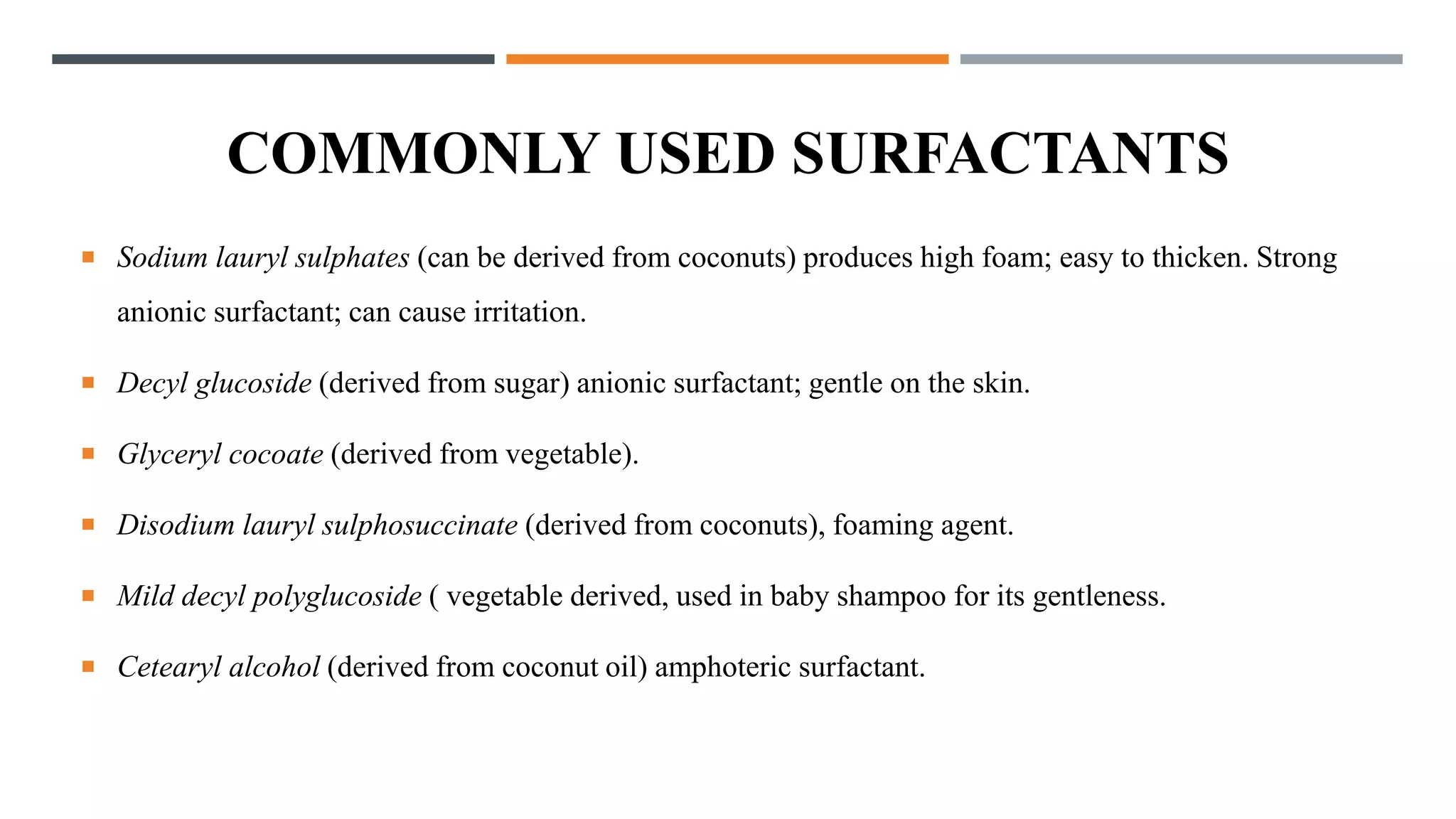
COMMONLY USED SURFACTANTS
 Sodium lauryl sulphates (can be derived from coconuts) produces high foam; easy to thicken. Strong
anionic surfactant; can cause irritation.
 Decyl glucoside (derived from sugar) anionic surfactant; gentle on the skin.
 Glyceryl cocoate (derived from vegetable).
 Disodium lauryl sulphosuccinate (derived from coconuts), foaming agent.
 Mild decyl polyglucoside ( vegetable derived, used in baby shampoo for its gentleness.
 Cetearyl alcohol (derived from coconut oil) amphoteric surfactant.
NATURAL SURFACTANTS
• They also used in cosmetics for the emulsifying properties such as lanoline, cholesterol and saponins.
• Today they largely replaced by synthetic detergent. However, lecithin which is a phospholipid is still
being used today in the preparation of milky lotion and creams lecithin is obtained from egg yolk and
soya bean.
SURFACTANT SURFACE ACTIVE AGENT.pptx

SURFACTANT SURFACE ACTIVE AGENT.pptx

  • 1.
    SURFACTANT (SURFACE ACTIVE AGENT)& CLASSIFICATION Submitted By: Rahul Pal, Prachi Pandey Submitted To: Dr. Himmat Singh Chawra M. Pharm (Pharmaceutics), IInd Sem. Subject: Cosmetics and Cosmeceuticals (MPH204T) Department of Pharmaceutics, NIMS Institute of Pharmacy, NIMS University Jaipur, Rajasthan, India, 303121
  • 2.
    INTRODUCTION  Surfactants, arewetting agent that lowers the surface tension of a liquid, allowing easier spreading, dispersion and also lower the interfacial tension between the two liquids.  Surfactant are usually organic compounds that are amphipathic, as they contains both hydrophobic groups (“tails”) and hydrophilic group (“head”). Therefore, they are soluble in both organic solvents and water.  Surfactant are indicated by the presence of both polar and non-polar region.  A surfactant molecule is composed of a hydrophilic head and a hydrophobic tail.  Similarly, the head can be an anionic, a cationic, a zwitterion, or a non-ionic group while the tail is a non- polar hydrocarbon chain.
  • 3.
    CLASSIFICATION OF SURFACTANT Accordingto the nature of the hydrophilic group surfactants are mainly classified as:  Anionic  Cationic  Non-ionic  Ampholytic
  • 4.
    ANIONIC SURFACTANT  Thosesurfactant in which surface active ion is negatively charged in solution, are known as anionic surfactant.  Anionic groups may be directly connected to hydrophobic part of these may be connected through ester, amide and amidine links.  Eg: Sodium Dodecyl Sulphate.
  • 5.
     Surfactant havinganionic groups connected directly to the hydrophobic unit. Ex: Fatty acid soaps, alkyl sulphonates, alkyl sulphates, alkyl aryl sulphonates and alkyl phosphates.  Surfactant having anionic groups connected through ester links. Ex: Monoglyceride sulphates, dialkyl sulphosuccinate, polyethylene glycol ester and sulphate isoethionates.  Surfactant having anionic groups connected through ether links. Ex: Alkyl ether sulphate, phenol ether sulphates and alkyl ether carboxylates.  Surfactant having anionic groups connected through amide links. Ex: Alkalonamide sulphates, taurined and sarcosinates.  Surfactant having anionic groups connected through amidine links. Ex: Imidazole sulphate
  • 6.
    CATIONIC SURFACTANT  Thosesurfactant in which surface active ion is positively charged in solution, are known as cationic surfactant. 6
  • 7.
    NITROGENOUS SURFACTANT  Quaternaryammonium salts in which nitrogen is directly attached to the hydrophobic part. Eg. Alkyl trimethyl ammonium salts, dialkyl dimethyl ammonium salts, alkyl dimethyl benzyl ammonium salts, ethoxylated alkyl-dimethyl ammonium salts.  Surfactants in which the cationic group separated from the hydrophobic group. Eg. Quarternized amides of ethylene diamine, quartemized amides of polyethyleneamine.  Surfactant in which cationic group is located in a heterocyclic ring. Eg. Alkyl pyridium salts, alkyl mophoinium salts and alkyl imidaxolinium salts.  Dicationic surfactant: eg. Quarternized diamine salts.  Non-Nitrogenous Surfactant: Eg. Sulphonium salts, phosphonium salts.
  • 8.
    NON-IONIC SURFACTANT  Hydrophilicpart of the molecule is made up of multiple uncharged polar groups. Eg. Hydroxyl group or ether linkage in ethylene oxide chains.
  • 9.
    Three types: 1. Alkanolamines:Fatty acid alkanolamine, fatty acid dialkanolamine 2. Polyethylene glycol derivative: Alkyl polyglycol ether, alkyl aryl polyglycol ethers and thioesters. 3. Polyethylenimine derivative: Alkylpolyrthyleneimine, polyethyleneimine amides.
  • 10.
    AMPHOTERIC (ZWITTER-IONIC) SURFACTANT Itsable to form a surface active ion with both positive and negative charge.  Three types: 01. Alkyl B aminopropionates, betaines. 02. Acylaminoacids: Acyl B amino propionates, acyl peptides. 03. Alkylimidazolines.
  • 11.
    APPLICATION OF SURFACTANTS “EMULSIFICATIONPURPOSE” Anionics  Widely used for emulsifying purposes especially in the formulations of hand creams and lotions.  Ex. Fatty acids soaps, fatty acid monoesters containing fatty acid soaps, Sulphuric esters etc. Cationic  Not widely used as emulsifying agents in cosmetics. Following properties: • Substantive to proteins at acid pH. • Produce emulsions with acid pH. • They germicidal properties if not inactivated by anionic or incompatible materials. Non-ionic surfactants  Compatible with large number of cosmetics because they do not ionize in solution. They are compatible with both anionic and cationic surfactants.  Ex; polyoxyethylene fatty acids esters, polyoxyehtylene fatty alcohol ethers, sorbitan fatty acid ester (sorbitol monosterate). Manu cosmetics are emulsions in which surfactants have been used as the emulsifying agents. They are three types usually used as emulsifying agents: anionic, cationic and non-ionic.
  • 12.
    FOAMING AND CLEANSINGPURPOSE Anionic surfactants  Most widely used for laundering, dishwashing liquids and shampoos because of its excellent cleaning properties.  In the shampoo the anions such as alkaline sulphonates and alkaline benzene sulphonates and fatty acids soaps are not used.  Sulphosuccinates are known for the mild effects and less irritant to eyes and used in mild shampoo as auxiliary surfactants.  Methyl taurides and acyl peptides may be used. Cationic surfactants  They are not goof foaming agents or detergent.  Also irritant to eyes and interact with proteins, thus they causes dirt re-disposition on hair shaft.  They can be used as additives for germicidal in 5% shampoo.  Ex. Alkyl trimethyl ammoniums and cetyl pyridinium salts. Non-Ionic Surfactant  Good detergent and used as principle surfactants.  Polyglyceryl ethers have good detergency and foaming properties.  Non-ionic used for increasing the stability and viscosity.  Alkanolaminde as non-ionic surfactant but not used as detergents but produce conditioning effects.  Ex. Pluronics and sorbitol esters For this purpose, surfactants are used mostly in shampoo, in which the principle ingredients are surfactants. For foaming and cleansing anionics, cationic, non-ionic and amphoteric surfactant are used.
  • 13.
    AMPHOTERIC SURFACTANTS Mainly used inmild shampoo such as baby shampoo because of their mildness to skin and eye.  They are known to have conditioning properties.  E.g.: n-Alkyl amino acids and betaines and imidazoline derivatives. They are stable over a wide range of pH (2-12). They are also compatible with cationic, anionics and non-ionics. Surface-active compounds with both acidic and alkaline properties are known as amphoteric surfactants. Amphoteric surfactants include two main groups, i.e. betaines and real amphoteric surfactants based on fatty alkyl imidazolines.
  • 14.
    APPLICATIONS Wetting Agents  Allsurfactants have good wetting properties.  For the purpose of enhancing the wetting, the short chain alkyl aryl sulphonates, alkyl ethyl sulphates are often used for improving wetting properties. Solubilization  Surfactant when used above CMC are known to have solubilizing properties.  For incorporating perfumes in cosmetics or certain additives which requires solubilization.
  • 15.
    COMMONLY USED SURFACTANTS Sodium lauryl sulphates (can be derived from coconuts) produces high foam; easy to thicken. Strong anionic surfactant; can cause irritation.  Decyl glucoside (derived from sugar) anionic surfactant; gentle on the skin.  Glyceryl cocoate (derived from vegetable).  Disodium lauryl sulphosuccinate (derived from coconuts), foaming agent.  Mild decyl polyglucoside ( vegetable derived, used in baby shampoo for its gentleness.  Cetearyl alcohol (derived from coconut oil) amphoteric surfactant.
  • 16.
    NATURAL SURFACTANTS • Theyalso used in cosmetics for the emulsifying properties such as lanoline, cholesterol and saponins. • Today they largely replaced by synthetic detergent. However, lecithin which is a phospholipid is still being used today in the preparation of milky lotion and creams lecithin is obtained from egg yolk and soya bean.