Presented by:
Sharanjeet Kaur
 Hydrophilic: A liquid/surface that has a high affinity
to water.
 Hydrophobic: A liquid/surface that has very low
affinity to water
 Lipophilic: A liquid/surface that has a high affinity to
oil.
 Lipophobic: A liquid/surface that has a very low
affinity to oil.
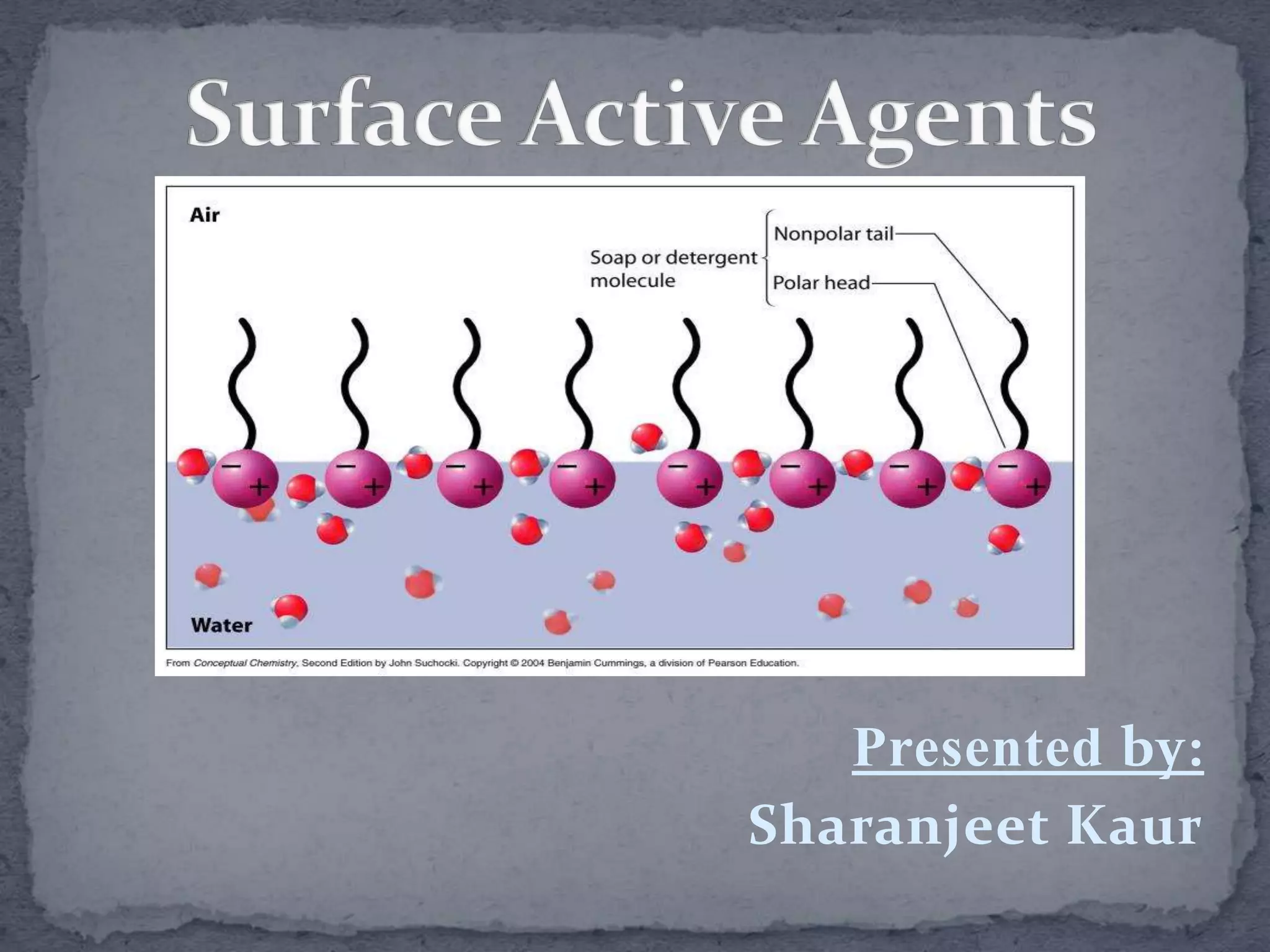
 A molecule that contains a polar portion and a non
polar portion is called surface active agent/ surfactant.
 A surfactant can interact with both polar and non
polar molecules.
 A surfactant increases the solubility of the otherwise
insoluble substances.
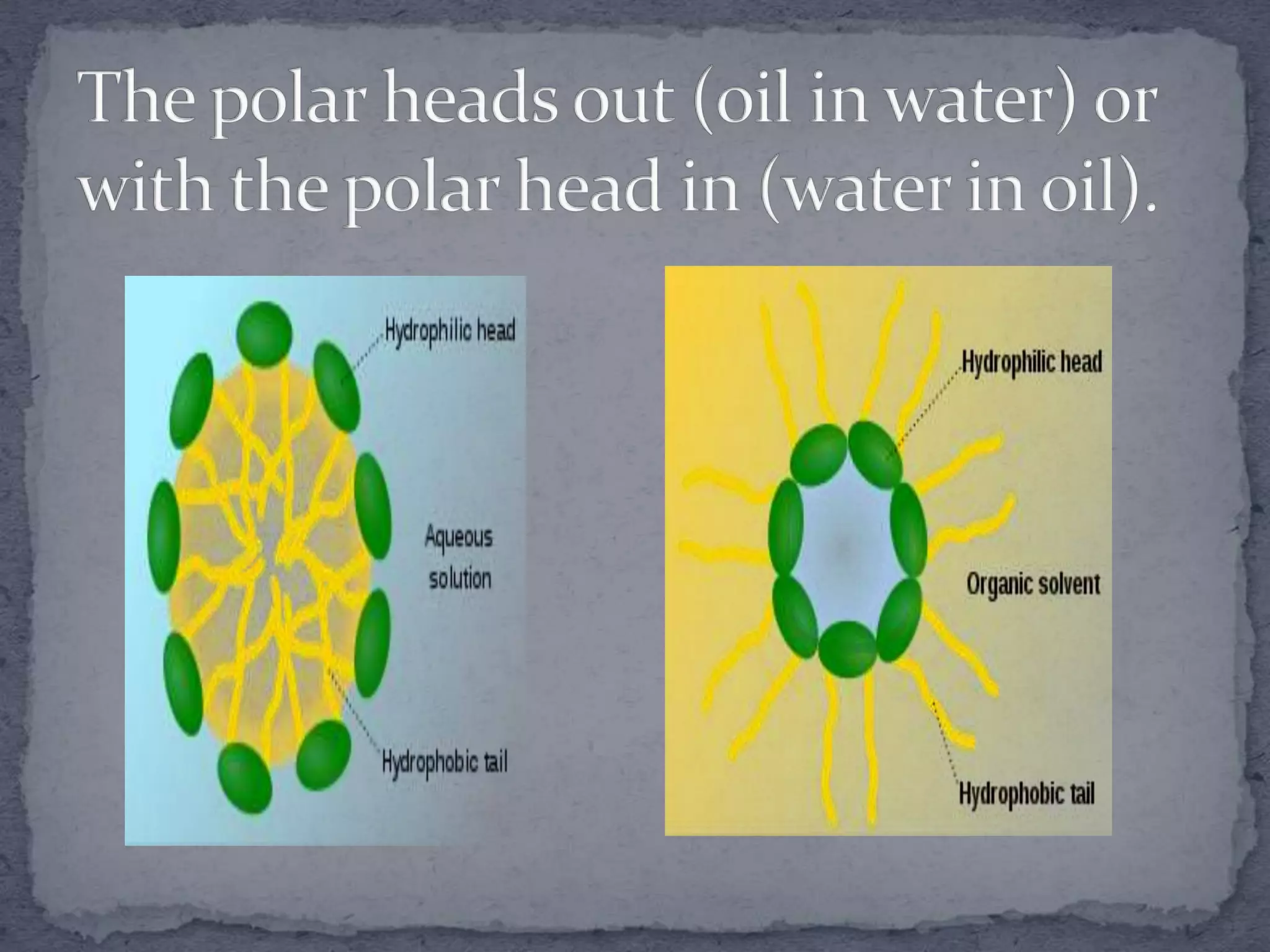
 In water, surfactant molecules tend to cluster into a
spherical geometry non polar ends on the inside of the
sphere polar ends on the outside .These clusters are
called micelles
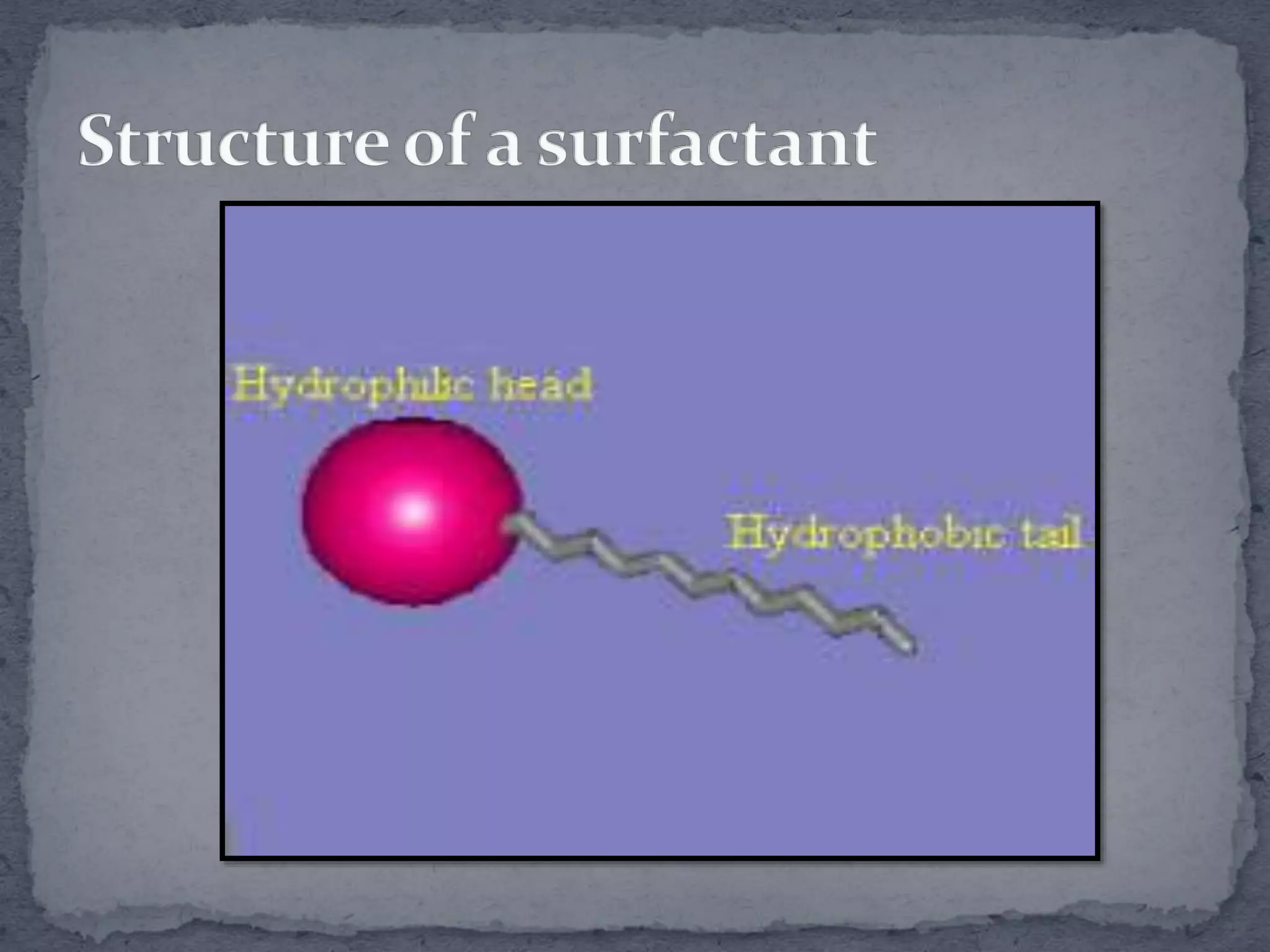
 Surfactants have amphipathic structure tail
or hydrophobic group little affinity for bulk
solvent.
 Usually hydrocarbon (alkyl/aryl) chain in
aqueous solvents.
 Can be linear or branched.
 Head or hydrophilic group strong affinity for
bulk solvent.
 Can be neutral or charged.
 Surfactants reduce the surface tension of water
by adsorbing at the liquid-gas interface.
 Many surfactants can also assemble in the
bulk solution into aggregates. Examples of such
aggregates are vesicles and micelles.
 Thermodynamics of the surfactant systems are of great
importance, theoretically and practically.
 Surfactants play an important role as
cleaning, wetting, dispersing, emulsifying, foaming
 and anti-foaming agents in many practical
applications and products
1. Anionic
2. Cationic
3. Non- Ionic
4. Amphoteric or Zwitterionic
Based on permanent anions or pH-dependent anions .
These are categorised as:
 1. Sulfates: Alkyl sulfates, Alkyl ether sulfates
 2. Sulfonates: Sulfonate fluorosurfactants, Alkyl
benzene sulfonates
 3. Phosphates: Alkyl aryl ether phosphate, Alkyl ether
phosphate
 4. Carboxylates: Alkyl carboxylates, Carboxylate
fluorosurfactants
 (~ 60% of industrial surfactants)
Based on pH-dependent primary, secondary or
tertiary amines i.e. primary amines become positively
charged at pH < 10, secondary amines become charged
at pH < 4.
 Examples:
 Cetylpyridinium chloride (CPC)
 Polyethoxylated tallow amine (POEA)
 Benzalkonium chloride (BAC)
 Benzethonium chloride (BZT)
 5-Bromo-5-nitro-1,3-dioxane
 Dimethyldioctadecylammonium chloride
Amphoteric surfactants are characterized by the fact
that these surfactants can carry a positive charge on a
cationic site and a negative charge on an anionic site.
The use of amphoteric terminology is still restrictive:
The charge of the molecule must change with pH,
showing a zwitterionic form at an intermediate pH
Examples:
 Amino acids
 Imino acids
 Betaines
 lecithin
They doesnt include any charged head. These are
categorised as:
1. Fatty Alcohols
2. Polyoxyethylene glycol
3. Polyoxypropylene gylcol
4. Glucoside
5. Polyoxyethylene glycol octylphenol ethers
6. Sorbitan alkyl esters
7. Polyoxyethylene glycol sorbitan alkyl esters
 The hydrophilic-lipophilic balance (HLB) of
a surfactant reflects its partitioning
behavior between a polar and non-polar
medium.
 HLB number, ranging from 0-40, can be
assigned to a surfactant, based on
emulsification data.
 Semi-empirical only.
 No dispersibility in water 0
 antifoaming agents 2
 Water –in- oil emulsifier 6
 Wetting agent 8
 Milky dispersion 10
 Oil-in-water emulsifier 12
 Clear solution 14
 Detergent 16
 Solubilizer 18
A value of 10 represents a “mid-point” of HLB.
For non ionic surfactants
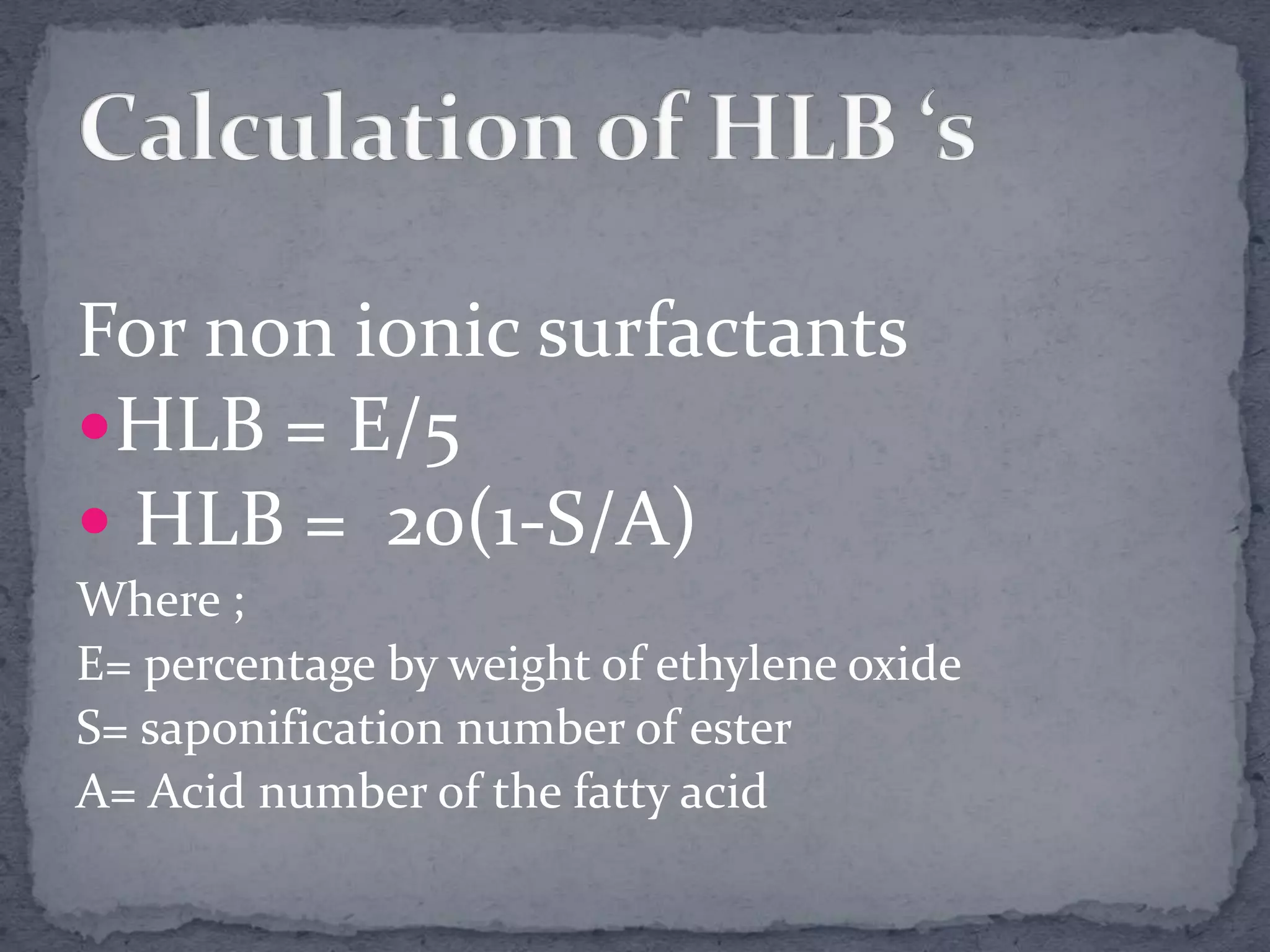
HLB = E/5
 HLB = 20(1-S/A)
Where ;
E= percentage by weight of ethylene oxide
S= saponification number of ester
A= Acid number of the fatty acid
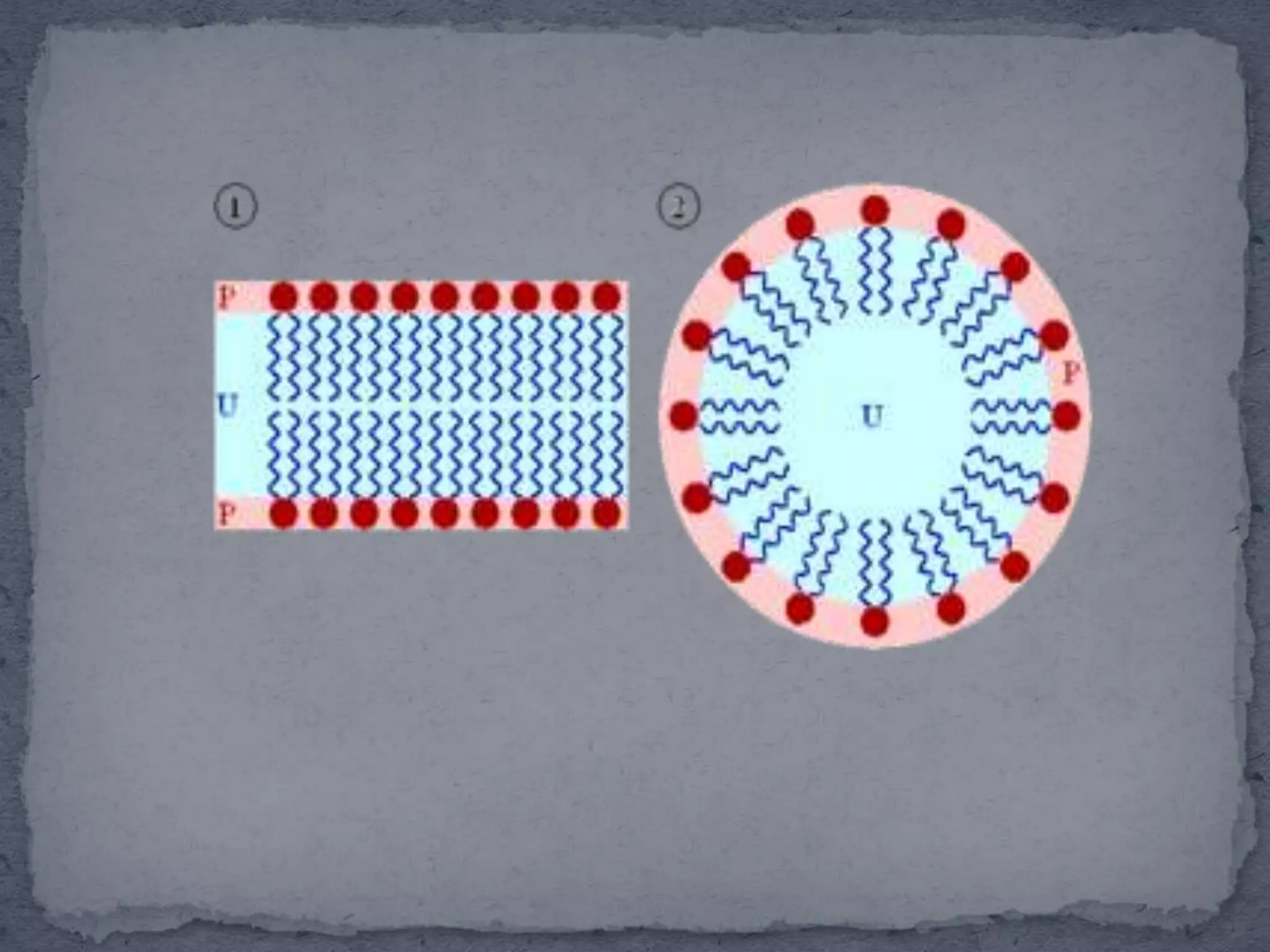
 Micelles are lipid molecules that arrange themselves in
a spherical form in aqueous solutions. The formation
of a micelle is a response to the amphipathic nature
of fatty acids, meaning that they contain both
hydrophilic regions (polar head groups) as well as
hydrophobic regions.
 Micelles contain polar head groups that usually form
the outside as the surface of micelles. They face to the
water because they are polar. The hydrophobic tails are
inside and away from the water since they are
nonpolar.
 Micelles contain polar head groups that usually form
the outside as the surface of micelles. They face to the
water because they are polar. The hydrophobic tails are
inside and away from the water since they are
nonpolar.
 Micelles form spontaneously in water, as stated above
this spontaneous arrangement is due to the
amphipatic nature of the molecule.
 when the lipids form micelles the hydrophobic tails
interact with each other, and this interaction releases
water form the hydrophobic tail and this increases the
disorder of the system, and this is increase in entropy
is favorable.
 Micelles only form when the concentration of
surfactant is greater than the critical micelle
concentration (CMC).
 The CMC is the concentration above surfactant
when micelles will form spontaneously.
 Micelle formation also depend on the Krafft
temperature. This temperature is when surfactants
will form micelles.
 As the temperature increases, the surfactant will
turn into a soluble form and be able to form
micelles from a crystalline state.
 Detergents
 Fabric softeners
 Emulsifying agents in Emulsions
 Paints
 Adhesives
 Inks
 Anti-fogs
 Suspending agents in suspensions
 Laxatives
surfaceactiveagents-110421171905-phpapp02 (1)

surfaceactiveagents-110421171905-phpapp02 (1)

  • 1.
  • 2.
     Hydrophilic: Aliquid/surface that has a high affinity to water.  Hydrophobic: A liquid/surface that has very low affinity to water  Lipophilic: A liquid/surface that has a high affinity to oil.  Lipophobic: A liquid/surface that has a very low affinity to oil.
  • 3.
     A moleculethat contains a polar portion and a non polar portion is called surface active agent/ surfactant.  A surfactant can interact with both polar and non polar molecules.  A surfactant increases the solubility of the otherwise insoluble substances.  In water, surfactant molecules tend to cluster into a spherical geometry non polar ends on the inside of the sphere polar ends on the outside .These clusters are called micelles
  • 4.
     Surfactants haveamphipathic structure tail or hydrophobic group little affinity for bulk solvent.  Usually hydrocarbon (alkyl/aryl) chain in aqueous solvents.  Can be linear or branched.  Head or hydrophilic group strong affinity for bulk solvent.  Can be neutral or charged.
  • 6.
     Surfactants reducethe surface tension of water by adsorbing at the liquid-gas interface.  Many surfactants can also assemble in the bulk solution into aggregates. Examples of such aggregates are vesicles and micelles.  Thermodynamics of the surfactant systems are of great importance, theoretically and practically.  Surfactants play an important role as cleaning, wetting, dispersing, emulsifying, foaming  and anti-foaming agents in many practical applications and products
  • 7.
    1. Anionic 2. Cationic 3.Non- Ionic 4. Amphoteric or Zwitterionic
  • 8.
    Based on permanentanions or pH-dependent anions . These are categorised as:  1. Sulfates: Alkyl sulfates, Alkyl ether sulfates  2. Sulfonates: Sulfonate fluorosurfactants, Alkyl benzene sulfonates  3. Phosphates: Alkyl aryl ether phosphate, Alkyl ether phosphate  4. Carboxylates: Alkyl carboxylates, Carboxylate fluorosurfactants  (~ 60% of industrial surfactants)
  • 9.
    Based on pH-dependentprimary, secondary or tertiary amines i.e. primary amines become positively charged at pH < 10, secondary amines become charged at pH < 4.  Examples:  Cetylpyridinium chloride (CPC)  Polyethoxylated tallow amine (POEA)  Benzalkonium chloride (BAC)  Benzethonium chloride (BZT)  5-Bromo-5-nitro-1,3-dioxane  Dimethyldioctadecylammonium chloride
  • 10.
    Amphoteric surfactants arecharacterized by the fact that these surfactants can carry a positive charge on a cationic site and a negative charge on an anionic site. The use of amphoteric terminology is still restrictive: The charge of the molecule must change with pH, showing a zwitterionic form at an intermediate pH Examples:  Amino acids  Imino acids  Betaines  lecithin
  • 11.
    They doesnt includeany charged head. These are categorised as: 1. Fatty Alcohols 2. Polyoxyethylene glycol 3. Polyoxypropylene gylcol 4. Glucoside 5. Polyoxyethylene glycol octylphenol ethers 6. Sorbitan alkyl esters 7. Polyoxyethylene glycol sorbitan alkyl esters
  • 12.
     The hydrophilic-lipophilicbalance (HLB) of a surfactant reflects its partitioning behavior between a polar and non-polar medium.  HLB number, ranging from 0-40, can be assigned to a surfactant, based on emulsification data.  Semi-empirical only.
  • 13.
     No dispersibilityin water 0  antifoaming agents 2  Water –in- oil emulsifier 6  Wetting agent 8  Milky dispersion 10  Oil-in-water emulsifier 12  Clear solution 14  Detergent 16  Solubilizer 18 A value of 10 represents a “mid-point” of HLB.
  • 14.
    For non ionicsurfactants HLB = E/5  HLB = 20(1-S/A) Where ; E= percentage by weight of ethylene oxide S= saponification number of ester A= Acid number of the fatty acid
  • 15.
     Micelles arelipid molecules that arrange themselves in a spherical form in aqueous solutions. The formation of a micelle is a response to the amphipathic nature of fatty acids, meaning that they contain both hydrophilic regions (polar head groups) as well as hydrophobic regions.  Micelles contain polar head groups that usually form the outside as the surface of micelles. They face to the water because they are polar. The hydrophobic tails are inside and away from the water since they are nonpolar.
  • 16.
     Micelles containpolar head groups that usually form the outside as the surface of micelles. They face to the water because they are polar. The hydrophobic tails are inside and away from the water since they are nonpolar.  Micelles form spontaneously in water, as stated above this spontaneous arrangement is due to the amphipatic nature of the molecule.  when the lipids form micelles the hydrophobic tails interact with each other, and this interaction releases water form the hydrophobic tail and this increases the disorder of the system, and this is increase in entropy is favorable.
  • 19.
     Micelles onlyform when the concentration of surfactant is greater than the critical micelle concentration (CMC).  The CMC is the concentration above surfactant when micelles will form spontaneously.  Micelle formation also depend on the Krafft temperature. This temperature is when surfactants will form micelles.  As the temperature increases, the surfactant will turn into a soluble form and be able to form micelles from a crystalline state.
  • 20.
     Detergents  Fabricsofteners  Emulsifying agents in Emulsions  Paints  Adhesives  Inks  Anti-fogs  Suspending agents in suspensions  Laxatives