Ryan Guzman, Wendy Heston, Terrence Mitchell, Ian Spaulding
AET/562
July, 11 2016
Professor Wyatt
Self-Guided Social Media Training Manual
Overview
There are many types of learning that are found to be effective for
different learners. Social learning provides a multisensory approach to
sharing. Learning mixed with external stimuli applied to life situations
of others will have a long lasting effect on memory especially with
adults who collaborate together on line and share information on a
specific topic. This type of learning that is beginning to emerge more
in the public eye is that of social learning. According to Deaton, “True
learning requires external stimuli and bits of information to be encoded
into the student's memory, able to be retrieved and applied to external
life situations. Social interaction is a complex system of collaborative
parts, each performing a different function that may or may not have
an effect on lasting memory.” (Deaton, 2015.)
Agenda
• Social Learning
• Problem Solving Through Social Learning
• Addressing Business Issues and Strengthening
• Relationships Through Social Learning
• Social Media Tools
Social Learning
• Social Learning
• Problem Solving Through Social Learning
• Addressing Business Issues and Strengthening
• Relationships Through Social Learning
• Social Media Tools
SOCIAL LEARNING
Social Learning as a trend Social Learning models that are preferred
www.gc-solutions.net
• Learners learn in many ways
• Some are visual
• Some are tactile
• Some are auditory
• Some are a mixture
• Recently because of difficulty in meeting in
person social learning has become a viable
option
Social Learning as a tool not a replacement
Private and Secure Model
• Benefits include
• Secure safe place to discuss private information
• Securely limit who is allowed to discuss
information
• This model can be used in healthcare, and public
education
Public Open Model
• Benefits include
• Many various ideas and inputs
• Collaborators from across the globe
• Easy to look up, not hidden on a private server
• Great innovation and collaboration due to diverse
contributors
It is a tool
• It can enhance the delivery of media
• It can facilitate as a medium a place for students to collaborate
• A real teacher or facilitator still must put the course together and manage the
interactions
Problem Solving Through Social Learning
Social Learning vs. Formal Training
www.kepner-tregoe.com
Social Learning Formal Training
• Will provide structure that focuses on learning
• Move beyond formal/traditional learning
• Provide a connection with real workplace issues
• Promotes corporate culture change
• Conflicting training schedules
• Lost of resources
• Employees are not able to voice concerns in
a timely manner
Social Learning & Business Issues
Business Goals and objectives
• Social learning will help align the organizations vision and mission.
• Social learning will improve how goals and objectives are accomplished
through social learning platforms.
• Social learning will enable individual employees to accomplish shared goals
and objectives through collaboration, benefiting the organization as a whole.
www.gc-solutions.net
Social Learning & Strengthening Relationships
Relationships
Social learning can be utilized to strengthen employee relations.
• Aligning social learning platforms and the business
• Collaborative initiatives
• Problem solving workplace issues
• Guideline and policy alignment to business goals and objectives
Integrating employee training and development with social
learning platforms
• Peer to peer sharing of knowledge
• Creating new connections and relationships among employees
• Enriching personal learning networks
• Developing learning communities of practice
www.moscavi.it
Social Learning: Business Issues & Strengthening
Relationships
Indicators of Successful Social Learning Implementation
• Employee engagement
• Employee increased participation and contributions
• Employee morale
• Employee learning evolving into intentional action to accomplish
goals and objectives
• Employee personal learning networks
expanding
www.careerealism.com
Social Media Tools
www.blogs.skype.com
www.frontpagemag.com
www.stuartjdavson.com
www.itproportal.com
www.telegraph.co.uk
Social Media Benefits and Limitations
Benefits
• Effective collaboration
• Effective communication
• Increased moral
• Increased productivity
• Builds strong relationships
Limitations
• Privacy limits data collection
• Cyber bullying
• Lack of leadership support
Organizational Application: Twitter
Organizational Application: Google+
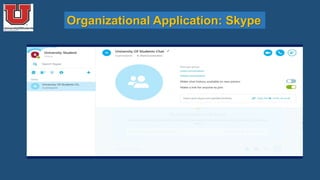
Organizational Application: Skype
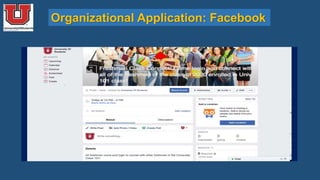
Organizational Application: Facebook
References
Bozarth, J. (2010). Social Media for Trainers. San Francisco, CA: John Wiley & Sons.
Levy, S., & Yupangco, J. (2008, August). Overcoming the Challenges of Social Learning in the Workplace. Learning Solutions. Retrieved from
http://www.learningsolutionsmag.com/articles/85/overcoming-the-challenges-of-social-learning-in the-workplace
Shannon, D. (2015). Social learning theory in the age of social media: Implications for educational practitioners. I-Manager's Journal of Educational
Technology, 12(1), 1.
Shear, B. (2016). Five ways to keep social media from being a legal headache. The Education Digest, 81(5), 54-58. Retrieved from
http://search.proquest.com/docview/1754113639?accountid=458
Sparta, P. (2012). Getting the most out of social learning: Utilizing social media in the workplace. Development and Learning in Organizations: An
International Journal, 26(2), 16-18. doi:10.1108/14777281211201187
Thomas, K.J. (2013). Social Media as Collaborative Media in Workplace Learning. University of Wisconsin, 12(3), 329 – 344.
References
Thomas, K.J. (2013). Social Media as Collaborative Media in Workplace Learning. University of Wisconsin, 12(3), 329 – 344.
University of Students. (n.d.). Timeline [Facebook page]. Retrieved July 9, 2016, from https://www.facebook.com/University-Of-Students
University of Students. (n.d.). Posts [Google+ page]. Retrieved July 9, 2016, from https://plus.google.com/u/0/106413987280183349478/posts
University of Students. (n.d.). Chat Room [Skype Profile]. Retrieved July 9, 2016, from https://join.skype.com/z285hzASReCv

Team E Social Media Training Manual Presentation

  • 1.
    Ryan Guzman, WendyHeston, Terrence Mitchell, Ian Spaulding AET/562 July, 11 2016 Professor Wyatt Self-Guided Social Media Training Manual
  • 2.
    Overview There are manytypes of learning that are found to be effective for different learners. Social learning provides a multisensory approach to sharing. Learning mixed with external stimuli applied to life situations of others will have a long lasting effect on memory especially with adults who collaborate together on line and share information on a specific topic. This type of learning that is beginning to emerge more in the public eye is that of social learning. According to Deaton, “True learning requires external stimuli and bits of information to be encoded into the student's memory, able to be retrieved and applied to external life situations. Social interaction is a complex system of collaborative parts, each performing a different function that may or may not have an effect on lasting memory.” (Deaton, 2015.)
  • 3.
    Agenda • Social Learning •Problem Solving Through Social Learning • Addressing Business Issues and Strengthening • Relationships Through Social Learning • Social Media Tools
  • 4.
    Social Learning • SocialLearning • Problem Solving Through Social Learning • Addressing Business Issues and Strengthening • Relationships Through Social Learning • Social Media Tools
  • 5.
    SOCIAL LEARNING Social Learningas a trend Social Learning models that are preferred www.gc-solutions.net • Learners learn in many ways • Some are visual • Some are tactile • Some are auditory • Some are a mixture • Recently because of difficulty in meeting in person social learning has become a viable option Social Learning as a tool not a replacement Private and Secure Model • Benefits include • Secure safe place to discuss private information • Securely limit who is allowed to discuss information • This model can be used in healthcare, and public education Public Open Model • Benefits include • Many various ideas and inputs • Collaborators from across the globe • Easy to look up, not hidden on a private server • Great innovation and collaboration due to diverse contributors It is a tool • It can enhance the delivery of media • It can facilitate as a medium a place for students to collaborate • A real teacher or facilitator still must put the course together and manage the interactions
  • 6.
    Problem Solving ThroughSocial Learning Social Learning vs. Formal Training www.kepner-tregoe.com Social Learning Formal Training • Will provide structure that focuses on learning • Move beyond formal/traditional learning • Provide a connection with real workplace issues • Promotes corporate culture change • Conflicting training schedules • Lost of resources • Employees are not able to voice concerns in a timely manner
  • 7.
    Social Learning &Business Issues Business Goals and objectives • Social learning will help align the organizations vision and mission. • Social learning will improve how goals and objectives are accomplished through social learning platforms. • Social learning will enable individual employees to accomplish shared goals and objectives through collaboration, benefiting the organization as a whole. www.gc-solutions.net
  • 8.
    Social Learning &Strengthening Relationships Relationships Social learning can be utilized to strengthen employee relations. • Aligning social learning platforms and the business • Collaborative initiatives • Problem solving workplace issues • Guideline and policy alignment to business goals and objectives Integrating employee training and development with social learning platforms • Peer to peer sharing of knowledge • Creating new connections and relationships among employees • Enriching personal learning networks • Developing learning communities of practice www.moscavi.it
  • 9.
    Social Learning: BusinessIssues & Strengthening Relationships Indicators of Successful Social Learning Implementation • Employee engagement • Employee increased participation and contributions • Employee morale • Employee learning evolving into intentional action to accomplish goals and objectives • Employee personal learning networks expanding www.careerealism.com
  • 10.
  • 11.
    Social Media Benefitsand Limitations Benefits • Effective collaboration • Effective communication • Increased moral • Increased productivity • Builds strong relationships Limitations • Privacy limits data collection • Cyber bullying • Lack of leadership support
  • 12.
  • 13.
  • 14.
  • 15.
  • 16.
    References Bozarth, J. (2010).Social Media for Trainers. San Francisco, CA: John Wiley & Sons. Levy, S., & Yupangco, J. (2008, August). Overcoming the Challenges of Social Learning in the Workplace. Learning Solutions. Retrieved from http://www.learningsolutionsmag.com/articles/85/overcoming-the-challenges-of-social-learning-in the-workplace Shannon, D. (2015). Social learning theory in the age of social media: Implications for educational practitioners. I-Manager's Journal of Educational Technology, 12(1), 1. Shear, B. (2016). Five ways to keep social media from being a legal headache. The Education Digest, 81(5), 54-58. Retrieved from http://search.proquest.com/docview/1754113639?accountid=458 Sparta, P. (2012). Getting the most out of social learning: Utilizing social media in the workplace. Development and Learning in Organizations: An International Journal, 26(2), 16-18. doi:10.1108/14777281211201187 Thomas, K.J. (2013). Social Media as Collaborative Media in Workplace Learning. University of Wisconsin, 12(3), 329 – 344.
  • 17.
    References Thomas, K.J. (2013).Social Media as Collaborative Media in Workplace Learning. University of Wisconsin, 12(3), 329 – 344. University of Students. (n.d.). Timeline [Facebook page]. Retrieved July 9, 2016, from https://www.facebook.com/University-Of-Students University of Students. (n.d.). Posts [Google+ page]. Retrieved July 9, 2016, from https://plus.google.com/u/0/106413987280183349478/posts University of Students. (n.d.). Chat Room [Skype Profile]. Retrieved July 9, 2016, from https://join.skype.com/z285hzASReCv

Editor's Notes

  • #6 The disadvantage comes as a result of privacy concerns of topics discussed or content shared. Sparta touches on this “balance must be stuck between restricting what content is made available and what is restricted in the learning process.” (Sparta, 2012.). Social learning is not a turn key operation. It requires inputs from the facilitators and course designers. It also requires management once the class begins to ensure participants are heading in the direction desired and contributing in meaningful ways.
  • #7 By addressing these problems and incorporating the previous strategies, we hope that problem solving in our organization become something that can happen anytime rather than brought up only through formal training. During formal training sessions, employees would burst and all the problems they ran into would explode into a complaining session. Much valuable time was lost with this method. Now, with the social learning initiative, whenever an employee runs into a problem in the workplace, they will have several outlets to address their problems and have them resolved. Employees can now post on Facebook, tweet at their managers and supervisors, attend a video conference call with IT immediately or connect with others who have experienced the same thing on Google+. In Learning Solutions Magazine, Shevy Levy and Jim Yupangco say it best when they say, “Because self-direction and problem-solving are critical to the learning process, the ideal environment for learning is open-ended. That is, learners receive direction to a problem, and to tools they can use to solve problems. They may solve the problem on their own, or in collaboration with other learners.” (Levy & Yupangco, 2008, p. 1). Levy, S., & Yupangco, J. (2008, August). Overcoming the Challenges of Social Learning in the Workplace. Learning Solutions Magazine. Retrieved from July 8, 2016 from http://www.learningsolutionsmag.com/articles/85/overcoming-the-challenges-of-social-learning-in-the-workplace
  • #8 Current trends of professional development in businesses is to utilize Web 2.0 technology to platform social learning through various forms of social media. It is recognized that social learning is no longer just a transmission of “substance“ from teachers to learners but that it is a resource that businesses can utilize to address business issues and to strengthen workplace relationships (Levey & Yupangco, 2008). Let’s look at how social learning is applicable to business goals and objectives as listed in the slide.
  • #9 Through social learning employees are able to enhance and advance workplace learning, expand personal learning networks, and to participated in the businesses community of practice (CoP). As noted in the slide workplace relationships will be strengthened by aligning social learning to the businesses' needs and by integrating employee training and development.
  • #12 Benefits: Through the use of an effective collaboration platform like blogs, RSS feeds, wikis the university benefits form having the ability to set up group projects along with activities set up by the users themselves without the approval from management which allows for an open and flexible social platform. It also allows for the UOS workforce dashboards allowing them to place links for those involved in any group work requiring one longin to all the elements and resources associated with that platform. The university can exploit these platforms to establish their own intranet that supports any and all collaborating working groups and social learning throughout the organization. Limitations: . Having an understanding and a strategy will help manage these limitations. Social networks place restrictions the amount of information that can be collected. The reason for this to protect the privacy of its users. Cyber bullying in recent years have become a means for individuals to express inappropriate behavior. Understanding what constitutes social media bullying will help the university identify if its employees have become victims to such behavior. Below is what constitutes social media bullying: Posting negative comments on pictures Posting abusive posts on a user’s wall Using pictures or videos to make fun of another user Another limitation is the lack of support from leadership is the number one concern for most organizations. Placing a dollar amount on social media tools and platforms for those leaders who lack the necessary skills and are often to decide to outsource this services through either web development firms or advertising agencies. The downside to this is that the organization does not learn about such platforms and what social media sites best suits the company needs and the workforce is likely to stay with the status quo when it comes to internal communication. Reference: Dagliano, A. (March 26, 2015). E Group. Sharing the wisdom and power of engagement to drive growth for organization. Retrieved from http://www.egroupengage.com/blog/leveraging-social-media-to-increase-employee-engagement Hart, J. Centre for Learning & Performance Technologies. 4: Social media tools and systems for learning. Retrieved from http://c4lpt.co.uk/learning-resources/social-learning- handbook/social-media-tools-and-systems-for-learning/ Kovary, G. (May 9, 2013). N-Gen blog. Improving engagement and productivity with media at work. Retrieved from http://www.ngenperformance.com/blog/hr-training/improving-engagement-and-productivity-with-social-media-at-work
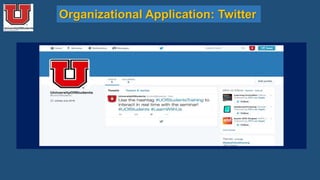
  • #13 On our Twitter page, you can see what we are using for our hashtag. By tagging a tweet with this hashtag (#UOfStudentsTraining), we can see all of the interaction the audience has with our seminar. Additionally, by going to this page and clicking the “Tweet” button at the top right hand corner, you can send our account a direct tweet. University of Students [Learning Team E]. (n.d.). Tweets [Twitter page]. Retrieved July 9, 2016, from https://twitter.com/UnivOfStudents
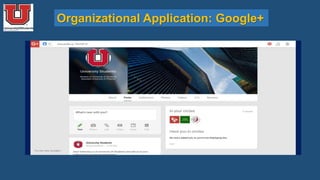
  • #14 On our Google+ page, we update what is going on with University Of Students. On your personal plus page, you’ll have several features. You can update your status by clicking on the link that says “Text” right under the “What’s new with you?” area. Also under there, you can choose to upload a photo, post a link to a webpage or online article, post a video, schedule an event and post it, or create an online poll. At the top of the page, you have the option to see your collections (groups of pages you follow), photos, videos, +1’s or reviews of your page by other users. On the right hand side, you will se who is in your particular circle (groups of users based on theme). University of Students. (n.d.). Posts [Google+ page]. Retrieved July 9, 2016, from https://plus.google.com/u/0/106413987280183349478/posts
  • #15 Skype has several options for you to use. On the current page, you see the chat feature. This is a basic instant messenger feature that allows a user to type text back and forth instantly. However, Skype allows several other functions. In the top right hand corner, there are three different icons. The first icon is a video camera. By selecting this option, you can video chat with another user or users. The second icon is a telephone and this allows you to audio chat with another user or users. Finally, the third icon allows you to search for other users on the Skype platform. University of Students. (n.d.). Chat Room [Skype Profile]. Retrieved July 9, 2016, from https://join.skype.com/z285hzASReCv
  • #16 The Facebook option allows a user to do several things. In this example, we set up an event for other students to join us online at a specific time to interact and connect. When the event begins, we will moderate the conversation and we will be able to see all the comments and posts on our wall and be able to interact directly with the students who are logged on to our page. University of Students. (n.d.). Timeline [Facebook page]. Retrieved July 9, 2016, from https://www.facebook.com/University-Of-Students
  • #17 The Facebook option allows a user to do several things. In this example, we set up an event for other students to join us online at a specific time to interact and connect. When the event begins, we will moderate the conversation and we will be able to see all the comments and posts on our wall and be able to interact directly with the students who are logged on to our page.
  • #18 The Facebook option allows a user to do several things. In this example, we set up an event for other students to join us online at a specific time to interact and connect. When the event begins, we will moderate the conversation and we will be able to see all the comments and posts on our wall and be able to interact directly with the students who are logged on to our page.