Support Vector Machine
Subject: Machine Learning
Dr. Varun Kumar
Subject: Machine Learning Dr. Varun Kumar (IIIT Surat) 1 / 12
Outlines
1 Introduction to Support Vector Machine (SVM)
2 Linearly vs Non-linearly Separable Pattern/Class
3 Mathematical Intuition for Hyperplane
4 Support Vector and Optimal Hyperplane
5 References
Subject: Machine Learning Dr. Varun Kumar (IIIT Surat) 2 / 12
Introduction to support vector machine (SVM):
Key Features:
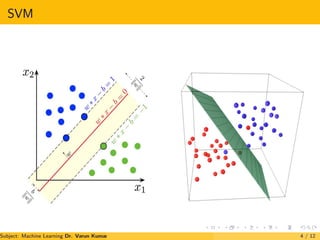
1 Support vector machine is a tool under supervise learning.
2 It is binary classifier.
3 Support vector machine constructs a hyperplane as the decision
surface in such a way that the margin of separation between positive
and negative examples.
Q What is hyperplane ?
Q What is decision surface ?
Q What is margin of separation ?
Q What is positive and negative example ?
Subject: Machine Learning Dr. Varun Kumar (IIIT Surat) 3 / 12
SVM
Subject: Machine Learning Dr. Varun Kumar (IIIT Surat) 4 / 12
Linearly vs non-linearly separable pattern/class
Subject: Machine Learning Dr. Varun Kumar (IIIT Surat) 5 / 12
Mathematical intuition for optimal hyperplane
Optimal hyperplane for linearly separable pattern
⇒ Consider the training sample {(xi , di )}N
i=1
⇒ xi is the input pattern for the ith example.
⇒ di → Corresponding desired response (target output).
⇒ Initial assumption → Class di = 1 and di = −1 are linearly separable.
⇒ The equation for decision surface is
wT
x + b = 0 (1)
x is an input vector, w is an adjustable weight vector, and b is a bias.
wT
x + b ≥ 0 ⇒ di = +1
wT
x + b < 0 ⇒ di = −1
(2)
Subject: Machine Learning Dr. Varun Kumar (IIIT Surat) 6 / 12
Support vector and optimal hyperplane
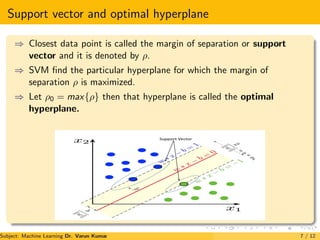
⇒ Closest data point is called the margin of separation or support
vector and it is denoted by ρ.
⇒ SVM find the particular hyperplane for which the margin of
separation ρ is maximized.
⇒ Let ρ0 = max{ρ} then that hyperplane is called the optimal
hyperplane.
Subject: Machine Learning Dr. Varun Kumar (IIIT Surat) 7 / 12
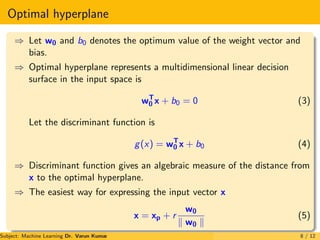
Optimal hyperplane
⇒ Let w0 and b0 denotes the optimum value of the weight vector and
bias.
⇒ Optimal hyperplane represents a multidimensional linear decision
surface in the input space is
wT
0 x + b0 = 0 (3)
Let the discriminant function is
g(x) = wT
0 x + b0 (4)
⇒ Discriminant function gives an algebraic measure of the distance from
x to the optimal hyperplane.
⇒ The easiest way for expressing the input vector x
x = xp + r
w0
k w0 k
(5)
Subject: Machine Learning Dr. Varun Kumar (IIIT Surat) 8 / 12
Continued–
⇒ xp is the normal projection of x onto the optimal hyperplane.
⇒ r is the desired algebraic distance.
⇒ If r is +ve, x is on the +ve side of the optimal hyperplane and
vice-versa.
⇒ By definition g(xp) = 0 and g(x) = wT
0 x + b0 = rk w0 k. Hence,
r =
g(x)
k w0 k
(6)
Subject: Machine Learning Dr. Varun Kumar (IIIT Surat) 9 / 12
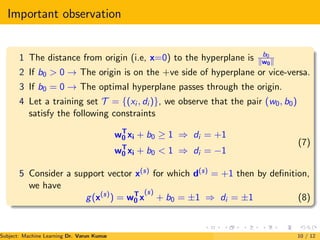
Important observation
1 The distance from origin (i.e, x=0) to the hyperplane is b0
kw0k
2 If b0 > 0 → The origin is on the +ve side of hyperplane or vice-versa.
3 If b0 = 0 → The optimal hyperplane passes through the origin.
4 Let a training set T = {(xi , di )}, we observe that the pair (w0, b0)
satisfy the following constraints
wT
0 xi + b0 ≥ 1 ⇒ di = +1
wT
0 xi + b0 < 1 ⇒ di = −1
(7)
5 Consider a support vector x(s) for which d(s) = +1 then by definition,
we have
g(x(s)
) = wT
0 x
(s)
+ b0 = ±1 ⇒ di = ±1 (8)
Subject: Machine Learning Dr. Varun Kumar (IIIT Surat) 10 / 12
Continued–
6 The algebraic distance from the support vector x(s) to the optimal
hyperplane is
r =
g(x(s))
k w0 k
1
k w0 k
⇒ if d(s)
= +1
−1
k w0 k
⇒ if d(s)
= −1
(9)
7 Let ρ denotes the optimum value of margin between two classes that
constitutes the training sample T , then
ρ =2r =
2
k w0 k
(10)
8 Maximizing the margin of separation is equivalent to minimizing the
Euclidean norm of the weight vector w
Subject: Machine Learning Dr. Varun Kumar (IIIT Surat) 11 / 12
References
E. Alpaydin, Introduction to machine learning. MIT press, 2020.
J. Grus, Data science from scratch: first principles with python. O’Reilly Media,
2019.
T. M. Mitchell, The discipline of machine learning. Carnegie Mellon University,
School of Computer Science, Machine Learning , 2006, vol. 9.
Subject: Machine Learning Dr. Varun Kumar (IIIT Surat) 12 / 12

Support vector machine (Machine Learning)

  • 1.
    Support Vector Machine Subject:Machine Learning Dr. Varun Kumar Subject: Machine Learning Dr. Varun Kumar (IIIT Surat) 1 / 12
  • 2.
    Outlines 1 Introduction toSupport Vector Machine (SVM) 2 Linearly vs Non-linearly Separable Pattern/Class 3 Mathematical Intuition for Hyperplane 4 Support Vector and Optimal Hyperplane 5 References Subject: Machine Learning Dr. Varun Kumar (IIIT Surat) 2 / 12
  • 3.
    Introduction to supportvector machine (SVM): Key Features: 1 Support vector machine is a tool under supervise learning. 2 It is binary classifier. 3 Support vector machine constructs a hyperplane as the decision surface in such a way that the margin of separation between positive and negative examples. Q What is hyperplane ? Q What is decision surface ? Q What is margin of separation ? Q What is positive and negative example ? Subject: Machine Learning Dr. Varun Kumar (IIIT Surat) 3 / 12
  • 4.
    SVM Subject: Machine LearningDr. Varun Kumar (IIIT Surat) 4 / 12
  • 5.
    Linearly vs non-linearlyseparable pattern/class Subject: Machine Learning Dr. Varun Kumar (IIIT Surat) 5 / 12
  • 6.
    Mathematical intuition foroptimal hyperplane Optimal hyperplane for linearly separable pattern ⇒ Consider the training sample {(xi , di )}N i=1 ⇒ xi is the input pattern for the ith example. ⇒ di → Corresponding desired response (target output). ⇒ Initial assumption → Class di = 1 and di = −1 are linearly separable. ⇒ The equation for decision surface is wT x + b = 0 (1) x is an input vector, w is an adjustable weight vector, and b is a bias. wT x + b ≥ 0 ⇒ di = +1 wT x + b < 0 ⇒ di = −1 (2) Subject: Machine Learning Dr. Varun Kumar (IIIT Surat) 6 / 12
  • 7.
    Support vector andoptimal hyperplane ⇒ Closest data point is called the margin of separation or support vector and it is denoted by ρ. ⇒ SVM find the particular hyperplane for which the margin of separation ρ is maximized. ⇒ Let ρ0 = max{ρ} then that hyperplane is called the optimal hyperplane. Subject: Machine Learning Dr. Varun Kumar (IIIT Surat) 7 / 12
  • 8.
    Optimal hyperplane ⇒ Letw0 and b0 denotes the optimum value of the weight vector and bias. ⇒ Optimal hyperplane represents a multidimensional linear decision surface in the input space is wT 0 x + b0 = 0 (3) Let the discriminant function is g(x) = wT 0 x + b0 (4) ⇒ Discriminant function gives an algebraic measure of the distance from x to the optimal hyperplane. ⇒ The easiest way for expressing the input vector x x = xp + r w0 k w0 k (5) Subject: Machine Learning Dr. Varun Kumar (IIIT Surat) 8 / 12
  • 9.
    Continued– ⇒ xp isthe normal projection of x onto the optimal hyperplane. ⇒ r is the desired algebraic distance. ⇒ If r is +ve, x is on the +ve side of the optimal hyperplane and vice-versa. ⇒ By definition g(xp) = 0 and g(x) = wT 0 x + b0 = rk w0 k. Hence, r = g(x) k w0 k (6) Subject: Machine Learning Dr. Varun Kumar (IIIT Surat) 9 / 12
  • 10.
    Important observation 1 Thedistance from origin (i.e, x=0) to the hyperplane is b0 kw0k 2 If b0 > 0 → The origin is on the +ve side of hyperplane or vice-versa. 3 If b0 = 0 → The optimal hyperplane passes through the origin. 4 Let a training set T = {(xi , di )}, we observe that the pair (w0, b0) satisfy the following constraints wT 0 xi + b0 ≥ 1 ⇒ di = +1 wT 0 xi + b0 < 1 ⇒ di = −1 (7) 5 Consider a support vector x(s) for which d(s) = +1 then by definition, we have g(x(s) ) = wT 0 x (s) + b0 = ±1 ⇒ di = ±1 (8) Subject: Machine Learning Dr. Varun Kumar (IIIT Surat) 10 / 12
  • 11.
    Continued– 6 The algebraicdistance from the support vector x(s) to the optimal hyperplane is r = g(x(s)) k w0 k 1 k w0 k ⇒ if d(s) = +1 −1 k w0 k ⇒ if d(s) = −1 (9) 7 Let ρ denotes the optimum value of margin between two classes that constitutes the training sample T , then ρ =2r = 2 k w0 k (10) 8 Maximizing the margin of separation is equivalent to minimizing the Euclidean norm of the weight vector w Subject: Machine Learning Dr. Varun Kumar (IIIT Surat) 11 / 12
  • 12.
    References E. Alpaydin, Introductionto machine learning. MIT press, 2020. J. Grus, Data science from scratch: first principles with python. O’Reilly Media, 2019. T. M. Mitchell, The discipline of machine learning. Carnegie Mellon University, School of Computer Science, Machine Learning , 2006, vol. 9. Subject: Machine Learning Dr. Varun Kumar (IIIT Surat) 12 / 12