SVM-Support Vector
Machine
ANUDEEP CHOWDARY KAMEPALLI
CB.EN.P2AEL20003
Overview
We are going to cover following topics:
 Support Vector Machines
 How does it work?
 Kernels
 Advantages and Disadvantages
SVM
 It but can be employed in both types of
classification and regression problems. It can
easily handle multiple continuous and
categorical variables.
 SVM constructs a hyperplane in
multidimensional space to separate different
classes. SVM generates optimal hyperplane
in an iterative manner,
 which is used to minimize an error. The core
idea of SVM is to find a maximum marginal
hyperplane(MMH) that best divides the
dataset into classes.
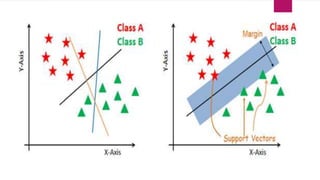
 Support Vectors:Support vectors are the data points, which are closest to the
hyperplane. These points will define the separating line better by calculating
margins. These points are more relevant to the construction of the classifier.
 Hyperplane:A hyperplane is a decision plane which separates between a set of
objects having different class memberships.
 Margin:A margin is a gap between the two lines on the closest class points. This
is calculated as the perpendicular distance from the line to support vectors or
closest points. If the margin is larger in between the classes, then it is considered
good margin, a smaller margin is a bad margin.
How does SVM work?
 The main objective is to segregate the given dataset in the best possible way.
The distance between the either nearest points is known as the margin. The
objective is to select a hyperplane with the maximum possible margin between
support vectors in the given dataset. SVM searches for the maximum marginal
hyperplane in the following steps:
 Generate hyperplanes which segregates the classes in the best way.
Dealing with non-linear and inseparable planes
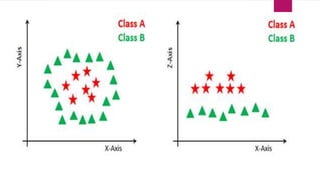
Some problems can’t be solved using linear hyperplane, as shown in the figure
below
In such situation, SVM uses a kernel trick to transform the input space to a higher
dimensional space as shown on the right. The data points are plotted on the x-axis
and z-axis (Z is the squared sum of both x and y: z=x^2=y^2). Now you can easily
segregate these points using linear separation.
SVM Kernels
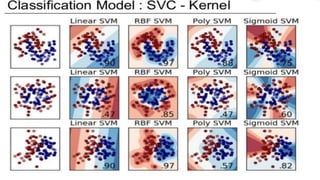
 The SVM algorithm is implemented in practice using a kernel. A kernel
transforms an input data space into the required form. SVM uses a technique
called the kernel trick. Here, the kernel takes a low-dimensional input space and
transforms it into a higher dimensional space. In other words, you can say that it
converts nonseparable problem to separable problems by adding more
dimension to it. It is most useful in non-linear separation problem. Kernel trick
helps you to build a more accurate classifier.
 Linear Kernel A linear kernel can be used as normal dot product any two given
observations. The product between two vectors is the sum of the multiplication of
each pair of input values.
 Polynomial Kernel A polynomial kernel is a more generalized form of the linear
kernel. The polynomial kernel can distinguish curved or nonlinear input space.
 Radial Basis Function Kernel The Radial basis function kernel is a popular kernel
function commonly used in support vector machine classification. RBF can map an
input space in infinite dimensional space.
Advantages
 Good accuracy and perform faster prediction compared to Naïve Bayes
algorithm.
 Use less memory because they use a subset of training points in the decision
phase.
 SVM works well with a clear margin of separation and with high dimensional
space
Disadvantages
 SVM is not suitable for large datasets because of its high training time
 Takes more time in training compared to Naïve Bayes.
 It works poorly with overlapping classes and is also sensitive to the type of kernel
used.
Before seeing the program a short video can explain whole concept in gist:
https://www.youtube.com/watch?v=Y6RRHw9uN9o
Support vector machine-SVM's

Support vector machine-SVM's

  • 1.
  • 2.
    Overview We are goingto cover following topics:  Support Vector Machines  How does it work?  Kernels  Advantages and Disadvantages
  • 3.
    SVM  It butcan be employed in both types of classification and regression problems. It can easily handle multiple continuous and categorical variables.  SVM constructs a hyperplane in multidimensional space to separate different classes. SVM generates optimal hyperplane in an iterative manner,  which is used to minimize an error. The core idea of SVM is to find a maximum marginal hyperplane(MMH) that best divides the dataset into classes.
  • 4.
     Support Vectors:Supportvectors are the data points, which are closest to the hyperplane. These points will define the separating line better by calculating margins. These points are more relevant to the construction of the classifier.  Hyperplane:A hyperplane is a decision plane which separates between a set of objects having different class memberships.  Margin:A margin is a gap between the two lines on the closest class points. This is calculated as the perpendicular distance from the line to support vectors or closest points. If the margin is larger in between the classes, then it is considered good margin, a smaller margin is a bad margin.
  • 5.
    How does SVMwork?  The main objective is to segregate the given dataset in the best possible way. The distance between the either nearest points is known as the margin. The objective is to select a hyperplane with the maximum possible margin between support vectors in the given dataset. SVM searches for the maximum marginal hyperplane in the following steps:  Generate hyperplanes which segregates the classes in the best way.
  • 7.
    Dealing with non-linearand inseparable planes Some problems can’t be solved using linear hyperplane, as shown in the figure below In such situation, SVM uses a kernel trick to transform the input space to a higher dimensional space as shown on the right. The data points are plotted on the x-axis and z-axis (Z is the squared sum of both x and y: z=x^2=y^2). Now you can easily segregate these points using linear separation.
  • 9.
    SVM Kernels  TheSVM algorithm is implemented in practice using a kernel. A kernel transforms an input data space into the required form. SVM uses a technique called the kernel trick. Here, the kernel takes a low-dimensional input space and transforms it into a higher dimensional space. In other words, you can say that it converts nonseparable problem to separable problems by adding more dimension to it. It is most useful in non-linear separation problem. Kernel trick helps you to build a more accurate classifier.
  • 10.
     Linear KernelA linear kernel can be used as normal dot product any two given observations. The product between two vectors is the sum of the multiplication of each pair of input values.  Polynomial Kernel A polynomial kernel is a more generalized form of the linear kernel. The polynomial kernel can distinguish curved or nonlinear input space.  Radial Basis Function Kernel The Radial basis function kernel is a popular kernel function commonly used in support vector machine classification. RBF can map an input space in infinite dimensional space.
  • 12.
    Advantages  Good accuracyand perform faster prediction compared to Naïve Bayes algorithm.  Use less memory because they use a subset of training points in the decision phase.  SVM works well with a clear margin of separation and with high dimensional space
  • 13.
    Disadvantages  SVM isnot suitable for large datasets because of its high training time  Takes more time in training compared to Naïve Bayes.  It works poorly with overlapping classes and is also sensitive to the type of kernel used. Before seeing the program a short video can explain whole concept in gist: https://www.youtube.com/watch?v=Y6RRHw9uN9o