LECTURE1: INTRODUCTION
TO MACHINE LEARNING
Dr. Ummesalma M,
Assistant Professor,
CHRIST (Deemed to be University),
Bengaluru -29
AGENDA
1. Preface
2. Prerequisite
3. Definition
4. Introduction to Machine Learning (ML)
5. Fields associated with ML
6. Need for ML
7. Difference between…
8. Types of learning in ML
9. Applications of ML
10. Limitations of ML
11. Old wine in a new bottle
2
PREFACE
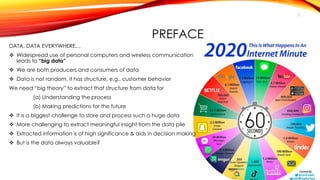
DATA, DATA EVERYWHERE…
 Widespread use of personal computers and wireless communication
leads to “big data”
 We are both producers and consumers of data
 Data is not random, it has structure, e.g., customer behavior
We need “big theory” to extract that structure from data for
(a) Understanding the process
(b) Making predictions for the future
 It is a biggest challenge to store and process such a huge data
 More challenging to extract meaningful insight from the data pile
 Extracted information is of high significance & aids in decision making
 But is the data always valuable?
3
PREFACE
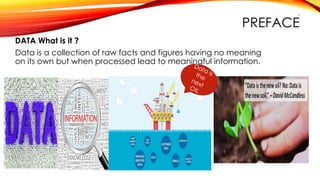
DATA What is it ?
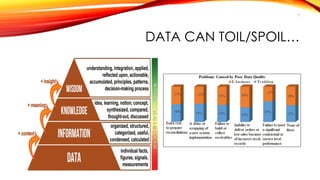
Data is a collection of raw facts and figures having no meaning
on its own but when processed lead to meaningful information.
4
DATA CAN TOIL/SPOIL…
5
6
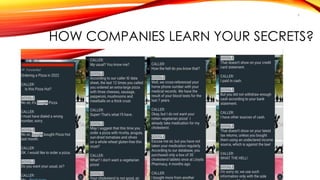
HOW COMPANIES LEARN YOUR SECRETS?
7
HOW COMPANIES LEARN YOUR SECRETS?
https://www.nytimes.com/2012/02/19/magazine/sho
pping-habits.html
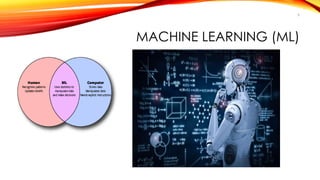
MACHINE LEARNING (ML)
8
PREREQUISITES TO LEARN
MACHINE LEARNING (ML)
9
Five essential prerequisites for studying machine learning:
1. Statistics Knowledge: Probability, Basic and Inferential Statistics
2. Mathematical foundation: Linear Algebra and Calculus
3. Programming Languages: Preferably Python (Pandas, Numpy, Matplotlib)
4. Domain Knowledge: Related to the problem
5. Common Sense – which isn’t common
INTRODUCTION TO MACHINE
LEARNING (ML)
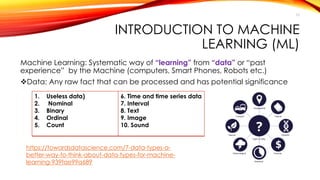
Machine Learning: Systematic way of “learning” from “data” or “past
experience” by the Machine (computers, Smart Phones, Robots etc.)
Data: Any raw fact that can be processed and has potential significance
10
1. Useless data)
2. Nominal
3. Binary
4. Ordinal
5. Count
6. Time and time series data
7. Interval
8. Text
9. Image
10. Sound
https://towardsdatascience.com/7-data-types-a-
better-way-to-think-about-data-types-for-machine-
learning-939fae99a689
INTRODUCTION TO MACHINE
LEARNING (ML) CONT.
Machine Learning: Systematic way of “learning” from “data” or “past
experience” by the Machine (computers, Smart Phones, Robots etc.)
 learning: Make intelligent predictions or decisions based on data by
optimizing a model
• There is no need to “learn” to calculate payroll
• Learning is used when:
• Human expertise does not exist (navigating on Mars),
• Humans are unable to explain their expertise (speech recognition)
• Solution changes in time (routing on a computer network)
• Solution needs to be adapted to particular cases (user biometrics)
11
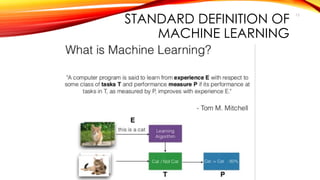
STANDARD DEFINITION OF
MACHINE LEARNING
12
NEED FOR ML
When do we need ML (I)?
For tasks that are easily performed by humans but are complex for computer
systems to emulate for example … So that machines can take charge of
humans
Vision: Identify faces in a photograph, objects in a video or still image, etc.
Natural language Processing: Translate a sentence from Hindi to English,
question answering, identify sentiment of text, etc.
 Speech Recognition: Recognize spoken words, speaking sentences
naturally
 Game playing: Play games like chess, Go, Dota.
 Robotics: Walking, jumping, displaying emotions, driverless car etc.
13
NEED FOR ML
When do we need ML? (II)
For tasks that are beyond human capabilities
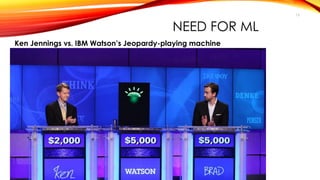
E.g. IBM Watson’s Jeopardy-playing machine
Facing certain defeat at the hands of room-size
I.B.M. computer on Wednesday evening, Ken
Jennings, famous for winning 74 games in a row
on the TV quiz show, acknowledged the obvious.
“I, for one, welcome our new computer overlords,”
he wrote on his video screen, borrowing a line
from a “Simpsons” episode.
14
NEED FOR ML
15
Ken Jennings vs. IBM Watson’s Jeopardy-playing machine
NEED FOR ML
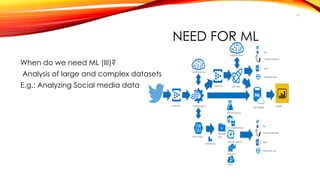
When do we need ML (III)?
Analysis of large and complex datasets
E.g.: Analyzing Social media data
16
NEED FOR ML
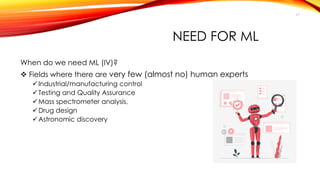
When do we need ML (IV)?
 Fields where there are very few (almost no) human experts
Industrial/manufacturing control
Testing and Quality Assurance
Mass spectrometer analysis,
Drug design
Astronomic discovery
17
NEED FOR ML
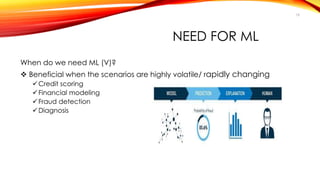
When do we need ML (V)?
 Beneficial when the scenarios are highly volatile/ rapidly changing
Credit scoring
Financial modeling
Fraud detection
Diagnosis
18
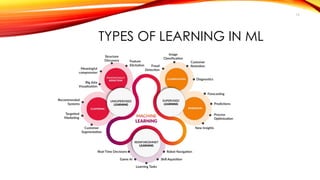
TYPES OF LEARNING IN ML
19
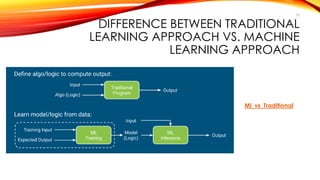
DIFFERENCE BETWEEN TRADITIONAL
LEARNING APPROACH VS. MACHINE
LEARNING APPROACH
20
Ml_vs_Traditional
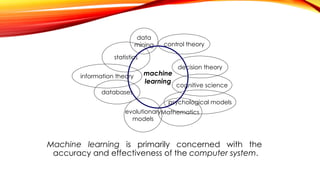
Machine learning is primarily concerned with the
accuracy and effectiveness of the computer system.
psychological models
data
mining
cognitive science
decision theory
information theory
databases
machine
learning
Mathematics
statistics
evolutionary
models
control theory
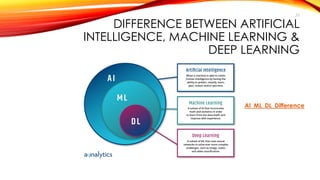
DIFFERENCE BETWEEN ARTIFICIAL
INTELLIGENCE, MACHINE LEARNING &
DEEP LEARNING
22
AI_ML_DL_Difference
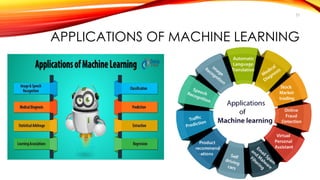
APPLICATIONS OF MACHINE LEARNING
23
APPLICATIONS OF MACHINE LEARNING
1. Image recognition: To identify objects, persons, places, digital images, etc. The popular
use case of image recognition and face detection is, Automatic friend tagging suggestion
by Facebook, geo tagging by Google, Biometrics etc.
2. Speech Recognition: Process of converting voice instructions into text. E.g. Speech to text,
Voice recognition, Google’s Voice Search, Voice based assistance viz Siri, Cortana,
and Alexa etc.
3. Product recommendations: Mechanism of understanding the user interest using various
machine learning algorithms & suggests the product as per customer interest. Google
recommendation, Youtube video recommendation, Food Recommendation on Apps etc.
4. Self-driving cars: The art of automating the driving by computers. E.g. Tesla cars by Tesla
company which uses unsupervised learning method to train the car models for object
(people, vehicle or any obstacle), detection navigation etc. to facilitate smooth driving.
5. Transportation and Commuting: It provides a customized application which is unique to
you. Automatically detects your location and provides options to either go home or office
or any other frequent place based on your History and Patterns E.g.: Uber/Ola
24
APPLICATIONS OF MACHINE
LEARNING
6. Stock Data Prediction: Predicting the closing price of stock using time series models
and neural networks.
7. Medical Diagnosis: ML is used for diseases identification, classification and
prediction of cancers and tumors using image processing and numerical data
analysis. E.g. 3D models that can predict the exact position of lesions in the brain.
Classification of disease as lethal or non-lethal, Prediction of reoccurrence of cancer
etc.
8. Automatic Language Translation: Converts the unknown language into known one.
E.g. Google's GNMT (Google Neural Machine Translation)
9. Basket Analysis: Identifying the frequently bought items and redesigning the shelf to
increase the sales in the super market.
10. Data Analytics: Analyzing the data to facilitate decision making. E.g. Sentiment
analysis, Business analytics, medical analytics etc.
25
LIMITATIONS OF MACHINE
LEARNING
Limitation 1 — Ethics: If my self-driving car kills someone on the road, whose
fault is it?
Limitation 2 — Deterministic Problems: Machine learning is stochastic, not
deterministic.
Limitation 3 — Data: Lack of data, lack of good data leads to wrong results.
Limitation 4 — Misapplication: whereby people blindly use machine learning
to solve statistical problems and statistical techniques to solve machine
learning problem. It should be noted that statistical modeling is inherently
confirmatory, and machine learning is inherently exploratory.
Limitation 5 — Interpretability: Lack of interpretability of the ML methods,
despite their apparent success especially in the field of genomics, proteomics,
metabolomics, etc.
26
OLD WINE IN NEW BOTTLE
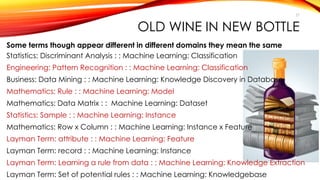
Some terms though appear different in different domains they mean the same
Statistics: Discriminant Analysis : : Machine Learning: Classification
Engineering: Pattern Recognition : : Machine Learning: Classification
Business: Data Mining : : Machine Learning: Knowledge Discovery in Database
Mathematics: Rule : : Machine Learning: Model
Mathematics: Data Matrix : : Machine Learning: Dataset
Statistics: Sample : : Machine Learning: Instance
Mathematics: Row x Column : : Machine Learning: Instance x Feature
Layman Term: attribute : : Machine Learning: Feature
Layman Term: record : : Machine Learning: Instance
Layman Term: Learning a rule from data : : Machine Learning: Knowledge Extraction
Layman Term: Set of potential rules : : Machine Learning: Knowledgebase
27
REFERENCES
BOOKS
E. Alpaydin, Introduction to Machine Learning, 3rd Edition, MIT Press, 2014.
C.M. Bishop, Pattern Recognition and Machine Learning, Springer, 2016.
Lecture Notes
Lecture Notes for E Alpaydın 2004 Introduction to Machine Learning © The MIT Press
(V1.1)
https://www.javatpoint.com/applications-of-machine-learning
Websites
Geekforgeeks.com
Medium.com
Towardsdatascience.com
Image Courtesy: Google Images
28
29
THANK YOU!

Lecture1 introduction to machine learning

  • 1.
    LECTURE1: INTRODUCTION TO MACHINELEARNING Dr. Ummesalma M, Assistant Professor, CHRIST (Deemed to be University), Bengaluru -29
  • 2.
    AGENDA 1. Preface 2. Prerequisite 3.Definition 4. Introduction to Machine Learning (ML) 5. Fields associated with ML 6. Need for ML 7. Difference between… 8. Types of learning in ML 9. Applications of ML 10. Limitations of ML 11. Old wine in a new bottle 2
  • 3.
    PREFACE DATA, DATA EVERYWHERE… Widespread use of personal computers and wireless communication leads to “big data”  We are both producers and consumers of data  Data is not random, it has structure, e.g., customer behavior We need “big theory” to extract that structure from data for (a) Understanding the process (b) Making predictions for the future  It is a biggest challenge to store and process such a huge data  More challenging to extract meaningful insight from the data pile  Extracted information is of high significance & aids in decision making  But is the data always valuable? 3
  • 4.
    PREFACE DATA What isit ? Data is a collection of raw facts and figures having no meaning on its own but when processed lead to meaningful information. 4
  • 5.
  • 6.
    6 HOW COMPANIES LEARNYOUR SECRETS?
  • 7.
    7 HOW COMPANIES LEARNYOUR SECRETS? https://www.nytimes.com/2012/02/19/magazine/sho pping-habits.html
  • 8.
  • 9.
    PREREQUISITES TO LEARN MACHINELEARNING (ML) 9 Five essential prerequisites for studying machine learning: 1. Statistics Knowledge: Probability, Basic and Inferential Statistics 2. Mathematical foundation: Linear Algebra and Calculus 3. Programming Languages: Preferably Python (Pandas, Numpy, Matplotlib) 4. Domain Knowledge: Related to the problem 5. Common Sense – which isn’t common
  • 10.
    INTRODUCTION TO MACHINE LEARNING(ML) Machine Learning: Systematic way of “learning” from “data” or “past experience” by the Machine (computers, Smart Phones, Robots etc.) Data: Any raw fact that can be processed and has potential significance 10 1. Useless data) 2. Nominal 3. Binary 4. Ordinal 5. Count 6. Time and time series data 7. Interval 8. Text 9. Image 10. Sound https://towardsdatascience.com/7-data-types-a- better-way-to-think-about-data-types-for-machine- learning-939fae99a689
  • 11.
    INTRODUCTION TO MACHINE LEARNING(ML) CONT. Machine Learning: Systematic way of “learning” from “data” or “past experience” by the Machine (computers, Smart Phones, Robots etc.)  learning: Make intelligent predictions or decisions based on data by optimizing a model • There is no need to “learn” to calculate payroll • Learning is used when: • Human expertise does not exist (navigating on Mars), • Humans are unable to explain their expertise (speech recognition) • Solution changes in time (routing on a computer network) • Solution needs to be adapted to particular cases (user biometrics) 11
  • 12.
  • 13.
    NEED FOR ML Whendo we need ML (I)? For tasks that are easily performed by humans but are complex for computer systems to emulate for example … So that machines can take charge of humans Vision: Identify faces in a photograph, objects in a video or still image, etc. Natural language Processing: Translate a sentence from Hindi to English, question answering, identify sentiment of text, etc.  Speech Recognition: Recognize spoken words, speaking sentences naturally  Game playing: Play games like chess, Go, Dota.  Robotics: Walking, jumping, displaying emotions, driverless car etc. 13
  • 14.
    NEED FOR ML Whendo we need ML? (II) For tasks that are beyond human capabilities E.g. IBM Watson’s Jeopardy-playing machine Facing certain defeat at the hands of room-size I.B.M. computer on Wednesday evening, Ken Jennings, famous for winning 74 games in a row on the TV quiz show, acknowledged the obvious. “I, for one, welcome our new computer overlords,” he wrote on his video screen, borrowing a line from a “Simpsons” episode. 14
  • 15.
    NEED FOR ML 15 KenJennings vs. IBM Watson’s Jeopardy-playing machine
  • 16.
    NEED FOR ML Whendo we need ML (III)? Analysis of large and complex datasets E.g.: Analyzing Social media data 16
  • 17.
    NEED FOR ML Whendo we need ML (IV)?  Fields where there are very few (almost no) human experts Industrial/manufacturing control Testing and Quality Assurance Mass spectrometer analysis, Drug design Astronomic discovery 17
  • 18.
    NEED FOR ML Whendo we need ML (V)?  Beneficial when the scenarios are highly volatile/ rapidly changing Credit scoring Financial modeling Fraud detection Diagnosis 18
  • 19.
  • 20.
    DIFFERENCE BETWEEN TRADITIONAL LEARNINGAPPROACH VS. MACHINE LEARNING APPROACH 20 Ml_vs_Traditional
  • 21.
    Machine learning isprimarily concerned with the accuracy and effectiveness of the computer system. psychological models data mining cognitive science decision theory information theory databases machine learning Mathematics statistics evolutionary models control theory
  • 22.
    DIFFERENCE BETWEEN ARTIFICIAL INTELLIGENCE,MACHINE LEARNING & DEEP LEARNING 22 AI_ML_DL_Difference
  • 23.
  • 24.
    APPLICATIONS OF MACHINELEARNING 1. Image recognition: To identify objects, persons, places, digital images, etc. The popular use case of image recognition and face detection is, Automatic friend tagging suggestion by Facebook, geo tagging by Google, Biometrics etc. 2. Speech Recognition: Process of converting voice instructions into text. E.g. Speech to text, Voice recognition, Google’s Voice Search, Voice based assistance viz Siri, Cortana, and Alexa etc. 3. Product recommendations: Mechanism of understanding the user interest using various machine learning algorithms & suggests the product as per customer interest. Google recommendation, Youtube video recommendation, Food Recommendation on Apps etc. 4. Self-driving cars: The art of automating the driving by computers. E.g. Tesla cars by Tesla company which uses unsupervised learning method to train the car models for object (people, vehicle or any obstacle), detection navigation etc. to facilitate smooth driving. 5. Transportation and Commuting: It provides a customized application which is unique to you. Automatically detects your location and provides options to either go home or office or any other frequent place based on your History and Patterns E.g.: Uber/Ola 24
  • 25.
    APPLICATIONS OF MACHINE LEARNING 6.Stock Data Prediction: Predicting the closing price of stock using time series models and neural networks. 7. Medical Diagnosis: ML is used for diseases identification, classification and prediction of cancers and tumors using image processing and numerical data analysis. E.g. 3D models that can predict the exact position of lesions in the brain. Classification of disease as lethal or non-lethal, Prediction of reoccurrence of cancer etc. 8. Automatic Language Translation: Converts the unknown language into known one. E.g. Google's GNMT (Google Neural Machine Translation) 9. Basket Analysis: Identifying the frequently bought items and redesigning the shelf to increase the sales in the super market. 10. Data Analytics: Analyzing the data to facilitate decision making. E.g. Sentiment analysis, Business analytics, medical analytics etc. 25
  • 26.
    LIMITATIONS OF MACHINE LEARNING Limitation1 — Ethics: If my self-driving car kills someone on the road, whose fault is it? Limitation 2 — Deterministic Problems: Machine learning is stochastic, not deterministic. Limitation 3 — Data: Lack of data, lack of good data leads to wrong results. Limitation 4 — Misapplication: whereby people blindly use machine learning to solve statistical problems and statistical techniques to solve machine learning problem. It should be noted that statistical modeling is inherently confirmatory, and machine learning is inherently exploratory. Limitation 5 — Interpretability: Lack of interpretability of the ML methods, despite their apparent success especially in the field of genomics, proteomics, metabolomics, etc. 26
  • 27.
    OLD WINE INNEW BOTTLE Some terms though appear different in different domains they mean the same Statistics: Discriminant Analysis : : Machine Learning: Classification Engineering: Pattern Recognition : : Machine Learning: Classification Business: Data Mining : : Machine Learning: Knowledge Discovery in Database Mathematics: Rule : : Machine Learning: Model Mathematics: Data Matrix : : Machine Learning: Dataset Statistics: Sample : : Machine Learning: Instance Mathematics: Row x Column : : Machine Learning: Instance x Feature Layman Term: attribute : : Machine Learning: Feature Layman Term: record : : Machine Learning: Instance Layman Term: Learning a rule from data : : Machine Learning: Knowledge Extraction Layman Term: Set of potential rules : : Machine Learning: Knowledgebase 27
  • 28.
    REFERENCES BOOKS E. Alpaydin, Introductionto Machine Learning, 3rd Edition, MIT Press, 2014. C.M. Bishop, Pattern Recognition and Machine Learning, Springer, 2016. Lecture Notes Lecture Notes for E Alpaydın 2004 Introduction to Machine Learning © The MIT Press (V1.1) https://www.javatpoint.com/applications-of-machine-learning Websites Geekforgeeks.com Medium.com Towardsdatascience.com Image Courtesy: Google Images 28
  • 29.