Lecturer: Jie Cai, jiec@iti.sdu.dk
OM-DSML
Session 10:
Support Vector Machines
2
To understand & learn the basic concepts of
maximal margin classifier, support vector
classifier, support vector machines and their
application in sciki-learn by examples.
Course Objective
James et al, Chapter 9: Support vector machines, P 367-386
Agenda of Session 10
❑ Maximal margin classifier
▪ Definition of hyperplane, classifier margin and support vectors.
▪ Basics of the optimization function in linear domain
❑ Support vector classifier
▪ Basics and definition related to support vector classifier accounting for outliers
▪ Python code
❑ Support vector machines
▪ Introduction of SVM in non-linear domain
▪ The concept of kernels
▪ Python code
❑ Multi-class classification
▪ Two approaches to apply SVM
▪ Python code
❑ Support vector regression
▪ Introduction to the concept and code application.
3
Support vector machines
❑ What is support vector machines (SVM)
▪ One of the most powerful “black box” learning algorithms in ML field
▪ One of the most widely used ML methods nowadays
▪ It loosely refers to the maximal margin classifier, the support vector classifier, and
the support vector machine
▪ Maximal margin classifier
-Use a hyperplane with a maximal margin to sperate a binary classification
problem.
▪ Support vector classifier (soft margin classifier)
-An extension of the maximal margin classifier that can be applied in a broader
range of cases, where misclassified samples are allowed.
▪ Support vector machine
-A further extension of the support vector classifier in order to accommodate non-
linear class boundaries.
4
Support vector machines
❑ Maximal margin classifier
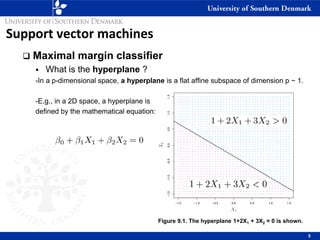
▪ What is the hyperplane ?
-In a p-dimensional space, a hyperplane is a flat affine subspace of dimension p − 1.
-E.g., in a 2D space, a hyperplane is
defined by the mathematical equation:
5
Figure 9.1. The hyperplane 1+2X1 + 3X2 = 0 is shown.
Support vector machines
❑ Maximal margin classifier
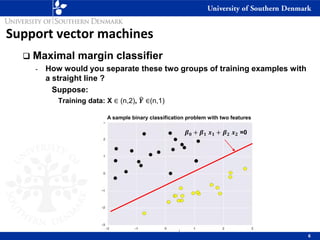
- How would you separate these two groups of training examples with
a straight line ?
Suppose:
Training data: X ∈ (n,2), ࡥ
𝒀 ∈(n,1)
6
A sample binary classification problem with two features
𝜷𝟎 + 𝜷𝟏 𝒙𝟏 + 𝜷𝟐 𝒙𝟐 =0
Support vector machines
❑ Maximal margin classifier
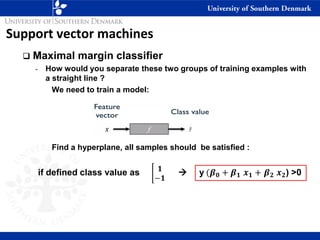
- How would you separate these two groups of training examples with
a straight line ?
We need to train a model:
Find a hyperplane, all samples should be satisfied :
if defined class value as → y (𝜷𝟎 + 𝜷𝟏 𝒙𝟏 + 𝜷𝟐 𝒙𝟐) >0
ቈ
𝟏
−𝟏
Support vector machines
❑ Maximal margin classifier
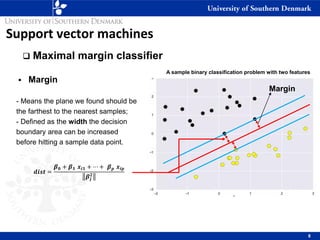
▪ Margin
- Means the plane we found should be
the farthest to the nearest samples;
- Defined as the width the decision
boundary area can be increased
before hitting a sample data point.
8
A sample binary classification problem with two features
Margin
𝒅𝒊𝒔𝒕 =
𝜷𝟎 + 𝜷𝟏 𝒙𝒊𝟏 + ⋯ + 𝜷𝒑 𝒙𝒊𝒑
𝜷𝒋
𝟐
Support vector machines
❑ Maximal margin classifier
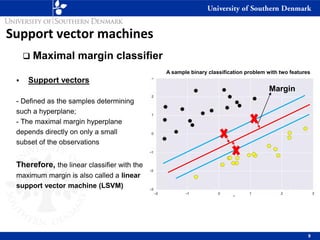
▪ Support vectors
- Defined as the samples determining
such a hyperplane;
- The maximal margin hyperplane
depends directly on only a small
subset of the observations
Therefore, the linear classifier with the
maximum margin is also called a linear
support vector machine (LSVM)
9
A sample binary classification problem with two features
Margin
Support vector machines
❑ Construction of the Maximal Margin Classifier
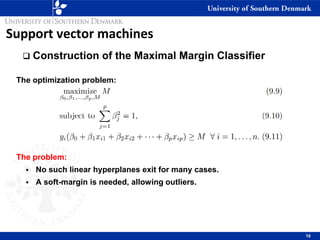
The optimization problem:
The problem:
▪ No such linear hyperplanes exit for many cases.
▪ A soft-margin is needed, allowing outliers.
10
Support vector machines
❑ Maximal margin Classifiers
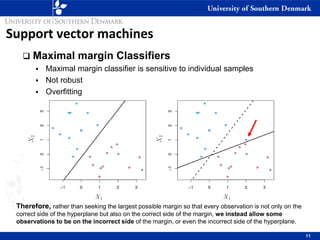
▪ Maximal margin classifier is sensitive to individual samples
▪ Not robust
▪ Overfitting
Therefore, rather than seeking the largest possible margin so that every observation is not only on the
correct side of the hyperplane but also on the correct side of the margin, we instead allow some
observations to be on the incorrect side of the margin, or even the incorrect side of the hyperplane.
11
Support vector machines
❑ Support Vector Classifiers
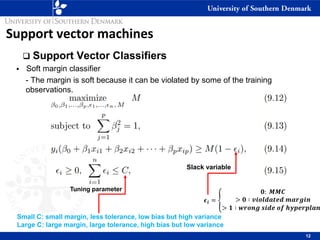
▪ Soft margin classifier
- The margin is soft because it can be violated by some of the training
observations.
12
𝝐𝒊 = ቐ
𝟎: 𝑴𝑴𝑪
> 𝟎 ∶ 𝒗𝒊𝒐𝒍𝒅𝒂𝒕𝒆𝒅 𝒎𝒂𝒓𝒈𝒊𝒏
> 𝟏 ∶ 𝒘𝒓𝒐𝒏𝒈 𝒔𝒊𝒅𝒆 𝒐𝒇 𝒉𝒚𝒑𝒆𝒓𝒑𝒍𝒂𝒏
Slack variable
Tuning parameter
Small C: small margin, less tolerance, low bias but high variance
Large C: large margin, large tolerance, high bias but low variance
Support vector machines
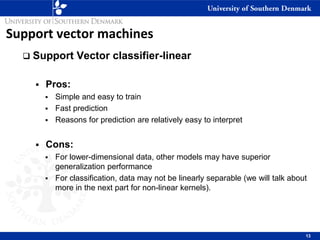
❑ Support Vector classifier-linear
▪ Pros:
▪ Simple and easy to train
▪ Fast prediction
▪ Reasons for prediction are relatively easy to interpret
▪ Cons:
▪ For lower-dimensional data, other models may have superior
generalization performance
▪ For classification, data may not be linearly separable (we will talk about
more in the next part for non-linear kernels).
13
Agenda of Session 10
❑ Maximal margin classifier
▪ Definition of hyperplane, classifier margin and support vectors.
▪ Basics to the optimization function in linear domain
❑ Support vector classifier
▪ Basics and definition related to support vector classifier accounting for outliers
▪ Python code application
❑ Support vector machines
▪ Introduction of SVM in non-linear domain
▪ The concept of kernels
▪ Python code
❑ Multi-class classification
▪ Two approaches to apply SVM
▪ Python code application
❑ Support vector regression
▪ Introduction to the concept and code application.
14
Support vector machines
❑ Support Vector machines
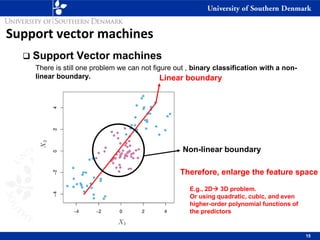
There is still one problem we can not figure out , binary classification with a non-
linear boundary.
15
Linear boundary
Non-linear boundary
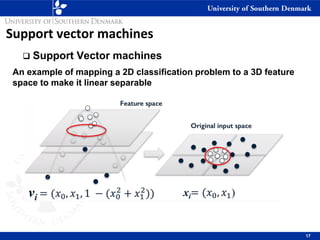
Therefore, enlarge the feature space
E.g., 2D→ 3D problem.
Or using quadratic, cubic, and even
higher-order polynomial functions of
the predictors
Support vector machines
❑ Support Vector machines
16
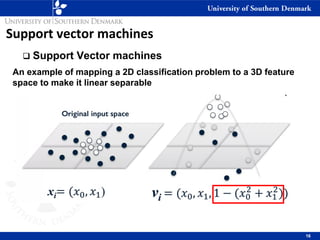
An example of mapping a 2D classification problem to a 3D feature
space to make it linear separable
Support vector machines
❑ Support Vector machines
17
An example of mapping a 2D classification problem to a 3D feature
space to make it linear separable
Support vector machines
❑ Support Vector Machines
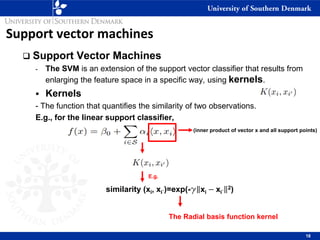
- The SVM is an extension of the support vector classifier that results from
enlarging the feature space in a specific way, using kernels.
▪ Kernels
- The function that quantifies the similarity of two observations.
E.g., for the linear support classifier,
18
similarity (xi, xi´)=exp(-g xi − xi´
2)
(inner product of vector x and all support points)
E.g.
The Radial basis function kernel
Support vector machines
❑ Support Vector machines
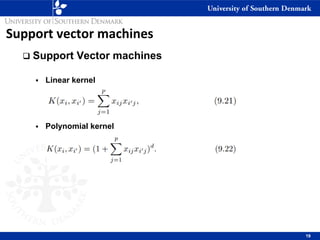
▪ Linear kernel
▪ Polynomial kernel
19
Support vector machines
❑ Support Vector machines
▪ Radial basis function kernel (RBF)
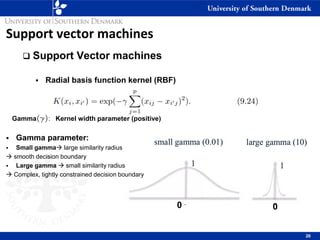
▪ Gamma parameter:
▪ Small gamma→ large similarity radius
→ smooth decision boundary
▪ Large gamma → small similarity radius
→ Complex, tightly constrained decision boundary
20
Gamma(g): Kernel width parameter (positive)
0 0
Agenda of Session 10
❑ Maximal margin classifier
▪ Definition of hyperplane, classifier margin and support vectors.
▪ Basics to the optimization function in linear domain
❑ Support vector classifier
▪ Basics and definition related to support vector classifier accounting for outliers
▪ Python code application
❑ Support vector machines
▪ Introduction of SVM in non-linear domain
▪ The concept of kernels
▪ Python code application
❑ Multi-class classification
▪ Two approaches to apply SVM
▪ Python code
❑ Support vector regression
▪ Introduction to the concept and code application.
21
Support vector machines
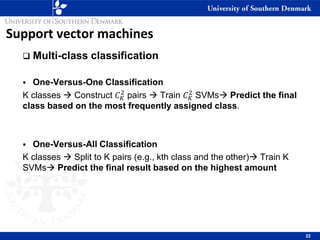
❑ Multi-class classification
▪ One-Versus-One Classification
K classes → Construct 𝐶𝐾
2
pairs → Train 𝐶𝐾
2
SVMs→ Predict the final
class based on the most frequently assigned class.
▪ One-Versus-All Classification
K classes → Split to K pairs (e.g., kth class and the other)→ Train K
SVMs→ Predict the final result based on the highest amount
22
Support vector machines
❑ Fruit types classification (one-versus-all)
23
Target_names_fruits = ['apple', 'mandarin', 'orange', 'lemon']
Support vector machines
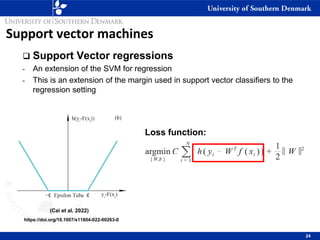
❑ Support Vector regressions
- An extension of the SVM for regression
- This is an extension of the margin used in support vector classifiers to the
regression setting
24
(Cai et al. 2022)
Loss function:
https://doi.org/10.1007/s11804-022-00263-0
Support vector machines
❑ Support Vector machines-kernelized
▪ Pros:
▪ Can perform well on different types of dataset
▪ Versatile: different kernel functions can be specified, or custom kernel
can be defined for specific types of data
▪ Works well for both high-and low-dimensional data
▪ Cons:
▪ Efficiency (running speed and memory usage) decreases as training set
size increases(e.g., over 50000 samples)
▪ Need careful normalization of input data and parameter tuning
▪ Does not provide directly probability estimation
▪ Difficult to interpret why a prediction is made.
25
SVM– Challenge Tasks
❑ Train a model by SVM to predict whether a mushroom is poisonous or not, and
find the gamma (g) values which are underfitting, overfitting and the best fitting,
respectively.
▪ mushrooms.csv
In this challenge, you need to answer 3 questions based on what you have learned
today for the SVM method and the previous knowledge as well.
Wrap up of the Day
Tak for denne gang!
2
Questions?

OM-DS-Fall2022-Session10-Support vector machine.pdf

  • 1.
    Lecturer: Jie Cai,jiec@iti.sdu.dk OM-DSML Session 10: Support Vector Machines
  • 2.
    2 To understand &learn the basic concepts of maximal margin classifier, support vector classifier, support vector machines and their application in sciki-learn by examples. Course Objective James et al, Chapter 9: Support vector machines, P 367-386
  • 3.
    Agenda of Session10 ❑ Maximal margin classifier ▪ Definition of hyperplane, classifier margin and support vectors. ▪ Basics of the optimization function in linear domain ❑ Support vector classifier ▪ Basics and definition related to support vector classifier accounting for outliers ▪ Python code ❑ Support vector machines ▪ Introduction of SVM in non-linear domain ▪ The concept of kernels ▪ Python code ❑ Multi-class classification ▪ Two approaches to apply SVM ▪ Python code ❑ Support vector regression ▪ Introduction to the concept and code application. 3
  • 4.
    Support vector machines ❑What is support vector machines (SVM) ▪ One of the most powerful “black box” learning algorithms in ML field ▪ One of the most widely used ML methods nowadays ▪ It loosely refers to the maximal margin classifier, the support vector classifier, and the support vector machine ▪ Maximal margin classifier -Use a hyperplane with a maximal margin to sperate a binary classification problem. ▪ Support vector classifier (soft margin classifier) -An extension of the maximal margin classifier that can be applied in a broader range of cases, where misclassified samples are allowed. ▪ Support vector machine -A further extension of the support vector classifier in order to accommodate non- linear class boundaries. 4
  • 5.
    Support vector machines ❑Maximal margin classifier ▪ What is the hyperplane ? -In a p-dimensional space, a hyperplane is a flat affine subspace of dimension p − 1. -E.g., in a 2D space, a hyperplane is defined by the mathematical equation: 5 Figure 9.1. The hyperplane 1+2X1 + 3X2 = 0 is shown.
  • 6.
    Support vector machines ❑Maximal margin classifier - How would you separate these two groups of training examples with a straight line ? Suppose: Training data: X ∈ (n,2), ෡ 𝒀 ∈(n,1) 6 A sample binary classification problem with two features 𝜷𝟎 + 𝜷𝟏 𝒙𝟏 + 𝜷𝟐 𝒙𝟐 =0
  • 7.
    Support vector machines ❑Maximal margin classifier - How would you separate these two groups of training examples with a straight line ? We need to train a model: Find a hyperplane, all samples should be satisfied : if defined class value as → y (𝜷𝟎 + 𝜷𝟏 𝒙𝟏 + 𝜷𝟐 𝒙𝟐) >0 ቈ 𝟏 −𝟏
  • 8.
    Support vector machines ❑Maximal margin classifier ▪ Margin - Means the plane we found should be the farthest to the nearest samples; - Defined as the width the decision boundary area can be increased before hitting a sample data point. 8 A sample binary classification problem with two features Margin 𝒅𝒊𝒔𝒕 = 𝜷𝟎 + 𝜷𝟏 𝒙𝒊𝟏 + ⋯ + 𝜷𝒑 𝒙𝒊𝒑 𝜷𝒋 𝟐
  • 9.
    Support vector machines ❑Maximal margin classifier ▪ Support vectors - Defined as the samples determining such a hyperplane; - The maximal margin hyperplane depends directly on only a small subset of the observations Therefore, the linear classifier with the maximum margin is also called a linear support vector machine (LSVM) 9 A sample binary classification problem with two features Margin
  • 10.
    Support vector machines ❑Construction of the Maximal Margin Classifier The optimization problem: The problem: ▪ No such linear hyperplanes exit for many cases. ▪ A soft-margin is needed, allowing outliers. 10
  • 11.
    Support vector machines ❑Maximal margin Classifiers ▪ Maximal margin classifier is sensitive to individual samples ▪ Not robust ▪ Overfitting Therefore, rather than seeking the largest possible margin so that every observation is not only on the correct side of the hyperplane but also on the correct side of the margin, we instead allow some observations to be on the incorrect side of the margin, or even the incorrect side of the hyperplane. 11
  • 12.
    Support vector machines ❑Support Vector Classifiers ▪ Soft margin classifier - The margin is soft because it can be violated by some of the training observations. 12 𝝐𝒊 = ቐ 𝟎: 𝑴𝑴𝑪 > 𝟎 ∶ 𝒗𝒊𝒐𝒍𝒅𝒂𝒕𝒆𝒅 𝒎𝒂𝒓𝒈𝒊𝒏 > 𝟏 ∶ 𝒘𝒓𝒐𝒏𝒈 𝒔𝒊𝒅𝒆 𝒐𝒇 𝒉𝒚𝒑𝒆𝒓𝒑𝒍𝒂𝒏 Slack variable Tuning parameter Small C: small margin, less tolerance, low bias but high variance Large C: large margin, large tolerance, high bias but low variance
  • 13.
    Support vector machines ❑Support Vector classifier-linear ▪ Pros: ▪ Simple and easy to train ▪ Fast prediction ▪ Reasons for prediction are relatively easy to interpret ▪ Cons: ▪ For lower-dimensional data, other models may have superior generalization performance ▪ For classification, data may not be linearly separable (we will talk about more in the next part for non-linear kernels). 13
  • 14.
    Agenda of Session10 ❑ Maximal margin classifier ▪ Definition of hyperplane, classifier margin and support vectors. ▪ Basics to the optimization function in linear domain ❑ Support vector classifier ▪ Basics and definition related to support vector classifier accounting for outliers ▪ Python code application ❑ Support vector machines ▪ Introduction of SVM in non-linear domain ▪ The concept of kernels ▪ Python code ❑ Multi-class classification ▪ Two approaches to apply SVM ▪ Python code application ❑ Support vector regression ▪ Introduction to the concept and code application. 14
  • 15.
    Support vector machines ❑Support Vector machines There is still one problem we can not figure out , binary classification with a non- linear boundary. 15 Linear boundary Non-linear boundary Therefore, enlarge the feature space E.g., 2D→ 3D problem. Or using quadratic, cubic, and even higher-order polynomial functions of the predictors
  • 16.
    Support vector machines ❑Support Vector machines 16 An example of mapping a 2D classification problem to a 3D feature space to make it linear separable
  • 17.
    Support vector machines ❑Support Vector machines 17 An example of mapping a 2D classification problem to a 3D feature space to make it linear separable
  • 18.
    Support vector machines ❑Support Vector Machines - The SVM is an extension of the support vector classifier that results from enlarging the feature space in a specific way, using kernels. ▪ Kernels - The function that quantifies the similarity of two observations. E.g., for the linear support classifier, 18 similarity (xi, xi´)=exp(-g xi − xi´ 2) (inner product of vector x and all support points) E.g. The Radial basis function kernel
  • 19.
    Support vector machines ❑Support Vector machines ▪ Linear kernel ▪ Polynomial kernel 19
  • 20.
    Support vector machines ❑Support Vector machines ▪ Radial basis function kernel (RBF) ▪ Gamma parameter: ▪ Small gamma→ large similarity radius → smooth decision boundary ▪ Large gamma → small similarity radius → Complex, tightly constrained decision boundary 20 Gamma(g): Kernel width parameter (positive) 0 0
  • 21.
    Agenda of Session10 ❑ Maximal margin classifier ▪ Definition of hyperplane, classifier margin and support vectors. ▪ Basics to the optimization function in linear domain ❑ Support vector classifier ▪ Basics and definition related to support vector classifier accounting for outliers ▪ Python code application ❑ Support vector machines ▪ Introduction of SVM in non-linear domain ▪ The concept of kernels ▪ Python code application ❑ Multi-class classification ▪ Two approaches to apply SVM ▪ Python code ❑ Support vector regression ▪ Introduction to the concept and code application. 21
  • 22.
    Support vector machines ❑Multi-class classification ▪ One-Versus-One Classification K classes → Construct 𝐶𝐾 2 pairs → Train 𝐶𝐾 2 SVMs→ Predict the final class based on the most frequently assigned class. ▪ One-Versus-All Classification K classes → Split to K pairs (e.g., kth class and the other)→ Train K SVMs→ Predict the final result based on the highest amount 22
  • 23.
    Support vector machines ❑Fruit types classification (one-versus-all) 23 Target_names_fruits = ['apple', 'mandarin', 'orange', 'lemon']
  • 24.
    Support vector machines ❑Support Vector regressions - An extension of the SVM for regression - This is an extension of the margin used in support vector classifiers to the regression setting 24 (Cai et al. 2022) Loss function: https://doi.org/10.1007/s11804-022-00263-0
  • 25.
    Support vector machines ❑Support Vector machines-kernelized ▪ Pros: ▪ Can perform well on different types of dataset ▪ Versatile: different kernel functions can be specified, or custom kernel can be defined for specific types of data ▪ Works well for both high-and low-dimensional data ▪ Cons: ▪ Efficiency (running speed and memory usage) decreases as training set size increases(e.g., over 50000 samples) ▪ Need careful normalization of input data and parameter tuning ▪ Does not provide directly probability estimation ▪ Difficult to interpret why a prediction is made. 25
  • 26.
    SVM– Challenge Tasks ❑Train a model by SVM to predict whether a mushroom is poisonous or not, and find the gamma (g) values which are underfitting, overfitting and the best fitting, respectively. ▪ mushrooms.csv In this challenge, you need to answer 3 questions based on what you have learned today for the SVM method and the previous knowledge as well.
  • 27.
    Wrap up ofthe Day
  • 28.
    Tak for dennegang! 2 Questions?