Support Vector Machine (SVM)
Dr. Prasenjit Dey
Dr.
Prasenjit
Dey
Linear Separators
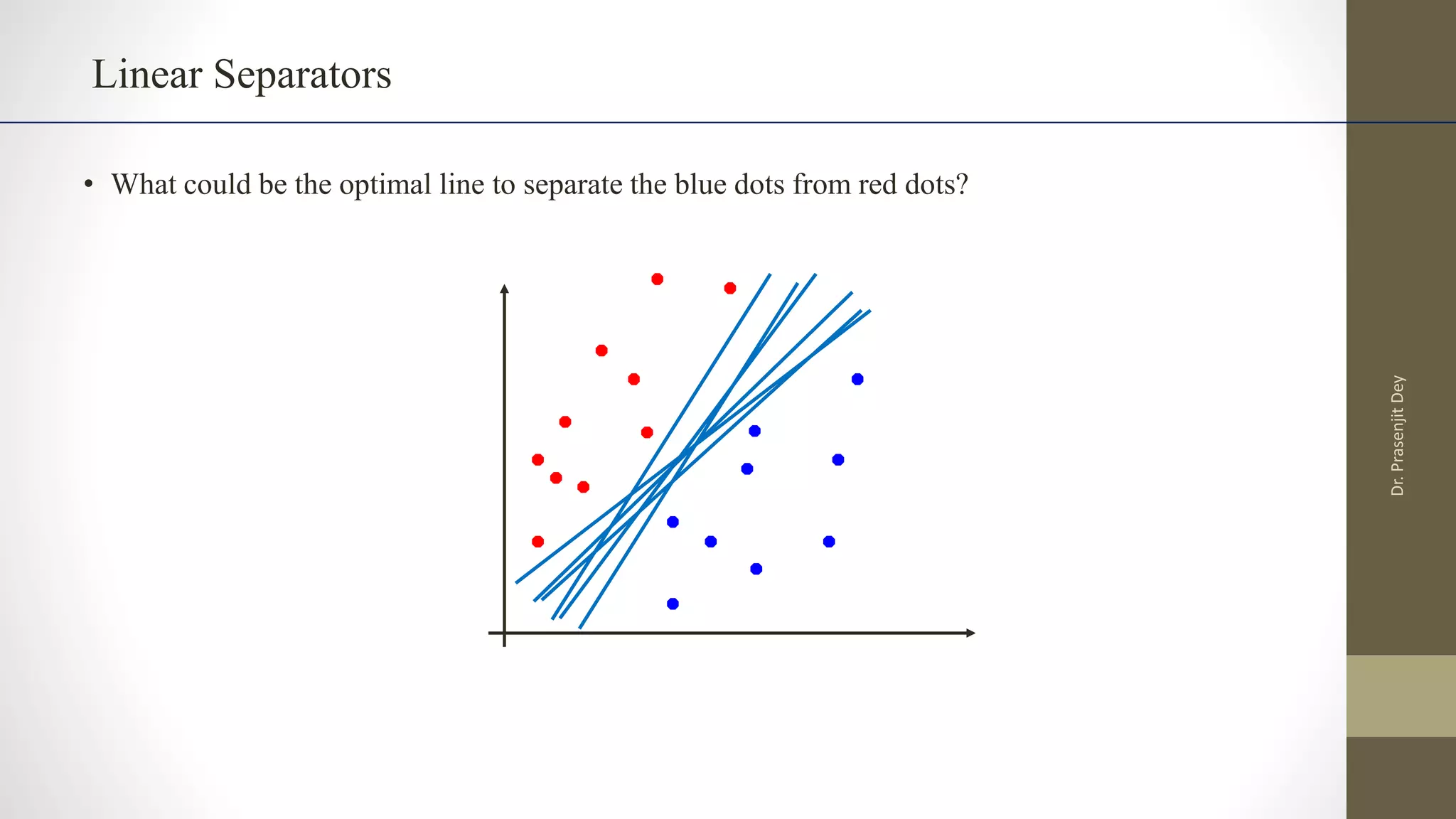
• What could be the optimal line to separate the blue dots from red dots?
Dr.
Prasenjit
Dey
Support Vector Machine (SVM)
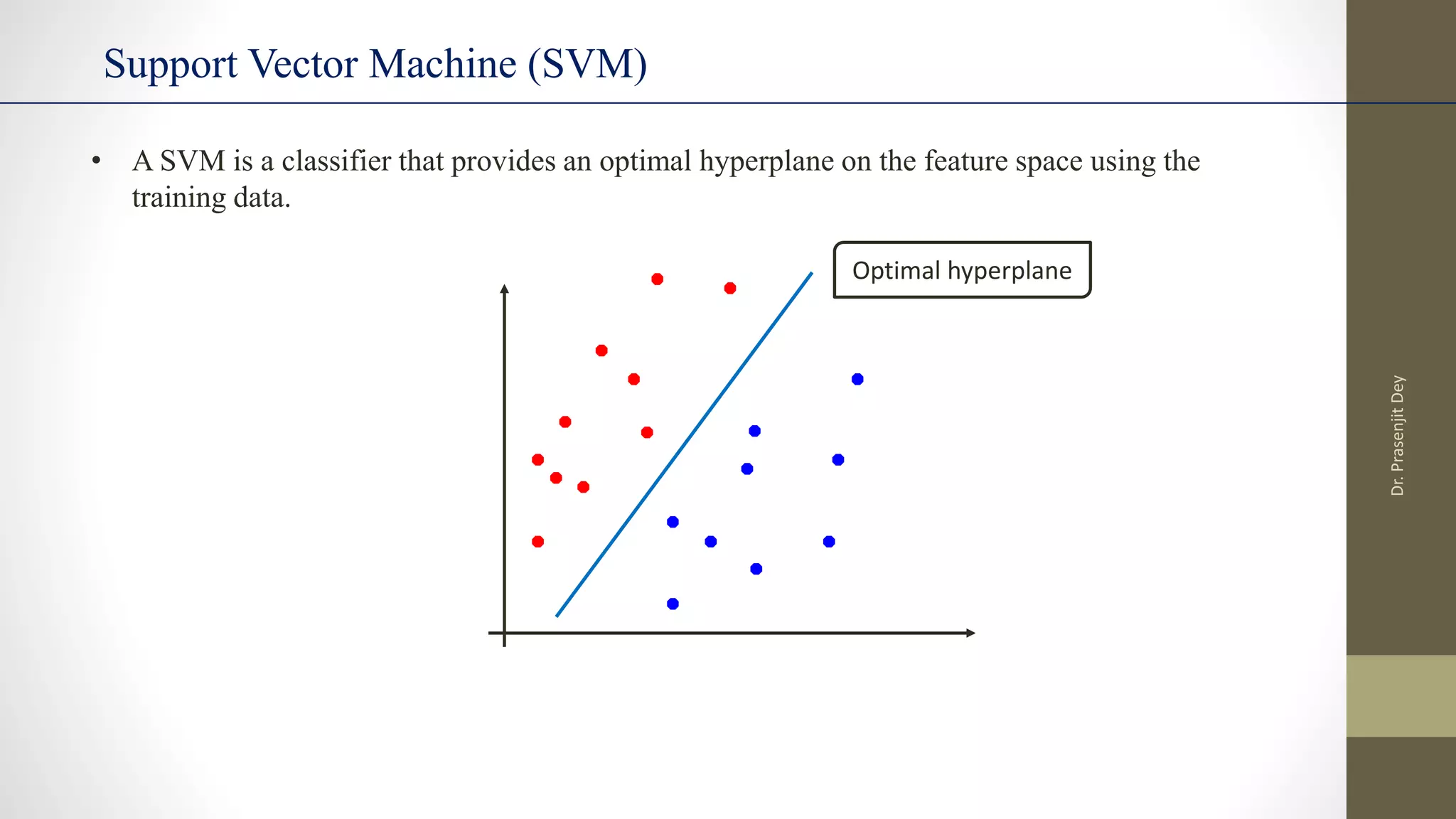
• A SVM is a classifier that provides an optimal hyperplane on the feature space using the
training data.
Optimal hyperplane
Dr.
Prasenjit
Dey
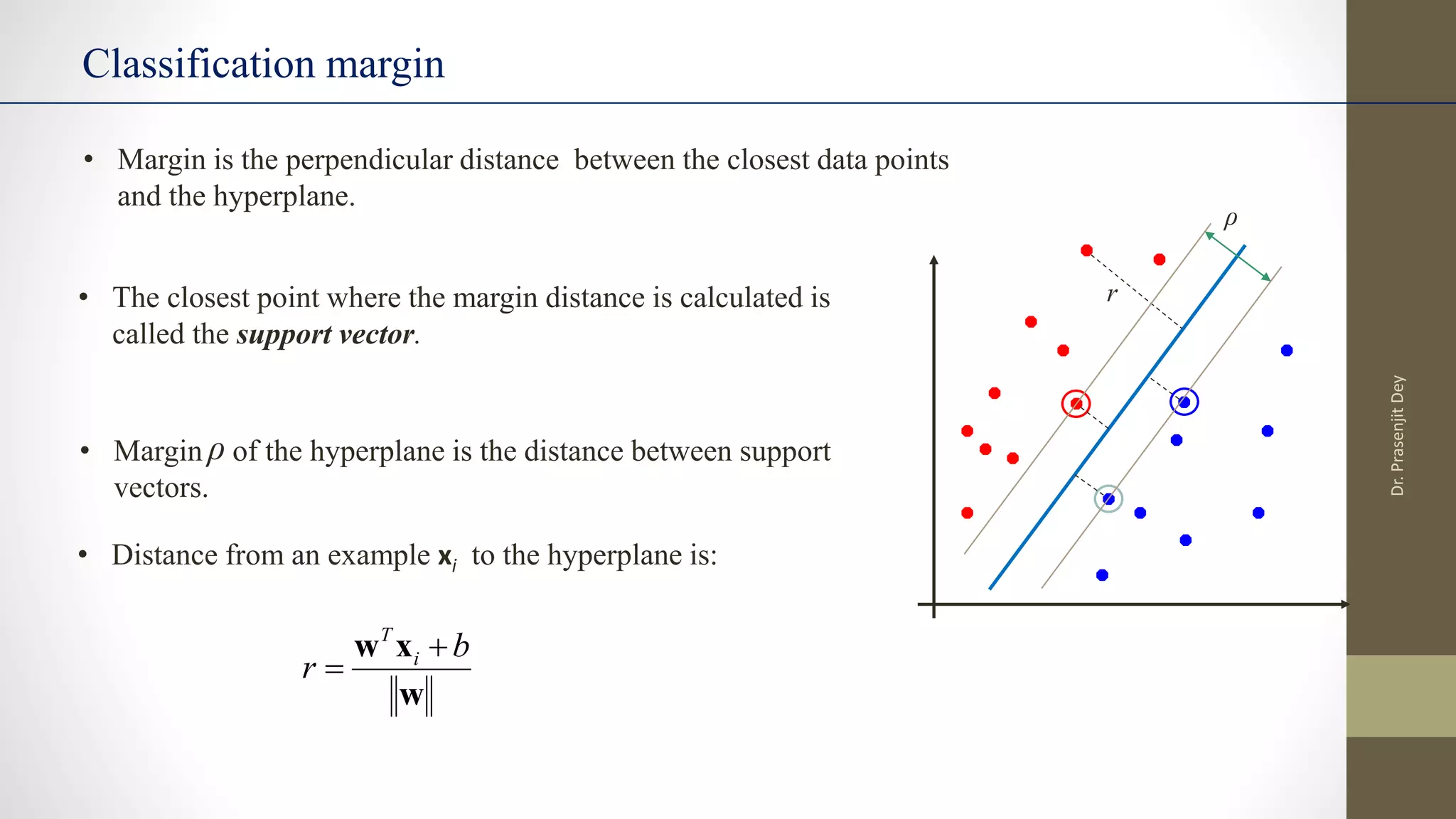
Classification margin
w
x
w b
r i
T


r
ρ
• Margin is the perpendicular distance between the closest data points
and the hyperplane.
• The closest point where the margin distance is calculated is
called the support vector.
• Margin of the hyperplane is the distance between support
vectors.
• Distance from an example xi to the hyperplane is:
ρ
Dr.
Prasenjit
Dey
Maximum classification margin
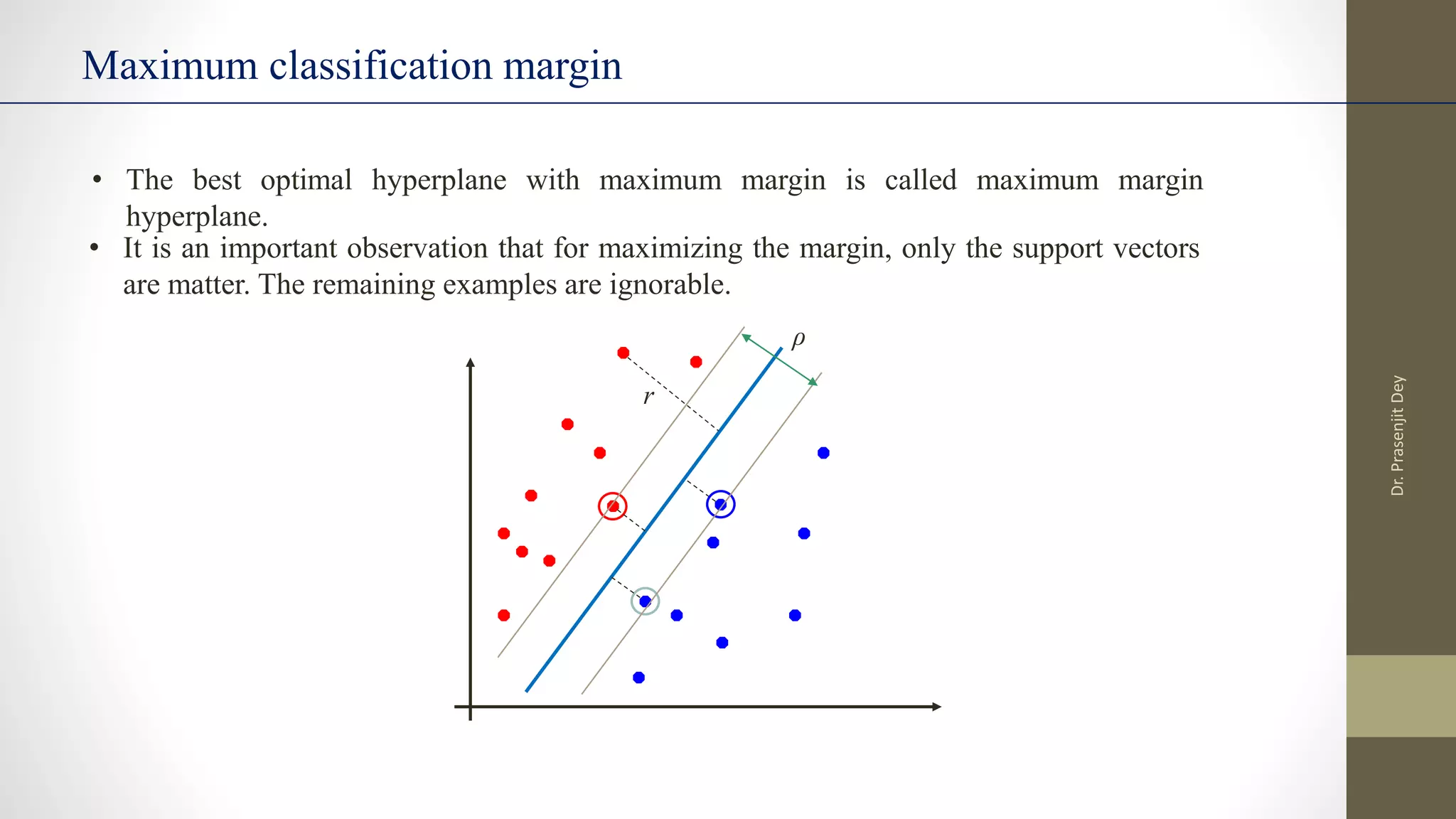
• The best optimal hyperplane with maximum margin is called maximum margin
hyperplane.
• It is an important observation that for maximizing the margin, only the support vectors
are matter. The remaining examples are ignorable.
r
ρ
Dr.
Prasenjit
Dey
Mathematical representation of the linear SVM (contd.)
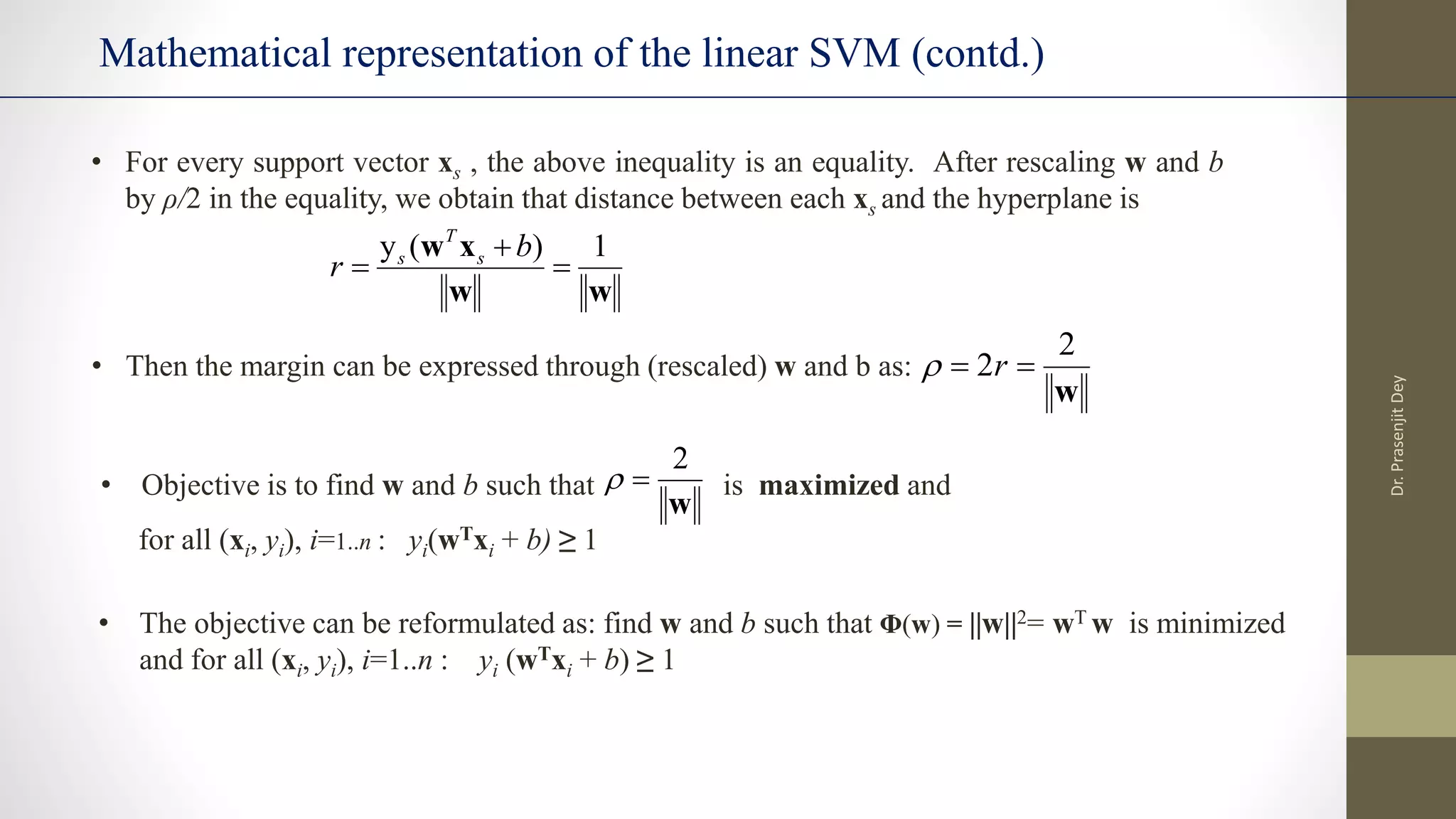
• For every support vector xs , the above inequality is an equality. After rescaling w and b
by ρ/2 in the equality, we obtain that distance between each xs and the hyperplane is
w
2
2 
 r

• Then the margin can be expressed through (rescaled) w and b as:
• Objective is to find w and b such that is maximized and
for all (xi, yi), i=1..n : yi(wTxi + b) ≥ 1
w
2


w
w
x
w 1
)
(
y



b
r s
T
s
• The objective can be reformulated as: find w and b such that Φ(w) = ||w||2= wT w is minimized
and for all (xi, yi), i=1..n : yi (wTxi + b) ≥ 1
Dr.
Prasenjit
Dey
Mathematical representation of the linear SVM
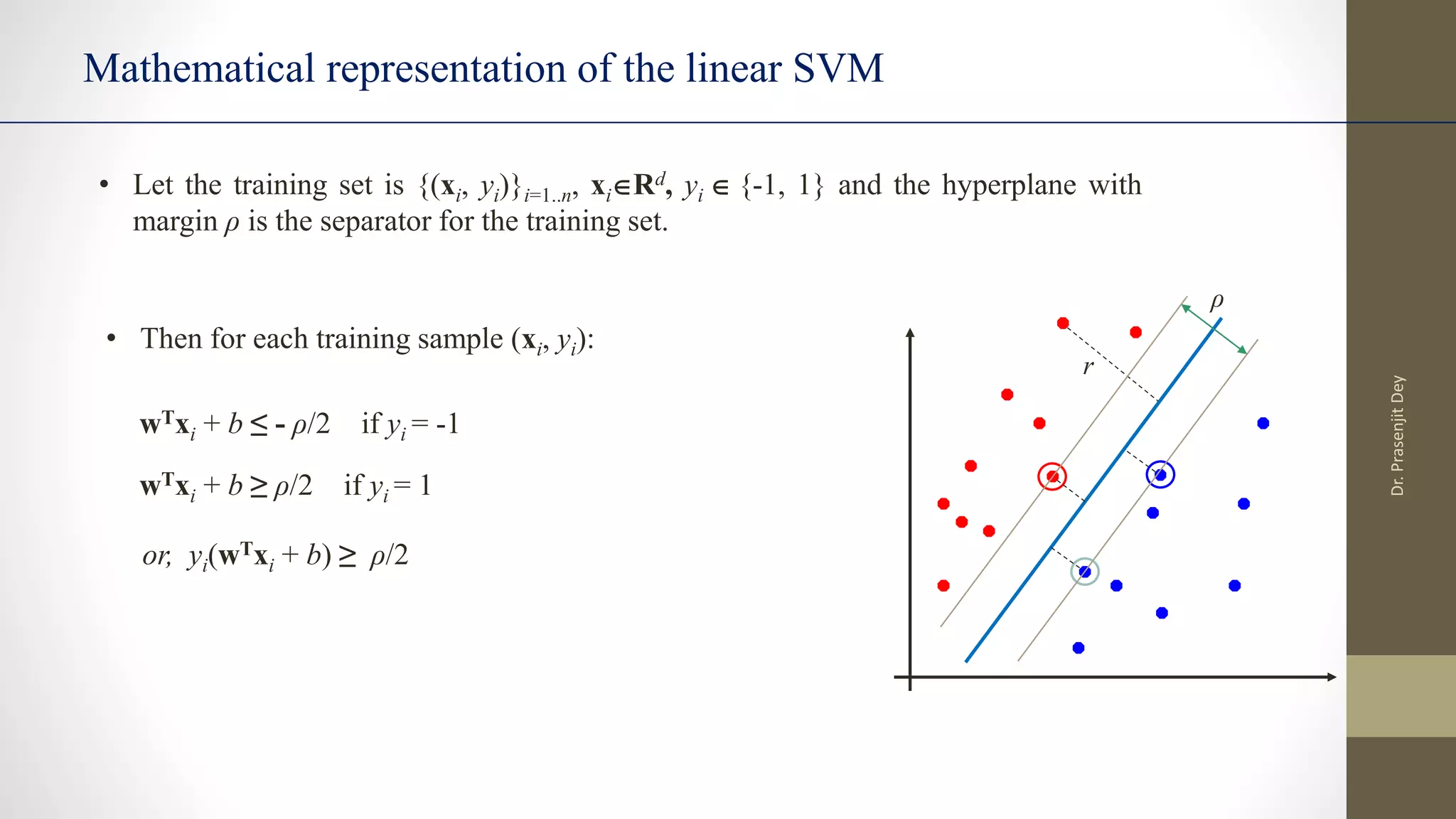
• Let the training set is {(xi, yi)}i=1..n, xiRd, yi  {-1, 1} and the hyperplane with
margin ρ is the separator for the training set.
wTxi + b ≤ - ρ/2 if yi = -1
wTxi + b ≥ ρ/2 if yi = 1
or, yi(wTxi + b) ≥ ρ/2
• Then for each training sample (xi, yi):
r
ρ
Dr.
Prasenjit
Dey
Linear and non-linear data
0
0
0
x2
x
x
x
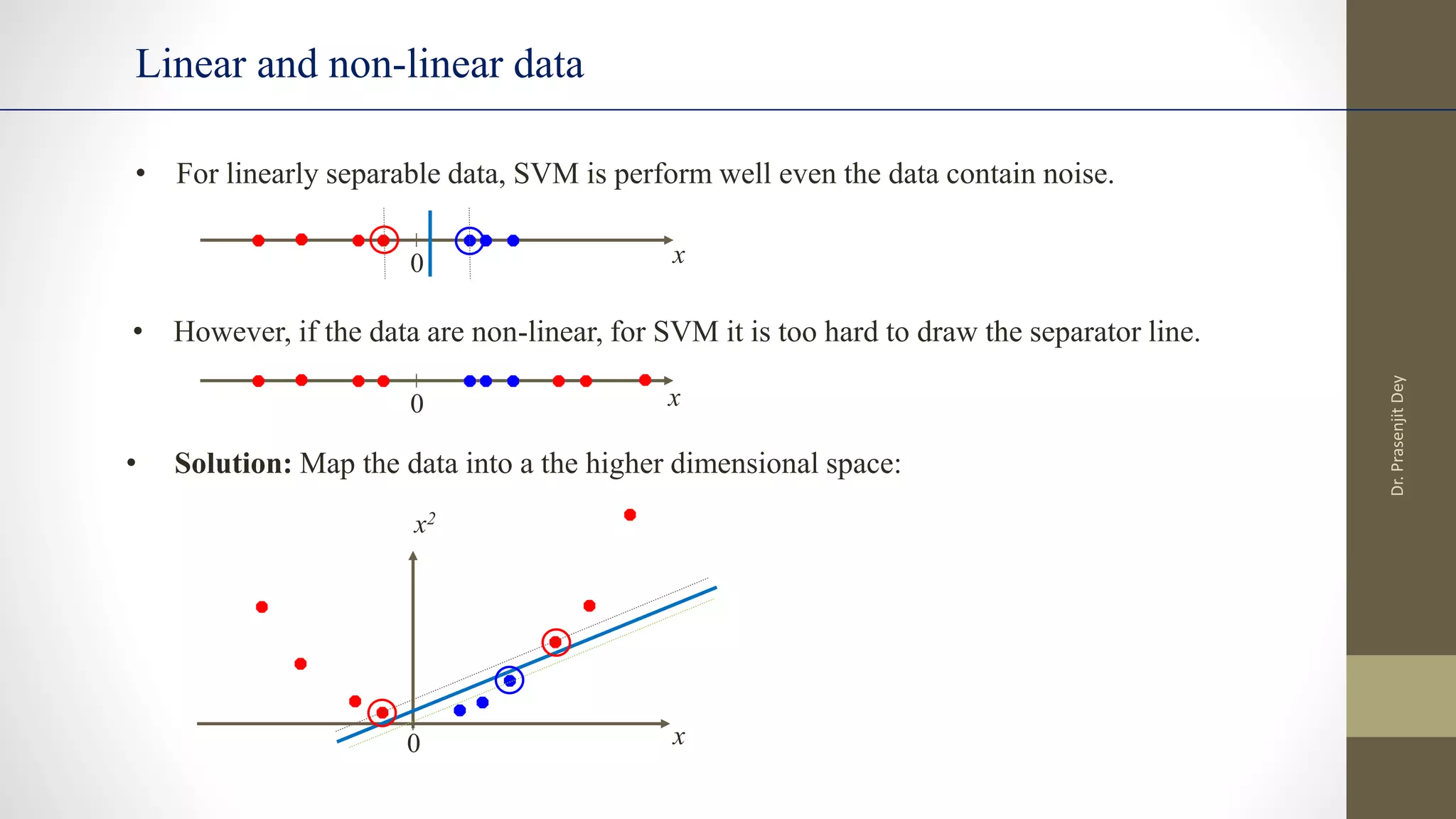
• For linearly separable data, SVM is perform well even the data contain noise.
• However, if the data are non-linear, for SVM it is too hard to draw the separator line.
• Solution: Map the data into a the higher dimensional space:
Dr.
Prasenjit
Dey
Non-linear data: example 1
Hyperplane in the higher
dimension
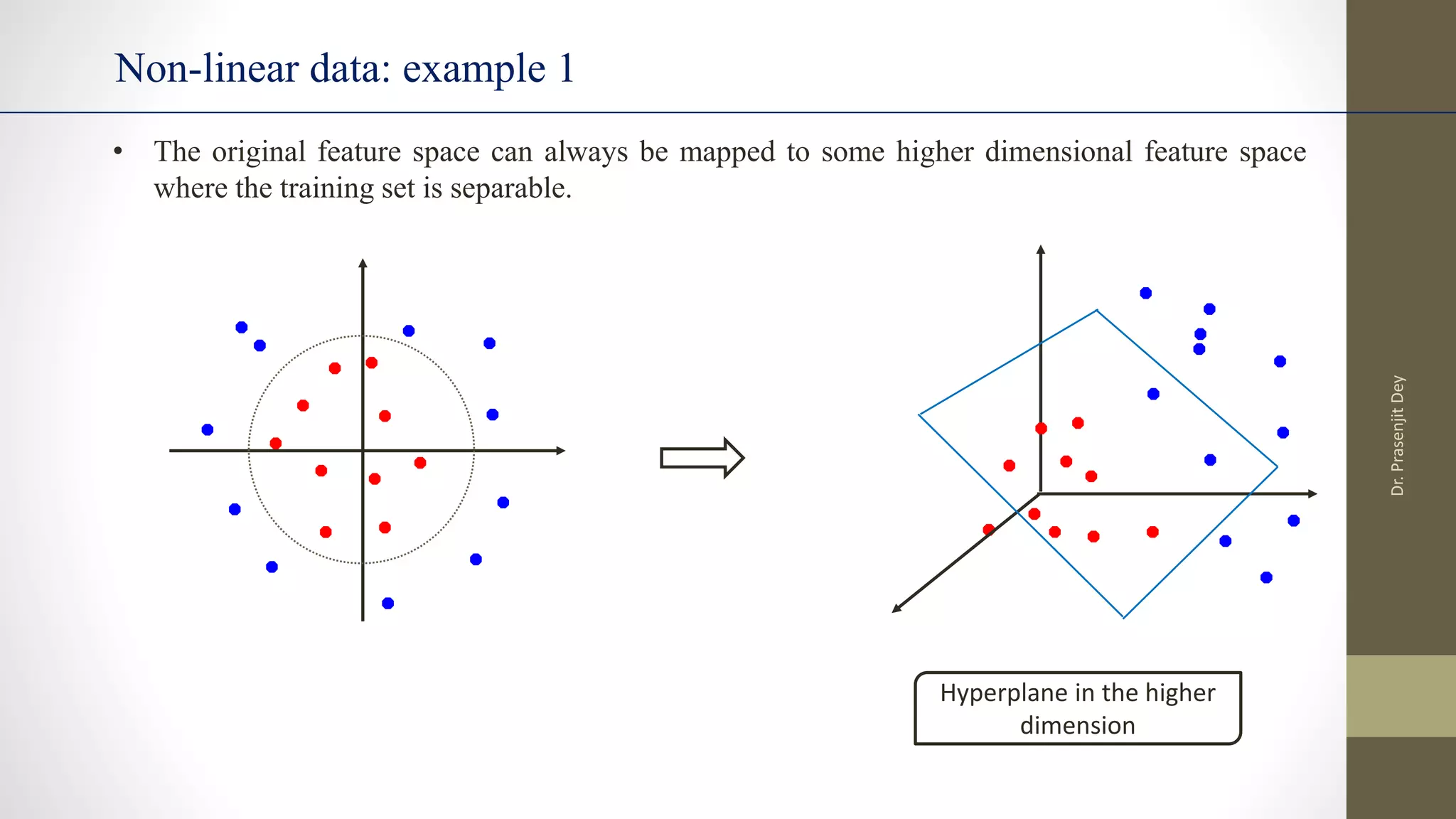
• The original feature space can always be mapped to some higher dimensional feature space
where the training set is separable.
Dr.
Prasenjit
Dey
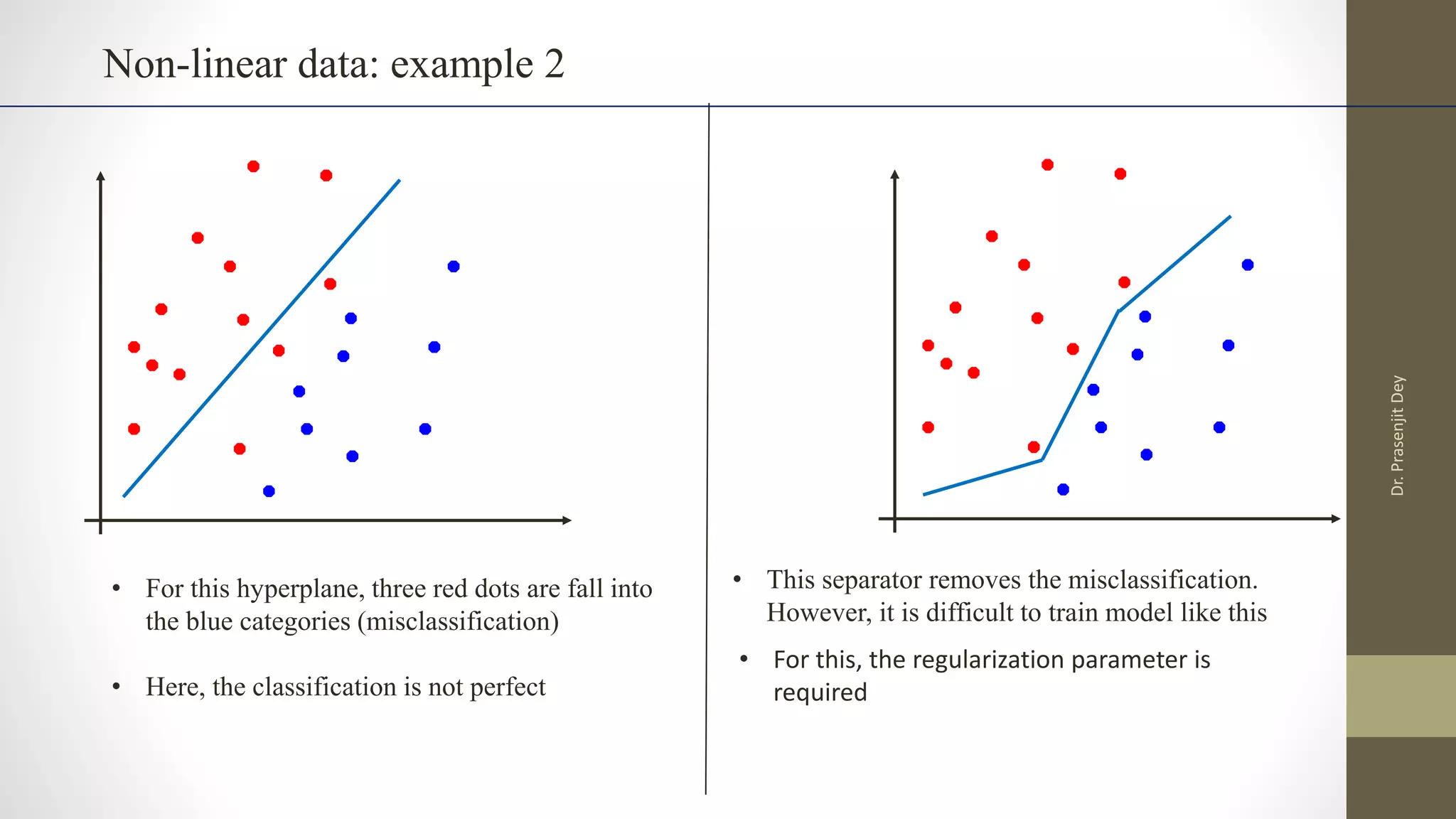
Non-linear data: example 2
• For this hyperplane, three red dots are fall into
the blue categories (misclassification)
• Here, the classification is not perfect
• This separator removes the misclassification.
However, it is difficult to train model like this
• For this, the regularization parameter is
required
Dr.
Prasenjit
Dey
• The linear classifier relies on inner product between vectors K(xi,xj) = xi
Txj
• If every datapoint is mapped into high-dimensional space via some transformation Φ: x → φ(x), the inner
product becomes: K(xi,xj)= φ(xi) Tφ(xj)
• A kernel function is a function that is equivalent to an inner product in some feature space.
• Example: 2-dimensional vectors x=[x1 x2]; let K(xi,xj) = (1 + xi
Txj)2
,
Need to show that K(xi,xj) = φ(xi) Tφ(xj):
K(xi,xj)=(1 + xi
Txj)2
,= 1+ xi1
2xj1
2 + 2 xi1xj1 xi2xj2+ xi2
2xj2
2 + 2xi1xj1 + 2xi2xj2=
= [1 xi1
2 √2 xi1xi2 xi2
2 √2xi1 √2xi2]T [1 xj1
2 √2 xj1xj2 xj2
2 √2xj1 √2xj2] =
= φ(xi) Tφ(xj), where φ(x) = [1 x1
2 √2 x1x2 x2
2 √2x1 √2x2]
• Thus, a kernel function implicitly maps data to a high-dimensional space (without the need to compute
each φ(x) explicitly).
The Kernel Functions
Dr.
Prasenjit
Dey
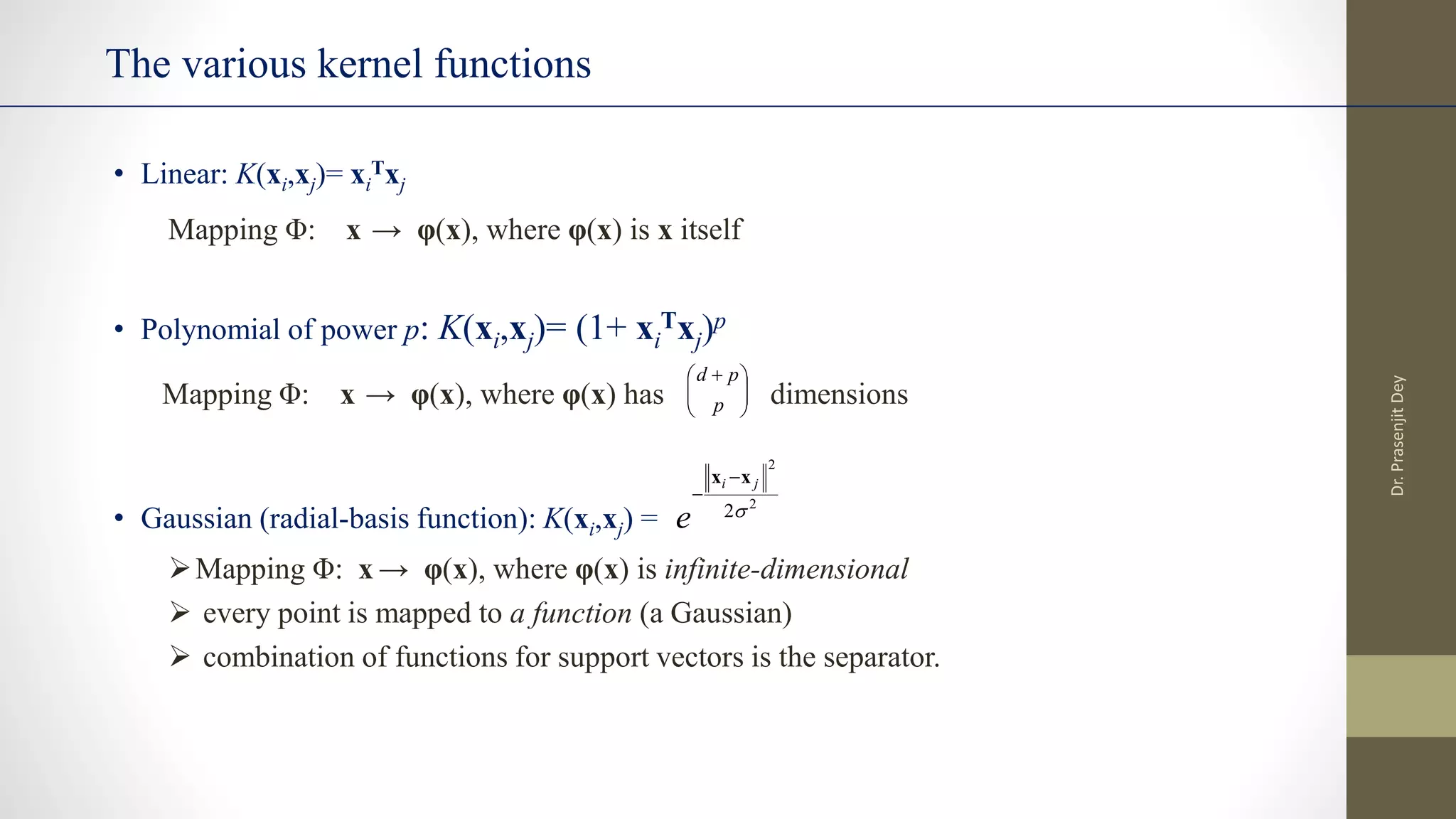
The various kernel functions
• Linear: K(xi,xj)= xi
Txj
Mapping Φ: x → φ(x), where φ(x) is x itself
• Polynomial of power p: K(xi,xj)= (1+ xi
Txj)p
Mapping Φ: x → φ(x), where φ(x) has dimensions
• Gaussian (radial-basis function): K(xi,xj) =
Mapping Φ: x → φ(x), where φ(x) is infinite-dimensional
 every point is mapped to a function (a Gaussian)
 combination of functions for support vectors is the separator.
2
2
2
j
i
e
x
x 








 
p
p
d
Dr.
Prasenjit
Dey
The main idea of SVM is summarized below
• Margin, Regularization, Gamma, Kernel
• Define an optimal hyperplane: maximize the margin
• Generalize to non-linearly separable problems: use penalty based regularization to deal with the
misclassification
• Map the data into a higher dimensional space where it is easier to classify with linear decision
surface: use the kernel function for transformation of the data from one feature space to another.
Tunable parameters of SVM
Dr.
Prasenjit
Dey
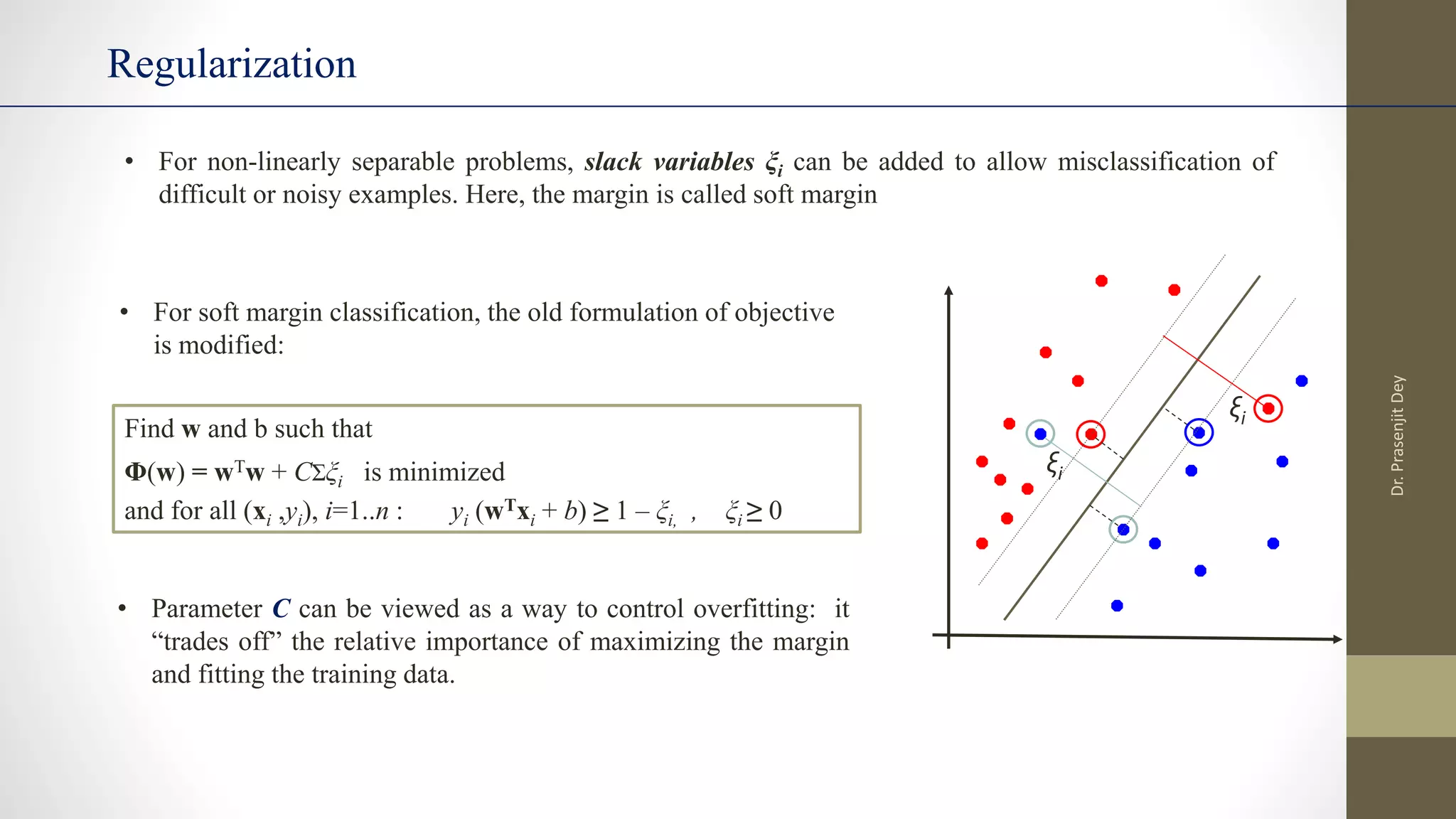
Regularization
• For non-linearly separable problems, slack variables ξi can be added to allow misclassification of
difficult or noisy examples. Here, the margin is called soft margin
ξi
ξi
• For soft margin classification, the old formulation of objective
is modified:
Find w and b such that
Φ(w) = wTw + CΣξi is minimized
and for all (xi ,yi), i=1..n : yi (wTxi + b) ≥ 1 – ξi, , ξi ≥ 0
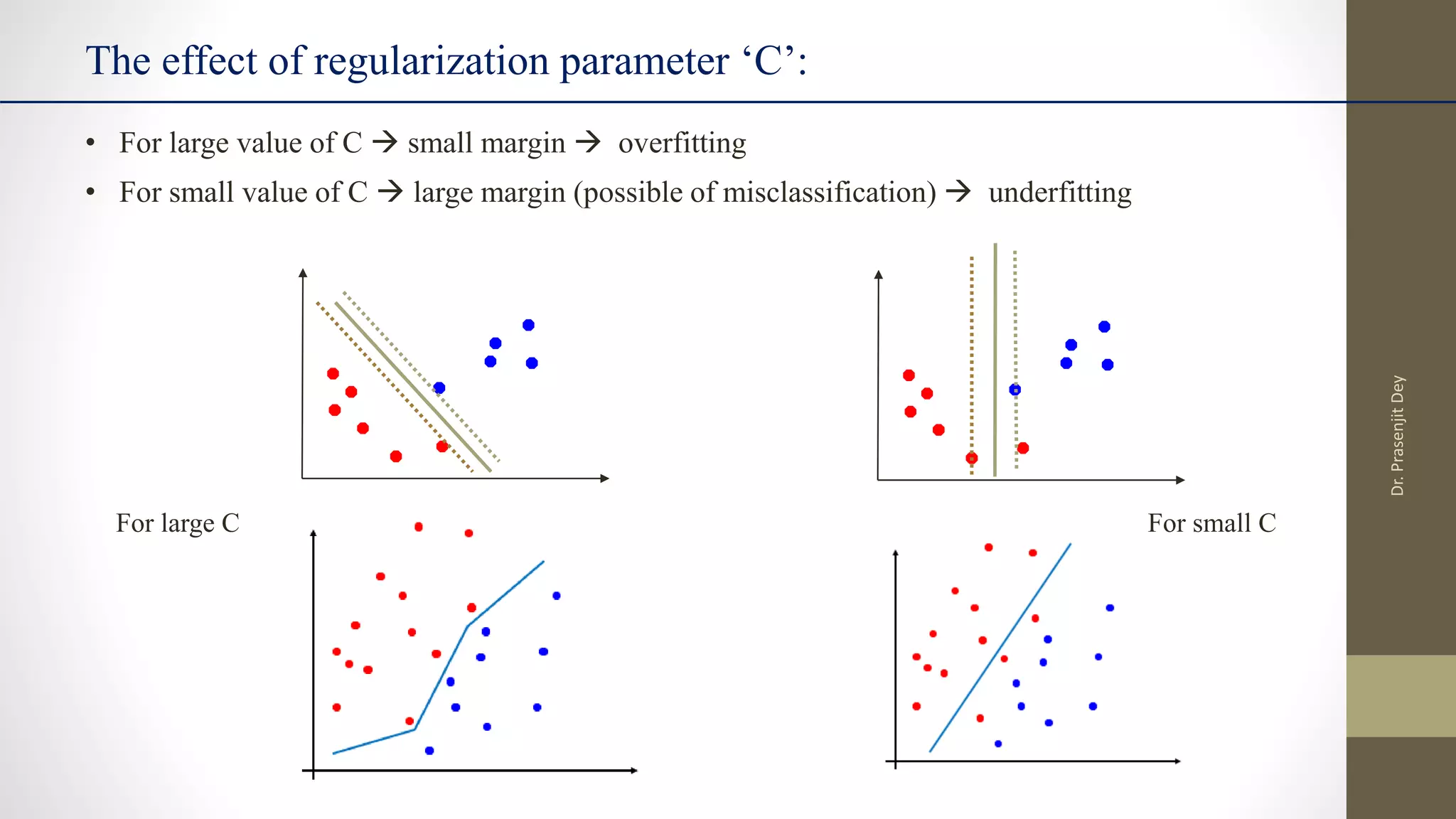
• Parameter C can be viewed as a way to control overfitting: it
“trades off” the relative importance of maximizing the margin
and fitting the training data.
Dr.
Prasenjit
Dey
The effect of regularization parameter ‘C’:
• For small value of C  large margin (possible of misclassification)  underfitting
• For large value of C  small margin  overfitting
For small C
For large C
Dr.
Prasenjit
Dey
Gamma
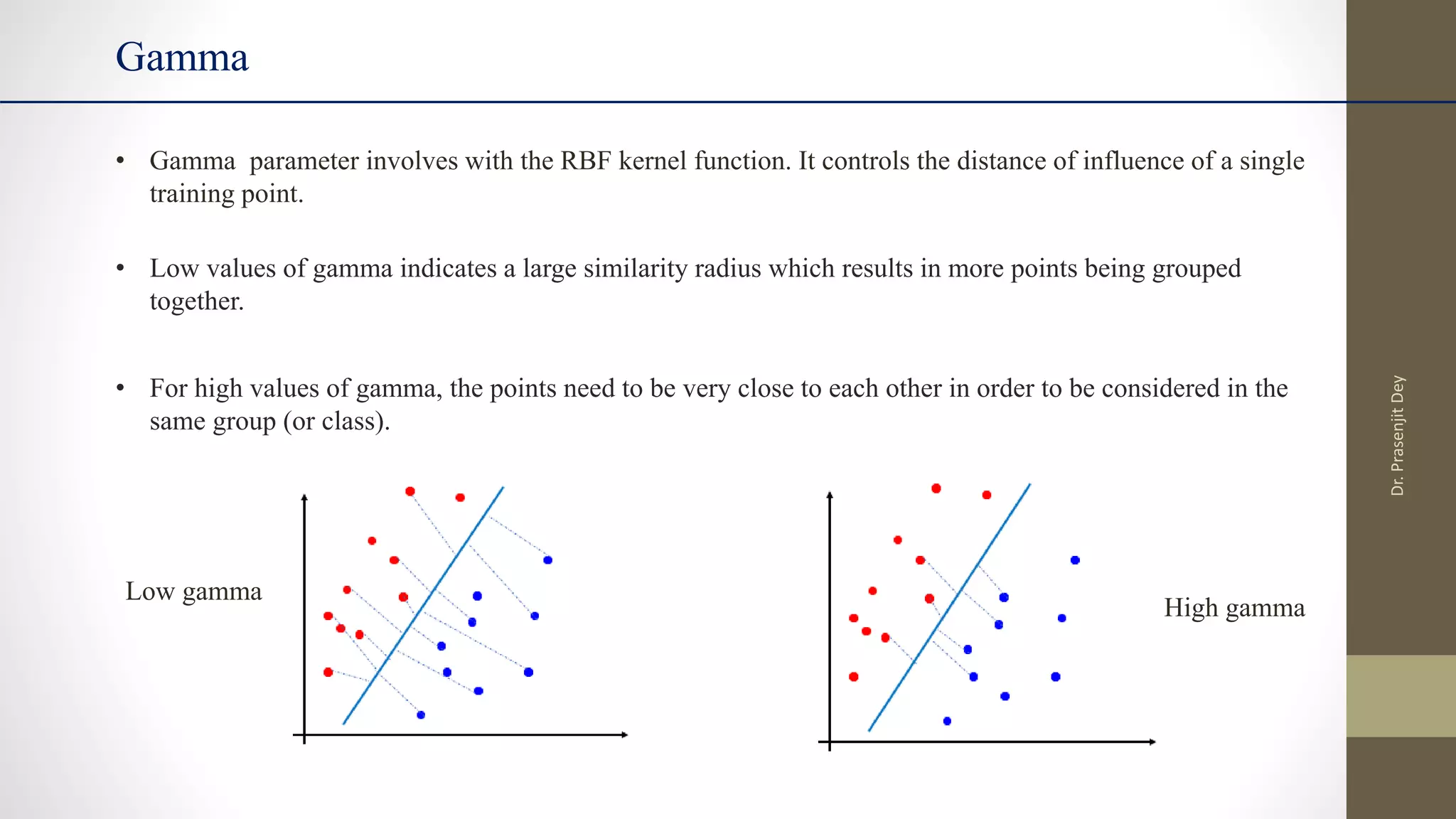
• Gamma parameter involves with the RBF kernel function. It controls the distance of influence of a single
training point.
• Low values of gamma indicates a large similarity radius which results in more points being grouped
together.
• For high values of gamma, the points need to be very close to each other in order to be considered in the
same group (or class).
Low gamma
High gamma
Dr.
Prasenjit
Dey
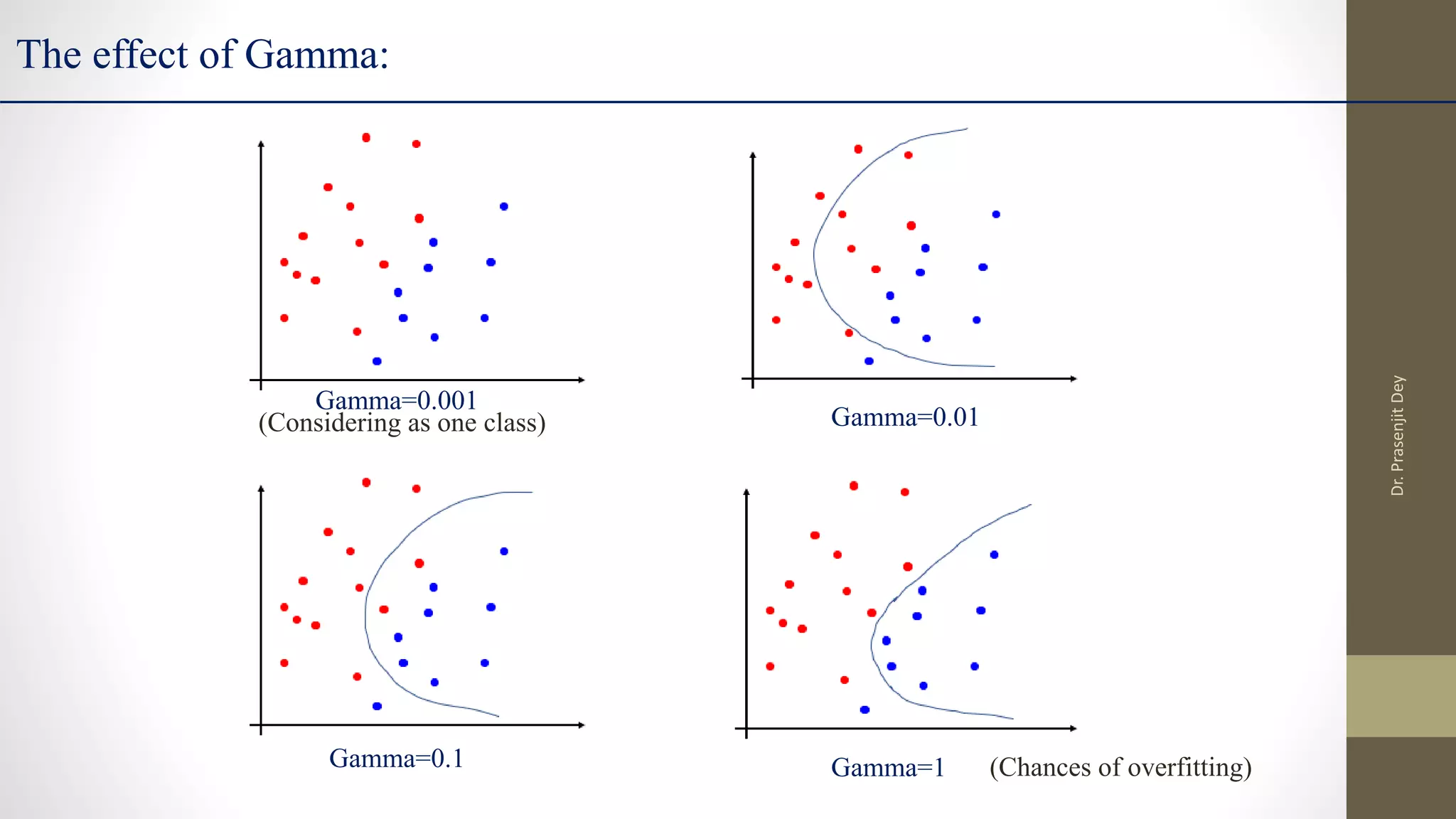
The effect of Gamma:
Gamma=0.001
Gamma=0.01
Gamma=0.1 Gamma=1 (Chances of overfitting)
(Considering as one class)
Dr.
Prasenjit
Dey
Thank you
Dr.
Prasenjit
Dey

Support vector machine

  • 1.
    Support Vector Machine(SVM) Dr. Prasenjit Dey Dr. Prasenjit Dey
  • 2.
    Linear Separators • Whatcould be the optimal line to separate the blue dots from red dots? Dr. Prasenjit Dey
  • 3.
    Support Vector Machine(SVM) • A SVM is a classifier that provides an optimal hyperplane on the feature space using the training data. Optimal hyperplane Dr. Prasenjit Dey
  • 4.
    Classification margin w x w b ri T   r ρ • Margin is the perpendicular distance between the closest data points and the hyperplane. • The closest point where the margin distance is calculated is called the support vector. • Margin of the hyperplane is the distance between support vectors. • Distance from an example xi to the hyperplane is: ρ Dr. Prasenjit Dey
  • 5.
    Maximum classification margin •The best optimal hyperplane with maximum margin is called maximum margin hyperplane. • It is an important observation that for maximizing the margin, only the support vectors are matter. The remaining examples are ignorable. r ρ Dr. Prasenjit Dey
  • 6.
    Mathematical representation ofthe linear SVM (contd.) • For every support vector xs , the above inequality is an equality. After rescaling w and b by ρ/2 in the equality, we obtain that distance between each xs and the hyperplane is w 2 2   r  • Then the margin can be expressed through (rescaled) w and b as: • Objective is to find w and b such that is maximized and for all (xi, yi), i=1..n : yi(wTxi + b) ≥ 1 w 2   w w x w 1 ) ( y    b r s T s • The objective can be reformulated as: find w and b such that Φ(w) = ||w||2= wT w is minimized and for all (xi, yi), i=1..n : yi (wTxi + b) ≥ 1 Dr. Prasenjit Dey
  • 7.
    Mathematical representation ofthe linear SVM • Let the training set is {(xi, yi)}i=1..n, xiRd, yi  {-1, 1} and the hyperplane with margin ρ is the separator for the training set. wTxi + b ≤ - ρ/2 if yi = -1 wTxi + b ≥ ρ/2 if yi = 1 or, yi(wTxi + b) ≥ ρ/2 • Then for each training sample (xi, yi): r ρ Dr. Prasenjit Dey
  • 8.
    Linear and non-lineardata 0 0 0 x2 x x x • For linearly separable data, SVM is perform well even the data contain noise. • However, if the data are non-linear, for SVM it is too hard to draw the separator line. • Solution: Map the data into a the higher dimensional space: Dr. Prasenjit Dey
  • 9.
    Non-linear data: example1 Hyperplane in the higher dimension • The original feature space can always be mapped to some higher dimensional feature space where the training set is separable. Dr. Prasenjit Dey
  • 10.
    Non-linear data: example2 • For this hyperplane, three red dots are fall into the blue categories (misclassification) • Here, the classification is not perfect • This separator removes the misclassification. However, it is difficult to train model like this • For this, the regularization parameter is required Dr. Prasenjit Dey
  • 11.
    • The linearclassifier relies on inner product between vectors K(xi,xj) = xi Txj • If every datapoint is mapped into high-dimensional space via some transformation Φ: x → φ(x), the inner product becomes: K(xi,xj)= φ(xi) Tφ(xj) • A kernel function is a function that is equivalent to an inner product in some feature space. • Example: 2-dimensional vectors x=[x1 x2]; let K(xi,xj) = (1 + xi Txj)2 , Need to show that K(xi,xj) = φ(xi) Tφ(xj): K(xi,xj)=(1 + xi Txj)2 ,= 1+ xi1 2xj1 2 + 2 xi1xj1 xi2xj2+ xi2 2xj2 2 + 2xi1xj1 + 2xi2xj2= = [1 xi1 2 √2 xi1xi2 xi2 2 √2xi1 √2xi2]T [1 xj1 2 √2 xj1xj2 xj2 2 √2xj1 √2xj2] = = φ(xi) Tφ(xj), where φ(x) = [1 x1 2 √2 x1x2 x2 2 √2x1 √2x2] • Thus, a kernel function implicitly maps data to a high-dimensional space (without the need to compute each φ(x) explicitly). The Kernel Functions Dr. Prasenjit Dey
  • 12.
    The various kernelfunctions • Linear: K(xi,xj)= xi Txj Mapping Φ: x → φ(x), where φ(x) is x itself • Polynomial of power p: K(xi,xj)= (1+ xi Txj)p Mapping Φ: x → φ(x), where φ(x) has dimensions • Gaussian (radial-basis function): K(xi,xj) = Mapping Φ: x → φ(x), where φ(x) is infinite-dimensional  every point is mapped to a function (a Gaussian)  combination of functions for support vectors is the separator. 2 2 2 j i e x x            p p d Dr. Prasenjit Dey
  • 13.
    The main ideaof SVM is summarized below • Margin, Regularization, Gamma, Kernel • Define an optimal hyperplane: maximize the margin • Generalize to non-linearly separable problems: use penalty based regularization to deal with the misclassification • Map the data into a higher dimensional space where it is easier to classify with linear decision surface: use the kernel function for transformation of the data from one feature space to another. Tunable parameters of SVM Dr. Prasenjit Dey
  • 14.
    Regularization • For non-linearlyseparable problems, slack variables ξi can be added to allow misclassification of difficult or noisy examples. Here, the margin is called soft margin ξi ξi • For soft margin classification, the old formulation of objective is modified: Find w and b such that Φ(w) = wTw + CΣξi is minimized and for all (xi ,yi), i=1..n : yi (wTxi + b) ≥ 1 – ξi, , ξi ≥ 0 • Parameter C can be viewed as a way to control overfitting: it “trades off” the relative importance of maximizing the margin and fitting the training data. Dr. Prasenjit Dey
  • 15.
    The effect ofregularization parameter ‘C’: • For small value of C  large margin (possible of misclassification)  underfitting • For large value of C  small margin  overfitting For small C For large C Dr. Prasenjit Dey
  • 16.
    Gamma • Gamma parameterinvolves with the RBF kernel function. It controls the distance of influence of a single training point. • Low values of gamma indicates a large similarity radius which results in more points being grouped together. • For high values of gamma, the points need to be very close to each other in order to be considered in the same group (or class). Low gamma High gamma Dr. Prasenjit Dey
  • 17.
    The effect ofGamma: Gamma=0.001 Gamma=0.01 Gamma=0.1 Gamma=1 (Chances of overfitting) (Considering as one class) Dr. Prasenjit Dey
  • 18.